The Short Answer
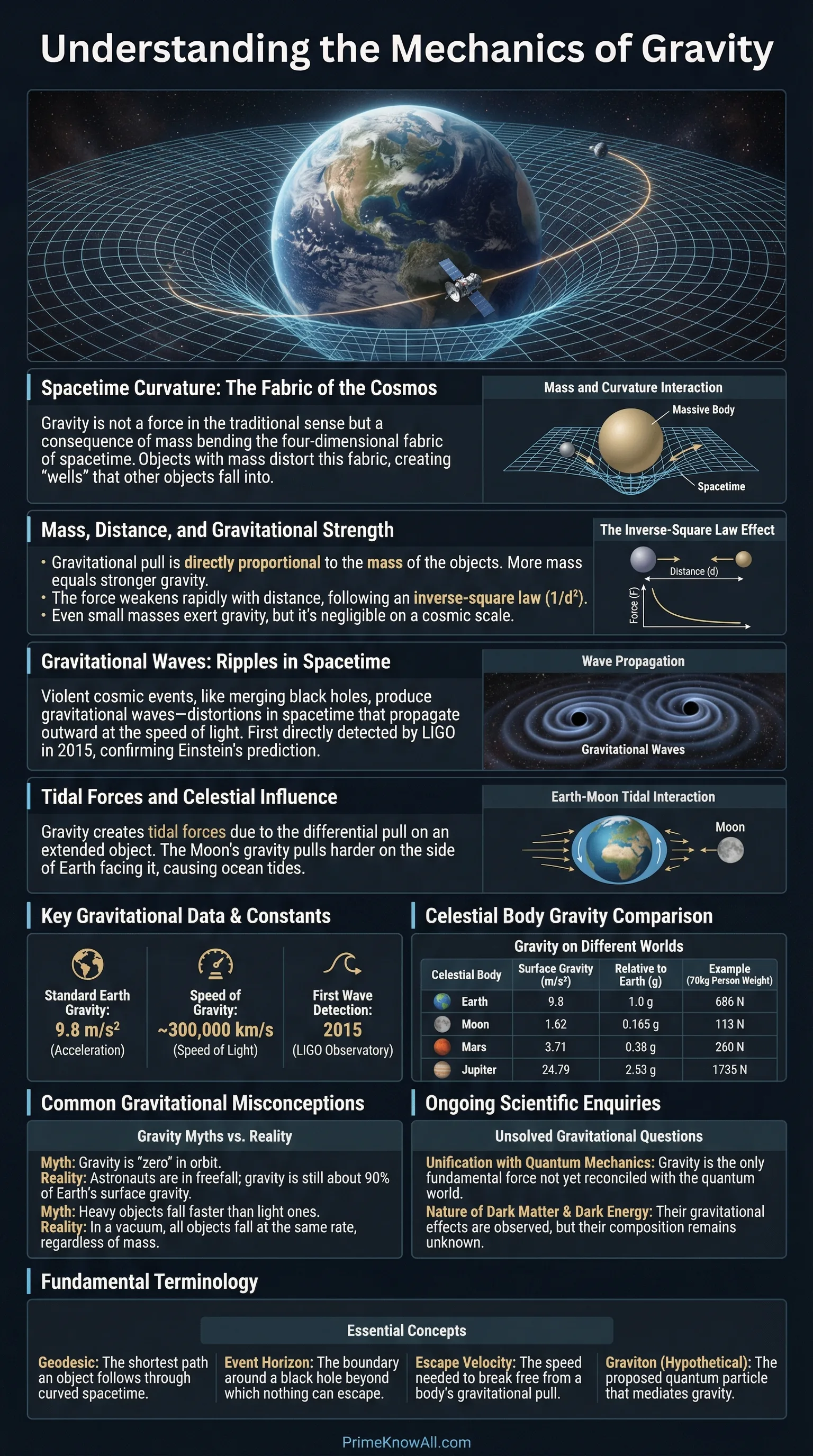
- Gravity is the rule that makes mass and energy pull objects together and shape how they move through space.
- Near Earth, it looks like a downward pull; in modern physics, it’s also spacetime curvature—objects follow the “straightest” paths available.
- We can predict most everyday motion with Newton’s approach, and we explain extreme precision effects with Einstein’s.
Main Points You Can Carry Into Any Conversation
- Gravity is not just “falling”; it is the reason for orbits, tides, and even subtle timing shifts in GPS signals.
- “Weight” changes with location; mass doesn’t.
- When you feel “weightless,” you are typically in free fall, not outside gravity.
- Physics uses multiple models for gravity because each one is useful in a different range.
- The big unsolved puzzle is how to combine gravity with quantum physics into one complete theory.
Gravity is the quiet architecture behind everyday life: it keeps oceans against continents, your phone on the table, and the Moon in a stable dance around Earth. At the same time, it is one of the most deeply studied forces in science, because a small change in gravity can rewrite how a planet, a satellite, or a star behaves.
In practical terms, gravity is the attraction between things with mass (and more broadly, with energy). In modern terms, it’s also the way mass-energy shapes spacetime, the combined “stage” of space and time where motion unfolds.
If you remember one thing… Gravity is best understood as a set of rules for motion: in everyday settings it behaves like a force, and at higher precision it behaves like geometry.
What Gravity Is In Plain English
Short answer: Gravity is the tendency of mass and energy to pull matter together and to guide motion along predictable paths, from falling objects to planetary orbits.
A helpful way to think about gravity is to separate what it does from how we describe it. What it does is consistent: it creates attraction and shapes motion. How we describe it depends on the question we are asking—engineering, astronomy, or precision timing.
- Gravity is a fundamental interaction that affects anything with mass-energy.
- A gravitational field, meaning a region where gravity influences motion, is a convenient way to describe “how strong gravity is” at each point in space.
- Spacetime, meaning the combined fabric of space and time, is the modern setting where gravity can be treated as curvature rather than a pull.
One practical mindset: Treat gravity like a map. For most tasks, you need a clear, usable map, not a perfect replica of the territory. Different gravity “maps” exist because each one is designed for different distances and levels of accuracy.
Three Definitions That Keep You Oriented
- Weight, which is the force you feel from gravity, depends on where you are (Earth’s surface, a mountain, or orbit).
- Mass, which is the amount of matter (and a measure of inertia), stays the same whether you’re on Earth or in deep space.
- Free fall, which is motion under gravity alone, is why astronauts can feel weightless even while gravity is still acting.
Newton And Einstein: Two Ways To Describe The Same Gravity
Short answer: Newton’s model treats gravity as a force between masses, while Einstein’s model treats gravity as curved spacetime that changes what “straight” motion looks like.
Newton’s View: Gravity As A Force
Newton’s approach is powerful because it is simple and predictive. It says two masses attract each other, and the strength depends on mass and distance. For many everyday and engineering problems, this model is accurate enough that it remains a workhorse.
- Inverse-square idea: when you double the distance, gravity becomes much weaker (it drops by a factor of four).
- Gravitational constant (G): a measured number that sets the scale of gravitational strength.
- Best use: trajectories, basic orbits, and many Earth-scale calculations where extreme precision is not required.
Light math, just enough context: Newton’s law is often written as F = G·m1·m2 / r². Here F is the pull, m1 and m2 are the masses, and r is the distance between them. The important takeaway is the relationship, not the algebra.
Einstein’s View: Gravity As Geometry
Einstein’s general relativity keeps Newton’s predictions in many everyday cases, but adds a key idea: mass-energy curves spacetime, and objects move along the “straightest available” paths called geodesics. This is why gravity can affect not only motion, but also time itself.
- Equivalence principle: locally, the effects of gravity can match the effects of acceleration, which is why free fall can feel like weightlessness.
- Gravitational time dilation: clocks at different gravitational strengths can tick at slightly different rates, which matters for GPS.
- Extreme environments: black holes and gravitational waves are best explained by Einstein’s theory.
| Model | What It Emphasizes | Where It Shines | What It Leaves Out |
|---|---|---|---|
| Newtonian Gravity | Force between masses | Everyday motion, many engineering tasks | High-precision timing effects; strong-field details |
| General Relativity | Curved spacetime and geodesics | GPS-level precision, black holes, gravitational waves | Quantum-scale behavior; a complete microscopic picture |
| Quantum Approaches | Particles and quantum fields | Research on the smallest scales | A single confirmed, complete theory of quantum gravity |
A Small Pause That Saves Confusion Later
- Newton is often the best tool when you need fast, reliable predictions.
- Einstein becomes essential when precision or extreme gravity is part of the problem.
- Using both is not a contradiction; it’s model selection.
Why Things Fall And Why Orbits Keep Missing The Ground
Short answer: Objects fall because gravity accelerates them toward Earth, while orbits happen when forward motion and gravitational pull balance into continuous free fall.
Near Earth’s surface, gravity produces an acceleration of about 9.8 m/s² (often written as g). That number changes slightly with altitude and latitude, but it’s a strong everyday approximation for understanding falling, jumping, and basic motion.
- Falling is gravity dominating motion when nothing else supports you (like the ground or a chair).
- Orbits are gravity shaping a path while the object also has strong sideways speed.
- Support forces (from the ground, a table, or a rope) are why you can feel weight even when you are not moving.
One analogy that stays accurate longer than it sounds: an orbit is like running around a giant, perfectly round track while leaning inward. You are trying to go straight, but the track keeps redirecting you. In an orbit, gravity plays the role of that inward redirection, continuously bending “straight-line” motion into a curved path without requiring a surface.
Weight, Mass, And The Feeling Of Gravity
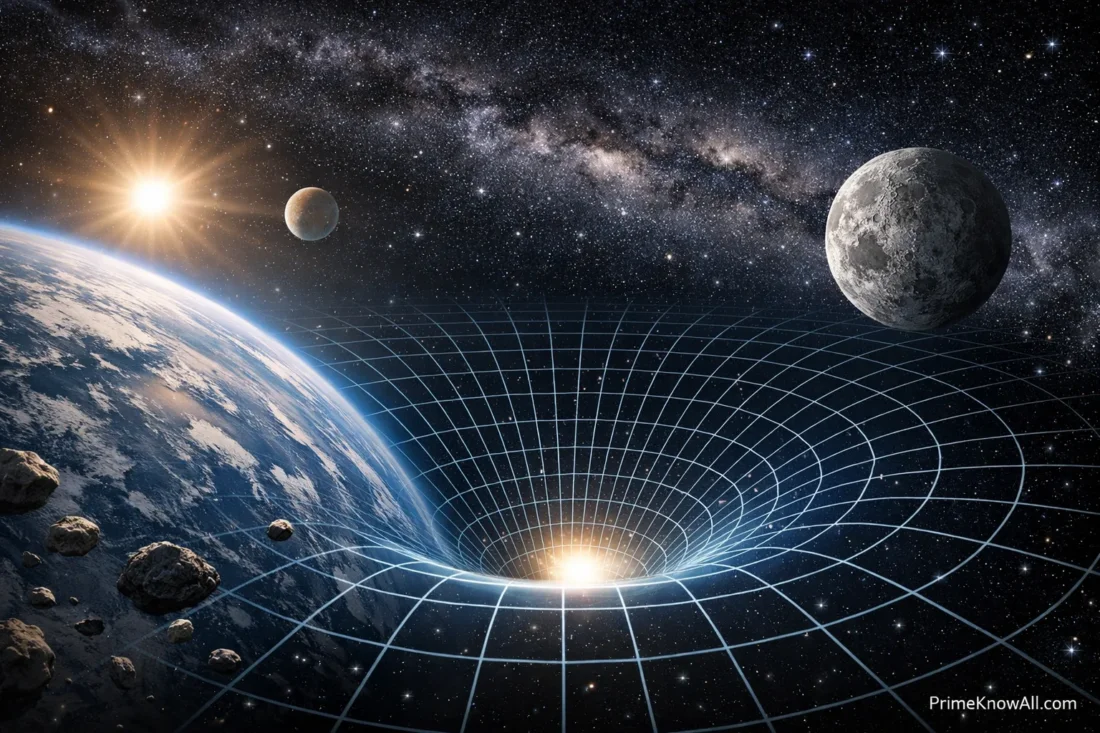
It helps to separate what gravity does from what you feel. Gravity acts on your mass, but your sensation of weight comes from the ground pushing back. In free fall, that support disappears, so the familiar feeling of weight can drop close to zero even though gravity remains present.
- Mass is constant: it measures how hard it is to change your motion.
- Weight depends on local gravity and support forces.
- Microgravity is not “no gravity”; it’s an environment where free fall dominates the experience.
Tidal Forces: Gravity’s “Difference Engine”
Short answer: Tidal forces are the small differences in gravity across an object, and those differences can stretch, squeeze, and even heat worlds over time.
Gravity does not pull equally on every part of a large object. The side closer to a massive body feels a slightly stronger pull than the far side. That gradient is what physicists call a tidal effect, and it is central to understanding ocean tides, moon geology, and why extreme gravity can tear matter apart near very compact objects.
- Ocean tides: a real-world example of gravity’s gradient acting across Earth.
- Tidal locking: over long times, tidal forces can synchronize a moon’s rotation with its orbit.
- Tidal heating: flexing caused by varying gravity can warm a moon’s interior and power geological activity.
Why Tides Are About Differences, Not Just Strength
A common intuition is “stronger gravity means bigger tides.” The more precise idea is: bigger differences in gravity across a planet or moon mean bigger tidal effects. A distant massive body can produce a noticeable tide if its gravitational pull changes enough from one side to the other.
- Nearness matters because gravity changes rapidly with distance.
- Size matters because larger bodies have more “room” for gravity to vary across them.
- Rigidity matters because a stiff world deforms less than a flexible one.
Two Takeaways Before Moving On
- Tides come from differences in gravity across a body, not just gravity’s overall strength.
- Those differences help explain slow, long-term changes like rotation and internal heating.
Gravity In Space: Why “Weightless” Does Not Mean “No Gravity”
Short answer: Astronauts feel weightless because they are in continuous free fall around Earth, not because Earth’s gravity disappears.
At the altitude of many low-Earth orbits, gravity is still a large fraction of what you feel on the ground. What changes is the environment: everything inside the spacecraft is falling together, so there is little relative pressure between your body and the floor. That is why “microgravity” is a better term than “zero gravity,” even though both get used in casual explanations.
- Microgravity means very small felt weight due to free fall.
- Orbit is a perpetual fall where the ground curves away.
- Drag and small pushes still exist, so spacecraft use gentle corrections over time.
Gravity And Time: The Part Most People Don’t Expect
Gravity is not only about pulling. In general relativity, gravity is also about timing. Clocks in different gravitational conditions can tick at slightly different rates, and practical systems like satellite navigation account for these shifts to maintain accuracy. The effect is small but measurable, which is part of what makes gravity scientifically fascinating.
- Stronger gravity can correspond to slightly slower clock rates in that region.
- Precision technology often includes relativistic corrections even when users never notice.
- Everyday relevance: the “geometry” view of gravity shows up in real engineering.
How Scientists Measure Gravity Without Guesswork
Short answer: Gravity is measured through motion (how objects accelerate), timing (how clocks compare), and signals (how light and radio waves bend or delay).
Measuring gravity sounds abstract until you remember what gravity reliably changes: paths, speeds, and time. That makes gravity unusually “visible” to careful instruments. Over the past century, gravity measurement has moved from tabletop experiments to satellites mapping Earth’s gravity field with remarkable detail.
- Drop tests and pendulums: classical ways to estimate local g.
- Torsion-balance experiments: delicate setups used to estimate the gravitational constant G.
- Satellite geodesy: missions that track tiny orbit changes to map Earth’s gravity variations.
- Atomic sensors: modern devices that can detect minute accelerations using quantum behavior of atoms.
Why Earth’s Gravity Is Not Perfectly Uniform
Earth is not a perfect sphere, its density varies, and it rotates. Those facts create a gravity field that changes slightly from place to place. In daily life, the differences are small; in surveying, satellite operations, and climate-related mass change studies, those differences can become important.
- Mountains and trenches redistribute mass and subtly affect local gravity.
- Earth’s rotation creates a small outward effect that changes apparent weight with latitude.
- Moving water and ice can shift gravity signals over months and years.
What This Means In Practice
- Gravity is measured by tracking what it changes: motion, time, and signals.
- “Local gravity” is contextual; it can vary slightly with location and altitude.
- Modern maps of gravity help connect the solid Earth to oceans and ice.
Limits And Open Questions: What We Don’t Yet Know
Short answer: Gravity is extremely well-tested in many settings, but physics still lacks a single confirmed theory that unifies general relativity with quantum mechanics.
This is where explanations must stay honest. Newton works brilliantly for many tasks. Einstein works brilliantly for precision and strong fields. Yet at extremely small scales (where quantum effects dominate), a complete, experimentally confirmed theory of quantum gravity is still missing. That gap is not a failure of science; it’s a sign that gravity sits at the boundary of what our best theories can currently explain.
- Quantum gravity: researchers explore candidate ideas, but no single model has universal experimental confirmation.
- Extreme density: the deep interior of black holes raises questions about what “spacetime” means at all.
- Precision frontiers: testing gravity at very small distances and very high energies remains challenging.
- Model limits: even a correct model may be an approximation outside its intended range.
Limits Of This Explanation
This article focuses on conceptual clarity rather than full derivations. It also avoids speculative claims about unresolved areas. Where gravity is still under active study, the safest approach is to treat explanations as working summaries rather than final statements.
- Equations were kept minimal to preserve readability.
- Astrophysical edge cases were described cautiously, because details depend on current research.
- Quantum topics were framed as open questions, not settled answers.
Common Misconceptions About Gravity
Short answer: Most misunderstandings come from mixing up weight with mass, or confusing free fall with “no gravity.”
- Wrong: “There is no gravity in space.” Correct: Gravity extends far; astronauts often feel weightless because of free fall. Why it’s misunderstood: “Weightless” sounds like “gravity-free.”
- Wrong: “Heavier objects fall faster.” Correct: In vacuum, objects fall at the same rate; air resistance changes what you see. Why it’s misunderstood: In air, shape and drag can dominate.
- Wrong: “Gravity is only about mass.” Correct: In relativity, energy and pressure also contribute to gravity. Why it’s misunderstood: Intro explanations simplify to mass for clarity.
- Wrong: “Orbits are stable because there’s no pull.” Correct: Orbits persist because gravity continuously bends motion into a curved path. Why it’s misunderstood: People picture orbit as “floating,” not falling sideways.
- Wrong: “Gravity is the same everywhere on Earth.” Correct: Local gravity varies slightly with altitude, latitude, and geology. Why it’s misunderstood: The differences are small in daily life.
- Wrong: “General relativity replaced Newton, so Newton is wrong.” Correct: Newton is an excellent approximation in many settings. Why it’s misunderstood: “Newer theory” is assumed to invalidate older tools.
- Wrong: “Gravity pulls from Earth’s center like a rope.” Correct: Gravity is best described as a field (and, at higher precision, curvature), not a physical tether. Why it’s misunderstood: Human intuition favors tangible mechanisms.
A Fast Reality Check
- If you are unsure, ask: am I mixing up weight and mass?
- If “no gravity” is mentioned, check whether the situation is actually free fall.
- When precision matters, remember that Einstein often handles what Newton approximates.
Everyday Situations Where Gravity Quietly Runs The Show
Short answer: Gravity shows up most clearly when it competes with other forces—friction, lift, tension, and your own momentum—creating patterns you can recognize once you know what to look for.
- Pouring water into a glass: the stream curves because gravity accelerates the water downward. Why this happens: the longer it falls, the faster its vertical speed becomes.
- A basketball arc: the ball’s path is a blend of forward motion and gravity’s pull. Why this happens: gravity changes vertical velocity while horizontal velocity stays roughly steady (ignoring air).
- Elevator sensations: you feel heavier or lighter when the elevator accelerates. Why this happens: your “weight feeling” is the support force changing, not your mass.
- Hiking at high altitude: you weigh slightly less at higher elevations. Why this happens: you are a bit farther from Earth’s mass, so gravity is slightly weaker.
- Satellite internet and GPS: timing and signal paths account for gravity-related effects. Why this happens: precision systems track tiny changes in time and motion.
- Ocean tides at a coastline: sea level shifts on a schedule tied to celestial positions. Why this happens: tidal forces depend on gravity’s differences across Earth.
- A spinning playground carousel: you lean inward to stay on. Why this happens: your motion needs inward acceleration, which in orbit is provided by gravity instead of friction.
Quick Test
Each prompt is a single sentence. Tap to reveal the answer and the reason behind it.
“Astronauts in orbit feel weightless because Earth’s gravity is nearly zero up there.”
Answer: False. Why: gravity is still strong in low-Earth orbit; astronauts feel weightless mainly because they are in continuous free fall with their spacecraft.
“If you drop a bowling ball and a tennis ball in a vacuum, they hit the ground together.”
Answer: True. Why: without air resistance, gravity accelerates objects the same way regardless of mass; differences you see in air come from drag.
“Tides happen because gravity is stronger at the coast than inland.”
Answer: Not quite. Why: tides are mainly about differences in gravitational pull across Earth (tidal forces), not a simple coast-versus-inland strength rule.
“Newton’s gravity is still used because it is often accurate enough and easier to compute.”
Answer: True. Why: Newton’s model is an excellent approximation for many Earth and solar system problems where extreme precision is not required.
“Gravity can affect time.”
Answer: True. Why: in general relativity, gravitational conditions relate to how clocks tick; tiny corrections matter in precision navigation systems.
“Orbits are possible because an object is constantly falling while also moving forward.”
Answer: True. Why: the forward motion keeps the object from hitting the ground, while gravity continuously curves its path into a stable trajectory.
Two-sentence wrap-up: Gravity is both a practical force for everyday prediction and a geometric rule for high-precision physics. Once you separate what you feel (weight) from what’s happening (gravity and support forces), the subject becomes far more intuitive.
The most common mistake: treating “weightless” as proof of “no gravity,” instead of recognizing free fall.
Memorable rule: If something looks like gravity “turned off,” first check whether everything is simply falling together.
Sources
NASA Space Place – What Is Gravity?
[Clear, beginner-friendly explanation of gravity, orbits, and why objects fall.]
NASA is a U.S. government space agency with strong science communication standards and expert review practices.
NASA – Basics Of Space Flight: Gravity And Orbits
[Practical explanation of orbital motion and free-fall intuition.]
This is an official NASA educational resource designed to be accurate and consistent with aerospace engineering fundamentals.
NIST – CODATA Value: Newtonian Constant Of Gravitation (G)
[Authoritative reference for the measured gravitational constant and related constants.]
NIST is the U.S. national standards institute and is widely trusted for vetted measurement data.
LIGO Caltech – What Are Gravitational Waves?
[Accessible overview of gravitational waves within general relativity.]
LIGO is a major scientific collaboration hosted by leading research institutions with peer-reviewed results.
The Einstein Papers Project (Princeton) – Einstein’s Works And Context
[Scholarly archive for Einstein’s writings and historical framing of relativity.]
This project is run by a major university press and focuses on carefully edited primary sources.
Living Reviews In Relativity (Springer) – Review Articles On General Relativity
[Peer-reviewed review journal covering tests and implications of general relativity.]
Review journals synthesize large bodies of research and are curated by experts in the field.
Encyclopaedia Britannica – Gravity (Physics)
[Well-edited reference overview with historical and conceptual context.]
Britannica uses editorial review and is a long-standing general reference source.
Stanford Encyclopedia Of Philosophy – Newton
[High-quality reference on Newton’s ideas and how they connect to physics.]
The Stanford Encyclopedia is academically curated and written by subject experts with editorial oversight.
FAQ
What is gravity in simple terms?
Gravity is the tendency of mass and energy to pull objects together and guide their motion. Near Earth, it appears as a constant downward acceleration that keeps people, air, and oceans on the planet.
Why do astronauts float if gravity is still there?
Astronauts often float because they are in free fall with their spacecraft. With no strong support force from a floor pushing up, the usual feeling of weight largely disappears.
Is gravity a force or a curvature of spacetime?
Both descriptions are used. Newton’s model treats gravity as a force and works well for many practical problems, while Einstein’s general relativity treats gravity as spacetime curvature and is essential for high precision and extreme environments.
Does gravity affect time?
Yes. In general relativity, clocks in different gravitational conditions can tick at slightly different rates. The effect is small in daily life but matters in precision systems like satellite navigation.
Do heavier objects fall faster than lighter ones?
In a vacuum, no: objects fall at the same rate regardless of mass. In air, differences often come from air resistance, which depends strongly on shape and surface area.
Why are there tides?
Tides happen mainly because of tidal forces, meaning small differences in gravitational pull across Earth. Those differences slightly stretch Earth’s oceans, producing regular sea level changes.
Article Revision History