
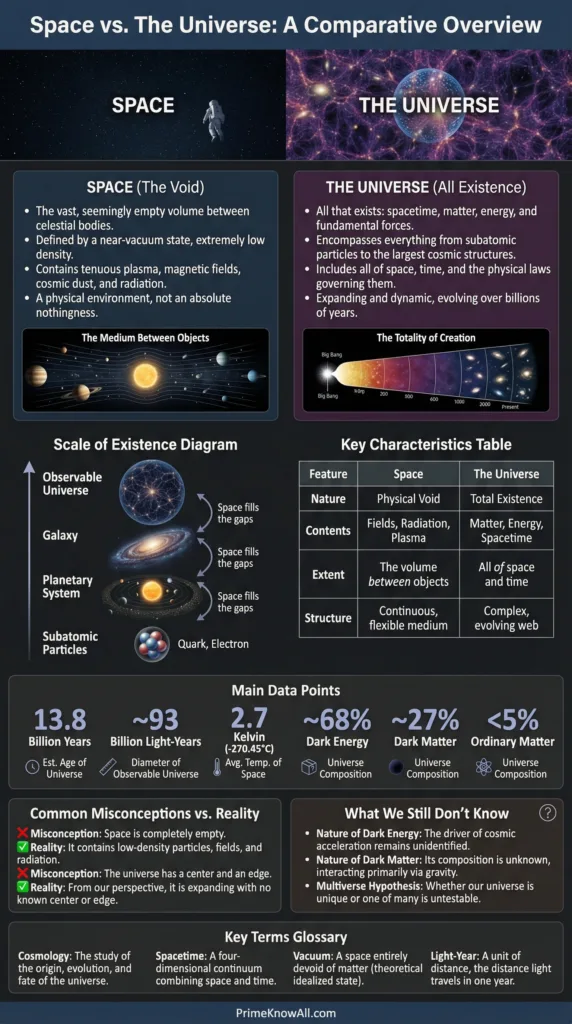
Space and the universe are not the same thing. Space is the physical extent in which objects can exist and move, while the universe includes all space, time, matter, energy, radiation, galaxies, stars, planets, and everything else that physically exists. In everyday astronomy, “space” often means the region beyond Earth’s atmosphere; “universe” refers to the whole cosmic system.
The difference becomes clearer when scale is considered. A spacecraft travels through space. A galaxy occupies space. Billions of galaxies, the space between them, cosmic radiation, dark matter, dark energy, and cosmic history are all parts of the universe.
- Space can mean the region beyond Earth’s atmosphere or physical spatial extent itself.
- The universe includes space rather than simply sitting inside it.
- The observable universe is only the portion whose signals have had enough time to reach us.
- The universe is about 13.8 billion years old, yet the observable region is roughly 92–93 billion light-years across because space has expanded while light was travelling.
What Is the Difference Between Space and the Universe?
Space describes where physical things can be located; the universe describes the total physical reality that contains those locations and everything in them. This distinction is simple, but everyday use of the word “space” can hide it.
| Feature | Space | Universe |
|---|---|---|
| Basic meaning | Physical extent or the region beyond Earth’s atmosphere | Everything physically included in cosmic existence |
| Includes matter? | Space can contain matter, but the word itself does not mean all matter | Yes |
| Includes energy? | Space can contain radiation and fields | Yes |
| Includes time? | Modern physics connects space with time as spacetime | Yes, cosmic time is part of the universe |
| Includes galaxies? | Galaxies occupy regions of space | All galaxies are parts of the universe |
| Has a known size? | Depends on which region of space is being discussed | The observable part can be estimated; the total size is unknown |
| Example | The region through which Voyager 1 travels | Voyager 1, Earth, the Milky Way, distant galaxies, space itself, matter and energy together |
A useful way to phrase the relationship is: outer space is part of the universe, while the universe includes much more than what people usually call outer space.
What Does Space Mean in Astronomy?
In everyday astronomy, space usually means the region beyond the denser part of Earth’s atmosphere. In physics, however, the word can describe physical spatial extent itself, so its meaning depends on context.
Outer Space Beyond Earth
When people say that astronauts travel into space or that a satellite operates in space, they usually mean outer space. There is no sharp natural wall where Earth’s atmosphere suddenly ends. The gases surrounding Earth become progressively thinner with altitude.
The Fédération Aéronautique Internationale uses the Kármán line at 100 kilometers (62 miles) above sea level as the conventional boundary for astronautical records. It is a useful dividing line, not a physical surface. Traces of Earth’s atmosphere extend far above it.
The 100-kilometer line does not mean that air reaches zero density at that altitude. Atmospheric particles remain above the Kármán line, and low-orbit spacecraft can still experience atmospheric drag.
Space as a Physical Dimension
Physics uses “space” more broadly. An object has a position in three spatial dimensions, and distances separate one position from another. Einstein’s theory of relativity links these spatial dimensions with time in the concept of spacetime.
Under this meaning, space is not restricted to the region above Earth. Spatial relationships exist here on Earth as well. Cosmologists discussing expanding space are therefore talking about something broader than the black region visible outside a spacecraft window.
What Does Universe Mean?
The universe means the total system of space, time, matter and energy. Earth is part of it, the Sun is part of it, every known galaxy is part of it, and so are regions that appear almost empty.
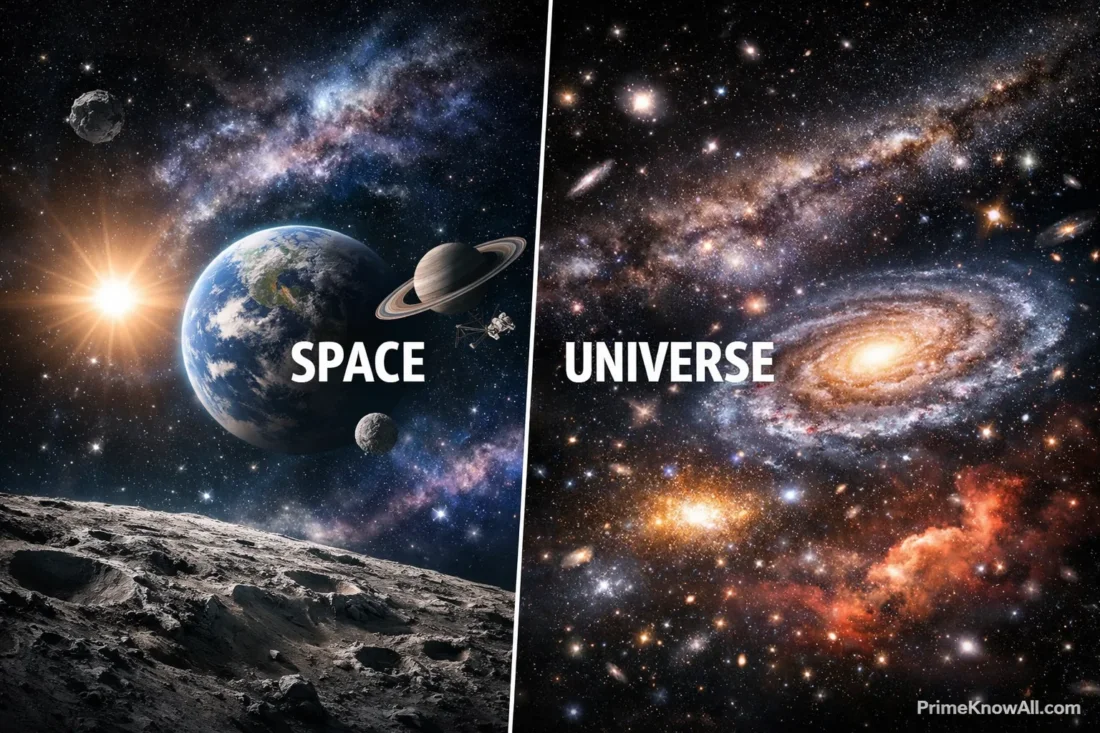
NASA describes the universe as including all of space and all the matter and energy that space contains. Time is included as well. This is why saying that the universe is merely “everything floating through space” gives the wrong mental picture: space itself belongs to the universe.
What the Universe Contains
- Planets, dwarf planets, moons, asteroids and comets
- Stars, stellar remnants and black holes
- Nebulae, gas clouds and cosmic dust
- Galaxies and galaxy clusters
- Interstellar and intergalactic matter
- Electromagnetic radiation, including visible light and microwaves
- Cosmic rays and other energetic particles
- Magnetic and gravitational fields
- Dark matter, detected through its gravitational effects
- Dark energy, the name given to the unknown component associated with accelerated cosmic expansion
- Space and time themselves
Measurements from ESA’s Planck mission fit a standard cosmological model in which ordinary atomic matter contributes roughly 4.9% of the cosmic matter-energy density, dark matter about 26.8%, and dark energy about 68.3%. These percentages depend on the cosmological model used to interpret the observations.
How Large Is Space Compared With the Universe?
There is no single useful size for “space,” because space is not normally treated as a separate container with known boundaries. Astronomers can instead estimate the size of the observable universe, while the full universe may extend much farther.
The Observable Universe
The observable universe is the region from which light or other signals have had enough cosmic time to reach us. NASA defines it as the portion of the entire universe that can be observed from Earth.
Its present diameter is estimated at roughly 92–93 billion light-years, giving a present-day radius of about 46 billion light-years. That number can sound impossible because the universe is about 13.8 billion years old.
Why It Is More Than 13.8 Billion Light-Years Across
Light from extremely distant regions has travelled for billions of years, but the distance between us and those regions did not remain fixed during the journey. Cosmic expansion increased those distances while the light was on its way. The location that emitted very old light can therefore be much farther away today than the light-travel time alone might suggest.
This distinction separates two different measurements: how long the light travelled and how far away the emitting region is now. Treating them as identical produces the mistaken claim that the observable universe must be only 27.6 billion light-years across.
Is the Observable Universe the Whole Universe?
No. The observable universe is a horizon-limited region, not necessarily the full universe. There may be regions so distant that their light has not reached us and may never reach us under the present pattern of accelerated expansion.
Observers in a very distant galaxy would have their own observable region centered on their location. This does not make Earth the center of the universe. It simply means that every observer receives information from within a horizon set by cosmic history and the speed at which signals propagate.
Scientists currently have no reliable measurement of the total size of the entire universe. It may be finite on scales far beyond the observable horizon, or spatial extent may be unlimited. Present observations do not settle that question.
Is the Universe Expanding Into Space?
Standard cosmology does not describe the universe as an object expanding into a larger empty room. Cosmic expansion refers to changes in distances described by the geometry of space itself.
A simple analogy is rising raisin dough. The raisins represent galaxies and the dough represents the changing distances between large cosmic structures. As the dough expands, separated raisins move farther apart without needing a special raisin at the center. The analogy has limits because real cosmic space is three-dimensional and does not need to expand into the kitchen surrounding an imaginary loaf.
On sufficiently large scales, galaxies that are not gravitationally bound tend to become more widely separated as the universe evolves. Solar systems, individual galaxies and many galaxy groups do not simply stretch with this expansion, because local gravitational and other forces dominate their structure.
Is Space Actually Empty?
Outer space has extremely low densities compared with Earth’s surface environment, but it is not perfectly empty. Different cosmic regions contain particles, radiation and fields at very different densities.
Interplanetary Space
The region between planets contains the solar wind, a stream of charged particles flowing outward from the Sun. It also contains magnetic fields, dust particles and electromagnetic radiation. Spacecraft travelling between planets therefore do not cross a literal void.
Interstellar Space
The space between stars contains the interstellar medium: gas, plasma and dust spread through a galaxy. Some regions are extremely diffuse, while molecular clouds can contain enough material for new stars to form.
Intergalactic Space
Even the enormous regions between galaxies contain matter. Gas can spread across galaxy groups and clusters, while dark matter contributes gravity without producing ordinary visible light. On vast scales, matter forms a pattern of filaments, clusters and voids called the cosmic web.
How the Terms Change With Scale
The word “space” changes meaning more readily than “universe.” Looking at a sequence from Earth outward shows why the terms can overlap in casual speech without becoming true synonyms.
- Earth’s surface: ordinary conversation does not call this outer space, although it exists within physical spacetime and within the universe.
- About 100 kilometers upward: the Kármán line provides a conventional marker widely used for the start of outer space.
- Earth orbit: satellites and crewed spacecraft operate in space while remaining close to Earth on cosmic scales.
- Interplanetary space: the region between planets remains inside the Solar System.
- Interstellar space: the region between star systems remains inside the Milky Way or another galaxy.
- Intergalactic space: the enormous regions separating galaxies remain inside the universe.
- Observable universe: all currently observable cosmic regions, including their space, matter and energy, form only the visible portion of the total universe.
Examples That Make the Difference Concrete
Everyday astronomy provides clear cases where “space” describes a location while “universe” describes the wider physical system. The distinction remains the same whether the example involves a spacecraft or a galaxy billions of light-years away.
- A rocket crosses the Kármán line. It has entered what is conventionally called outer space, but it has not entered the universe; it was already part of the universe while sitting on the launch pad.
- An astronaut works aboard an orbiting spacecraft. The astronaut is in outer space and, like every person on Earth, is also inside the universe.
- Voyager 1 travels through interstellar space. Its location has changed from near-Earth space to regions beyond the heliosphere, but every stage of the journey occurs within the same universe.
- A telescope detects a galaxy billions of light-years away. The light crosses enormous amounts of space, while both the light and galaxy remain components of the universe.
- A cosmic void contains very few galaxies. Calling it “empty space” is convenient, yet it can still contain sparse matter, radiation and fields. It remains part of the universe.
- A distant galaxy becomes farther away through cosmic expansion. Cosmology describes this through expanding spatial distances, not by placing the entire universe inside a larger known void.
- Earth remains below the everyday boundary of outer space. This does not place Earth outside the universe. Earth, its atmosphere and everything on its surface are cosmic contents too.
Ideas That Commonly Cause Confusion
Several familiar statements mix everyday language with cosmological language. Correcting them makes the space–universe distinction easier to remember.
- “The universe is floating in space.” Standard cosmology treats space as part of the universe, so no surrounding external space is required.
- “Space is complete nothingness.” Many regions are close to a vacuum by terrestrial standards, yet particles, radiation and fields remain present.
- “The universe is 13.8 billion light-years wide.” The number 13.8 billion describes its approximate age in years. The present observable diameter is roughly 92–93 billion light-years.
- “The observable universe is the entire universe.” Observation is limited by a cosmic horizon. The full spatial extent is unknown.
- “The Big Bang exploded into empty space.” The standard Big Bang model describes an early hot, dense state followed by cosmic expansion; it does not require an explosion from one point into pre-existing emptiness.
- “Earth is outside space.” Earth is outside what everyday speech calls outer space, but it still occupies physical space and belongs to the universe.
Does the Universe Have a Center or an Edge?
Observations do not identify Earth, the Milky Way or another known location as the geometric center from which cosmic expansion began. The Big Bang model describes the early evolution of space throughout the observable region rather than a blast spreading outward from one address.
The apparent boundary of the observable universe is also not a physical wall. It is an observational horizon. Looking toward that horizon means looking farther back in time because light from distant regions took longer to reach us.
The oldest electromagnetic radiation directly observed is the cosmic microwave background. It comes from a period about 380,000 years after the beginning of cosmic expansion, when the universe cooled enough for light to travel freely over large distances.
What Cosmology Still Cannot Tell Us
The difference between space and the universe is well defined enough for everyday astronomy, but several properties of the universe remain unresolved. Measurements can constrain cosmic models without revealing every aspect of physical reality.
- The total size of the universe is unknown. We can estimate the observable region, not the full extent beyond our horizon.
- It is not established whether spatial extent is finite or unlimited. Observations show that large-scale spatial geometry is very close to flat, but that alone does not reveal the universe’s full global size or topology.
- The physical nature of dark matter remains unknown. Its gravitational effects are measured, but its underlying particle or physical explanation has not been confirmed.
- The nature of dark energy remains unresolved. The term describes the component used in cosmological models to account for accelerated expansion, not a fully understood substance.
- Regions beyond the observable horizon cannot currently be inspected directly. Statements about them rely on models and assumptions consistent with the portion we can observe.
- A multiverse has not been established by observation. Some theories discuss other universes, but they should not be confused with the directly studied universe of observational cosmology.
How Modern Telescopes Study the Universe Through Space
Astronomers use instruments placed both on Earth and in space to study the wider universe. This wording itself shows the distinction: a telescope can be physically located in outer space while observing galaxies, radiation and cosmic history that belong to the universe.
ESA’s Euclid mission offers a current example. Its survey is designed to map enormous numbers of galaxies and examine how matter is distributed across cosmic history. ESA’s first public Euclid survey release in March 2025 covered about 63 square degrees and contained roughly 30 million detected objects.
In July 2026, ESA reported that Euclid observations had identified 31 very ancient quasars, including two seen as they appeared when the universe was about 670 million years old. The spacecraft itself operates in space; the distant quasars and the cosmic era being investigated belong to the universe.
That wording captures the relationship neatly: astronomers travel into and place instruments in space so they can learn about the universe.
Frequently Asked Questions
Is space bigger than the universe?
No. Under the normal astronomical meaning, space is part of the universe. The total universe includes space, time, matter and energy, so space is not treated as a larger container surrounding it.
Is space the same as the observable universe?
No. Space is a broader spatial concept. The observable universe is the specific region of the universe from which signals have been able to reach us.
Where does space begin?
Earth’s atmosphere fades gradually rather than ending at one physical surface. The Kármán line at 100 kilometers above sea level is widely used as a conventional boundary for outer space.
Is Earth inside the universe?
Yes. Earth, its atmosphere, every person on it and all terrestrial matter are parts of the universe. Earth is not normally described as being in outer space, but it still occupies physical spacetime.
How can the universe be 13.8 billion years old but more than 90 billion light-years across?
Space expanded while ancient light travelled toward us. The present distance to the regions that emitted that light is therefore much greater than simply multiplying the universe’s age by the speed of light.
What is outside the universe?
Standard observational cosmology does not identify a known physical region outside the universe. Because the universe includes spacetime itself, asking what physical space surrounds it assumes an external structure that current observations have not established.
Does space contain anything?
Yes. Depending on location, space contains gas, plasma, dust, radiation, magnetic fields, energetic particles and other forms of matter and energy. Even intergalactic regions are not perfect nothingness.
Are cosmos and universe the same word?
In astronomy, “cosmos” is commonly used as a synonym for the universe. “Space” is less exact because it can mean outer space, spatial extent or a particular region between objects.
Sources
- NASA Science – What Is the Universe? NASA defines the universe as all space together with the matter, energy and time associated with it, making this a direct authority for the main distinction.
- NASA Science – Universe Glossary NASA’s astronomy glossary supplies current terminology for concepts such as the observable universe and cosmic structures.
- NASA – How Big Is Space? This NASA explanation supports the estimated scale of the observable universe and explains why the full size of the universe remains unknown.
- European Space Agency – The Universe ESA explains the contents, scale and expansion of the universe in accessible astronomical terms.
- European Space Agency – Planck Science Highlights ESA summarizes Planck measurements of cosmic age, ordinary matter, dark matter and dark energy.
- Fédération Aéronautique Internationale – Statement About the Kármán Line FAI documents the use of 100 kilometers as its conventional boundary between aeronautical and astronautical flight.
- European Space Agency – Euclid Discovers Ancient Quasars ESA’s July 2026 report provides the current Euclid example and the reported age of the universe when the earliest objects in that sample emitted their observed light.
- Astronomy & Astrophysics – Planck 2018 Results VI: Cosmological Parameters This peer-reviewed Planck Collaboration paper provides the research basis for modern cosmological parameter estimates.
- Merriam-Webster – Space Definition The dictionary distinguishes physical spatial extent from the everyday meaning of the region beyond Earth’s atmosphere.
- Merriam-Webster – Universe Definition The reference definition supports the ordinary-language meaning of the universe as the total body of things and phenomena considered as a whole.
Article Revision History