Skip to content
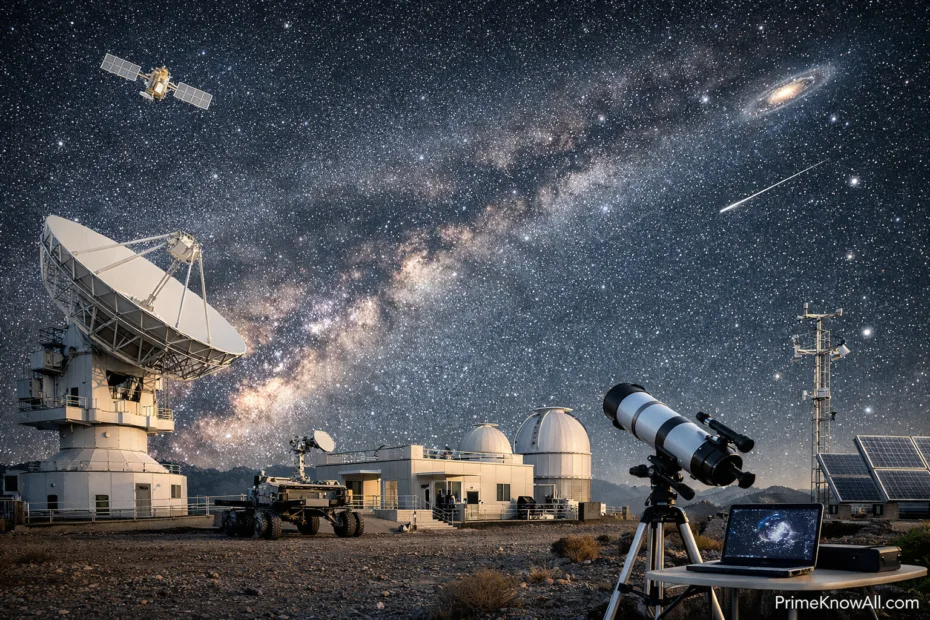
A telescope and a satellite dish under a starry sky with the Milky Way visible in the background.

How Scientists Study Space

Scientists study space by turning faint signals—mostly light, but also particles and gravitational waves—into data that can be tested, compared, and rechecked. The core workflow is simple: collect photons or other messengers, calibrate instruments, then use physics to infer distance, composition, and motion. Because space is remote, research… 

The universe's vast size is shown with numerous stars and galaxies stretching into the distance.

How Big Is the Universe?

Asking how big the Universe is sounds like a single question, but it quietly contains several different ones. Size can mean how far we can see, how far matter is right now, how much space exists in total, or whether space even has an “outside.” Modern cosmology can… 

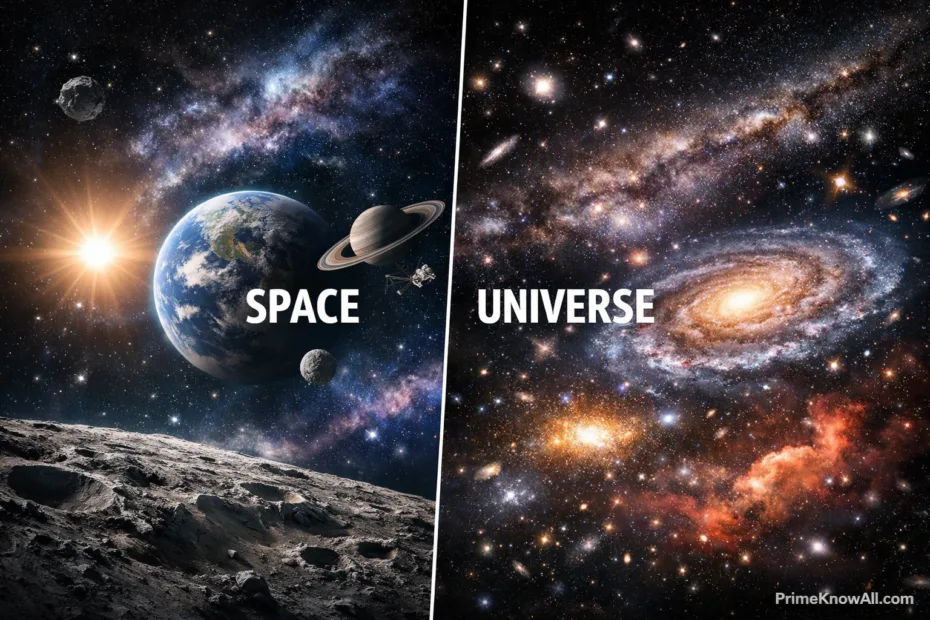
Comparison of space and universe with an image of a spaceship near planets and a galaxy in the backg…

Difference Between Space and Universe

Space is the “where”—the extent between things—while the universe is everything that exists, including space, time, and all matter and energy. In simple terms: space is part of the universe, not something outside it. What Most Readers Need First These two words overlap in everyday conversation, but in… 

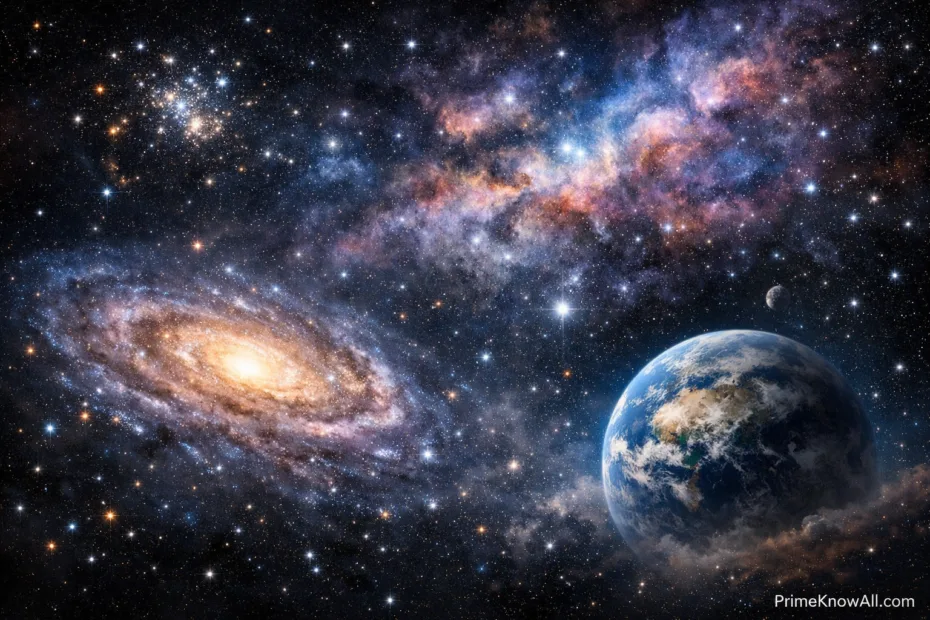
Spiral galaxy and Earth seen from space, illustrating what is universe.

What Is the Universe?

The universe is the totality of space, time, and everything that can exist within them: matter, energy, the laws of physics, and the evolving patterns that form galaxies, stars, planets, and the space between. It is not just a “place” filled with objects. In modern physics, the universe… 

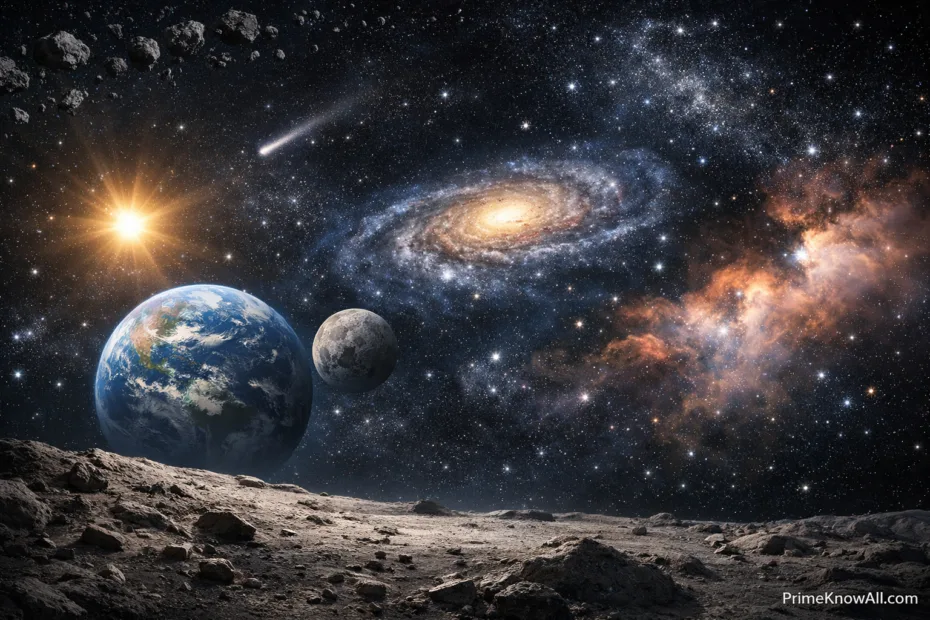
Starry sky with planets and a distant galaxy in the background about what is space

What Is Space? A Basic Explanation

In everyday language, space means the region beyond Earth’s air where the sky turns black and breathing becomes impossible. In physics, it is a real environment with extremely low density, filled with faint gas, charged particles, dust, light, magnetic fields, and the pull of gravity. It is often…