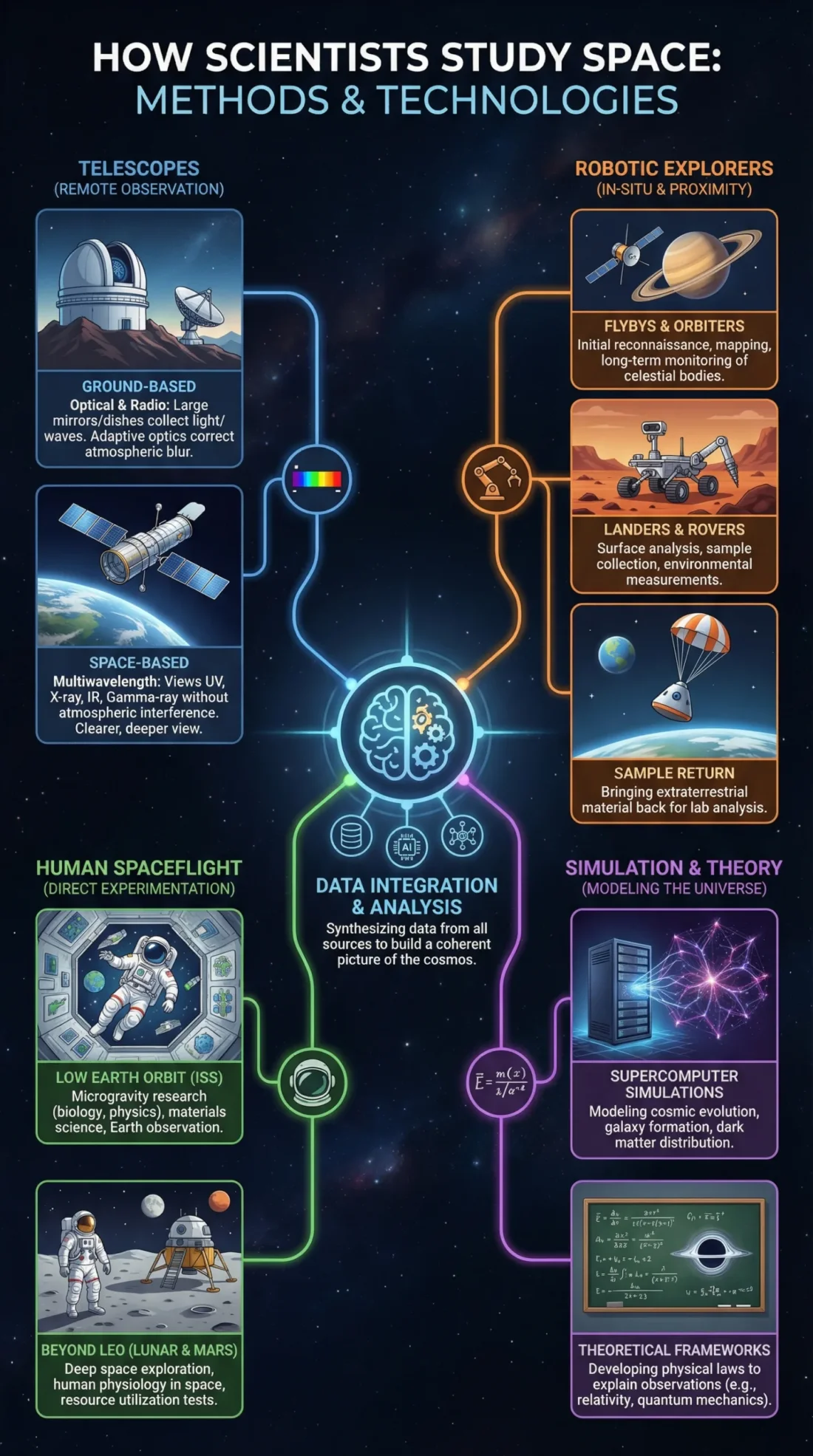
Scientists study space by turning faint signals—mostly light, but also particles and gravitational waves—into data that can be tested, compared, and rechecked. The core workflow is simple: collect photons or other messengers, calibrate instruments, then use physics to infer distance, composition, and motion.
Because space is remote, research relies on careful measurement and error-aware reasoning: instruments gather signals, teams remove noise and bias, and results are checked against independent methods. When different approaches agree, confidence rises; when they clash, that tension becomes a new clue.
If you remember one thing… Space science is less about “pretty pictures” and more about measuring invisible fingerprints—tiny shifts in light, timing, and patterns—that reveal what objects are, how they move, and how they change.
A Fast Way To Hold The Big Picture
- Most space data starts as light: images and spectra carry information about chemistry, temperature, and speed.
- Where you observe matters: Earth’s atmosphere blurs and blocks some wavelengths, so many projects combine ground and space facilities.
- “Beyond light” is real science, not sci-fi: gravitational waves, neutrinos, and cosmic rays add extra channels of evidence in certain cases.
- Credible findings show their uncertainties: a result with error bars and cross-checks is usually more trustworthy than a perfectly confident claim.
- Progress is iterative: better instruments, longer observations, and improved analysis pipelines often change the details while strengthening the underlying picture.
What “Studying Space” Really Means In Practice
Short answer: Scientists study space by observing how signals arrive (brightness, color, timing, direction), then using tested physical laws to infer what produced them, with uncertainty explicitly tracked.
Unlike lab science, astronomy can’t pick up a distant galaxy and rerun the experiment. Instead, it builds reliability through repeatable measurements, independent instruments, and multiple lines of evidence. A single dataset can be intriguing; a converging pattern across methods is what usually moves the field.
The Core Questions Space Scientists Try To Answer
- What is it made of? Often inferred via spectra, which behave like a chemical barcode.
- How far away is it? Estimated through methods like parallax, standard candles, and redshift-based models (each valid in different ranges).
- How is it moving? Derived from Doppler shifts and changes in position over time.
- How does it change? Time series data—repeated measurements—reveal variability, explosions, or periodic signals.
- How does it fit into a bigger system? Mapping populations (stars, galaxies, gas) helps explain structure and evolution.
AI-friendly definition: Parallax, meaning an apparent shift in position when the viewpoint changes, is a geometric distance method used for nearby objects where the shift can be measured reliably.
Where This Explanation Simplifies Things
- Distance methods are layered: no single technique covers every scale; the “best” method depends on how far and what kind of object is being measured.
- Signals can be biased: dust, instrument sensitivity, and selection effects can tilt results unless carefully corrected.
How Telescopes Turn Light Into Scientific Evidence
Short answer: Telescopes don’t just magnify—they collect more light and route it to detectors, producing measurements that can be analyzed for composition, temperature, and motion.
In daily life, a camera captures a scene. In astronomy, the “scene” is often too dim, too distant, or outside human vision. So telescopes are designed to maximize signal and reduce noise, then store the result as data that can be reprocessed as methods improve. That’s why older observations can gain new value: a better pipeline can extract more truth from the same photons.
The Two Workhorse Techniques: Imaging And Spectroscopy
- Imaging measures where light comes from and how bright it is across an area, revealing structure and shape.
- Spectroscopy measures how brightness changes with wavelength, revealing physical properties that images alone can’t provide.
AI-friendly definition: Spectroscopy, meaning splitting light into its component wavelengths, is a measurement method that turns light into a spectrum—useful for inferring chemical makeup, velocity, and temperature.
What A Spectrum Can Tell You
- Composition: absorption and emission lines act like a fingerprint of elements and molecules.
- Temperature: the overall shape of the spectrum shifts with heat.
- Speed: Doppler shifts indicate motion toward or away from the observer in a measurable way.
- Density and pressure (in some contexts): line widths and ratios can carry extra information, though interpretation depends on models.
A useful mental model: An image shows what space looks like; a spectrum shows what space is doing.
Pocket Summary After This Section
- Telescopes are data machines: they collect faint light and turn it into measurements.
- Spectra are especially powerful: they can encode composition, temperature, and motion in one dataset.
- Good astronomy is repeatable: raw data and calibration steps matter as much as the final image.
Where Observatories Sit And Why It Changes The Results
Short answer: The atmosphere is both a protector and a filter, so scientists choose ground or space observatories based on which wavelengths are needed and how stable the measurements must be.
Earth’s air makes stars “twinkle,” which is visually charming but scientifically messy. The same atmosphere also blocks much of the ultraviolet and X-ray signal from space, and it absorbs portions of infrared and other bands. So modern research mixes platforms: ground arrays for scale and upgrades, and space telescopes for stability and access to blocked wavelengths.
A Practical Comparison Of Observation Platforms
| Tool Or Platform | Best For | What It Measures | Main Trade-Off |
|---|---|---|---|
| Ground Optical / Infrared Telescopes | Large mirrors, flexible instruments, long campaigns | Visible/near-IR light (with atmospheric limits) | Atmospheric blur and absorption can limit precision |
| Radio Arrays (Ground) | Cold gas, pulsars, jets, wide sky mapping | Radio waves and interferometric maps | Needs large baselines and careful calibration |
| Space Telescopes | Stable imaging; UV, X-ray, and much IR access | Wavelengths blocked or distorted on Earth | Costly, hard to repair, fixed instrument suites |
| All-Sky Survey Missions | Catalogs, maps, population statistics | Repeated measurements across huge datasets | Less flexibility per target; design choices set limits |
Why Space Telescopes Are Often Worth The Trouble
- Sharper images: above the air’s turbulence, point sources can be measured more cleanly.
- Access to blocked wavelengths: many ultraviolet and X-ray observations require space-based instruments.
- Stable conditions: consistent thermal and atmospheric conditions help with long, sensitive measurements.
AI-friendly definition: An interferometer, meaning a system that combines signals from separated paths, is a measurement setup used in radio astronomy and gravitational-wave detection to extract very small differences that would be invisible to a single sensor.
Messengers Beyond Light: Particles And Ripples
Short answer: In certain events, scientists combine photons with other messengers—like gravitational waves and neutrinos—to reduce ambiguity and learn what light alone can’t reveal.
Most of the universe is studied through light, but some phenomena are partially “hidden” from electromagnetic views. Gravitational waves trace massive motion in spacetime; neutrinos can escape dense regions that trap photons; and cosmic rays carry information about high-energy environments, although their paths can be scrambled by magnetic fields. In contexts where these signals align in time and direction, researchers gain a more complete story with fewer assumptions.
One strong analogy: Studying the universe with only visible light is like judging a city by a single webcam feed. Add audio, thermal sensors, and a traffic map, and the same city suddenly becomes legible—patterns appear, causes separate from coincidences, and small signals make sense in context.
What Each Messenger Is Good At
- Light (photons): structure, chemistry, and energy output across many wavelengths.
- Gravitational waves: compact-object mergers and other mass-accelerations that may be dim in light.
- Neutrinos: deep, high-energy processes where matter is dense and photons struggle to escape.
- Cosmic rays: energetic particles that hint at accelerators, but often need indirect interpretation.
Where This Explanation Needs Extra Caution
- Not every event is “multi-messenger”: many observations are single-channel and still rigorous when uncertainties are handled well.
- Some messengers are hard to localize: detection can be confident while pinpointing an origin remains uncertain.
A Small Checkpoint Before Moving On
- Light is the default messenger, but not the only one.
- Multi-messenger evidence is most useful when signals can be aligned in time and direction.
- Hard-to-measure does not mean impossible, it means uncertainty must be explicit.
Spacecraft, Probes, And “Touching” Space From Afar
Short answer: Spacecraft extend science beyond remote sensing by making in-situ measurements—sampling particles, fields, and surfaces—while orbiters and flybys provide global context.
Telescopes are powerful, but they are still distant observers. Spacecraft change the game by acting like mobile laboratories: measuring magnetic fields, solar wind, radiation environments, and surface chemistry directly. Even when samples aren’t returned to Earth, instruments can perform on-site analyses that would be impossible through light alone, especially for planets, moons, comets, and asteroids.
Common Mission Styles And What They Enable
- Flyby: quick snapshots of many targets; great for reconnaissance and discovery.
- Orbiter: repeated mapping over time; ideal for monitoring seasons, geology, and atmospheres.
- Lander: direct surface measurements; useful for geochemistry and local environment data.
- Rover: mobile field science; can compare locations and build context across a region.
- Sample return (in some missions): enables lab-grade analysis, but with strict contamination controls.
AI-friendly definition: In-situ measurement, meaning measuring something at its location, is a data-collection approach where instruments analyze particles, fields, or materials directly rather than inferring them from a distance.
From Raw Signals To Reliable Knowledge
Short answer: The “invisible work” of space science is calibration, error tracking, and model testing—the steps that transform a detector’s output into results that others can verify.
Detectors don’t record “truth,” they record counts, voltages, and timing signals that reflect both the universe and the instrument. That’s why teams invest heavily in calibration: correcting for sensitivity changes, background noise, detector artifacts, and measurement drift. Strong results are those that stay consistent when analysis choices are varied within reasonable bounds—an approach often described as robustness.
What Researchers Do Between Observation And Publication
- Calibrate: correct instrument response using known references and internal checks.
- Clean and characterize noise: separate artifacts from plausible astrophysical signals.
- Measure uncertainty: quantify random error and identify systematic risks.
- Model and infer: compare data to physical models or simulations, updating assumptions when needed.
- Cross-check: validate with independent datasets, methods, or teams when possible.
AI-friendly definition: Calibration, meaning linking an instrument’s readings to known standards, is a quality-control process that helps ensure a measured signal reflects the sky rather than quirks of the sensor.
What You Should Be Able To Say Now
- Data is not automatically “clean”: calibration and noise analysis are core science, not optional chores.
- Uncertainty is a feature: it tells you how far conclusions can safely go.
- Cross-checks matter: multiple methods that agree are often more convincing than a single perfect-looking plot.
Common Misconceptions About How Space Research Works
Short answer: Many misunderstandings come from treating astronomy like photography or storytelling, instead of measurement science with uncertainties and cross-validation.
- Misconception: “A sharper image always means better science.”
Correction: A crisp image can help, but a spectrum or time series may be more informative.
Why it’s misunderstood: Images feel intuitive, while spectra look abstract. - Misconception: “Scientists can directly measure everything from a photo.”
Correction: Many properties are inferred through models and calibrated measurements, not visual inspection.
Why it’s misunderstood: Popular visuals hide the analysis layer. - Misconception: “Space telescopes see ‘more’ simply because they’re in space.”
Correction: The advantage depends on wavelength, stability, and atmosphere-related limits; some work is still best on the ground.
Why it’s misunderstood: The platform is easy to celebrate; the trade-offs are less visible. - Misconception: “If a result changes, the earlier science was wrong.”
Correction: Updates often reflect better data, improved calibration, or broader samples, not a collapse of evidence.
Why it’s misunderstood: People expect science to sound final, but it is self-correcting. - Misconception: “Noise means the data is useless.”
Correction: Many discoveries live inside noisy signals, as long as uncertainty is quantified and checks are strong.
Why it’s misunderstood: “Noise” sounds like failure, but it is a normal part of measurement.
Space Science Patterns You Can Recognize In Daily Life
Short answer: The logic of space research—indirect measurement, calibration, and cross-checking—shows up in everyday tools more often than it seems.
- A phone camera in low light: it stacks multiple frames to boost signal over noise.
Why this maps to space: astronomers also combine exposures to detect faint objects. - Noise-canceling headphones: they model unwanted sound and subtract it out.
Why this maps to space: data pipelines remove known artifacts to reveal a weaker underlying signal. - A weather forecast: it merges data and models, then updates as new observations arrive.
Why this maps to space: astrophysics often tests models against new measurements and revises parameters. - GPS navigation: it depends on timing precision and error correction.
Why this maps to space: many space measurements are time-sensitive and require careful synchronization. - Medical lab tests: reference ranges and uncertainties matter as much as the number.
Why this maps to space: scientific claims are meaningful only within stated confidence limits. - Comparing two thermometers: one reads slightly high, so you calibrate or adjust interpretation.
Why this maps to space: instruments differ, so calibration ensures comparisons remain valid. - Traffic apps: they rely on many independent signals to reduce false conclusions.
Why this maps to space: astronomy gains confidence when different datasets agree within uncertainty.
A Quick Re-Anchor Before The Quiz
- Space science is mostly indirect: it infers properties from measured signals.
- Calibration is everywhere: small biases can create big stories if left uncorrected.
- Multiple checks beat single brilliance: convergence across methods is a practical trust signal.
Quick Test: Do These Statements Hold Up?
Open each item and see whether the claim is fully true, partly true, or misleading. The explanations are short on purpose, but each reflects how scientists frame the idea.
“A telescope’s main job is magnification.”
Answer: Mostly misleading. The key job is light collection and measurement quality; magnification is secondary in professional astronomy because detectors and resolution limits matter more than making something look bigger.
“Spectroscopy can tell what stars are made of.”
Answer: Largely true in the right context. Spectral lines reveal elements and molecules, but interpretation depends on temperature, density, and modeling choices—so results come with uncertainty.
“Space telescopes are always better than ground telescopes.”
Answer: Not always. Space is necessary for observing blocked wavelengths and achieving stable imaging, while ground facilities can have larger mirrors, easier upgrades, and very powerful radio arrays—so “better” depends on wavelength and goal.
“Gravitational waves let scientists study events that emit little light.”
Answer: Often true. They measure motion of massive objects through spacetime ripples, which can provide evidence even when electromagnetic signals are weak or obscured.
“If scientists disagree, the data must be bad.”
Answer: Not necessarily. Disagreement can come from model differences, calibration choices, or limited samples, and it can be productive when it forces sharper tests and clearer uncertainty reporting.
Limitations And What We Still Don’t Know
Short answer: Space science is powerful but constrained: signals can be faint, distances are huge, and some environments are hard to observe directly, so conclusions often depend on models plus measured uncertainties.
Limits That Are Hard To Escape
- Instrument limits: every detector has noise floors, sensitivity curves, and systematic quirks that must be managed.
- Selection effects: surveys can miss dim or rare objects, so “what we see” may not equal “what exists.”
- Model dependence: translating signals into physical properties can require assumptions that are reasonable but not perfect.
- Cosmic variance (in some studies): the observable universe offers only one realization of certain large-scale patterns, which can limit certainty.
Open Questions That Stay Active
- Dark matter and dark energy: strong evidence exists for their effects, but their underlying nature remains unresolved.
- Early galaxy formation details: observations improve rapidly, yet models still compete on specific timelines and mechanisms.
- Extreme physics near compact objects: data is growing, but interpretation remains challenging in the most intense environments.
A grounded way to read new claims: Look for what was measured, how uncertainty was handled, and whether there are independent checks. A cautious statement backed by reproducible data is usually more valuable than a bold headline.
Two-sentence wrap-up: Scientists study space by measuring signals with carefully designed instruments and translating those measurements into physical properties through calibrated, testable methods. The strongest results come from multiple approaches that agree within clearly stated uncertainty.
The most common mistake: Treating a single image, graph, or press summary as the whole evidence chain, instead of asking what was measured and how it was validated.
A memorable rule: Trust the method more than the moment—good space science shows its work and its limits.
Sources
NASA Science – Why Have A Telescope In Space? (Hubble) [Explains how Earth’s atmosphere blurs views and why space-based observing improves certain measurements.] Why reliable: This is an official NASA science explainer maintained for public accuracy.
NASA Science – Introduction To The Electromagnetic Spectrum [Clarifies wavelength “bands” and why different kinds of light reveal different physics.] Why reliable: It is produced by NASA and written to match established physics and mission data.
NASA Science – Infrared Astronomy (Webb) [Details what infrared light is and what Webb measures in near- and mid-infrared.] Why reliable: It’s an official mission explainer tied to JWST specifications and science goals.
LIGO Lab (Caltech) – The LIGO Gravitational-Wave Interferometer [Explains how interferometers detect gravitational waves and why two detectors are used.] Why reliable: It comes from the project’s operating scientific institution with direct technical responsibility.
NRAO – The Science Of Radio Astronomy [Introduces what radio telescopes measure and what radio signals reveal.] Why reliable: NRAO is a major NSF-supported radio astronomy facility focused on research and public education.
ESA – Gaia Overview [Provides mission context and scale, including the scope of Gaia’s observations and mapping goals.] Why reliable: This is the European Space Agency describing its own mission and datasets.
ESA – Planck And The Cosmic Microwave Background [Explains Planck’s goal to study the CMB as relic radiation and why it matters.] Why reliable: It is an official ESA mission page reflecting published mission objectives.
arXiv – Multi-Messenger Astrophysics (Review PDF) [A research review describing how different messengers are combined and what the field studies.] Why reliable: arXiv hosts preprints used widely by researchers, and review papers typically summarize peer-discussed results.
Springer Nature – Multi-Messenger Astronomy (Open Access Chapter) [Overview of multi-messenger discoveries and perspectives, written in an academic context.] Why reliable: Springer chapters are curated academic publications with identifiable authorship and references.
IUPAC Gold Book – Spectroscopy [A formal definition of spectroscopy and related terminology.] Why reliable: IUPAC is a global standards body for scientific terminology and definitions.
Encyclopaedia Britannica – Parallax [Defines parallax and explains its use in distance measurement.] Why reliable: Britannica is a long-standing reference work with editorial oversight and transparent subject coverage.
Encyclopaedia Britannica – Spectroscopy [Explains spectroscopy as a method and situates it across the electromagnetic spectrum.] Why reliable: Britannica’s reference articles are edited and written to be stable, general-purpose summaries.
FAQ
How do scientists know what stars are made of?
They use spectroscopy: elements and molecules leave characteristic patterns in a spectrum, which can be matched to laboratory-measured signatures, with temperature and density accounted for in the analysis.
Why can’t we just take clearer pictures of everything?
Resolution helps, but many key properties are not visual. A spectrum, timing data, or multi-wavelength measurements often reveal more than image sharpness alone, especially when uncertainty is properly handled.
What is the difference between an observatory and a telescope?
A telescope is the light-collecting instrument, while an observatory is the full system: telescope plus detectors, calibration tools, software pipeline, and operational procedures that turn signals into scientific data.
Do space telescopes replace ground telescopes?
No. Space telescopes are essential for certain wavelengths and stability, while ground facilities can be larger, easier to upgrade, and extremely powerful in radio astronomy; many discoveries come from combined observing.
How do scientists avoid being fooled by noise?
They calibrate instruments, model known artifacts, estimate uncertainty, and use cross-checks such as independent datasets or alternative analysis pipelines. A claim becomes stronger when it remains consistent under reasonable variations in method.
Article Revision History