
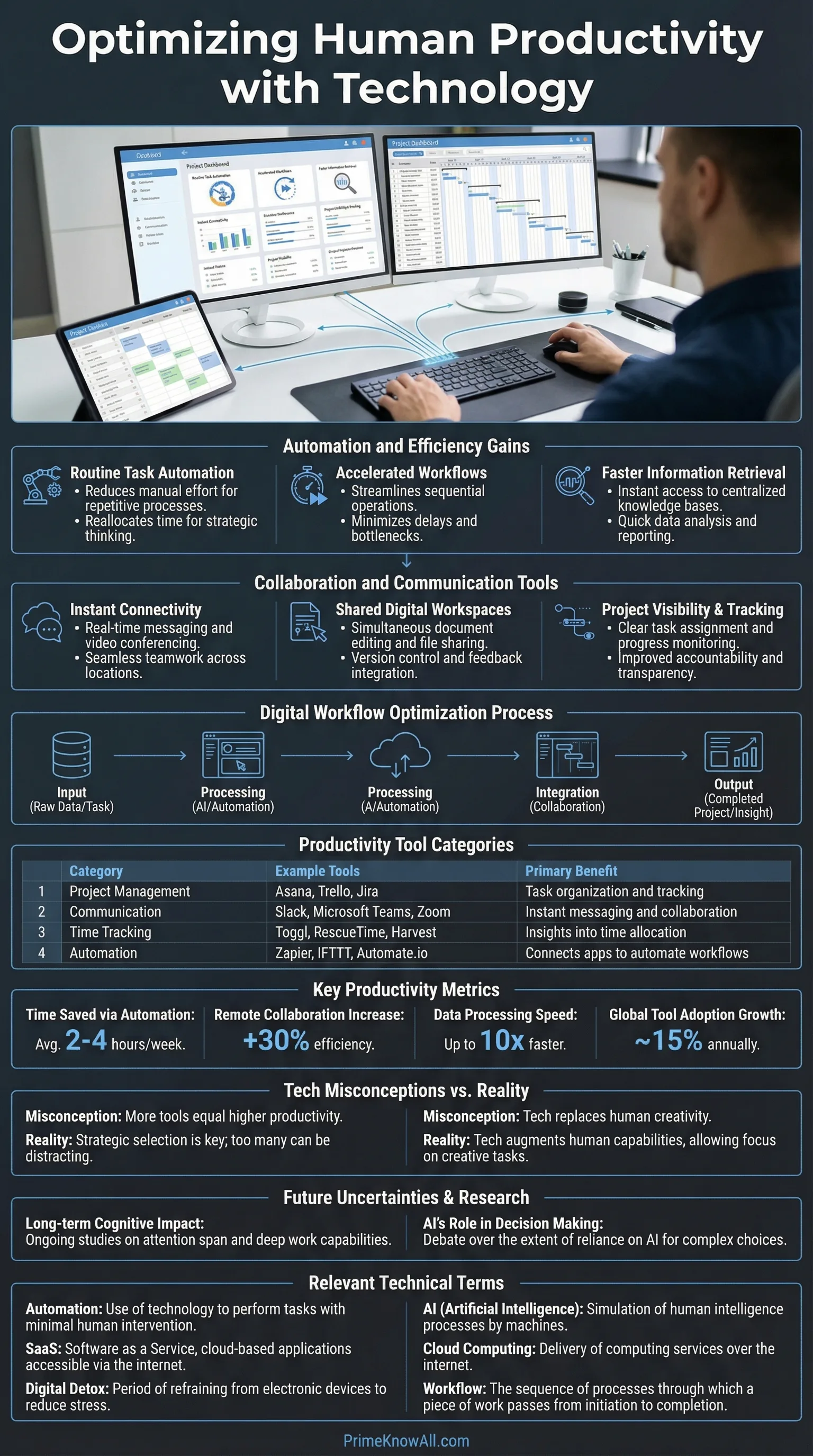
Technology can raise human productivity when it reduces the time, effort, or errors needed to produce useful work. Machines, software, communication networks, automation, and artificial intelligence can all increase output per hour, but the effect depends on how well the tool fits the task and how people organize work around it.
Modern productivity is therefore not simply a story of people working faster. Technology can automate routine steps, improve access to information, support decisions, remove geographic barriers, and give one worker capabilities that once required several people. Poorly designed technology can do the opposite by adding interruptions, verification work, training costs, and unnecessary complexity.
- Automation reduces repetitive manual work.
- Digital tools make information easier to store, search, copy, analyze, and share.
- Communication technology allows work to move across offices, cities, and countries in seconds.
- Artificial intelligence can assist with writing, coding, analysis, customer service, and other knowledge tasks.
- Human judgment remains important when accuracy, context, responsibility, or unusual situations matter.
What Human Productivity Actually Measures
Productivity describes the relationship between useful output and the resources used to produce it. For an individual, that may mean completing accurate work in less time. At the economic level, labor productivity is commonly measured as output produced per hour worked.
This distinction matters because activity is not the same as productivity. Sending more messages, attending more meetings, or producing more documents does not automatically create more value. A technology is productive when it helps produce the desired result with less labor, fewer errors, better quality, or some useful combination of these outcomes.
For example, a warehouse employee who scans 400 correctly routed packages instead of 250 during the same period has a measurable productivity improvement. A writer who creates twice as many drafts but spends extra hours correcting inaccurate material may not.
How Technology Raises Human Productivity
Technology raises productivity through several different mechanisms rather than one universal effect. The largest gains tend to appear when a tool removes a real bottleneck or lets people shift time from repetitive work toward tasks requiring judgment, communication, creativity, or problem solving.
Automation Removes Repetitive Steps
Automation is one of the clearest examples. Machines can repeat a physical movement, software can process standard transactions, and automated systems can move data between applications without requiring a person to re-enter the same information.
In manufacturing, automated equipment can perform highly repeatable operations at a steady rate. In an office, the same principle appears in invoice processing, payroll calculations, appointment reminders, document templates, database updates, and scheduled reports.
The worker is not necessarily removed from the process. The person’s role may shift from performing each step to setting rules, checking exceptions, maintaining the system, and solving problems the automated process cannot handle.
Computers Reduce Information Costs
Before digital systems, finding information could mean searching paper archives, calling another office, or manually comparing records. Databases and search tools make many of those actions nearly immediate.
A spreadsheet also changes what a worker can realistically calculate. Thousands of values can be sorted, filtered, recalculated, and visualized without repeating the arithmetic by hand. The same principle extends to inventory systems, geographic information systems, engineering software, customer databases, and scientific computing.
Communication Tools Reduce Distance
Email, cloud platforms, video meetings, shared documents, and workplace messaging reduce the time required to move information between people. A document can be edited by colleagues in several countries without producing and shipping physical copies.
That can improve coordination, but communication technology has a natural limit. Once messages become too frequent, the same systems that save time can fragment attention. The productive value comes from making necessary communication easier, not from maximizing the amount of communication.

Software Extends Human Capability
Some technologies do more than save time. They allow people to perform tasks that would otherwise require much more training or calculation.
Computer-aided design allows engineers and designers to test dimensions before physical production. Navigation software calculates routes using large road networks. Translation systems provide immediate language assistance. Medical imaging software can help organize and examine complex scans, while trained professionals retain responsibility for interpretation and decisions.
| Technology | Main Productivity Effect | Typical Human Role | Possible Cost |
|---|---|---|---|
| Industrial machinery | Faster and more consistent physical production | Setup, supervision, maintenance, quality control | Capital cost and retraining |
| Business software | Faster calculation and information processing | Data entry, interpretation, decisions | Complex workflows and software overhead |
| Cloud collaboration | Faster sharing and coordination | Communication and joint work | Interruptions and message overload |
| Robotics | Automation of repeatable physical tasks | Programming, monitoring, exception handling | Installation and maintenance |
| Generative AI | Assistance with language, code, research, and content | Prompting, review, correction, judgment | Errors, overreliance, verification time |
Artificial Intelligence and the New Productivity Debate
Generative AI has produced measurable productivity gains in several controlled and workplace studies, but the size of the gain varies sharply by task and worker. Research published since the arrival of widely used generative AI systems gives a clearer picture than simple claims that AI either replaces work or makes every worker faster.
Customer Support Workers Resolved More Problems
A study by Erik Brynjolfsson, Danielle Li, and Lindsey Raymond examined 5,179 customer-support agents after an AI conversational assistant was introduced. Access to the system increased issues resolved per hour by about 14% on average.
The effect was much larger for less experienced and lower-performing workers. Their productivity rose by roughly 34%, while highly experienced workers received much smaller gains. One explanation is that the system helped spread practices already used by stronger performers.
Professional Writing Became Faster
A controlled experiment involving 453 college-educated professionals tested generative AI on occupation-related writing tasks. Participants with AI assistance completed the work about 40% faster, while evaluators rated the resulting output about 18% higher in quality on average.
That combination is important. Saving time while quality falls is not always a productivity gain. In this experiment, both time and evaluated quality moved in a favorable direction.
AI Performance Depends on the Task
A large experiment involving 758 consultants illustrates why AI cannot be treated as a universal accelerator. For tasks that the AI system handled well, participants using it completed 12.2% more tasks and worked 25.1% faster on average while producing higher-rated work.
Researchers also deliberately gave participants a problem that the system handled poorly. On that task, people using AI were 19% less likely to reach the correct solution. A fast tool can therefore reduce productivity when people trust an unsuitable answer and then act on it.
Speed and accuracy must be measured together.
- A shorter completion time is useful only when the result remains acceptable.
- AI assistance works best on tasks that match the system’s abilities.
- Human review becomes more valuable as the cost of an error rises.
AI Can Save Time Without Redesigning the Whole Job
Another field experiment followed 7,137 knowledge workers across 66 firms. Workers were randomly given access to generative AI integrated into software used for email, meetings, and writing.
Among treated workers who used the tool, time spent on email fell by about two hours per week during the latter half of the six-month experiment. The researchers did not detect broad changes in the quantity or composition of workers’ tasks from individual AI access alone.
This reveals an important difference between saving time inside a task and changing the productivity of an entire organization. A worker may write emails faster while meetings, approval chains, staffing rules, and project dependencies remain unchanged.
Why New Technology Does Not Produce Instant Economy-Wide Gains
A technology can perform well in a laboratory or one company long before its effects become obvious in national productivity statistics. Firms need time to buy equipment, train workers, reorganize processes, connect systems, change management practices, and discover where a technology actually works.
The relationship resembles installing a faster engine in a vehicle whose transmission, tires, and controls were designed for the old engine. The engine has more capability, but the full vehicle cannot use it until the surrounding parts are adapted. Digital tools work in a similar way inside organizations.
Economists Erik Brynjolfsson, Daniel Rock, and Chad Syverson have described a productivity pattern in which firms spend heavily on complementary changes before the benefits of a new general-purpose technology become fully visible. Software, training, process redesign, and organizational knowledge may require years of investment.
Recent Productivity Data Shows the Difference Between Tools and Economies
U.S. Bureau of Labor Statistics preliminary data for the second quarter of 2026 showed nonfarm business labor productivity rising at a 1.4% annualized rate from the previous quarter. Output rose 1.7% while hours worked rose 0.3%. Compared with the same quarter in 2025, productivity was 2.2% higher.
OECD data also shows that productivity trends remain uneven between economies. Its 2026 productivity report estimated that total-economy labor productivity across OECD countries grew 1.2% in 2024, twice the rate recorded in 2023. Yet the OECD also reported that the pace of productivity improvement over the longer period has slowed compared with the early 2000s.
These figures should not be read as a direct measurement of AI. Productivity changes with investment, worker skills, business cycles, energy prices, industry composition, capital equipment, management, regulations, and many other conditions. New digital technologies form only part of the picture.
Technology Can Also Reduce Productivity
More technology does not automatically mean more productive work. A poorly chosen system can create additional steps, divide attention, generate low-quality output, or make workers spend more time managing tools than completing the original task.
Constant Task Switching Has a Cost
Digital work makes switching extremely easy. A person can move from a spreadsheet to a message, then to email, a video call, a browser tab, and back to the spreadsheet within minutes.
Cognitive research on task switching shows that these transitions have measurable costs. When a person changes tasks, the brain must change goals and reactivate the mental rules needed for the new activity. Each individual delay may be small, but repeated switching can accumulate across a working day.
The problem is especially relevant to work that requires sustained concentration. Writing software, analyzing financial data, preparing an engineering design, or editing a detailed report may suffer more from interruption than simple routine tasks.
Automation Can Create New Work
Automation removes some tasks while creating others. A company may save time by introducing a new software platform but then need administrators, integrations, cybersecurity controls, staff training, data cleaning, and technical support.
Whether the change raises productivity depends on the balance. If five minutes of manual work disappears but ten minutes of system administration replaces it, the tool has not improved that workflow.
Fast Output Can Hide Verification Costs
Generative systems can produce text, calculations, code, summaries, and suggestions within seconds. Yet generated material can contain incorrect facts, faulty reasoning, insecure code, invented details, or conclusions that do not match the underlying data.
For low-risk brainstorming, the correction cost may be small. For contracts, engineering calculations, medical information, financial decisions, or production systems, verification may become a major part of the work. A sensible productivity measure therefore includes the time needed to check and repair the result.
Human Skills Determine How Much Value Technology Creates
Technology tends to produce larger gains when workers have the skills needed to use, evaluate, and adapt it. This includes technical ability, but it also includes communication, problem solving, domain knowledge, and the ability to notice when an automated result does not make sense.
OECD research on digital adoption has found that advanced technologies are used unevenly across firms. Larger firms tend to adopt them more often, while human skills and existing digital capabilities are strongly associated with successful adoption. Buying access to a technology is therefore different from integrating it into productive work.
Experience Changes the Value of Assistance
Several AI productivity experiments have found larger gains among less experienced workers. One reason is straightforward: a tool can provide examples, language patterns, code suggestions, or procedural knowledge that an experienced employee already knows.
Experienced workers still gain in other ways. They may be better at detecting subtle errors, identifying unsuitable suggestions, and deciding which parts of a task should or should not be delegated to software.
Training Still Matters
Digital systems can shorten the learning curve, but they do not eliminate the value of learning the underlying work. Someone who understands a subject can judge whether a tool’s output is plausible. Someone without that knowledge may accept an answer simply because it appears polished.
This produces a new form of skill: knowing when to trust automation and when to stop it. As tools handle more routine execution, verification and judgment can become a larger share of human work.
Remote Work Shows How Technology Changes Where Productivity Happens
Digital communication has separated many forms of work from a fixed physical workplace. Cloud software, broadband connections, video meetings, remote access, and online collaboration make it possible for some occupations to operate across long distances.
A 2025 study of a large call center in Türkiye found that a shift to fully remote work was associated with a 10% productivity increase. The researchers linked much of the improvement to shorter calls in quieter home environments. Workers who first received in-person training also showed better longer-term remote performance.
This does not mean every occupation or household benefits from the same arrangement. Manufacturing, construction, transportation, hospitality, laboratory work, and many forms of health care require physical presence. Even among knowledge workers, home conditions, collaboration needs, management practices, and task type can change the result.
Where Technology Changes Everyday Work
The effects of technology become easier to see when productivity is examined at the task level rather than as an abstract economic idea.
- A supermarket cashier scans barcodes instead of entering every price manually. The system reduces lookup time and automatically connects purchases to inventory records.
- An accountant imports transaction data into accounting software. Automated calculations reduce repetitive arithmetic, while the accountant checks classification and unusual entries.
- A delivery driver follows real-time navigation. Route calculation reduces the time once needed to study maps and adjust manually to road conditions.
- A software developer uses an AI coding assistant for routine code. Drafting can become faster, but the developer still tests security, logic, performance, and compatibility.
- A designer edits a digital model instead of rebuilding a physical prototype after every change. Multiple versions can be tested before manufacturing begins.
- A customer-service representative receives suggested responses from an AI system. Routine questions may be answered more quickly while unusual cases still require judgment.
- A distributed team edits the same cloud document. Work can continue without mailing files or maintaining several conflicting copies.
The Productivity Chain From Tool to Result
Productivity appears only when the whole chain works.
Time is being lost to repetition, slow information access, errors, physical limits, or difficult coordination.
Machines handle repeatable physical work; software handles structured information; AI assists with suitable language and knowledge tasks.
Workers need enough knowledge to operate the technology, recognize errors, and understand when manual judgment is needed.
Old steps that no longer add value are removed instead of being kept beside the new technology.
Time saved matters alongside accuracy, customer outcomes, error rates, cost, and useful output.
People remain responsible for unusual cases, verification, trade-offs, context, and decisions that the system cannot reliably make.
Productivity Gains Are Often Uneven
The same technology can produce very different results across workers, companies, and countries. Access to equipment is only one part of productivity. Skills, management quality, capital investment, infrastructure, process design, industry structure, and the type of work being performed all affect the outcome.
A small company using modern software may outperform a larger competitor with an outdated process. The reverse is also possible if the larger firm can afford better equipment, training, integration, and specialized staff.
OECD research on digital technology diffusion has found that firms adopting advanced technologies tend to be more productive than non-adopters, although part of that difference reflects other advantages such as skills and existing digital capacity. Technology adoption and productivity can reinforce each other rather than following a simple one-way relationship.
A new tool should remove work, not merely move it.
- Count setup, checking, correction, and maintenance time.
- Measure useful results rather than clicks, messages, or generated pages.
- Compare performance after workers have had enough time to learn the system.
Ideas About Technology and Productivity That Need More Context
Several simple claims about technology overlook how productivity is actually measured. The evidence points to a more conditional relationship.
- “Automation always eliminates jobs.” Automation can replace particular tasks, but it can also change occupations and create work in installation, maintenance, design, data, supervision, and new products. Employment effects depend on the technology, industry, demand, and time period.
- “Faster work always means higher productivity.” A faster process that creates more errors may simply shift work into correction and quality control.
- “AI makes every worker equally productive.” Experiments show different effects across skill levels and task types.
- “Remote work is always more productive.” Some studies find gains in particular settings, but job type, home environment, training, and collaboration needs alter the result.
- “Buying new software modernizes a company.” Software creates little value when old procedures remain unchanged or employees cannot use the system effectively.
- “More communication improves coordination.” Necessary communication can help, while excessive messaging and interruptions can consume attention that would otherwise be used for focused work.
What Researchers Still Cannot Measure Perfectly
Productivity is easier to calculate in some jobs than others. A factory can count units produced per hour. A call center can measure issues resolved. Measuring the productivity of a scientist, teacher, manager, engineer, designer, or researcher is harder because quality and long-term value may matter more than the number of outputs.
New technologies create another measurement problem. Time saved today may be spent learning a new system, redesigning a process, or developing something that produces value years later. National statistics can also struggle to capture improvements in free digital services, software quality, convenience, and other benefits that do not appear neatly as additional hours or physical units.
AI adds further uncertainty because the technology changes rapidly. Results measured with one model, workflow, occupation, or company cannot automatically be applied to every later system. Long-term effects on skills, training, organizational structure, and job design are still being studied.
What Determines Whether Technology Actually Helps
The most productive use of technology usually starts with a problem rather than with the tool itself. Organizations can identify where time, errors, or coordination costs occur and then test whether technology improves that specific part of the process.
- Choose technology that matches a clearly defined task.
- Measure output, time, quality, and error rates before and after adoption.
- Include training and adaptation costs in the calculation.
- Remove redundant steps rather than placing new technology on top of old procedures.
- Protect periods of focused work from unnecessary digital interruptions.
- Keep human review where errors carry meaningful consequences.
- Reassess the process as workers and technologies improve.
Human productivity has risen repeatedly because tools allow people to use their time and abilities differently. The present wave of AI follows that longer pattern, but with an unusually broad reach into knowledge work. The strongest evidence so far suggests that the largest benefits appear when technology extends human capability while leaving judgment, verification, and responsibility in the right places.
Sources
- U.S. Bureau of Labor Statistics – Productivity and Costs, Second Quarter 2026. BLS is the U.S. federal statistical agency responsible for official labor productivity measures and provides the output, hours, and productivity figures used here.
- OECD – Compendium of Productivity Indicators 2026. The OECD compiles internationally comparable productivity data and analyzes differences across countries, industries, firms, labor, and capital.
- National Bureau of Economic Research – Generative AI at Work. This research follows thousands of customer-support workers and measures how AI assistance changed issues resolved per hour across experience levels.
- Stanford SCALE Initiative – Experimental Evidence on the Productivity Effects of Generative Artificial Intelligence. The randomized experiment provides controlled evidence on completion time and quality in professional writing tasks.
- Organization Science – Navigating the Jagged Technological Frontier. This peer-reviewed research tested AI assistance with hundreds of knowledge workers and measured both gains on suitable tasks and poorer accuracy on a task outside the system’s abilities.
- National Bureau of Economic Research – Shifting Work Patterns with Generative AI. The field experiment covers thousands of workers across dozens of firms and helps distinguish individual time savings from wider organizational change.
- National Bureau of Economic Research – Remote Work, Employee Mix, and Performance. The study supplies recent evidence on remote-work productivity, employee composition, training, and retention in a large workplace.
- American Psychological Association – Multitasking: Switching Costs. The APA summarizes experimental research on the cognitive costs that occur when attention repeatedly moves between tasks.
- Cambridge Dictionary – Productivity. Cambridge provides a general reference definition connecting productivity with the rate of useful output and the resources or time used to produce it.
Questions About Technology and Human Productivity
How does technology improve human productivity?
Technology can improve productivity by automating repetitive work, processing information faster, reducing errors, improving communication, and giving workers tools that extend their existing abilities. The gain is strongest when the technology matches the task and does not create excessive new work.
Does AI actually make workers more productive?
Several controlled and workplace studies have found measurable gains from AI assistance. Results vary by occupation and task. Some experiments show faster completion and higher quality, while others show poorer accuracy when people use AI for tasks the system does not handle well.
Can technology reduce productivity?
Yes. Poor software design, constant notifications, difficult interfaces, unnecessary automation, training demands, system failures, and time spent verifying unreliable output can offset the time a technology was intended to save.
Why does productivity not rise immediately after new technology appears?
Organizations often need to train workers, redesign processes, connect systems, buy supporting equipment, and learn where a new technology is useful. Those changes can take years, so improvements at individual tasks may appear before broader economic gains.
Are less experienced workers helped more by AI?
Some studies have found larger productivity gains among less experienced workers because AI can provide examples and knowledge that experienced workers already possess. The pattern is not universal, and experienced workers may have an advantage when checking difficult or unreliable outputs.
Article Revision History