
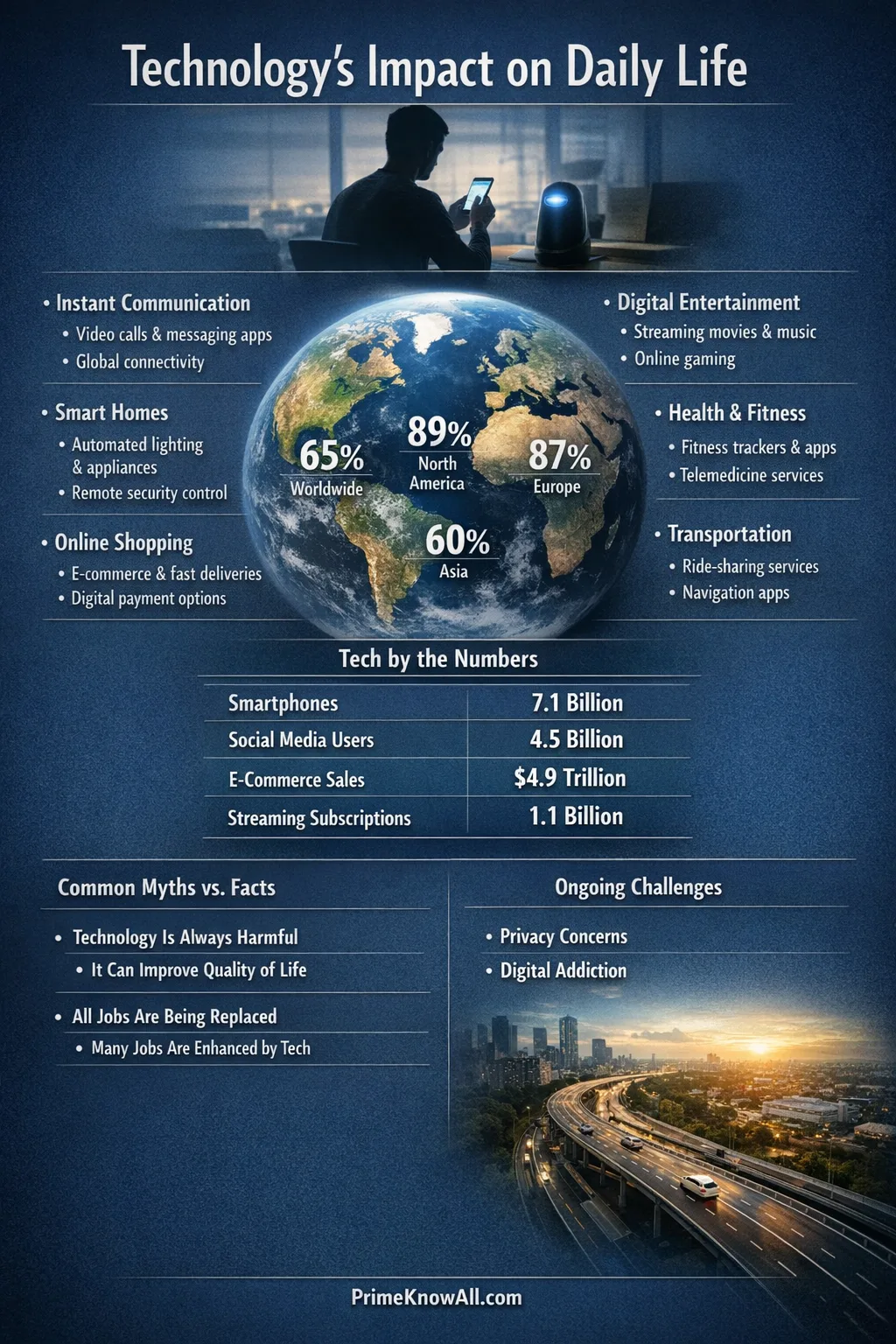
Technology changes daily life by reducing the time, distance, and effort needed to complete ordinary tasks. Smartphones, internet services, digital payments, navigation systems, connected devices, cloud software, and artificial intelligence now affect how people communicate, work, learn, travel, shop, manage money, and access health information.
The change is often less visible than the devices themselves. Sending money may take seconds instead of a trip to a bank. A family can hold a video call across continents. A worker can open the same files from home and the office. A phone can replace a camera, map, ticket, calculator, music player, wallet, and part of a desktop computer.
By 2025, the International Telecommunication Union estimated that 6 billion people, or 74% of the global population, were using the internet. Yet 2.2 billion people remained offline. This gap matters because many everyday services now assume that a person has connectivity, a suitable device, and enough digital skill to use it.
- Communication: messages, calls, shared media, and meetings can cross long distances almost instantly.
- Daily tasks: payments, navigation, shopping, reservations, documents, and appointments can move from physical locations to digital services.
- Work and learning: cloud software, online courses, video meetings, and AI tools allow many activities to happen away from a fixed desk or classroom.
- Homes and transport: sensors, software, automation, and connected devices can monitor conditions and respond with limited human input.
- New trade-offs: convenience can involve data collection, distraction, cybersecurity risks, unequal access, and dependence on services that people do not directly control.
What Counts as Technology in Daily Life?
Technology is broader than computers and smartphones. It includes practical methods, machines, software, networks, infrastructure, and systems created to accomplish tasks or solve problems.
A washing machine is technology. So are GPS satellites, contactless payment terminals, medical imaging systems, barcode scanners, fiber-optic networks, traffic sensors, cloud servers, electric motors, hearing aids, and software that predicts the next word while someone types.
Digital technology receives much of the attention today because many separate functions have merged into connected devices. A smartphone works like a pocket-sized switchboard: one small object connects a person to banking networks, communication systems, cameras, maps, shops, entertainment libraries, workplaces, and information services. The phone is only the visible end of a much larger network.
How Technology Changes Ordinary Tasks
The clearest effect of modern technology is that many tasks no longer require the person, information, and service to be in the same physical place. This changes not only speed but also expectations about when services should be available.
| Daily Activity | Earlier Constraint | Technology Used Today | New Trade-Off |
|---|---|---|---|
| Talking to someone far away | Distance, call charges, fixed locations | Messaging, video calls, internet calling | Notifications and constant availability |
| Finding a destination | Paper maps and advance planning | GPS, live traffic data, navigation apps | Dependence on location data and connectivity |
| Paying for goods | Cash, bank visits, manual processing | Cards, mobile wallets, instant transfers, QR payments | Fraud, account security, service outages |
| Working with a team | Shared physical workplace | Cloud files, messaging, video meetings | Blurred boundaries between work and personal time |
| Learning a skill | Local teachers, books, scheduled classes | Online courses, digital libraries, simulations, AI tools | Information quality varies widely |
| Shopping | Travel and local store availability | E-commerce, digital catalogs, delivery platforms | More data about purchases and preferences |
Communication Is Faster and Less Tied to Distance
Digital networks have separated communication from physical distance. A message sent across a city and one sent across an ocean can travel through similar internet infrastructure and arrive within seconds.
Text messaging, email, group chats, voice calls, video meetings, shared photo libraries, and social platforms have also changed the amount and type of information people exchange. Conversation can be synchronous, such as a video call, or asynchronous, such as a message answered several hours later.
This has practical value for families living in different countries, distributed workplaces, students, travelers, and businesses serving customers across several time zones. It also creates social availability beyond physical presence: a person may leave work or school but remain reachable through several digital channels.
Connectivity Changes More Than Message Speed
- Groups can coordinate without meeting in one location.
- Photos, documents, voice, and video can travel through the same device.
- People may also face more interruptions because communication follows them throughout the day.
Work Can Move Beyond a Fixed Workplace
Cloud computing and communication software allow some jobs to be performed from almost any location with suitable internet access. The change is especially visible in office-based work involving documents, software, design, analysis, support, or digital services.
A document stored in the cloud can be edited by several people without passing copies back and forth. Project systems can record tasks and deadlines. Video platforms connect teams, while online calendars coordinate meetings across locations.
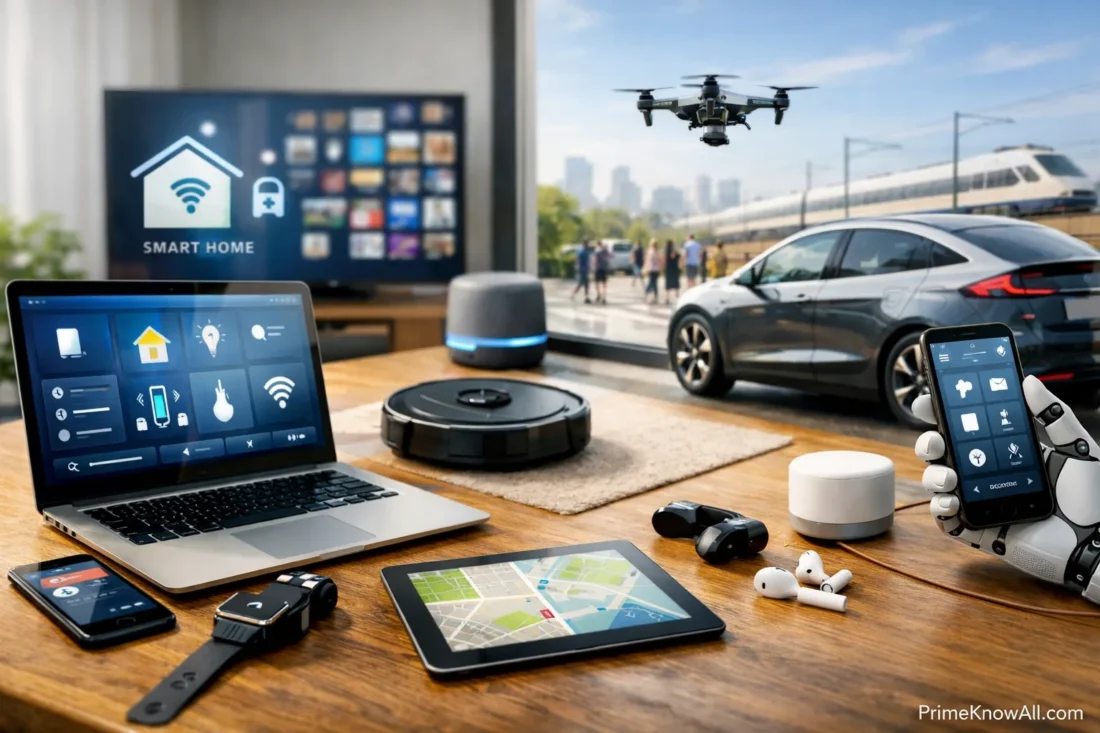
Automation also changes the work itself. Software can sort records, generate invoices, check inventory, schedule appointments, transcribe meetings, search large collections of documents, and perform repetitive calculations. In many occupations, this shifts human effort toward decisions, review, communication, and tasks that are harder to standardize.
The benefit depends heavily on the job. A warehouse employee, electrician, nurse, driver, laboratory technician, and construction worker still need physical access to workplaces for much of their work. Remote work is therefore a technological option for certain activities, not a universal replacement for workplaces.
Education Is Less Restricted by Location and Schedule
Digital learning makes educational material available outside a traditional classroom. Recorded lessons, digital textbooks, university repositories, language apps, virtual laboratories, educational videos, and learning platforms can be used at different times and locations.
Search engines reduced the effort required to locate information. The newer change is generative AI, which can produce explanations, examples, translations, summaries, practice questions, computer code, and other material in response to instructions.
OECD data show how quickly this newer layer has entered ordinary use. More than one-third of individuals across OECD countries used generative AI tools in 2025. Use was much higher among students: about three-quarters of students aged 16 and older reported using such tools.
Access to an answer is not the same as understanding it. Search results can be misleading, online courses vary in quality, and AI-generated information can contain errors. Digital literacy now includes knowing how to check a claim, compare sources, protect personal data, and recognize when an automated answer needs human verification.
Money Moves Through Phones and Networks
Banking technology has turned many financial actions into software interactions. People can check balances, transfer money, pay bills, shop online, receive wages, use mobile wallets, and authorize purchases without visiting a bank branch.
The World Bank’s Global Findex 2025 found that 79% of adults worldwide owned a financial account. It also reported that 86% of adults owned a mobile phone and 68% owned a smartphone, based on data collected during 2024.
These technologies are particularly useful where physical banking services are distant or limited. Mobile money can connect a phone number to payments, transfers, saving, and other financial services without requiring the same branch network used by traditional banking.
The convenience creates another security boundary. A lost phone can now contain access to messages, identity records, payment cards, passwords, and financial apps. Screen locks, device updates, multi-factor authentication, transaction alerts, and careful password practices therefore protect far more than the device itself.
Health Technology Moves Some Care Into the Home
Digital health tools can connect health information, monitoring, communication, and care without requiring every interaction to happen inside a clinic. Examples include telehealth visits, patient portals, electronic prescriptions, appointment systems, wearable sensors, and connected monitoring equipment.
A smartwatch may record heart rate or activity. A glucose sensor can collect measurements repeatedly. A patient portal can provide laboratory results and allow messages to a healthcare provider. Telehealth can remove travel from some consultations.
These tools do not turn consumer devices into doctors. Measurements may be incomplete, sensors have technical limits, and symptoms still require appropriate clinical assessment. The useful change is that some information can be collected or exchanged between visits, giving healthcare systems more ways to communicate with patients.
Transportation Now Combines Maps, Sensors, and Software
Technology changes travel before, during, and after a journey. Digital maps can calculate routes, phones can display public transport times, payment systems can replace paper tickets, and vehicles can use cameras or sensors to assist drivers.
GPS navigation is one of the clearest examples. Instead of memorizing a route, a driver or pedestrian can receive turn-by-turn directions while software adjusts the route when traffic conditions change. Ride-hailing and delivery systems add another layer by matching location data with nearby drivers and customers.
Modern vehicles may also provide forward-collision warnings, blind-spot warnings, lane assistance, parking sensors, automatic emergency braking, or adaptive cruise control. These features vary by vehicle and do not all perform the same task.
Driver assistance is not the same as full self-driving. Systems sold in ordinary consumer vehicles can help with selected driving functions, but the driver may still need to monitor the road and remain responsible for the driving task. Product names can make this distinction less obvious than the underlying technology.
Homes Are Becoming Software-Controlled Environments
Connected home devices allow physical equipment to react to schedules, sensors, remote commands, or automated rules. Lights, thermostats, cameras, doorbells, speakers, appliances, plugs, locks, and energy monitors can now connect to home networks.
A thermostat can change temperature settings when a home is empty. A motion sensor can activate a light. A smart plug can cut power according to a schedule. A doorbell camera can send an alert when someone approaches the entrance.
Automation is useful because it removes repeated small decisions. Yet each connected device can also create another account, password, software update, data stream, or network connection that requires maintenance.
For that reason, the useful question is not simply whether a device is “smart.” It is whether the connected feature solves a real household problem well enough to justify the added complexity.
Shopping and Entertainment Became On-Demand Services
Digital platforms have changed both what people can access and when they can access it. Stores can remain searchable after their physical locations close, while streaming libraries make music, films, games, podcasts, and books available without owning a physical copy.
E-commerce expands the number of sellers a buyer can compare. Reviews, price comparison tools, product databases, delivery tracking, and digital payment systems can all operate within a single purchase.
Entertainment has undergone a similar change. Broadcasting once centered on schedules chosen by television and radio stations. Streaming shifts much of that control to the viewer or listener. Recommendation algorithms then influence what appears next, turning selection itself into a software-assisted process.
Artificial Intelligence Adds a New Layer of Automation
AI changes daily technology by allowing software to interpret patterns and generate responses instead of following only fixed commands. It is already present in spam filters, recommendation systems, image processing, translation, speech recognition, fraud detection, search, navigation, and customer-service systems.
Generative AI makes this interaction more visible because people can request text, images, code, explanations, plans, or edits through ordinary language. This can shorten the distance between an intention and a first usable result.
The result still needs judgment. A fluent response may contain an incorrect date, invented detail, poor assumption, or outdated information. AI can reduce the effort needed to produce or organize information, but verification remains a separate task.
A Day Shaped by Connected Technology
Many technological changes become easier to see when they are placed along an ordinary day rather than separated into device categories.
Convenience Often Comes From Removing Small Frictions
The effect of technology is often cumulative rather than dramatic. Saving two minutes on one task may seem minor. Repeating that saving across communication, navigation, payments, information searches, work files, bookings, and household tasks can change the structure of an entire day.
Technology can remove travel, waiting, manual copying, repeated data entry, physical storage, or the need to coordinate two people at exactly the same time. This is why a digital tool can reshape behavior even when its individual function seems simple.
It can also create new friction. Password resets replace some paperwork. Software updates replace some mechanical maintenance. Delivery tracking removes uncertainty about a package but creates another notification to check. Technology rarely removes every step; it often moves the steps somewhere else.
Technology Can Change Attention and Sleep
Always-available screens can extend digital activity into periods that were once less connected. Notifications, video, games, messaging, work applications, and social feeds can compete for attention late into the evening.
A 2025 study involving 122,058 adults examined electronic screen use before bed. Daily pre-bed screen use was associated with a 33% higher prevalence of self-reported poor sleep quality and about 48 fewer minutes of sleep per week compared with no pre-bed screen use.
This was an observational analysis, so the finding does not prove that screens alone caused the difference. Sleep behavior is affected by many variables. The study is useful because it shows why claims such as “all screen time is harmless” or “any screen use destroys sleep” are both too simple.
The Useful Distinction Is Context
- A video call with family and an hour of repeated notifications are both “screen time,” but they are not the same activity.
- Work, education, navigation, entertainment, and passive scrolling place different demands on attention.
- Timing, duration, content, and individual habits can matter as much as the presence of a device.
Privacy and Cybersecurity Become Everyday Issues
A connected service usually needs data to provide personalized or remote functions. Navigation requires location. An online shop records transaction information. A streaming service can record viewing history. A fitness device may store activity data. A smart camera can process video from a home.
The practical privacy question is therefore not simply whether data exist. It is which data are collected, why they are needed, how long they are retained, who can access them, and what controls the user has.
Cybersecurity has also moved into ordinary household maintenance. Updating a phone, securing a wireless router, using unique passwords, protecting a banking account, reviewing app permissions, and enabling multi-factor authentication are now routine parts of using connected technology safely.
The Digital Divide Changes Who Receives the Benefits
Technology can expand access while creating difficulties for people who lack connectivity, devices, affordability, accessibility, or digital skills. This is one of the most important differences between making a service available online and making it genuinely accessible.
ITU estimated that 2.2 billion people were still offline in 2025. Internet use also differed sharply by national income level: about 94% of people in high-income countries were online compared with 23% in low-income countries.
That difference has practical consequences when job applications, education, banking, government services, healthcare information, and commercial services move online. A digital-only process may save time for one person while becoming an additional barrier for another.
Access is not binary either. Someone may technically have internet access but rely on an older phone, expensive mobile data, unreliable coverage, a shared device, or limited digital skills. The quality of access can shape the value a person receives from technology.
Where Everyday Technology Is Often Misread
Several popular claims about technology become less accurate when the underlying systems are examined more closely.
- “Technology always saves time.” It can remove travel or manual work, but setup, updates, troubleshooting, notifications, and extra digital tasks can consume part of that saving. The misunderstanding comes from counting the automated step without counting the new maintenance around it.
- “Everything is becoming fully automated.” Many systems automate narrow tasks while people still make decisions, correct errors, provide physical labor, or handle unusual cases. Automation is often partial rather than total.
- “AI understands information the same way a person does.” Generative systems can create fluent and useful outputs, but their answers still require verification when accuracy matters. Natural language can make the underlying uncertainty easy to overlook.
- “Being online means having equal digital access.” Connection speed, cost, device quality, skills, language, and accessibility all affect what a person can actually do online. A connection alone does not remove these differences.
- “Smart devices are automatically better than ordinary devices.” Connectivity is useful when remote control, monitoring, automation, or data provide real value. Otherwise it can add accounts, updates, and security responsibilities without improving the main function.
Seven Ordinary Moments That Now Run Differently
Small scenarios show how several technologies can combine around a single everyday need.
- A delayed commute: a navigation app detects slower traffic and suggests another route. This works because location, road maps, traffic measurements, and routing software are combined in near real time.
- A forgotten bill: a banking app sends a reminder and allows payment from a phone. The physical trip disappears because account access and payment authorization move through digital networks.
- A group school project: students edit the same document from different homes. Cloud storage keeps one shared version rather than several disconnected copies.
- A family member abroad: a video call carries voice and moving images across thousands of kilometers. Internet infrastructure turns geographic distance into a much smaller communication barrier.
- An unfamiliar product in a shop: a person scans its barcode or searches the model on a phone to compare specifications and reviews. Information that once required advance research becomes available at the point of decision.
- A medical follow-up: some appointments can occur by video while laboratory results appear in a patient portal. Information moves without requiring every interaction to happen in the same room.
- Leaving an empty home: connected devices can change temperature settings, switch lights, or send security alerts. Sensors and software allow the home to respond when nobody is actively operating each device.
What Is Still Hard to Measure
There is no single number that can show whether technology has made daily life better or worse. Benefits and costs depend on the technology, the task, the user, the country, access conditions, and how the tool is used.
Research can measure internet adoption, device ownership, financial access, sleep patterns, productivity, or technology use. Measuring the combined effect on a person’s entire life is harder. A service may save time while increasing interruptions. Remote work can remove commuting while changing social contact. Online shopping can widen choice while generating more packaging and delivery activity.
Technology also changes faster than many long-term studies can follow it. Evidence about one generation of smartphones, social platforms, AI systems, or connected devices may not fully describe later versions. For that reason, dated statistics and carefully defined measurements are more useful than permanent claims about “technology” as one single force.
Modern daily life is therefore shaped less by one spectacular invention than by many connected systems working together. The most useful technologies tend to become almost invisible: people notice the task they completed, while networks, sensors, software, databases, and machines perform much of the work underneath.
Sources
- International Telecommunication Union – Facts and Figures 2025. ITU is the United Nations specialized agency for information and communication technologies, and this report provides global internet-use and connectivity estimates used in the article.
- World Bank – The Global Findex Database 2025. The World Bank bases this dataset on nationally representative surveys across 141 economies, making it a strong source for mobile-phone ownership, financial accounts, and digital finance.
- OECD – Generative AI. OECD data provide cross-country measurements of generative AI adoption among individuals, workers, students, and other population groups.
- World Health Organization – Digital Health. WHO provides internationally recognized health guidance and describes the role of digital systems, data exchange, and health technologies in healthcare.
- National Highway Traffic Safety Administration – Driver Assistance Technologies. NHTSA explains the functions and limits of collision warnings, automatic braking, lane assistance, and other vehicle technologies using standardized safety terminology.
- JAMA Network Open – Electronic Screen Use and Sleep Duration and Timing in Adults. This peer-reviewed study analyzed more than 122,000 adults and supports the article’s statistics on pre-bed screen use and sleep while clearly noting the observational study design.
- Technology in Society – The Impact of Digitalisation on European Citizens’ Daily Lives. This 2026 academic study examines how digitalization relates to communication, services, work, education, and differences between population groups.
- Merriam-Webster – Technology Definition & Meaning. Merriam-Webster provides an established reference definition that describes technology as the practical application of knowledge and as methods used to accomplish tasks.
Questions About Technology and Daily Life
How does technology affect everyday life?
Technology affects everyday life by changing how people communicate, work, learn, travel, pay, shop, access information, manage homes, and use services. Its main practical effects are reducing distance, automating repeated tasks, speeding up information exchange, and allowing some activities to happen remotely.
What are examples of technology used every day?
Examples include smartphones, Wi-Fi routers, GPS navigation, payment cards, mobile wallets, washing machines, barcode scanners, traffic sensors, cloud storage, streaming services, medical devices, smart thermostats, vehicle safety systems, search engines, and AI software.
Has technology made life easier?
Many technologies reduce travel, waiting, manual calculations, repeated work, and communication delays. They can also create new tasks involving passwords, software updates, cybersecurity, notifications, subscriptions, and data management. The effect depends on the tool and how it is used.
How does technology change communication?
Internet-based messaging, email, voice calls, and video allow people to exchange text, images, documents, and live conversations across long distances with very little delay. Communication can also continue outside fixed workplaces, schools, or homes.
What are the main disadvantages of technology in daily life?
Potential disadvantages include privacy loss, cybersecurity risks, distraction, excessive notifications, unequal digital access, unreliable information, dependence on online services, and difficulty separating work from personal time. These effects vary by technology and user behavior.
How is AI changing everyday life?
AI is used in recommendations, translation, search, fraud detection, navigation, speech recognition, image processing, customer service, and generative tools. It can automate parts of information work, but generated results may still contain errors and should be checked when accuracy matters.
Article Revision History