
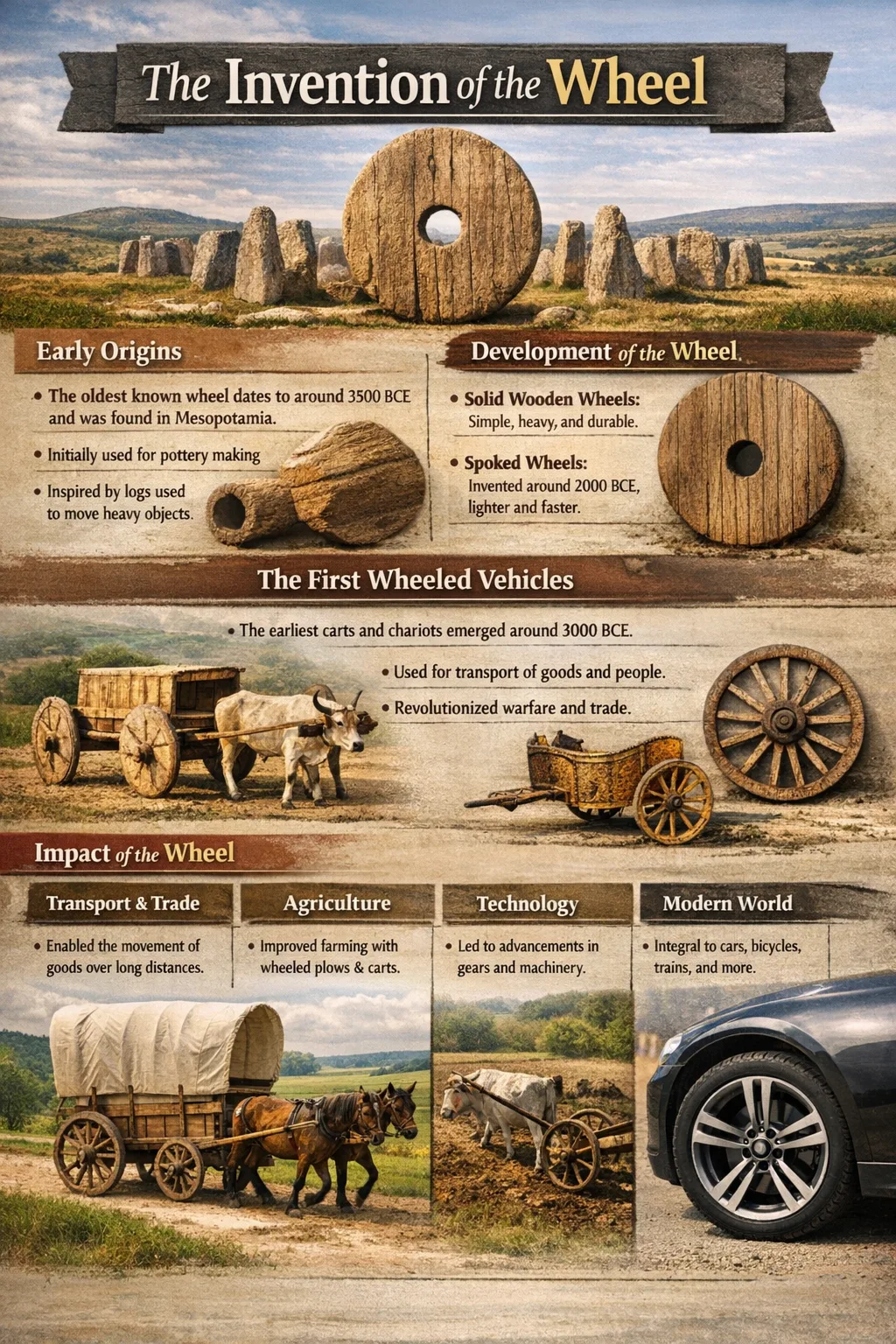
The wheel was not invented by one known person, and archaeology does not point to one uncontested birthplace. Wheeled vehicles appear in the archaeological record around the middle of the fourth millennium BCE, with early evidence in Central Europe and Southwest Asia, while much older tools show that people had learned to control rotary motion long before carts appeared.
What made the transport wheel new was not simply a round object. The real step was a working wheel-and-axle system that could carry a load, turn repeatedly, survive uneven surfaces, and be built with the woodworking tools available at the time. That combination helps explain why the wheel appeared relatively late in human prehistory.
- No named inventor is known. The evidence comes from tracks, images, models, and surviving wooden parts.
- Several regions show very early evidence. Finds in Germany, Poland, Mesopotamia, and Slovenia cluster within a few centuries.
- Rotation is older than wheeled transport. Spindles and other rotary tools show that circular motion was understood much earlier.
- The earliest surviving vehicle wheels are solid. Spoked wheels came much later, after craftsmen had already learned to build workable carts and wagons.
When Was the Wheel Invented?
The safest historical answer is around 3500–3300 BCE for early wheeled transport, with some evidence and newer hypotheses reaching earlier. Archaeologists do not have a single dated workshop where the first wheel was made, so the date depends on what counts as evidence: a vehicle track, a drawing of a wagon, a clay model, or an actual wooden wheel.
This distinction matters. A picture can prove that people knew the idea, but it does not preserve the vehicle itself. A wheel rut proves that something wheeled moved across the ground, yet the cart may have vanished. Waterlogged wood can survive for thousands of years, but such preservation is rare.
| Evidence | Approximate Date | Place | What It Shows |
|---|---|---|---|
| Perforated spindle-whorl candidates | About 12,000 years ago | Nahal Ein-Gev II, Israel | Possible early use of a wheel-like object rotating around an axis; not a transport wheel |
| Bronocice vessel wagon image | Late 4th millennium BCE | Bronocice, Poland | One of the earliest depictions of a wheeled vehicle |
| Flintbek cart tracks | About 3420–3385 BCE | Flintbek, Germany | Physical traces consistent with a wheeled cart or wagon |
| Late Uruk wheeled-vehicle evidence | Late 4th millennium BCE | Mesopotamia and nearby regions | Early wheeled transport appears at roughly the same broad period as European evidence |
| Ljubljana Marshes wheel and axle | About 3350–3100 BCE | Ljubljana Marshes, Slovenia | A surviving wooden wheel-and-axle assembly from an early cart |
Why the First Wheel Was More Difficult Than It Looks
A circle is easy to imagine. A useful cart wheel is not. The builder needs a round wheel, a strong hub, an axle, a way to support the load, enough clearance for rotation, and wood that will not split under repeated stress. If any one of those parts is badly shaped, the vehicle drags, wobbles, binds, or breaks.
The engineering problem can be pictured like moving a heavy box across a floor. Sliding the whole box forces a broad surface to scrape along the ground. Put the load on wheels, and most of that sliding contact disappears; resistance becomes concentrated around the rolling wheel and the much smaller bearing area near the axle. The wheel does not remove friction, but it can move the main friction problem to a place where it is easier to manage.
The Axle Was as Important as the Wheel
Early vehicle makers had two basic choices. In a wheelset, the wheels and axle turn together as one unit. In another arrangement, the axle stays more fixed while the wheels rotate around it. Each design creates different problems with turning, wear, lubrication, and the strength of the hub.
A 2024 study in Royal Society Open Science used computational mechanics to test a proposed evolutionary path from rollers to grooved rollers, then to a wheelset, and later to wheels that could move more independently around an axle. The study supports a hypothesis that mining conditions in the Carpathian region may have encouraged this sequence, but the authors also state that there is no scholarly consensus on exactly where, how, or by whom the wheel was first invented.
Roundness alone was not the breakthrough. A practical vehicle needed a wheel, axle, hub, body, and load path that worked together. That is why a rolling log and a cart wheel belong to the same mechanical story but are not the same invention.
What the Earliest Archaeological Evidence Tells Us
The earliest record is scattered across several archaeological sites, and each site preserves a different part of the story. Taken together, they show that wheeled transport was present by the late fourth millennium BCE across a broad zone stretching from Central Europe toward Southwest Asia.
Flintbek: Wheel Tracks Preserved Under a Neolithic Monument
At Flintbek in northern Germany, archaeologists found paired track marks beneath part of a Neolithic long barrow. Radiocarbon dating and the construction sequence place the tracks around 3420–3385 BCE in one published chronology. Their spacing and form are consistent with a wheeled vehicle.
Tracks are unusually useful evidence because they record movement rather than just an object. They show that a vehicle was not merely imagined or modeled; something with wheels actually crossed the site before later construction sealed the traces.
Bronocice: A Wagon Drawn on Pottery
The Bronocice vessel, found in southern Poland, carries an incised image widely interpreted as a four-wheeled wagon. Material associated with the find dates to the same broad period as the earliest wagon evidence elsewhere in Europe and the Near East. The image matters because it shows recognizable vehicle structure rather than an isolated circle.

It also weakens the old habit of assigning the entire invention to one famous ancient civilization. The archaeological picture is geographically wider, and the earliest dates are close enough that researchers still debate whether one region invented the technology first, whether it spread rapidly, or whether similar solutions emerged in more than one place.
Ljubljana Marshes: A Real Wooden Wheel and Axle
A waterlogged find from the Ljubljana Marshes in Slovenia gives the story something rarer: surviving wooden hardware. The wheel is about 5,200 years old and was found with an axle. Museum records describe the wheel as being made from ash wood and the axle from oak.
The object is technically revealing. It was not simply a rough slice cut from a tree trunk. The surviving wheel was carefully constructed from wooden sections, showing that prehistoric carpenters understood grain, joining, shaping, and the stresses placed around the hub. A functional wheel required skilled woodworking before metal bearings, steel rims, or modern fasteners existed.
Mesopotamia: Early Vehicles and Rotary Craft
Mesopotamia remains central to the history of the wheel because late fourth-millennium BCE evidence from the region includes early wheeled vehicles, while rotary methods also became closely tied to pottery production. Older summaries often present a simple sequence in which the potter’s wheel appeared first in Mesopotamia and the transport wheel followed.
That sequence is now treated with more care. Early rotary pottery technology, wagon imagery, European trackways, and preserved wheels do not line up neatly enough to identify one certain first event. The better-supported view is that rotational technologies developed in stages, and wheeled transport emerged during a period of experimentation across connected farming and craft communities.
Did the Potter’s Wheel Come Before the Cart Wheel?
It is possible to separate the question into two parts: rotary tools are clearly older than transport wheels, but the exact relationship between the potter’s wheel and the first wagon remains debated. Rotation did not begin with road transport.
Research published in 2024 on 113 perforated stones from the Late Natufian site of Nahal Ein-Gev II in Israel proposed that many were spindle whorls used to spin fibers roughly 12,000 years ago. These objects were not cart wheels. Their value to the history of technology is that they show people exploiting a round object rotating around a central axis thousands of years before the first known wagons.
That makes the invention less like a sudden leap and more like a sequence of mechanical lessons. Spinning, drilling, turning pottery, moving loads on rollers, and building carts all involve controlled rotation, yet each solves a different problem.
How a Wheel-and-Axle System May Have Developed
No preserved workshop shows every stage, so any reconstruction must be presented as a model rather than a recorded event. One long-discussed idea begins with rollers placed under heavy loads. A load can move forward as the rollers turn, but workers must keep collecting rollers from the back and moving them to the front.
- Free rollers: logs or poles rotate under a sledge or platform, reducing direct sliding.
- Grooved rollers: repeated contact or deliberate shaping creates a narrower middle section that helps keep the load aligned.
- Wheelset: the center becomes thinner while the ends remain large, producing two wheel-like ends joined by an axle.
- Separated wheel and axle parts: later designs allow better turning and make it easier to replace worn components.
- Lighter wheel construction: improved carpentry eventually leads to composite and spoked wheels that reduce mass.
The 2024 computational study of wheel origins found that a similar progression can make mechanical sense, especially in narrow, relatively straight mine passages. That result does not prove that prehistoric miners followed those exact steps, but it demonstrates that the proposed changes can improve performance in ways that match known engineering constraints.
Possible spindle whorls at Nahal Ein-Gev II show controlled rotation around a central opening.
People already used sledges, rollers, drilling, spinning, and other techniques that taught practical lessons about friction and rotation.
Wagon images, vehicle tracks, and early transport evidence appear across Central Europe and Southwest Asia.
Sites such as Flintbek and the Ljubljana Marshes preserve direct physical evidence of wheeled transport and wooden wheel construction.
Spoked-wheel construction appears after the first solid-wheeled carts, allowing lighter vehicle designs.
Why Wheeled Transport Appeared So Late
Humans had made boats, woven baskets, stone tools, cordage, and permanent buildings long before the earliest known wagons. The delay is a reminder that useful inventions depend on systems, not isolated shapes.
Woodworking Had to Be Precise Enough
A heavy solid wheel places stress around its hub and outer edge. The axle must stay straight enough to turn, and paired wheels need to be aligned closely enough that the vehicle does not fight itself. Early carpenters had to achieve this with stone, bone, and early metal tools depending on the region and date.
The Vehicle Needed Something Worth Carrying
Farming communities stored grain, moved timber, transported building material, and exchanged goods. Those activities created repeated situations in which a cart could save labor. In some places, cattle could also provide traction, making heavier wheeled loads more practical than human pulling alone.
Terrain and Routes Mattered
A wheel performs best when the surface lets it roll. Mud, steep slopes, loose rock, dense vegetation, and broken ground can erase much of its advantage. Sledges, boats, pack animals, or carrying by hand may work better in those settings. The wheel therefore did not make every older transport method obsolete.
- Good surface: rolling can sharply reduce the effort needed to move a load.
- Bad surface: wheels can sink, catch, or require roads that are costly to maintain.
- Heavy cargo: the benefit grows when the cart, axle, draft power, and route can handle the weight.
How Early Wheels Were Built
The earliest surviving vehicle wheels were solid wooden discs or composite solid wheels, not the light spoked forms seen on later chariots. Solid construction was heavy, but it was achievable with Neolithic carpentry and could handle rough use at slow speeds.
Wood Selection
Wood species behaved differently under load. The Ljubljana find is especially useful because the wheel and axle used different woods: ash for the wheel and oak for the axle. That pairing suggests material choice mattered. A wheel needs toughness around the hub and rim, while an axle needs strength along its length and resistance to wear.
Hub and Axle Fit
The hub is the center of the wheel where force is transferred between the wheel and axle. If the fit is too loose, the wheel wobbles and damages the joint. If it is too tight in a design that requires relative rotation, friction rises and the parts can seize. Lubricants such as animal fat or plant oils are plausible for ancient bearings, although the exact substances used in the earliest vehicles are not always preserved.
Solid Wheels Before Spokes
Spokes remove wood from areas that do not need to be solid while keeping a strong connection between hub and rim. That reduces rotating mass and can support faster vehicles, but it also demands more advanced joinery. Spoked-wheel evidence belongs to later Bronze Age contexts, well after the first known solid-wheeled vehicles. The lighter structure could support faster vehicle designs, but it demanded more exact joinery than a solid wooden disc.
What the Wheel Changed
The wheel did not transform society in one moment. Its effects grew as people combined it with draft animals, roads, specialized carpentry, trade networks, and later metalworking. Where those conditions came together, carts and wagons could move loads farther or with less labor than dragging them directly across the ground.
- Agriculture: carts could move harvested crops, manure, tools, and timber between fields, settlements, and storage areas.
- Construction: wheeled vehicles offered another way to transport stone, earth, wood, and other heavy material when routes allowed.
- Trade: bulk goods could travel over land more efficiently along suitable paths, linking settlements over wider areas.
- Craft production: rotary motion became useful far beyond transport, including pottery, spinning, grinding, pulleys, gears, and later machinery.
- Warfare and prestige transport: much later, lighter spoked wheels supported chariot systems in parts of Eurasia.
The larger lesson is mechanical. Once people learned to control rotary motion reliably, the same principle could be adapted to many devices. The transport wheel is one branch of that story, not the beginning of every rotating technology.
Where the Same Principle Appears in Daily Life
Modern objects often hide the same basic relationship between a rotating circle, an axis, and a load. The materials have changed, but the geometry is still recognizable.
- A bicycle wheel: the rim turns around the hub while spokes keep the structure light; the same problem of supporting a load with low rolling resistance remains.
- A suitcase caster: a small wheel converts dragging into rolling, making a heavy bag easier to move across a smooth floor.
- A car wheel and bearing: modern bearings separate rotating and stationary parts with far tighter tolerances than a wooden axle could achieve.
- A pottery wheel: the object stays in one place while rotary motion helps the potter shape clay evenly around a central axis.
- A conveyor roller: many small rotating cylinders move boxes with less sliding, echoing the older idea of placing rollers beneath a load.
- A doorknob or handwheel: a larger radius lets the hand apply useful torque around a smaller central shaft.
- Gears inside machines: toothed wheels turn controlled rotation into changes of speed, torque, or direction.
Ideas About the Wheel That Need More Care
Several familiar statements are too simple once the archaeological evidence is compared closely.
- “The Sumerians definitely invented the wheel.” Mesopotamia has very early evidence, but finds in Europe overlap closely in date, so a single proven birthplace has not been established.
- “The first wheel was a sliced log.” Surviving early wheels show deliberate carpentry and joined wooden elements; a usable wheel also needed a hub and axle system.
- “The wheel was invented for chariots.” Chariots belong to a later stage. Heavy carts and wagons with solid wheels came first.
- “Nothing similar existed before 3500 BCE.” Rotary tools are much older. The later innovation was applying rotation to load-bearing land transport.
- “Once invented, wheels were automatically useful everywhere.” Their value depended on surfaces, terrain, vehicle construction, available traction, and the kind of cargo being moved.
What Archaeologists Still Cannot Pin Down
The first wooden wheels were made from materials that decay easily, and the communities that developed early carts left no written engineering records. That creates a gap between the moment the idea first worked and the oldest evidence that happened to survive.
Researchers therefore remain cautious about three questions: the exact location of the first invention, whether wheeled transport arose once or more than once, and the precise sequence from earlier rotary tools to vehicles. Radiocarbon dating can narrow time ranges, but when discoveries from different regions fall within a few generations or centuries, it may not be possible to tell which came first.
New research continues to reshape the discussion. The 2024 computational study supporting a Carpathian mining hypothesis and the 2024 study of 12,000-year-old spindle-whorl candidates both widen the story without closing the debate. They point toward a long history of experimentation with rotation rather than a single isolated moment of invention.
Questions About the Invention of the Wheel
Who invented the wheel?
No individual inventor is known. Archaeological evidence for early wheeled transport appears in several regions during the late fourth millennium BCE, and researchers still debate where the first working wheel-and-axle vehicle was developed.
When was the first wheel invented?
Early wheeled-vehicle evidence is commonly dated to roughly 3500–3300 BCE. Some newer hypotheses propose earlier stages, while rotary tools such as spindle whorls may be thousands of years older than transport wheels.
Where was the wheel invented?
There is no uncontested birthplace. Mesopotamia, Central Europe, and the Carpathian region all appear in research on the earliest wheel-and-wagon technology.
What is the oldest surviving wooden wheel?
The Ljubljana Marshes wheel in Slovenia is about 5,200 years old and is displayed by the City Museum of Ljubljana. It was found with an axle and provides rare physical evidence of early vehicle construction.
Was the potter’s wheel invented before wheeled transport?
Rotary craft technologies predate or overlap the earliest transport wheels, but the exact order and relationship between early pottery wheels and vehicle wheels is not settled as neatly as older summaries sometimes suggest.
Why did it take humans so long to invent the wheel?
A transport wheel requires more than a circular object. Builders needed accurate woodworking, a workable hub and axle, a vehicle body, suitable routes, and a practical reason to move heavy loads by land.
Sources
- Kiel University – 3400 BC: The Oldest Evidence for the Use of the Wheel and Wagon Originates from Northern Germany. Kiel University summarizes the Flintbek excavations, radiocarbon work, and the interpretation of the preserved vehicle tracks.
- Museum and Galleries of Ljubljana – The Wheel, 5,200 Years. The institution that preserves the Ljubljana Marshes wheel documents its age, archaeological setting, and status as an exceptionally early wooden wheel-and-axle find.
- Antiquity – The Earliest Evidence of Wheeled Vehicles in Europe and the Near East. This peer-reviewed study compares radiocarbon and archaeological evidence from Europe and the Near East and is a strong academic reference for the dating debate.
- Royal Society Open Science – Reconstructing the Invention of the Wheel Using Computational Structural Analysis and Design. The 2024 paper tests a proposed mechanical path from rollers to wheel-and-axle systems and clearly separates its Carpathian hypothesis from settled archaeological fact.
- PLOS ONE – 12,000-Year-Old Spindle Whorls and the Innovation of Wheeled Rotational Technologies. This peer-reviewed 2024 study examines 113 perforated stones and proposes that they represent much earlier rotary technology rather than transport wheels.
- Smithsonian Magazine – A Salute to the Wheel. Smithsonian provides a readable reference overview of the wheel’s wider technological history and places transport wheels among other forms of rotary technology.
Article Revision History