
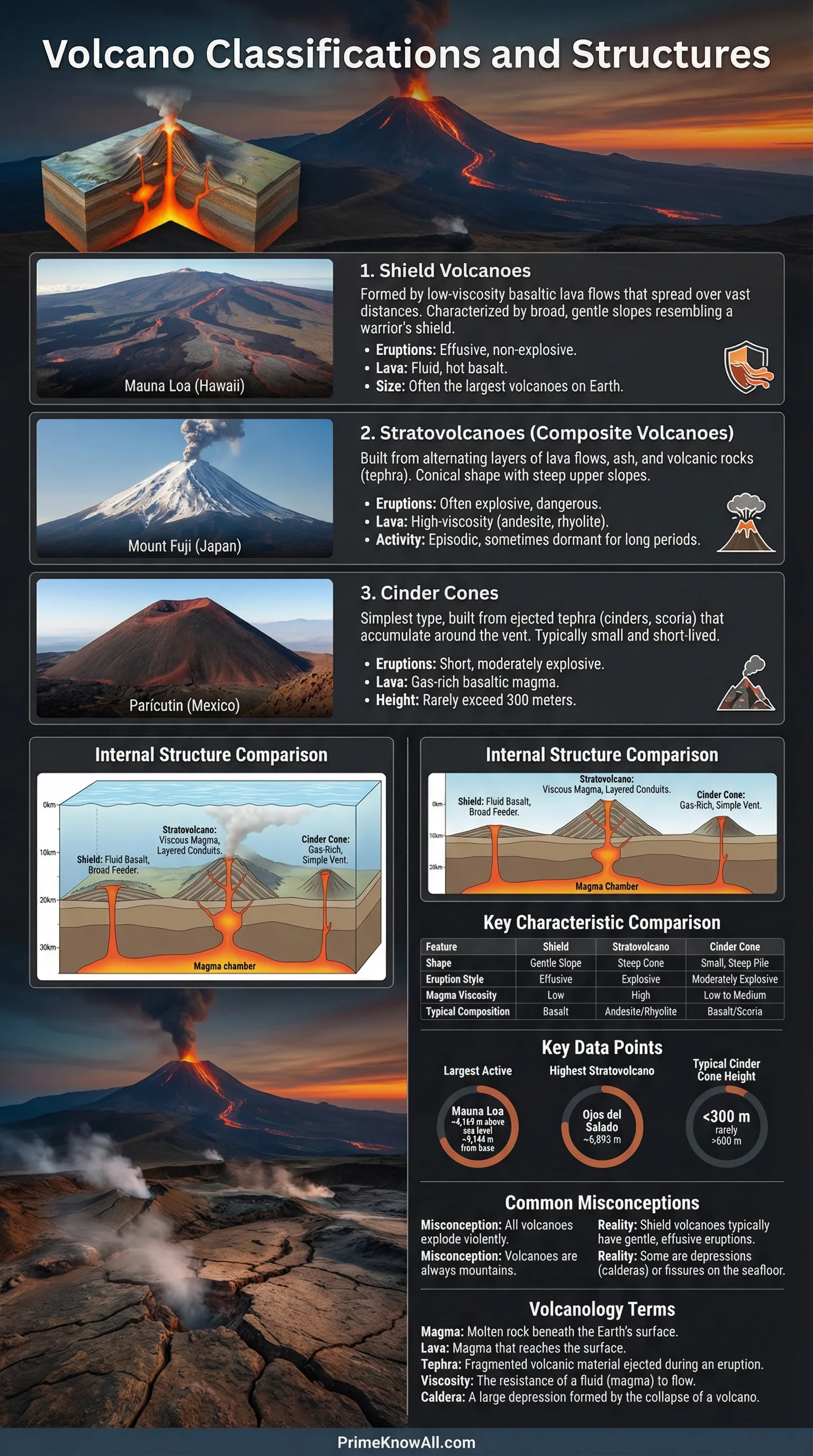
Shield volcanoes are broad, gently sloping mountains built mainly by fluid lava, stratovolcanoes are taller cones formed through repeated eruptions of lava and fragmented volcanic material, and cinder cones are smaller, steep-sided piles of scoria and other tephra around a vent. Their different shapes reflect differences in magma viscosity, gas, eruption style, and the length of time a volcanic system remains active.
The familiar three-type classification is useful because each form leaves a recognizable landscape. It is still a simplification. A large shield volcano can carry dozens of small cinder cones on its flanks, and a stratovolcano can contain lava domes, craters, secondary vents, and deposits left by very different kinds of eruptions.
- Shield volcano: broad profile, fluid lava, many overlapping flows.
- Stratovolcano: high cone, mixed lava and pyroclastic deposits, varied eruption styles.
- Cinder cone: compact cone, loose volcanic fragments, commonly formed during a short eruptive episode.
Why Volcanoes Develop Different Shapes
A volcano’s shape records how material reached the surface and what happened after it erupted. Low-viscosity magma can spread far before cooling, while stickier magma and loose volcanic fragments tend to accumulate closer to the vent.
Viscosity means resistance to flow. Water has low viscosity; syrup has more. Magma behaves in a related way, although temperature, chemical composition, dissolved gases, crystals, and pressure make volcanic systems far more complicated than a household liquid.
A useful analogy is to imagine building three hills with different materials. Repeated sheets of runny material spread outward and make a low, broad mound like a shield volcano. Alternating sticky material and loose fragments can build a taller layered structure like a stratovolcano. Tossing coarse particles repeatedly around one point produces a smaller, steep pile resembling a cinder cone.
| Volcano Type | Typical Shape | Main Material | Eruption Pattern | Typical Scale | Example |
|---|---|---|---|---|---|
| Shield volcano | Very broad with gentle slopes | Mostly fluid basaltic lava flows | Often effusive, with lava fountains and fissure eruptions possible | Can extend tens or even more than 100 km across | Mauna Loa, Hawaiʻi |
| Stratovolcano | Tall cone with steeper upper slopes | Lava, tephra, pyroclastic deposits, domes, and other volcanic material | Ranges from lava-producing eruptions to highly explosive events | Commonly rises thousands of metres | Mount Rainier, United States |
| Cinder cone | Small, steep cone with a summit crater | Scoria, lapilli, bombs, ash, and sometimes associated lava flows | Commonly short-lived and mildly to moderately explosive | Usually less than about 300–330 m above its surroundings | Parícutin, Mexico |
Shield Volcanoes
Shield volcanoes are built mainly by repeated flows of fluid lava that spread far from their vents. Instead of piling upward rapidly, the lava covers large areas in relatively thin layers. Thousands of overlapping flows can eventually create an enormous volcanic mountain with slopes that appear gentle from a distance.
How a Shield Volcano Forms
Most well-known shield volcanoes are dominated by basaltic magma. Basaltic lava is commonly hot and relatively fluid compared with many silica-richer magmas, allowing it to travel farther before solidifying.
Eruptions do not need to occur only at the summit. Magma can move through fractures and reach the surface along rift zones and fissures on a volcano’s flanks. This spreads new lava across an even wider area and helps maintain the volcano’s broad profile.
How Large Can Shield Volcanoes Become?
Shield volcanoes can reach extraordinary dimensions because they may remain active through many eruptive periods. Mauna Loa rises 4,169 m above sea level, but much of the volcano lies below the ocean. Its long submarine flanks make the complete volcanic structure far taller when measured from its underlying base.
The gentle profile can make its size deceptive. A person standing on the flank may not see anything resembling the steep triangular volcano commonly shown in illustrations. The landscape may instead look like an immense tilted plain of old and new lava flows.
Shield Volcano Eruptions
Many shield-volcano eruptions are effusive, meaning lava reaches the surface and flows rather than being fragmented into a large eruption column. Lava fountains can still occur, and eruptive activity can change rapidly along fissures.
Effusive does not mean harmless. Lava flows can cover roads, buildings, farmland, utilities, and other infrastructure. Volcanic gases can also affect air quality. Explosive activity is possible under some conditions, including situations where magma interacts with water.
A gentle volcanic slope does not mean a volcano presents no hazard. Volcano shape describes how the landform was built; it does not provide a complete forecast of what the next eruption will do.
Mauna Loa as a Shield Volcano
Mauna Loa on the Island of Hawaiʻi is one of the clearest examples of shield-volcano architecture. Its basaltic lava has accumulated through repeated eruptions, producing a huge mountain with summit and rift-zone vents.
Its eruption beginning on November 27, 2022 ended a quiet interval that had lasted since 1984. Activity began in the summit area before lava emerged from fissures in the Northeast Rift Zone. The event showed how a shield volcano can shift eruptive activity from its summit toward flank fissures within a short period.
Stratovolcanoes or Composite Volcanoes
Stratovolcanoes are large volcanic mountains produced by many eruptions that add lava, fragmented rock, ash, pyroclastic deposits, and sometimes lava domes to the same volcanic system. They are also widely called composite volcanoes.
The term “layered volcano” can be useful, but real stratovolcano interiors are rarely made of tidy alternating stripes. Eruptions, erosion, landslides, intrusions, crater formation, and later eruptions can create a much more irregular structure.
Why Stratovolcanoes Are Steeper
Stratovolcanoes commonly erupt andesitic or dacitic magma, although their compositions can range more widely. Magmas with greater viscosity do not spread as easily as very fluid basaltic lava, so more material remains near the vent.
Pyroclastic material also accumulates around the volcanic center. Repeated eruptions gradually produce the familiar profile: relatively broad lower slopes that become steeper toward the upper part of the mountain.
Where Stratovolcanoes Commonly Form
Many stratovolcanoes occur above subduction zones, where one tectonic plate descends beneath another. Volcanic chains around much of the Pacific margin include numerous examples, which is one reason stratovolcanoes are strongly associated with the Pacific Ring of Fire.
Mount Fuji in Japan, Mount Rainier and Mount St. Helens in the United States, Mayon in the Philippines, and numerous volcanoes of the Andes illustrate this relationship between convergent plate boundaries and tall composite volcanic systems.
Stratovolcano Eruption Hazards
Stratovolcanoes can produce a wider mixture of hazardous processes than their simple cone shape suggests. Possible activity includes ashfall, lava flows, pyroclastic flows, ballistic fragments, lava-dome growth, landslides, and lahars.
A pyroclastic flow is a hot, ground-hugging current containing volcanic gases, ash, and rock fragments. A lahar is a fast-moving mixture of water and volcanic sediment that can travel along valleys. Snow and ice on high volcanoes can provide water for lahars during some eruptions, although lahars can also form through heavy rainfall or other processes.
Mount Rainier as a Stratovolcano
Mount Rainier in Washington State is a large active composite volcano. Its volcanic structure includes lava flows and extensive deposits produced by lahars and other mass movements.
Its glaciers and snowfields matter when evaluating volcanic hazards because water and loose volcanic material can combine to form debris-rich flows. This is a useful example of why volcano classification extends beyond the question of whether an eruption is explosive.
Cinder Cone Volcanoes
Cinder cones are small, steep volcanoes built when pieces of lava are thrown from a vent and fall back around it. Geologists also call them scoria cones, because scoria commonly forms much of the cone.
What Cinder Cones Are Made Of
Gas bubbles expanding in rising magma can break molten material into fragments. Pieces thrown into the air cool partly or completely before falling around the vent. Repetition builds a circular or oval pile of tephra.
Tephra is a broad term for volcanic material thrown through the air. It includes fine ash, larger lapilli, and still larger blocks or volcanic bombs. Scoria is typically dark, highly vesicular volcanic rock filled with cavities left by gas bubbles.
Why Cinder Cones Are Steep
Fresh cinders accumulate close to the angle at which loose fragments can remain stable. As a result, young cones can develop relatively straight, steep sides, commonly approaching roughly 30–35 degrees in their steepest sectors. Weathering and erosion can reduce those slopes over time.
A bowl-shaped crater commonly remains around the central vent. Lava may also emerge from the cone’s base or from nearby fractures because rising magma can push through the loosely consolidated material.
How Long Cinder Cone Eruptions Last
Many cinder cones are monogenetic, meaning the individual volcanic vent is mainly formed during one eruptive episode rather than being repeatedly rebuilt for hundreds of thousands of years.
National Park Service summaries of historic cinder-cone eruptions report that about half lasted less than 30 days and roughly 95 percent lasted less than one year. Individual cases can depart from that pattern, so a cone’s appearance alone cannot reveal the exact duration of its eruption.
Parícutin as a Cinder Cone
Parícutin in Mexico provides an unusually well documented example because its eruption began in 1943 in an agricultural area where people could observe the new volcano developing. Explosive bursts threw fragments around the vent while lava flows spread into the surrounding area.
The activity continued until 1952. That history is a reminder that “short-lived” is a geological description: even a volcano associated with one eruptive episode can remain active for years.
Shield vs Stratovolcano vs Cinder Cone
The easiest way to separate the three is to examine scale, slope, volcanic material, and eruption history together. No single feature works perfectly in every case.
- A very wide volcanic mountain with gentle slopes and extensive basaltic lava fields is likely to be a shield volcano.
- A large, high cone containing lava and many kinds of fragmental deposits is likely to be a stratovolcano.
- A small, steep cone dominated by loose scoria around a crater is likely to be a cinder cone.
Size differences can be enormous. National Park Service comparisons note that large shield volcanoes may be many times taller than small cinder cones and vastly greater in volume. The contrast becomes even larger when the hidden submarine portions of oceanic shield volcanoes are included.
How Magma Controls Volcano Shape
Magma composition affects viscosity, and viscosity helps determine how far erupted lava can travel. Temperature, crystals, and dissolved gases also matter, so composition should not be treated as a one-variable explanation.
Basaltic Magma
Basaltic magma normally contains less silica than andesitic, dacitic, or rhyolitic magma. Under many volcanic conditions it flows relatively easily. This behavior favors extensive lava flows and helps explain why basalt dominates many shield volcanoes.
Andesitic and Dacitic Magma
Intermediate compositions such as andesite and dacite are common in many stratovolcanoes. Their greater viscosity can restrict lava movement and can also influence how easily gases escape from rising magma.
Gas and Fragmentation
Volcanic gases are dissolved in magma under pressure. As magma rises and pressure falls, gases can form bubbles and expand. If magma fragments, it produces material ranging from fine ash to large bombs. This process is central to the construction of cinder cones and many deposits found on composite volcanoes.
The Three Shapes Do Not Describe Every Volcano
The shield–stratovolcano–cinder cone system is a convenient teaching classification, but volcanic landscapes contain more than three landforms. Calderas, lava domes, maars, tuff rings, fissures, and broad volcanic fields do not fit neatly into the familiar three-cone diagram.
This also explains an apparent contradiction: a cinder cone can sit on a shield volcano. The small cone describes one vent and the deposits surrounding it, while the shield describes the much larger volcanic edifice on which that vent formed.
- Lava domes form when very viscous lava accumulates close to a vent.
- Calderas are large depressions produced when part of a volcanic system collapses after magma is removed from beneath it.
- Maars and tuff rings can develop through explosive interaction between magma and water.
- Fissure eruptions release lava along elongated fractures rather than from one central cone.
- Monogenetic volcanic fields contain many separate vents, each commonly associated with its own eruptive episode.
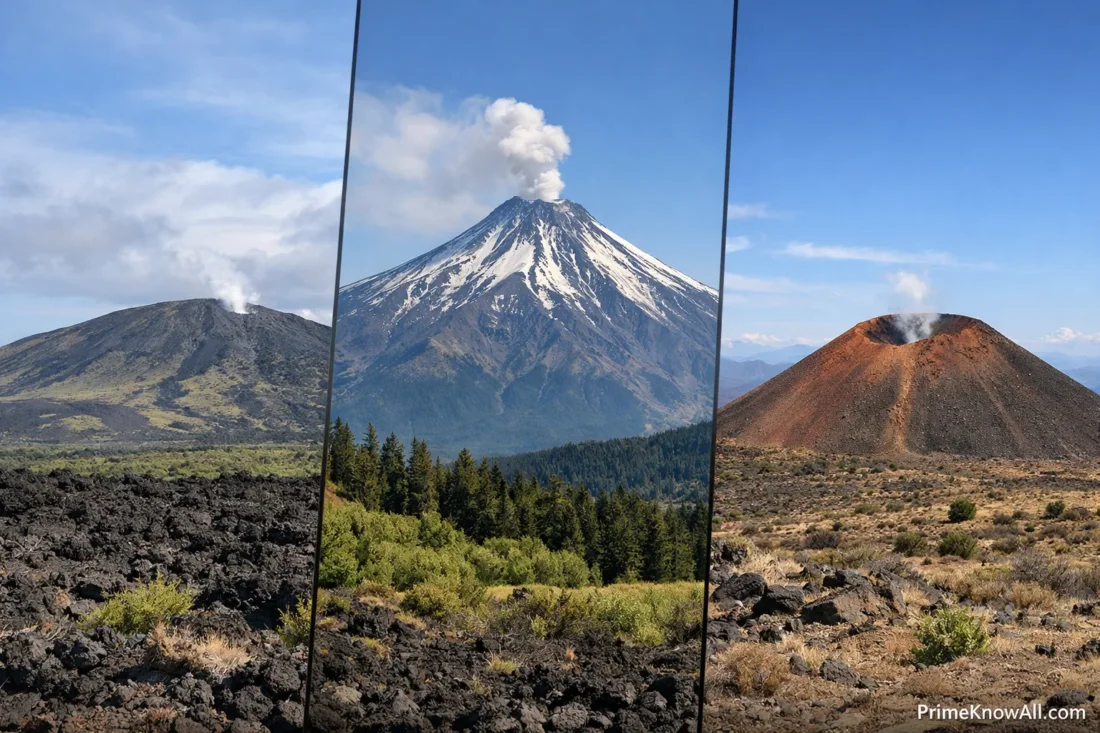
A Vertical View of the Three Main Forms
Examples That Make the Differences Easier to See
Volcano classification becomes easier when the shape is connected to something visible in the landscape rather than memorized as three definitions.
- A satellite image shows a volcano covering a huge part of an island: a shield volcano is a strong possibility because repeated fluid flows can spread across a very wide area.
- A snow-covered mountain rises as a tall cone above a volcanic arc: the combination of shape and tectonic setting may point toward a stratovolcano.
- A small dark cone appears beside a much larger volcano: it may be a cinder cone formed from a secondary flank vent rather than a separate large volcanic system.
- A road cuts through dozens of thin lava layers: repeated lava flows are consistent with the internal construction expected in a shield-volcano landscape.
- A fresh cone has loose, bubbly black and reddish rocks on its slopes: those pieces may be scoria produced during cinder-cone building eruptions.
- A valley below a high composite volcano contains old mudflow deposits: those deposits may record past lahars, even if the valley lies many kilometres from the summit vent.
- A volcano produces both lava and explosive ash during different periods: mixed behavior does not make its classification impossible; stratovolcanoes can record varied eruption styles through time.
Volcano Shape Does Not Predict Every Eruption
Volcano type describes a landform and its accumulated deposits, not a fixed set of future actions. Shield volcanoes can have explosive episodes. Stratovolcanoes can produce lava flows. Cinder cones can occur on the flanks of both.
Two volcanoes placed in the same broad category may also have different magma compositions, vent systems, water availability, eruption frequencies, and local hazards. Scientists therefore study seismic activity, deformation, gas emissions, thermal observations, geology, and previous deposits rather than forecasting an eruption from shape alone.
Points That Are Easy to Mix Up
“Shield volcanoes never erupt explosively” is incorrect. Their eruptions are often dominated by fluid lava, but explosive activity can occur under suitable conditions, including interaction between magma and external water.
“Stratovolcano means every layer alternates perfectly between lava and ash” is too literal. Real composite volcanoes contain irregular sequences shaped by eruptions, erosion, landslides, intrusions, domes, and later rebuilding.
“Every cinder cone is an independent volcanic system” is also inaccurate. Many form as small vents within larger volcanic fields or on the flanks of shield and composite volcanoes.
“The tallest-looking volcano must be the largest” can be misleading. Stratovolcanoes often look visually taller because of their steep slopes, while a shield volcano can contain far more material spread across a much wider base.
“Volcano type and activity status mean the same thing” is false. Shield, stratovolcano, and cinder cone describe physical form and construction. Active, dormant, and extinct concern eruptive history and the likelihood of future activity, and those status terms can carry uncertainty.
Where Classification Becomes Uncertain
Nature does not produce volcanoes according to fixed diagrams. Erosion may remove much of an older cone, later vents can alter its profile, and repeated landslides can reshape an entire flank. A volcanic complex may also contain several overlapping centers formed at different times.
Terminology varies between institutions and researchers. Composite volcano and stratovolcano are widely used for the same broad group, although some geologists prefer “composite volcano” because the deposits are not always arranged as simple, orderly strata.
Measurements such as typical slope angle, height, or eruption duration should therefore be treated as ranges rather than hard boundaries. Geological mapping and study of the actual deposits provide a better classification than silhouette alone.
Questions About Volcano Types
What are the three main types of volcanoes?
The three widely taught forms are shield volcanoes, stratovolcanoes or composite volcanoes, and cinder cones. Other volcanic landforms include lava domes, calderas, maars, tuff rings, fissures, and volcanic fields.
Which type of volcano is the largest?
Shield volcanoes can become the largest volcanic edifices because fluid lava can spread across enormous areas during many eruptions. Mauna Loa in Hawaiʻi is a well-known example.
Which volcano type has the steepest slopes?
Fresh cinder cones can have very steep, relatively straight slopes formed from loose scoria. Stratovolcanoes are also steep, especially near their upper flanks, while shield volcanoes have much gentler profiles.
Are stratovolcanoes always explosive?
No. Stratovolcanoes are strongly associated with explosive activity, but they can also produce lava flows and lava domes. Their long histories commonly include several different eruption styles.
Can a cinder cone form on a shield volcano?
Yes. Small cinder cones frequently form around secondary vents on larger volcanic systems. A shield volcano can therefore have numerous cinder cones scattered across its flanks.
Why are shield volcanoes so wide?
The basaltic lava associated with many shield volcanoes has relatively low viscosity and can travel far from its source. Repeated flows spread outward rather than accumulating mainly near the vent, producing a broad volcanic mountain.
Is a composite volcano the same as a stratovolcano?
The terms are commonly used for the same broad volcano type. “Composite” emphasizes the mixture of lava, pyroclastic material, domes, and other deposits that accumulate through repeated eruptions.
Sources
- U.S. National Park Service – Types of Volcanoes — An official U.S. government geology resource explaining the major volcanic landforms and how their eruption histories differ.
- U.S. Geological Survey – About Volcanoes — USGS operates the U.S. Volcano Hazards Program and provides scientific descriptions of volcano structure, lava behavior, monitoring, and hazards.
- U.S. National Park Service – Composite Volcanoes (Stratovolcanoes) — Provides detailed information about composite-volcano composition, eruption styles, tectonic settings, and associated hazards.
- U.S. National Park Service – Cinder Cones — Supports the descriptions of scoria cones, typical dimensions, eruption duration, magma composition, and monogenetic behavior.
- U.S. Geological Survey – November 27–December 10, 2022 Eruption of Mauna Loa — Documents the eruption sequence, summit activity, rift-zone fissures, monitoring observations, and lava flows from the 2022 event.
- Oregon State University Volcano World – Types of Volcanoes — An academic volcanology resource that also explains why the familiar three-type classification does not cover every volcanic landform.
- San Diego State University – How Volcanoes Work: Volcano Types — A university reference comparing volcano shape, composition, slope, and eruption style.
- British Geological Survey – How Volcanoes Form — A national geological survey reference explaining the relationship between magma viscosity, lava composition, slope, and volcano form.
Article Revision History