
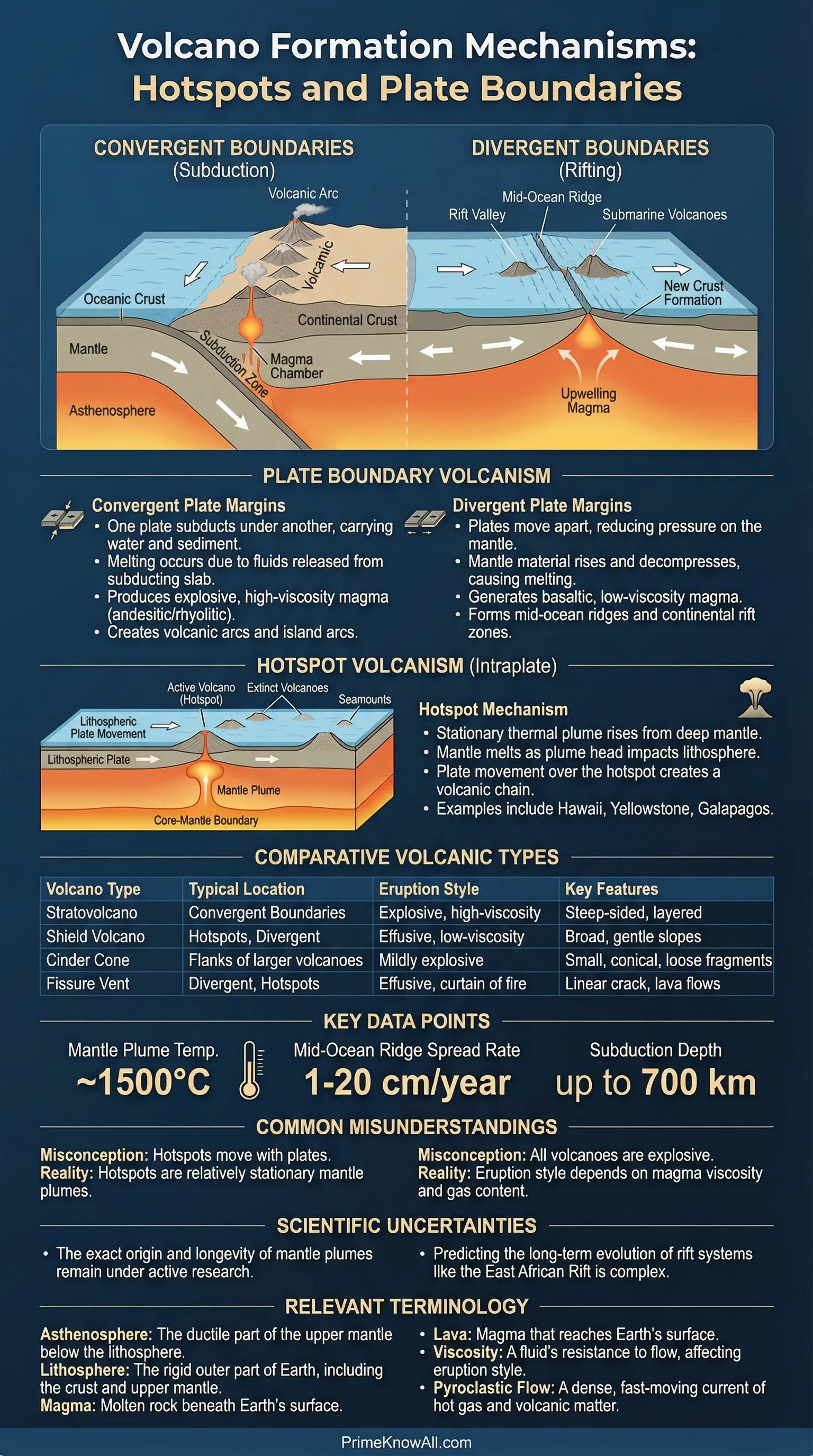
Volcanoes form when magma rises from inside Earth and reaches the surface, but the magma is not produced everywhere in the same way. Most volcanism is linked to convergent or divergent plate boundaries, while hotspots can feed volcanoes within a plate or add extra magma where a hotspot meets a plate boundary.
The main difference is the trigger for melting. At spreading boundaries, rising mantle rock melts as pressure drops. At subduction zones, water and other volatile compounds released from a sinking oceanic plate help the mantle above it melt. At hotspots, unusually warm mantle material can rise and undergo partial melting beneath the lithosphere.
- Convergent boundaries: subduction commonly builds volcanic arcs such as the Andes and Cascades.
- Divergent boundaries: plates pull apart, creating rifts, mid-ocean ridges, fissures, and new crust.
- Hotspots: long-lived magma sources can make volcanic chains such as Hawaiʻi or volcanic fields such as Yellowstone.
- Transform boundaries: plates mainly slide sideways, so volcanism is not a normal result unless another process also creates melting or extension.
Where Magma Comes From
Earth’s mantle is mostly solid rock, even though it is hot enough to flow very slowly over geologic time. Magma forms only where conditions allow part of that rock to melt. Geologists call this partial melting because only some minerals melt at a given temperature and pressure.
Three processes explain much of the magma associated with volcanoes: decompression melting, melting aided by water and other volatiles, and melting related to unusually warm mantle upwelling. These processes can overlap, especially in places such as Iceland.
| Setting | Plate Motion | Main Melting Process | Typical Surface Pattern | Examples |
|---|---|---|---|---|
| Convergent boundary | Plates move together; one oceanic plate may subduct | Water and other volatiles released from the slab help melt the mantle wedge | Volcanic arcs parallel to a trench | Andes, Cascades, Aleutians |
| Divergent boundary | Plates move apart | Rising mantle decompresses and partially melts | Mid-ocean ridges, rifts, fissure eruptions | Mid-Atlantic Ridge, East African Rift |
| Hotspot | A plate moves over a persistent zone of mantle upwelling | Hot mantle rises and can melt as pressure decreases | Island chains, seamount chains, or broad volcanic fields | Hawaiʻi, Yellowstone |
| Transform boundary | Plates slide past each other | No standard magma-producing process | Faults and earthquakes dominate | San Andreas Fault |
How Volcanoes Form at Convergent Plate Boundaries
At a convergent boundary, volcanism commonly develops where a dense oceanic plate sinks beneath another plate. This process is called subduction. The descending slab carries seawater in pores and chemically bound water inside altered minerals.
As the slab descends, rising temperature and pressure destabilize those water-bearing minerals. Water and other volatile compounds escape into the hotter mantle wedge above. Their presence lowers the temperature at which mantle rock begins to melt, producing magma that can rise toward the crust.
The Subducting Plate Does Not Simply Melt Away
A common classroom shortcut says the sinking plate melts and turns directly into volcanoes. That description misses the main mechanism in many volcanic arcs. Fluids released from the slab promote melting in the mantle above it; the resulting magma may then mix, cool, crystallize, or melt parts of the overlying crust before any portion reaches the surface.
This helps explain why chains of volcanoes often sit inland from an ocean trench rather than directly on top of it. The geometry and depth of the descending plate influence where enough fluid is released and where magma can be generated.
Why Subduction Zones Often Build Volcanic Arcs
Because subduction extends along long plate boundaries, magma sources also develop in elongated belts. Over time, repeated eruptions and underground intrusions can build a volcanic arc. An oceanic plate sinking beneath a continent can form a continental arc, as in the Andes. Oceanic plate convergence can create island arcs, as seen in the Aleutian region.
Many arc magmas evolve while stored in the crust. Changes in silica, crystal content, temperature, and dissolved gases affect viscosity and eruption style. Tectonic setting tells where magma is likely to form, but it does not by itself predict whether every eruption will produce a slow lava flow or an explosive ash-rich event.
How Volcanoes Form at Divergent Plate Boundaries
At divergent boundaries, tectonic plates move away from one another. Hot mantle rock rises to occupy the space beneath the thinning lithosphere. As it rises, pressure decreases faster than temperature, allowing part of the mantle to melt without needing an added external heat source.
This is called decompression melting. The magma is commonly basaltic. Some erupts through fissures, while much of it cools below the surface. At oceanic spreading centers, repeated magma intrusion and eruption create new oceanic crust.
Most Spreading-Boundary Volcanism Is Underwater
The global mid-ocean ridge system runs for roughly 60,000 kilometers, making it the planet’s longest mountain system. Much of its volcanic activity happens far below sea level, which is why familiar land volcanoes give an incomplete picture of Earth’s total volcanism.
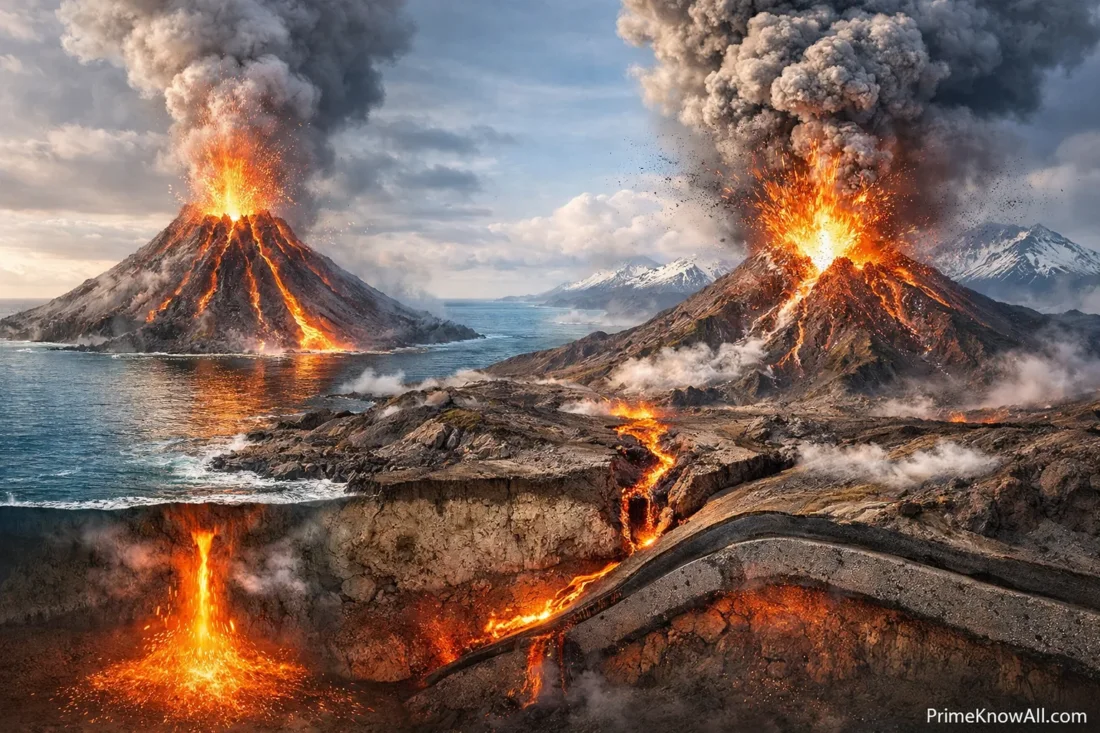
Continents can also stretch and split. In a continental rift, thinning crust and rising mantle can produce volcanoes before a new ocean basin exists. The East African Rift shows several stages of this process across a broad region rather than along one simple crack.
How Hotspot Volcanoes Form
A hotspot is a long-lived area of magma generation that is not limited to the normal processes at a plate edge. The widely used explanation links many hotspots to upwelling mantle that is hotter than its surroundings. As that material rises, decompression can lead to partial melting beneath the lithosphere.
Hotspots are often described as nearly fixed while a tectonic plate moves overhead, but modern research treats that picture as an approximation. Some hotspot sources may drift, bend in mantle flow, or have more complicated shapes than a narrow vertical plume.
Why Hotspots Can Leave Chains of Volcanoes
Imagine a moving sheet passing over a persistent source of heat. A mark forms where the sheet is currently above the source, then moves away while a newer mark forms behind it. A moving tectonic plate can record hotspot volcanism in a similar way, leaving a trail in which older volcanoes lie farther from the present magma source.
The Hawaiian chain is the classic example. The Pacific Plate moves across the Hawaiian hotspot, so the youngest active volcanic centers lie near the southeastern end of the island chain, while progressively older volcanoes and seamounts extend away from that area.
Hotspots Can Also Occur Beneath Continents
Hotspot volcanism is not limited to ocean islands. The Yellowstone volcanic system sits above a mantle melting anomaly beneath North America. A trail of older volcanic centers extends southwest across the Snake River Plain, recording millions of years of relative motion between the plate and the hotspot source.
Yellowstone also shows why a hotspot does not have to build a tall cone. Depending on magma composition, crustal structure, eruption history, and collapse, hotspot activity can produce lava plateaus, calderas, hydrothermal systems, and broad volcanic fields.
When a Hotspot and Plate Boundary Work Together
Iceland is an important case because it combines divergent-boundary volcanism with a hotspot-related mantle anomaly. The Mid-Atlantic Ridge crosses the island as the North American and Eurasian plates move apart, while an unusually strong magma supply helps keep a large section of the ridge above sea level.
That overlap also makes Iceland useful for watching rifting happen in real time. On August 18, 2026, the Icelandic Meteorological Office reported continued ground uplift and magma accumulation beneath Svartsengi on the Reykjanes Peninsula. Its model estimated about 29.1 million cubic meters of magma-related volume increase since the July 2025 eruption, while officials said another dike intrusion and possible eruption remained the most likely longer-term scenario.
What the measurements show:
- GNSS stations can detect ground movement as magma changes pressure underground.
- Satellite InSAR can map deformation across a wider area.
- Deformation reveals magma movement, but it does not guarantee that magma will reach the surface.
A Vertical View of the Main Volcano-Forming Settings
1. Convergent Boundary
Oceanic plate descends → water-bearing minerals break down → fluids enter the mantle wedge → melting begins → magma rises → a volcanic arc can grow.
2. Divergent Boundary
Plates separate → mantle rises → pressure falls → decompression melting produces magma → fissures and intrusions create new crust.
3. Hotspot
Warm mantle upwells → partial melting feeds magma → the plate moves relative to the source → volcanoes or volcanic fields can form a time-ordered trail.
4. Transform Boundary
Plates slide sideways → faults and earthquakes dominate → volcanoes are uncommon unless extension, a nearby ridge, or another magma-producing process is also present.
Why Magma Rises but Does Not Always Erupt
Magma tends to rise because it can be less dense than the solid rock around it, and tectonic fractures can provide pathways through the crust. Yet magma generation is not the same as an eruption. A large share of magma can stall underground, cool, crystallize, or accumulate in reservoirs and sheet-like intrusions.
Whether magma reaches the surface depends on pressure, buoyancy, the strength of surrounding rock, the availability of fractures, magma viscosity, gas content, and the stress field in the crust. This is why a region can show earthquakes or ground deformation without producing an eruption.
What Tectonic Setting Can and Cannot Tell You
Knowing the tectonic setting gives a strong first clue about where the magma came from. It is less reliable as a stand-alone prediction of volcano shape or eruption behavior. A setting influences magma chemistry, but the magma can change substantially while rising and sitting in the crust.
- Subduction zone does not mean every eruption is explosive. Arc volcanoes can produce lava flows as well as ash-rich eruptions.
- Hotspot does not mean shield volcano. Hawaiʻi has large shield volcanoes, while Yellowstone is known for calderas and rhyolitic volcanism.
- Divergent boundary does not mean one visible cone. Much of the activity occurs through fissures and undersea ridges.
- An earthquake belt does not automatically mean a volcanic belt. Transform faults can produce many earthquakes with little or no magma generation.
Where These Processes Appear on Earth
- Andes, South America: The Nazca Plate subducts beneath the South American Plate, helping generate magma that feeds a long continental volcanic arc.
- Cascade Range, North America: Subduction of the Juan de Fuca system beneath North America supplies the tectonic setting for volcanoes such as Mount St. Helens and Mount Rainier.
- Mid-Atlantic Ridge: Oceanic plates separate, mantle rises, and basaltic magma creates new seafloor along a vast underwater volcanic ridge.
- East African Rift: Continental stretching thins the lithosphere, allowing mantle upwelling and decompression melting in parts of the rift system.
- Hawaiian Islands: The Pacific Plate moves over a hotspot, leaving an age-progressive chain of volcanoes and seamounts.
- Yellowstone and Snake River Plain: A continental hotspot track records changing volcanic centers as North America moves relative to the magma source.
- Iceland: A divergent plate boundary and hotspot-related magma supply overlap, producing more volcanic output than a typical section of mid-ocean ridge.
How Much Volcanism Is Concentrated Around the Pacific?
The popular term Pacific Ring of Fire describes many volcanic regions around the Pacific, most of them associated with subduction. It is not one connected volcanic system, and the exact share of Earth’s volcanoes assigned to it depends on how the region and the word “active” are defined.
Using its current regional definition, the Smithsonian Global Volcanism Program’s August 7, 2026 database lists 687 of 1,214 Holocene volcanoes, or 57%, within Ring of Fire regions. Those same regions account for 68% of confirmed eruptions since 1960. The data show a strong Pacific concentration without implying that all of those volcanoes share one magma system.
What Scientists Still Debate About Hotspots
The basic relationship between plate motion and long-lived volcanic tracks is well supported, but the deep origin of every hotspot is not settled. Many researchers link major hotspots to mantle plumes that may extend far below the upper mantle. Seismic imaging, geochemistry, and plate reconstructions support deep sources for several cases, yet the depth, shape, temperature contrast, and motion of individual plumes remain areas of active study.
Another uncertainty is how fixed a hotspot really is. Treating hotspots as stationary is useful for explaining patterns such as Hawaiʻi, but mantle flow can tilt or move upwellings. For this reason, geologists compare multiple kinds of evidence rather than using one volcanic chain as a perfect ruler for past plate motion.
Sources
- U.S. Geological Survey – What Is a Hotspot and How Do You Know It’s There? USGS explains hotspot tracks, the Hawaiian example, Iceland’s boundary-hotspot overlap, and the remaining debate about hotspot origins.
- NOAA Ocean Exploration – What Features Form at Plate Tectonic Boundaries? NOAA provides a clear official explanation of convergent, divergent, and transform boundaries and how subduction fluids help create magma.
- Smithsonian Global Volcanism Program – Pacific Ring of Fire The Smithsonian maintains a global volcano database and provides the 2026 Holocene-volcano and eruption counts used here.
- Icelandic Meteorological Office – Situation on the Reykjanes Peninsula Iceland’s official monitoring agency provides the August 2026 deformation and magma-accumulation measurements cited for Svartsengi.
- Nature Reviews Earth & Environment – Mantle Plumes and Their Role in Earth Processes This peer-reviewed review summarizes seismic, geochemical, and modeling evidence for mantle plumes while discussing open questions about plume structure and motion.
- Annual Review of Earth and Planetary Sciences – The Role of H2O in Subduction Zone Magmatism This peer-reviewed review explains how water released from a subducting slab promotes melting in the mantle wedge above it.
- Oregon State University Volcano World – Can Volcanoes Form Just Anywhere? This university resource compares hotspot, divergent-boundary, and convergent-boundary volcanism in accessible terms.
- National Geographic Education – Plate Tectonics and Volcanic Activity This educational reference connects major volcanic landforms with plate motion and provides geographic examples for general readers.
Questions About Volcano Formation
Do all volcanoes form at plate boundaries?
No. Many volcanoes form at convergent and divergent boundaries, but hotspots can create volcanoes within a tectonic plate. Hawaiʻi is the best-known oceanic example.
Why do volcanoes form at subduction zones?
The sinking oceanic plate releases water and other volatiles as it descends. These materials enter the hot mantle above the slab and lower the temperature needed for melting, helping generate magma.
Why do volcanoes form where plates move apart?
As plates separate, hot mantle rises beneath the thinning lithosphere. Pressure drops during the rise, allowing partial melting through decompression and creating magma that can form new crust.
What is the difference between a hotspot and a plate boundary?
A plate boundary is where tectonic plates meet or separate. A hotspot is a persistent area of magma generation that can occur inside a plate, although some hotspots, including Iceland’s, overlap with a plate boundary.
Can transform plate boundaries create volcanoes?
Transform boundaries mainly produce faults and earthquakes because the plates slide sideways rather than creating the usual conditions for mantle melting. Volcanism can occur nearby if extension, a spreading center, or another magma source is also present.
Is magma the same as lava?
Magma is molten or partly molten rock below Earth’s surface. Once that material erupts onto the surface, it is called lava.
Volcanoes are therefore best understood by asking what caused the rock to melt and what path allowed the magma to rise. Plate boundaries explain much of Earth’s volcanism, while hotspots show that moving plates can also pass over long-lived mantle sources far from a plate edge.
Article Revision History