
Soil forms when parent material is weathered, mixed with organic matter, and altered by water, living organisms, climate, landscape position, and time. This process is called pedogenesis. It may begin soon after fresh rock or sediment is exposed, but distinct soil horizons commonly need hundreds to thousands of years to develop.
Soil is therefore more than broken rock. A developing soil becomes a living, layered natural body as minerals change, roots grow, organisms recycle organic material, and water moves dissolved substances and fine particles through the profile.
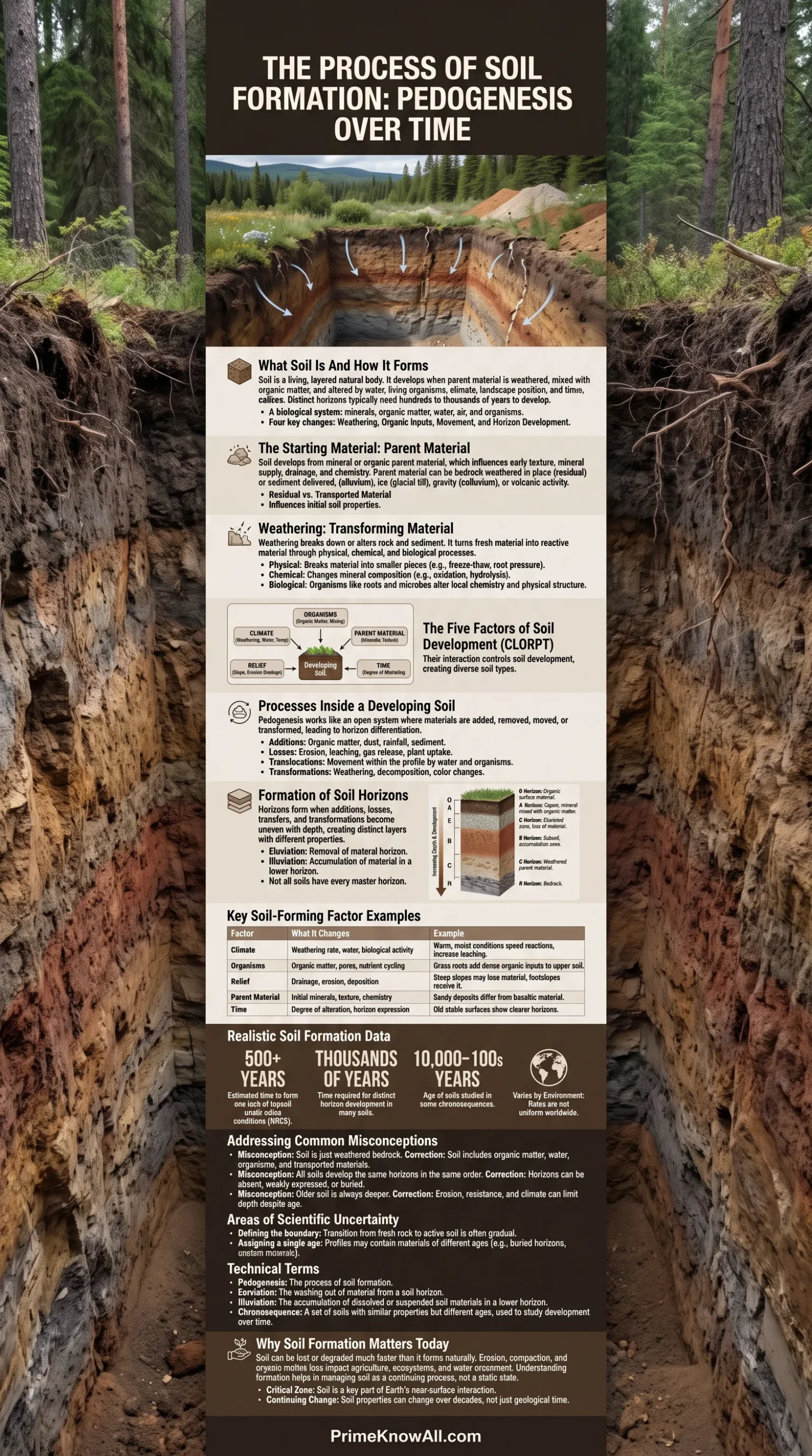
The process can be followed through four linked changes:
- Weathering breaks down or chemically alters rock, sediment, and minerals.
- Organic inputs add carbon and nutrients from plants, microbes, and other organisms.
- Movement within the soil redistributes clay, dissolved ions, organic compounds, and water.
- Horizon development creates layers with different colors, textures, structures, and chemical properties.
How Soil Formation Begins
Soil formation starts with parent material, the mineral or organic material in which a soil develops. That material may be bedrock weathered in place, but it can also be sediment delivered by rivers, glaciers, wind, gravity, or volcanic activity.
Parent Material Is the Starting Material, Not Always the Bedrock
A common simplified picture shows soil sitting directly above the rock that produced it. That happens in residual soils, but many soils develop in transported material. Loess can arrive by wind, alluvium by rivers, glacial till by ice, and colluvium by downslope movement.
This matters because the parent material affects early texture, mineral supply, drainage, and chemistry. Quartz-rich sandy deposits tend to behave differently from basaltic material rich in more easily altered minerals. As a soil ages, other processes may partly blur the original parent-material signal, but they do not erase its history.
Weathering Turns Fresh Material Into Reactive Material
Physical weathering breaks material into smaller pieces without changing the basic chemistry of its minerals. Freeze-thaw action, heating and cooling, abrasion, root pressure, and wetting-drying cycles can all open cracks or increase surface area.
Chemical weathering changes minerals themselves. Water can dissolve soluble compounds, oxygen can oxidize iron-bearing minerals, and reactions such as hydrolysis can transform primary minerals into secondary minerals, including many clays. Smaller particles expose more surface to water and chemical reactions, so physical and chemical weathering often reinforce one another.
Biological weathering overlaps both. Roots widen cracks, microbes alter local chemistry, and lichens or decaying organic material can release organic acids that interact with mineral surfaces. These biological effects become stronger once vegetation and microbial communities establish themselves.
Five Factors That Control Soil Development
Soil scientists commonly explain soil development through five interacting factors: climate, organisms, relief, parent material, and time. Their initials form the well-known soil-science shorthand CLORPT, associated with the work of soil scientist Hans Jenny.
| Factor | What It Changes | Example |
|---|---|---|
| Climate | Weathering rate, water movement, biological activity, decomposition | Warm, moist conditions can speed many chemical reactions and increase leaching. |
| Organisms | Organic matter, pores, mixing, nutrient cycling, root channels | Grass roots can add dense organic inputs to the upper soil. |
| Relief | Drainage, erosion, deposition, temperature, moisture | A steep slope may lose material while a footslope receives it. |
| Parent Material | Initial minerals, particle sizes, chemistry, permeability | Windblown silt begins with a different texture from coarse river gravel. |
| Time | Degree of alteration and horizon expression | A recently deposited flood layer may show little horizon development. |
Climate Controls Water and Reaction Rates
Temperature and moisture affect nearly every part of pedogenesis. Water carries dissolved materials, supports organisms, and participates in mineral reactions. Temperature influences reaction speed, evaporation, plant growth, and decomposition. In cold or very dry settings, some soil-forming processes proceed slowly; in warm, wet settings, chemical alteration and leaching can be much stronger.
Organisms Reshape the Soil From the Surface Down
Plants, bacteria, fungi, soil animals, and people all change soil. Roots create channels, draw up nutrients, and return organic residues to the surface. Fungi and bacteria decompose residues and transform nutrients into other chemical forms. Burrowing animals mix material and create pores that influence air flow, infiltration, and root growth.
Relief Changes What Water and Gravity Do
Relief means the shape and position of the land, including slope, aspect, elevation, and landscape position. On a steep slope, erosion may remove surface material almost as fast as soil processes create it. Lower positions can receive sediment, water, and dissolved material from upslope. Even two neighboring slopes may develop differently if one receives more sunlight and dries faster.
Time Records the Effects of the Other Four Factors
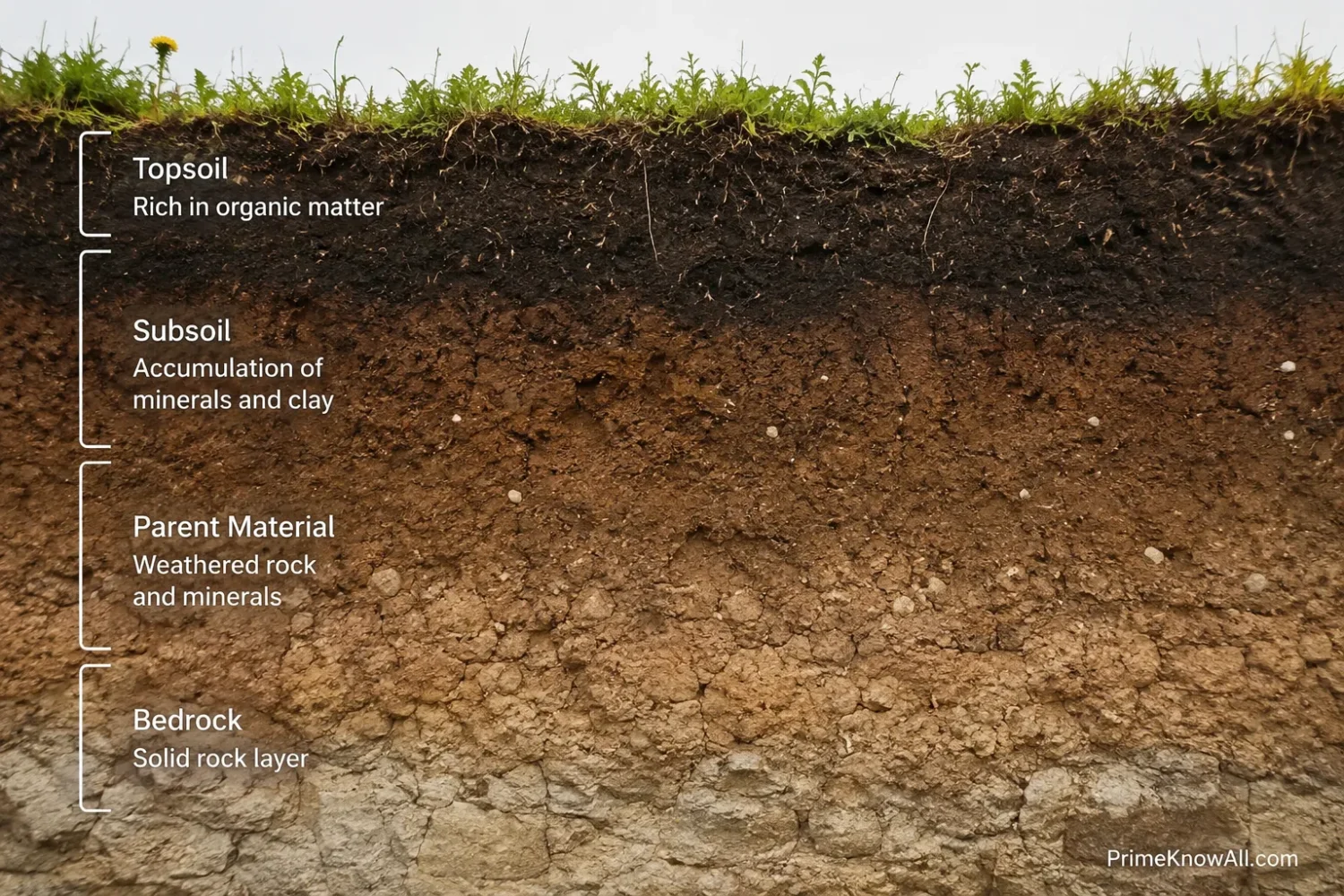
Time does not act alone. It gives the other factors an opportunity to leave a stronger imprint. A young surface may retain many properties of its original sediment, while an older stable surface can show clay formation, mineral depletion, organic accumulation, stronger structure, and clearer horizons.
What Changes Inside a Developing Soil
Pedogenesis is easier to understand when the soil is treated as an open system. Material can be added, removed, moved within the profile, or transformed. These four process groups help explain why horizons emerge even when the starting material was fairly uniform.
Additions
Leaves, roots, dust, rainfall, flood sediment, salts, and human-added materials can enter the soil. Plant litter is especially visible, but windblown mineral dust can also change soil chemistry and texture over long periods.
Losses
Soils lose material through erosion, leaching, gas release, plant uptake followed by export, and dissolved drainage. Loss is selective: water may remove soluble ions while leaving less soluble minerals behind, gradually changing the chemical balance of a horizon.
Translocations
Some material moves without leaving the soil profile. Percolating water can carry dissolved compounds or fine clay downward. Organisms move organic matter in several directions. In dry climates, water moving upward and evaporating near the surface may help concentrate soluble salts or carbonates at particular depths.
Transformations
Transformations change the material itself. Primary minerals weather into new minerals; plant residues become more processed soil organic matter; iron can oxidize and produce red or yellow colors; repeated wetting can create other color patterns. Soil aggregates also form and break apart as roots, fungi, clay, organic compounds, and physical forces interact.
A useful analogy is a slowly reorganizing pantry: new items arrive, some leave, some are moved to different shelves, and some are changed into something else. A soil profile works in a similar way, except the “shelves” are horizons and the rearrangement can continue for centuries or longer.
How Soil Horizons Form
Soil horizons form when additions, losses, transfers, and transformations become uneven with depth. The resulting layers may differ in color, organic matter, clay content, structure, mineralogy, acidity, or other properties. Not every soil contains every master horizon.
| Horizon | Typical Meaning | What May Be Seen |
|---|---|---|
| O | Organic surface material | Leaves, needles, partly decomposed plant residues, organic matter |
| A | Mineral surface horizon influenced by organic matter | Darker color, roots, biological mixing |
| E | Zone with loss of certain materials | Paler color where clay, iron, aluminum, or organic compounds have been removed |
| B | Subsurface horizon altered by soil-forming processes | Clay accumulation, iron oxides, stronger structure, color change |
| C | Relatively weakly altered parent material | Weathered sediment or rock material with less pedogenic change |
| R | Hard bedrock | Consolidated rock beneath the soil or weathered material |
Eluviation and Illuviation Create Contrasting Layers
Eluviation is the removal of material from a horizon by downward-moving water, while illuviation is the accumulation of material in a lower horizon. Where these processes are well expressed, an E horizon may become lighter as material leaves it, while a B horizon below gains clay, iron compounds, organic compounds, or other constituents.
The boundary between horizons is not always sharp. Some profiles change gradually over several centimeters, and some young, disturbed, sandy, waterlogged, or strongly eroded soils show weak horizon contrast. A diagram showing every letter in perfect sequence is a teaching model, not a rule for every landscape.
How Long Soil Formation Takes
There is no single worldwide rate for making soil. USDA educational material describes horizon development as a process that can take hundreds to thousands of years, while Soil Science Society of America teaching material notes that forming an inch of topsoil can take more than 500 years under some conditions. These values are useful for scale, not as universal conversion formulas.
Rates vary because “soil formation” can mean different things. One study may measure the conversion of bedrock to mobile soil, another may track chemical weathering, and another may ask how long it takes a recognizable A or B horizon to form. Erosion and deposition also alter the apparent rate: a surface can gain mineral material from upslope even while the underlying rock weathers slowly.
Soil chronosequences help scientists study this problem. A chronosequence compares soils on surfaces of different known or estimated ages that otherwise share similar environmental conditions. California studies, for example, have examined soils developed over tens of thousands to hundreds of thousands of years to track changes in clay accumulation, permeability, mineral losses, and water chemistry.
From Fresh Material to a Layered Soil
Rock, ash, glacial debris, river sediment, or other parent material is exposed. Horizon contrast is weak or absent.
Cracks widen, minerals react with water and air, and smaller particles appear.
Roots, microbes, fungi, and soil animals add organic material and create pores.
Water and organisms move clay, dissolved compounds, and organic matter. Upper and lower zones become less alike.
Color, structure, chemistry, texture, and organic content show a longer record of soil development.
The sequence is not a fixed timetable. Deposition, erosion, waterlogging, drought, fire, cultivation, or other disturbances can redirect development.
Why Two Nearby Soils Can Be Different
Soils can differ over surprisingly short distances because the five soil-forming factors change across a landscape. A few meters of elevation, a change in slope, or a buried sediment layer can alter drainage and parent material enough to produce a different profile.
Consider a hill. Near the crest, runoff and erosion can limit soil thickness. Mid-slope positions may shed both water and particles. At the footslope, sediment and moisture may accumulate. The soils are exposed to the same regional climate, yet their local water balance and material inputs differ.
Aspect can add another contrast. In the Northern Hemisphere, a sun-facing slope may be warmer and drier than a shaded slope nearby (the size of the difference depends on latitude, season, vegetation, and local terrain). That can change plant cover, decomposition, moisture, and weathering, which then changes the soil.
How Soil Formation Differs by Environment
The same process groups operate across Earth, but their balance changes with climate, vegetation, drainage, and parent material. Different environments therefore produce different horizon patterns rather than one universal “mature soil.”
Humid Forests
Where precipitation regularly moves through the profile, leaching and downward translocation can be pronounced. Forest litter supplies organic material at the surface, while acidity generated by organic processes can aid mineral alteration. Some forest soils develop a pale E horizon above a B horizon enriched in transferred materials, but this pattern is not present in every forest.
Grasslands
Dense root systems can place large amounts of organic material directly into the upper mineral soil. In some temperate grasslands this helps produce a thick, dark surface horizon. Climate, grazing, fire history, parent material, and drainage still affect the final profile.
Drylands
Limited rainfall reduces sustained downward leaching. Where evaporation exceeds downward water movement for long periods, carbonates, gypsum, or soluble salts may accumulate within or near the soil profile. Surface organic inputs are often lower where vegetation is sparse, though local dryland soils vary widely.
Floodplains and Deltas
Frequent sediment deposition can repeatedly bury developing surfaces. A floodplain may therefore contain stacked buried soils and younger sediment layers. On a higher river terrace that no longer floods regularly, a soil may have much more time to develop clear horizons.
Volcanic Landscapes
Fresh volcanic ash can create new parent material in a single event. Fine volcanic glass is chemically reactive, and under suitable moisture conditions it can weather into distinctive short-range-order minerals. Repeated eruptions may produce layered sequences in which older soils are buried beneath younger ash.
Soil Formation in Familiar Places
Pedogenesis is slow, but its controls can be recognized in ordinary landscapes. These examples connect the process to places people regularly see.
- A roadside cut shows several colors. The exposed face may reveal horizons created by differences in organic matter, mineral movement, drainage, and weathering with depth.
- A river leaves fresh silt after a flood. The new deposit becomes parent material; if it remains undisturbed long enough, biological activity and horizon development begin again near the surface.
- A wooded slope has thinner soil than the flatter ground below. Downslope transport can remove material from the slope and add it to lower positions, changing both profiles.
- A garden bed darkens after years of organic additions. Compost and plant residues can change the upper soil quickly, although this managed change is not the same as forming an entire natural soil profile from fresh parent material.
- A construction site exposes pale compacted subsoil. Earthmoving may strip away the former A horizon and bring B or C material to the surface, resetting many surface processes.
- A forest floor develops a layer of litter. Leaves and needles are decomposed by organisms, and some of that carbon becomes incorporated into the mineral soil below.
- A dry field shows a whitish subsurface zone. In some settings, repeated water movement and evaporation can concentrate carbonates or salts at depth; field and laboratory tests are needed to identify the material correctly.
Ideas About Soil Formation That Need More Precision
Several simplified statements are useful for teaching but become misleading when treated as universal rules.
- “Soil is just weathered bedrock.” Weathered mineral material is important, but soil also contains organic matter, water, gases, organisms, and materials that may have arrived from somewhere else.
- “All soils develop the same horizons in the same order.” O, A, E, B, C, and R are master horizon symbols, not a required sequence. Horizons can be absent, combined, weakly expressed, buried, or altered.
- “Older soil is always deeper.” An old stable surface may support deep soil, but erosion, resistant bedrock, aridity, deposition, or landscape position can break the simple age-depth relationship.
- “One centimeter of soil always takes a fixed number of years.” Published estimates vary because formation rates depend on climate, parent material, organisms, slope, erosion, and what a study measures as newly formed soil.
- “Topsoil and soil are the same thing.” Topsoil usually refers to the upper, biologically active portion of a profile. Soil as a natural body includes deeper horizons as well.
- “Weathering and erosion are the same process.” Weathering breaks down or alters material in place; erosion removes and transports material. They can operate together but describe different changes.
Why Soil Age Is Hard to Measure
Assigning one age to a soil can be difficult because a profile may contain materials with several histories. Organic matter can be young while mineral grains are ancient, and the land surface may have been stable for a different length of time again. Buried horizons complicate the picture further.
Scientists therefore date or compare specific parts of the system: a volcanic ash layer, a river terrace, an organic fraction, a mineral coating, or a geomorphic surface. Chronosequences are useful when surfaces have known relative ages, but they work best when other soil-forming factors are similar enough for age to be meaningfully compared.
Another uncertainty is the boundary between weathered rock, regolith, and soil. Soil classification systems use practical depth and diagnostic rules, yet biological activity and chemical alteration can extend below the layers that are most obvious in a pit. The transition from fresh rock to biologically active soil is often gradual rather than a single line.
Why Soil Formation Matters Today
Soil can be altered or removed far faster than a well-developed profile can be rebuilt naturally. That mismatch is why erosion, compaction, loss of organic matter, and horizon removal matter for agriculture, ecosystems, construction, and water movement.
Modern soil research also treats soil as part of Earth’s Critical Zone, the near-surface region where rock, water, air, and living systems interact. Long-term experiments and newer soil-structure studies examine how management, roots, organic inputs, pore networks, and mineral processes change soil over decades as well as over geological time.
Natural soil development is slow, but many soil properties are not frozen in place. Structure, organic matter, nutrient availability, compaction, and biological activity can change within years or decades. Rebuilding a lost natural profile is a different task from improving the condition of soil that is still present.
Soil formation is best understood as continuing change, not a march toward one final soil type. Each profile records a particular combination of starting material, water, life, terrain, disturbance, and time, which is why the ground beneath two nearby places can tell very different stories.
Questions About Soil Formation
How Does Soil Form From Rock?
Rock can contribute to soil when physical and chemical weathering break it down and alter its minerals. The resulting material becomes soil as it is mixed with organic matter, affected by organisms, moved by water, and differentiated into horizons over time. Many soils also form in transported sediments rather than directly from the bedrock below.
How Long Does It Take for Soil to Form?
There is no fixed rate. Clear horizon development may take hundreds to thousands of years, while commonly cited educational estimates place an inch of topsoil at more than 500 years under some conditions. Climate, parent material, organisms, relief, deposition, and erosion can make the real rate much faster or slower.
What Are the Five Factors of Soil Formation?
The five classic factors are climate, organisms, relief, parent material, and time. Soil scientists often abbreviate them as CLORPT. They interact, so the effect of one factor depends partly on the others.
Does Every Soil Have O, A, E, B, C, and R Horizons?
No. These letters identify master horizons and layers, but a real profile may lack several of them. E horizons, for example, develop only where enough material has been removed to create a distinct eluviated layer.
What Is the Difference Between Weathering and Soil Formation?
Weathering is one part of soil formation. It breaks down or chemically changes rock and minerals. Soil formation also includes organic inputs, biological activity, movement of material through the profile, losses from the system, and the development of horizons.
Sources
- USDA Natural Resources Conservation Service – Soil Facts. This federal soil-science resource explains the five soil-forming factors, parent materials, horizon development, soil classification, and the continuing movement and alteration of material in soils.
- USDA Natural Resources Conservation Service – A Soil Profile. NRCS is the U.S. federal agency responsible for the National Cooperative Soil Survey, and this page describes master horizons and the properties soil scientists use to recognize them.
- Food and Agriculture Organization of the United Nations – How Is Soil Formed?. FAO explains how weathering, organisms, organic matter, microorganisms, parent material, topography, climate, and time interact during soil formation.
- U.S. Geological Survey – Soil Formation: Chapter 6. USGS provides a geology-centered treatment of parent material, climate, organisms, topography, time, and soil organic matter within Earth’s Critical Zone.
- Soil Science Society of America Journal – Outline of a Generalized Theory of Soil Genesis. Roy Simonson’s peer-reviewed paper is a foundational scientific treatment of additions, removals, transfers, and transformations as processes that differentiate soil horizons.
- Soil Science Society of America Journal – An Updated Method for Identifying the Formative Factors in Soil Structure. This 2024 peer-reviewed study supports the use of soil structure as an indicator of development and as a property linked to water, air, and root movement.
- U.S. Geological Survey – Chemical Weathering Rates of a Soil Chronosequence on Granitic Alluvium. This research record describes soil and water changes across a California chronosequence extending from tens of thousands to hundreds of thousands of years.
- Dictionary.com – Pedogenesis. The dictionary entry provides the standard scientific meaning of pedogenesis as the process of soil formation.
- Encyclopedia.com – Soil Horizon. This earth-science dictionary entry gives a concise description of soil horizons and the O, A, E, B, C, and R notation used in profile descriptions.