The world’s largest lake by area is the Caspian Sea, an inland water body so wide that many maps label it with the word “sea.” By common reference ranking, it is followed by Lake Superior, Lake Victoria, Lake Huron, and Lake Michigan.
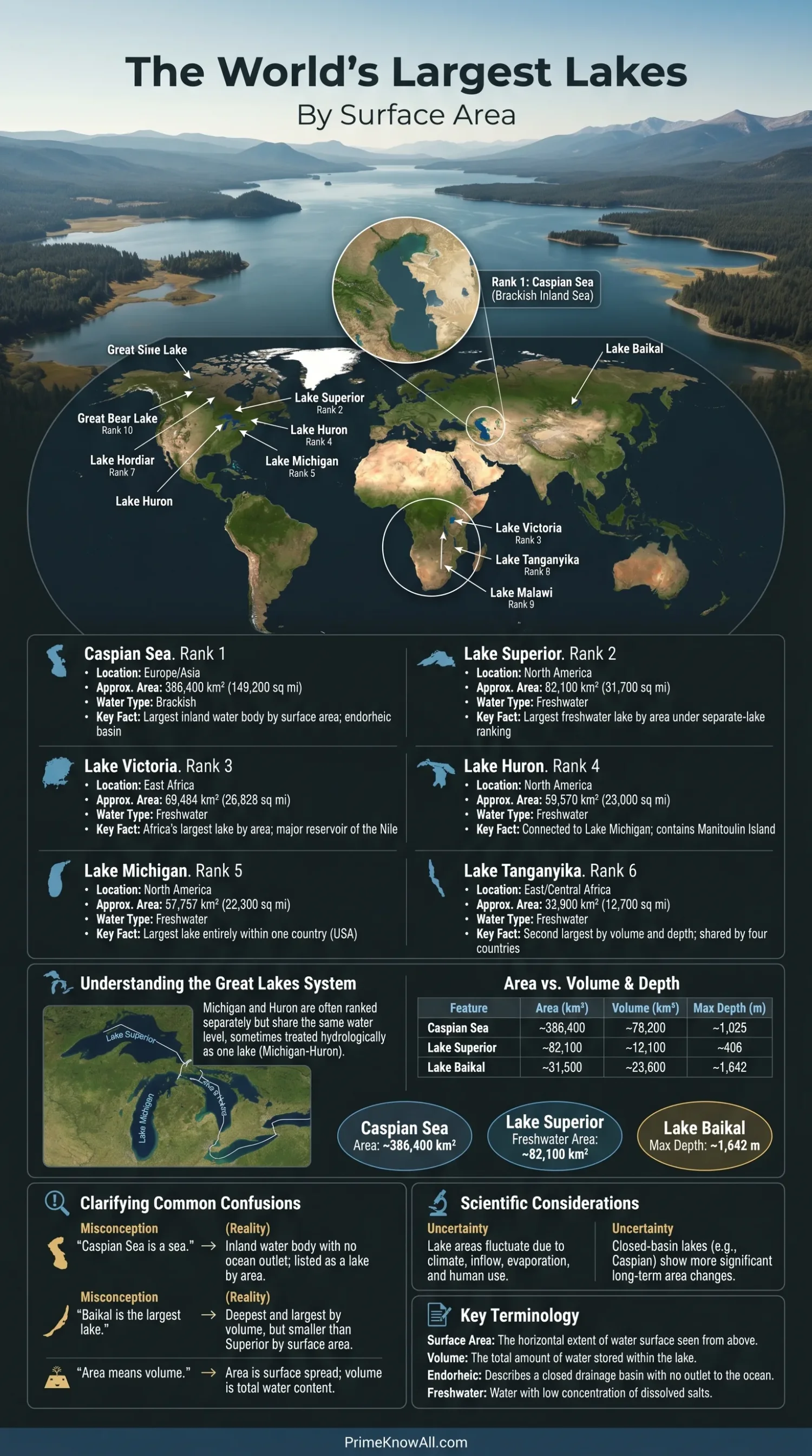
A lake’s surface area means the size of the water surface seen from above. It is not the same as depth, volume, shoreline length, or water quality. That is why a broad but shallow lake can rank above a smaller lake that holds far more water.
If you remember one thing… the ranking is about area, not water volume. The Caspian Sea covers the most surface, Lake Superior is the largest freshwater lake when Michigan and Huron are counted separately, and Lake Baikal holds far more water than many wider lakes because it is exceptionally deep.
- Largest overall: Caspian Sea.
- Largest freshwater lake by area: Lake Superior, under the usual separate-lake ranking.
- Largest freshwater system by area: the North American Great Lakes as a connected group.
- Area can change: lake levels rise and fall with climate, inflow, evaporation, and human water use.
What Counts As A Lake By Area
A lake by area is ranked by the horizontal spread of its water surface. This measure helps compare lakes on maps, but it does not tell the full story of the lake’s depth, chemistry, ecology, or how much water it stores.
Surface area is a two-dimensional measurement, usually shown in square kilometers or square miles. Think of it like the footprint of a rug on a floor: a rug may cover a large space, but that tells nothing about how thick it is. A lake works in a similar way. Lake Victoria is broad and shallow compared with Lake Baikal, while Baikal is smaller in area but much deeper.
- Area tells how wide the lake spreads across the landscape.
- Volume tells how much water the lake holds.
- Maximum depth tells the deepest measured point.
- Shoreline length changes with islands, bays, and mapping scale.
- Water type can be freshwater, brackish, saline, or alkaline.
Endorheic means a basin has no natural outlet to the sea. The Caspian Sea is the best-known example in this ranking. Rivers, especially the Volga, bring water in, while evaporation removes water out. Over time, that closed-basin behavior helps explain why the Caspian is brackish rather than freshwater.
The Ranking Used Here
This article uses the common geographic ranking of named lakes as separate water bodies. That means Lake Michigan and Lake Huron appear separately, even though they are connected through the Straits of Mackinac and are sometimes treated as one hydrological lake.
Worth Keeping In Mind
- Area rankings are snapshots, not permanent measurements carved into stone.
- Closed-basin lakes can shift more visibly because they depend heavily on inflow and evaporation.
- Different sources may round values or use measurements from different water-level periods.
The World’s Largest Lakes Ranked By Surface Area
The Caspian Sea ranks first by a wide margin. Its commonly cited area is far larger than Lake Superior, the next lake on the list. The first five places include one inland brackish sea, three North American Great Lakes, and one African Great Lake.
| Rank | Lake | Region | Approx. Area | Water Type | Why It Matters |
|---|---|---|---|---|---|
| 1 | Caspian Sea | Europe / Asia | 386,400 km² / 149,200 sq mi | Brackish inland water body | The largest inland water body on Earth by area. |
| 2 | Lake Superior | North America | 82,100 km² / 31,700 sq mi | Freshwater | The largest freshwater lake by area when the Great Lakes are counted separately. |
| 3 | Lake Victoria | East Africa | 69,484 km² / 26,828 sq mi | Freshwater | Africa’s largest lake by area and a core part of the Nile basin. |
| 4 | Lake Huron | North America | 59,570 km² / 23,000 sq mi | Freshwater | Known for Georgian Bay, many islands, and its connection to Lake Michigan. |
| 5 | Lake Michigan | North America | 57,757 km² / 22,300 sq mi | Freshwater | The largest lake entirely within one country, the United States. |
| 6 | Lake Tanganyika | East / Central Africa | 32,900 km² / 12,700 sq mi | Freshwater | Very long, very deep, and shared by four countries. |
| 7 | Lake Baikal | Siberia, Russia | 31,500 km² / 12,200 sq mi | Freshwater | The deepest lake on Earth and one of the oldest known lakes. |
| 8 | Great Bear Lake | Canada | 31,328 km² / 12,096 sq mi | Freshwater | A large northern lake in Canada’s Northwest Territories. |
| 9 | Lake Malawi / Nyasa / Niassa | Southeast Africa | 29,604 km² / 11,430 sq mi | Freshwater | Known for fish diversity, especially cichlids. |
| 10 | Great Slave Lake | Canada | 28,568 km² / 11,030 sq mi | Freshwater | One of North America’s largest and deepest northern lakes. |
The ranking also shows a clear pattern: North America and Africa dominate the upper list after the Caspian Sea. Canada alone has two lakes in the top ten, while the African Great Lakes region includes Victoria, Tanganyika, and Malawi.
The Next Ten Large Lakes
The lakes after the top ten still cover huge areas. Several are familiar because of shipping, borders, cities, or high-altitude geography.
| Rank | Lake | Approx. Area | Short Note |
|---|---|---|---|
| 11 | Lake Erie | 25,667 km² | Shallowest of the Great Lakes by average depth. |
| 12 | Lake Winnipeg | 24,387 km² | A broad Canadian lake with a large drainage basin. |
| 13 | Lake Ontario | 19,011 km² | The smallest Great Lake by area but still globally large. |
| 14 | Lake Ladoga | 17,600 km² | Europe’s largest freshwater lake, in northwestern Russia. |
| 15 | Lake Balkhash | 15,500 km² | A partly saline lake in Kazakhstan. |
| 16 | Lake Vostok | 12,000 km² | A subglacial lake beneath Antarctica’s ice sheet. |
| 17 | Lake Onega | 9,720 km² | A large freshwater lake in European Russia. |
| 18 | Lake Titicaca | 8,300 km² | A high-altitude lake shared by Peru and Bolivia. |
| 19 | Lake Nicaragua | 8,157 km² | A large tropical freshwater lake in Central America. |
| 20 | Lake Athabasca | 7,936 km² | A large lake shared by Alberta and Saskatchewan. |
How The Largest Lakes Compare
Surface area shows the map footprint of each lake, not the amount of water stored below the surface.
1. Caspian Sea — 386,400 km²
2. Lake Superior — 82,100 km²
3. Lake Victoria — 69,484 km²
4. Lake Huron — 59,570 km²
5. Lake Michigan — 57,757 km²
Reading tip: the bar lengths make one point clear: the Caspian Sea is not just first; it is in a separate size class.
Why The Caspian Sea Is Listed As A Lake
The Caspian Sea is usually listed as the largest lake because it is inland and has no direct natural connection to the ocean. Its name reflects size and history, not a strict oceanographic category.
The Caspian sits between Europe and Asia and touches Russia, Kazakhstan, Turkmenistan, Iran, and Azerbaijan. It receives water from several rivers, with the Volga River being the largest inflow. Because it has no ocean outlet, water leaves mainly through evaporation.
- It is landlocked: no open sea passage connects it naturally to the world ocean.
- It is brackish: its water is saltier than freshwater but usually less salty than ocean water.
- It has shifting levels: changes in inflow, evaporation, and climate can alter shoreline position.
- It has legal complexity: countries around it treat it through special agreements because of navigation, energy, fishing, and borders.
Some sources give the Caspian Sea near 371,000 km², while reference lists may show about 386,400 km². That difference does not change its rank. It still remains far larger than Lake Superior by area.
Freshwater Lakes Tell A Different Story
If brackish inland water is excluded, Lake Superior becomes the largest freshwater lake by area. It is part of the North American Great Lakes, a connected freshwater system that holds about one-fifth of the world’s surface freshwater supply.
Freshwater rankings matter for drinking water, shipping, fisheries, and regional climate. They also help explain why the Great Lakes appear so often in geography lessons, weather reports, and satellite images. Their size changes local winds, snowfall patterns, and shoreline planning.
- Lake Superior has the largest freshwater surface area under the usual separate-lake ranking.
- Lake Victoria is the largest lake in Africa by area and the largest tropical lake by area.
- Lake Baikal is not the widest, but it is the deepest and stores an unusually large share of unfrozen freshwater.
- Lake Tanganyika is long, deep, and one of the most water-rich freshwater lakes by volume.
Useful Pause
- Largest by area is not the same as largest by volume.
- Baikal ranks lower by area because it is narrow compared with Superior or Victoria.
- Depth can change the story when the question is water storage rather than map size.
Lake Michigan And Lake Huron: One Lake Or Two?
Lake Michigan and Lake Huron are usually ranked separately, but hydrologically they can be treated as one connected lake. They share the same water level through the Straits of Mackinac, so some scientific and water-level discussions use the combined name Michigan-Huron.
This distinction changes the freshwater ranking. If Michigan and Huron are combined, Michigan-Huron covers about 117,000 km², which makes it larger than Lake Superior by area. If they are counted separately, Superior remains the largest freshwater lake by area.
| Counting Method | Largest Freshwater Lake By Area | Approx. Area | Why The Difference Exists |
|---|---|---|---|
| Common named-lake ranking | Lake Superior | 82,100 km² | Michigan and Huron are listed as separate named lakes. |
| Hydrological ranking | Lake Michigan-Huron | About 117,000 km² | The two lakes share water level through a deep strait. |
The practical rule is simple: for school-style lists, use Lake Superior. For water-level science or Great Lakes hydrology, Michigan-Huron may appear as one connected system.
Why Lake Area Numbers Do Not Always Match
Lake area values differ because lakes are not fixed shapes. Their shorelines can move with rainfall, snowmelt, river inflow, evaporation, groundwater exchange, dam operation, sediment, and human water withdrawals.
Large lakes can look stable on a wall map, yet their edges may change over time. A few meters of water-level change can move a shallow shoreline across wide flats. This is one reason closed-basin lakes, such as the Caspian Sea or Lake Balkhash, need careful wording when area values are given.
- Water level: a higher lake surface can flood shallow margins and expand measured area.
- Mapping scale: a detailed shoreline survey may count bays and islands differently from a simpler map.
- Season: snowmelt and rainfall can change connected wetlands and shallow edges.
- Human use: irrigation, dams, canals, and diversions can reshape inflows and outflows.
- Lake definition: reservoirs, lagoons, subglacial lakes, and salt lakes may be included or excluded depending on the list.
The Aral Sea is the strongest warning example. It was once one of the largest lakes by area, but large-scale river diversion reduced it to several smaller remnants. It shows why a lake ranking should always be read as a measurement tied to time, source, and method.
Map Reader Note
- Use rounded figures when comparing world rankings.
- Check the source date for lakes with known level changes.
- Do not mix area and volume unless the article clearly says which measure is being used.
Where These Numbers Show Up Outside A Map
Large-lake area rankings are not only trivia. They help explain real choices in shipping, water supply, weather forecasting, fisheries, conservation, and even city planning near shorelines.
- A weather forecast near Lake Superior: cold air passing over a huge water surface can help create lake-effect snow. The lake’s area gives storms room to gather moisture.
- A shipping route through the Great Lakes: wide freshwater lakes act like inland seas, so wind, waves, ports, and navigation rules matter.
- A fishing policy on Lake Victoria: a lake shared by three shoreline countries needs coordination because fish populations and water quality cross borders.
- A satellite image of the Caspian Sea: the coastline can shift over time, so area estimates may not match older maps exactly.
- A school geography question: “largest lake” may mean Caspian Sea overall, but “largest freshwater lake” usually points to Lake Superior.
- A conservation plan for Lake Malawi: a large lake can contain many local habitats, so area alone cannot show biological value.
- A travel map around Lake Titicaca: even a lake outside the top ten can shape borders, culture, transport, and settlement at a high elevation.
Common Misunderstandings About Large Lakes
Most confusion comes from mixing measurement types. A lake can be the largest by area, deepest by maximum depth, largest by volume, largest freshwater lake, or largest lake inside one country.
| Misunderstanding | Clearer Version | Why It Happens |
|---|---|---|
| “The Caspian Sea cannot be a lake because it says sea.” | It is commonly ranked as the largest inland water body because it is landlocked. | Names often come from history, not modern measurement rules. |
| “Lake Baikal is the largest lake.” | Baikal is the deepest lake and a giant by volume, but not by surface area. | Depth and volume are often blended into one vague idea of size. |
| “Lake Superior always ranks first among freshwater lakes.” | Superior ranks first when Michigan and Huron are counted separately. | Hydrological lists sometimes combine Michigan and Huron. |
| “A larger area means more water.” | A broad shallow lake may hold less water than a narrower deep lake. | Maps show surface, not underwater shape. |
| “All rankings use the same numbers.” | Rounded values differ because lakes change and sources use different methods. | Water levels and shoreline mapping are not identical across sources. |
Quick Test
Use these short checks to test the main ideas. Each answer opens below the question, so the section works well for readers who want to confirm the ranking without rereading the full article.
1. Which lake is the largest in the world by surface area?
The Caspian Sea is the largest inland water body by surface area. It is brackish and landlocked, which is why it appears in lake rankings even though its name includes “Sea.”
2. Which is the largest freshwater lake by area?
Lake Superior is the largest freshwater lake by area when Lake Michigan and Lake Huron are counted separately.
3. Why is Lake Baikal not higher on an area list?
Lake Baikal is extremely deep, but its surface footprint is smaller than Superior, Victoria, Huron, and Michigan. It ranks higher when the question is volume or depth.
4. Can lake area change over time?
Yes. Lake area can change with rainfall, evaporation, river inflow, groundwater, dams, withdrawals, and long-term climate patterns.
5. Why do some lists combine Michigan and Huron?
Lake Michigan and Lake Huron are connected through the Straits of Mackinac and share the same water level. In hydrological discussions, they may be treated as one lake system.
Limits Of The Numbers
The ranking is reliable for broad comparison, but exact lake areas should be treated as rounded values. A single number can hide shoreline complexity, seasonal change, different survey methods, and source choices.
- Satellite data can improve mapping, but cloud cover, ice, wetlands, and shallow edges can still make boundaries hard to define.
- Subglacial lakes, such as Lake Vostok, are hard to compare with open surface lakes because they sit under ice.
- Reservoirs and temporary lakes may be excluded from some natural-lake lists.
- Legal and cultural names do not always match physical categories.
Another limit is that area does not measure ecological health. A very large lake can face pollution, invasive species, warming water, or falling levels. A smaller lake may be rare, clean, or biologically rich. Size is useful, but it is not a full scorecard.
Final Memory Rule
- Ask “largest by what?” before comparing lakes.
- Use area for map size, volume for stored water, and depth for vertical scale.
- Check whether Michigan-Huron is combined when reading freshwater rankings.
The world’s largest lakes by area are best understood as map-scale giants, led by the Caspian Sea and followed by Lake Superior, Lake Victoria, Lake Huron, and Lake Michigan. The most frequent error is treating “largest” as one simple label, when it depends on whether the question asks about area, volume, depth, or freshwater status.
Easy rule: Caspian for largest overall, Superior for largest freshwater lake by the usual separate-lake list, Baikal for depth and freshwater volume.
Sources
The following sources were used to check lake areas, Great Lakes measurements, lake definitions, and global lake datasets.
- NASA Earth Observatory – Caspian Sea NASA is reliable here because it uses Earth observation data and explains the Caspian Sea as the largest inland water body by surface area.
- U.S. Environmental Protection Agency – Physical Features Of The Great Lakes This is a government source with measured Great Lakes area, depth, and volume values.
- NOAA Office For Coastal Management – Great Lakes NOAA is reliable for coastal and lake-system context, including the Great Lakes’ freshwater share and water-level notes.
- UNESCO World Heritage Centre – Lake Baikal UNESCO is useful for Lake Baikal’s age, depth, freshwater importance, and protected status.
- HydroSHEDS – HydroLAKES HydroLAKES is used by researchers for global lake polygons, area, shoreline, and related lake attributes.
- USGS – Global Abundance And Size Distribution Of Lakes, Ponds, And Impoundments This academic source is useful for understanding global lake counts and why small lakes dominate by number.
- Geophysical Research Letters – A Global Inventory Of Lakes Based On High-Resolution Satellite Imagery This peer-reviewed research helps explain how satellite-based lake inventories measure lake area at global scale.
- Encyclopaedia Britannica – World’s Largest Lakes Britannica is a trusted reference source for a rounded public ranking of the largest lakes by area.
FAQ
What is the largest lake in the world by area?
The largest lake in the world by area is the Caspian Sea. It is landlocked, brackish, and much larger in surface area than Lake Superior.
What is the largest freshwater lake by surface area?
Lake Superior is the largest freshwater lake by surface area when Lake Michigan and Lake Huron are counted as separate lakes.
Is the Caspian Sea a lake or a sea?
The Caspian Sea is commonly treated as a lake in geographic rankings because it is an inland water body with no natural outlet to the ocean. Its name reflects its size and history.
Why is Lake Baikal not the largest lake by area?
Lake Baikal is deep rather than very wide. It is the deepest lake on Earth and holds a huge volume of freshwater, but its surface area is smaller than several wider lakes.
Are Lake Michigan and Lake Huron one lake?
They are usually named and ranked separately, but they are connected through the Straits of Mackinac and share water level. Hydrologically, they may be treated as one lake called Michigan-Huron.
Do lake area rankings change?
They can change slightly because lake levels rise and fall. Closed-basin lakes, shallow shorelines, and lakes affected by water diversion can show larger changes over time.
Which continent has the most top-ten largest lakes?
North America has several of the top-ten largest lakes by area, including Superior, Huron, Michigan, Great Bear, and Great Slave. Africa also has several, including Victoria, Tanganyika, and Malawi.