
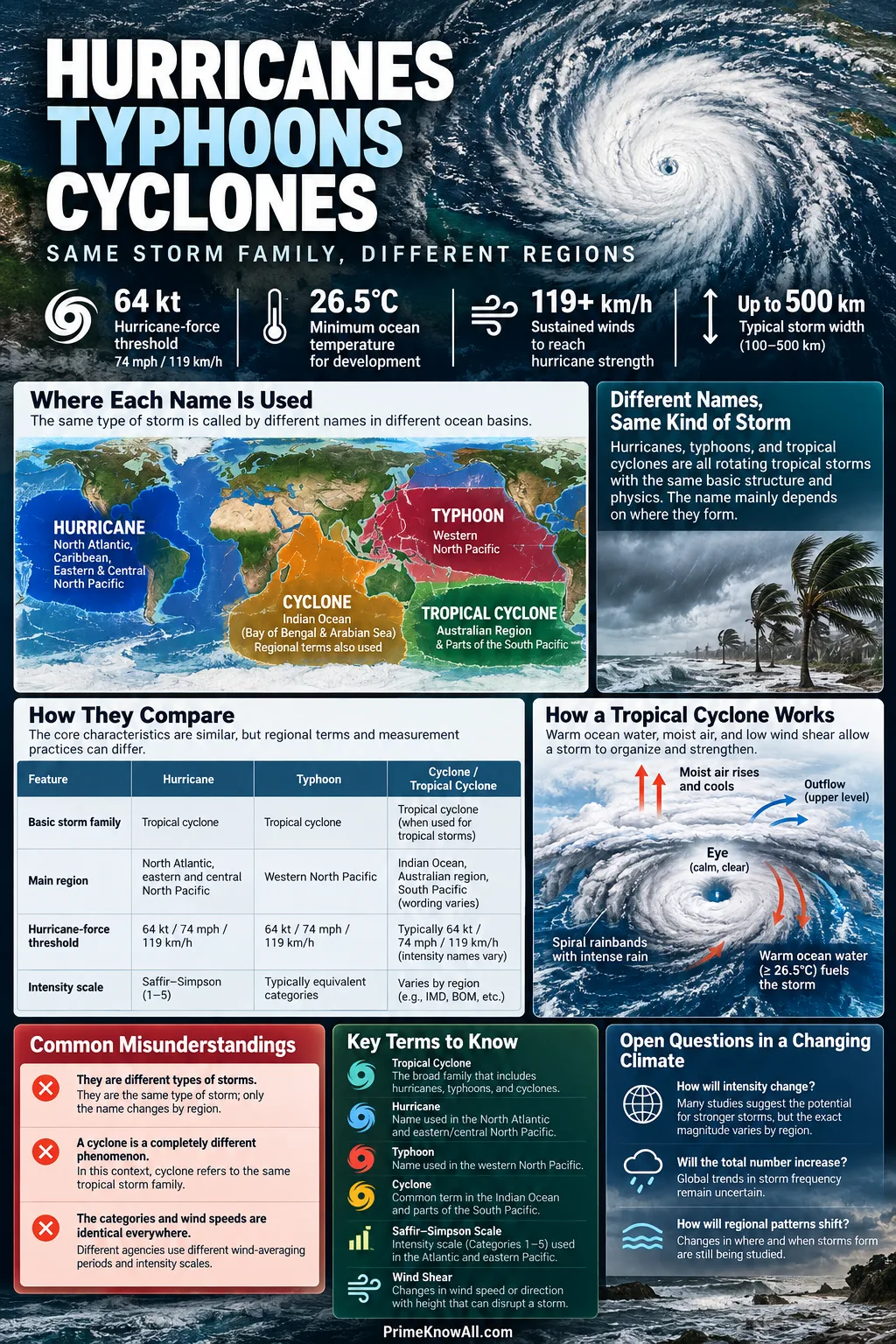
Hurricanes, typhoons, and tropical cyclones are the same basic kind of rotating tropical storm; the name changes mainly with the ocean basin. A storm of hurricane strength is called a hurricane in the North Atlantic and eastern or central North Pacific, and a typhoon in the western North Pacific. Across parts of the Indian Ocean and South Pacific, cyclone, tropical cyclone, and related regional terms are used instead.
The shared physics does not mean every regional label or category can be compared number for number. Meteorological agencies use different wind-averaging periods, intensity classes, and category scales, so two official reports can describe the same storm with wind values that look different.
- Hurricane: North Atlantic, Caribbean region, eastern North Pacific, and central North Pacific.
- Typhoon: western North Pacific.
- Cyclone or tropical cyclone: common across the Indian Ocean, Australian region, and South Pacific, with more specific regional terms at some intensity levels.
- Tropical cyclone: the broad meteorological family that includes these storms.
Where Hurricanes, Typhoons, and Cyclones Get Their Names
The dividing line is mainly geography, not storm structure. Moving the same type of storm from one ocean basin to another does not suddenly give it a different physical mechanism.
The World Meteorological Organization uses hurricane for storms in the Caribbean Sea, North Atlantic, and eastern and central North Pacific. Typhoon is used in the western North Pacific. Regional terminology becomes more varied around the Indian Ocean and Southern Hemisphere.
One Storm Family, Regional Names
HURRICANE
TYPHOON
CYCLONE and more detailed regional intensity terms
TROPICAL CYCLONE at hurricane-force intensity
TROPICAL CYCLONE, with “severe tropical cyclone” used for stronger categories in the Australian system
Hurricane vs Typhoon vs Cyclone Comparison
The three terms overlap strongly, but “cyclone” needs the most care. It can refer to a tropical cyclone in regional weather language, while the broader meteorological word cyclone also covers other rotating low-pressure systems.
| Feature | Hurricane | Typhoon | Cyclone / Tropical Cyclone |
|---|---|---|---|
| Basic storm family | Tropical cyclone | Tropical cyclone | Tropical cyclone when used for tropical storms |
| Main region | North Atlantic, eastern and central North Pacific | Western North Pacific | Indian Ocean, Australian region, South Pacific; wording varies by basin |
| International hurricane-force threshold | 64 kt / 74 mph / 119 km/h | 64 kt / about 119 km/h in international western North Pacific classification | No single worldwide threshold for the word “cyclone” by itself; regional systems differ |
| Typical official wind averaging | 1-minute sustained wind in the U.S. system | 10-minute sustained wind in RSMC Tokyo international classification | Varies by regional agency; Australia uses a 10-minute mean |
| Category system | Saffir-Simpson Hurricane Wind Scale in NHC areas | Western North Pacific intensity classes | Several regional scales and storm classes |
| Rotation | Counterclockwise in the Northern Hemisphere | Counterclockwise | Counterclockwise north of the equator; clockwise south of it |
Why the Word “Cyclone” Causes More Confusion
Tropical cyclone is the broad scientific term for an organized, warm-core rotating storm that develops over tropical or subtropical water. Hurricanes and typhoons fit inside that family.
The word cyclone is broader. In everyday weather reporting around the Indian Ocean, Australia, and parts of the South Pacific, it commonly refers to a tropical cyclone. In meteorology, though, a cyclone simply involves a closed cyclonic circulation around low pressure. An extratropical cyclone, for example, gets much of its energy from horizontal temperature contrasts rather than the warm-ocean process that maintains a tropical cyclone.
The useful distinction
- A hurricane is a tropical cyclone.
- A typhoon is a tropical cyclone.
- Not every system described meteorologically as a cyclone is tropical.
A useful analogy is a train crossing an international border. The train itself can remain the same while the operating terminology around it changes. A tropical cyclone that crosses an ocean-basin boundary can likewise receive a different regional storm label without becoming a new type of weather system.
Do Hurricanes and Typhoons Have the Same Wind Threshold?
At the international hurricane-force level, 64 knots is the familiar dividing point. The U.S. National Hurricane Center defines a hurricane or typhoon at maximum sustained surface winds of at least 64 kt, 74 mph, or 119 km/h, using the U.S. one-minute wind convention for its definition.
RSMC Tokyo’s international western North Pacific classification also places typhoon at 64 knots or above, but its maximum sustained wind is based on a 10-minute average. Below that are severe tropical storm and tropical storm classes.
That difference matters. A one-minute sustained wind and a 10-minute mean wind are not interchangeable measurements. Shorter averaging periods can preserve stronger short-duration winds, so readers should check the measurement standard before comparing numbers reported by agencies in different regions.
Why Two Agencies Can Give Different Wind Speeds
A tropical cyclone does not have one perfectly uniform wind speed. Winds vary around the circulation, observations can be sparse over open water, and agencies combine satellite analysis, aircraft data where available, surface observations, radar, and other tools to estimate intensity.
Then comes the averaging period. The National Hurricane Center commonly expresses maximum sustained wind as a one-minute average at 10 metres above the surface. Australia’s Bureau of Meteorology bases cyclone intensity on a 10-minute mean wind. Japan’s international western North Pacific classification also uses 10-minute maximum sustained wind.
Do not compare the number alone. A reported wind of 130 km/h based on one averaging period is not automatically equivalent to 130 km/h measured under another standard. The agency, averaging period, and intensity scale belong with the wind value.
Category 1 Does Not Mean the Same Thing Everywhere
A category number can look universal when it is not. The Saffir-Simpson Hurricane Wind Scale and the Australian tropical cyclone category system both run from Category 1 to Category 5, but their thresholds are very different.
| Category | Saffir-Simpson Hurricane Wind Scale | Australian Tropical Cyclone Scale |
|---|---|---|
| 1 | 119–153 km/h (74–95 mph), 1-minute sustained | 63–88 km/h, 10-minute mean |
| 2 | 154–177 km/h (96–110 mph) | 89–117 km/h |
| 3 | 178–208 km/h (111–129 mph) | 118–159 km/h |
| 4 | 209–251 km/h (130–156 mph) | 160–199 km/h |
| 5 | 252 km/h (157 mph) or higher | 200 km/h or higher |
Australia calls Category 3, 4, and 5 systems severe tropical cyclones. A Category 1 Australian cyclone therefore does not correspond to a Category 1 Atlantic hurricane. The scales start from different thresholds and use different wind-averaging periods.
This also explains why converting a category number from one basin directly into another can give a false impression of storm strength.
What Hurricanes, Typhoons, and Tropical Cyclones Have in Common
The regional names change, but the storm’s basic anatomy does not. A mature tropical cyclone has a low-pressure centre, organized thunderstorms, spiral rainbands, and often an eye surrounded by an eyewall.
- Eye: the relatively calm central area that can develop in a well-organized storm.
- Eyewall: the ring of intense convection around the eye, where some of the strongest winds and heaviest rain occur.
- Rainbands: curved bands of clouds and thunderstorms extending outward from the centre.
- Warm core: the storm’s central atmospheric column is warmer than its surroundings at the same pressure levels.
- Ocean energy: evaporation from warm tropical water supplies moisture, while condensation releases heat that helps maintain deep convection.
According to the World Meteorological Organization, a tropical cyclone is commonly around 200 to 500 km across, though some systems can reach roughly 1,000 km. Size and intensity are separate properties: a compact cyclone can be very intense, while a physically large cyclone is not automatically stronger.
Why Cyclones Spin in Opposite Directions
Tropical cyclones rotate counterclockwise in the Northern Hemisphere and clockwise in the Southern Hemisphere. The difference is linked to Earth’s rotation and the Coriolis effect.
This is why Atlantic hurricanes and western North Pacific typhoons rotate counterclockwise, while tropical cyclones near Australia commonly rotate clockwise. The Coriolis effect is also very weak close to the equator, which is one reason tropical cyclones rarely develop directly on it.
Are Typhoons Stronger Than Hurricanes?
No. “Typhoon” does not mean a stronger version of a hurricane. The regional name alone says where the storm is occurring, not how powerful it is.
The western North Pacific can produce very intense tropical cyclones, but an individual typhoon is not automatically stronger than an individual hurricane. Intensity has to be judged from its measured or estimated winds, central pressure, structure, and official regional classification.
Globally, the World Meteorological Organization reports that roughly 85 tropical storms form over warm tropical oceans in an average year, with about 45 reaching hurricane-, typhoon-, or equivalent tropical-cyclone strength. About 72% of tropical storms form in the Northern Hemisphere.
Storm Category Does Not Measure Every Hazard
Wind category is useful, but it cannot describe the whole threat. Tropical cyclones can produce storm surge, coastal inundation, extreme rainfall, freshwater flooding, large waves, erosion, and tornadoes in addition to damaging wind.
The Saffir-Simpson scale is based only on maximum sustained wind. It does not include rainfall, storm surge, or tornado potential. A lower-category hurricane can therefore produce severe flooding if it moves slowly, carries abundant moisture, or pushes water toward a vulnerable coastline.
The Australian category scale has a similar limitation: its number is based on wind. The Bureau of Meteorology specifically warns that a lower-category cyclone can still cause damaging rainfall and flooding.
- Category measures wind intensity within a particular scale.
- Storm size affects how wide an area may experience damaging conditions.
- Rainfall and storm surge can create serious impacts that the category number does not express.
Can a Hurricane Become a Typhoon?
Yes. A hurricane can become a typhoon if the same tropical cyclone crosses into the western North Pacific while remaining strong enough for the regional classification.
Hurricane Dora in 2023 provides a clear example. Dora travelled west across the eastern and central North Pacific and then crossed the International Date Line. Once it entered the western North Pacific, the storm was referred to as Typhoon Dora.
The National Hurricane Center’s tropical cyclone report for Dora, updated in January 2026, describes it as a long-lived hurricane that reached Category 4 intensity, crossed the Date Line, and became a typhoon. The circulation did not disappear and reform just because the regional terminology changed.
This is one of the clearest reasons to think of hurricane and typhoon as regional names within the tropical cyclone family, rather than separate kinds of storms.
When Hurricane, Typhoon, and Cyclone Seasons Occur
Tropical cyclone activity follows different seasonal patterns around the planet because ocean temperature, atmospheric moisture, wind shear, monsoon circulations, and large-scale climate patterns vary through the year.
| Region | Regional Term | Season or Main Period |
|---|---|---|
| North Atlantic | Hurricane | June 1 – November 30 |
| Eastern North Pacific | Hurricane | May 15 – November 30 |
| Central North Pacific | Hurricane | June 1 – November 30; storms can occur outside the season |
| Western North Pacific | Typhoon | Possible year-round; most form from roughly May through October |
| Australian region | Tropical cyclone | November 1 – April 30 |
| South Pacific | Tropical cyclone | Typical season November 1 – April 30 |
An official season is not a physical barrier. Out-of-season storms can occur. The dates mainly describe when routine monitoring products and climatological activity are concentrated in that basin.
How the Regional Names Work in Practice
The terminology becomes easier to apply when the storm’s location is known.
- A 120 km/h tropical cyclone in the North Atlantic: under the NHC one-minute wind convention, a storm at or above the 119 km/h hurricane threshold would be classified as a hurricane.
- A hurricane moving west across the International Date Line: if it retains typhoon-strength winds after entering the western North Pacific, regional bulletins can begin calling it a typhoon, as happened with Dora.
- A strong storm approaching the Philippines: the international western North Pacific terminology uses typhoon once the 10-minute maximum sustained wind reaches 64 knots.
- A Category 1 system near northern Australia: it is already a tropical cyclone under the Australian scale at a 10-minute mean wind of 63–88 km/h. It is not equivalent to a Category 1 Saffir-Simpson hurricane.
- A rotating winter low over the North Atlantic: it can be a cyclone in the meteorological sense without being a tropical cyclone, hurricane, or typhoon.
- A tropical system with lower winds but extreme rain: its wind category may be modest while its flood threat remains serious.
Several Familiar Claims Need More Precision
“Hurricanes happen in the Atlantic, typhoons in the Pacific, and cyclones in the Indian Ocean.” This is too simple. Hurricanes also occur in the eastern and central North Pacific, while tropical cyclone terminology is used across several Southern Hemisphere basins.
“Typhoon means a more powerful hurricane.” It does not. The distinction is geographic. Storm strength requires an intensity measurement.
“Category 3 means the same storm strength everywhere.” It does not. A Category 3 Australian tropical cyclone and a Category 3 Saffir-Simpson hurricane belong to different scales with different thresholds and averaging periods.
“Cyclone is just another word for hurricane.” That works only in a limited regional sense. Meteorology also uses cyclone for other low-pressure circulations, including extratropical cyclones.
“A storm becomes less dangerous when its wind category drops.” Not necessarily. Rainfall, storm surge, waves, storm size, forward speed, local terrain, and exposure all affect the resulting conditions.
How Climate Change Affects Tropical Cyclones
Climate change does not support the simple claim that every ocean basin will just produce more tropical cyclones. The evidence is more specific than that.
The IPCC assessment finds that the global proportion of major tropical cyclone intensities likely increased over the past several decades. As global temperature rises, tropical-cyclone rainfall, average peak wind speeds, and the proportion of intense storms are projected to rise globally with high confidence. For the total global frequency of tropical cyclones across all categories, projections lean toward a decrease or little overall change, with lower confidence than some of the intensity and rainfall findings.
Sea-level rise adds another issue for coastal areas. A similar storm surge occurring on top of a higher average sea level can reach farther inland or produce higher coastal water levels than it would have under a lower baseline sea level.
What Researchers Still Cannot Pin Down
Long-term tropical cyclone trends are harder to measure than modern satellite maps may suggest. Observation methods have changed markedly over time, and reliable historical coverage is not equally complete across every ocean basin.
Natural year-to-year and decade-to-decade variability also changes cyclone activity. El Niño, La Niña, atmospheric circulation, ocean heat, and wind shear can shift where storms form and how they develop. For that reason, global climate findings should not be treated as a precise forecast for the number or strength of storms in one particular basin or season.
Questions About Hurricanes, Typhoons, and Cyclones
Is a hurricane the same as a typhoon?
They are the same basic type of tropical cyclone. Hurricane is used in the North Atlantic and eastern or central North Pacific, while typhoon is the international term for a hurricane-strength tropical cyclone in the western North Pacific.
Which is stronger, a hurricane or a cyclone?
The name alone cannot tell which storm is stronger. Cyclone is used differently among regions, and tropical cyclone agencies also use different wind-averaging periods and intensity scales. Compare the actual wind measurements and the regional classification rather than the name.
Why are they called cyclones in Australia?
Australia lies in a region where tropical cyclone is the standard term. The Australian Bureau of Meteorology uses a Category 1–5 tropical cyclone scale based on 10-minute mean wind speed, with Categories 3–5 described as severe tropical cyclones.
Can a hurricane cross the Date Line and become a typhoon?
Yes. If a hurricane moves west of the International Date Line into the western North Pacific and remains at the required intensity, the regional term changes to typhoon. Hurricane Dora did this in 2023.
Do tropical cyclones form directly on the equator?
They rarely form directly on the equator because the Coriolis effect is very weak there. Tropical cyclone development normally occurs far enough from the equator for planetary rotation to help organize the developing circulation.
A storm’s regional name is therefore only one piece of information. Location explains whether it is called a hurricane, typhoon, or cyclone; the regional wind standard and official classification explain its intensity. Rain, storm surge, size, and movement still matter even when two storms carry the same category number.
Sources
- World Meteorological Organization – Characteristics of Tropical Cyclones. WMO coordinates international meteorological cooperation and provides the regional naming, storm structure, size, and rotation information used here.
- World Meteorological Organization – Tropical Cyclone Climatology. This WMO fact sheet provides global tropical storm frequency and hemispheric distribution figures.
- NOAA National Hurricane Center – Saffir-Simpson Hurricane Wind Scale. The National Hurricane Center maintains the operational hurricane wind categories used for the North Atlantic and its other forecast areas.
- NOAA National Hurricane Center – Glossary. The NHC glossary gives official definitions for hurricane, typhoon, tropical cyclone, sustained wind, and related storm terminology.
- Australian Bureau of Meteorology – Tropical Cyclone Categories. Australia’s national weather agency documents its Category 1–5 thresholds, 10-minute mean wind basis, and cyclone hazards.
- Japan Meteorological Agency – RSMC Tokyo Tropical Cyclone Information. RSMC Tokyo is the WMO-designated regional centre for the western North Pacific and documents the area’s operational tropical cyclone classifications.
- NOAA National Hurricane Center – Tropical Cyclone Report: Hurricane Dora. The official post-storm report documents Dora’s track through the eastern and central Pacific and its transition to typhoon terminology after crossing the International Date Line.
- IPCC – Climate Change 2021: The Physical Science Basis, Chapter 12. The IPCC assessment synthesizes peer-reviewed evidence on observed and projected changes in tropical cyclone intensity, rainfall, and global frequency.
- Nature Climate Change – Tropical Cyclone Climatology Change Greatly Exacerbates US Extreme Rainfall–Surge Hazard. This peer-reviewed study examines the interaction between tropical cyclone rainfall, storm tides, sea-level rise, and changing cyclone characteristics.
- Advances in Atmospheric Sciences – Understanding of the Effect of Climate Change on Tropical Cyclone Intensity: A Review. This peer-reviewed review discusses tropical cyclone intensity evidence, historical-data uncertainty, natural variability, and model projections.
- American Meteorological Society Glossary of Meteorology – Tropical Cyclone. The AMS peer-reviewed glossary supplies the meteorological distinction between tropical and extratropical cyclones and defines the broader tropical cyclone family.