
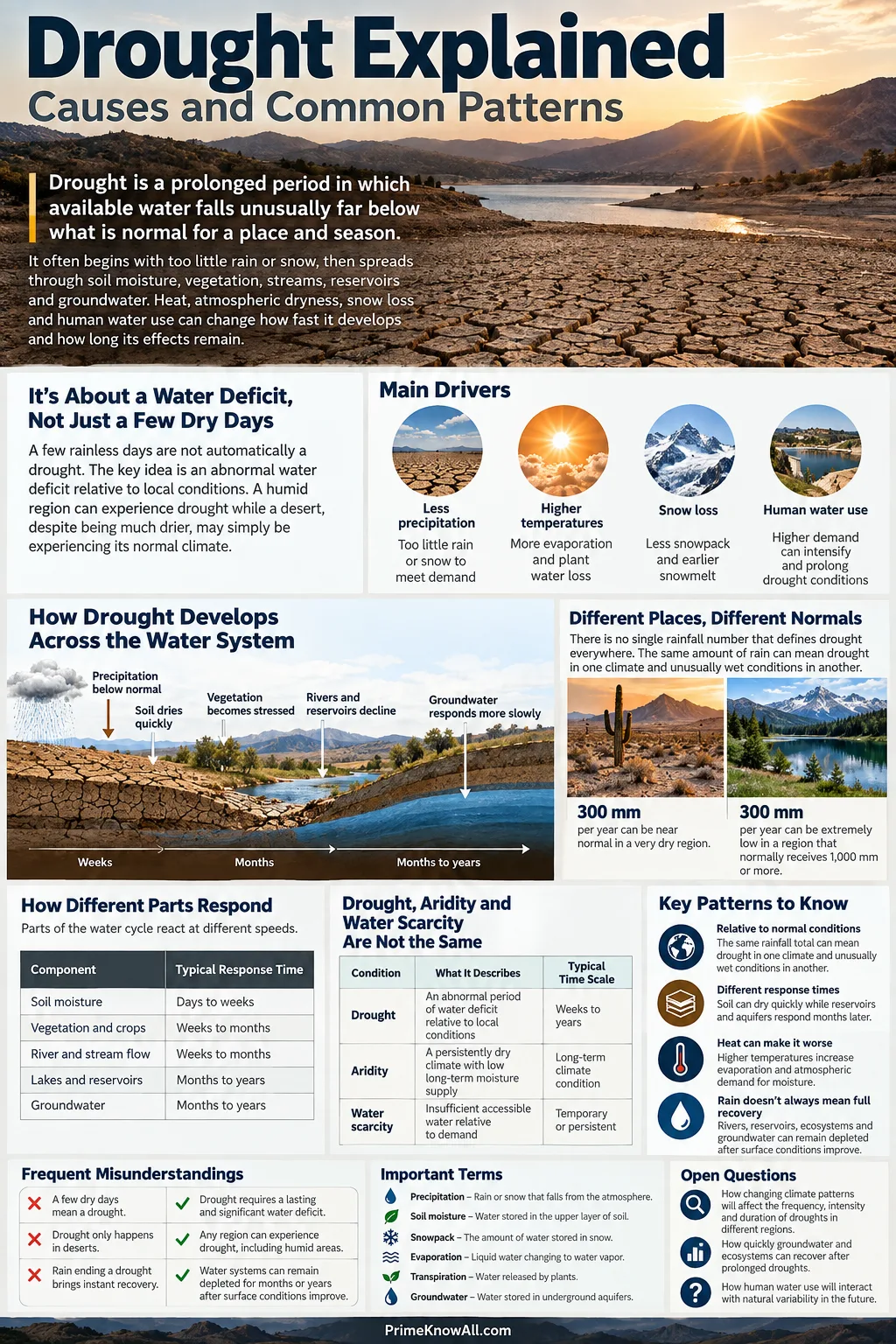
Drought is a prolonged period in which available water falls unusually far below what is normal for a place and season. It often begins with too little rain or snow, then spreads through soil moisture, vegetation, streams, reservoirs and groundwater. Heat, atmospheric dryness, snow loss and human water use can change how fast the shortage develops and how long its effects remain.
A few rainless days are not automatically a drought. The defining idea is abnormal water deficit relative to local conditions. A humid region can experience drought while a desert, despite being much drier, may simply be experiencing its normal climate.
- Drought is relative to normal conditions: the same rainfall total can mean drought in one climate and unusually wet conditions in another.
- Different parts of the water cycle react at different speeds: soil can dry quickly while reservoirs and aquifers respond months later.
- Heat can worsen a rainfall shortage by raising evaporation, plant water loss and atmospheric demand for moisture.
- Rain returning does not guarantee full recovery. Rivers, reservoirs, ecosystems and groundwater can remain depleted after surface conditions improve.
What Makes a Dry Period a Drought?
A dry period becomes a drought when the shortage lasts long enough and reaches far enough below expected conditions to create a meaningful water deficit. There is no single rainfall number that defines drought everywhere.
Climate varies too much for a universal threshold. A hypothetical annual total of 300 mm could be wetter than normal in a very dry region but extremely low in a place that normally receives 1,000 mm. Season also matters. Losing 100 mm during a normally dry month may have little effect, while losing the same amount during the main wet season can alter the water supply for months.
Drought assessments can consider several parts of the water system:
- rainfall and snowfall compared with the local climate record;
- soil moisture available to plants;
- evaporation and transpiration;
- snowpack and the amount of water stored in snow;
- river and stream flow;
- lake and reservoir levels;
- groundwater levels;
- vegetation stress and crop water demand.
This is one reason the beginning of a drought can be harder to identify than the arrival of a storm. Drought may develop gradually across several weeks or seasons, with each part of the landscape responding on its own timetable.
Drought, Aridity and Water Scarcity Are Different Conditions
Drought describes an abnormal episode. Aridity describes a long-term climate characteristic, while water scarcity describes a situation in which accessible water is insufficient for the demand placed on it. They can overlap, but they are not interchangeable terms.
| Condition | What It Describes | Typical Time Scale | Can It Occur in a Humid Climate? |
|---|---|---|---|
| Drought | An abnormal period of water deficit relative to local conditions | Weeks to years | Yes |
| Aridity | A persistently dry climate in which long-term moisture supply is low | Long-term climate condition | It defines a dry climate rather than a temporary event |
| Water scarcity | Insufficient accessible water relative to demand | Temporary or persistent | Yes |
A useful distinction: a tropical region can enter drought if rainfall falls far below its usual level. A desert can remain extremely dry without being in drought if conditions are close to its long-term norm.
How Drought Develops Through the Water Cycle
Most droughts begin with a persistent shortage of precipitation, but the effects can move through the water cycle long after the first rainfall deficit appears. This movement is often called drought propagation.
.drought-flow{max-width:760px;margin:28px auto;padding:22px;border:1px solid #d7dee8;border-radius:12px;background:#fff} .drought-flow-item{padding:15px 18px;border-left:4px solid #0B3D91;background:#f6f8fb;border-radius:6px} .drought-flow-arrow{text-align:center;padding:7px;color:#374151;font-weight:700} .drought-flow-title{color:#0B3D91;font-weight:700}Rain or snow remains below the amount normally received for the season.
Evaporation and plant water use continue while less water enters the soil.
Roots have less accessible water and plants may reduce growth or transpiration.
Less excess water reaches streams after soil and vegetation needs are met.
Longer-lasting deficits begin to affect slower water stores.
Water supply, agriculture and ecosystems may remain affected even after rainfall improves.
This sequence is common, but it is not a fixed timetable. Soil type, vegetation, snow storage, basin size, reservoir capacity, geology and water withdrawals can speed up, delay or partly interrupt the sequence.
A useful analogy is a set of connected bank accounts. Rain and snow provide the income. Soil moisture is a small account used frequently, rivers and reservoirs are larger accounts, and deep groundwater can act like slow-access savings. A temporary loss of income may empty the smallest account first, while larger stores remain available. During a long drought, withdrawals begin to reach those deeper reserves as well.
The Main Types of Drought
Drought can be classified according to where the water deficit is being observed. Meteorological, agricultural, hydrological, ecological and socioeconomic drought can occur together, but they do not always begin or end at the same time.
| Drought Type | Where the Deficit Appears | Common Indicators | Typical Response |
|---|---|---|---|
| Meteorological | Rainfall or snowfall | Precipitation anomaly, SPI | Can appear early |
| Agricultural | Soil and crop root zone | Soil moisture, evaporative demand, crop stress | Can develop rapidly during hot growing conditions |
| Hydrological | Rivers, reservoirs, lakes and groundwater | Streamflow, storage, groundwater level | Often responds more slowly |
| Ecological | Natural ecosystems | Vegetation stress, habitat conditions, stream temperature | Varies by ecosystem and season |
| Socioeconomic | Water-dependent goods and services | Supply relative to demand | Depends on water use and available storage |
Meteorological Drought
Meteorological drought occurs when precipitation remains unusually low for the location and season. It is commonly identified by comparing recent rain or snow with a long-term climate record.
The relevant time scale can range from weeks to years. A short deficit may matter for shallow soil moisture, while a year-long deficit can have much wider effects on rivers and stored water.
Agricultural Drought
Agricultural drought develops when soil water becomes insufficient for crops, pasture or other vegetation. Rainfall matters, but temperature, wind, humidity, plant growth stage, soil depth and irrigation access can alter the outcome.
The timing of the shortage can matter as much as its size. A moisture deficit during germination, flowering or grain filling may affect a crop differently from the same deficit at another growth stage.
Hydrological Drought
Hydrological drought appears when the shortage reaches streams, rivers, lakes, reservoirs or groundwater. It often lags behind meteorological drought because large water stores do not respond instantly to a few dry weeks.
A region can therefore have severely dry soil while a large reservoir still holds water accumulated during earlier wet years. If dry conditions continue, that stored buffer can shrink.
Ecological Drought
Ecological drought occurs when water availability falls far enough to place ecosystems under damaging stress. Effects can include reduced plant growth, warmer streams, lower aquatic habitat availability, declining water quality or longer-lasting vegetation change.
The threshold is not identical for every ecosystem. A wetland, alpine forest, grassland and desert shrub community have very different water needs and natural tolerance ranges.
Socioeconomic Drought
Socioeconomic drought occurs when a physical water shortage begins to constrain the supply of water-dependent goods or services relative to demand. Municipal water supply, irrigation, hydropower and navigation can all be affected under the right conditions.
Human demand changes this category strongly. Two regions with similar rainfall deficits can experience very different consequences if one has greater storage, lower demand or access to alternative supplies.
What Causes Drought?
Drought usually begins when weather patterns reduce precipitation for long enough to create an accumulating moisture deficit. Atmospheric circulation, ocean conditions, seasonal rainfall systems and temperature can all influence where that deficit develops and how quickly it intensifies.
Persistent High Pressure and Shifted Storm Tracks
A persistent high-pressure pattern can suppress rising air and cloud development over a region or help steer storm systems elsewhere. The effect becomes relevant to drought when the circulation pattern lasts long enough to reduce the precipitation that would normally replenish soil and water stores.
Storm tracks can also shift north, south or away from their usual route. A place does not need completely rain-free weather to develop drought. Repeated storms missing the region can gradually create the deficit.
Failure of a Main Wet Season
Some climates receive a large share of their annual water during a limited season. Missing that season can matter far more than several dry months that are normally dry.
This pattern is especially relevant in monsoon climates, Mediterranean climates and other regions with strongly seasonal precipitation. A poor wet season can leave soils, reservoirs and snow-fed water systems with less stored water before the dry part of the year begins.
Ocean–Atmosphere Patterns Such as El Niño
Large-scale ocean temperature patterns can reorganize atmospheric circulation and shift rainfall across wide areas. El Niño does not mean drought everywhere. It can raise the chance of dry conditions in some regions while making other regions wetter.
The local outcome depends on season, location and interactions with other climate patterns. This is why an ENSO phase should be treated as a change in probability rather than a guarantee of drought at a particular place.
A current example: WMO reported in September 2026 that El Niño was firmly established and expected to strengthen further into late 2026. Its seasonal outlook showed a classic uneven rainfall response, with higher drought risk in some regions and wetter conditions in others. The event illustrates why El Niño should not be translated into a single worldwide drought outcome.
Heat and Atmospheric Water Demand
Rainfall is only one side of drought. Warm, sunny, dry or windy weather can increase the rate at which water is transferred from land and plants to the atmosphere. This combined transfer is called evapotranspiration.
Potential evapotranspiration describes how much water could move to the atmosphere if enough water were available. It is influenced by temperature, solar energy, wind and humidity. High atmospheric demand can therefore deepen soil moisture loss during a period of low rainfall.
Why Vapor Pressure Deficit Matters
Vapor pressure deficit, or VPD, describes the difference between the amount of moisture in the air and how much moisture the air could hold at that temperature. Higher VPD corresponds to a drier atmosphere relative to its moisture-holding capacity.
When VPD is high, vegetation can lose water more rapidly and plants may close their stomata to limit water loss. Soil and vegetation stress can then intensify even if the rainfall deficit itself has not changed.
Water supply and atmospheric demand are separate parts of the problem.
- Low precipitation reduces the amount of incoming water.
- High evaporative demand increases the pressure removing water from soil and vegetation.
- When both occur together, landscape drying can accelerate.
Flash Drought Can Develop in Only a Few Weeks
Flash drought is the rapid onset or intensification of drought. The word “flash” refers to the speed of development, not necessarily to a short total duration.
A flash drought can form when below-normal precipitation combines with unusually high temperature, wind, solar radiation or atmospheric evaporative demand. Soil moisture can fall rapidly, leaving crops and ecosystems little time to adjust.
This differs from the familiar slow-onset pattern in which rainfall deficits accumulate for several months before strong impacts become visible. Flash drought can move from near-normal conditions toward severe plant and soil moisture stress within weeks.
| Feature | Slow-Onset Drought | Flash Drought |
|---|---|---|
| Development | Usually builds over months or longer | Can intensify over several weeks |
| Typical early signal | Accumulating precipitation deficit | Rapid soil moisture and evaporative-demand change |
| Heat influence | May worsen the drought | Can strongly accelerate development |
| Main challenge | Long-term accumulation | Limited time before impacts appear |
Snow Drought Can Begin Months Before Summer Water Shortages
Snow drought occurs when snowpack is unusually low for the time of year. In snow-fed regions, winter snow acts as temporary water storage and releases meltwater into streams during spring and summer.
Dry Snow Drought
A dry snow drought develops when cold-season precipitation itself is below normal. Less precipitation means less snow is available to accumulate.
Warm Snow Drought
A warm snow drought can occur even when total precipitation is closer to normal. Warm conditions cause more precipitation to fall as rain instead of snow, reduce snow accumulation or trigger unusually early snowmelt.
The shortage can become most visible later. A basin may receive winter precipitation yet enter summer with less snowmelt available to support rivers, reservoirs, irrigation and ecosystems.
Common Drought Patterns
Drought does not follow one universal sequence, but several recurring patterns help explain why water conditions can look very different from one region or season to another.
Meteorological Drought Often Appears Before Hydrological Drought
Rainfall can fall below normal immediately, but rivers, reservoirs and aquifers contain stored water from earlier periods. That stored water can delay the hydrological response.
As the deficit continues, less water reaches streams and recharge zones. Hydrological drought can then emerge after soil moisture and vegetation have already been affected.
The Reverse Lag Can Happen During Recovery
Rainfall may return before the entire water system recovers. Surface soil can become wet after several storms while deep groundwater remains low. A reservoir depleted over several dry years may also need far more water than a single wet month can provide.
This creates an important asymmetry: drought can end meteorologically while continuing hydrologically.
Drought Often Has a Seasonal Fingerprint
The effect of a precipitation shortage depends on when it occurs. The most damaging timing varies with the local water system.
- Mediterranean climates: weak winter rainfall can leave less stored water for the dry summer.
- Monsoon regions: a weak or badly timed rainy season can affect a large share of the annual water supply.
- Snow-fed basins: low winter snow storage can reduce spring and summer streamflow.
- Agricultural regions: soil moisture deficits can have different effects depending on the crop growth stage.
Hot Drought Can Reinforce Itself
When soil is wet, some incoming energy is used to evaporate water. As soil dries, less evaporative cooling may occur and more energy can heat the land surface and nearby air. Under suitable weather conditions, hotter and drier conditions can then raise atmospheric moisture demand and add further stress to vegetation.
This feedback is not equally strong in every landscape, but it helps explain why drought combined with heat can behave differently from a cool-season rainfall shortage.
Multi-Year Drought Can Outlast a Normal Rainy Season
A drought lasting several years can progressively reduce stored water. One near-normal season may stop further deterioration without fully replacing the water lost during earlier years.
For example, rainfall can return to normal while reservoir storage remains below normal because part of the new water is first absorbed by dry soils, vegetation and upstream areas. Groundwater recharge can take longer still.
Drought Is Rarely Uniform Across a Region
A drought map may show broad dry areas, but conditions on the ground can vary sharply. Elevation, soil depth, vegetation, geology, irrigation, river access and local rainfall all influence the result.
A mountain catchment may retain snow while a nearby valley dries. Irrigated fields may stay green while surrounding rain-fed land develops severe moisture stress. Deep-rooted vegetation may also respond differently from shallow-rooted crops.
Why One Heavy Rainstorm May Not End a Drought
A heavy storm can improve surface conditions quickly, but drought recovery depends on which part of the water system was depleted. Wet topsoil does not mean reservoir storage or groundwater has recovered.
Some rainfall is intercepted by vegetation, some evaporates, some replenishes dry soil and some becomes runoff. Only part may reach deeper groundwater. Where water stores have accumulated large deficits over months or years, recovery can require repeated wet periods rather than one storm.
Flooding and Drought Can Occur in the Same Place
A flood describes excess water over a short period; drought describes a water deficit over a longer period. These time scales can overlap.
A drought-stricken basin can receive intense rainfall that causes flash flooding while its seasonal rainfall total, reservoir level or groundwater storage remains below normal. A flood is therefore not proof that the longer drought has ended.
Human Water Use Can Amplify Drought Effects
Human water use does not have to cause the original rainfall deficit to change the severity of its effects. Withdrawals, storage decisions, irrigation and groundwater pumping alter how much water remains available as drought progresses.
A region with large reservoirs may buffer a short meteorological drought. Another area that depends heavily on shallow rivers can feel the shortage sooner. Heavy groundwater pumping can also deepen water-level declines when recharge is already reduced.
This is where drought and water scarcity can become intertwined. The climate controls part of the supply, while infrastructure, consumption and allocation influence how that supply is used.
How Scientists Measure Drought
There is no single instrument or index that measures every form of drought. Monitoring systems combine rainfall, temperature, soil moisture, streamflow, snow, groundwater, vegetation and other observations according to the question being asked.
A short agricultural drought and a deep groundwater drought can exist on different time scales. Using only one variable can hide that difference.
Common Drought Indicators and Indices
| Measure | What It Emphasizes | Useful For |
|---|---|---|
| Precipitation anomaly | Rain or snow compared with normal | Identifying meteorological dryness |
| Soil moisture | Water stored in the soil | Agriculture and vegetation stress |
| Streamflow | Water moving through rivers | Hydrological drought |
| Reservoir storage | Stored surface water | Water supply conditions |
| Groundwater level | Water stored below the surface | Longer-term hydrological conditions |
| Snow water equivalent | Amount of water contained in snowpack | Snow-fed basins |
| SPI | Standardized precipitation anomaly | Comparing rainfall deficits across several time scales |
| SPEI | Precipitation combined with potential evapotranspiration | Conditions where both supply and atmospheric demand matter |
| PDSI | Longer-term soil water-balance conditions | Tracking extended wet and dry periods |
| EDDI | Anomalous atmospheric evaporative demand | Detecting rapid drying pressure and conditions linked to flash drought |
Why Drought Indices Can Disagree
Different indices can give different answers without either one being wrong. They may be measuring different variables or different time scales.
A three-month SPI can show a recent rainfall deficit while a twelve-month measure remains closer to normal because earlier months were wet. SPEI can indicate stronger dryness than a precipitation-only measure when evaporative demand is unusually high.
Groundwater can create an even larger contrast. Recent rainfall may improve, yet an aquifer can remain depleted because recharge and subsurface movement take much longer.
What a Drought Map Is Actually Showing
A drought map should be read according to the variable and time period behind it. A soil moisture map, precipitation anomaly map and seasonal forecast do not describe the same thing.
- Observed precipitation maps show how much rain or snow has fallen.
- Anomaly maps compare recent conditions with a historical reference period.
- Soil moisture maps show conditions closer to plant water availability.
- Drought classifications may combine several observations and indices.
- Forecast maps describe probabilities for future conditions rather than the drought state already observed.
This distinction matters when two maps appear to conflict. They may simply be showing different layers of the same evolving drought.
How Drought Patterns Appear on the Ground
The mechanisms become easier to recognize when they are placed into realistic situations. The following examples show how similar weather deficits can produce different outcomes.
- A Mediterranean basin has a dry winter: summer is normally dry, so the main problem is that reservoirs and soils entered summer without their usual winter recharge.
- A farming area receives little rain during a heatwave: high evaporative demand accelerates soil moisture loss, allowing agricultural drought to intensify much faster than rainfall totals alone suggest.
- A mountain region has normal winter precipitation but unusually warm weather: more precipitation falls as rain and snow melts early, creating a warm snow drought even without a large total precipitation deficit.
- Several storms arrive after a year of drought: shallow soil moisture improves first, while depleted reservoirs and groundwater take longer to recover.
- A river basin has intense rainfall during an ongoing drought: local flooding can occur while the basin remains below normal in seasonal rainfall or stored water.
- Two neighboring districts receive similar rainfall: one experiences stronger water stress because its soils are shallow, irrigation demand is high or groundwater reserves are already low.
- A wet tropical area enters drought: rainfall may still exceed what a desert receives, yet it is far below the tropical region’s own normal level and insufficient for ecosystems adapted to abundant moisture.
What Recent Global Water Data Show
Recent observations show why drought is better understood as a whole-water-cycle problem rather than rainfall alone. The World Meteorological Organization reported in September 2026 that global river discharge during 2025 was among the driest observed in the previous 35 years.
The same assessment found that the previous seven years had the fewest rivers with flows classified as normal since 1991. WMO also reported a decline in water stored on Earth’s land surface over the preceding decade and continuing glacier loss across all regions for a fourth consecutive year.
Those observations describe global patterns rather than a single worldwide drought. Some regions were unusually dry while others experienced excess water. The contrast reinforces a central feature of the water cycle: too little water and too much water can occur in different places, or even in the same basin at different time scales.
How Climate Warming Can Change Drought
Climate warming can alter drought through several pathways, but the effect is not identical in every region or for every drought type. Higher temperatures can raise atmospheric evaporative demand, change snow accumulation and melt timing, and increase moisture loss where water is available to evaporate.
Changes in precipitation are more geographically varied. Some regions may become wetter on average while still facing dry episodes, and changes in heavy rainfall do not automatically translate into reliable soil moisture or groundwater recharge.
For this reason, the statement “climate change causes drought” is too broad to describe every event. Individual droughts develop through a mixture of weather variability, ocean–atmosphere patterns, land conditions, temperature and water management. Climate change can alter the background conditions and probabilities of some of those processes.
Why Drought Boundaries and End Dates Stay Uncertain
Drought has no universal start date, severity threshold or end date. Different definitions are useful for different sectors, climates and water systems.
A farmer may care most about root-zone soil moisture during a growing season. A reservoir operator may focus on inflow and storage over several years. A groundwater specialist may examine aquifer levels that respond slowly to rainfall. All can describe drought while observing different pieces of the system.
Measurement also has practical limits. Rain gauges are unevenly distributed, soil moisture varies over short distances, groundwater records may be sparse and satellite observations often need models or ground measurements for interpretation. Drought maps therefore represent the best available evidence for a defined variable and time scale rather than a perfectly sharp boundary on the landscape.
The same caution applies to recovery. Recent research on groundwater drought shows that aquifer depth and storage characteristics can produce very different lag and recovery behavior. A landscape that looks green again may still carry a deeper water deficit.
Questions About Drought
How long does a drought have to last?
There is no universal minimum duration. Drought is defined relative to the climate, season and water system being measured. Some agricultural or flash droughts can develop over weeks, while hydrological drought can persist for months or years.
Can drought happen in a rainforest?
Yes. Drought is based on conditions being abnormally dry relative to the local climate. A normally wet rainforest can experience drought even while receiving more rainfall than a desert.
Does heavy rain end a drought?
Not necessarily. Heavy rain can restore surface moisture quickly, but reservoirs, rivers and groundwater may need much more water and a longer period to recover.
What is the difference between drought and a dry spell?
A dry spell is a period with little or no precipitation. Drought involves a broader and more persistent moisture deficit relative to expected conditions and may affect soil, water supplies, vegetation or ecosystems.
What is flash drought?
Flash drought is a drought that begins or intensifies unusually quickly. Low precipitation combined with high temperature, wind, solar radiation or strong evaporative demand can cause soil moisture to fall rapidly over several weeks.
Can floods happen during a drought?
Yes. Floods describe excess water over a short time, while drought reflects a deficit over a longer period. An intense storm can produce flooding without replacing a large seasonal, reservoir or groundwater deficit.
Why do drought maps sometimes disagree?
They may measure different variables or time scales. One map may show rainfall, another soil moisture, another streamflow and another a forecast. Different results can therefore describe different parts of the same drought.
Drought is best understood as a moving water deficit: it can begin in the atmosphere, reach soils and vegetation, spread into rivers and stored water, then recover at different speeds. That layered behavior explains why neither a few dry days nor a single heavy storm can describe the full condition.
Sources
- NOAA/NIDIS Drought.gov – Drought Basics. NOAA’s national drought information system explains drought definitions, major drought types and the difficulty of identifying exact beginnings and endings.
- NOAA/NIDIS Drought.gov – Flash Drought. This federal resource explains rapid drought intensification and the roles of precipitation, temperature, wind, radiation, evapotranspiration and soil moisture.
- NOAA/NIDIS Drought.gov – Snow Drought. The page distinguishes dry snow drought from warm snow drought and explains the role of snowpack as seasonal water storage.
- World Meteorological Organization – State of Global Water Resources 2025. WMO’s global hydrological assessment supports the figures on 2025 river discharge, abnormal river flows, terrestrial water storage and glacier conditions reported in 2026.
- World Meteorological Organization – El Niño/La Niña Update, August 2026. WMO’s operational climate update supports the description of the strong 2026 El Niño and its uneven influence on temperature and rainfall patterns.
- IPCC Sixth Assessment Report, Working Group I – Water Cycle Changes. The assessment synthesizes peer-reviewed research on drought propagation, soil moisture, hydrological drought, evaporative demand and water-cycle responses to warming.
- Hydrology and Earth System Sciences – Groundwater Drought Propagation and Recovery. This peer-reviewed 2026 study examines lag, duration and recovery differences among aquifer systems, supporting the discussion of delayed groundwater response.
- National Drought Mitigation Center, University of Nebraska–Lincoln – Types of Drought. The university-based drought center explains meteorological, agricultural, hydrological, socioeconomic and ecological drought and how deficits propagate through water systems.
- American Meteorological Society Glossary of Meteorology – Drought. The peer-reviewed meteorological glossary provides a concise technical definition of drought and emphasizes that drought is a relative condition tied to location and water use.