
Earth has seasons because its rotation axis is tilted about 23.4° relative to its orbit around the Sun. As Earth travels around the Sun, that tilt changes the angle of sunlight and the length of daylight received by each hemisphere. Earth’s changing distance from the Sun is not the main cause of summer and winter.
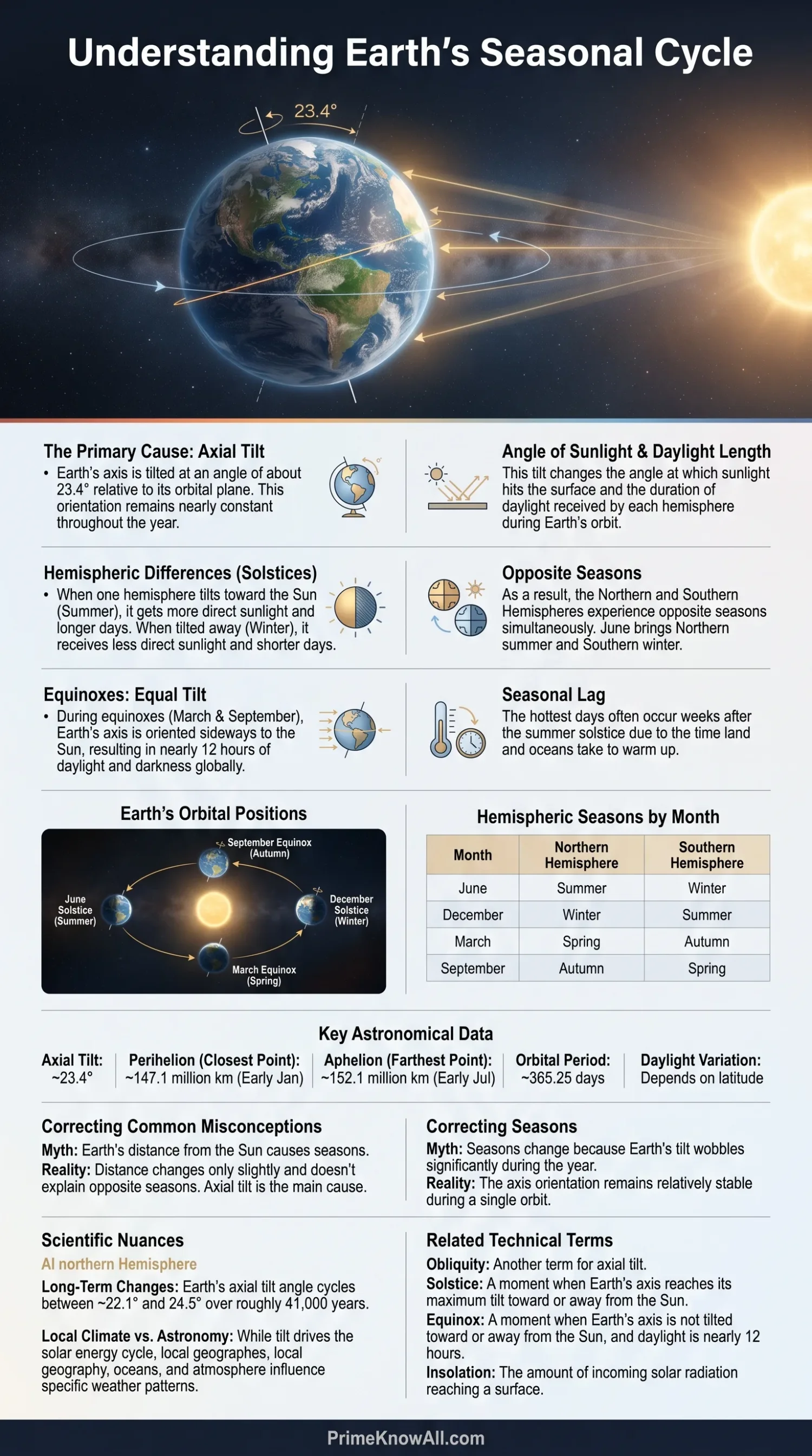
When a hemisphere tilts toward the Sun, the Sun climbs higher in its sky, daylight lasts longer, and solar energy reaches the surface more directly. When that hemisphere tilts away, the Sun stays lower, days shorten, and the same incoming energy is spread across a larger surface area. These changes create the familiar annual cycle of spring, summer, autumn, and winter across much of the planet.
- Earth’s rotational axis is tilted by about 23.4°.
- The Northern and Southern Hemispheres experience opposite seasons.
- Summer combines a higher Sun angle with longer daylight.
- Winter combines a lower Sun angle with shorter daylight.
- Earth is actually closest to the Sun during early January, when it is winter in the Northern Hemisphere.
Why Earth’s Axial Tilt Creates Seasons
Axial tilt, also called obliquity, is the angle between Earth’s rotation axis and a line perpendicular to its orbital plane. Earth’s present tilt is about 23.4°. The direction of that axis remains nearly fixed during a single trip around the Sun.
This means Earth does not straighten up and tilt again every six months. Instead, the planet carries its tilted orientation around its orbit. Around June, the North Pole leans more toward the Sun. Around December, it leans away, while the South Pole points more toward the Sun.
The effect can be pictured with a flashlight and a sheet of paper. Aim the light straight at the paper and its energy is concentrated in a smaller patch. Tilt the paper sharply and the same beam spreads across a larger area. Summer sunlight behaves more like the first case; winter sunlight behaves more like the second.
One orbit, one tilted axis, changing sunlight throughout the year
The rotation axis is tilted relative to the plane of Earth’s orbit.
Higher solar path + longer daylight + more direct sunlight = summer conditions.
Lower solar path + shorter daylight + less direct sunlight = winter conditions.
Neither hemisphere is tilted strongly toward the Sun. These positions produce the equinoxes.
One hemisphere reaches its greatest tilt toward the Sun while the other reaches its greatest tilt away. These positions produce the solstices.
Earth reaches perihelion near the start of January and aphelion around early July, yet the hemispheres have opposite seasons at the same time.
How Sun Angle Changes Surface Heating
A hemisphere becomes warmer in summer partly because sunlight reaches the ground at a steeper angle. A given amount of incoming solar radiation is concentrated over a smaller surface area than it is when the Sun sits low in the sky.
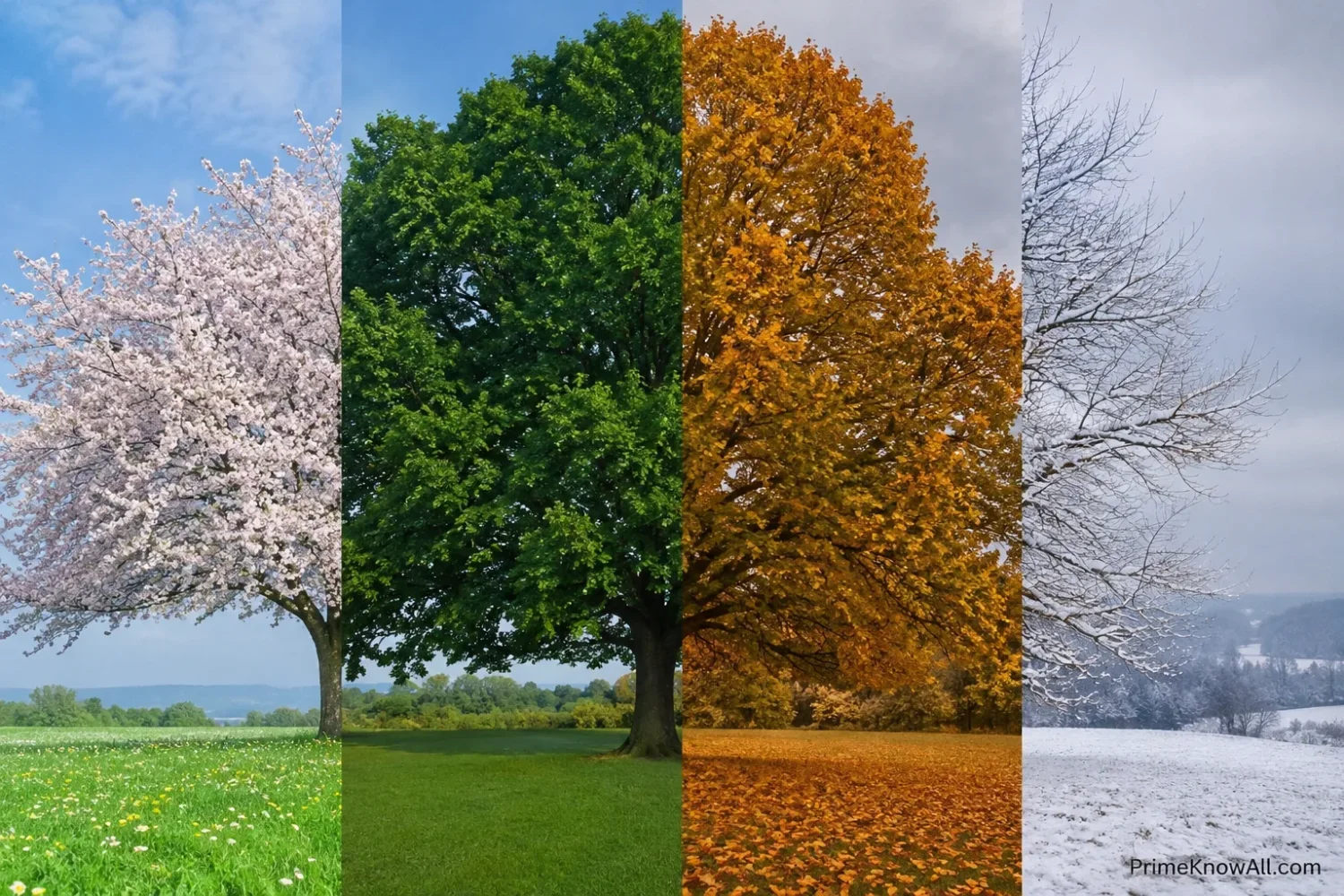
During winter, sunlight arrives at a shallower angle. The energy is spread across more ground, so each square meter receives less solar energy. The lower winter Sun also means incoming light travels through more atmosphere before reaching the surface.
This is why the height of the Sun at solar noon changes noticeably through the year at middle and high latitudes. A summer noon Sun can stand high overhead, while a winter noon Sun follows a much lower path across the sky.
Why Longer Summer Days Matter
Day length works together with Sun angle. A hemisphere tilted toward the Sun spends more hours illuminated during each rotation of Earth. More daylight gives the surface additional time to absorb solar energy.
In winter, the opposite occurs. Shorter days reduce the number of hours available for solar heating, while longer nights give the surface more time to lose heat.
The size of this daylight change depends strongly on latitude. Close to the equator, day length stays near 12 hours throughout the year. Farther north or south, seasonal differences become much larger.
Inside the Arctic and Antarctic Circles, the effect becomes extreme enough to produce periods of continuous summer daylight and continuous winter darkness. At the geographic poles, daylight and darkness each persist for months rather than switching every 24 hours.
Why the Northern and Southern Hemispheres Have Opposite Seasons
The two hemispheres cannot tilt toward the Sun at the same time. When the Northern Hemisphere is oriented toward the Sun, the Southern Hemisphere is oriented away from it. June therefore brings northern summer and southern winter.
About six months later, Earth has moved to the opposite side of its orbit. The geometry reverses. The Southern Hemisphere receives longer days and more direct sunlight, producing southern summer while the north experiences winter.
Solstices and Equinoxes Mark Earth’s Seasonal Positions
Solstices and equinoxes are precise astronomical events, not entire days. They describe particular moments in Earth’s orbit when the Sun-Earth geometry reaches specific positions.
June Solstice
At the June solstice, the Northern Hemisphere reaches its greatest annual tilt toward the Sun. Locations north of the equator have their longest daylight period of the year, while the Southern Hemisphere reaches its shortest.
December Solstice
The arrangement reverses at the December solstice. The Southern Hemisphere reaches its greatest tilt toward the Sun, while the Northern Hemisphere reaches its greatest tilt away.
March and September Equinoxes
At an equinox, Earth’s axis is oriented so that neither hemisphere is tilted toward the Sun more than the other. The geometric center of the Sun crosses Earth’s equator, and daylight becomes close to 12 hours across the planet.
The word equinox is often interpreted as meaning exactly equal day and night, but measured daylight is usually a little longer than 12 hours. Sunrise and sunset are defined using the edge of the Sun rather than its center, and atmospheric refraction makes the Sun appear above the horizon when it is geometrically slightly below it.
Earth’s 2026 Seasonal Markers
The dates below show the relationship between the astronomical seasons and Earth’s closest and farthest points from the Sun. Times are given in Universal Time (UT), so the calendar date can differ in some local time zones.
| Event | 2026 Date and Time (UT) | What It Means |
|---|---|---|
| Perihelion | January 3, 17:15 | Earth is closest to the Sun. |
| March Equinox | March 20, 14:46 | Northern spring and southern autumn begin astronomically. |
| June Solstice | June 21, 08:24 | Northern summer and southern winter begin astronomically. |
| Aphelion | July 6, 17:30 | Earth is farthest from the Sun. |
| September Equinox | September 23, 00:05 | Northern autumn and southern spring begin astronomically. |
| December Solstice | December 21, 20:50 | Northern winter and southern summer begin astronomically. |
Why Earth’s Distance From the Sun Does Not Cause the Seasons
The idea that summer occurs because Earth moves closer to the Sun sounds reasonable, but observations show that it cannot explain the seasonal cycle. Earth reaches perihelion, its closest orbital point to the Sun, in early January. That is winter across much of the Northern Hemisphere.
Earth reaches aphelion, its farthest point, around early July, during northern summer. NASA gives the present perihelion-to-aphelion distance difference as roughly 5.1 million kilometers (3.2 million miles). Because Earth’s orbit is close to circular, this corresponds to a distance change of only a few percent.
Distance does have a measurable effect. NASA estimates that Earth currently receives about 6.8% more incoming solar radiation at perihelion than at aphelion. But that variation affects the whole planet at once and cannot explain why one hemisphere has winter while the other has summer.
A simple test separates the two explanations: if Earth-Sun distance controlled the seasons, both hemispheres would warm and cool together. Instead, their seasons are reversed.
Why the Hottest Days Usually Come After the Summer Solstice
The June solstice provides the Northern Hemisphere with its longest days, but it is not normally the hottest part of summer. Many regions continue warming for several weeks afterward. This delay is known as seasonal lag.
Land, water, and the lower atmosphere take time to warm. After the solstice, incoming daytime energy can still exceed the amount of heat lost at night even though daylight has begun to shorten. Temperatures keep rising until the daily energy balance shifts toward cooling.
NOAA climate records show this pattern across much of the United States, where the warmest average period often arrives in July rather than directly on the June solstice. Oceans can delay seasonal temperature changes even more because water heats and cools more slowly than many land surfaces.
Why Seasons Change With Latitude
The effect of axial tilt becomes more visible as distance from the equator increases. Latitude controls how much the Sun’s height and daylight duration can change during the year.
- Near the equator: daylight stays close to 12 hours throughout the year, and the Sun remains relatively high in the sky.
- Subtropical regions: solar angle and day length change more, though temperature seasons may still be less pronounced than at higher latitudes.
- Middle latitudes: large changes in solar height and daylight produce the familiar temperature-based four-season cycle in many climates.
- High latitudes: seasonal daylight differences become very large, producing extremely long summer days and very short winter days.
- Polar regions: parts of the year can pass without a sunset or without a sunrise.
This is also why not every place experiences four seasons in the same way. Near the equator, changes in temperature can be relatively modest, while rainfall patterns may provide a more useful division between parts of the year. Local geography, ocean currents, elevation, winds, and regional climate patterns further shape what each season feels like.
Astronomical and Meteorological Seasons Are Different
The word season can refer to more than one calendar system. Astronomical seasons are tied to Earth’s orbital position and begin at the equinoxes and solstices. Their exact starting times therefore shift slightly from year to year.
Meteorologists and climatologists often use fixed three-month periods instead. In the Northern Hemisphere, meteorological spring runs from March through May, summer from June through August, autumn from September through November, and winter from December through February. The Southern Hemisphere uses the opposite seasonal arrangement.
Fixed months make it easier to compare temperature, rainfall, and other climate records across different years. Neither system changes the physical cause of Earth’s seasonal sunlight cycle.
What Would Happen if Earth Had No Axial Tilt?
If Earth’s rotational axis were perpendicular to its orbital plane, the familiar astronomical seasons would largely disappear. The Sun would follow nearly the same yearly path at each latitude, and daylight duration would remain close to 12 hours throughout the year.
The poles would no longer spend months tilted toward or away from the Sun. Middle latitudes would lose much of their present summer-winter contrast. Weather would still vary, and climate would still differ between the equator and poles because Earth is spherical, but the annual cycle produced by axial tilt would be greatly reduced.
How the Seasonal Cycle Appears in Everyday Life
- A long June evening in Europe: the Northern Hemisphere is tilted toward the Sun, so daylight extends well beyond the hours seen in December.
- A December beach day in southern Australia: southern summer occurs while Europe and much of North America are experiencing winter.
- A low winter Sun through a window: the shallower solar path can send sunlight farther into a room than the high summer Sun.
- Very late sunsets in Alaska: high northern latitude magnifies the daylight effect of Earth’s tilt as the June solstice approaches.
- July temperatures exceeding June averages: the surface continues gaining heat after the longest day because of seasonal lag.
- Nearly steady day length near the equator: low latitudes experience much smaller annual changes in daylight than places farther north or south.
- Opposite December conditions in Canada and Argentina: the hemispheres face opposite solar geometry even though both are almost the same distance from the Sun.
Several Ideas About Seasons Need Correction
“Earth Is Closer to the Sun in Summer”
This cannot explain the global seasonal cycle. Earth is closest to the Sun around early January, while the Northern Hemisphere is experiencing winter and the Southern Hemisphere is experiencing summer.
“Earth Tilts Back and Forth During the Year”
Earth keeps nearly the same axial orientation as it moves around the Sun. The changing position of Earth in its orbit makes each hemisphere alternately face more toward or away from the Sun.
“The Equinox Always Has Exactly 12 Hours of Daylight”
The geometry is close to a 12-hour split, but observed sunrise-to-sunset time is usually somewhat longer. The visible size of the solar disk and atmospheric refraction affect the measured times.
“Summer Starts Because the Weather Suddenly Becomes Hotter at the Solstice”
A solstice marks an astronomical position, not an instant temperature change. Local weather responds to oceans, land surfaces, cloud cover, atmospheric circulation, elevation, and accumulated heat, so temperatures can peak well after the solstice.
Earth’s Tilt Also Changes Over Very Long Periods
Earth’s axial tilt is not permanently fixed at exactly 23.4°. Over tens of thousands of years, gravitational interactions slowly change its angle. NASA describes a cycle of roughly 41,000 years in which Earth’s obliquity varies between about 22.1° and 24.5°.
A larger tilt produces stronger differences in summer and winter sunlight, especially at higher latitudes. A smaller tilt reduces those contrasts. These slow changes form part of the astronomical cycles associated with long-term changes in Earth’s climate and ice sheets.
Where Astronomy Stops and Local Climate Takes Over
Axial tilt explains why the yearly solar-energy cycle exists, but it cannot predict the exact weather of a particular season. Two cities at similar latitudes can have very different winters or summers because geography changes how the atmosphere and surface respond to incoming sunlight.
Ocean currents, proximity to large bodies of water, altitude, mountain ranges, snow cover, soil moisture, clouds, and atmospheric circulation can all modify seasonal temperatures. Seasonal boundaries used by cultures and weather services can also differ from the astronomical divisions based on solstices and equinoxes.
The basic physical pattern remains clear: Earth’s approximately 23.4° axial tilt changes solar angle and daylight duration as the planet completes its yearly orbit. Those changes redistribute solar energy between the hemispheres and create Earth’s repeating astronomical seasons.
Frequently Asked Questions About Earth’s Seasons
What is the main cause of seasons on Earth?
Earth’s seasons are mainly caused by its approximately 23.4° axial tilt. As Earth orbits the Sun, each hemisphere alternately receives more direct sunlight and longer days, then less direct sunlight and shorter days.
Does Earth’s distance from the Sun cause summer and winter?
No. Earth’s distance changes during its slightly elliptical orbit, but it is closest to the Sun in early January and farthest around early July. The opposite seasons of the Northern and Southern Hemispheres show that axial tilt is the main cause.
Why is summer warmer if the Sun is not much closer?
Summer brings a higher Sun angle and longer daylight. Solar energy is concentrated over a smaller surface area and reaches the ground for more hours each day.
Why are seasons opposite in the two hemispheres?
When the Northern Hemisphere tilts toward the Sun, the Southern Hemisphere tilts away. About six months later the arrangement reverses, so summer in one hemisphere occurs alongside winter in the other.
Why is the summer solstice not usually the hottest day?
Land, water, and the atmosphere take time to warm. For weeks after the solstice, many locations continue receiving more heat during the day than they lose at night, producing seasonal lag.
Are day and night exactly equal on an equinox?
Not usually when measured from sunrise to sunset. Atmospheric refraction and the apparent size of the Sun add several minutes of daylight, with the exact difference depending partly on latitude.
Sources
- NASA Science – Facts About Earth. NASA provides current reference values for Earth’s axial tilt, rotation, orbit, and annual motion around the Sun.
- NASA Space Place – What Causes the Seasons?. NASA explains the relationship between axial tilt, direct sunlight, opposite hemispheric seasons, perihelion, and aphelion in accessible terms.
- U.S. Naval Observatory – The Seasons and the Earth’s Orbit. The Naval Observatory provides astronomical detail on obliquity, Earth’s elliptical orbit, perihelion, solstices, and long-term orbital changes.
- U.S. Naval Observatory – Earth’s Seasons for 2026. This astronomical data service supplies the 2026 UT times used for the equinox, solstice, perihelion, and aphelion table.
- U.S. Naval Observatory – Length of Day and Night at the Equinoxes. This page explains why observed day and night are not normally exactly equal on the dates of the equinoxes.
- NOAA National Centers for Environmental Information – Meteorological Versus Astronomical Seasons. NOAA explains why climate records commonly use fixed three-month meteorological seasons rather than changing astronomical dates.
- NOAA National Centers for Environmental Information – When to Expect the Warmest Day of the Year. NOAA climate data illustrate why the warmest period in many locations arrives after the summer solstice.
- OpenStax Astronomy 2e – The Seasons. This university-level astronomy text explains solar angle, daylight length, latitude, and why orbital distance does not produce the seasons.
- NASA Science – Milankovitch Orbital Cycles and Their Role in Earth’s Climate. NASA documents Earth’s long-term obliquity cycle, current orbital eccentricity, and the difference in incoming solar radiation between perihelion and aphelion.