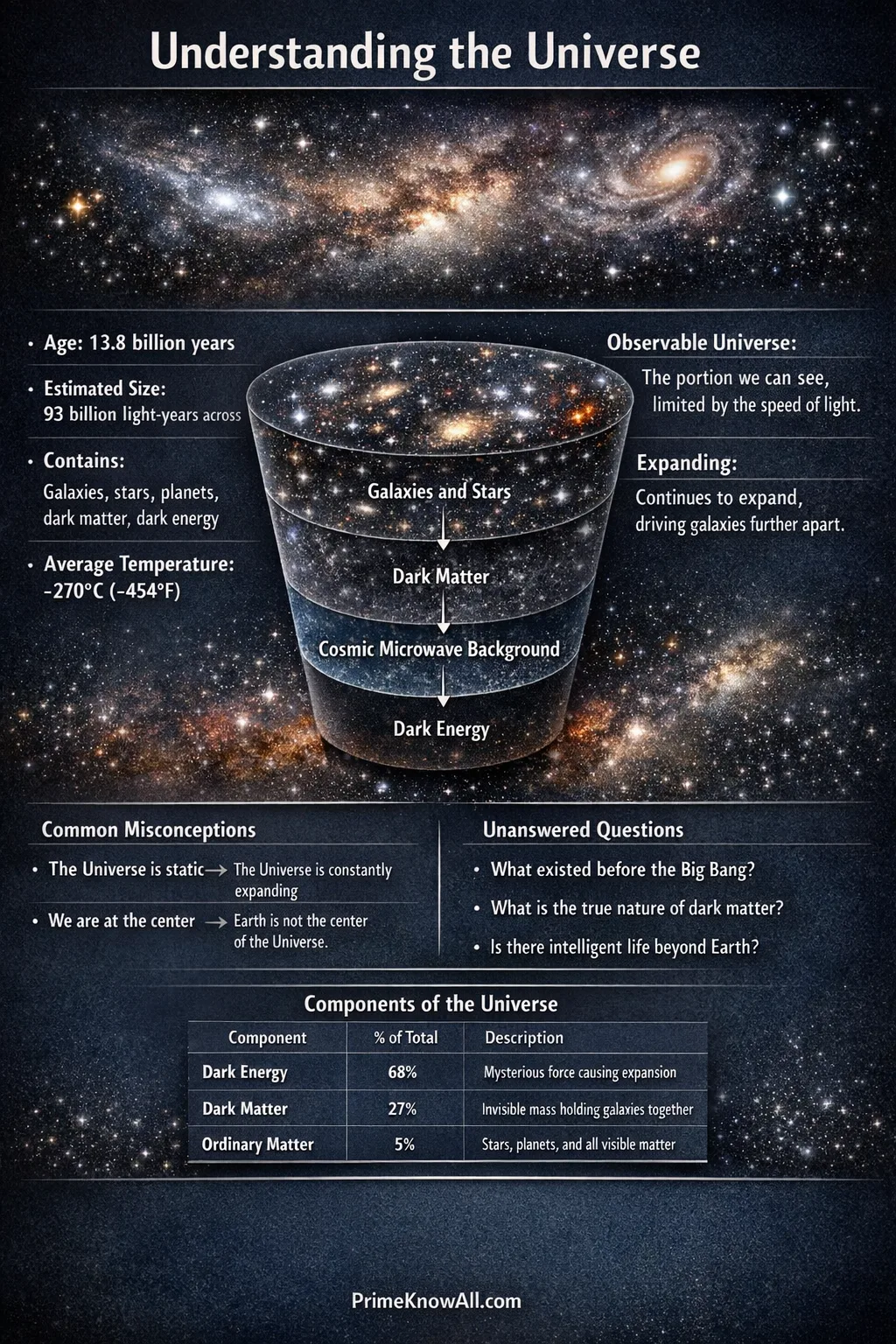
The universe is the totality of space, time, and everything that can exist within them: matter, energy, the laws of physics, and the evolving patterns that form galaxies, stars, planets, and the space between. It is not just a “place” filled with objects. In modern physics, the universe is an active system where space-time can stretch, bend, ripple, and shape what happens inside it.
A Practical Definition of the Universe
When scientists say universe, they usually mean a single connected physical reality described by the same underlying rules. That includes geometry (how space is shaped), contents (what exists), and history (how it changes). The universe is studied as a whole because many of its most important features—like expansion—only make sense at the largest scales.
A useful way to think about it is this: the universe is an evolving “stage” and “script” at the same time. The stage is space-time, which sets distances, time intervals, and motion. The script is physics—rules that govern how light travels, how matter clumps, and how energy transforms. The actors are everything from photons to galaxy clusters.
Observable Universe vs. the Whole Universe
There is an important distinction between the universe and the observable universe. The observable universe is the region we can, in principle, get information from—because light (or other signals) has had enough time to reach us since the universe became transparent. Beyond that horizon, space may continue, but it is currently unobservable, not necessarily nonexistent.
Common point of confusion: the edge of the observable universe is not a wall. It is a time limit set by the finite age of the cosmos and the speed at which information travels. As time passes, the observable region can change, but cosmic expansion also creates horizons that keep some regions permanently out of reach.
This is why two statements can both be true: the universe is about 13.8 billion years old, and yet the observable universe is far larger than 13.8 billion light-years across. Expansion means that the space light traveled through has been stretching the entire time.
How Big Is the Universe?
Size depends on which universe you mean. The observable universe is often described as a sphere with a radius of roughly 46 billion light-years (so about 92–93 billion light-years across). A light-year is a distance: how far light travels in one year, not a unit of time.
The whole universe could be vastly larger—possibly infinite—because our observations only cover a finite region. Cosmologists test the overall shape of space (its curvature) using patterns in the cosmic microwave background and the distribution of galaxies. Current measurements suggest space is very close to flat on large scales, which is compatible with either an extremely large finite universe or an infinite one.
What the Universe Is Made Of
When people think of the universe’s “ingredients,” they usually picture atoms: protons, neutrons, electrons, and the familiar chemistry of stars and life. Surprisingly, that everyday matter is only a small fraction. Modern cosmology describes a universe dominated by dark energy and dark matter, with ordinary matter making up the rest.
These fractions come from a blend of evidence: the glow of the early universe (the cosmic microwave background), how galaxies cluster, and how the universe’s expansion has changed over time. The numbers below are best thought of as well-supported estimates, not the final word.
| Component | Approximate Share | What It Does | How We Infer It |
|---|---|---|---|
| Ordinary matter (atoms) | ~5% | Forms stars, planets, gas clouds, people, and all known chemistry | Light from stars/galaxies, gas measurements, nucleosynthesis predictions |
| Dark matter | ~25–30% | Adds gravity; scaffolds cosmic structure without emitting light | Galaxy rotation, gravitational lensing, cluster dynamics, structure growth |
| Dark energy | ~65–70% | Drives accelerated expansion at cosmic scales | Supernova distances, CMB patterns, large-scale clustering |
| Radiation (photons, neutrinos) | <1% | Dominant in the early universe; still present as background relics | CMB temperature, neutrino physics, early-universe models |
Calling something “dark” does not mean it is spooky or supernatural. It simply means it does not interact with light the way atoms do, so it is hard to detect directly. Dark matter behaves like invisible mass, while dark energy behaves like a property of space itself, influencing the expansion of the universe.
How the Universe Changes Over Time
Cosmology is not only about what exists, but also about when it existed and how conditions evolved. The leading model is the Big Bang model: the universe has been expanding and cooling from a much hotter, denser state. Importantly, the Big Bang describes an early phase of the universe, not a conventional explosion into empty space.
A simplified timeline helps anchor the story. The exact details are still being refined, but the broad sequence is well established across multiple lines of evidence.
- Very early universe: rapid changes in energy and fields; many models include a brief period of inflation (an extremely fast expansion).
- First minutes: formation of light elements like hydrogen and helium in primordial nucleosynthesis.
- ~380,000 years: atoms form; the universe becomes transparent and releases the cosmic microwave background.
- Hundreds of millions of years: first stars and galaxies ignite; ultraviolet light begins reionizing intergalactic gas.
- Billions of years: galaxies grow, merge, and build heavy elements; planetary systems become common.
- Recent cosmic era: expansion accelerates, consistent with dark energy dominating the energy budget.
This history is why the universe is often described as a time machine for observers. Looking farther away means looking further back in time, because light takes time to travel. Deep-space surveys are not only mapping distance; they are mapping cosmic history.
The Universe Has Structure
At the largest scales, the universe is not evenly filled with galaxies like sprinkles in a jar. It forms a cosmic web: filaments of galaxies and gas connecting clusters, with huge voids in between. Dark matter plays a central role here, because its gravity helps gather ordinary matter into the places where galaxies can form.
Structure is built through a tug-of-war between gravity and expansion. Gravity tries to pull matter together; expansion increases distances. Over billions of years, small differences in density grew into the rich hierarchy we see: stars in galaxies, galaxies in groups, groups in clusters, and clusters in superclusters.
On smaller scales, the universe can look messy and local: spiral arms, exploding stars, black holes, and turbulent gas. Yet across very large distances, the distribution becomes statistically uniform. This idea is often summarized as the cosmological principle: on sufficiently large scales, the universe is homogeneous and isotropic (similar in all directions), even though it is clumpy up close.
The Rules That Make a Universe Behave
Physics describes the universe using a small set of deep principles. For cosmic scales, Einstein’s general relativity is the main tool: it links the distribution of energy and matter to the curvature of space-time. That curvature tells objects—and even light—how to move.
At very small scales, quantum physics dominates. The Standard Model of particle physics explains known particles and three of the fundamental forces with extraordinary precision. Cosmology often sits at the boundary between these domains, because the early universe combined extreme density with tiny scales. That is where questions about quantum gravity arise.
Four fundamental interactions are used to describe what we observe: gravity, electromagnetism, and the strong and weak nuclear forces. The universe’s large-scale behavior is shaped mostly by gravity and the overall energy budget, while stars, chemistry, and life depend heavily on electromagnetism and nuclear physics.
How We Learn About the Universe
Because the universe is not a laboratory experiment in the traditional sense, cosmology relies on careful inference. Scientists test models by checking whether they predict the same patterns that nature shows us—across many independent measurements. Confidence grows when different methods point to the same underlying picture.
- Telescopes across the spectrum: radio, infrared, visible, ultraviolet, X-ray, and gamma-ray observations reveal different physical processes.
- Cosmic microwave background studies: tiny temperature differences encode information about early-universe conditions and cosmic composition.
- Galaxy surveys: mapping millions of galaxies shows how structure formed and how expansion evolved.
- Gravitational lensing: the bending of light by mass traces dark matter directly through gravity.
- Gravitational waves: ripples in space-time provide a new channel for studying black holes and neutron stars.
- Particle physics and accelerators: recreate early-universe-like energies to test theories about matter and forces.
Good cosmology is also careful about limits. Some questions are currently unanswerable with existing data, and others have multiple plausible explanations. A strong model earns trust by being predictive and by surviving repeated tests, not by being the most dramatic story.
Questions That Are Still Open
Even with a successful standard picture of cosmology, the universe still holds deep mysteries. Some are about what exists, others about why the laws take the form they do. These open questions are active research frontiers, and they shape how future telescopes and experiments are designed.
- What is dark matter? Is it a new particle, a family of particles, or something more subtle about gravity?
- What is dark energy? Is it a constant property of space, a changing field, or a sign that the theory needs modification?
- Did inflation happen? Many observations fit inflation-like models, but researchers still debate its exact mechanism and how to test it decisively.
- Why is there more matter than antimatter? The early universe likely produced both, yet the visible cosmos is overwhelmingly matter.
- What happens at extreme densities? A complete theory that unifies quantum physics and gravity remains elusive.
These questions do not weaken the value of what we know. They highlight something more interesting: the universe is understood enough to make precise predictions, yet still unknown enough to leave room for surprising discoveries.
Common Misunderstandings
“What is the universe expanding into?” Expansion describes how distances between far-apart points in space increase over time. It does not require a surrounding empty room. In general relativity, space itself can expand without being embedded in something larger.
“Where is the center?” On large scales, expansion is not like debris flying from a single point. Every observer, in a broad sense, sees distant galaxies moving away, because the metric (the way distances are defined in space-time) changes with time. That makes the idea of a single central location misleading.
“Is the universe the same as ‘space’?” Not quite. Space is part of the universe, but the universe also includes time, contents, and the laws that relate them. Saying “the universe is space” is like saying “a novel is paper.” The paper matters, but so do the story and the structure.
“If we can’t see beyond the observable universe, it must not exist.” Lack of observation is not proof of absence. It is simply a boundary of current information. Cosmology handles this by focusing on what can be tested, while building models that remain consistent if the universe extends further.
Sources
- NASA Science – Universe [Clear overview of cosmic expansion, large-scale structure, and modern cosmology topics]
- NASA WMAP – Universe 101 [Accessible explanations of the Big Bang model, the CMB, and the observable universe]
- European Space Agency – Planck [Mission background and why precise CMB measurements matter for universe composition and age]
- European Space Agency – Cosmology [Short guides to key ideas like expansion, cosmic history, and the early universe]
- LIGO Caltech – What Are Gravitational Waves? [Intro to space-time ripples and why they are a new way to observe the universe]
- CERN – The Standard Model [Foundational reference for the particle physics theory used in early-universe cosmology]
FAQ
Is the universe infinite?
No one knows for sure. Measurements suggest the universe is very close to spatially flat at large scales, which fits both an infinite universe and a finite but extremely large one. What can be tested directly is the observable universe, not the full extent beyond cosmic horizons.
How old is the universe?
Current cosmological measurements indicate an age of about 13.8 billion years. This value comes from combining observations such as the cosmic microwave background, galaxy clustering, and expansion history.
What is the difference between space and space-time?
Space refers to the three dimensions of distance. Space-time combines space with time into one connected structure. In general relativity, gravity is described as the curvature of space-time, which affects how matter and light move.
Why can the observable universe be larger than 13.8 billion light-years?
Because the universe has been expanding while light has been traveling. Light from very early times has been moving toward us for 13.8 billion years, but the space it crossed also stretched, making today’s distances to those regions much larger than 13.8 billion light-years.
Does dark matter mean “hidden planets” or faint stars?
No. Dark matter is inferred from its gravitational effects and cannot be explained by ordinary objects like dim stars, dust, or rogue planets alone. It behaves like non-luminous mass distributed in large halos around galaxies and clusters.
Article Revision History
