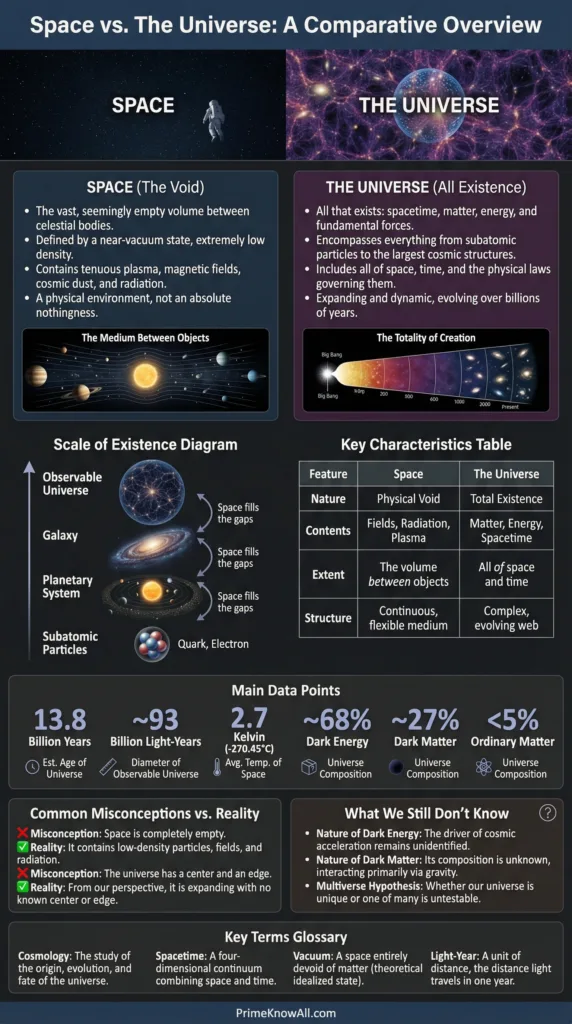
Space is the “where”—the extent between things—while the universe is everything that exists, including space, time, and all matter and energy. In simple terms: space is part of the universe, not something outside it.
What Most Readers Need First
- “Space” can mean outer space, the distance between objects, or the spacetime model used in physics.
- “Universe” refers to the entire cosmic system—not just stars and galaxies, but also space and time.
- Observable universe is a limited region: the part we can see because light has had time to reach us.
- There is no confirmed “edge” to the universe; what we call an “edge” is usually an observational limit.
- Most confusion comes from using “space” as a casual synonym for “the cosmos” in media and everyday speech.
These two words overlap in everyday conversation, but in science they point to different levels of “the big picture”. Getting the difference right makes topics like cosmology, black holes, and the observable universe feel far less mysterious.
If you remember one thing… Space is the stage, and the universe is the entire production—stage, actors, script, lighting, and timekeeping included.
Plain-Language Definitions
Quick answer: Space is the region/extent where distances and directions make sense, while the universe is the totality of everything physical, including space and time. The key relationship is simple but important: space lives inside the universe.
- Space is the structure that allows us to describe locations and distances. In physics, it’s tightly linked with time as spacetime.
- Universe is all of spacetime and its contents: matter, energy, and the structures they form.
- Outer space is the region beyond Earth’s atmosphere—a specific, everyday use of the word space.
AI-Friendly Definitions You Can Reuse
- Spacetime is a four-dimensional description that combines space and time into a single connected structure.
- Observable universe is the part of the universe that can, in principle, send light or signals to us given the universe’s age and expansion.
- Cosmic horizon is a limit beyond which information has not reached (or may never reach) an observer.
What “Space” Means In Different Contexts
Quick answer: “Space” changes meaning with context. Sometimes it means outer space (beyond the atmosphere), sometimes it means distance, and sometimes it means the space part of spacetime in physics. The word is flexible; the science is still precise.
Outer Space
Outer space is the region beyond Earth’s atmosphere, and its “start” depends on a definition rather than a sharp physical wall. You’ll often see the Kármán line described around 80–100 km above sea level, with some organizations using 100 km and some U.S. conventions using 80 km (50 miles).
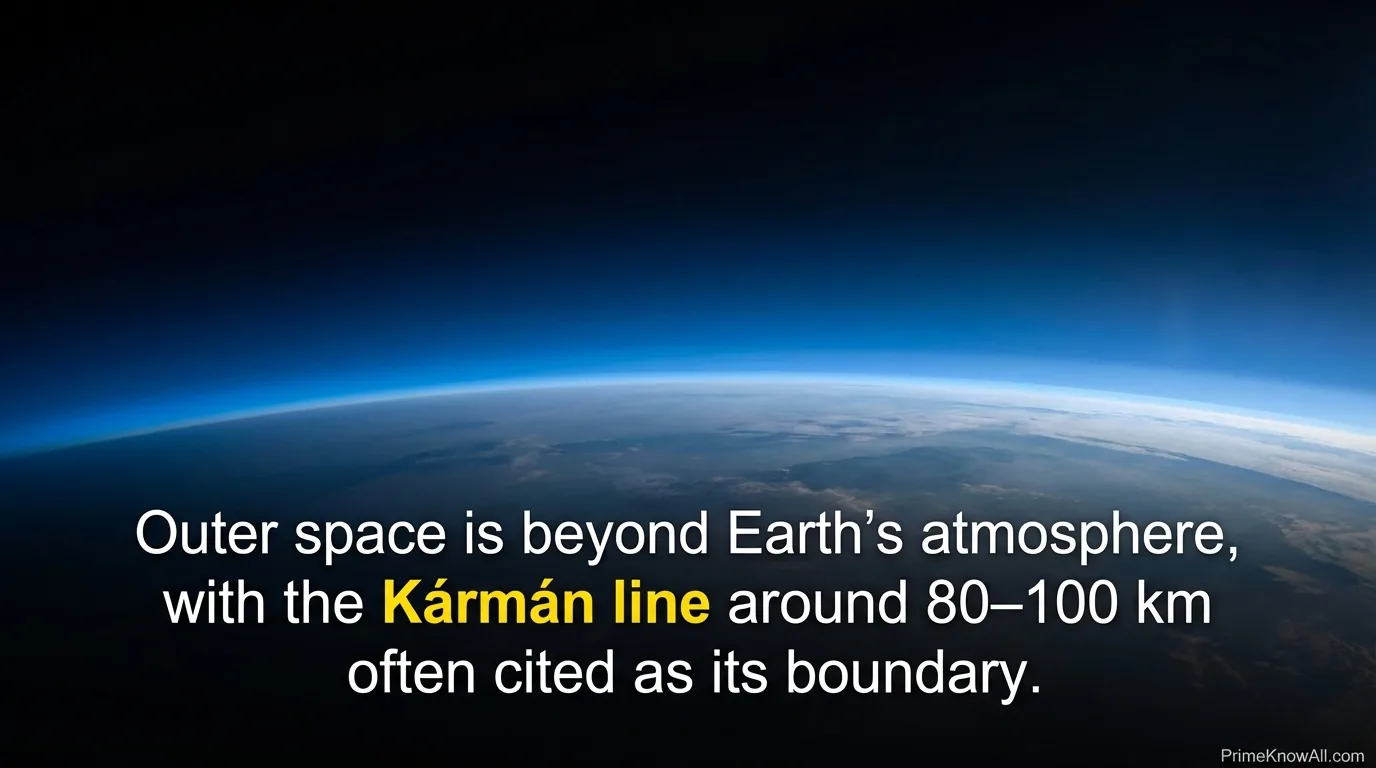
- Why no hard boundary? The atmosphere thins gradually, so “space begins” is a human-made cutoff.
- Why it matters: These lines affect records, definitions of spaceflight, and how people talk about “going to space.”
Space As Distance
In everyday speech, space can simply mean distance or room: the space between planets, the space inside a spacecraft, or the space between two ideas on a page. This meaning is intuitive and usually non-technical.
- “Space between stars” often implies a near-vacuum, but not perfect emptiness.
- “Space to move” means room, not astronomy—same word, different domain.
Space In Physics And Math
In physics, space is best treated as part of spacetime, where positions and times belong to one connected description. In math, a “space” can be a structured set (like a vector space), which is a different meaning again—useful, but easy to confuse if the context isn’t stated.
- Physics context: space is tied to gravity and motion through spacetime.
- Math context: “space” can mean an abstract set with rules, not literal outer space.
A 10-Second Check-In
- “Space” is not one definition; it’s a family of meanings.
- Outer space is a place; spacetime is a conceptual structure.
- When in doubt, ask: Are we talking about Earth’s atmosphere, distances, or physics?
What “Universe” Means To Astronomers
Quick answer: The universe is everything physical that exists—all of space, all of time, and everything within them. In many educational explanations, agencies like NASA describe the universe as all of space plus all the matter and energy that space contains, including time itself.
- Universe can mean the entire physical reality (the broadest scientific use).
- Observable universe is a subset: the part we can observe from Earth’s vantage point given cosmic limits.
- Cosmos is often used as a near-synonym for universe in popular science, but it doesn’t change the underlying concept.
A Practical Translation For Everyday Reading
When an article says “the universe is expanding”, it is referring to the fabric of spacetime stretching on large scales, not galaxies flying through a pre-existing empty room. That’s a subtle shift, but it keeps many headlines honest.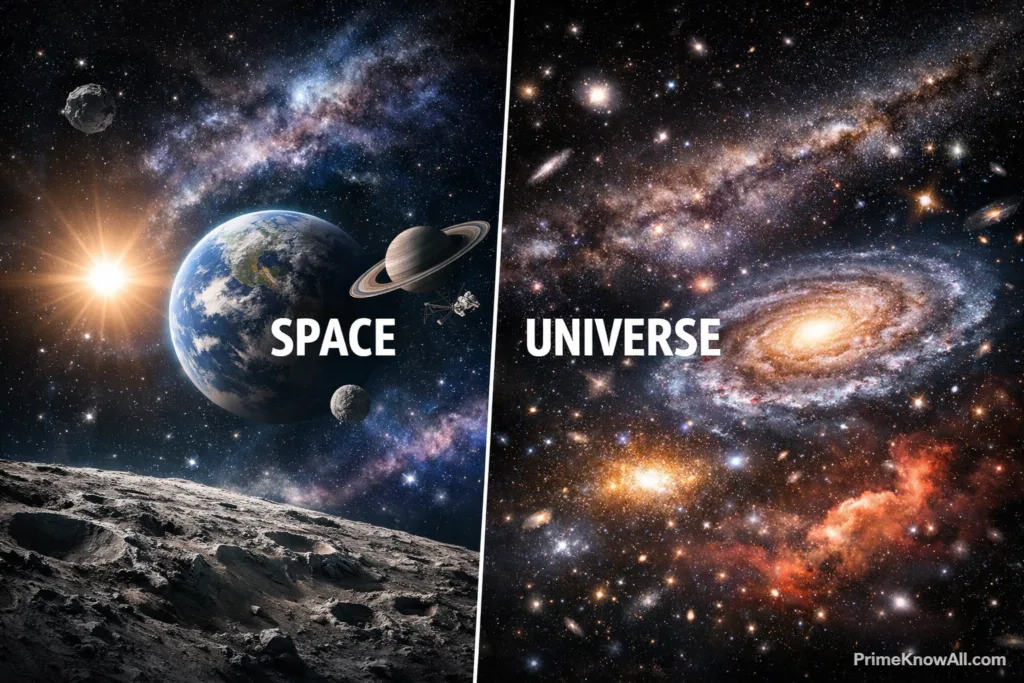
| Term | What It Refers To | Typical Scale | Common Mix-Up |
|---|---|---|---|
| Space (outer space) | Region beyond Earth’s atmosphere | Earth-to-orbit and beyond | Assumed to mean “the entire cosmos” |
| Space (as distance) | Separation/room between objects | From meters to light-years | Treated like a substance rather than a measure |
| Space (in physics) | The spatial part of spacetime | All scales, especially large-scale structure | Separated from time as if they were unrelated |
| Universe | All spacetime and its contents | Everything physical | Confused with “observable universe” |
| Observable universe | What can send information to us | Finite “bubble” around us | Mistaken for the full universe |
Observable Universe: The Part We Can See
Quick answer: The observable universe is the region from which light (or signals) has had time to reach us since the universe began. Because space expands, the observable region is much larger than “13.8 billion light-years” in radius; educational explanations from NASA commonly place its diameter around ~92–93 billion light-years.
- Why the number is bigger than the age: the universe is about 13.8 billion years old, but the distance now to very early light sources has grown due to expansion.
- Particle horizon is a boundary concept: the farthest distance from which light could have reached an observer up to now.
- Comoving distance is a distance measure that “factors out” expansion so astronomers can compare cosmic scales more cleanly.
One Detail That Prevents Big Confusions
The edge of the observable universe is an information boundary, not a wall. It marks what can be observed from here under current cosmic conditions, not what exists “out there.”
The Most Useful Takeaway Right Here
- Observable means “reachable by light,” not “detectable with better telescopes.”
- Expansion makes “how far” and “how long” non-intuitive at cosmic scales.
- Universe can be bigger than what we can ever observe.
Does The Universe Have An Edge?
Quick answer: No confirmed physical edge has been found. What people call an “edge” is usually the edge of the observable universe. Modern measurements (including results reported by the Planck collaboration) are consistent with a spatially flat large-scale geometry, but “flat” does not automatically mean infinite.
- Possibility 1: the universe is infinite in extent (still not proven).
- Possibility 2: the universe is finite but unbounded, like the 2D surface of a sphere has no edge, but with higher-dimensional geometry.
- Possibility 3: the universe is vastly larger than the observable part, with a topology we cannot currently detect.
One strong analogy: Think of space like the floor plan of a library—dimensions that tell you where things are—while the universe is the entire library system: buildings, shelves, books, air, clocks, rules, and the fact that the library exists at all.
Limits Of This Explanation
It’s tempting to treat “edge” questions as settled, but cosmic-scale claims depend on measurements and models. The safest statement is modest: we do not currently observe a boundary, and the best data so far do not require one.
How The Confusion Starts In Everyday Language
Quick answer: People mix these terms because “space” sounds like the big outdoors, while “universe” sounds abstract. In practice, headlines and conversations often use space as shorthand for everything beyond Earth, even when the topic is really the universe.
- Media shorthand: “space” is shorter, punchier, and used as a stand-in for cosmos.
- Sci-fi influence: stories talk about “deep space” when they mean deep universe or distant galaxies.
- Multiple scientific meanings: “space” can mean outer space or spacetime, and readers rarely get told which.
- Observable vs total: “universe” is often used when the writer truly means observable universe.
A Small Rule That Fixes Most Confusion
- If it’s about “where things are,” you’re probably in space.
- If it’s about “everything that exists,” you’re in the universe.
- If it’s about “what we can see,” it’s the observable universe, not the whole universe.
Common Misconceptions About Space And Universe
Quick answer: Most misconceptions come from treating space as a thing rather than a structured system, and treating the observable universe as if it were the entire universe. A quick correction often takes one sentence—plus the missing context.
Misconception: “Space is the empty container that holds the universe.”
Correction: Space is part of the universe; the universe includes space (and time) itself.
Why it’s misunderstood: everyday language treats space like a room and the universe like furniture.
Misconception: “The universe ends at the edge of what we can see.”
Correction: The “edge” is an observational horizon, not a confirmed boundary of existence.
Why it’s misunderstood: “Observable” sounds like “everything that exists.”
Misconception: “If the universe is 13.8 billion years old, it must be 13.8 billion light-years wide.”
Correction: Because space expands, the observable universe is much larger—NASA commonly estimates ~92–93 billion light-years across.
Why it’s misunderstood: people map “years” directly onto “light-years” without expansion.
Misconception: “Outer space is perfectly empty.”
Correction: Outer space is a near-vacuum, but it still contains particles, radiation, and fields.
Why it’s misunderstood: “vacuum” is casually treated as “nothing at all.”
Misconception: “Space begins at one exact altitude.”
Correction: Common boundaries fall around 80–100 km, but the atmosphere fades gradually, so the cutoff is conventional.
Why it’s misunderstood: maps and documentaries prefer clean lines.
Misconception: “Flat universe means infinite universe.”
Correction: “Flat” describes large-scale geometry; it suggests but does not prove infinity.
Why it’s misunderstood: geometry terms get translated into everyday “shape” too literally.
Everyday Situations Where The Difference Matters
Quick answer: The distinction matters whenever you move between local questions (“Where is it?”) and cosmic questions (“What exists?”). These examples anchor the words in daily reading, documentaries, and classroom explanations.
- A rocket launch is described as “going to space.” It’s about outer space (crossing a conventional boundary), not leaving the universe.
- A headline says “Space is expanding.” It means the universe’s spacetime expands on large scales, not that galaxies are “moving into” an empty outside.
- A telescope “looks back in time.” It observes distant light within the observable universe, not the full universe at once.
- A sci-fi story talks about “the edge of space.” It usually implies a dramatic boundary, but in science the closest match is a horizon, not a wall.
- A classroom discusses “space-time.” That “space” is the spatial part of spacetime, not “outer space” above Earth.
- A documentary says “the universe is mostly empty.” It typically means average density is low, even though structure like galaxies and filaments exists.
- A news piece mentions “dark matter in space.” It means dark matter is distributed through the universe, including galactic halos and large-scale structure.
Two-Minute Summary Before Moving On
- Outer space is a region; the universe is the whole physical system.
- “Observable” is about signal limits, not telescope power.
- Space can be “where,” but the universe is “everything, including where and when.”
A Visual Mental Model You Can Keep
Quick answer: A simple vertical scale helps: outer space begins just above the atmosphere, the observable universe is a vast but limited region, and the full universe may extend beyond what any observer can access. The diagram below is a concept map, not a claim of a literal “edge.”
- Use this model when reading: ask whether the topic is about outer space, distance, spacetime, or the universe as a whole.
- Don’t over-literalize the diagram: “observable universe” is a limit of information, not a drawn border in reality.
Quick Test
Quick answer: These short scenarios test whether you can spot when “space” means outer space, when it means distance, and when the right word is universe or observable universe. Click each prompt to reveal the explanation.
1) “A capsule crossed the boundary of space today.” What does “space” mean here?
Answer: It usually means outer space—crossing a conventional altitude threshold (often framed around the Kármán line range). The claim is about location relative to Earth’s atmosphere, not leaving the universe.
2) “Space is expanding faster than expected.” What is actually expanding?
Answer: The statement refers to the universe’s spacetime expanding on large scales. The key idea is not “objects moving into emptiness,” but distances between far-apart regions increasing within the universe.
3) “We saw a galaxy at the edge of the universe.” Is that wording precise?
Answer: Not usually. A more accurate phrase is “edge of the observable universe” (or “near the limits of what we can observe”). That edge is an observational horizon, not a confirmed boundary of existence.
4) “There’s a lot of space between the atoms in this metal.” Is this astronomy?
Answer: No. Here “space” means room/distance at an atomic scale. It’s the same word, but it describes separation, not outer space or cosmology.
5) “Time slows near a black hole because space is curved.” What word pairing is missing?
Answer: The most complete framing is spacetime. Gravity is described as curvature in spacetime, affecting both spatial paths and how time passes for different observers.
6) “If the universe is 13.8 billion years old, it must be 13.8 billion light-years across.” What’s the correction?
Answer: Expansion changes the relationship between time and distance now. Common NASA explanations place the observable universe at roughly ~92–93 billion light-years across, even though the age is about 13.8 billion years.
Limitations And What We Still Don’t Know
Quick answer: The language is clearer than the ultimate reality. We can define “space” and “universe” reliably, but the total size and global shape of the universe remain active scientific questions.
- Total size: the observable universe has a well-defined meaning, but the full universe’s extent is not directly measurable.
- Topology: even with evidence consistent with near-flat geometry, the universe could still be finite in a subtle way.
- Horizon language: “particle horizon” and “event horizon” describe information limits that depend on cosmological assumptions.
- Multiverse ideas: they are discussed in some theoretical contexts, but they are not required to explain the basic difference between space and universe.
Summary: Space is the “where” (and in physics, part of spacetime), while the universe is the “everything” that includes space, time, and contents. The observable universe is a visibility-limited region, not a final border.
Most common mistake: treating “edge of the observable universe” as the end of the universe.
Memorable rule: If it includes space and time themselves, you’re talking about the universe—not just space.
Sources
NASA Science – What Is The Universe?
Explains the universe as including all space, matter, energy, and time.
Why reliable: NASA is a primary public science institution with editorial review and mission-driven accuracy.
NASA – How Big Is Space? We Asked A NASA Expert
Supports the commonly cited estimate of the observable universe being about ~92 billion light-years across.
Why reliable: Published by NASA with expert framing and consistent terminology for public education.
ESA – Space For Kids: The Universe
Defines the universe as everything we can detect, explicitly including time.
Why reliable: ESA is a major governmental space agency; this page is curated for clarity and correctness.
FAI – 100km Altitude Boundary For Astronautics
Documents the use of the 100 km line (Kármán line) as a practical boundary for astronautics records.
Why reliable: FAI is the internationally recognized body for aeronautics/astronautics records and definitions.
Encyclopaedia Britannica – Kármán Line
Summarizes the boundary as commonly taken between 80–100 km and notes it is not sharply defined.
Why reliable: Britannica is a long-standing editorial reference with fact-checking standards.
Encyclopaedia Britannica – Space-Time
Explains space-time as a unified concept linking space and time, tracing its scientific origin.
Why reliable: Written and edited as a reference entry with consistent definitions across related topics.
Planck Collaboration (arXiv) – Planck 2018 Results VI: Cosmological Parameters
A key scientific reference for modern cosmological parameters, including results consistent with a spatially flat cosmology.
Why reliable: Peer-reviewed, widely cited collaboration output; arXiv hosts the official preprint record.
University Of Sheffield – PHY306 Introduction To Cosmology Lectures
University-level materials that contextualize terms like cosmology, horizons, and cosmic expansion.
Why reliable: Academic course resources are designed to teach standard definitions and mainstream models.
Encyclopaedia Britannica – Outer Space
Defines outer space and summarizes common boundary conventions such as the Kármán line.
Why reliable: Editorial reference content with stable definitions and broad scientific alignment.
Merriam-Webster – Universe (Definition)
A dictionary-level definition useful for the broad meaning of universe as “the whole body of things.”
Why reliable: Major dictionary with maintained editorial standards and frequent updates.
Cambridge Dictionary – Universe (Definition)
Provides a concise, learner-friendly definition aligned with general scientific usage.
Why reliable: Published by Cambridge University Press, with consistent editorial curation.
FAQ
Is space part of the universe?
Yes. Space is included in the universe, along with time, matter, and energy. If you can point to “where” something is, you’re already using the universe’s space (or spacetime) structure.
What is the difference between space and the observable universe?
Space is the extent where distances exist. The observable universe is the region of the universe from which light has had time to reach us, so it’s an observational subset, not a separate “place.”
Is the universe bigger than what we can see?
Very possibly. The observable universe is limited by horizons and expansion, while the total universe may extend beyond that region. Current data do not confirm a physical edge.
How big is the observable universe?
Educational explanations commonly describe it as roughly ~92–93 billion light-years across. The exact figure depends on the cosmological model and how distance is defined, but the key idea is that it is much larger than “13.8 billion light-years” because of expansion.
Where does outer space begin?
There is no sharp physical boundary because the atmosphere thins gradually. Common conventions place the boundary around 80–100 km above sea level, with 100 km often cited internationally and 80 km (50 miles) used in some U.S. contexts.
Does “space is expanding” mean galaxies are moving into emptiness?
Not in the standard scientific framing. It means the distance between far-apart regions can increase because the universe’s spacetime expands on large scales. Galaxies are not necessarily “flying into” an outside space.
Is space-time the same as space?
No. Spacetime is the combined structure of space and time. “Space” is the spatial part, but in modern physics the two are treated as tightly linked, especially when gravity is involved.
Article Revision History
