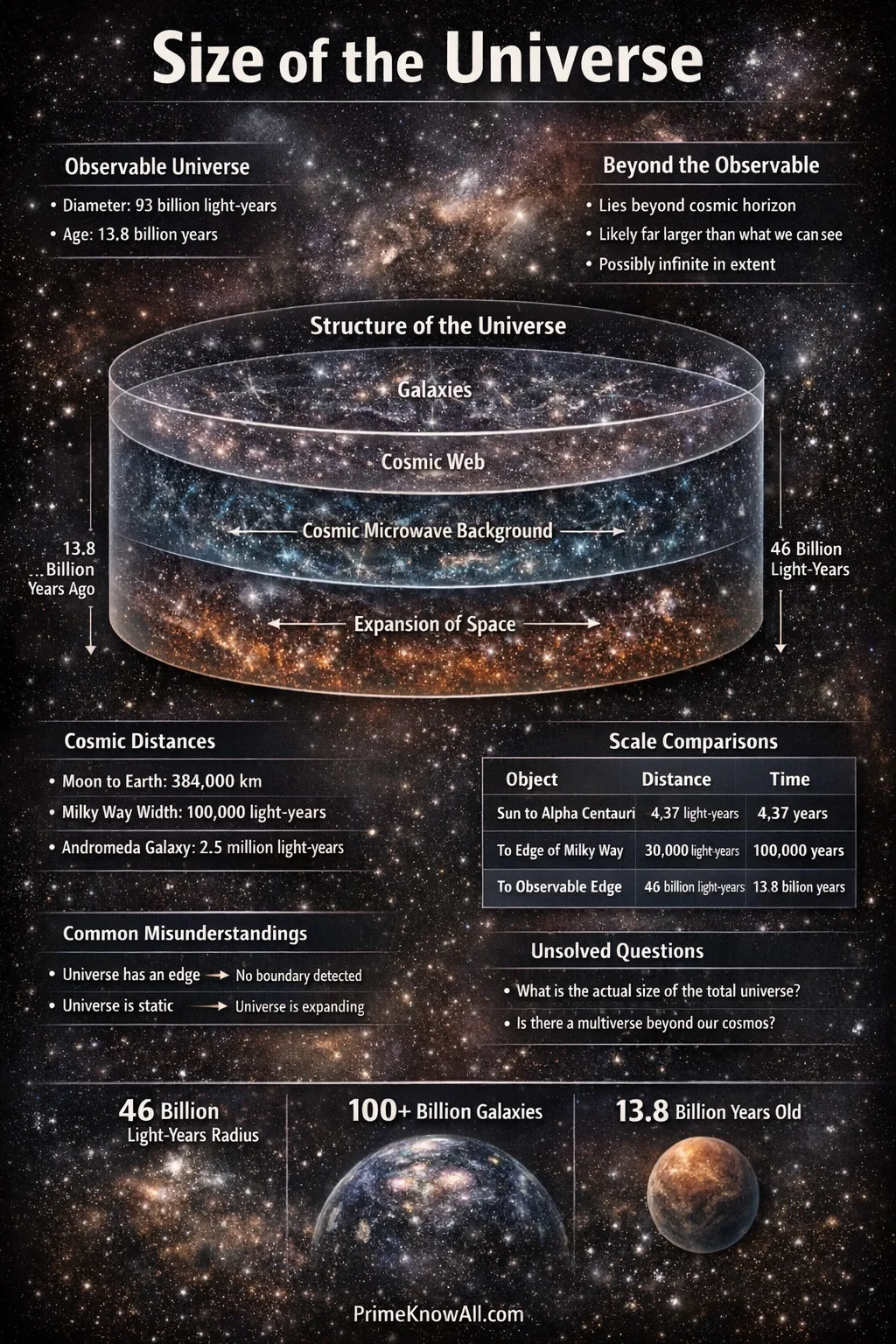
Asking how big the Universe is sounds like a single question, but it quietly contains several different ones. Size can mean how far we can see, how far matter is right now, how much space exists in total, or whether space even has an “outside.” Modern cosmology can answer some of these with impressive precision, while others remain open—partly because light has a speed limit and the Universe has a finite age.
Two Different Meanings Of How Big
When scientists talk about the Universe’s size, they usually separate what can be observed from what might exist. This distinction matters because astronomy is built on signals—mostly light, but also particles and gravitational waves—and signals take time to travel. The result is a natural boundary called the cosmic horizon.
- The observable Universe: the region whose light (or other signals) has had time to reach Earth since the beginning of cosmic history.
- The whole Universe: everything that exists, including regions beyond our horizon. It could be much larger than what we can observe, or it could be infinite.
Even within the observable Universe, “size” depends on which distance definition is being used. Cosmology often distinguishes between light-travel distance (how far light has traveled) and comoving distance (a way to track positions while space expands). Those sound technical, but they explain the most famous “paradox” in this topic.
Key idea: The Universe is about 13.8 billion years old, but the observable Universe today is about 93 billion light-years across. This is not a contradiction. It happens because space expanded while the light was on its way.
What We Can Measure: The Observable Universe
The cleanest answer to “How big is the Universe?”—the one that can be stated as a number—is the size of the observable Universe. In today’s best-fit cosmological model, the observable region has a radius of roughly 46.5 billion light-years, which implies a diameter of roughly 93 billion light-years. That number refers to where those most distant regions are now, not where they were when the light was emitted.
It helps to picture the observable Universe as a sphere centered on the observer (in this case, Earth). But this is not a special position in any cosmic sense. Any observer, anywhere, would have their own observable sphere limited by the same physics: finite light speed plus a finite cosmic age.
Why The Observable Universe Is Larger Than 13.8 Billion Light-Years
If the Universe were not expanding, the radius of what we could see would be close to age × speed of light, so roughly 13.8 billion light-years. But the Universe has been expanding for its entire history. While a photon is traveling toward us, the space it is crossing stretches. That means the galaxy that emitted the photon can be much farther away today than the light-travel time alone would suggest.
Cosmologists handle this by using distance measures designed for an expanding cosmos. One common choice is comoving distance, which factors out expansion so that large-scale positions remain stable in the coordinate system. When you hear “about 93 billion light-years across,” that’s essentially the comoving diameter of the observable Universe today.
A useful rule: when a number for “the size of the Universe” is given in light-years, it almost always means the observable Universe today—not the total Universe.
How Big Is A Light-Year, Really?
A light-year is a distance unit: how far light travels in one year. It is about 9.46 trillion kilometers (about 5.88 trillion miles). Using light-years keeps cosmic distances readable, because kilometers become unmanageable almost instantly once you step beyond the Solar System.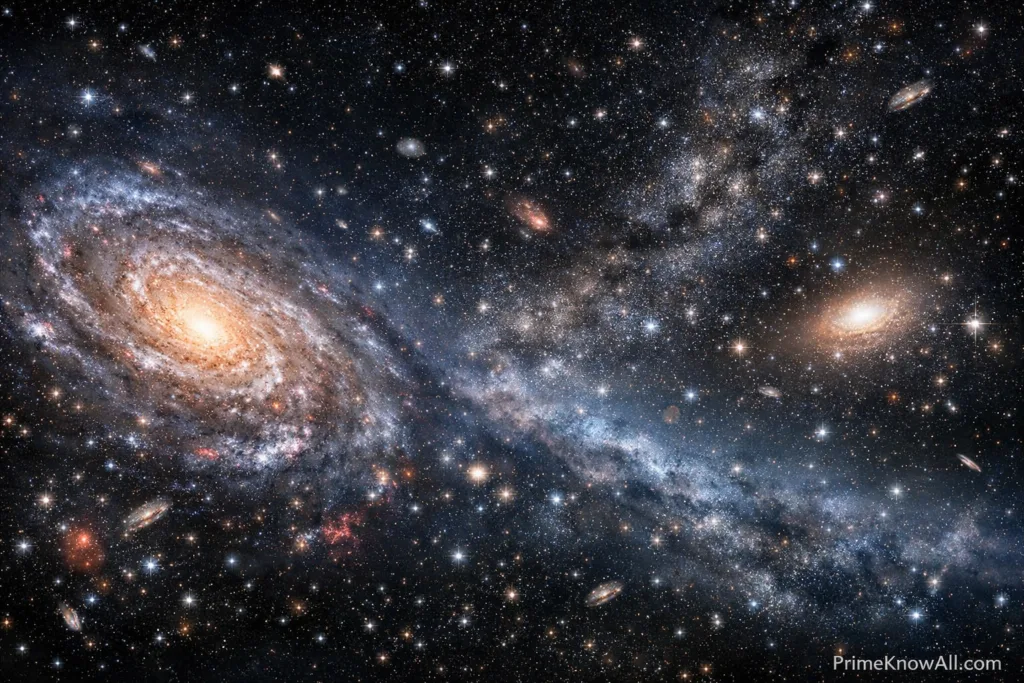
Professional astronomers often use parsecs instead of light-years. A parsec is defined through parallax (the tiny apparent shift of a star as Earth orbits the Sun), making it a natural unit for measuring stellar distances. One parsec is about 3.26 light-years.
Scales Inside The Observable Universe
“93 billion light-years” is the outer envelope. Inside it, the Universe is structured into galaxies, groups, clusters, and the vast cosmic web—filaments and walls of matter separated by enormous voids. Getting a feel for size becomes easier when you compare a few nested scales.
| Structure | Approximate Scale | What That Implies |
|---|---|---|
| Earth–Sun Distance | 1 AU | Useful for Solar System geometry; tiny compared to stellar distances. |
| Solar System (Planetary Region) | ~100 AU (order of magnitude) | Light takes hours to cross; still inside a microscopic corner of the Galaxy. |
| Milky Way Galaxy | ~100,000 light-years across | Stars are separated by light-years; the Galaxy is a thin disk with a larger halo. |
| Local Group | ~10 million light-years across | Dozens of galaxies bound together by gravity. |
| Large-Scale Cosmic Web Features | Hundreds of millions of light-years | Filaments and voids define where galaxies form across space. |
| Observable Universe | ~93 billion light-years across | The maximum region whose signals can reach us given cosmic age and expansion. |
These numbers are deliberately stated as approximate scales. The Universe is not made of clean shells; it is a messy hierarchy of structures. Still, the table shows why “big” is a slippery word: you move from AU to light-years to billions of light-years in just a few conceptual steps.
Expansion Makes Size A Moving Target
The Universe expands in a specific sense: the average distance between far-apart galaxies increases over time. Galaxies are not typically flying through space like shrapnel; rather, space itself changes in a way described by Einstein’s general relativity. This is why cosmologists are careful about which distances they quote.
Two helpful distance concepts appear again and again:
- Light-travel distance: how far the light has traveled to reach us. This connects directly to lookback time—how far into the past we are observing.
- Proper distance “now”: how far away the source region is at this moment, after billions of years of stretching space.
Because expansion has not been constant across cosmic history, converting between these distances requires a cosmological model. That model is constrained by multiple datasets—especially the cosmic microwave background (CMB), the large-scale distribution of galaxies, and supernova measurements. The details can be debated at the edges, but the central picture is clear: the observable Universe is far larger than its age in light-years.
A Common Confusion To Avoid
Sometimes people hear that galaxies can be “receding faster than light” and assume this breaks relativity. The key is that special relativity limits how fast objects move through space locally, while cosmic expansion describes how the metric of space changes on large scales. In that model, it is possible for the distance between very distant regions to grow at an effective rate that exceeds c, without any object locally outrunning light.
Is The Universe Infinite?
The most honest scientific answer is: we do not yet know. Observations strongly suggest that, on large scales, space is extremely close to flat. A flat geometry is compatible with an infinite Universe, but it does not prove infinity. A Universe can also be finite yet unbounded, meaning it has no edge—like the surface of a sphere has a finite area but no border, except in three dimensions rather than two.
Why is this hard to settle? Because curvature and topology reveal themselves over extremely large scales. If the Universe is finite but vastly larger than the observable region, its global shape would be almost impossible to detect from inside a 93-billion-light-year bubble. In practice, the best we can currently do is tighten bounds: if it is finite, it is likely much larger than the observable Universe.
What Lies Beyond Our Horizon
Beyond the observable Universe, there may be more galaxies, more cosmic web, and more of the same large-scale statistics. Many cosmological models—especially those involving an early phase of inflation—suggest the total Universe could be enormously larger than what we can see. But we need to keep the wording careful: regions beyond the horizon are not directly observable by definition, so claims about them depend on how confidently we extend well-tested physics beyond our cosmic neighborhood.
Even within the observable Universe, there are practical observational limits. Extremely distant objects become so redshifted and so faint that they can be hard to detect, even if they are technically inside the horizon. That is why the phrase “observable Universe” means “observable in principle,” not “easily visible with today’s instruments.”
How We Measure Something This Big
Cosmic size estimates come from a blend of geometry, physics, and a careful ladder of measurements. No single telescope “measures the edge.” Instead, cosmologists infer distances by comparing how the Universe behaves to what the laws of physics predict.
The Distance Ladder In Simple Terms
For nearby stars, parallax provides direct geometric distances. Farther out, astronomers use objects with known brightness—standard candles such as certain supernovae—to estimate distance from how dim they appear. On the largest scales, patterns imprinted in the early Universe provide “standard rulers,” including features in the distribution of galaxies and the CMB.
- Parallax for nearby stars (geometry).
- Standard candles (especially Type Ia supernovae) for intergalactic distances.
- Standard rulers (such as baryon acoustic oscillations) for large-scale expansion mapping.
- Cosmic microwave background measurements for early-Universe geometry and parameters.
This mix does more than deliver a single “size.” It builds a consistent picture of cosmic history: how the expansion rate changed, how matter clumped, and how the observable horizon evolved. When multiple lines of evidence point to the same parameters, the inferred horizon size becomes a high-confidence result.
Why Different Sources Sometimes Quote 92 Or 93 Billion Light-Years
You may see the observable Universe quoted as about 92 or about 93 billion light-years across. That small spread is not disagreement about the cosmos; it comes from rounding, slightly different parameter choices, and whether a source is quoting a precise model estimate or a reader-friendly approximation. Either way, the important takeaway is the scale: tens of billions of light-years in radius.
A Few Numbers That Anchor The Scale
If the goal is a mental handle on the question, these figures are the ones worth remembering. They are widely used, stable within modern cosmology, and connected to multiple independent measurements.
- Age of the Universe: about 13.8 billion years.
- Radius of the observable Universe (today): about 46.5 billion light-years.
- Diameter of the observable Universe (today): about 93 billion light-years.
- Cosmic microwave background emission: about 380,000 years after the Big Bang (the “last scattering” era).
- Meaning of deep views: looking far away means looking back in time, because the signal has been traveling for billions of years.
Put together, these numbers support a simple, accurate statement: the Universe we can observe is a vast, expanding region with a present-day diameter near 93 billion light-years. Whether the total Universe is only modestly larger or effectively infinite is still unknown, but the observable size is already enough to make human-scale intuition feel small—and that is a feature, not a flaw, of the question.
Sources
- NASA – How Big Is Space? We Asked A NASA Expert (Episode 61) [Explains why the observable Universe is around 92 billion light-years across and links the idea to expansion.]
- Encyclopaedia Britannica – Observable Universe [Clear overview of the observable Universe concept and why expansion changes “distance today.”]
- arXiv – Planck 2018 Results VI: Cosmological Parameters [Primary technical reference for widely used cosmological parameter estimates behind modern size calculations.]
- ESA Science – Planck 2018 Results Overview [Mission-backed summary page pointing to the final Planck legacy constraints.]
- NASA WMAP – Age Of The Universe [Explains how cosmic microwave background measurements constrain the Universe’s age and composition.]
- NASA Science – What Is A Light-Year? [Defines a light-year and provides the standard kilometer and mile conversions.]
- International Astronomical Union – Measuring The Universe [Accessible explanation of light-years, parsecs, and how distance units are defined.]
- Particle Data Group – Cosmological Parameters (Review PDF) [High-trust summary of cosmological parameters and how they are defined and constrained.]
FAQ
How can the Universe be 13.8 billion years old but 93 billion light-years across?
Because space expanded while light was traveling. The age tells you the maximum light-travel time since the early Universe. The 93 billion light-year figure describes the present-day comoving (or “distance now”) scale of the observable region after billions of years of expansion.
Does “observable Universe” mean we can see its edge with a telescope?
Not exactly. Observable means “observable in principle,” limited by physics, not by technology. In practice, the faintest and most redshifted objects can be extremely difficult to detect, even if they are inside the horizon.
Is the Universe expanding into something?
In standard cosmology, expansion is a change in the scale of space itself, not an explosion into surrounding emptiness. Asking what it expands “into” assumes an external space around the Universe, which may not exist in the model. The mathematics tracks how distances between far-apart regions grow without requiring a surrounding container.
Is the Universe infinite?
It might be, but infinity is not directly measurable. Observations suggest space is very close to flat, which is compatible with an infinite Universe, but a finite Universe that is vastly larger than the observable region could look nearly flat as well. Current data mainly tell us that if there is curvature, it is small.
Can we ever see beyond the observable Universe?
The horizon changes over time, but there will always be a boundary set by finite signal speed and cosmic history. Even if future observers see more than we do today, regions beyond the horizon remain unreachable by light at the present moment. The observable Universe is a moving window, not a wall you can walk through.
Article Revision History
