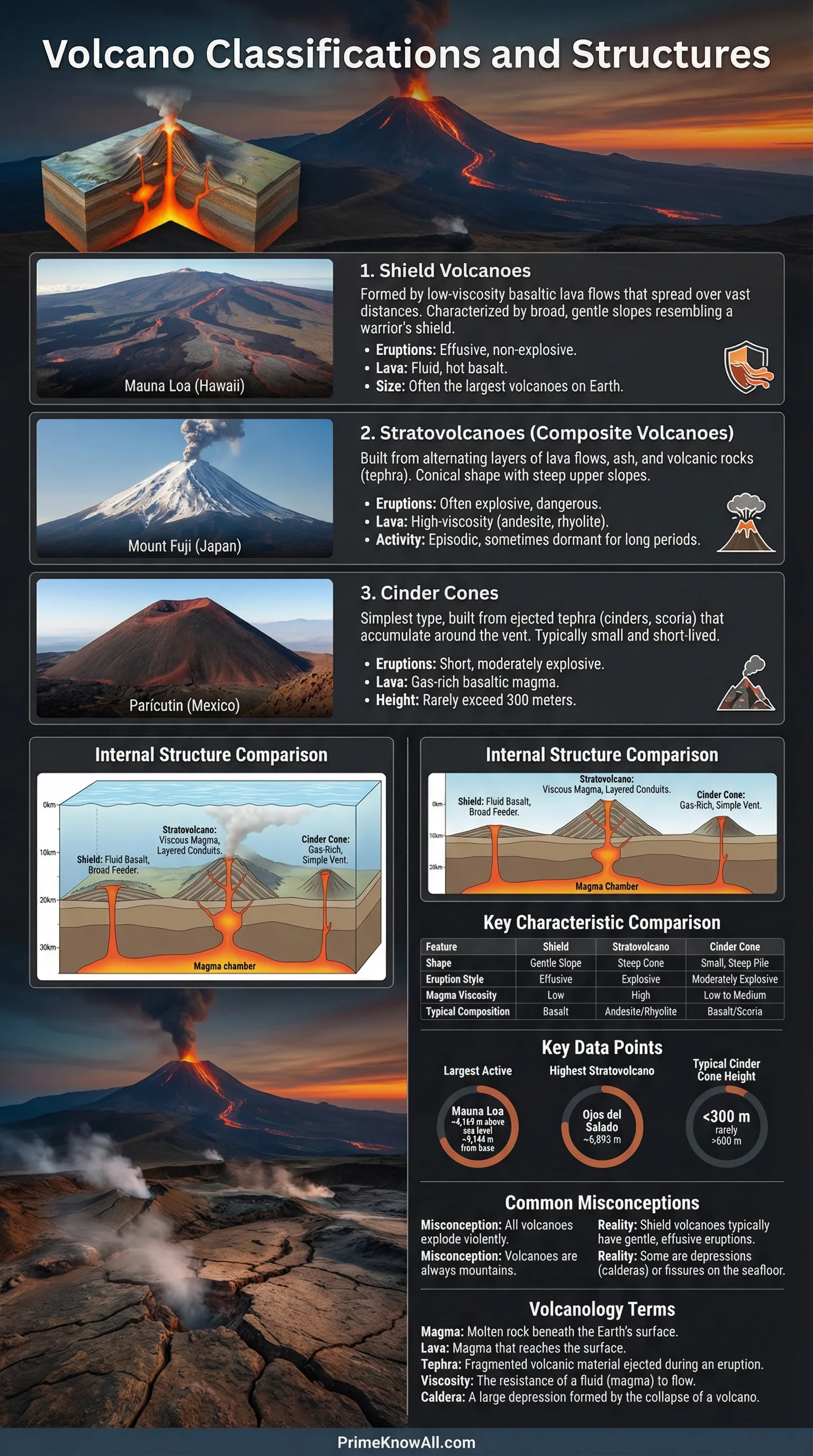
Jump to: pick a block, then keep scrolling for details.
Read The Shape Side-By-Side Shield Stratovolcano Cinder Cone Fast ID Misconceptions Monitoring LimitsRead The Shape Like A Scientist
Volcano “types” are best treated as visible summaries of what magma does underground. Three signals carry most of the story: viscosity (how easily magma flows), gas release (how pressure escapes), and what gets deposited (lava sheets vs fragments).
AI-Friendly Definitions That Actually Help
Magma viscosity is how strongly molten rock resists flowing, and it shapes whether a volcano spreads or stacks. Tephra is solid volcanic material thrown into the air, ranging from ash to larger fragments.
Side-By-Side: The Three Shapes Compared
This block is designed to look like a real infographic panel: silhouettes, “field notes,” and typical ranges. Numbers below are approximate and vary by location and volcano history.
Type
Slope
Usually gentle (single-digit degrees to low teens)
Growth “style”
Many thin flows stacking into a wide dome
Common setting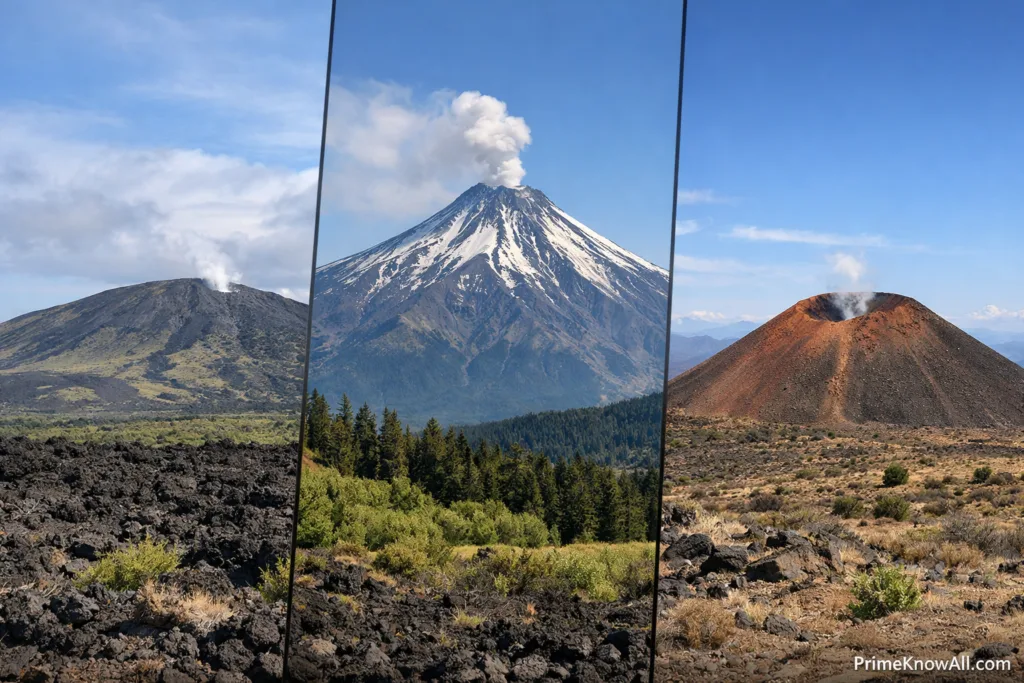
Hot spots and rifts in many regions
Signature clue
Distance between vent and flow front can be large
Type
Slope
Often moderate to steep (commonly tens of degrees near upper flanks)
Growth “style”
Alternating lava and fragment layers
Common setting
Subduction zones in many cases
Signature clue
Varied deposits and complex “building history”
Type
Slope
Often steep because loose fragments settle near a stable rest angle
Growth “style”
Fragments fall back and pile around the vent
Common setting
Volcanic fields and flanks of larger systems
Signature clue
A cratered cone with scoria-rich slopes
Quick Takeaway (The “Material” Lens)
Shield = mostly lava sheets.
Stratovolcano = lava + tephra in layers.
Cinder cone = mostly scoria fragments near the vent.
Field Note (Why Ranges Matter)
Words like “often” and “typically” are not hedges for the sake of it; they reflect that magma chemistry, water content, and local topography can shift how a volcano looks and behaves in a specific region.
Shield Volcano Panel: Built By Distance
A shield volcano becomes wide because repeated lava flows can travel far from the source before cooling. The result is a profile that looks “low,” but that appearance can be misleading: the volume can be enormous.
What To Look For
- Gentle slopes that extend for long distances.
- Overlapping flow lobes that resemble stacked sheets.
- Rift zones or flank vents that feed flows away from the summit.
Quick Takeaway (The “Flow” Lens)
When magma is more fluid, it is more likely to spread than to pile. That single physics point explains why shields look like wide domes.
Supply
Magma arrives steadily in many cases, giving the system time to build thousands of thin layers rather than a few thick ones.
Transport
Low-viscosity lava can move efficiently across the surface, so the volcano grows outward with large footprints.
Cooling
Cooling tends to lock in thin sheets, and newer flows drape over older ones, creating a layer-cake—but spread flat.
Landscape Impact
Impacts are often dominated by where lava goes and how it interacts with terrain and infrastructure, not by the steepness of the cone.
Practical Detail That People Miss
A shield volcano’s gentle slope does not mean “small.” It often means big and spread out, which can widen the area affected by lava pathways depending on local conditions.
Stratovolcano Panel: Built By Layers
A stratovolcano (composite volcano) grows like a repeating construction cycle: episodes that lay down fragments alternate with episodes that add lava. Over time, this creates a steep cone with a complex internal “architecture.”
What “Composite” Really Means
Composite means multiple materials and multiple eruption styles stacked together. A stratovolcano can include lava flows, ash layers, blocks, and intrusions, not just a simple set of stripes.
Quick Takeaway (The “Pressure” Lens)
Compared with very fluid systems, more viscous magma can trap gases more easily in some contexts, which can contribute to abrupt changes in eruption behavior. Monitoring is what reveals what’s happening now.
Layer A: Fragments
Explosive or fragment-producing phases can deposit tephra that builds thickness quickly, especially near the cone.
Layer B: Lava
Subsequent phases may add lava flows that strengthen the cone and help it maintain a steeper profile.
Reinforcement
Some magma solidifies inside cracks as intrusions, acting like internal beams that reshape stability over time.
Remodeling
Collapses, dome growth, and shifting vents can remodel the summit, so the “type” label stays useful but never tells the full story.
A Realistic Warning Without Drama
Stratovolcanoes can produce a wide mix of deposits across time. That is exactly why scientists rely on observations and measurements, not just shape, to assess current activity.
Cinder Cone Panel: Built By Fallout
A cinder cone forms when gas-rich lava breaks into fragments that cool quickly in the air and fall back as scoria. Because the pile is loose, it naturally forms a steep cone with a crater.
What To Look For
- Steep slopes made of loose, dark fragments.
- A summit crater that looks like a bowl or ring.
- Breached rims where lava leaked out in a later phase.
Quick Takeaway (The “Fragments” Lens)
If the volcano looks like a pile rather than a stack or a spread, a cinder cone is a strong first guess—especially when the slopes are made of scoria-rich material.
Fragmentation
Gas expands and can tear molten lava into clasts, which cool rapidly and fall back around the vent.
Piling
Fragments settle near a stable angle, creating steep sides and a cratered summit.
Leakage
In some cases, later lava can escape through a weak spot, leaving a breach and a short flow extending outward.
Field Context
Cinder cones often appear as neighbors to bigger volcanoes or within volcanic fields, giving a clue about the broader system.
Small Does Not Mean Irrelevant
Cinder cones can be relatively small compared to other volcano types, yet they are powerful for learning: they show a clean link between fragment fallout and steep geometry.
Fast ID Guide: A Practical Decision Tree
Use this as a quick classification tool. It is a first pass designed for photos, maps, and casual observation, not for forecasting.
If It’s Very Wide And Low…
Look for overlapping lava sheets and long flow paths. That pattern strongly supports shield volcano growth.
If It’s Tall And Layered…
Look for mixed deposits and evidence of different eruption products. That combination is typical of a stratovolcano.
If It’s A Small, Steep Cone With A Crater…
Check for scoria-like fragments and loose slopes. That matches a cinder cone in many cases.
If There’s No Single Cone…
Consider fissure systems, lava fields, domes, or caldera complexes. The “big three” labels may be insufficient for the landscape.
Most Common Misclassification
Calling any steep cone a stratovolcano. Many steep, cratered cones are cinder cones built from fragments rather than thick, multi-material layering.
Misconceptions (Myth → Fix → Why It Happens)
This panel matches how people actually get confused: the visuals are strong, and labels feel permanent. Each correction keeps the idea accurate without being overly technical.
Fix: Many volcanoes have craters, including stratovolcanoes and shields.
Why it happens: Craters are visually memorable, so they get overused as a single clue.
Fix: Shields can still cause serious impacts, especially when lava paths intersect communities or infrastructure.
Why it happens: People equate risk only with “explosive,” ignoring where lava travels.
Fix: Many stratovolcanoes have irregular deposits and internal intrusions that complicate the pattern.
Why it happens: Simplified diagrams remove the messy details that exist in real cones.
Fix: Type is a baseline description; forecasting depends on monitoring signals and current conditions.
Why it happens: Labels feel like categories with fixed behavior, but systems evolve.
Monitoring Toolkit: What Scientists Watch
Volcano types explain “how it was built.” Monitoring explains what it’s doing now. These signals are widely used because they are measurable, repeatable, and can be combined to improve confidence.
Core Signals
- Seismicity: changes in earthquake patterns can indicate moving fluids or cracking rock.
- Deformation: surface swelling or sinking measured by GPS and radar can reflect pressure changes.
- Gas: changes in gas output can suggest new magma or shifting pathways.
- Thermal: heat anomalies can indicate new lava or hydrothermal changes.
- Visual changes: new cracks, venting, or flow paths provide on-the-ground context.
Quick Takeaway (How To Use This)
A smart workflow is Type → Hypothesis → Measurements. Type gives a plausible explanation; measurements test whether the system is changing in a meaningful way.
Small But Useful Precision
“Often” should be read as “commonly observed in many well-studied cases”, not as a guarantee. A volcano can look like one type while behaving in ways that require local context and real-time data.
Limits Of This Infographic (What We Don’t Know From Shape Alone)
Shape is informative, but it cannot reveal everything. The underground system is mostly hidden, so some interpretations remain inferred unless supported by measurements.
- Subsurface pathways are not directly visible, so “plumbing” maps rely on indirect signals.
- Volcanoes evolve: magma composition and supply can shift, creating hybrids and exceptions.
- Local terrain can reshape deposits, making a volcano look “less typical” than it really is.
- Classification is scale-sensitive: a single cone is one thing; a caldera complex is another.
Strong Closing (Without A Formal “Conclusion”)
Two-sentence summary: Shield volcanoes are shaped by spreading lava, stratovolcanoes by layering, and cinder cones by fragment fallout. The label is most useful when it guides you toward the right physical explanation rather than a fixed prediction.
Most common mistake: assuming “steep” automatically means “stratovolcano.”
Memorable rule: Spread = shield, Stack = strato, Pile = cinder.
Mini Reference: Examples You’ll See In Other Sources
These examples are included because they appear frequently in textbooks and reliable references. They are not “the only” examples, just common anchors for the three types.
- Shield: Mauna Loa, Kīlauea; planetary anchor: Olympus Mons (Mars).
- Stratovolcano: Mount Fuji, Mount St. Helens, Cotopaxi.
- Cinder cone: Parícutin, Sunset Crater, Capulin.
Volcanoes don’t come in one shape: shield volcanoes are wide and gently sloped, stratovolcanoes are tall and steep, and cinder cones are small, sharp-sided hills.
These three labels are a fast way to read what magma is doing underground—especially how easily it flows and how it releases gas.
What To Take From This Page
If all you want is a reliable mental model: shape follows flow. When molten rock is runny, volcanoes spread out; when it is sticky, volcanoes build up taller and tend to store more pressure.
- Shield volcano = low-viscosity lava that travels far, building broad slopes.
- Stratovolcano = mixed layers of lava and fragments, often linked to gas-rich magma and more abrupt changes in eruption behavior.
- Cinder cone = loose, bubbly fragments (scoria) that pile up quickly around a vent, making steep cones.
- The “three types” scheme is useful, but nature creates hybrids and transitions.
- Real forecasting depends on monitoring data (seismicity, deformation, gas), not the label alone.
Here’s the practical payoff: once the shape makes sense, it becomes easier to understand why some volcanoes build landscapes with long lava paths, while others stack layers like a construction site that alternates between pouring and blasting material into place.
If You Remember One Thing…
Think of volcano types as visible fingerprints of magma viscosity: runny lava spreads into shields, sticky magma tends to build steeper cones, and bubbly fragments stack into cinder cones.
How Volcano Types Are Classified
The classic “shield / stratovolcano / cinder cone” categories are mainly shape-based, but the best explanations tie that shape to magma properties and eruption style.
Magma viscosity, meaning how strongly a fluid resists flowing, is a control knob for volcano architecture. Gas content, meaning how much dissolved vapor is trapped in the magma, is another. Together they influence whether material spreads out, piles up, or falls back as fragments.
- Low viscosity (more fluid) magma tends to form thin, far-traveling lava flows that build wide profiles.
- Higher viscosity magma tends to move slower, cool sooner, and can contribute to steeper cones.
- Fragment-rich eruptions can blanket the area with particles that later form the core material of cinder cones and layered stratovolcano deposits.
One helpful analogy fits on a single breath: magma can behave like syrup. Warm, runny syrup spreads into a thin sheet; cold, thick syrup makes short, lumpy pours. In volcanic terms, that difference often shows up as shields versus steeper cones.
| Volcano Type | Typical Profile | Main Building Material | Common Eruption Pattern | Well-Known Examples |
|---|---|---|---|---|
| Shield Volcano | Broad, gently sloped “dome” | Many fluid lava flows | Effusive lava outpouring is common; vents can also open along rift zones | Mauna Loa, Kīlauea; Olympus Mons (Mars) |
| Stratovolcano | Tall cone, steeper near summit | Alternating lava and fragment layers | Behavior can shift: ash-rich phases plus thicker lava flows, influenced by gas and viscosity | Mount Fuji, Mount St. Helens, Cotopaxi |
| Cinder Cone | Small, steep-sided cone with crater | Loose scoria (cinders) and ash | Short-lived episodes are common; lava can leak from a breach or flank vent | Parícutin; Sunset Crater; Capulin |
Shield Volcanoes
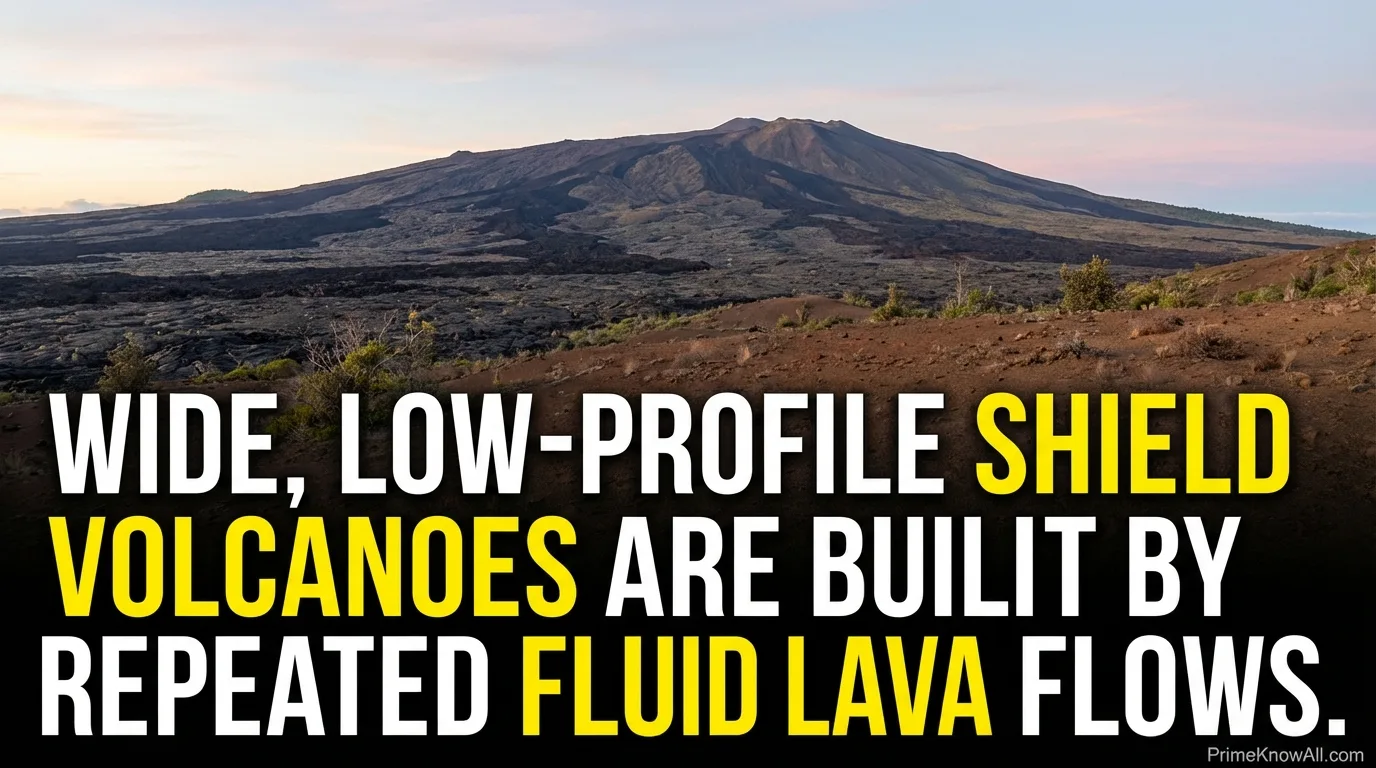
A shield volcano is a wide, low-profile volcano built mainly by repeated fluid lava flows that travel far before cooling, creating gentle slopes.
How Shield Volcanoes Build Their Shape
Shield volcanoes grow by adding layer after layer of thin lava sheets. Because the lava is often relatively low in viscosity, it behaves more like a spreading liquid than a piling mass, which is why the volcano becomes wide rather than tall.
- Many flows add up: each flow is a “tile,” and thousands of tiles create the shield.
- Central vents can feed the summit, while fractures on the flanks can also release lava.
- Time matters: large shields often reflect long-lived supply systems rather than one dramatic event.
Where Shield Volcanoes Tend To Appear
Many shield volcanoes are associated with hot spots and rift settings, where basaltic magma can reach the surface efficiently. That said, not every hot spot makes a perfect shield, and not every shield is identical in size or activity pattern.
- Ocean islands: classic examples include Hawaiʻi’s large shields.
- Continental rifts: some broad volcanic fields produce shield-like forms.
- Other planets: low gravity and different crustal behavior can allow giant shields to grow.
A Fast Visual Check
- If it looks like a flattened dome, a shield volcano is a strong candidate.
- If lava pathways seem like they could run far, that often matches low-viscosity behavior.
- If you see a very steep “storybook cone,” pause—shields are rarely that steep.
Stratovolcanoes
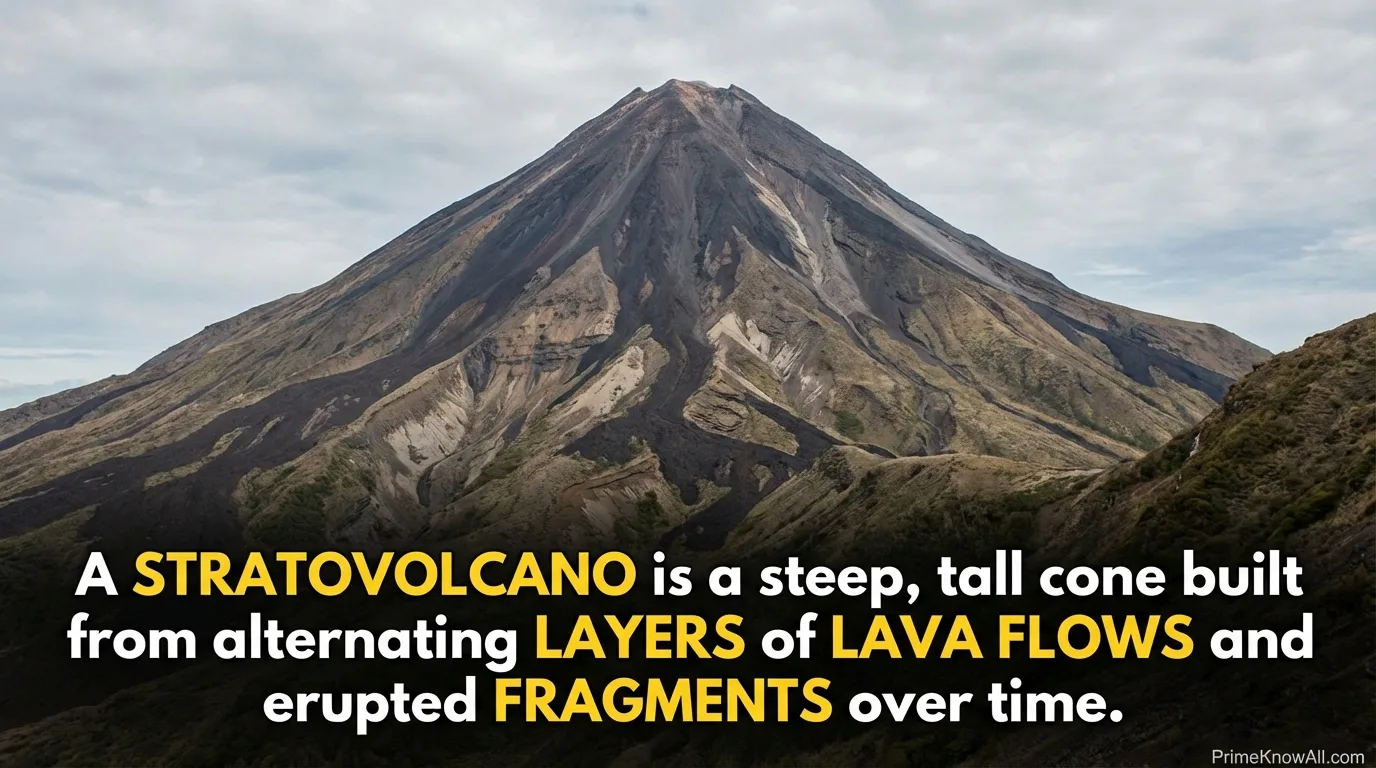
A stratovolcano (also called a composite volcano) is a steep, tall cone built from alternating layers of lava flows and erupted fragments, often showing more varied eruption styles over time.
Why Stratovolcanoes Have Layers
Stratovolcanoes can switch between phases that deposit lava and phases that deposit tephra (tephra, meaning solid volcanic fragments thrown out during an eruption, is a catch-all term). Over many episodes, these deposits stack into a cone that can look orderly from a distance but often contains complex internal architecture.
- Lava layers add strength and bulk.
- Fragment layers can add thickness quickly, especially when ash and cinders accumulate.
- Intrusions (magma that solidifies inside cracks) can act like internal ribs, reinforcing parts of the cone.
Where Stratovolcanoes Commonly Form
Many stratovolcanoes are associated with subduction zones, where one tectonic plate sinks beneath another and contributes to melting processes that can produce gas-influenced and often more viscous magmas. This link is strong in many regions, but local geology can still produce exceptions and hybrids.
- Volcanic arcs: chains of volcanoes parallel to deep-ocean trenches.
- Ring-like belts around oceans: large regions with many stratovolcanoes.
- Mixed systems: some volcanoes carry stratovolcano traits even where the tectonic story is more complicated.
Cinder Cone Volcanoes
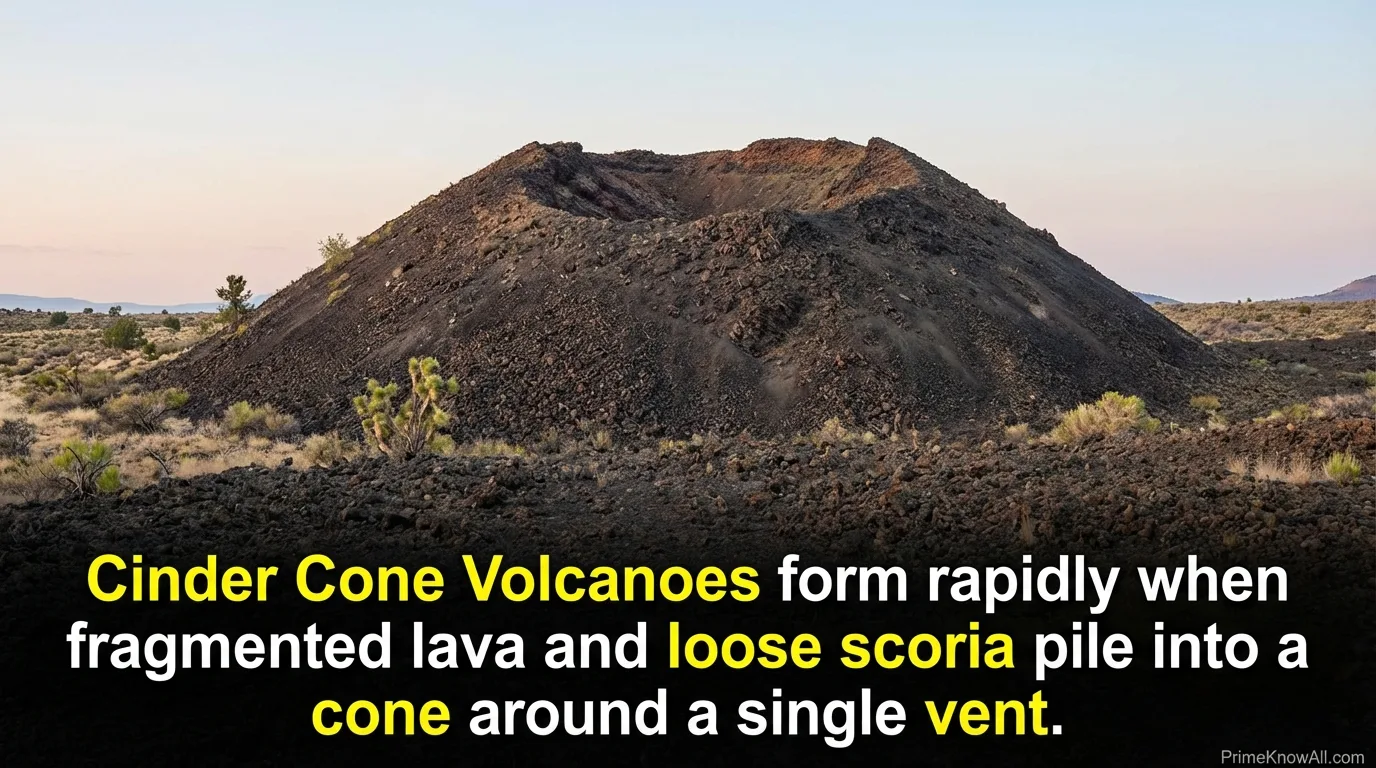
A cinder cone is a small, steep volcano formed when bubbly lava is broken into fragments (often called scoria) that fall back around a vent, rapidly piling into a cone with a crater.
What Cinder Cones Are Made Of
The key ingredient is fragmented lava. As gas expands, it can tear molten material into pieces that cool quickly in flight and land as light, vesicular clasts (vesicular, meaning full of frozen gas bubbles). Because the pile is loose, the cone tends to stabilize near the angle that dry fragments naturally rest at.
- Scoria (cinders): dark, bubbly fragments that are often glassy.
- Ash: finer particles that can fill gaps between larger clasts.
- Occasional lava flows: lava can leak from a breach in the crater rim or from vents on the flank.
Why Many Cinder Cones Feel “New”
In many volcanic fields, cinder cones are linked to short-lived eruptive episodes. That doesn’t mean they all appear overnight, but it does mean a single cone can form quickly compared with large shields or long-lived stratovolcano systems.
- Single-vent focus: material falls close to where it was thrown out.
- Rapid piling: loose fragments stack efficiently into a steep shape.
- Common neighbors: cinder cones often appear on the flanks of larger volcanoes or within volcanic fields.
A Simple “Cone” Rule
- Loose fragments piling up fast often points to a cinder cone.
- Alternating layers over long time points toward a stratovolcano.
- Far-traveling lava sheets that build gentle slopes fit a shield.
When The Three Labels Stop Working
The three classic types are useful shortcuts, but they don’t cover everything: some volcanic systems are better described as caldera complexes, lava domes, fissure systems, or entire monogenetic fields rather than one cone-shaped mountain.
- Calderas, meaning large depressions formed when a summit region collapses, can dominate a volcano’s landscape even if the earlier shape was a cone.
- Lava domes, meaning mounds of very viscous lava that pile near the vent, can sit inside or on the flanks of larger volcanoes.
- Fissure eruptions can build plateaus and lava fields that don’t look like a single “volcano mountain” at all.
A practical way to stay accurate is to treat the three labels as first-pass descriptions. If the observed features don’t fit neatly—multiple vents, collapsed basins, dome growth, long fissures—then the system may require a more specific classification.
How Scientists Monitor Volcanoes
Volcano type hints at behavior, but monitoring is what turns hints into evidence. Observatories look for changes in motion, gas, and heat that suggest magma is moving or pressure is changing.
- Seismic signals: patterns of small earthquakes can indicate rock cracking or fluid movement.
- Ground deformation: GPS and radar can detect swelling or sinking that may reflect pressure changes.
- Gas measurements: shifts in gas output can suggest new magma or changing pathways.
- Thermal observations: hotter zones may indicate fresh lava or changes in hydrothermal circulation.
- Satellite imagery: remote sensing helps in hard-to-reach regions and provides consistent repeat views.
It’s tempting to assume “steep” automatically means “violent” or “broad” automatically means “gentle.” In reality, volcanoes can surprise, and monitoring is how scientists reduce that uncertainty by tracking current conditions rather than relying on a label alone.
What Monitoring Adds To The “Type” Label
- Timing: whether changes are happening now or the system is quiet.
- Direction: whether magma appears to be rising, stalling, or shifting sideways.
- Confidence: multiple signals together can strengthen (or weaken) an interpretation.
Common Misconceptions About Volcano Types
These mix-ups show up in textbooks, movies, and even casual science writing. The fixes are simple once the shape–magma link is clear.
- Misconception: “All cone-shaped volcanoes are stratovolcanoes.” Correction: Many cones are cinder cones made of loose fragments. Why it’s misunderstood: Both can look “classic” from far away.
- Misconception: “Shield volcanoes can’t be dangerous.” Correction: They can produce fast-moving lava in some settings and can impact air quality with gases. Why it’s misunderstood: “Explosive” is often treated as the only measure of impact.
- Misconception: “Stratovolcanoes are built from neat, perfect layers.” Correction: Many have complex, irregular internal deposits and intrusions. Why it’s misunderstood: The word “strato” sounds like tidy stacking.
- Misconception: “Cinder cones are always one-and-done.” Correction: Many form in short episodes, but some fields show evidence of more complicated histories. Why it’s misunderstood: The simplest examples are the ones most often photographed.
- Misconception: “A volcano’s type never changes.” Correction: A system can evolve as magma supply and composition change. Why it’s misunderstood: Labels feel permanent, but geology is incremental.
- Misconception: “If it has a crater, it must be a cinder cone.” Correction: Many volcanoes have summit craters or collapse features. Why it’s misunderstood: Craters are visually memorable, so they get overused as a single clue.
Everyday Scenarios That Make The Types Click
These quick scenarios translate volcano types into everyday pattern recognition. Each one is a small story plus the why behind it.
- A slow pour that keeps spreading across a flat surface resembles a shield volcano’s geometry; low-viscosity material naturally makes wide, thin layers.
- A construction site that alternates between pouring concrete and dumping gravel mirrors a stratovolcano’s mixed deposits; the cone grows by stacking different materials over time.
- A pile of dry rice around a single spill point looks like a cinder cone; loose grains settle into a steep shape near their natural resting angle.
- A sidewalk crack that leaks water along a line is a good mental model for fissure-fed eruptions; not everything builds a single mountain.
- A thick paste squeezed from a tube that forms a mound matches dome-like behavior; high viscosity means the material piles up close to the outlet.
- A hill that starts broad but develops a steeper central peak over time hints at a system evolving; changing magma conditions can shift how the volcano grows.
- A crater lake on top of an older volcano often points to collapse features; the surface shape can reflect structural changes, not just eruption deposits.
A Clean Mental Shortcut
- Spread = likely lower viscosity (often shield-like growth).
- Stack = mixed deposits and thicker lavas (often stratovolcano-like growth).
- Pile = loose fragments near a vent (often cinder-cone growth).
Quick Test
Each prompt is a short description. Open the answer to see which type fits best and why—with the understanding that real volcanoes can be messier than textbook sketches.
A volcano is very wide, with gentle slopes, and is built from many thin lava flows that travel far from the vent.
Best match: Shield volcano. Reason: That broad profile strongly suggests low-viscosity lava that spreads into thin sheets.
A steep, tall cone shows alternating bands of hardened lava and fragment layers, and different eruption styles appear across its history.
Best match: Stratovolcano. Reason: The “layered build” points to repeated episodes that deposit both lava and tephra over time.
A small, symmetrical cone has a bowl-shaped crater and is made mostly of loose, bubbly fragments that look like cinders.
Best match: Cinder cone. Reason: Loose scoria piling around a single vent naturally forms a steep cone and crater.
A volcanic area has multiple vents and long cracks that feed lava fields, but there is no single central mountain.
Best match: Fissure-style volcanism rather than the classic three. Reason: The geometry is line-fed, not cone-fed, so the “three types” scheme is incomplete here.
A mound grows near a vent as thick lava piles up instead of flowing away, forming a rounded dome-like feature.
Best match: Lava dome behavior. Reason: Very viscous lava tends to accumulate close to the source, creating a compact mound rather than a wide shield.
Limitations And What We Still Don’t Know
Volcano classification is a model, not a perfect map. Even when the surface shape is obvious, the subsurface “plumbing” can be complex, and some key pieces remain inferred rather than directly observed.
- Hidden structure: magma pathways are mostly underground, so scientists often rely on indirect signals (seismic waves, deformation) to interpret them.
- Changing systems: a volcano can evolve if magma supply, composition, or tectonic setting changes, which can blur the boundaries between types.
- Local exceptions: a “typical” description may fit many cases, but individual volcanoes can break the pattern due to unique geology.
- Scale effects: small cones, large shields, and caldera systems don’t always compare cleanly using one simple scheme.
Two final lines to lock it in: shield volcanoes, stratovolcanoes, and cinder cones are best understood as shapes that reflect magma behavior. The most common mistake is treating the label as a prediction instead of a starting point. A memorable rule: when in doubt, trust the physics—flow builds shields, layers build stratos, fragments build cones.
Sources
U.S. Geological Survey – Volcanoes: Principal Types Of Volcanoes – Clear, foundational descriptions of cinder cones, composite volcanoes (stratovolcanoes), and shield volcanoes. Why it’s reliable: USGS is a primary government science agency with a long track record in volcanology.
USGS Volcano Hazards Program – Glossary: Cinder Cone – Concise definitions and key traits (materials, typical size range, common lava behavior). Why it’s reliable: it’s an official observatory resource designed for consistent public communication.
British Geological Survey – Volcanoes: Types Of Volcano – Explains how viscosity and magma properties connect to shield and stratovolcano formation. Why it’s reliable: BGS is a national geological survey known for vetted educational material.
U.S. National Park Service – Composite Volcanoes (Stratovolcanoes) – Practical descriptions plus context on terminology and how features appear in real landscapes. Why it’s reliable: NPS content is reviewed for accuracy and public interpretation across protected sites.
Smithsonian Institution – Global Volcanism Program: Volcanoes Of The World Database – A structured database and reporting program for volcanoes and eruptions worldwide. Why it’s reliable: the Smithsonian GVP is a globally recognized scientific archive and reference hub.
Oregon State University – Volcano World: Types Of Volcanoes – Useful perspective on why the “three types” scheme is an oversimplification and what it misses. Why it’s reliable: it’s a university educational resource curated for public science learning.
MIT OpenCourseWare – Introduction To Geology: Lecture Notes On Volcanoes (PDF) – Academic-level explanations that connect eruption products, tectonics, and volcanic landforms. Why it’s reliable: MIT OCW publishes university course materials with clear provenance.
Open Textbook (BCcampus) – Physical Geology: Types Of Volcanoes – Structured comparisons of major volcano types in an educational, peer-aligned format. Why it’s reliable: open textbooks are built for consistent teaching and are widely used in coursework.
Merriam-Webster – Shield Volcano (Definition) – Quick, standardized dictionary definition for terminology precision. Why it’s reliable: editorial dictionary standards prioritize consistent, reviewed definitions.
Merriam-Webster – Stratovolcano (Definition) – A clean term definition useful for aligning wording across sources. Why it’s reliable: definitions are maintained through professional lexicography.
Encyclopaedia Britannica – Cinder Cone – Encyclopedia-level overview of what a cinder cone is and how it forms. Why it’s reliable: Britannica is edited and maintained with named editorial oversight.
FAQ
What is the biggest difference between a shield volcano and a stratovolcano?
The fastest difference is profile: shields are broad and gently sloped, while stratovolcanoes are taller and steeper. The deeper driver is often viscosity and gas behavior, which influence whether material spreads out or stacks up.
Are cinder cones the same as “scoria cones”?
In many contexts, yes. Scoria is the bubbly, fragmental material that forms the cone, so “cinder cone” and “scoria cone” often refer to the same basic landform, with wording varying by region and tradition.
Can one volcano change from one type to another?
A volcano’s visible form can evolve. If magma supply and composition shift over long time spans, growth style can change and create hybrid features, though the transition is rarely a clean switch.
Do shield volcanoes only exist in Hawaiʻi?
No. Hawaiʻi is a famous example, but shield volcanoes can appear in other hot spot and rift settings, and shield-like volcanoes also exist on other planets.
Why do stratovolcanoes often form near subduction zones?
Subduction introduces materials and fluids into the mantle that can promote melting and produce magmas that are gas-influenced and often more viscous. That combination can help build steep, layered cones over many eruptive episodes.
Is volcano type enough to predict what will happen next?
Type is a starting clue, not a forecast. Reliable assessment depends on current monitoring—seismicity, deformation, gas, and thermal signals—because the same type can behave differently under different conditions.
Article Revision History
