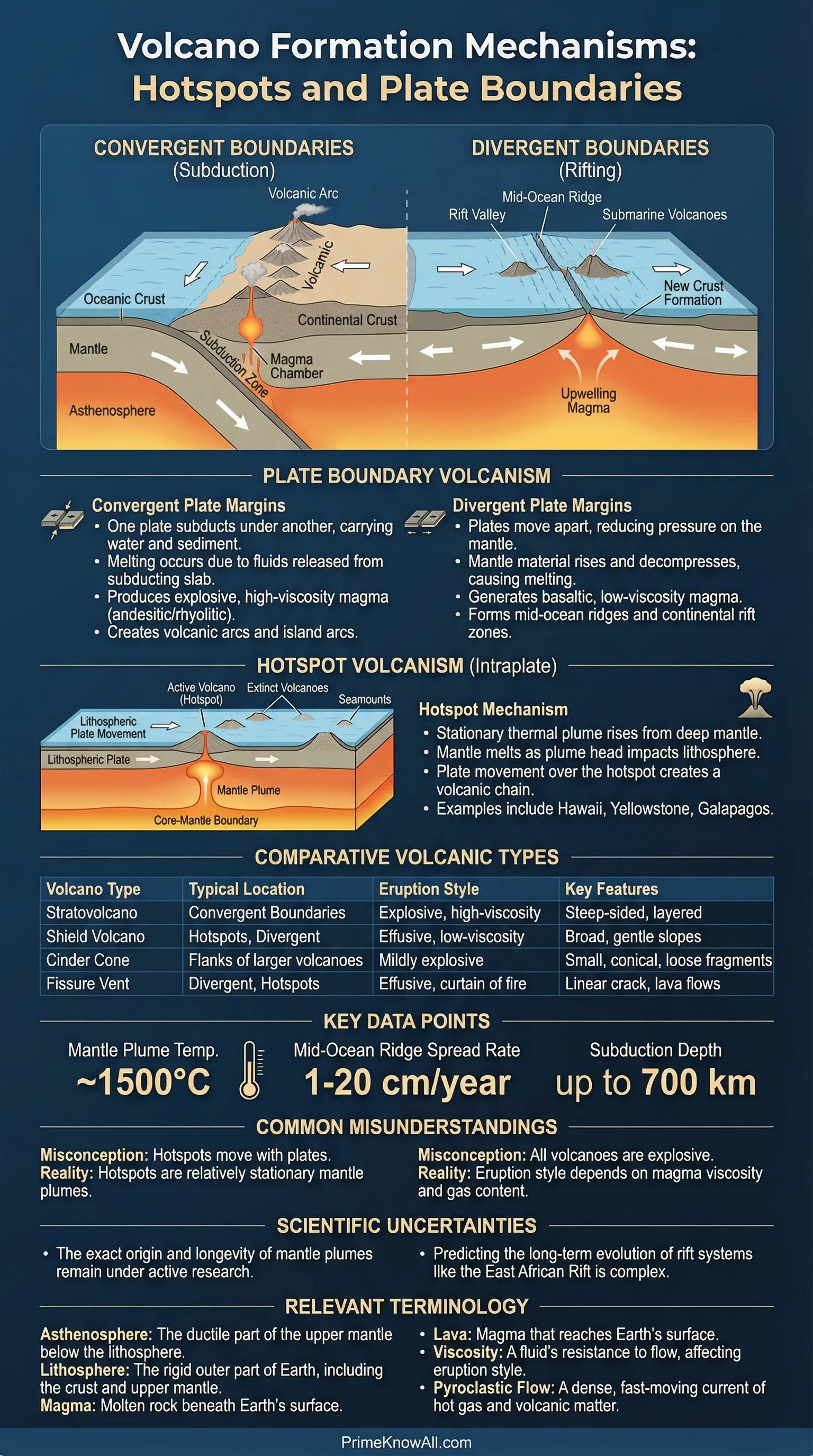
Volcanoes form when hot rock melts and that melt finds a way to the surface—most commonly at plate boundaries or above hotspots that feed magma through the middle of a plate. In practice, the “why” is usually about how melting starts (pressure drops, water is added, or extra heat is supplied) and the “how” is about pathways that let magma rise.
The Essentials In Under A Minute
Ultra-short answer: Most volcanoes are built where plates separate (decompression melting) or where a plate subducts (water-driven melting). A smaller but important group forms above hotspots, where unusually warm mantle or focused upwelling supplies magma away from edges.
- Plate boundaries explain the majority of volcano belts seen on world maps.
- Divergent boundaries tend to produce runnier, basalt-rich magma and broad volcanic features.
- Subduction zones often generate stickier, gas-rich magma that can erupt explosively, depending on local conditions.
- Hotspots can create chains of volcanoes as a plate moves overhead.
- Eruption style is strongly shaped by magma viscosity and trapped gas, not by “volcano type” alone.
To make sense of any volcano, it helps to separate where the melt comes from (the melting trigger) from how it travels (cracks, dikes, and storage zones in the crust). This guide follows that logic, moving from plate boundaries to hotspots, then to what controls whether eruptions are gentle or explosive.
If you remember one thing… find the melting trigger first, then find the pathway—that pairing explains most of what you see, from lava chemistry to eruption behavior.
The Core Ingredients: Heat, Melt, And Pathways
Short answer: Volcanoes appear when Earth’s interior produces melt and the crust provides a route upward. Without both, magma stays hidden as deep intrusions instead of building a surface volcano.
Magma, a mixture of molten rock, crystals, and dissolved gases, is the raw material of volcanoes. A tectonic plate is a rigid slab meaning a moving piece of Earth’s lithosphere that rides over softer mantle. When conditions change enough to start melting, buoyant magma can rise through fractures, sometimes pooling in storage zones before it erupts.
In most settings, melting begins through a small set of repeatable mechanisms:
- Decompression melting: rock rises, pressure drops, and some of it melts without needing extra heat.
- Flux melting: water and other volatiles lower the melting point, letting rock melt more easily.
- Heat transfer: hotter material intrudes and warms surrounding rock until partial melting occurs.
Think of this as a two-step recipe: make melt, then connect it to the surface. Plate boundaries and hotspots are simply the most common places where those steps happen repeatedly and at scale.
Divergent Plate Boundaries: Where The Crust Pulls Apart
Short answer: At divergent boundaries, plates separate and hot mantle rises to fill the gap; the pressure drop triggers decompression melting, producing abundant basaltic magma that often erupts through fissures.
The biggest volcanic factory on Earth is the global system of mid-ocean ridges. Most of it is underwater, so the activity is easy to overlook, but it steadily builds new oceanic crust. On land, divergent settings show up as continental rifts, where thinning crust, faulting, and rising mantle can create volcanoes and lava fields.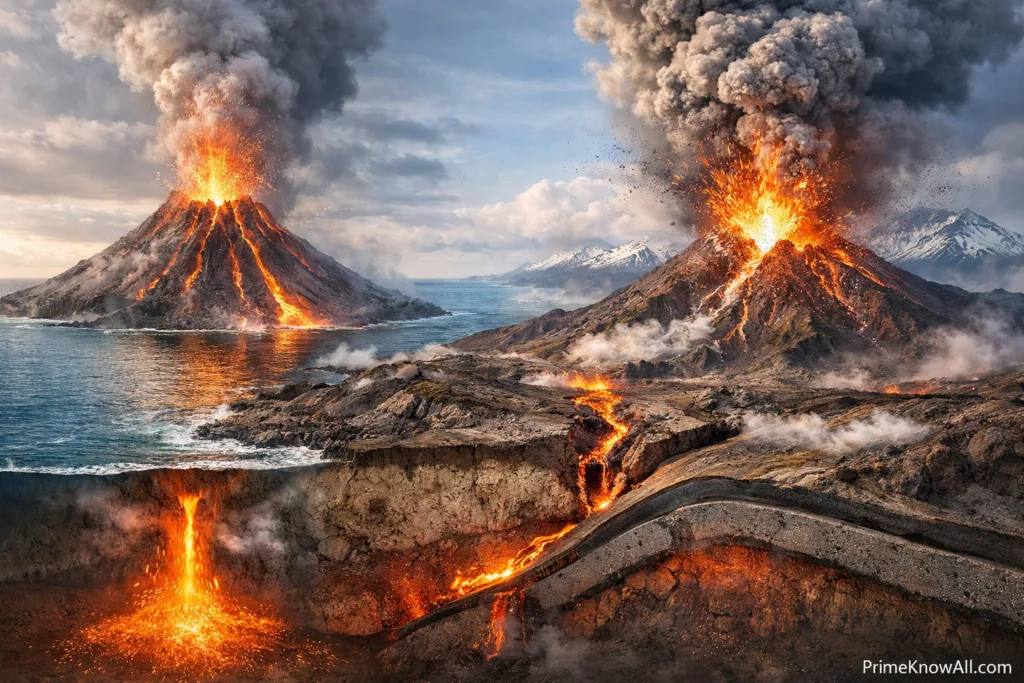
Typical features of divergent-boundary volcanism include:
- Long fissure eruptions rather than single central vents in many episodes.
- Basalt-dominated lava that can travel far when slopes allow.
- Shallow earthquakes linked to cracking and magma movement.
Because basalt is often less viscous than silica-rich magma, these eruptions can be more likely to flow than to explode, although local factors (ice, water, steep terrain, trapped gas) can still raise hazards in specific places.
Pocket Summary (Divergent Settings)
- Main trigger: decompression as mantle rises.
- Common outcome: basaltic lava and fissure-fed eruptions.
- Good mental image: a seam opening and hot material welling up to fill it.
Convergent Plate Boundaries: Subduction Makes “Wet” Magma
Short answer: At many convergent boundaries, an oceanic plate sinks beneath another plate; released water and other volatiles promote flux melting, generating magma that can be gas-rich and, in many arcs, more prone to explosive eruptions.
A subduction zone is a plate boundary meaning the place where one plate dives into the mantle beneath another. As the descending slab warms and dehydrates, fluids move into the overlying mantle wedge, lowering melting temperatures. This process commonly builds volcanic arcs—chains of volcanoes such as those seen around the Pacific.
Subduction-related volcanoes often share patterns that are useful for readers and travelers alike:
- Steeper cones and layered deposits from alternating lava and ash.
- Mixed magma compositions (basalt to andesite to rhyolite) shaped by crustal processing.
- Hazards beyond lava, including ash fall, pyroclastic flows, and lahars, depending on geography and water/ice.
It is tempting to treat “subduction volcano” as shorthand for “always explosive,” but a more careful statement is that subduction environments often supply water, which can increase gas pressure and change magma behavior; the final outcome depends on storage depth, magma mixing, and how easily gases can escape.
Hotspots: Volcanoes Away From Plate Edges
Short answer: Hotspots are regions meaning focused sources of magma that can form volcanoes within a plate, not just at its edges. Many hotspot chains show age progression as the plate moves, leaving older volcanoes behind and building new ones above the magma supply.
A hotspot is a volcanic region meaning a place where magma generation stays active for a long time in roughly the same area relative to plate motion. The classic explanation is a mantle plume, a column of unusually warm upwelling mantle, but some hotspots may also involve shallow mantle processes, cracks that focus melt, or interactions with nearby plate stresses. In other words, “hotspot” describes a pattern, and the deepest cause can vary.
Three practical clues often used to recognize hotspot-style volcanism are:
- Intraplate location away from obvious plate boundaries.
- Linear chains or trails of volcanoes with older features farther from the active center.
- Distinct geochemistry that can suggest a deeper or different mantle source compared with ridge basalts.
Some hotspots are mainly oceanic (building shield volcanoes), while others interact with thick continental crust and can produce very different outcomes, including large caldera systems. The same label can cover a wide range of volcanic styles, which is why context matters.
Fast Mental Model (Boundaries vs Hotspots)
- Boundaries: plate motion directly creates the melting conditions.
- Hotspots: a persistent magma supply interacts with a moving plate.
- Best first question: “Is the volcano on an edge or inside a plate?”
| Setting | Primary Melting Trigger | Typical Magma Tendency | Common Surface Expression | Example Regions |
|---|---|---|---|---|
| Divergent Boundary | Decompression as mantle rises | Often basalt-rich, lower viscosity | Ridges, fissures, lava fields | Mid-ocean ridges, Iceland-style rifts |
| Subduction Zone Arc | Flux melting from slab-released water | Often more variable; can be gas-rich | Stratovolcano chains, ash layers | Andes, Japan arcs, Cascades |
| Oceanic Hotspot | Persistent upwelling and focused melt | Commonly basaltic; high eruption volumes in some phases | Shield volcanoes, seamount chains | Hawaiian-type chains |
| Continental Hotspot Or Intraplate Province | Hot melt interacts with thick crust | Can evolve toward silica-rich magma | Calderas, widespread ash deposits | Large continental volcanic provinces |
Why Some Volcanoes Are Gentle And Others Explosive
Short answer: Eruption style depends heavily on viscosity and gas pressure. Low-viscosity magma can let gases escape, making flowing lava more likely; high-viscosity magma can trap gases, which increases the chance of explosive fragmentation when pressure releases.
Viscosity is a measure meaning how resistant a fluid is to flow. Silica-rich magma is typically more viscous, while basaltic magma is often less viscous. Volatiles are dissolved gases meaning water vapor, carbon dioxide, and similar components that can expand rapidly as pressure drops. When gas expansion outpaces gas escape, eruptions can become more explosive.
A simple analogy helps: opening a soda bottle is calm if the gas can vent gradually, but it becomes chaotic if pressure is high and escape routes are blocked—magma behaves similarly when gases are trapped by sticky melt and narrow pathways.
Factors that often tilt behavior one way or the other include:
- Composition: higher silica commonly increases viscosity.
- Gas content: more volatiles can build more pressure, especially if trapped.
- Temperature: hotter magma can be less viscous, all else equal.
- Crystal content: more crystals can thicken magma and hinder gas escape.
The important nuance is scope: while subduction settings often provide water that can amplify gas-driven explosivity, local plumbing and degassing can produce quieter lava eruptions there too. Likewise, basaltic hotspots can still generate explosive events when magma meets water or when gas builds in confined pathways.
How Volcano Plumbing Systems Grow Over Time
Short answer: Many volcanoes are built by a plumbing system—networks of dikes, sills, and storage zones—that evolves as magma repeatedly intrudes, cools, mixes, and sometimes erupts.
A dike is a sheet-like intrusion meaning magma that cuts across surrounding rock; a sill is similar but spreads along layers. A magma chamber is a reservoir meaning a region where melt accumulates and can differentiate (change composition) before eruption. Over time, repeated injections can enlarge pathways, heat surrounding rock, and create longer-lived volcanic centers.
Common stages seen in many volcanic systems (with plenty of real-world variation) include:
- Initial intrusions that may never erupt but weaken and heat the crust.
- Focused vents forming once pathways become established.
- Storage and mixing as multiple magma batches interact.
- Structural change such as caldera formation if a large volume is erupted and the roof collapses.
One useful but less obvious point is that “volcano location” can be stable while the magma feeding it changes. A hotspot volcano, for example, may start with basaltic flows and later show more evolved magma in some phases if storage and crustal interaction become substantial.
What You Should Keep Right Now (Eruption Style + Plumbing)
- Composition and gas shape explosivity more directly than “volcano label.”
- Storage matters: time underground lets magma evolve and mix.
- Pathways decide whether pressure vents steadily or releases violently.
How Scientists Tell Which Setting Built A Volcano
Short answer: Researchers combine plate reconstructions, geochemistry, and geophysics to infer whether a volcano is linked to a boundary, a hotspot, or a more complex regional interaction.
Geologists rarely rely on a single clue. A volcano’s location on a map is useful, but it can be misleading near complicated plate margins or rifting regions. Instead, multiple lines of evidence are assembled to create a consistent story of melt source and magma pathway.
Common tools and what they reveal include:
- Chemical fingerprints: element ratios and isotopes can hint at mantle source and slab influence.
- Seismic imaging: tomography can suggest hotter or partially molten regions at depth.
- GPS and InSAR: ground deformation can indicate magma movement and storage.
- Age dating: systematic age progression supports a moving-plate-over-source pattern typical of many hotspot chains.
A measured way to say it is: in many well-studied cases, these methods converge on a clear classification, but some regions remain debated because multiple processes can produce similar surface outcomes.
Common Misconceptions About Hotspots And Plate Boundaries
Short answer: Many misunderstandings come from treating volcanoes as if they have one cause. In reality, melting triggers and crustal pathways combine, and that combination can differ even within the same region.
Misconception: “All volcanoes sit on plate boundaries.”
Correction: Many volcanoes are boundary-related, but intraplate hotspots and rifts can also produce volcanism.
Why it’s misunderstood: Global maps highlight boundary belts, making exceptions easy to miss.
Misconception: “Hotspots always mean a deep mantle plume.”
Correction: A hotspot describes persistent volcanism; the deepest mechanism can vary by region.
Why it’s misunderstood: The plume model is a clean explanation that became widely taught as the default.
Misconception: “Basaltic volcanoes are harmless.”
Correction: Basaltic eruptions can still be dangerous through fast lava, gases, and water-ice interactions.
Why it’s misunderstood: People equate “less explosive” with “safe,” which is not the same claim.
Misconception: “Subduction volcanoes always explode.”
Correction: Many arcs do produce explosive eruptions, but eruption style depends on viscosity, gas, and plumbing at that moment.
Why it’s misunderstood: Iconic arc eruptions dominate public memory and footage.
Misconception: “A volcano’s shape tells you everything.”
Correction: Shape helps, but chemistry, tectonic setting, and history matter more for a full explanation.
Why it’s misunderstood: Visual categories are easier than process-based thinking.
Misconception: “Hotspot chains prove the source is perfectly fixed.”
Correction: Age-progressive chains can still involve source motion, changing plate speed, or complex mantle flow.
Why it’s misunderstood: Diagrams often simplify motion to a single stationary arrow.
Reality Check (Misconceptions)
- Setting narrows options, but it does not dictate a single eruption outcome.
- Hotspot is a pattern label; the underlying mechanism can be more than one thing.
- Risk comes from context—terrain, water, gases, and population matter as much as magma type.
Everyday Patterns That Make Volcano Formation Click
Short answer: Plate boundaries and hotspots can feel abstract until they’re matched to familiar systems: pressure release, added “ingredients”, and plumbing constraints show up in everyday life in surprisingly clear ways.
- Pulling apart warm taffy: stretching makes it thin and easier to deform. Why this maps: divergence reduces pressure and encourages melting.
- Adding water to dry flour: the mix changes dramatically with a small addition. Why this maps: volatiles can lower melting temperatures in subduction settings.
- Traffic through a narrow tunnel: flow looks smooth until a bottleneck builds pressure. Why this maps: tight pathways trap gas and raise explosivity potential.
- A factory that never moves, while roads do: the output leaves a line of deliveries. Why this maps: a persistent hotspot plus moving plate can create volcanic chains.
- Reheating leftovers repeatedly: flavors blend and textures change over time. Why this maps: magma storage and mixing can evolve composition before eruption.
- Steam escaping from a lid: a small vent prevents a bigger burst. Why this maps: efficient degassing can shift eruptions toward gentler behavior.
These analogies are not perfect physics, but they help keep the core idea intact: melting creates material, and the system’s constraints decide how that material is released.
Quick Test: See If The Story Sticks
Short answer: Use these short scenarios to practice spotting the setting, the melting trigger, and the likely magma behavior.
A long line of small eruptions appears where the crust is pulling apart.
Answer: This fits a divergent boundary or rift, where decompression melting commonly feeds fissures with basaltic magma.
A volcanic chain gets older in one direction across an oceanic plate.
Answer: That pattern is consistent with a hotspot-style track, where plate motion carries older volcanoes away from the active magma source.
A steep volcano sits above a trench, with frequent ash layers in the surrounding geology.
Answer: This strongly suggests a subduction-zone arc, where water-driven melting and variable magma can support more explosive eruptions in many cases.
Two volcanoes in the same arc behave differently—one mostly effusive, one highly explosive.
Answer: The key is plumbing and degassing: storage depth, magma mixing, and gas escape pathways can diverge even within the same tectonic setting.
A basaltic eruption becomes dangerous mainly because it meets water and produces ash and steam-driven blasts.
Answer: That points to a magma–water interaction, showing that “basaltic” does not automatically mean “low hazard,” especially in wet or icy environments.
Mini Recap (After The Test)
- Spot the setting: boundary, hotspot, or rift-like intraplate region.
- Name the trigger: decompression, added volatiles, or heating.
- Then predict behavior from viscosity + gas + pathways, not from labels alone.
Limitations And What We Still Debate
Short answer: The big picture is well supported, but the details can be uncertain because Earth’s interior is hard to observe directly. Some questions remain open, especially about deep mantle dynamics and how multiple processes overlap in the same region.
Here are a few honest limits of this explanation:
- Hotspot causes vary: some hotspots fit plume expectations well, while others may be shaped by shallower mantle flow or lithospheric structure.
- Boundaries are messy: real plate edges can be broad zones with microplates, rifts, and changing geometry over time.
- Geochemistry is powerful but not magic: similar chemical signals can sometimes be produced by different histories of melting and mixing.
- Forecasting is not the same as explaining: knowing the tectonic setting does not precisely predict when a volcano will erupt.
A careful way to hold these uncertainties is to treat the setting as a strong constraint, not a guarantee. It narrows the story, while local plumbing, time, and crustal interaction fill in the ending.
A Practical Rule For Reading Any Volcano
Short answer: Ask two questions in order: What made the melt? and what route did it take? Those answers usually explain the volcano’s shape, typical products, and the range of likely hazards.
Summary: Plate boundaries generate volcanism mainly through decompression (divergence) or volatile-aided melting (subduction). Hotspots generate volcanism through persistent magma supply inside a plate, often leaving age-progressive trails.
The most common mistake: assuming a volcano’s tectonic setting automatically dictates a single eruption style, instead of checking viscosity, gas, and pathways.
Memorable rule: Find the trigger, then find the pathway.
Sources
USGS – Volcano Hazards Program [Clear, practical explanations of how volcanoes work and how scientists monitor them.] Why reliable: A primary U.S. government science agency with direct research and monitoring responsibilities.
Smithsonian Institution – Global Volcanism Program [Authoritative reference data on volcanoes worldwide and their tectonic context.] Why reliable: A long-running institutional database curated by specialists and widely used in research.
British Geological Survey – Volcanoes [Accessible overviews linking volcanism to plate tectonics and hazards.] Why reliable: A national geological survey that publishes vetted educational material based on scientific practice.
NASA Earth Observatory – Earth Processes And Volcanic Activity [Contextual visuals and explanations for hotspots, tectonics, and Earth system connections.] Why reliable: Produced by a major scientific institution with strong editorial standards for Earth science communication.
NOAA Ocean Exploration – Mid-Ocean Ridges [Focused explanation of ridge processes, where much divergent volcanism occurs.] Why reliable: A U.S. government science organization with mission-driven ocean research and education.
Encyclopaedia Britannica – Volcano [Quick reference definitions and broad context for general readers.] Why reliable: A long-established editorial reference with expert-reviewed entries.
Merriam-Webster – Hotspot (Definition) [Helpful for the everyday meaning of “hotspot” and how the term is used in English.] Why reliable: A widely used dictionary with professional lexicography and consistent definitions.
FAQ
Do volcanoes only form at plate boundaries?
No. Many do form at plate boundaries, but hotspots and some rifted intraplate regions can also generate volcanoes when magma supply and pathways persist.
What is the main difference between hotspot volcanoes and subduction volcanoes?
Hotspot volcanism is driven by a relatively persistent magma source within a plate, while subduction volcanism is commonly driven by water-assisted melting above a sinking plate. Eruption style can vary in both settings.
Why are many subduction volcanoes explosive?
In many arcs, magma can become more viscous and gas-rich, which can trap pressure. Still, local plumbing and degassing can produce quieter eruptions too.
How do scientists know a hotspot chain is getting older in one direction?
They use radiometric dating to measure ages across the chain. A consistent age progression supports a moving plate over a persistent source interpretation.
Can a volcano switch from gentle lava flows to explosive eruptions?
Yes. Changes in magma composition, gas content, temperature, and storage can shift viscosity and pressure conditions, altering eruption behavior over time.
What is the simplest way to identify how a volcano formed?
Start with location: boundary, intraplate, or rift-like. Then look for the melting trigger (decompression, volatiles, heat) and the plumbing that controls gas escape.
Article Revision History
