
Roman colonnades turned public space into something usable: a shaded path, a civic stage, a market edge, a legal setting, and a visual map of power. A colonnade is a row of columns that supports a roof or frames an open area; in Roman cities, it helped people move, wait, trade, meet, and understand where authority lived.
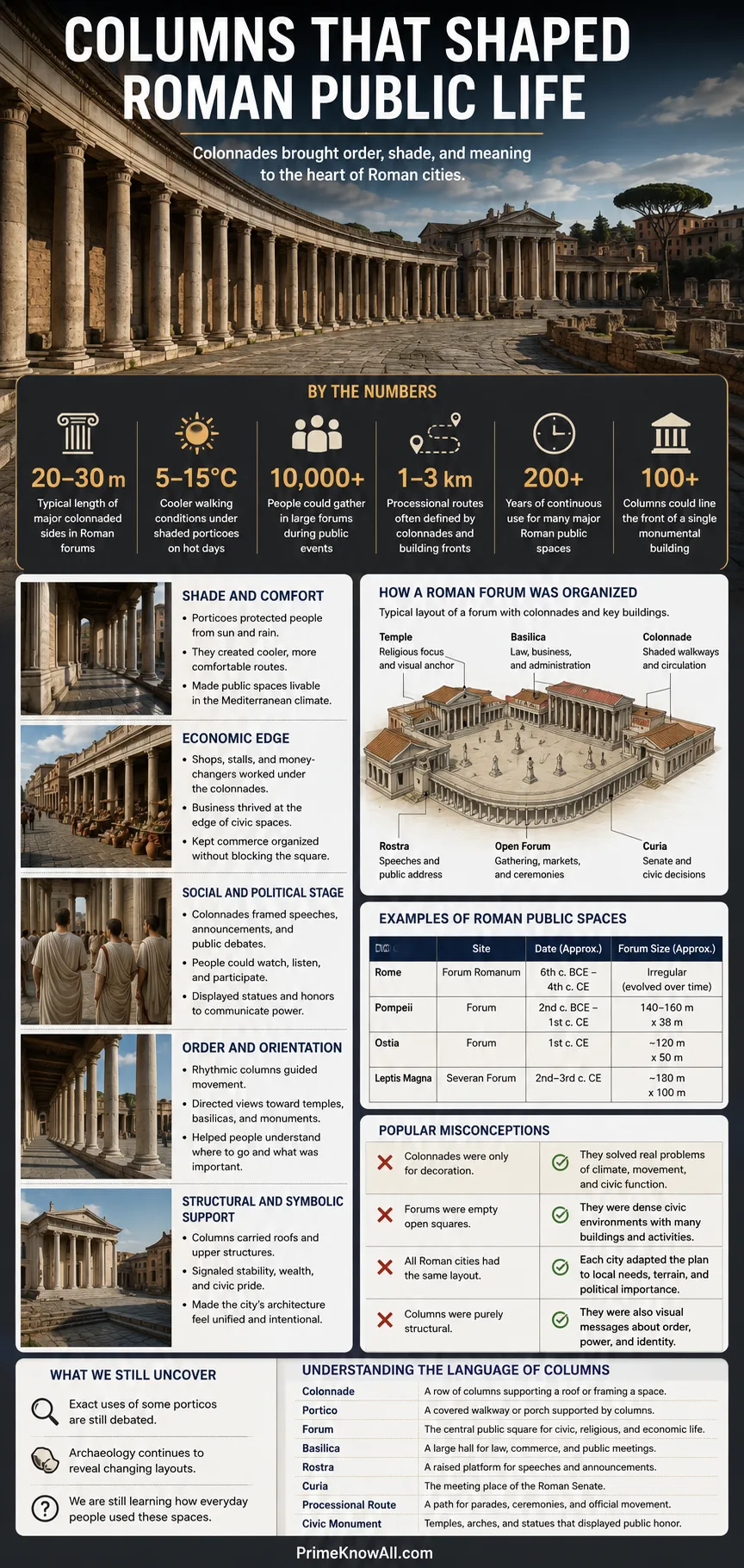
Roman colonnades were not just decoration. They made forums, basilicas, temples, baths, theatres, and market courts easier to use by giving people shade, rhythm, order, and direction. In a Roman city, columns did not only hold up stone; they organized public life.
Core Terms In Roman Public Space
- Forum means a central Roman public square used for law, business, religion, and civic display.
- Portico means a covered walkway or porch supported by columns, often attached to a building or surrounding a court.
- Basilica originally meant a large Roman public hall for law, trade, and meetings, not a church.
- Public space in Roman cities was practical before it was pretty: it had to handle heat, crowds, ceremonies, noise, movement, and status.
What Roman Colonnades Were Used For
Roman colonnades helped public spaces work like civic machines. They gave structure to open squares, kept people out of harsh sun, marked routes toward temples and courts, and created semi-public edges where business could happen without blocking the main square.
A Roman forum could look open at first glance, but it was rarely just an empty plaza. Around it were temples, basilicas, shops, archives, senate buildings, honorific statues, market halls, fountains, and speaker platforms. Colonnades tied these pieces together. They acted like a readable border: walk here, gather there, face this building, pass through that entrance.
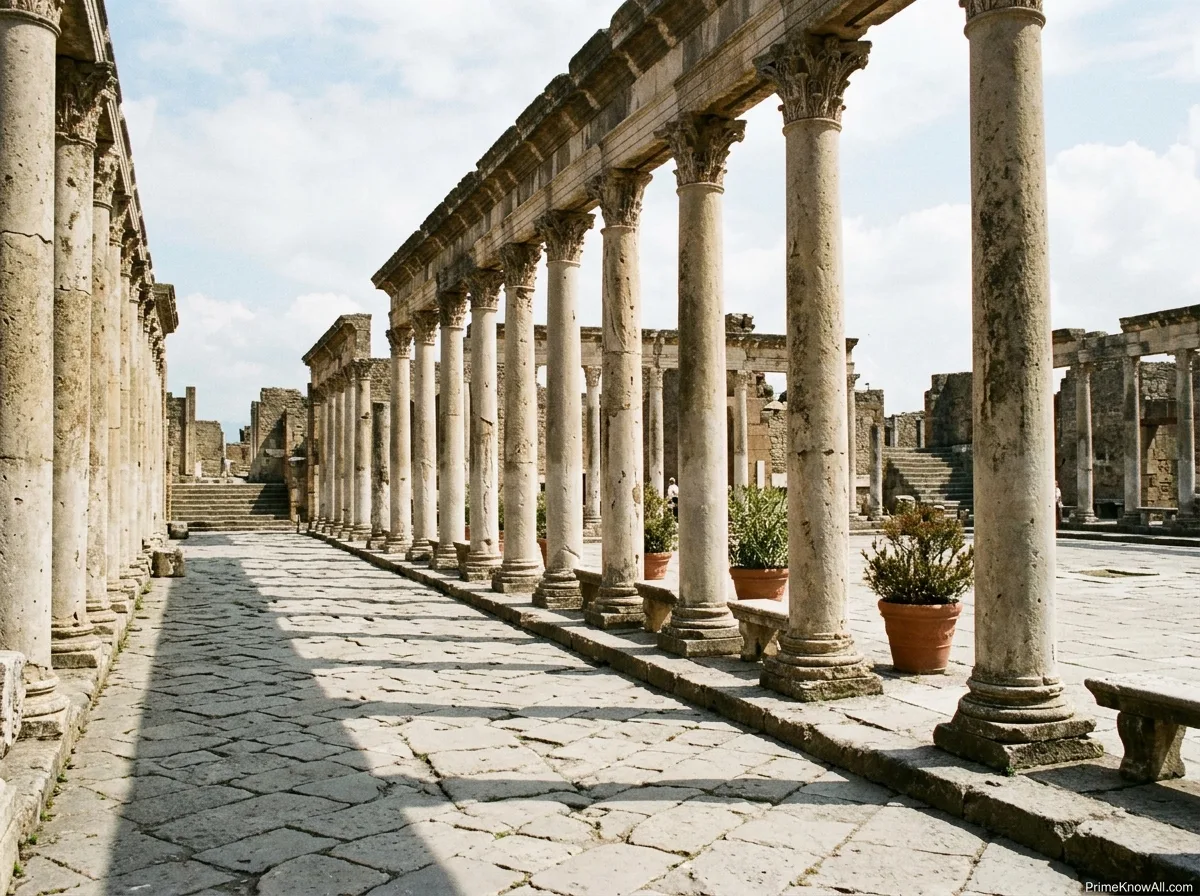
A portico, in plain terms, is a covered public edge. It let people move through a city while protected from sun and rain. That sounds simple, but in a Mediterranean climate it mattered. A shaded strip could turn a hot stone square from a place to cross quickly into a place where people could stay.
- Climate control: shade, rain cover, and cooler walking routes.
- Traffic control: a clear path around busy civic areas.
- Social control: places to wait, watch, talk, and be seen.
- Visual control: repeated columns guided the eye toward temples, basilicas, arches, or statues.
- Economic use: market stalls, money-changing, legal documents, and everyday negotiation could happen near the edges.
Why Public Space Mattered In Roman Cities
Roman public spaces were where a city explained itself. A person could enter a forum and quickly understand who governed, which gods were honored, where justice was handled, where trade happened, and whose names were meant to be remembered.
The Forum Romanum in Rome is the best-known case. It grew in a valley between the Palatine and Capitoline hills after drainage works made the area usable. Over time it became a dense civic zone rather than a single planned square. Temples, basilicas, arches, the Curia, the Rostra, and processional routes all competed for attention. That crowding is part of its value: the Forum was not a clean museum plan. It was a living political and social surface.
In planned towns, the idea could be easier to read. At Pompeii, the forum was a long rectangular space, roughly 140–160 meters long and about 38 meters wide depending on the measurement used by different site descriptions. It was surrounded on several sides by porticoes and public buildings. Its colonnades helped separate pedestrian civic space from the streets and shops around it.
Forum Functions
- A forum was not only a market. It mixed law, religion, money, ceremony, and status.
- A colonnade made the edge of a square active, shaded, and easier to navigate.
- The most useful Roman public spaces worked at two scales: the whole city and the single person walking through it.
The Main Parts Of A Roman Public Space
A Roman public space was usually built from repeatable civic parts. The exact mix changed by city, budget, local history, and political needs, but the same urban language appears again and again across the Roman world.
| Element | Plain Definition | Typical Public Role | How Colonnades Helped |
|---|---|---|---|
| Forum | The central civic square of a Roman town or city. | Meetings, markets, speeches, ceremonies, courts, public memory. | Porticoes framed movement and gave the square a readable edge. |
| Basilica | A large covered hall, usually rectangular, used for civic business. | Law courts, contracts, commercial meetings, public administration. | Rows of columns divided the nave and aisles, helping crowds move indoors. |
| Temple | A sacred building, often raised and placed as a visual focus. | Ritual, vows, state religion, civic identity. | Columns turned the front into a ceremonial face. |
| Portico | A covered walkway held by columns. | Shade, shelter, waiting, display, social exchange. | It was the colonnade in daily use. |
| Rostra | A raised speaking platform. | Public speeches, announcements, political performance. | Nearby colonnades created viewing edges and controlled gathering space. |
| Macellum | A covered or partly covered market building. | Food trade, especially meat, fish, and produce in many towns. | Columned courts and edges supported stalls and circulation. |
The pattern is easy to miss because ruins often leave only stone bases, broken capitals, and a few standing shafts. Yet in use, these spaces had roofs, painted surfaces, metal fixtures, inscriptions, statues, shopfronts, awnings, wooden doors, and crowds. A surviving column is only the hard skeleton of a much livelier place.
The Forum As A Civic Room Without A Roof
The forum worked like an outdoor room. Its “walls” were public buildings and porticoes. Its “furniture” included statues, altars, speaker platforms, measurement tables, and sometimes temporary stalls. The open center could hold people; the edges handled movement and business.
This is why the forum should not be imagined as a quiet monument. It was closer to a mix of city hall square, courthouse lobby, market edge, religious precinct, and public noticeboard. A Roman could meet a client, hear news, watch a procession, settle a debt, see a statue inscription, or pass a temple in the same civic circuit.
The Basilica As The Covered Version Of Public Life
A basilica was a public hall before it became a church form. In Roman use, it gave courts and business a roof. Columns divided the interior into a broad central nave and side aisles, allowing judges, merchants, clients, and spectators to occupy different zones without needing separate rooms.
The Basilica Ulpia in Trajan’s Forum shows how large this type could become. Scholarly and educational descriptions commonly give it a length of about 169 meters, with a central nave about 25 meters wide and a double surround of columns. That is not a small legal office. It is a huge civic hall made legible by repeated supports.
2026 Discovery: Vitruvius’s Basilica at Fano
On January 19, 2026, Italy’s Ministry of Culture announced that remains uncovered beneath Piazza Andrea Costa in Fano, ancient Fanum Fortunae, matched the Roman basilica described by Vitruvius in Book V of De Architectura. Vitruvius wrote that he had personally overseen the building, making the identification unusually useful for comparing an ancient architectural description with excavated remains.
The exposed structure has a rectangular plan with a perimeter colonnade. The arrangement recorded by the Ministry places eight columns along each long side and four along each short side. The columns were about 147–150 cm in diameter—approximately five Roman feet—and are reconstructed at roughly 15 meters high. They were associated with piers and pilasters that helped support an upper level.
The wider plan, about 50 × 35 meters, closely matches the proportions and column layout given in Vitruvius’s text. A newly located corner column helped fix the building’s position and orientation, strengthening the identification announced by the Italian authorities. For Roman public-space archaeology, Fano provides a current example of how a basilica’s colonnade organized a large covered civic hall beside the forum rather than serving as an ornamental screen alone.
How Columns Shaped Movement, Shade, And Status
Columns shaped behavior as much as they shaped views. Repetition tells people where to walk. Open bays let them enter and leave. Roofed edges invite waiting. Raised steps slow the body down. A long colonnade can make a crowd flow in one direction without a written sign.
Think of a Roman colonnade like the edge of a modern train platform. The platform does not force every movement, but it suggests safe zones, waiting zones, entry points, and sightlines. A portico did something similar in stone: it made a public place easier to read without needing constant instruction.
- Along the side of a forum: columns created a protected pedestrian loop.
- In front of a temple: columns framed a sacred entrance and made the building feel formal.
- Inside a basilica: columns divided legal, commercial, and walking areas.
- Around a courtyard: columns gave rhythm to viewing, shopping, exercise, or waiting.
- Beside a theatre or bath: columns helped manage crowds before and after events.
Status also mattered. A colonnade made a space look ordered, costly, and official. Marble, granite, limestone, travertine, local tuff, brick-faced concrete, painted stucco, and reused older stone could all send different messages. The same row of columns could say “this is a public route,” “this is a sacred front,” or “this family or emperor paid for civic improvement.”
Practical Role Of Colonnades
- Roman colonnades were practical infrastructure, not only visual ornament.
- They helped cities manage heat, rain, crowds, commerce, and ceremony.
- The same architectural feature could serve a daily task and a political message at the same time.
Column Orders And The Roman Eye
Roman builders used column orders as a visual language. An architectural order is a set of column parts and proportions, including the shaft, capital, base, and the horizontal structure above. A reader today may see “just columns,” but Roman viewers could notice differences in mood, cost, and formality.
The main orders were Doric, Ionic, Corinthian, Tuscan, and Composite. Roman architecture borrowed from Greek forms and adapted them freely. In many public spaces, especially during the imperial period, the Corinthian and Composite orders helped create a richer civic image. The leafy Corinthian capital, with acanthus decoration, became a common sign of public dignity and visual polish.
- Doric: plainer, heavier in feel, often linked with strength and older Greek forms.
- Ionic: known for scroll-like volutes on the capital.
- Corinthian: leafed capital, widely used by Romans in formal public settings.
- Tuscan: a simpler Roman form, plain and sturdy.
- Composite: a Roman blend of Ionic scrolls and Corinthian leaf forms.
Not every viewer read architecture like a trained architect. Yet the repeated use of columns, capitals, colored materials, and aligned axes made the city feel ordered and official. That effect was part of the design.
A Walk Through A Roman Forum
A forum was meant to be experienced by walking. Roman colonnades become easier to understand when the square is considered from the position of a person moving through it rather than only from a plan.
The person steps from a street into a brighter open space. The first thing they notice may be shade under a portico. Then the rhythm of columns pulls the eye sideways. A temple rises ahead. A basilica stretches along one side. Statues stand on bases with names and honors. A speaker platform marks the political edge. Shops, money-handlers, or market buildings sit close enough to serve the crowd.
Street Entrance
A visitor leaves a narrow street and reaches a wider civic space.
Portico Edge
A roofed colonnade gives shade and creates a walking route around the square.
Open Center
The paved area holds ceremonies, waiting crowds, traders on certain days, and public movement.
Basilica Side
Legal and business activity moves indoors, where rows of columns divide the hall.
Temple Or Monument Focus
A raised building, arch, statue group, or speaker platform gives the space a clear civic memory.
This movement pattern explains why colonnades appear in so many Roman spaces. They were not isolated objects. They were routes, filters, stages, and boundaries.
Roman Colonnades In Forums, Baths, Theatres, And Markets
Colonnades were useful far beyond the main forum. Roman cities used them wherever large numbers of people needed to move, wait, look, buy, exercise, or gather.
In baths, colonnaded courts could support walking, exercise, and social time before or after bathing. In theatre districts, porticoes helped absorb crowds and offered shaded space around performances. In markets, columned courts allowed goods to be arranged around a central zone. In sanctuaries, colonnades could mark a holy boundary and make ritual movement feel ordered.
- Bath complexes: used colonnaded areas for social walking and exercise.
- Theatres: used porticoes as gathering and circulation zones.
- Market buildings: used columns to support covered edges and divide stalls.
- Temple precincts: used colonnades to mark sacred courts.
- Imperial fora: used porticoes to frame power, victory, and public memory.
The Forum of Trajan in Rome shows the imperial version of this idea. Its portico-lined square, exedrae, monumental entrances, statues, and adjoining Basilica Ulpia created a controlled sequence of open and covered spaces. The colonnades gave pedestrians shelter and circulation routes while also framing views toward architecture associated with imperial authority and public memory.