
Roman baths worked because heat, water, and drainage were designed as one system. Furnaces warmed floors and walls through a hypocaust, water arrived from springs or aqueducts by gravity, and drains kept the whole complex moving. That is why a Roman bath was never just a pool. It was a carefully managed machine made for bathing, comfort, ritual, and daily urban life.
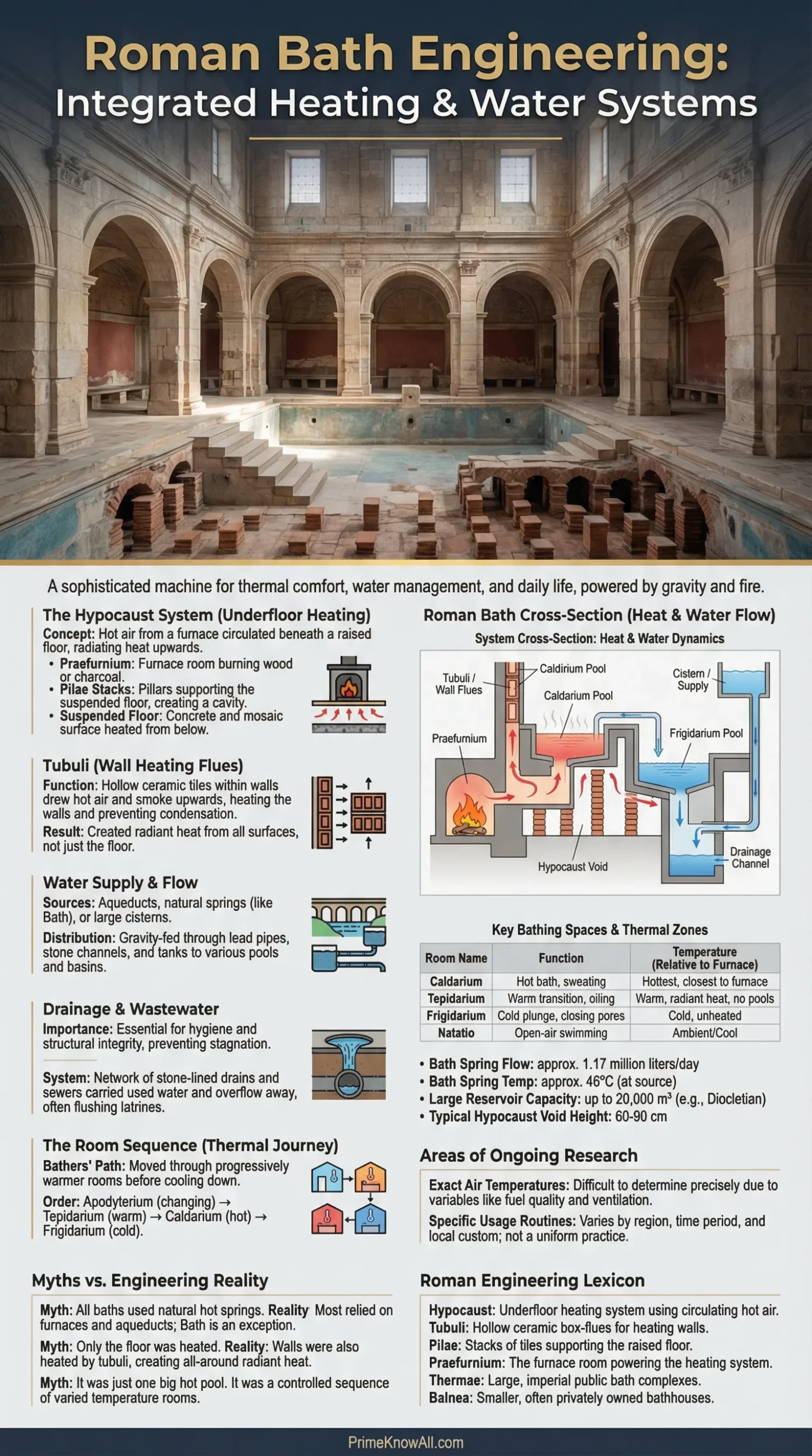
- Roman baths heated rooms as much as water.
- Hot rooms sat nearest the furnace, while cooler rooms sat farther away.
- Water supply mattered, but drainage mattered just as much.
- Bath, in Britain, was unusual because it used a natural hot spring rather than relying only on heated water.
- If you remember one thing: Roman baths were engineered environments, not simple bathing basins.
A visitor entering a working Roman bath complex moved through a building where temperature, humidity, surfaces, water flow, and movement between rooms were all planned. According to the Roman Baths museum in Bath, the spring there still rises at about 46°C and produces roughly 1.17 million litres a day. In larger imperial bath complexes elsewhere in the Roman world, aqueducts and reservoirs supplied the same kind of controlled abundance.
Keep This In Mind Before Reading Further: a bathhouse only worked when fuel supply, water supply, air movement, and wastewater removal all stayed in balance. Remove one piece, and the comfort vanished fast.
How Roman Baths Worked As One System
The short answer: Roman baths combined room sequencing, underfloor heating, gravity-fed water, and planned drainage. The goal was not only to wash the body. It was to create a controlled path from warm to hot to cool spaces, while keeping the building dry enough to function and wet enough to feel luxurious.
- Heat path: furnace, underfloor void, wall flues, hot room.
- Water path: spring or aqueduct, tank or cistern, pools and basins, drain.
- User path: changing area, warm room, hot room, cold plunge, rest or social space.
Hypocaust means an underfloor heating system that moves hot air below a raised floor. Tubuli are hollow ceramic flues in walls that let hot air rise upward. Caldarium means the hot room, tepidarium the warm room, and frigidarium the cold room. Those terms look technical at first, but the logic is plain: hotter spaces stood closest to the heat source.
Britannica’s entries on thermae and hypocausts show the same broad pattern across the Roman world. Even when local layouts varied, bathhouses usually depended on a fixed relationship between fire, raised floors, wall heating, and room order. That is one reason bath architecture spread so widely from Italy to Britain, North Africa, the Balkans, and Anatolia.
| Part | What It Did | How It Usually Worked | Why It Mattered |
|---|---|---|---|
| Praefurnium | Produced heat | Wood or charcoal burned in a furnace beside the hot rooms | Without steady firing, the whole sequence broke down |
| Hypocaust | Moved hot air under floors | Floors stood on small tile stacks called pilae | Created radiant heat rather than only open flame heat |
| Wall Flues | Heated walls and vented gases upward | Hollow ceramic tubes carried hot air up masonry walls | Made rooms warmer and less damp |
| Cisterns And Pipes | Stored and directed water | Gravity moved water through channels, tanks, and pipes | Allowed steady filling instead of chaotic flooding |
| Pools And Basins | Held water at different temperatures | Separate rooms offered hot, warm, or cold immersion | Defined the bathing routine |
| Drains | Removed overflow and wastewater | Stone-lined drains carried water away continuously | Stopped stagnation and protected the building |
How The Heating System Worked
The short answer: Roman baths heated rooms by sending hot air from a furnace beneath raised floors and then up through wall flues. The hottest spaces stood nearest the furnace, the warm rooms sat a little farther away, and cold rooms needed little or no artificial heating.
- The furnace did not heat one tub alone. It heated a whole zone.
- Radiant warmth mattered. Floors and walls gave off heat after the air moved through.
- The system needed labor. Fires had to be fed, ash had to be cleared, and airflow had to stay open.
The Furnace Sat Beside The Hottest Rooms
The praefurnium, the furnace room, was normally placed beside the caldarium. That was not decorative planning. It was practical. The caldarium needed the most heat, the most steam, and the fastest recovery after people opened doors and moved between spaces. Roman builders reduced heat loss by putting the demanding room closest to the source.
Raised Floors Turned The Whole Room Into A Heater
At Bath, the Roman Baths museum still shows stacks of ancient tiles that once supported heated floors. Hot air moved through the gap below the floor, then warmed the stone or mosaic surface above it. That meant heat rose evenly from below instead of gathering around a brazier in one corner. The result was more comfortable, more controlled, and much better suited to a public building.
Wall Flues Made The System More Efficient
A common oversimplification says Roman baths had “heated floors.” That is only part of the story. Cambridge research on box-flue tiles and the Roman Baths museum’s own explanation both show that walls were heated too. Hollow ceramic flues pulled hot air upward. This reduced cold wall surfaces, helped dry the room, and made the warm spaces feel much more even.
One useful analogy helps here. A Roman bath functioned a bit like a building-sized heat exchanger with people and pools placed inside it. Fire stayed mostly out of sight. The real effect came from what the fire did to the structure.
Pause Here:
- Roman heat was structural. It moved through floors and walls, not only through open flames.
- The caldarium was hot by design, not by chance.
- Heating a bathhouse meant managing airflow as carefully as managing fuel.
How Water Reached The Baths And Left Again
The short answer: Roman baths depended on steady inflow and steady outflow. Water usually arrived from an aqueduct, spring, or cistern, then moved by gravity into pools, basins, and service areas. Excess water and used water left through drains built into the complex.
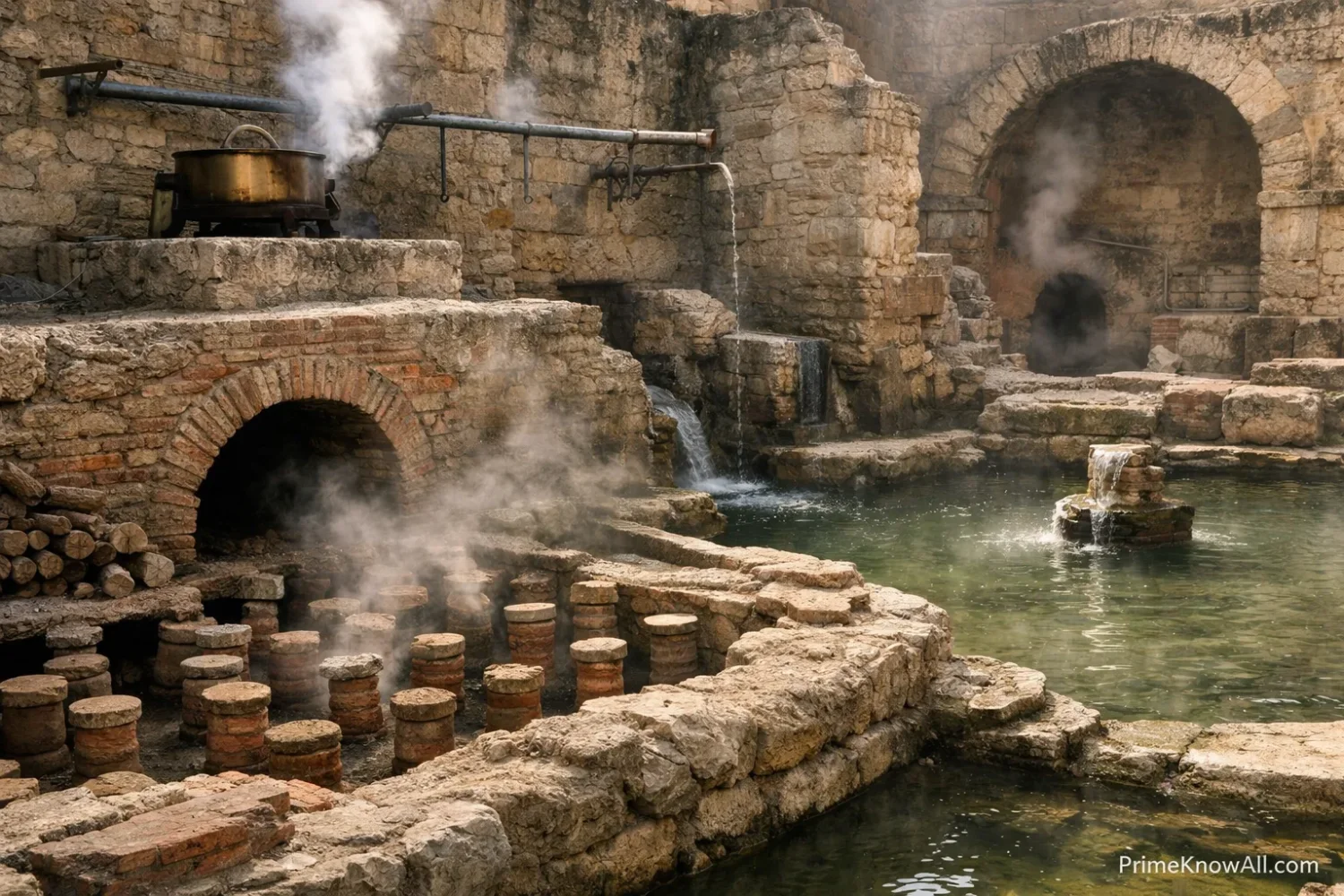
- Most Roman water systems worked by gravity.
- Lead pipes were common, but so were stone channels, tanks, and brick-lined conduits.
- Drains were not secondary. A bath without drainage became a maintenance problem very quickly.
Bath Was Special Because The Heat Came From The Spring Itself
The site at Aquae Sulis, modern Bath, was unusual. According to the Roman Baths museum and Bath & North East Somerset Council, the spring water there still rises at about 46°C and about 1.17 million litres per day. That let Roman builders work with naturally hot mineral water on a scale that most bathhouses did not have. Even so, natural heat did not remove the need for engineering. Water still had to be directed, contained, and drained.
The same official material also notes that the sacred spring was enclosed in a lead-lined tank and its water could move in two directions: into the baths or out through an overflow drain toward the River Avon. That is a revealing detail. It shows that the Romans designed the site around control, not just access.
Large Imperial Baths Needed Huge Supply Systems
In Rome and other major cities, natural hot springs were not enough. Britannica notes that Roman urban water systems relied heavily on gravity-fed aqueducts, and World History Encyclopedia points out that large bath complexes used reservoirs on a startling scale. For the Baths of Diocletian, one reported reservoir capacity reaches about 20,000 cubic metres. Even if one treats ancient figures with care, the scale makes the point: these were civic waterworks as much as leisure buildings.
Drainage Kept The System Alive
Drainage is one of the least discussed parts of Roman bath engineering, even though it did much of the daily work. At Bath, the Roman Baths museum explains that surplus spring water still runs into the original Roman drain and on toward the River Avon. In a 2023 cleaning report, the same museum described the Great Bath as holding around 500 cubic metres of water and noted that parts of the Roman drainage logic are still used during maintenance.
That kind of continuity matters. Floors, pools, and statues attract attention. A good drain keeps the site functioning.
What A Visit Felt Like Inside The Bath Sequence
The short answer: a Roman bather moved through rooms in a temperature sequence rather than diving into one big hot bath. Britannica’s standard description of thermae gives the familiar order of warm, hot, and cold spaces, though local layouts and personal habits could vary.
- Apodyterium: changing area.
- Tepidarium: warm transition room.
- Caldarium: hot bathing and steaming room.
- Frigidarium: cold plunge or cool room.
- Natatio: open-air swimming pool in some larger complexes.
This sequence was sensible for the body and sensible for the building. Warm rooms prepared bathers for heat. Hot rooms did the heavy work of sweating, soaking, and washing. Cold rooms closed the cycle. In some places, people used oils and a strigil, a curved scraping tool, as part of cleaning. Bathing was not a single action. It was a routine built around movement and changing temperature.
A common image today shows the Great Bath at Bath as if it were the whole experience. It was not. The Roman Baths museum explains that the site also had heated rooms, plunge pools, changing areas, and service spaces. That is another content gap in many short summaries: the famous outdoor pool tends to hide the rest of the machine.
What Sticks From This Section:
- A Roman bath was a route, not one pool.
- Warm rooms mattered because they eased the shift into hotter spaces.
- The famous pool was only one part of a much larger experience.
Why Roman Baths Were More Than Pools
The short answer: Roman baths joined engineering, social life, health culture, and urban identity. They were places to wash, but also places to wait, talk, recover, pray, negotiate, and be seen.
- They were social spaces.
- They reflected local status and civic pride.
- They pushed Roman builders to solve real mechanical problems.
UNESCO describes the Roman remains at Bath as among the most important north of the Alps, and that is not only because of the stonework. The site shows how a spring, a temple, and a bathhouse could anchor an entire settlement. More than 12,000 Roman coins were deposited in the Sacred Spring there, according to the Roman Baths museum, which also calls it the largest known votive deposit in Britain. That detail reminds us that the bath complex was tied to religion as well as bathing.
Academic work in Springer and Cambridge also shows that bath buildings spread as markers of Roman urban habit. A bathhouse signaled access to fuel, water, labor, construction skill, and civic order. In other words, a well-run bath told the city something about itself.
A Vertical Look At Heat And Water
The short answer: if the system is viewed vertically, the logic becomes easier to see. Water sat in pools and tanks above, while hot air ran through hidden voids below and within the walls.
Hot air and smoke needed a path out. Vents helped keep draft moving upward.
Tubuli, hollow wall flues, pulled hot air upward and reduced cold wall surfaces.
Caldarium, tepidarium, and frigidarium offered different temperatures and humidity levels.
The walking surface sat above a cavity carried by pilae, small tile stacks.
Hot air crossed this hidden underfloor chamber before rising into the walls.
The furnace burned fuel and fed heat into the system. Hot rooms stood nearest this point.
Springs, aqueducts, cisterns, lead pipes, channels, sluices, and drains handled constant inflow and outflow. At Bath, the spring still reaches around 46°C and delivers about 1.17 million litres a day.
Common Myths About Roman Baths
The short answer: many modern summaries flatten Roman baths into one image: a steaming pool. That misses how these sites actually worked.
- Wrong: All Roman baths were fed by hot springs.
Better: Many relied on aqueducts, cisterns, and heated water; Bath is the unusual spring-fed case.
Why This Confusion Lasts: Bath is famous, so its setup often gets treated as the norm. - Wrong: The hypocaust only heated the floor.
Better: In many baths, walls were heated too through flues and box tiles.
Why This Confusion Lasts: Underfloor spaces survive visibly in ruins, while upper wall systems are easier to miss. - Wrong: Roman baths were mostly about hygiene in the modern sense.
Better: They mixed washing, exercise, relaxation, religion, and social life.
Why This Confusion Lasts: The word “bath” sounds narrower in modern English than it was in Roman practice. - Wrong: One giant hot pool did the whole job.
Better: The real experience depended on a sequence of rooms and temperatures.
Why This Confusion Lasts: Large surviving pools photograph well and dominate memory. - Wrong: Water supply was the hardest part; once water arrived, the rest was easy.
Better: Drainage, fuel supply, airflow, and maintenance were just as important.
Why This Confusion Lasts: Hidden service systems attract less attention than baths and mosaics. - Wrong: Every Roman bath had the same plan.
Better: Shared logic existed, but layout changed by region, budget, date, and water source.
Why This Confusion Lasts: Textbook diagrams usually show one idealized plan.
Worth Carrying Forward:
- Bathhouses varied, but the engineering logic stayed recognizable.
- Famous examples can mislead. Bath is famous because it is unusual in some ways.
- Most of the real work happened behind surfaces.
How This Played Out In Daily Use
The short answer: Roman bath systems solved ordinary problems in practical ways. The best way to see that is to imagine real use rather than only architecture.
- A winter arrival in Roman Britain: a visitor steps first into a warm room rather than going straight into steam. Why? The building eases the body into heat and reduces shock.
- A crowded hot room in late afternoon: doors open and close, people move, and heat starts to escape. Why? The caldarium sits nearest the furnace so it can recover faster.
- Mineral spring overflow at Bath: the water keeps rising whether anyone is bathing or not. Why? A controlled drain is as necessary as the pool itself.
- A wall stays warm after the fire has been going for a while: the room feels more even and less damp. Why? Heated walls add radiant comfort, not just floor heat.
- A wealthy city builds a larger bath complex: it needs more than stone and decoration. Why? It must also secure fuel, water, labor, and repairs.
- A visitor remembers the big pool but not the service spaces: the famous view dominates memory. Why? Hidden systems usually do their best work when nobody notices them.
- A modern engineer looks at a hypocaust: the principle feels familiar. Why? It uses controlled airflow and radiant surfaces in a way that still makes sense today.
What We Can Say And What We Cannot
The short answer: the broad mechanics of Roman bath heating and water systems are well supported, but exact temperatures, usage patterns, and site-by-site routines are not always known with full precision.
- Bathhouses varied by region and date. A small local bath did not operate exactly like the Baths of Caracalla.
- Archaeology preserves some parts better than others. Floors, drains, and foundations often survive better than roofs, doors, or upper flues.
- Temperature estimates can be debated. Heat levels changed by room, fuel supply, ventilation, and crowd size.
- Visitor routines were not identical. There was a broad sequence, but personal habits and local customs still mattered.
That limit does not weaken the main picture. It simply means the safest explanation is the one that stays close to the evidence: Roman baths were carefully engineered spaces that managed heat, water, movement, and waste together.
Check Your Understanding
Did Roman baths heat only the water?
No. The system heated both water and rooms. The hypocaust warmed floors, while wall flues warmed masonry and helped move hot air upward.
Why was Bath different from many other Roman bath sites?
Bath used a natural hot spring. Many other Roman baths depended mainly on aqueduct-fed water that then had to be heated or managed in other ways.
What made the caldarium the hottest room?
It usually stood closest to the furnace, so it received the strongest and freshest flow of heat through the underfloor system and wall flues.
Why do drains matter so much in a bathhouse?
Because baths needed constant inflow and constant outflow. Without good drainage, overflow, dirty water, and structural damp would quickly become a problem.
Were all Roman baths giant imperial complexes?
No. Some were huge civic thermae, while others were smaller balnea. The scale changed, but the engineering logic stayed recognizable.
Why The System Still Feels Familiar
Roman baths feel modern because their problems still feel modern: how to move water cleanly, how to warm a room evenly, how to vent heat, and how to make a public building comfortable for a lot of people. That is why the subject keeps resurfacing in museum interpretation, academic work, and even present-day sustainability projects.
Bath offers a neat example. The Roman Baths museum explains that the same spring now supports a modern heat recovery scheme, with energy exchange blades installed to warm nearby heritage buildings. The old Roman system and the new one are not identical, but the shared instinct is obvious: use the site’s natural thermal resource intelligently.
Roman baths succeeded because they treated heat and water as one design problem. The rooms, pools, walls, drains, and furnaces only make full sense when read together. The most common mistake is to focus on the famous pool and forget the hidden service network. The rule worth keeping is simple: if a Roman bath looks calm on the surface, a lot of engineering is working behind it.
Sources
- The Roman Baths – Walkthrough — Useful for site-specific facts on the Sacred Spring, water flow, the original drain, and the layout of the Bath complex. Why reliable? It is the official museum site for the monument itself.
- The Roman Baths – How the People of Aquae Sulis Kept Warm — Explains the hypocaust, raised floors, wall flues, and why Bath’s hot spring mattered. Why reliable? It is published by the official institution that manages and interprets the archaeological site.
- Bath & North East Somerset Council – Learn About Bath Hot Springs — Helpful for the protection, monitoring, and civic importance of Bath’s thermal springs. Why reliable? It comes from the public authority responsible for protecting the springs.
- UNESCO World Heritage Centre – City of Bath — Gives the formal heritage context and explains why the Roman remains and hot springs matter at an international level. Why reliable? UNESCO is the global body that records and evaluates World Heritage status.
- Encyclopaedia Britannica – Thermae — Good for the standard room sequence, bathing routine, and the broad meaning of Roman public baths. Why reliable? Britannica is a long-established edited reference work with subject oversight.
- Encyclopaedia Britannica – Roman Achievements in Construction — Useful for the wider Roman context of aqueducts, gravity-fed supply, and lead piping. Why reliable? It is an edited reference entry that summarizes stable engineering history clearly.
- Springer – Baths and Bathing, Roman — Helpful for the development of the hypocaust and the bathhouse as an architectural type. Why reliable? It comes from an academic reference platform used in higher education and research.
- Cambridge Core – Heating Londinium: Dating Relief-Patterned Box-Flue Tiles and Other Wall Cavity Traditions in Roman London’s Baths and Heated Buildings — Useful for the wall-heating side of Roman bath engineering, which is often skipped in short summaries. Why reliable? It is a specialist journal article from a major academic publisher.
- World History Encyclopedia – Roman Baths — A strong synthetic overview for reservoir scale, bath functions, and architectural spread. Why reliable? It is editorially reviewed and very useful for broad historical synthesis, though it is best read alongside museum and academic sources.
- The Roman Baths – The Roman Baths and Pump Room to Be Heated by Spa Water — Adds a modern connection through the site’s energy exchange scheme. Why reliable? It is an official update from the institution running the project on site.
FAQ
How did Roman baths heat the rooms?
They used a hypocaust, an underfloor heating system. Hot air from a furnace moved beneath raised floors and often rose through hollow wall flues, warming both the floor and the walls.
How did Roman baths get water?
Water came from springs, aqueducts, cisterns, or reservoirs. In Bath, the system was built around a natural hot spring. In many other cities, gravity-fed aqueduct water supplied the baths.
What is the difference between a caldarium and a tepidarium?
The caldarium was the hot room, usually nearest the furnace. The tepidarium was the warm room, used as a transition space before or after hotter bathing.
Did Roman baths only matter for hygiene?
No. They also mattered for social life, ritual practice, rest, exercise, and civic identity. In places like Bath, they were tied to sacred water and religious offerings as well.
Why are Roman baths still studied today?
Because they show how Roman builders handled heat, water, comfort, and public infrastructure in one building type. Their logic still feels familiar to modern architects, engineers, and conservators.