
Prehistoric megalithic structures are large stone monuments built before written records in many parts of the world. They include standing stones, dolmens, stone circles, passage tombs, temples, and carved stone jars. Their main uses were burial, ritual gathering, landscape marking, seasonal timing, and public memory.
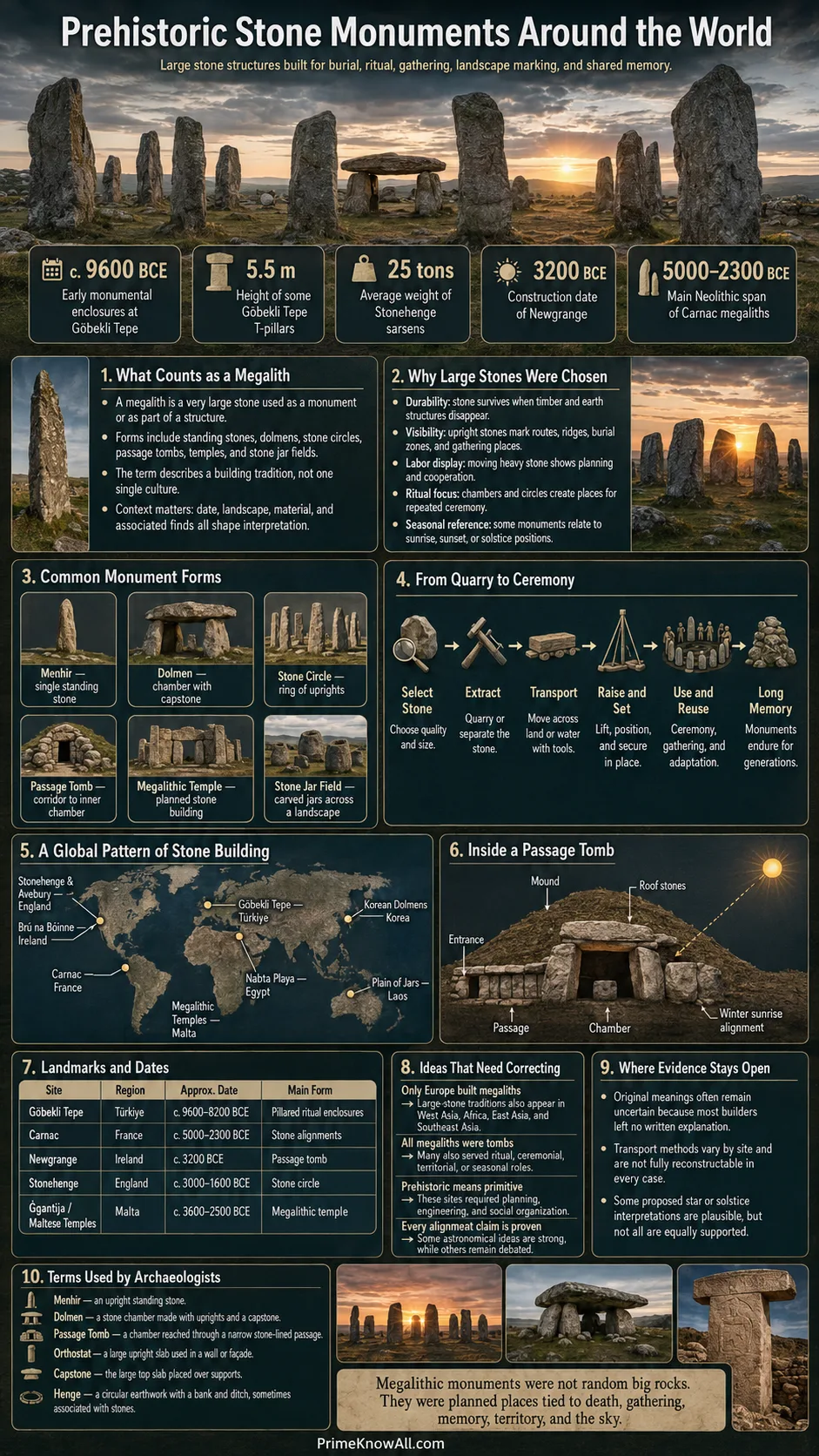
A megalith is a very large stone used as a monument or part of a structure. The word sounds simple, but the sites are not. A stone circle in Britain, a T-shaped pillar in southeastern Türkiye, a dolmen cemetery in Korea, and a carved jar field in Laos can all belong to the same wide family of large-stone building traditions.
If you remember one thing: prehistoric megaliths were not random “big rocks.” They were planned features in lived landscapes, often tied to death, gathering, sky-watching, territory, craft, and shared identity.
What To Notice First
- Megalithic structures appear on several continents, not only in western Europe.
- Dates vary widely: Göbekli Tepe belongs to the 10th–9th millennia BCE, while many dolmen and stone-jar traditions are much later.
- Function is not one-size-fits-all: some sites were tombs, some were gathering spaces, some were temples, and some combined several roles.
- Engineering mattered: builders quarried, moved, raised, balanced, carved, and aligned heavy stones without modern machinery.
- Many meanings remain uncertain because most of these societies left no written explanation.
What Prehistoric Megalithic Structures Are
Prehistoric megalithic structures are monuments made with large stones before written records were used in that place. The term covers a wide range of forms, from a single upright stone to a built chamber, a stone-lined avenue, or a large ritual complex.
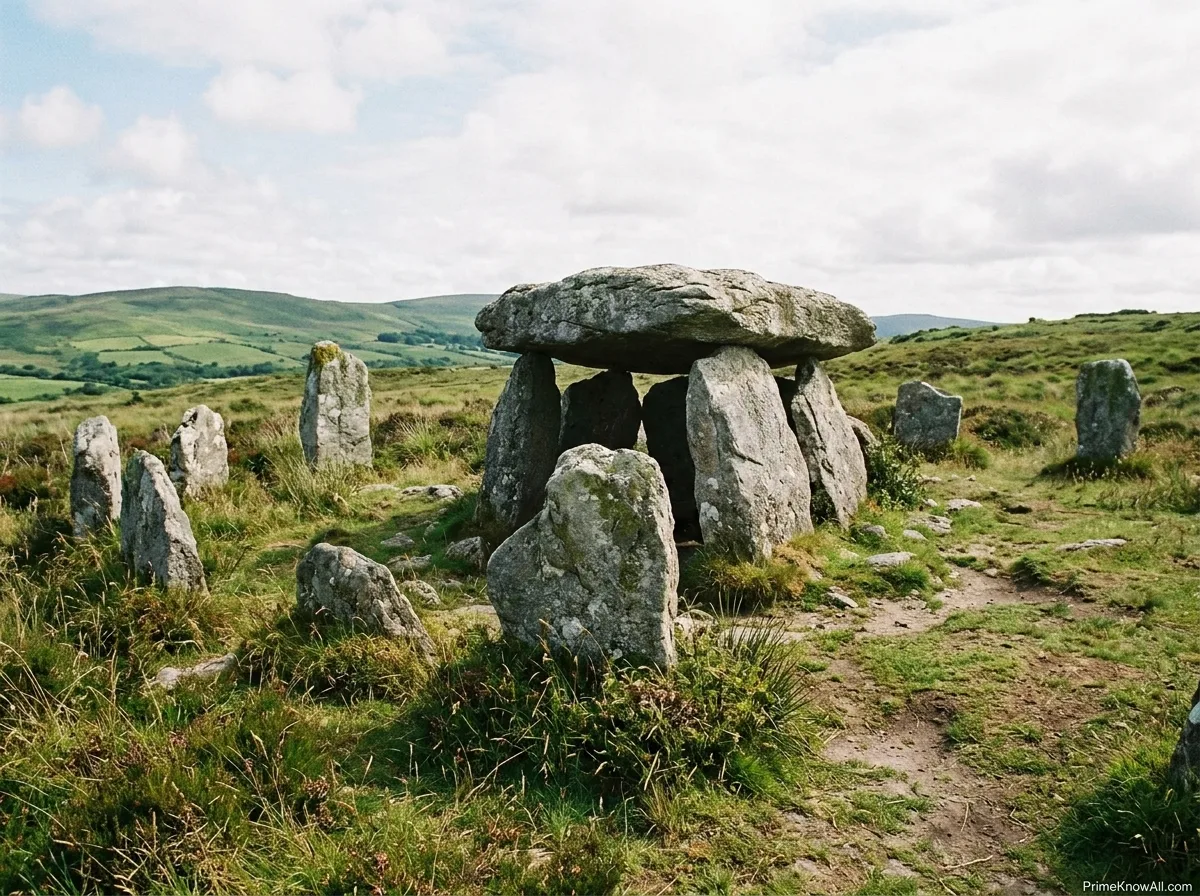
A menhir is an upright standing stone. A dolmen is a stone chamber, often made with upright supports and a capstone. A passage tomb is a mound with a stone-lined passage leading into an inner chamber. A stone circle is a ring of standing stones, sometimes linked to seasonal alignments or public ceremonies.
- Material: limestone, sandstone, granite, silcrete, basalt, and other local or transported stone.
- Scale: from modest stones that one team could move to slabs weighing many tons.
- Setting: ridges, river bends, coastlines, uplands, former lakebeds, sacred hills, and cemetery zones.
- Use: burial, ritual, territorial marking, seasonal observation, communal gathering, and memory.
Why The Word “Prehistoric” Needs Care
Prehistoric means “before written records” for a specific society, not “simple” or “less intelligent.” Many megalith builders showed careful planning, skill with stone, and social organization. In some regions, megalithic building continued into periods where nearby cultures already used writing, so the term depends on local context.
Small Reader Note
- Megalithic describes a building habit, not one single culture.
- Similar stone forms can appear in distant places for different reasons.
- Good interpretation starts with location, date, material, and archaeological context.
Why Large Stones Appeared In So Many Places
Large stones made ideas durable. In many prehistoric societies, a heavy stone could mark a burial, gather a community, point toward a horizon event, or turn a landscape into a shared memory map.
That does not mean every megalith had the same purpose. A Korean dolmen cemetery and Malta’s temple complexes belong to different regions, dates, and social worlds. The shared feature is not a single religion. It is the decision to use large stone as a public material.
- Durability: stone survives where timber, reeds, and mud walls often vanish.
- Visibility: upright stones can mark a route, ridge, cemetery, or gathering zone.
- Labor display: moving heavy stones shows coordination and shared effort.
- Ritual focus: chambers, circles, and platforms create special places for repeated events.
- Sky and season: some monuments relate to sunrise, sunset, solstice, or horizon points.
A useful analogy: a megalithic site can work like a town square, family archive, calendar mark, and memorial folded into one physical place. It does not need writing to carry meaning. Its location, stones, route, view, and repeated use do part of the work.
Main Types Of Megalithic Structures
Megalithic structures are easier to understand when grouped by form. The same type can still have different meanings from region to region, but the shape gives a useful starting point.
| Type | Simple Definition | Common Use | Examples |
|---|---|---|---|
| Menhir | A single upright stone | Marker, ritual focus, boundary, or alignment point | Carnac alignments, parts of western European stone rows |
| Dolmen | A chamber made from upright stones and a capstone | Burial, ancestor memory, elite tomb marking | Korean dolmens, Poulnabrone, Antequera Viera Dolmen |
| Stone Circle | A ring of standing stones | Gathering, ceremony, seasonal alignment, landscape focus | Stonehenge, Avebury, smaller circles across Britain and Ireland |
| Passage Tomb | A mound with a passage leading into a chamber | Burial and ritual movement through controlled space | Newgrange, Knowth, Dowth |
| Megalithic Temple | A planned stone building with rooms, walls, and decorated spaces | Ritual activity, offerings, gathering, symbolic display | Ġgantija, Ħaġar Qim, Mnajdra, Tarxien |
| Stone Jar Field | Large carved stone vessels placed across a landscape | Funerary practice and ritual landscape use | Plain of Jars, Laos |
How Form Changes Meaning
A circle invites movement around a center. A passage tomb controls entry, darkness, and light. A dolmen creates a chamber for the dead or for memory of the dead. A stone row can turn the wider landscape into part of the monument.
What This Means
- Shape is evidence, not a full answer. A stone form needs its date, setting, and finds.
- Burial and ritual often overlap in prehistoric sites, especially where ancestors mattered.
- The landscape is part of the structure when stones point to hills, rivers, coastlines, or horizon events.
How A Megalithic Site Worked From Quarry To Memory
A megalithic monument was a process before it was a finished structure. Builders had to choose stone, move it, raise it, shape the setting, use the place, and maintain its meaning over time.
1. Stone Choice
The builders selected stones for size, shape, source, color, durability, or social value. Some stones came from nearby outcrops; others moved across long distances.
2. Extraction And Transport
Teams used tools, ropes, sledges, levers, rollers, tracks, ramps, or water routes depending on terrain and material. The exact methods vary by site.
3. Raising And Setting
Stoneholes, packing stones, earth ramps, counterweights, and careful balancing helped turn weight into architecture.
4. Use And Reuse
The site could host burials, gatherings, offerings, seasonal observation, or repeated visits over centuries.
5. Long Memory
Later people often reinterpreted older stones. Some sites stayed meaningful long after the original builders were gone.
This sequence helps explain why a monument can be both engineering and social memory. The stone is visible, but the real achievement also includes planning, food supply, leadership, craft knowledge, route choice, and repeated participation.
Major Megalithic Landscapes Around The World
The best-known megalithic sites are only a sample. Large-stone traditions appear across Europe, western Asia, Africa, and parts of Asia and Oceania, with strong local differences in date, form, and purpose.
Göbekli Tepe, Türkiye
Göbekli Tepe, in southeastern Anatolia, is one of the oldest known monumental stone complexes. UNESCO places its round-oval and rectangular megalithic structures in the Pre-Pottery Neolithic period, about 9,600–8,200 BCE. Its T-shaped limestone pillars, some up to about 5.5 meters high, carry carved images of wild animals.
- Why it matters: it shows that hunter-gatherer groups could build large ritual structures before fully settled farming life dominated the region.
- What is still debated: the exact meaning of the T-shaped pillars, the rituals performed there, and how nearby sites such as Karahantepe fit into the same regional pattern.
- Useful definition: Pre-Pottery Neolithic means an early farming-era period before pottery became common in that region.
Nabta Playa, Egypt
Nabta Playa sits in the southern Egyptian desert, in a former seasonal lake basin. University research reports describe a stone circle, tomb-like stone features, and lines of standing or fallen megaliths dating roughly 6,500–6,000 years before present. It is often discussed in relation to early sky observation in North Africa.
- Why it matters: it moves the story of megalithic planning beyond the usual European map.
- Environmental setting: the site belonged to a wetter Sahara during the African Humid Period, when seasonal lakes supported people and cattle.
- Careful wording: solar alignments are better grounded than some wider stellar claims, which remain more open to interpretation.
Carnac And The Morbihan Megaliths, France
Carnac and the shores of Morbihan in Brittany form one of the densest megalithic landscapes in Europe. UNESCO’s 2025 inscription describes Neolithic megalithic structures from about 5000–2300 BCE, arranged in relation to terrain, waterways, and the wider coastal setting.
- Best-known feature: long alignments of standing stones.
- Better way to read the site: not as isolated stones, but as a planned landscape of rows, tombs, enclosures, and natural features.
- Modern link: its 2025 World Heritage listing brought fresh attention to how stone rows relate to landscape planning, not only to mystery tourism.
Megalithic Temples Of Malta
Malta’s megalithic temples, including Ġgantija, Ħaġar Qim, Mnajdra, Skorba, Ta’ Ħaġrat, and Tarxien, were built mainly during the 4th and 3rd millennia BCE. UNESCO ranks them among the earliest free-standing stone buildings known, with varied plans, decorated surfaces, concave façades, and stone orthostats.
- Why they stand out: they are not just stone markers; they are planned buildings with internal space.
- Technical note: an orthostat is an upright stone slab used as part of a wall or façade.
- Open question: the social system behind the temple culture is still discussed because written records are absent.
A Useful Pause
- Old does not mean simple. Göbekli Tepe and Malta both show planned stone architecture, but in different social settings.
- Europe is only part of the story. North Africa and western Asia matter for any world-level view.
- New listings still change the map. Carnac’s 2025 UNESCO inscription is a recent reminder that heritage status keeps evolving.
Stonehenge And Avebury, England
Stonehenge is the most famous stone circle, but it belongs to a wider prehistoric landscape that includes Avebury, Durrington Walls, Woodhenge, the Avenue, barrows, and other earthworks. UNESCO places the wider use of this landscape roughly between 3700 and 1600 BCE.
English Heritage notes that Stonehenge uses two main stone groups: larger sarsens and smaller bluestones. Average sarsens weigh about 25 tons, while bluestones weigh roughly 2 to 5 tons. The source story is still active: 2024 Nature research argued that the Altar Stone likely came from the Orcadian Basin area of northeast Scotland, far beyond the older Wales-only model for Stonehenge’s smaller stones.
- Stonehenge: carefully shaped stones, lintels, solstice links, and long-distance material movement.
- Avebury: a very large henge and stone circle within a dense ritual landscape.
- Modern lesson: even famous sites can change under new geochemical research.
Brú Na Bóinne, Ireland
Brú na Bóinne, around a bend of the River Boyne, is dominated by Newgrange, Knowth, and Dowth. Newgrange was built around 3200 BCE and is known for the winter solstice sunrise entering through a roof box and lighting the passage and chamber.
- Site type: passage tomb landscape with satellite monuments