Ultra Short Answer: Persepolis was not just a royal showpiece. It was a carefully engineered Persian imperial complex where architecture, sculpture, color, and movement worked together to present order, hierarchy, and the reach of the Achaemenid Empire.
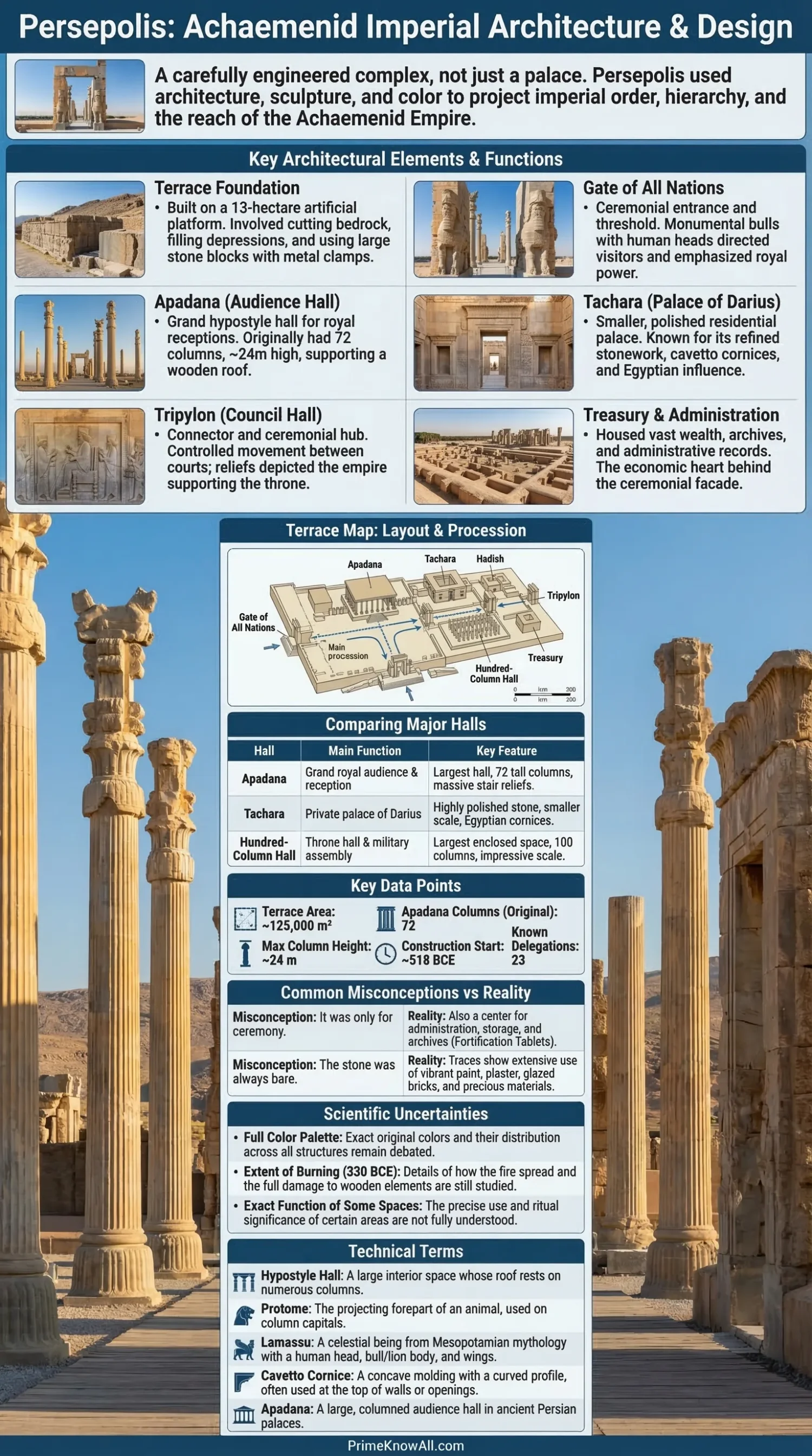
Persepolis looks like stone frozen in place, but its architecture was made to guide people, not just impress them. The terraces, stairways, gates, halls, columns, reliefs, and even hidden water channels were arranged to turn a rocky slope in Fars, Iran into a royal setting where the empire could be seen, staged, and understood.
This matters because Persian Empire architecture is often reduced to a few standing columns and the story of Alexander’s fire. That misses the more interesting part. Persepolis was a place where engineering solved terrain, art shaped political meaning, and design choices linked Mesopotamian, Egyptian, and Iranian traditions without simply copying any one of them.
If you remember one thing: Persepolis was designed as an imperial performance space—part palace, part archive, part ceremonial route, and part statement about who ruled, how they ruled, and how many peoples stood inside that system.
What To Notice First
- The site begins with terrain. Persepolis stands on a half-natural, half-artificial terrace, not on a flat empty plain.
- The architecture manages movement. Visitors were slowed, directed, and framed by stairs, gates, and columned halls.
- The buildings were never plain stone alone. Many surfaces once carried paint, glazed decoration, and in some cases metal attachments.
- The reliefs are political design. They show order, tribute, rank, and controlled diversity rather than random ornament.
- The site was not only ceremonial. The Persepolis Fortification Archive shows that administration, labor, storage, and record-keeping were part of its life.
Why Persepolis Was Built This Way
Short answer: Persepolis was built to make imperial order visible. Its architecture turns rule into something physical: a raised platform, a controlled entrance, repeated images of guards and delegates, and halls large enough to make the king feel distant without making the empire feel abstract.
Construction began under Darius I around 518 BCE. The site is usually described as a capital, but that can mislead modern readers. The Achaemenid Empire did not run from one single desk in one single city. Susa, Babylon, and Ecbatana also mattered. Persepolis appears to have been a royal center for Persia proper, a place for court ceremony, selected receptions, storage, and administration, especially during parts of the year when the court could be there.
This is one reason the site feels unusual. It was not laid out like a dense everyday city with ordinary streets pressed against markets and houses. It was more selective. Open courts, monumental stairs, gates, and audience spaces give the complex the mood of a planned state event. That is why people still describe it as ceremonial. Even so, the tablet archives found there show that real administration sat behind the stone image.
Not The Empire’s Only Power Center
A helpful correction is this: Persepolis was a royal center, not the empire in full. That small distinction changes how the architecture reads. The complex did not need to look like a busy capital with every civic function crowded inside it. It needed to display rank, continuity, and control. In modern terms, it functioned less like a full capital district and more like a carefully prepared state campus where every approach carried meaning.
How The Terrace Turned A Hillside Into A Royal Stage
Short answer: the terrace is the first architectural achievement at Persepolis. Before the columns and reliefs, Persian builders had to create a huge stable platform by cutting rock, filling depressions, using massive stone slabs, and linking blocks with metal clamps rather than mortar.
The terrace covered about 13 hectares, often described as roughly 125,000 square meters. UNESCO calls it an immense half-natural, half-artificial terrace. That phrasing matters. It shows that the builders did not simply place palaces on ready ground. They reshaped the site itself. The result was both practical and symbolic: a high platform that improved visibility, separated the royal complex from the plain, and created a controlled approach.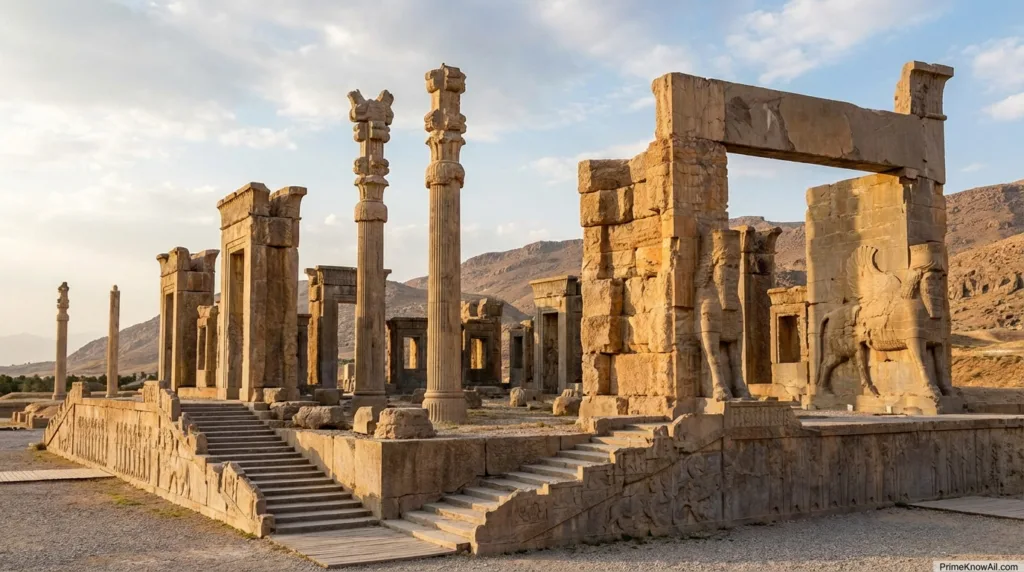
Construction technology here deserves more attention than it usually gets. Parts of the retaining wall were cut from bedrock. Other parts were built with large polygonal stone blocks fitted with care and held by metal clamps. Below and within the terrace, builders also created an underground drainage system to move water away from vulnerable zones. That is easy to overlook today because drains are not as photogenic as columns, yet they are part of the reason the site could function at all.
An apadana is a large columned audience hall. A hypostyle hall is a hall whose roof stands on many columns. Those definitions sound simple, but they explain why the terrace mattered. Large halls need stable ground, and large processional spaces need carefully managed levels. Persepolis solved both.
| Space | Approximate Data | Main Use | What The Design Tells You |
|---|---|---|---|
| Terrace | About 13 hectares / roughly 125,000 m² | Raised platform for the royal complex | Power begins before any palace is entered. |
| Apadana | About 1,000 m² hall; 72 columns originally; columns about 24 m high | Audience and reception space | Height and repetition create scale without crowding the plan. |
| Tachara | About 40 × 30 m | Palace of Darius | Finer carving and tighter proportions create a more intimate royal space. |
| Tripylon | Main hall about 15.46 × 15.46 m | Connector and ceremonial transition point | Movement between courts and halls was scripted, not casual. |
| Treasury | About 120 × 60 m in its enlarged form | Storage, wealth, records, and controlled access | Behind ceremony stood an organized administrative machine. |
Hold On To These Points
- Persepolis begins with engineering, not decoration.
- The terrace is part of the message: height, distance, and access all shape authority.
- Water management mattered almost as much as stone cutting.
Which Buildings Define Persepolis Architecture
Short answer: Persepolis is best understood through a small set of spaces that each do a different job. The Gate of All Nations handles entry. The Apadana handles audience and image. The Tachara shows fine royal residence design. The Tripylon links ceremonial movement. The Hundred-Column Hall expands reception space. The Treasury anchors storage and administration.
Gate Of All Nations
The Gate of All Nations, usually linked to Xerxes I, works like a threshold and a statement at once. Monumental guardian figures and a propylaea-like layout tell visitors they are leaving ordinary ground behind. This is not a neutral entry. It is an architectural filter. It reduces confusion, orders arrival, and frames the experience before the visitor reaches the great courts.
Apadana
The Apadana is the image most readers carry in their heads. Its hall covered about 1,000 square meters and originally stood on 72 columns about 24 meters high. A column capital is the top element of a column; at Persepolis many capitals take the form of back-to-back bulls, or other animals, that help support the crossing beams above. The idea is structural and symbolic at the same time.
The monumental stairways of the Apadana carry one of the site’s best-known sculptural programs: delegations from 23 subject peoples bringing gifts to the king. These reliefs are orderly, measured, and notably calm. They do not show battle frenzy. They show a controlled imperial image in which difference is visible but placed inside a larger political order.
Tachara
The Tachara, often described as the palace of Darius, is smaller and more refined in feel. It is where scale gives way to finish. The plan is rectangular, the carving is crisp, and the stone window frames were cut with unusual care. Some were made from single stone blocks and topped with an Egyptian-style cavetto cornice, which is a concave molding that curves outward near the top. This is one small example of how Persepolis absorbs outside forms and makes them feel local.
Door jambs here carry finely cut figures of attendants, guards, and royal imagery. Traces of pigment survive in places, and some carved details once held metal attachments. That matters because it reminds us that Persepolis was once brighter, shinier, and more materially varied than the bare gray ruins suggest.
Tripylon
The Tripylon, sometimes called the Central Palace, is easy to underestimate because it is smaller. In practice it is one of the clearest examples of architectural choreography. It links spaces, lifts one court above another, and carries reliefs showing the throne being borne by representatives of imperial lands. In simple terms, it turns movement into ideology.
Hundred-Column Hall
The Hundred-Column Hall, also called the Throne Hall, extends the logic of the Apadana but shifts the mood slightly. It is more enclosed, more concentrated, and more emphatic. If the Apadana feels like a space of formal approach, the Hundred-Column Hall feels like a space of controlled reception on a grand scale. The very number in its modern name tells you the design strategy: repetition used to create magnitude.
Treasury
The Treasury is where the image of Persepolis becomes grounded in administration. It was large, heavily enclosed, and built in stages. This is the part of the site that helps correct the lazy idea that Persepolis was only ceremonial. Wealth, objects, and records passed through here. The famous Treasury and Fortification tablets found in the broader complex make that impossible to ignore.
How The Site Worked, Step By Step
This vertical visual summary follows the visitor experience from the outer approach to the inner meaning of the complex.
The terrace lifts the royal complex above everyday ground. Elevation creates separation, control, and long visual lines.
Broad stairways and controlled entries slow movement. This is processional architecture, not casual circulation.
Gates, columns, and high roofs place the ruler at the visual center even before he appears in relief or ceremony.
Delegations wear distinct dress and carry distinct gifts, yet the reliefs keep their pace calm and coordinated. Difference is shown inside imperial order.
Behind the grand façades stood archives, storage, craft work, and drainage. The spectacle worked because the system worked.
Even in ruin, the site still teaches the same lesson: Persian architecture at Persepolis was built to be read, not merely seen.
How Columns, Color, And Reliefs Controlled The Visitor Experience
Short answer: Persepolis does not rely on size alone. It shapes perception through slender columns, animal capitals, painted surfaces, glazed details, and reliefs that direct the eye toward rank, repetition, and ceremony.
UNESCO notes that Achaemenid architects used lighter roofs and wooden lintels to support broad spaces with a relatively small number of strikingly slender columns. That is an architectural choice with visual effects. The halls feel open and elevated rather than squat and heavy. The column forest does not crush the visitor. It orders the space and pulls the gaze upward.
A protome is the sculpted forepart of an animal projecting from an architectural element. At Persepolis, bull, lion, and other animal forms appear in capitals and decorative programs. These are not cute additions. They help mediate between vertical columns and horizontal beams while also carrying royal meaning.
Then there is color. Many visitors imagine Persepolis as pure exposed stone because that is what survives best. The evidence says otherwise. Traces of red, blue, turquoise, gold, and other finishes have been recorded on reliefs and architectural elements. Some surfaces were plastered. Some zones used glazed brick. Some carved details likely carried attached precious materials. The ruins are quiet; the original complex was not.
The Apadana stair reliefs make the political program easy to see. Delegations bring gifts, guards repeat in disciplined ranks, and royal imagery sits at the center of the visual order. The tone is calm for a reason. Persepolis does not sell empire through battle scenes as its main language. It sells empire through managed approach, polite submission, and ritual clarity.
What Should Be Clear By Now
- Persepolis was once colorful, not just gray stone.
- The reliefs are about order more than combat.
- Columns are both structural tools and visual symbols.
Where The Design Came From
Short answer: Persepolis architecture is Persian, but it is Persian in a way that absorbs and reorganizes ideas from other parts of the empire. You can see echoes of Mesopotamian monumental gateways, Egyptian molding, and older Iranian palace habits, yet the full composition feels distinctively Achaemenid.
UNESCO points to Mesopotamian models in the broader palace conception, and the site’s propylaea-like entries and monumental guardian forms support that reading. The cavetto cornice on parts of the Tachara points toward Egyptian influence. The broad use of columned halls belongs to a wider Near Eastern conversation, but the way Persepolis arranges those halls on a terrace and ties them to relief-driven processions is its own.
This selective borrowing is part of the point. An empire that ruled across many regions could present itself in architecture by gathering forms, techniques, labor, and materials from different places and turning them into a single court language. Persepolis is not a collage. It is a controlled synthesis.
A useful analogy: reading Persepolis is a bit like reading a theater set where every stair, doorway, and backdrop tells actors where to stand and tells the audience where to look. The difference is that here the “actors” are kings, guards, delegates, servants, and petitioners, while the “script” is cut into stone and laid out across a terrace.
What The Tablets Changed In Our Understanding
Short answer: the discovery of the Persepolis Fortification Archive and related administrative records changed the site from a mostly visual symbol into a much fuller historical place. The tablets show storage, rations, workers, travel, and bureaucratic control on a large scale.
The Institute for the Study of Ancient Cultures describes the archive as the remains of roughly 15,000 to 18,000 original documents from around 500 BCE. That is not a decorative footnote to the architecture. It changes how the architecture is read. A terrace with treasuries, storerooms, service areas, and controlled access makes more sense when one remembers that written records, goods, and people were moving through an organized system.
The tablets also broaden the social picture. They show workers, officials, travelers, and members of the royal household. Modern readers often picture Persepolis only from the top down: king above, subjects below. The archive adds depth. It shows a palace economy and a state apparatus operating behind the ceremonial image. That does not erase the symbolic function of the architecture. It explains how that symbolic function was sustained.
This is one of the largest gaps in many popular articles. They spend pages on Alexander and almost none on administration. Yet without administration, Persepolis becomes a postcard instead of a system.
Common Misreadings
- Wrong: Persepolis was just a city of giant stone ruins. Better reading: much of the complex also used mud-brick, wood, plaster, and color. Why the mistake happens: stone survives better than the rest.
- Wrong: It was only a ceremonial site. Better reading: ceremony mattered, but so did storage, records, and administration. Why the mistake happens: reliefs and columns are easier to photograph than archives.
- Wrong: The reliefs show loose multicultural celebration. Better reading: they show difference arranged under royal order. Why the mistake happens: calm scenes can look neutral when they are actually highly structured.
- Wrong: Persian architecture here simply copied older empires. Better reading: Persepolis borrowed selectively and reorganized those forms into a distinct Achaemenid language. Why the mistake happens: shared motifs can hide deeper design choices.
- Wrong: The site was meant to be read as empty grandeur. Better reading: movement, access, relief placement, and archives show a place with active functions. Why the mistake happens: ruins strip away crowds, textiles, furniture, wood, and ceremony.
The Short Memory Version
- Do not read the ruins as the full original site.
- Do not separate image from administration.
- Do not mistake calm reliefs for neutral decoration.
Scenes That Make Persepolis Easier To Read
Short answer: the site becomes clearer when its design is tied to familiar situations. These examples are simple, but they help translate imperial architecture into everyday logic.
- A formal embassy enters a government complex. Security, stairs, waiting zones, and reception rooms sort the visit before any meeting begins. Why this fits: Persepolis also used sequence and separation to shape status.
- A museum uses lighting and ceiling height to slow visitors. People look up, lower their voices, and move differently. Why this fits: tall columned halls at Persepolis changed behavior through scale.
- A corporate headquarters hides service corridors behind a polished lobby. The public image looks clean because the logistics are elsewhere. Why this fits: the Treasury, storerooms, and archives supported the visible grandeur.
- A national ceremony shows many regions under one flag. Different clothes and symbols remain visible, yet all are placed inside one formal script. Why this fits: the Apadana reliefs present diversity under royal order.
- A stadium uses ramps, gates, and corridors to control flow. Architecture reduces confusion by controlling movement. Why this fits: Persepolis does the same with stairways, courts, and thresholds.
- A restored historic building looks monochrome because paint has faded away. Visitors assume bare material was always the intended finish. Why this fits: Persepolis once carried much more color than the present ruins suggest.
What Scholars Still Debate
Short answer: many parts of Persepolis are well established, but several larger questions still need caution. That is normal for a site built in stages, damaged by fire, stripped of many organic materials, and reconstructed through both archaeology and interpretation.
- How ceremonial was it, exactly? Many scholars still see the site as deeply tied to court ritual and perhaps springtime activity, but the balance between ceremony, residence, and administration is still discussed.
- How colorful was the whole complex? Pigment traces and reports show color, but the full original palette and distribution across all structures cannot be restored with total certainty.
- How should some relief scenes be read? Certain identifications and narrative details remain debated, especially where damage, later reuse, or older interpretations shaped the conversation.
- How exactly did the burning unfold in 330 BCE? Ancient sources disagree in tone and motive, and modern research still tests how the fire spread through the terrace and timber elements.
- How complete are modern reconstructions? Standing columns and restored fragments help readers, but any reconstruction of roofs, textiles, furniture, and lighting contains a degree of inference.
Limits of this explanation: what survives at Persepolis is rich, but incomplete. Wood, textiles, many wall finishes, and daily activity survive poorly compared with stone. That means every careful description of the site should separate what is directly preserved from what is strongly supported, and from what remains open.
Quick Test
Was Persepolis built only as a home for the king?
No. Persepolis included royal halls and palaces, but also treasury space, archives, and controlled service areas. The architecture makes the symbolic side obvious, while the tablets reveal the administrative side.
Why do the broad stairways matter so much?
They do more than connect levels. Their width, gentle rise, and monumental reliefs slow movement and turn arrival into a formal approach. In other words, the stairways are part of the message.
Did the halls always look like bare gray stone?
No. The ruins hide the original visual effect. Evidence from the site points to paint, plaster, glazed decoration, and in some cases metal embellishment. The current look is a survival pattern, not the full design intent.
What does the Apadana relief program really show?
It shows delegations from many lands bringing gifts in a controlled and orderly way. The reliefs do not erase difference, but they place it under royal authority and within a formal visual script.
What is the biggest mistake people make when reading Persepolis?
The biggest mistake is treating it as a static ruin instead of a working imperial environment. Once movement, color, archives, and ceremony are put back into the picture, the architecture becomes much easier to understand.
Persepolis matters because it shows how an empire could build with stone, wood, water engineering, image-making, and administration at the same time. Read it as a connected system, and the site becomes far more precise than the usual “lost palace” label allows.
The most common error is to confuse the surviving ruins with the full original effect.
The rule worth keeping: when a place at Persepolis looks decorative, ask what job it was also doing.
Sources
- UNESCO World Heritage Centre – Persepolis — UNESCO’s page is reliable because it summarizes the site’s value, scale, chronology, and conservation status using World Heritage documentation and formal review.
- Encyclopaedia Iranica – Persepolis — This is reliable because it is a specialist reference work written for serious historical use, with detailed architectural descriptions, measurements, and discussion of reliefs, pigments, and building phases.
- Smarthistory – Persepolis: The Audience Hall of Darius and Xerxes — This source is useful because it explains the Apadana in clear art-historical language while keeping the structural and political reading tied together.
- Encyclopaedia Britannica – Persepolis: History — Britannica is dependable for broad historical framing, especially on the city’s role within the Achaemenid world and its later destruction and decline.
- Institute for the Study of Ancient Cultures, University of Chicago – Persepolis Fortification Archive — This page is reliable because it comes from the institution that has long studied the tablets and explains how the archive reshaped our understanding of Persepolis beyond architecture alone.
- Encyclopaedia Britannica – Iranian Art and Architecture — This source is useful for placing Achaemenid architectural style, terrace design, and column forms within the wider history of Iranian building.
- Journal of Fine Arts: Architecture & Urban Planning – Analysis of Drainage System and Water Canals of Persepolis — This academic article is dependable because it focuses on one of the site’s less visible but vital technical systems: water control and drainage.
- UNESCO Periodic Reporting – Persepolis — This document is trustworthy because it records management, protection, and conservation work in an official heritage-monitoring context rather than repeating travel-site summaries.
FAQ
What is Persepolis best known for in architecture?
Persepolis is best known for its raised terrace, monumental stairways, Apadana audience hall, double-animal column capitals, and reliefs showing delegations from across the empire.
Was Persepolis the main capital of the Persian Empire?
It was a major Achaemenid royal center, but not the empire’s only power base. Susa, Babylon, and Ecbatana also had central roles in governance and court life.
Why are there so many columns at Persepolis?
The large halls needed broad roof spans, and the Persian builders used columned hypostyle spaces to create height, openness, and visual order. The columns also helped make authority feel architectural, not just personal.
Did Persepolis have color originally?
Yes. Surviving traces and archaeological reports show that parts of the site once carried paint, plaster, glazed decoration, and possibly metal details. The present stone surfaces are only part of the original look.
What do the Apadana reliefs represent?
They represent delegations from different lands bringing gifts to the king. The reliefs show diversity in dress and objects, but they present that diversity inside a calm and ordered imperial setting.
Why is Persepolis still important today?
It remains one of the clearest surviving examples of how architecture can combine engineering, ceremony, administration, and imperial image-making in one planned complex. It is also a UNESCO World Heritage Site and a major focus of ongoing conservation and research.
