
The Minoan palaces of Crete were not simply royal houses. They worked as multi-use urban centers where storage, ritual, administration, craft work, and public gathering were pulled together around a central court. That is why Knossos, Phaistos, Malia, Zakros, Zominthos, and Kydonia matter more as working systems than as isolated ruins.
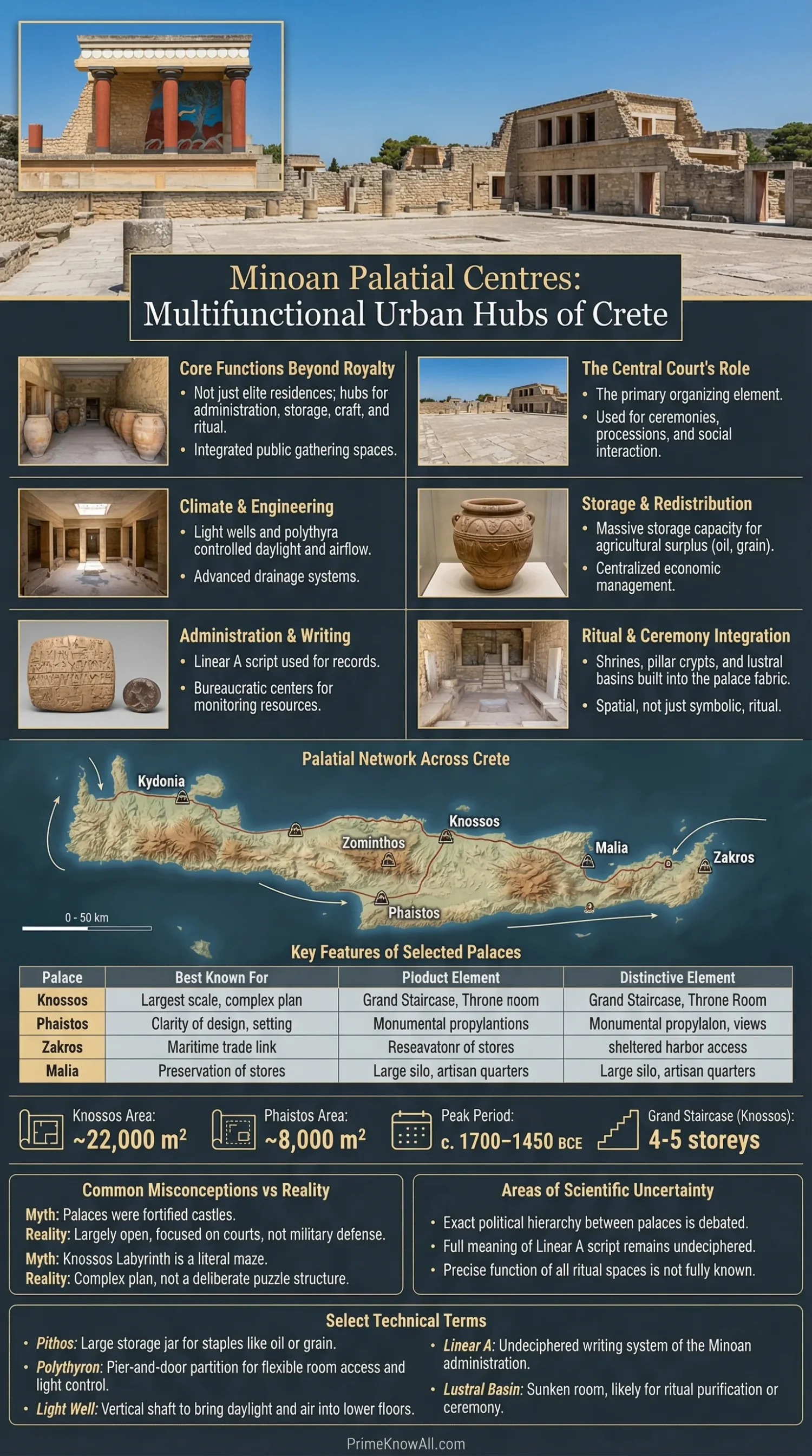
What makes these sites memorable is their planning. Rooms were arranged to manage light, air, water, movement, ceremony, and storage in the same complex. Read that way, the palaces stop looking like mythic mazes and start looking like well-run Bronze Age hubs.
If you remember one thing… the “palace” label is useful, but incomplete. These places were not only about rulers. They were also about organization, redistribution, ritual display, and connection to the wider eastern Mediterranean.
Start Here
- UNESCO added six Minoan palatial centres to the World Heritage List in 2025, which pushed fresh attention onto the whole Cretan network, not just Knossos.
- Knossos is the largest known complex, at about 22,000 square metres, while Phaistos, Malia, Zakros, and Zominthos show smaller but very distinct versions of the same planning logic.
- “Palace” is a modern habit of speech. Current scholarship and UNESCO documentation treat these places as administrative, economic, and religious hubs, not only royal homes.
- The repeated design clues matter: central courts, storerooms, giant pithoi jars, frescoes, light wells, pier-and-door partitions, and careful drainage.
- The hardest modern issue is authenticity. At Knossos, part of what visitors see is Bronze Age masonry, and part is 20th-century reconstruction.
What the Minoan Palaces of Crete Were
Short answer: Minoan palaces were planned centers of power and coordination. They brought together food storage, craft production, ritual rooms, archives, ceremonial courts, and reception spaces inside one linked architectural system.
The older picture treated these places as the homes of kings. That view still shapes tourist language, especially at Knossos. Yet the archaeological pattern is broader. The complexes include storerooms, workshops, records, roads, courts, shrines, stairways, and service systems. That mix points to buildings that handled many kinds of activity at once.
A useful comparison is this: a Minoan palace was a bit like a town hall, a warehouse district, a ritual complex, and an event courtyard folded into one place. That analogy is not exact, but it helps. The central court tied everything together, while wings and corridors sorted activities by access, status, and need.
- Central court: an open rectangular yard around which the main spaces were arranged.
- Pithos: a giant storage jar used for staples such as oil, grain, or other stored goods.
- Polythyra: a pier-and-door partition that could open or close a room to control light, airflow, and access.
- Linear A: the still-undeciphered writing system tied to Minoan administration.
- Lustral basin: a sunken chamber reached by steps, often read as ritual space, though its exact use is still debated.
Why Crete Produced This Type of Palace
Short answer: Crete sat in the right place and had the right landscape. The island could connect sea routes, fertile plains, mountain resources, and inland movement, so large coordinating centers made practical sense.
UNESCO’s current dossier describes Crete as a bridge between Europe, Africa, and Asia. That matters. A palace in such a setting did not need to be only symbolic. It could also organize exchange, store goods, route traffic, and host public ritual. Zakros, with its eastern coastal position and link to a protected bay, is a clear case where location and trade role line up closely.
Location also worked at a smaller scale. Knossos sat on Kephala Hill with access to both the sea and the Cretan interior. Phaistos overlooked the Messara Plain, one of the island’s best farming zones. Malia stood in a fertile north-coast setting. Zominthos, high in the foothills of Mount Psiloritis, shows that not every palace was coastal; some were tied to upland movement and resource control.
- Sea access helped connect Crete to Egypt, the Aegean, and the Near East.
- Plains and valleys made staple storage and redistribution practical.
- Mountain routes linked upland products, pasture zones, and ritual landscapes.
- Open planning set Minoan palatial centres apart from later fortified Mycenaean palace traditions.
Pause Here
- Crete’s geography helps explain why these places were network nodes, not isolated monuments.
- “Palace” is a workable word only if it includes storage, ritual, records, and public use.
- The court was the organizing heart of the whole plan.
How a Palace Was Planned and Used
Short answer: the plan was ordered without looking rigid. Each palace grouped rooms by use, visibility, and movement, while the central court acted as the social and spatial anchor.
The court is the clue that unlocks everything else. UNESCO’s 2025 evaluation notes that the central court remains the defining feature of the Minoan palatial centre. Around it sat rooms for storage, audience, ritual, circulation, and sometimes residence. The palace did not force all functions into one hall. It separated them, then stitched them together with corridors, stairs, thresholds, and carefully controlled entries.
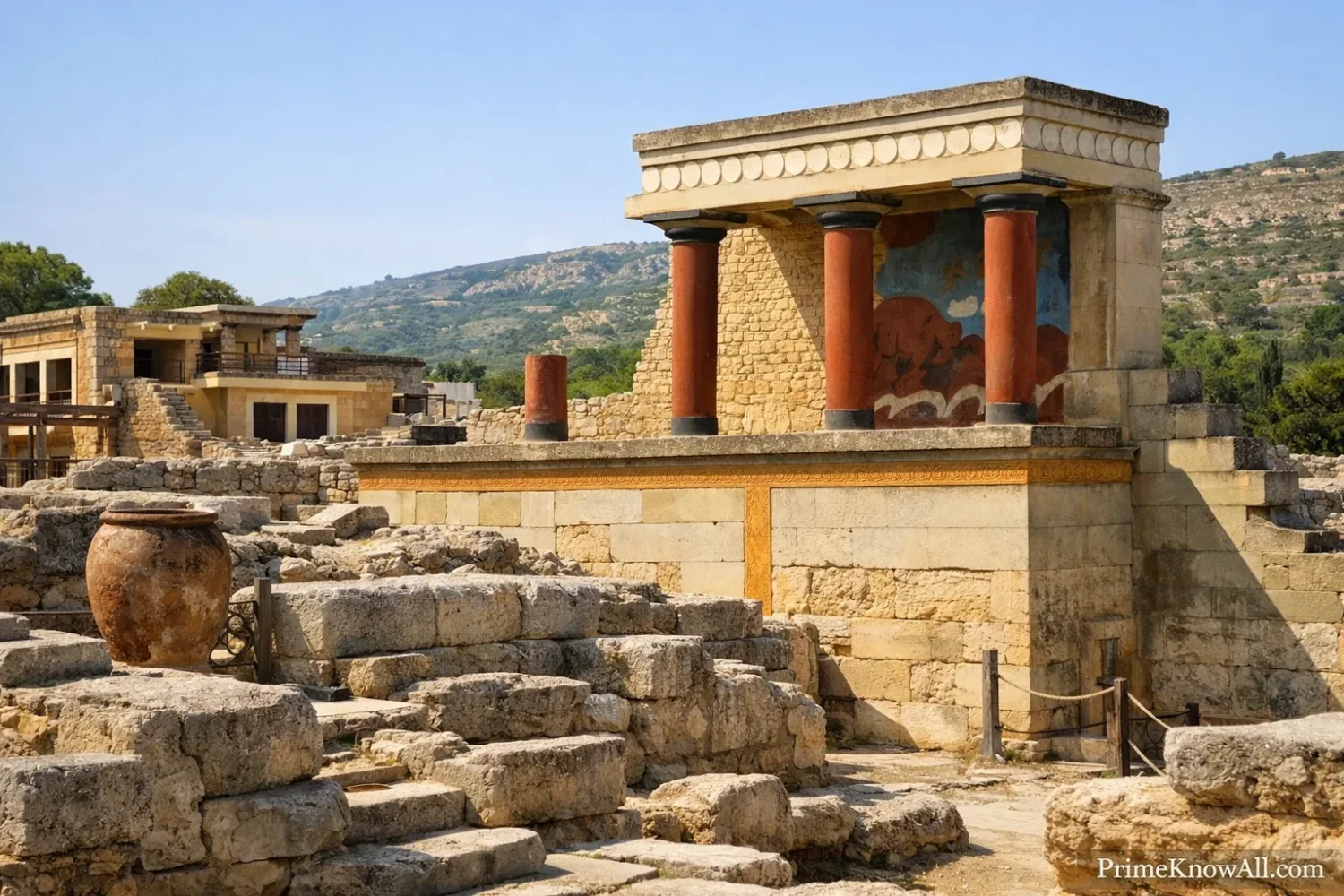
At Knossos, the West Court acted as a formal approach and ceremonial zone. The west wing held official and religious rooms, including the so-called Throne Room, pillar crypts, and repositories. The east wing contained major reception and residential suites such as the Hall of the Double Axes and the Queen’s Hall, reached by the Grand Staircase. This is not the layout of a single household. It is the layout of a building that handled many levels of access.
- Courts handled gathering, procession, and orientation.
- West-side zones often lean toward administration, storage, and ritual.
- East-side zones often include larger reception and living areas.
- Roads and entrances tied the palace to the town, the harbor, and processional movement.
Main Palaces Compared
Short answer: the palaces share a common language, but each one solves a different local problem. Some lean harder into scale, some into trade, some into upland control, and some survive only in parts because later settlement sits on top of them.
| Site | Approximate Size | Setting | Best Known For | Useful Reading Point |
|---|---|---|---|---|
| Knossos | About 22,000 m² | Kephala Hill near the Kairatos River | Largest complex, multi-level plan, strong myth link, major reconstruction history | Read it as a palace-city hub, not just a legend site |
| Phaistos | About 8,000 m² | Hill above the Messara Plain | Refined planning, monumental facades, strong tie to southern Crete | Best for seeing clarity of plan |
| Malia | About 7,500 m² | Fertile north-coast valley | Storerooms, archives, water systems, less later overbuilding | Best for seeing a palace with less visual over-restoration |
| Zakros | About 3,500 m² | Eastern coast near a protected bay | Trade role and harbor connection | Best for linking palace planning with maritime exchange |
| Zominthos | About 2,150 m² | About 1,200 m above sea level near Mount Psiloritis | Highland setting, corridors, storerooms, workshops | Shows that Minoan palace logic also worked away from the coast |
| Kydonia | Partly unexcavated | Kastelli Hill under modern Chania | Urban setting, frescoes, light wells, drainage, later Linear B tablets | Best example of how modern cities can hide ancient centers |
A Vertical Snapshot of the Palace Network
c. 1900 BCE
The first palace phase begins at sites such as Knossos and Phaistos. Large courts and storage zones start to define the new built order.
c. 1700 BCE
An earthquake horizon is often linked with destruction at major sites. Rebuilding follows, and palace planning becomes more mature and more elaborate.
c. 1700–1450 BCE
This rebuilt era is the high point for the palatial system: frescoes, light wells, polythyra, archives, storerooms, and careful circulation.
Regional Roles
Knossos dominates in scale, Phaistos in clarity, Malia in preservation value, Zakros in trade position, Zominthos in upland function, and Kydonia in urban continuity.
2025
UNESCO’s listing of the six sites confirmed that the story is now told as a network of palatial centres, not as one famous ruin standing alone.
Before Moving On
- Shared vocabulary does not mean identical buildings.
- Scale varies a lot, but the planning logic still repeats.
- UNESCO’s six-site grouping makes the wider network easier to see.
Climate, Water, and Movement in the Design
Short answer: these palaces were engineered for use. They were not only decorative shells. Their builders paid close attention to ventilation, daylight, circulation, structural stability, and water control.
Official material from the Greek Ministry of Culture describes light wells, polythyra, timber reinforcement in masonry, and complex drainage and water-supply systems at Knossos. That combination matters because it shows a design culture that cared about how a building felt to move through. A light well is exactly what it sounds like: a vertical open space that brings daylight and air deep into a plan. A polythyron is a flexible wall of openings. Open it, and a room expands. Close it, and the same area becomes more private.
The Grand Staircase at Knossos helps make the point physically. Ashmolean documentation notes that it descended over seven metres below the Central Court across several storeys. That is not casual construction. It belongs to a building culture comfortable with vertical planning, controlled circulation, and structural problem-solving.
Drainage deserves more attention than it gets in many short articles. Water is a daily test of design quality. When drains, channels, and supply systems work well, public courts stay usable, rooms stay cleaner, and the building can support denser activity. In Bronze Age terms, that is practical intelligence, not ornament.
- Light wells reduced darkness in deep interior zones.
- Polythyra let one room behave like several room types.
- Timber reinforcement helped masonry cope better with stress.
- Drainage systems protected courts and circulation routes.
- Stairs and level changes sorted access and status without breaking the whole plan apart.
Writing, Storage, and Ritual in One Place
Short answer: a Minoan palace makes the most sense when record-keeping, surplus storage, and ritual display are read together rather than as separate stories.
The famous images are often the frescoes or the so-called throne. Yet the quieter spaces may be even more telling. At Knossos, the West Magazines formed the main storage area. At Minoan sites across Crete, giant pithoi signal collection and holding capacity. Storage on that scale suggests planning beyond one elite household. It points toward accounting, redistribution, and controlled access.
Writing strengthens that reading. The British Museum highlights Linear A as evidence of writing in Minoan Crete, while official material for Knossos points to the archive of Linear B tablets from its later phase. UNESCO also notes Linear B finds at Kydonia. A simple way to frame this is useful: Linear A belongs to the Minoan administrative world and remains undeciphered; Linear B appears later and records Greek.
Ritual spaces sit close to these practical systems. That is one reason the old split between “sacred” and “administrative” often feels too neat. At Knossos, official descriptions place the Tripartite Shrine, Sacred Repositories, Pillar Crypts, and Throne Room in the west wing beside other official rooms. The message is architectural: in this built world, power, display, and procedure shared walls.
- Pithoi suggest planned storage on a large scale.
- Linear A points to administration, even if the script still resists full reading.
- Linear B at later Knossos and Kydonia shows changing political history after the main Minoan phase.
- Ritual rooms were not hidden in a separate sacred district; they were woven into the palace fabric.
What to Hold On To
- Storerooms and archives matter as much as frescoes.
- Ritual and management were physically close inside the same complex.
- The palace worked through coordination, not just display.
Knossos and the Reconstruction Problem
Short answer: Knossos is both indispensable and difficult. It preserves the largest palace, but it also carries early 20th-century reconstruction so visibly that every visitor needs to separate ancient fabric from modern re-creation.
Sir Arthur Evans excavated Knossos from 1900 to 1931. Later he and his team restored parts of the palace using modern materials, including reinforced concrete. Ashmolean material calls this the most controversial part of his work, and UNESCO’s evaluation says authenticity at Knossos has been affected by those interventions. Neither point erases the site’s value. They simply change how it should be read.
This matters more today because Knossos is under very heavy visitor pressure. Ashmolean notes that the site draws almost a million visitors a year, and current conservation work now has a double task: protect the Bronze Age remains and also maintain the old reconstructions that have themselves become part of the site’s modern history.
A careful visitor should ask three questions in each area: What is original masonry? What is Evans’s reconstitution? What is later conservation? That habit produces a better reading of the place than simply accepting every bright wall and restored column as a direct window into the Bronze Age.
- Original: excavated Bronze Age remains, layout, many structural traces.
- Reconstructed: parts of the Throne Room, Stepped Portico, North Entrance, fresco displays, and other reimagined elements.
- Current conservation: repair, stabilization, visitor routing, and digital tools that try to distinguish layers more clearly.
Common Misreadings
Short answer: the largest errors come from reading the palaces as myth first and architecture second. The built evidence is richer, and often less tidy, than the popular story.
- Wrong: “The palaces were castles.”
Better correction: They were largely open palatial centres, not fortress-style compounds like later Mycenaean palaces.
Why this gets mixed up: “Palace” makes readers expect walls, rulers, and military display. - Wrong: “Knossos stands for all Minoan architecture.”
Better correction: Knossos is the largest case, but Phaistos, Malia, Zakros, Zominthos, and Kydonia each show different local solutions.
Why this gets mixed up: Knossos dominates tourism, school books, and myth. - Wrong: “The labyrinth was a literal maze preserved in stone.”
Better correction: The palace plan is complex, but the mythic labyrinth is not the same thing as an architect’s blueprint.
Why this gets mixed up: corridors, stairs, and reconstruction make the idea visually tempting. - Wrong: “The frescoes at Knossos show exact original scenes and colors.”
Better correction: Many displays are based on fragments plus modern restoration choices.
Why this gets mixed up: restored images are vivid and easy to remember. - Wrong: “A throne room proves a king ruled in the later Greek sense.”
Better correction: the political model remains debated, and the word palace can oversimplify how power worked.
Why this gets mixed up: later palace traditions influence modern expectations.
A Short Recap
- Myth helps people arrive, but architecture explains more.
- Reconstruction at Knossos is part of the site’s story, not a side issue.
- The safest reading is always: function first, legend second.
Six Familiar Scenes That Make the Layout Easier to Read
Short answer: the fastest way to understand a Minoan palace is to relate it to familiar types of organized space. The comparison is never perfect, but it helps the plan stop feeling abstract.
- A school built around a main yard: the court works like a central point for gathering, orientation, and movement.
Why this helps: many palace rooms make more sense once the open yard is seen as the anchor. - A warehouse with controlled access: storerooms, narrow passages, and containers suggest careful handling of goods.
Why this helps: the palace was not only ceremonial; it also managed supply. - A civic building with public and private zones: some rooms are easy to approach, while others are harder to reach.
Why this helps: status and function were shaped by movement paths. - A festival square linked to official rooms: courts and processional ways turn architecture into public theatre.
Why this helps: ritual in Minoan Crete was spatial, not only symbolic. - A house with an internal light shaft or atrium: light wells brought air and daylight into deeper parts of the complex.
Why this helps: engineering and comfort were part of the design logic. - A transport hub with clear routing: roads, entrances, stairs, and thresholds direct bodies and attention.
Why this helps: the palace controlled how a person encountered authority.
What Archaeologists Still Debate
Short answer: the broad role of the palatial centres is clear, but the fine detail is not fully settled. Scholars still argue over how centralized Minoan rule was, how ritual worked inside the courts and special rooms, and how much later myth should shape interpretation.
UNESCO’s own 2025 evaluation is unusually helpful here because it states the issue plainly: scholars still debate the precise nature of occupation and use, the interrelationship between sites, and the political role of the palatial centres at different moments. It also notes that old ideas such as Pax Minoica and simple stories about social status are debated rather than fixed fact. That caution is healthy.
What Can Be Said With Confidence
- The palaces were multifunctional.
- The central court was the core organizing feature.
- Storage, writing, ritual, and circulation were all part of palace life.
- Crete’s geography and maritime position shaped the system.
- Knossos cannot be read without thinking about reconstruction history.
What We Still Cannot Say With Full Confidence
- Exactly how power was distributed between palaces, towns, and elites at every stage.
- The exact function of every special room type, including some lustral basins and ritual spaces.
- The full content of Linear A records, because the script remains undeciphered.
- The cleanest cause-and-effect story for every destruction and rebuilding phase.
- How far myth preserves memory of real Bronze Age experience.
Limitations and What We Do Not Know
The palaces survive as ruins, excavation records, restored fragments, and later interpretations. That means any explanation must stay measured. A room label used on a site plan is not always a proven ancient job title, and a restored fresco is not always a one-to-one record of what once covered the wall.
Two things stay true. The Minoan palaces of Crete are best understood as working centres of coordination, and each site adds a different piece to that picture. They matter because they show how a Bronze Age society could merge engineering, ceremony, storage, and movement into one connected built form.
The most common mistake is treating Knossos as the whole story.
A simple rule to keep in mind: when a room or court seems mysterious, ask first how it worked, not only what legend it resembles.
Quick Test
1. A Minoan palace was only a royal home. True or false?
False. The evidence points to multifunctional centres with storage, ritual, administration, workshops, and gathering space, not only elite residence.
2. Why does the central court matter so much?
Because it is the main organizing space. Once the court is identified, the surrounding wings, approaches, and special rooms become much easier to read.
3. Which palace is easiest to connect with maritime trade?
Zakros. Its eastern coastal position, harbor road, and link to wider eastern Mediterranean exchange make that role especially clear.
4. Why do scholars speak cautiously about Knossos?
Because Bronze Age remains, Evans-era reconstruction, and later conservation all sit together on the same site, which complicates direct visual reading.
5. What is one of the clearest signs that these palaces handled administration?
Writing and storage together. Large storerooms, pithoi, archives, and scripts such as Linear A and later Linear B point to organized management.
Sources
- UNESCO World Heritage Centre – Minoan Palatial Centres — Useful for the current six-site UNESCO status, date span, and official summary of why the centres matter. Why reliable? It is the official World Heritage listing page.
- UNESCO / ICOMOS – Minoan Palatial Centres (Greece) No. 1733 Evaluation Report — Useful for site-by-site size data, current conservation notes, authenticity issues at Knossos, and the modern definition of “palatial centre.” Why reliable? It is the formal evaluation document used in the World Heritage process.
- Hellenic Ministry of Culture / ODAP – Knossos — Useful for the official description of the court system, west and east wings, drainage, light wells, polythyra, and major spaces inside the palace. Why reliable? It is an official Greek state publication for the archaeological site.
- British Museum – Greece: Minoans and Mycenaeans — Useful for the museum-level overview of Minoan Crete and the reference to Linear A as evidence of writing. Why reliable? It comes from a major museum with long-standing curatorial research in Aegean archaeology.
- Ashmolean Museum – Rebuilding the Palace of Minos at Knossos — Useful for excavation dates, Evans’s reconstruction methods, the Grand Staircase depth, and the modern problem of reading restored versus ancient fabric. Why reliable? It is written by the Ashmolean’s curator of Bronze Age and Classical Greece.
- Knossos Documenta – Reconstruction Work — Useful for current conservation of Evans-era rebuilt sections. Why reliable? It is a dedicated documentation project focused on the site’s conservation history.
- Knossos Documenta – West Magazines — Useful for the storage role of the west wing and why magazines matter in reading palace function. Why reliable? It is site-specific documentation rather than general travel writing.
- Heraklion Archaeological Museum – The Phaistos Disc — Useful for the context of the famous inscribed object from Phaistos and for linking palace archaeology with Minoan writing culture. Why reliable? It is the official museum holding one of the best-known finds from the site.
- The Annual of the British School at Athens – The Drainage System of the Domestic Quarter in the Palace at Knossos — Useful for the technical reading of drainage as a planned part of palace function. Why reliable? It is peer-reviewed scholarship from a leading Aegean research institution.
- JSTOR – The Central Court of the Palace at Knossos — Useful for the court’s role in orientation and interpretation. Why reliable? It is an academic article used in serious archaeological study.
- JSTOR – Minoan Palaces — Useful for the older but still useful scholarly discussion of palace functions and organization. Why reliable? It is a research article with long citation use in Aegean studies.
FAQ
What is the most famous Minoan palace in Crete?
Knossos is the most famous because it is the largest, it is tied to the Labyrinth story, and its early excavation made it central to public understanding of Minoan Crete.
Were Minoan palaces really homes of kings?
They may have included elite residential spaces, but the broader evidence points to multifunctional centres used for storage, ritual, administration, and public display as well.
Why is Knossos linked to the Labyrinth myth?
The complex plan, later Greek storytelling, and Evans’s strong use of myth in interpretation helped fuse Knossos with the idea of the Labyrinth. The myth is culturally important, but it is not a literal site map.
Which Minoan palaces are part of the UNESCO listing?
The 2025 UNESCO listing groups Knossos, Phaistos, Malia, Zakros, Zominthos, and Kydonia as the Minoan Palatial Centres.
What makes Phaistos different from Knossos?
Phaistos is smaller and often feels clearer in plan, while Knossos is larger, more layered, and more affected by modern reconstruction.
What writing system did the Minoan palaces use?
The Minoan palatial world is tied mainly to Linear A, which remains undeciphered. Linear B appears later, especially in the post-Minoan or Mycenaean phase at places such as Knossos and Kydonia.