
Mesopotamian temples were the working houses of the gods and the organizing centers of many cities. They held ritual, storage, writing, labor, and royal display in one place. The best-known examples are ziggurats, yet the story starts earlier with low mudbrick sanctuaries and grows into large temple precincts that helped shape urban life across Sumer, Akkad, Babylonia, and Assyria.
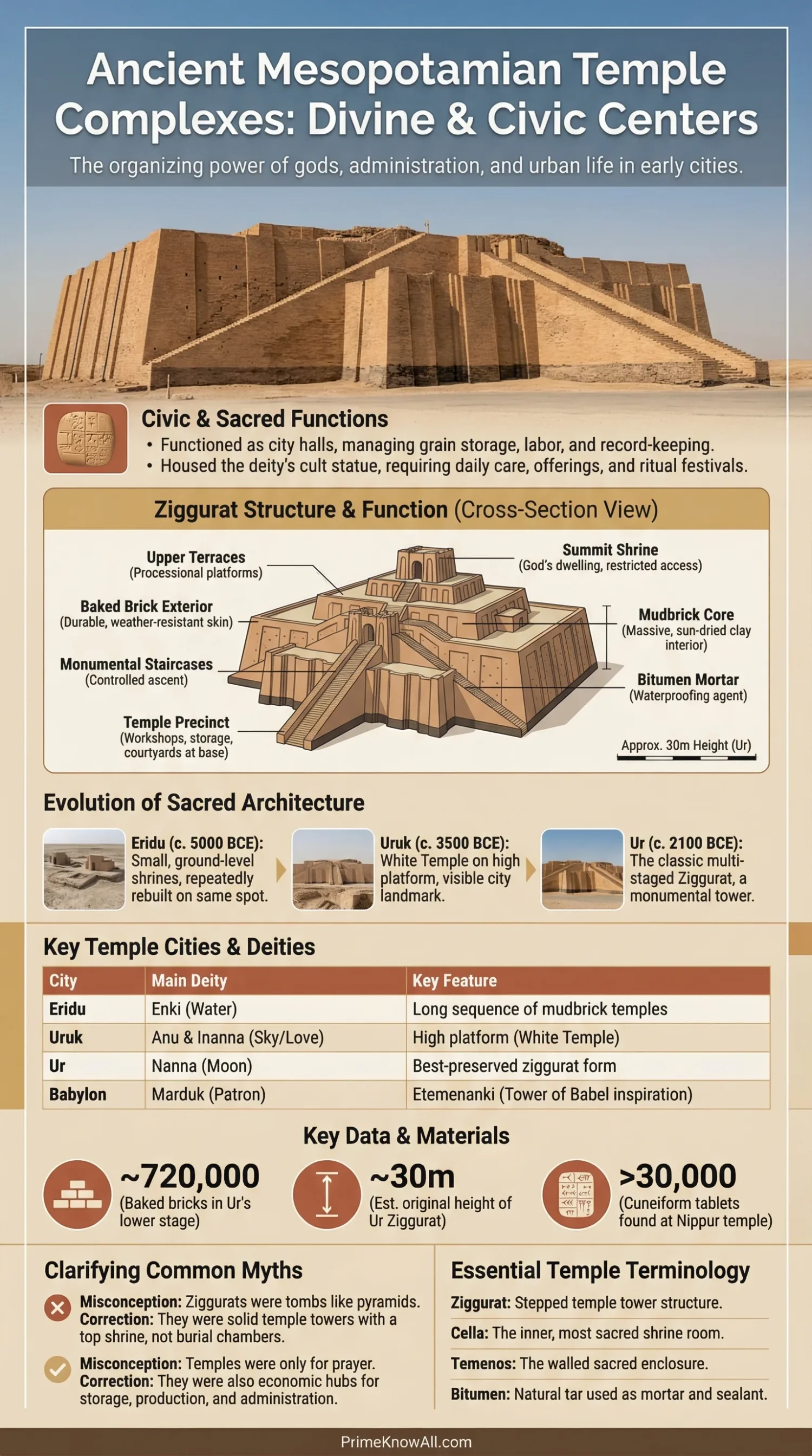
That is why the ancient temples of Mesopotamia matter so much. They were not separate from daily life. In many excavated cities, the temple sat near storage rooms, courtyards, workshops, archives, and processional routes, so a reader who only sees a “religious building” misses half of the picture. A stepped tower, a shrine, a brick stamp, a cuneiform tablet, and a line of offerings all belong to the same system.
If you remember one thing… read a Mesopotamian temple as a city institution under divine ownership. The tower matters, but the rooms around it, the records inside it, and the deity attached to it matter just as much.
What To Notice First
- Temple did not just mean a prayer space; it could mean a precinct with many buildings.
- Ziggurat means a raised, stepped temple tower, not a tomb.
- City and deity were tightly linked: Enki at Eridu, Anu and Inanna at Uruk, Nanna at Ur, Enlil at Nippur, Marduk at Babylon.
- Mudbrick is the default material because southern Mesopotamia had abundant clay but far less building stone.
What Made a Mesopotamian Temple Different
A Mesopotamian temple was understood as the house of a god. That sounds simple, but it changes how the whole building should be read. The deity was not treated as an abstract idea. In texts and ritual practice, the god was present through a cult statue, and that statue had to be clothed, fed, honored, and carried in festival processions.
This is why temple architecture and temple routine belong together. A shrine room, a courtyard, an offering table, a storage area, and a route for movement inside the complex are all part of the same logic. In many cities, kings rebuilt temples not only to show devotion but also to show that rule itself had divine backing.
- Cult statue: a physical image believed to host the deity during ritual.
- Temple precinct: the wider sacred enclosure, not just one room or one tower.
- Offering: food, drink, textiles, animals, incense, or valuables presented to the deity.
- Procession: a formal ritual movement of divine images, priests, officials, and offerings through the city.
A useful way to picture the temple is this: it worked more like a combined city hall, ceremonial kitchen, warehouse, archive, and landmark skyline structure than like a quiet stand-alone chapel. That analogy is not perfect, but it helps explain why temple ruins produce both ritual objects and administrative tablets.
How Temples Grew From Eridu to Uruk
The long story starts low and gets taller over time. At Eridu, archaeologists found a sequence of ever larger mudbrick temples from the Ubaid period, which shows that sacred building in southern Mesopotamia did not begin with giant towers. It began with repeated rebuilding on the same holy ground.
By the late 4th millennium BCE, the picture had changed at Uruk. The White Temple, set on a high platform, turned sacred architecture into part of the urban skyline. Smarthistory notes that it stood about 40 feet above the plain, which is exactly the sort of visual command that mattered in a flat river landscape. Uruk is also where the earliest writing appears, so temple growth, city growth, and record-keeping sit close together in the archaeological story.
| Site | Main Deity | Main Periods | What Stands Out | Why It Matters |
|---|---|---|---|---|
| Eridu | Enki | Ubaid to Ur III | Long sequence of rebuilt mudbrick temples | Shows how temple tradition formed before the classic ziggurat skyline |
| Uruk | Anu, Inanna | Late Uruk | White Temple on a raised platform | Links temple display, early urbanism, and early writing |
| Ur | Nanna | Ur III, Neo-Babylonian | Best-known restored ziggurat | Gives the clearest picture of a monumental temple tower |
| Nippur | Enlil | 3rd millennium BCE onward | Ekur temple and ziggurat, huge tablet finds | Shows the temple as a religious and textual center |
| Babylon | Marduk | 1st millennium BCE | Esagila and Etemenanki | Shows how temple building fed royal image and later cultural memory |
What This Means So Far
- The earliest Mesopotamian temples were not huge towers.
- Height grew with time, politics, and urban display.
- Rebuilding the same sacred spot mattered almost as much as building something new.
What Happened Inside a Temple Complex
Temple life was practical as well as sacred. Excavated tablets and temple archives show priests, scribes, laborers, suppliers, and managers moving goods and information through these spaces. Offerings had to be prepared. Textiles had to be stored. Animals had to be counted. Grain had to be recorded. Festivals had to be organized.
That does not mean every part of the city belonged to the temple. Modern scholarship is more careful than older textbook summaries on this point. Large temple households could control land, labor, and redistribution, yet private households and other institutions also mattered. The safest reading is that the temple was one of the main engines of urban life, not the only one.
- Food and drink for ritual had to be prepared and logged.
- Textiles and animals could move through temple accounts.
- Scribes recorded deliveries, allocations, and obligations on clay tablets.
- Festivals connected the temple to streets, gates, and other buildings.
- Royal inscriptions turned rebuilding into public political language.
Nippur is a good reminder of that wider role. The Institute for the Study of Ancient Cultures notes that excavations there recovered more than 30,000 cuneiform tablets. A number like that changes the mood of the site immediately: this was not a silent ruin when it was active. It was a place of movement, memory, accounting, and ritual routine.
Why Ziggurats Were Built
Ziggurats raised the temple into the skyline, but they were not giant tombs. That is the first correction worth making. Britannica describes the ziggurat as a stepped temple tower with a mudbrick core and a baked-brick exterior, and notes that it had no internal chambers. The shrine belonged at or near the top, not inside a buried maze.
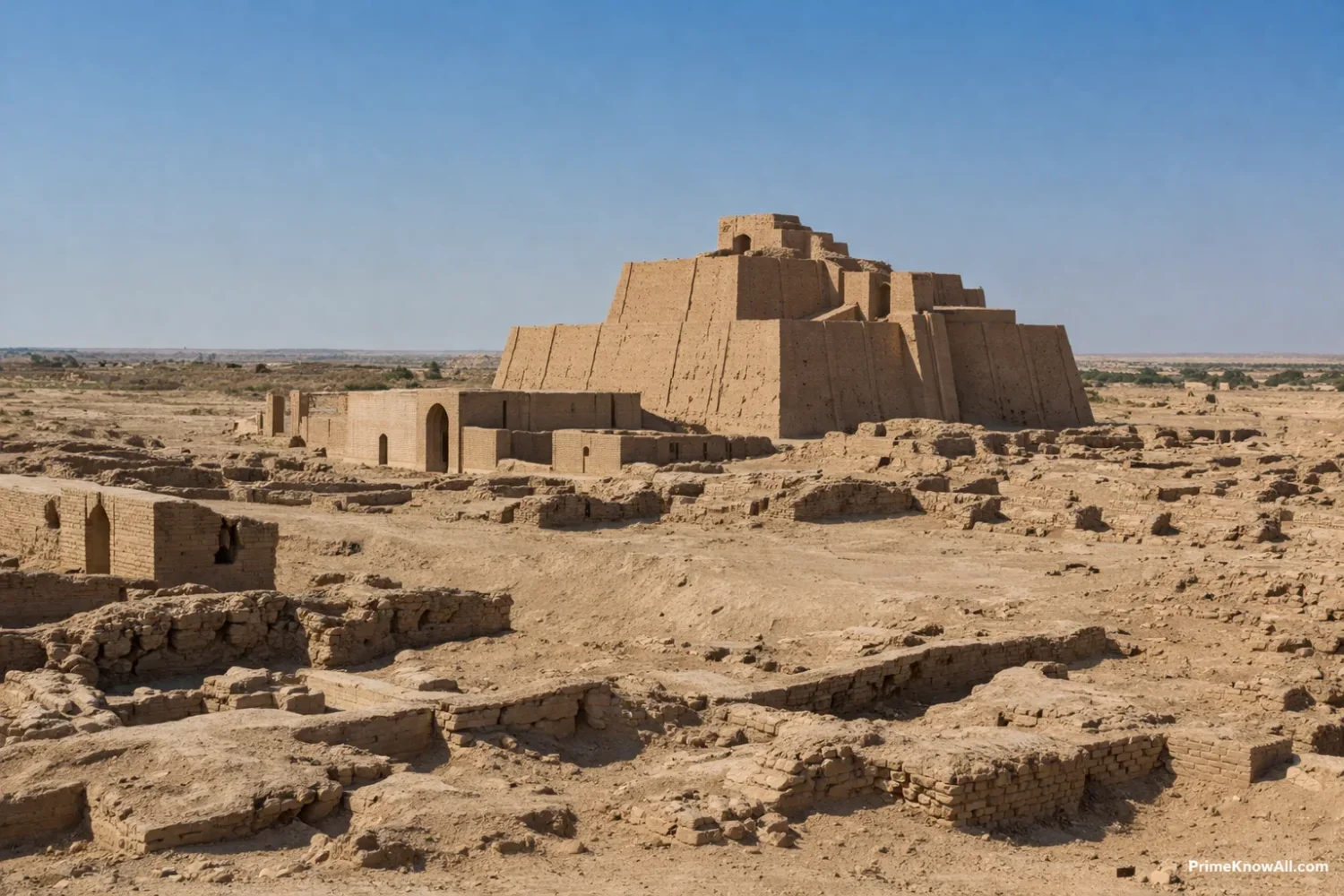
Several ideas seem to meet here. Height made the sacred precinct visible from a distance. Receding stages turned a heavy mudbrick mass into a controlled form. In some interpretations, the tower also echoed the idea of a sacred mountain in a low alluvial landscape. None of those readings needs to cancel the others. In Mesopotamia, religious meaning and public display often worked together.
The Ziggurat of Ur is the clearest example for many readers. It was built under Ur-Nammu around the late 3rd millennium BCE and later rebuilt by Nabonidus. Its base measured roughly 64 by 45 meters, and its original height is often estimated at over 30 meters. Smarthistory also notes that the lower portion alone used about 720,000 baked bricks. Even if a reader ignores the ritual side for a moment, the labor and planning behind that figure are hard to miss.
- Not a pyramid tomb: Mesopotamian ziggurats are different in plan and use from Egyptian pyramids.
- Not only symbolic: the tower also made a city’s sacred center unmistakably visible.
- Not one fixed template: stages, size, and attached structures could vary by city and period.
Pause Here
- A ziggurat is a raised temple tower, not a burial monument.
- The tower is only one part of the full temple complex.
- The best question is not “How tall was it?” but “What system did it serve?”
Temple Centers That Shaped Mesopotamia
The best way to understand Mesopotamian temples is to compare cities, not to memorize one famous ruin. Different sites show different stages of development, different deities, and different local priorities. Together they give a much clearer picture than the usual single-image focus on one tower.
Southern Cities
- Eridu: tied to Enki, the god linked with fresh water and the subterranean deep. It is valuable because it preserves a long sacred sequence under later construction.
- Uruk: tied to Anu and Inanna. It shows how raised temple architecture became part of the city’s visual authority.
- Ur: tied to Nanna, the moon god. Its ziggurat is the example most readers recognize first, and for good reason: the physical remains are unusually legible.
- Nippur: tied to Enlil. Its Ekur, or “mountain temple,” carried prestige beyond one city because rulers sought the favor of Enlil there.
Babylon and Assyria
- Babylon: the temple Esagila and the ziggurat Etemenanki sit near the center of later Mesopotamian memory. Archaeology confirms a huge temple-tower beside Marduk’s temple, even if many details remain debated.
- Ashur: the UNESCO World Heritage description records a site of about 70 hectares with temples and three ziggurats. That alone is enough to show that northern Mesopotamia also used temple-tower forms in varied ways.
- Nimrud: better known for palaces, yet its temple zone matters too. Recent conservation and excavation work there has brought renewed attention to damaged Assyrian sacred spaces near the ziggurat.
What repeats across these cities is not one exact floor plan. It is the tight bond between deity, place, and authority. A temple was local in one sense because it belonged to a city god, yet it could also project influence far beyond that city through pilgrimage, royal building, and written memory.
How Builders Solved Real Engineering Problems
Mesopotamian temple architecture is a lesson in making monumentality out of clay. Southern Mesopotamia had huge supplies of alluvial mud, reeds, and bitumen, but less easy access to building stone. Builders responded by using mudbrick cores for mass, baked brick on outer faces for durability, and bitumen as bonding and waterproofing material.
That material choice shaped the look of the buildings. Thick walls, terraces, buttresses, and repeated rebuilding make sense in a mudbrick environment. Even when the outer skin looked crisp and geometric, the whole structure still needed care. Water, salt, and neglected drainage could do damage fast. That is one reason so many surviving temple remains look worn, broken, or melted into the mound around them.
- Bitumen: a natural tar used to seal and bond bricks.
- Tripartite plan: a temple layout with a long central hall and rooms on both sides.
- Buttress and recess: alternating projections and set-backs that strengthen and decorate exterior walls.
- Platform: a raised base that lifts the sacred building above the ground line.
What To Keep in Mind
- The dramatic silhouette depends on very ordinary materials: clay, reeds, and bitumen.
- Mesopotamian engineering was shaped by the river plain, not by a stone-rich landscape.
- Preservation is hard because mudbrick monuments keep reacting to water and salt long after abandonment.
Common Misconceptions
Most confusion comes from treating all stepped monuments as the same thing. Mesopotamian temples look familiar to modern eyes, but they do not work by Egyptian, Greek, or later Near Eastern rules.
- Wrong: “A ziggurat is just a Mesopotamian pyramid.”
Better reading: A ziggurat is a temple tower, not a royal tomb.
Why this gets mixed up: Both use big geometric mass and dominate the skyline. - Wrong: “All temples were giant towers.”
Better reading: Many early temples were lower shrines on platforms, courtyards, or rebuilt sacred spots.
Why this gets mixed up: Towers survive in memory better than lower mudbrick layouts. - Wrong: “Temples were only for prayer.”
Better reading: They also handled offerings, storage, administration, skilled labor, and festivals.
Why this gets mixed up: Modern readers often split religion and civic life more sharply than Mesopotamian cities did. - Wrong: “Every city followed one exact temple plan.”
Better reading: Repeated patterns exist, but layout and scale shift by place and period.
Why this gets mixed up: Textbook diagrams flatten several centuries into one model. - Wrong: “Temple economy means the temple owned everything.”
Better reading: Temple households were powerful, yet other households and institutions also operated alongside them.
Why this gets mixed up: Older summaries leaned too hard on one totalizing model.
What Archaeologists Still Debate
Some parts of the story are clear, and some parts are still open. The material record shows where temples stood, how builders used mudbrick, which gods were tied to which cities, and how temples appear in inscriptions and archives. What is less certain is the full day-to-day feel of access, sound, smell, crowd size, and how some upper shrine spaces looked in detail.
That uncertainty matters because popular writing sometimes overstates the evidence. The symbolic meaning of height, for example, is plausible and widely discussed, but it should still be phrased carefully. The exact look of a top shrine, the full movement pattern during festivals, and the balance between temple institutions and other urban actors are not equally visible in every site or every period.
Limitations and What We Still Do Not Know
- The full superstructure of many ziggurats is lost, so reconstructions remain partly provisional.
- Mudbrick decay means some temples survive mainly as plan traces, not standing walls.
- Texts come from specific cities and periods, so one archive should not be pushed onto all Mesopotamia.
- Later rebuilding can blur what belongs to the original phase and what belongs to restoration.
- Modern viewers tend to over-focus on towers, while lower precinct buildings are often the harder and more revealing evidence.
The Safest Reading
- Say “archaeologists suggest” when discussing symbolism that cannot be measured directly.
- Trust sites with both architecture and texts more than sites with one thin clue.
- Read temples as changing institutions, not frozen monuments.
Why These Temples Still Matter
Mesopotamian temples still matter because they show how early cities tied belief, labor, record-keeping, and public image into one visible system. They also matter because many of them are fragile right now. UNESCO reported in January 2026 that the Ziggurat of Ashur faces erosion, water infiltration, weather stress, and long periods of limited maintenance. That turns a remote ancient monument into a very current conservation problem.
The same lesson appears farther south. UNESCO’s World Heritage material on the Ahwar of Southern Iraq keeps Ur, Uruk, and Eridu in the same frame as a changing landscape. That is useful. These temples were never floating abstractions. They belonged to rivers, marshes, clay, heat, salt, labor, and time. Those conditions built them, and those conditions still shape their survival.
Where This Becomes Easy To Picture
- A skyline marker: In a flat plain, a stepped temple tower worked like a civic landmark everyone could orient themselves by. Why this fits: height in Mesopotamia was also a way to organize attention.
- A storage-and-record hub: Imagine grain, wool, animals, and offerings being counted and logged on clay tablets. Why this fits: temple archives show that ritual needed administration.
- A royal public message: A king stamps his name on bricks and rebuilds a temple. Why this fits: rebuilding turned piety into political language.
- A festival route: A god’s statue leaves the shrine during a procession and the city becomes part of the ritual stage. Why this fits: sacred life did not stop at the doorway.
- A maintenance headache: A mudbrick monument needs constant care when water, salt, and heat work against it. Why this fits: Mesopotamian engineering solved real problems, but it did not make those problems disappear.
- A place where writing matters: A small tablet can explain a room full of ruins. Why this fits: text and architecture make the best sense when read together.
These temples are the clearest places to watch early urban civilization think in brick, ritual, and administration at the same time. They are not just old sacred sites; they are records of how cities organized meaning and material life together. The most common mistake is to reduce them to “Mesopotamian pyramids.” A good rule to remember is this: if the building links a city to a god, a precinct, a set of records, and a public skyline, it should be read as a temple system, not just a tower.
Quick Test
Were all Mesopotamian temples ziggurats?
No. Many early temples were lower mudbrick shrines or raised sanctuaries on platforms. The ziggurat is one famous form within a wider temple tradition.
Why is Eridu so useful for understanding temple history?
Because Eridu preserves a long sequence of rebuilt sacred structures. It shows that temple tradition started with repeated mudbrick rebuilding long before the skyline was dominated by big stepped towers.
What is the clearest difference between a ziggurat and an Egyptian pyramid?
A ziggurat is a temple tower tied to a shrine and precinct, while an Egyptian pyramid is a royal funerary monument. Similar silhouette, different job.
Why do archaeologists care so much about tablets found near temples?
Because tablets turn a ruin into an institution. They can show deliveries, labor, offerings, names of rulers, and links between buildings and deities.
Why were Mesopotamian temples built mostly in brick?
Because the river plain offered abundant clay, reeds, and bitumen, while large building stone was less available in many southern areas. The material shaped both the design and the conservation problems.
Sources
- The Metropolitan Museum of Art – Ur: The Ziggurat – Useful for the Ur-Nammu building phase, later rebuilding, and how ziggurats fit temple building programs. Why reliable: this is a museum curatorial essay tied to excavated material and long-standing Near Eastern scholarship.
- Smarthistory – White Temple and Ziggurat, Uruk – Helpful for the raised White Temple, Uruk’s late 4th millennium setting, and the visual role of elevation. Why reliable: Smarthistory is an art-history teaching resource written by subject specialists and widely used in higher education.
- Institute for the Study of Ancient Cultures, University of Chicago – Nippur: Sacred City of Enlil – Good for the Ekur complex and the scale of tablet finds at Nippur. Why reliable: it comes from a university research institution directly involved in Mesopotamian archaeology.
- UNESCO World Heritage Centre – The Ahwar of Southern Iraq – Useful for the landscape setting of Ur, Uruk, and Eridu and their surviving ziggurat remains. Why reliable: UNESCO World Heritage pages are official heritage records with site-specific documentation.
- UNESCO – Protecting the Ziggurat of Ashur – Helpful for the current conservation picture and the practical threats facing mudbrick monuments in Iraq. Why reliable: this is a current official preservation update from UNESCO.
- Cambridge World History – Mesopotamian Cities and Urban Process, 3500–1600 BCE – Useful for the idea of temples as the households of gods and for placing temple building inside city formation. Why reliable: Cambridge publishes peer-reviewed academic work used widely in research and teaching.
- Penn Museum – Texts, Tablets, and Teaching – Helpful for understanding why temple archives and administrative writing matter to archaeology. Why reliable: Penn Museum is a long-established research museum with direct excavation history in Mesopotamia.
- Encyclopaedia Britannica – Ziggurat – Useful for a concise technical summary of ziggurat form, dates, and materials. Why reliable: Britannica is a long-running reference work edited for general readers and checked by specialists.
FAQ
What Is a Mesopotamian Temple?
A Mesopotamian temple was the house of a deity and usually part of a wider precinct. It could include shrines, courtyards, storage rooms, work areas, and administrative spaces.
Were All Mesopotamian Temples Built as Ziggurats?
No. The ziggurat is one famous temple form, but many early and local sanctuaries were lower structures or stood on smaller platforms rather than on giant stepped towers.
Why Were Mesopotamian Temples So Tall?
In the best-known cases, height gave the sacred center visual authority, lifted the shrine above the flat plain, and helped turn the temple into a city landmark. It may also have carried symbolic mountain associations.
What Were Mesopotamian Temples Made Of?
Most were built mainly from mudbrick, with baked brick and bitumen used on exposed faces and high-stress areas. This material choice reflects the resources of the river plain.
Did Temples Matter Outside Religion?
Yes. In many cities, temples were tied to storage, labor, writing, offerings, festivals, and royal inscriptions, so they played a civic and economic role as well as a sacred one.
Why Are So Many Temple Ruins Hard To Read Today?
Because mudbrick decays fast when exposed to rain, salt, erosion, and long gaps in maintenance. Many temple sites survive as mounds, wall stubs, and reconstructed lower sections rather than complete standing monuments.