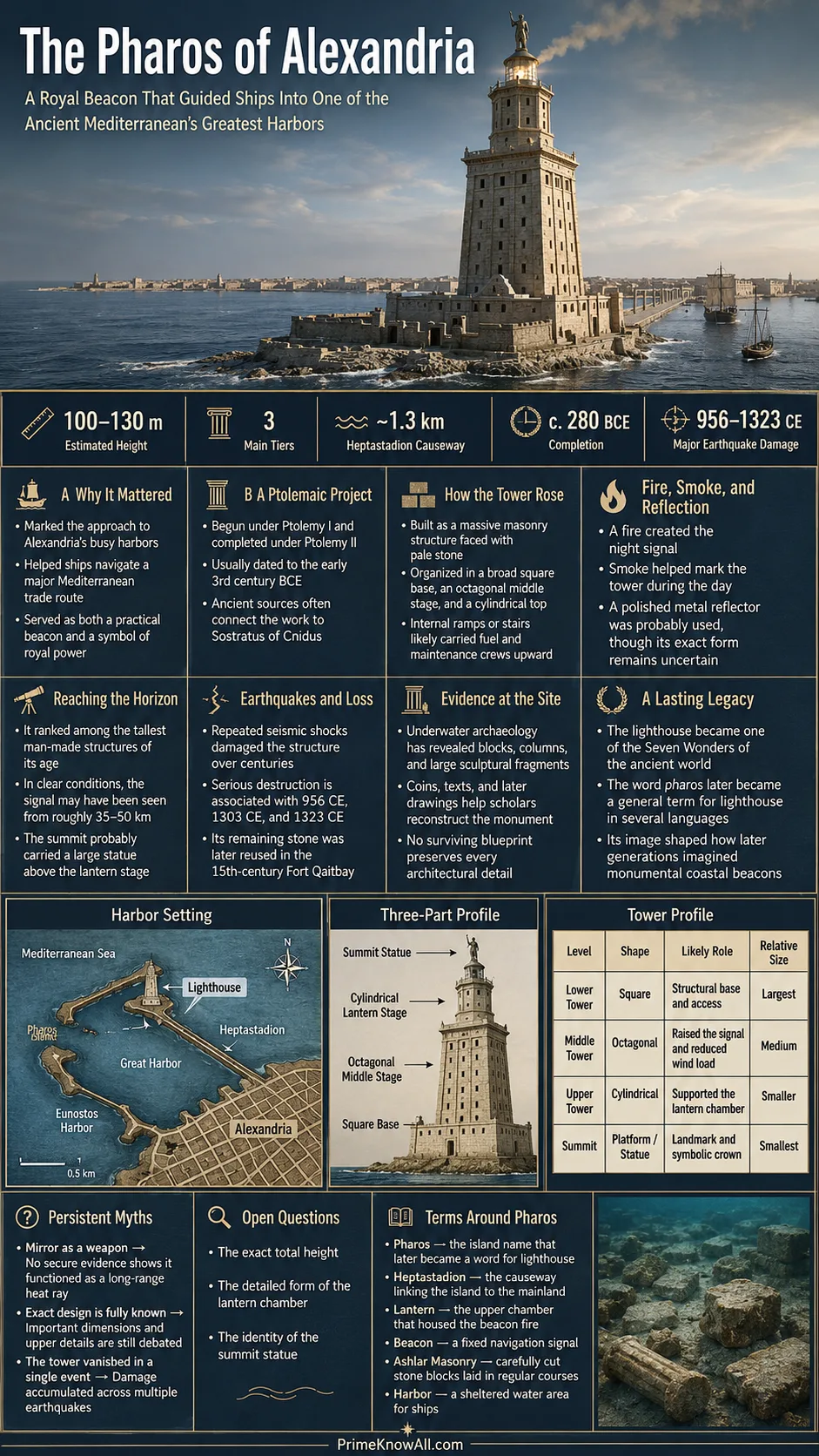
The Ancient Lighthouse of Alexandria was a tall harbour tower built on the island of Pharos around the 3rd century BCE to help ships enter Alexandria safely. It stood roughly 100–110 meters high by many modern estimates, used fire and height as a navigation aid, and later became one of the Seven Wonders of the Ancient World.
If you remember one thing: the Lighthouse of Alexandria was not just a beautiful monument. It was a working piece of ancient maritime infrastructure built for a busy, risky, and valuable port.
Worth keeping in mind:
- Pharos was both the island name and the name that later shaped words for “lighthouse” in several languages.
- The tower likely had three main levels: square, octagonal, and cylindrical.
- Its remains are not fully lost; many blocks and sculptures lie underwater near Qaitbay Fort.
- Modern researchers now use photogrammetry, meaning 3D modeling from many photographs, to study the submerged site.
What Was the Ancient Lighthouse of Alexandria?
The Lighthouse of Alexandria, also called the Pharos of Alexandria, was a monumental tower built to guide ships into the harbour of Alexandria in Egypt. It joined practical navigation, royal display, and city branding in one structure.
Alexandria was founded by Alexander the Great in 331 BCE, then developed under the Ptolemaic dynasty. Its harbour linked the Mediterranean, the Nile Delta, the Red Sea trade routes, and grain shipments that fed major cities. A tower at the harbour mouth helped sailors find the entrance and avoid dangerous approaches.
The lighthouse stood on Pharos Island, near the entrance to the Great Harbour. A causeway called the Heptastadion connected the island to the mainland and helped shape Alexandria’s two harbour zones.
- Place: Pharos Island, Alexandria, Egypt
- Main function: guide ships into harbour by day and night
- Political meaning: show the reach of Ptolemaic Egypt
- Later legacy: became a model for harbour towers across the Mediterranean
Why Was It Built?
The lighthouse was built because Alexandria needed a visible, dependable marker for one of the busiest ports in the eastern Mediterranean. The coast was low, the approach could be confusing, and the harbour entrance mattered for trade, taxes, military movement, and food supply.
A harbour without a clear marker is like an airport with no runway lights. Ships may still arrive, but pilots and sailors need more guesswork, more local knowledge, and more luck. The Pharos reduced that uncertainty by turning the skyline into a navigation tool.
It also served a second purpose. The Ptolemies ruled a wealthy Greek-speaking kingdom in Egypt, and Alexandria was their showcase city. A huge white tower at the harbour entrance told arriving merchants, envoys, and sailors that this was a serious capital with money, engineering skill, and sea power.
What this means so far:
- The tower was useful first, famous second.
- Its location mattered as much as its height.
- It helped Alexandria look safe, organized, and powerful to people arriving by sea.
Who Built the Lighthouse of Alexandria?
The lighthouse is usually linked to Ptolemy I Soter, Ptolemy II Philadelphus, and the architect or patron Sostratus of Cnidus. The safest wording is that it was planned or started under Ptolemy I and finished under Ptolemy II, around 280 BCE.
Ancient sources connect Sostratus with the tower, but they do not all explain his exact role in the same way. He may have been the designer, the project leader, the funder, or a high-status figure attached to the work. That uncertainty matters because many short summaries present his role as a settled fact.
- Ptolemy I Soter: Macedonian ruler of Egypt after Alexander’s death; likely started the project.
- Ptolemy II Philadelphus: son of Ptolemy I; commonly linked with the tower’s completion.
- Sostratus of Cnidus: the name most often attached to the construction story.
- Alexandria: the port city that gave the lighthouse its real purpose.
How Tall Was the Lighthouse of Alexandria?
Most modern summaries place the lighthouse somewhere around 100 to 110 meters tall, though older and later descriptions can push the estimate higher. A cautious range is better than a single exact number because the tower no longer stands and ancient measurements are not always easy to convert.
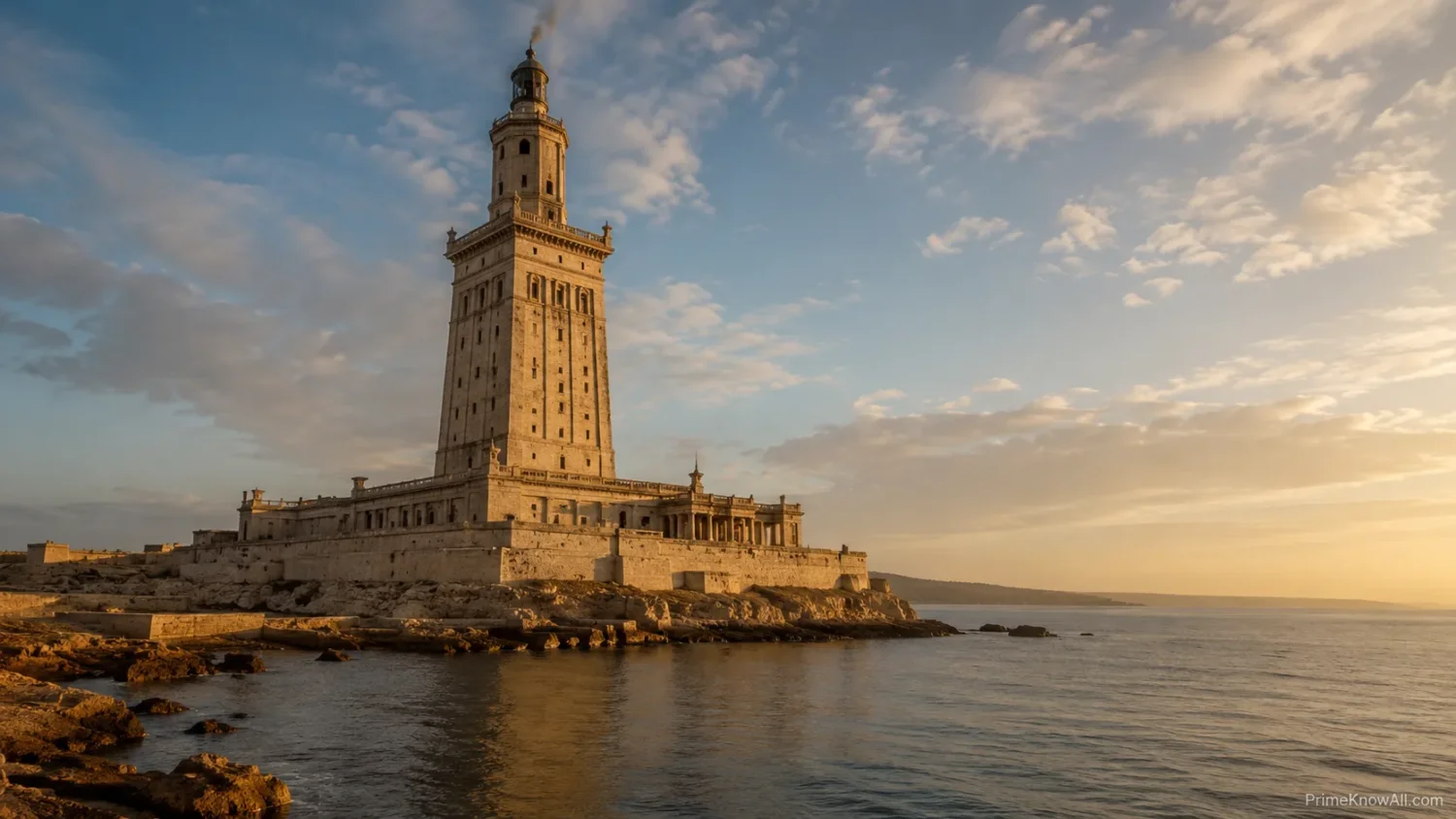
Even the lower estimates make the Pharos an astonishing tower for its time. At roughly 100 meters, it would have been taller than many modern apartment blocks and visible from far across a flat coastline. Height made the beacon useful; it raised the fire or bright signal above sea haze, harbour buildings, masts, and shoreline clutter.
| Feature | Likely Or Commonly Cited Detail | Why It Matters |
|---|---|---|
| Height | About 100–110 meters, with some estimates reaching higher | Made the tower one of the tallest human-made structures of its age |
| Date | Completed around 280 BCE | Places it in the early Ptolemaic period |
| Main Shape | Square base, octagonal middle, cylindrical top | Helped balance mass, height, and visibility |
| Site Today | Underwater remains near Qaitbay Fort | Lets archaeologists study real blocks, not only written descriptions |
| Documented Area | About 1.6 hectares in CEAlex site records | Shows that the remains are spread across a broad underwater zone |
What Did the Lighthouse Look Like?
The best-known reconstruction shows a tall, white, three-part tower: a square lower stage, an octagonal middle stage, and a round upper stage. This shape appears in many modern reconstructions because it matches several later descriptions and visual traditions.
The lower level may have contained rooms, storage areas, service spaces, and a broad ramp or internal passage system. A ramp is a sloped path used to move people, animals, fuel, or materials upward without stairs. That detail makes sense for a lighthouse because fuel and maintenance gear had to reach the upper level again and again.
The tower may have been topped by a statue. Ancient and later descriptions differ on who the statue represented. Some candidates include Zeus Soter, Helios, Poseidon, Alexander, or a Ptolemaic ruler shown in divine form. The honest answer is that the exact statue remains uncertain.
A clear mental picture:
- Think of the tower as three stacked shapes, not one plain column.
- The design likely balanced weight below with visibility above.
- The top statue is one of the details that should be treated with care.
How Did the Lighthouse Work?
The Pharos worked by placing a visible signal high above the harbour. At night, that signal was probably a fire. By day, the tower itself, its pale surface, and possibly smoke or reflected sunlight helped sailors identify the harbour entrance.
A beacon is a visible signal used for guidance. In the Pharos, the beacon was likely not a glass lamp in the modern sense. It was more probably a managed flame, fed with fuel and protected as much as possible from wind. Later writers also mention a mirror, often described as polished metal, but the exact design and power of that reflector are debated.
The tower did not need to “throw light” like a modern electric lighthouse to be useful. In an ancient harbour, a tall, steady signal in the correct location could guide approach, confirm direction, and help sailors separate the safe entrance from a flat and confusing coast.
- Night use: fire or flame at the top.
- Day use: tower silhouette, pale surface, smoke, and harbour alignment.
- Possible reflector: often described, but not fully proven in mechanical detail.
- Main value: helped ships identify the entrance and avoid wrong approaches.
A Simple Definition of Photogrammetry
Photogrammetry is a 3D recording method that uses many overlapping photographs to measure and model objects. For the Pharos site, it helps researchers turn scattered underwater blocks into measurable digital pieces.
The Harbour Setting Made the Tower Necessary
The Lighthouse of Alexandria mattered because it stood in the right place: at the edge of a major harbour serving a city built for sea traffic. A tall tower in the wrong place would have been impressive; a tall tower at Pharos became useful.
Alexandria sat near the Nile Delta, where sandbanks, shallow water, and low coastline could make approach difficult. Ships carrying grain, papyrus, glassware, luxury goods, soldiers, and officials needed a safe entry point. The lighthouse worked as part of a wider port system that included quays, warehouses, royal districts, temples, and naval facilities.
The Heptastadion, the causeway joining Pharos to the mainland, also changed the harbour’s shape. It helped create two different harbour areas and turned the island into a controlled maritime edge rather than a loose offshore marker.
The harbour lesson:
- The Pharos was part of a port network, not a lonely monument.
- Its value came from matching height with location.
- Alexandria’s wealth made the tower both affordable and useful.
A Text-Based View of the Lighthouse System
The easiest way to understand the Pharos is to read it from bottom to top. Each layer had a job: stability, height, signal, and meaning.
Top Signal Zone
The upper stage likely held the fire, reflector area, and possibly a statue. This was the visible marker sailors looked for at night or in poor coastal visibility.
Round Upper Stage
A narrower top reduced weight while lifting the beacon higher. The exact statue and finishing details remain debated.
Octagonal Middle Stage
The eight-sided form may have eased the visual shift between the square base and round top, while giving the tower a more refined outline from the sea.
Square Lower Stage
The broad base carried the mass of the tower. It may have included rooms, ramps, storage, and service areas needed for daily operation.
Pharos Island And Harbour Entrance
The tower stood where a ship needed guidance most: near the entrance to Alexandria’s Great Harbour, close to the route between open sea and protected water.
How Long Did the Lighthouse Stand?
The Lighthouse of Alexandria likely stood, in changing condition, for more than 1,500 years. It was built in the 3rd century BCE, damaged over time by earthquakes, and later replaced on the site by Qaitbay Fort in the 15th century.
Its long life is easy to miss. Many people remember only that it was destroyed, but the more interesting point is that it kept shaping Alexandria’s harbour for century after century. Medieval travelers still described it, repaired parts seem to have changed its top, and later builders reused stone from the ruined structure.
- 3rd century BCE: construction under the early Ptolemies.
- Late antiquity and medieval period: repairs, damage, and changes to the upper structure.
- 1303 CE: severe earthquake and tsunami damage linked with the eastern Mediterranean.
- 15th century: Qaitbay Fort built on or near the old lighthouse site, using material from the ruin according to many accounts.
What Destroyed the Lighthouse of Alexandria?
The lighthouse was not destroyed in a single clean moment. Earthquakes weakened it over many centuries, and the severe 1303 CE earthquake and tsunami appear to have ended its working life. Later rebuilding, stone reuse, and coastal change finished the transformation from tower to ruin.
Alexandria sits in a region affected by Mediterranean seismic activity. A tall masonry tower beside the sea faced several risks at once: ground movement, wave impact, salt damage, repair limits, and the simple pressure of age. A structure can survive one blow and still become weaker for the next one.
The tower’s fall also explains why so much evidence is now underwater. Blocks may have collapsed into the sea, while parts on land were reused. The current site is not a neat foundation with a tower outline; it is a field of stone, sculpture, metal connectors, and architectural fragments.
The collapse was gradual:
- Earthquakes damaged the tower across different periods.
- The 1303 event seems to have been the final major blow to its use as a beacon.
- Stone reuse later erased much of what remained above water.
What Remains Today?
Today, the physical story of the Pharos is mostly underwater near Qaitbay Fort. Researchers have recorded thousands of architectural and sculptural blocks in the submerged zone, including hard-stone fragments, statuary, and pieces linked to monumental entrances.
CEAlex, the Centre d’Études Alexandrines, reports that the underwater site covers about 1.6 hectares. Its harbour exhibition material states that 4,081 architectural and sculptural blocks have been recorded and documented. This is why modern work on the Pharos is not only text-based history. It is also field archaeology.
One reconstructed doorway from fragments is reported at about 11.5 meters by 4.9 meters and 2.1 meters deep. That scale gives a useful clue: the Pharos was not just tall. Its architectural pieces were massive, heavy, and carefully shaped.
- Blocks: granite, limestone, marble, quartzite, greywacke, and other hard stones.
- Metal elements: lead, iron, and bronze connectors linked with ancient building methods.
- Sculpture: large royal and divine figures connected with the harbour setting.
- Depth: many remains are studied underwater, often several meters below the surface.
Why Modern Researchers Are Still Studying It
The Pharos still matters because new tools can ask new questions of old stone. Modern teams use underwater archaeology, 3D scanning, photogrammetry, and digital reconstruction to test how the tower may have been assembled, damaged, and seen from the harbour.
A digital twin is a data-based 3D model of a real object or site. For the Lighthouse of Alexandria, a digital twin lets researchers compare block shapes, test alignments, rebuild doorways virtually, and share the site without moving every object from the seabed.
Recent work under the PHAROS project has renewed public interest because selected large blocks have been raised or scanned for study. Reports in 2025 and 2026 describe pieces weighing around 70–80 tons, including doorway and gateway elements. The point is not treasure recovery; the point is measurement, documentation, and better reconstruction.
Why the new research matters:
- It replaces guesswork with measured stone evidence.
- It helps separate likely design features from later legend.
- It gives the public a way to understand a lost monument without pretending the full tower survives.
Real-World Ways to Understand the Pharos
The Lighthouse of Alexandria becomes easier to grasp when it is placed beside familiar daily scenes. It was ancient, but many of its problems still feel practical.
- A ship arriving after sunset: the beacon helped sailors confirm they were approaching Alexandria, not just an ordinary stretch of coast.
- A foggy or hazy morning: the tower’s height and pale mass could help the harbour stand out when smaller markers were hard to see.
- A merchant captain with valuable grain: safer entry meant less risk to cargo, crew, and profit.
- A new visitor seeing Alexandria for the first time: the Pharos acted like a skyline signature, the way a major airport tower or bridge can mark a city today.
- A harbour official managing traffic: a known entry marker helped ships follow expected routes.
- A modern diver near Qaitbay Fort: scattered blocks on the seabed show how a famous building becomes archaeological evidence.
- A 3D modeler working with stone fragments: each measured block can help test whether a proposed reconstruction is realistic.
Common Misconceptions About the Lighthouse of Alexandria
Several popular claims about the Pharos are repeated because they are easy to remember. Some are partly true, but they need careful wording.
| Misconception | Better Correction | Why People Get It Wrong |
|---|---|---|
| It was only a symbol. | It was a working harbour beacon and a symbol. | Its fame as a Wonder can hide its practical job. |
| We know exactly how tall it was. | Its height is best treated as an estimated range, often around 100–110 meters. | Ancient and medieval measurements do not match perfectly. |
| It was destroyed in one earthquake. | It was weakened by multiple earthquakes and later stone reuse. | Single-event stories are easier to retell. |
| The mirror system is fully known. | A reflector is often mentioned, but its exact design is not settled. | Later legends make the technology sound clearer than the evidence allows. |
| Nothing remains. | Many remains are underwater near Qaitbay Fort. | The standing tower is gone, so people assume the evidence is gone too. |
What We Still Cannot Confirm
Some details about the Lighthouse of Alexandria remain uncertain because the standing structure disappeared, written sources vary, and underwater remains are scattered. Good history should leave room for that uncertainty.
- Exact height: modern estimates are careful, but no complete standing measurement survives.
- Exact beacon mechanism: a fire is likely; the full reflector system is harder to prove.
- Top statue: several identities are possible, and different sources point in different directions.
- Interior layout: ramps, rooms, and service spaces are likely in some form, but not every detail can be mapped with certainty.
- Full collapse sequence: earthquakes, sea action, repair, and reuse all played roles, but the order is not perfectly visible.
Why the Lighthouse Changed the Idea of a Lighthouse
The Pharos did not invent the idea of using light or landmarks for navigation, but it gave the lighthouse a new scale. After Alexandria, a harbour beacon could be both a safety device and a public monument.
The name Pharos became tied to lighthouse language. In French, phare means lighthouse; in Italian and Spanish, faro carries the same idea. That linguistic survival is a small clue to the tower’s reach. A building vanished, but its name kept working.
Architecturally, the lighthouse also offered a model: tall base, rising stages, visible crown, and harbour-facing identity. Later towers, watchpoints, and minarets developed in different cultural settings, so direct influence should not be overstated. Still, the Pharos showed what a vertical maritime landmark could do.
The lasting idea:
- The Pharos turned a harbour light into city identity.
- Its name survived in lighthouse vocabulary.
- Its most durable influence may be the mix of navigation, height, and public meaning.
Quick Test
Use these short checks to test whether the main ideas are clear.
The Lighthouse of Alexandria stood on Pharos Island.
Answer: True. The tower stood on the island of Pharos near Alexandria’s harbour entrance.
The lighthouse was built only as decoration for the city.
Answer: False. It also had a practical navigation role for ships entering the harbour.
Modern researchers know the exact height of the tower.
Answer: False. They work with estimates, commonly around 100–110 meters, because the tower no longer stands.
Qaitbay Fort is connected to the lighthouse site.
Answer: True. The fort stands at the historic location associated with the Pharos, and older stones are often linked with the ruined lighthouse.
Photogrammetry helps researchers study underwater remains.
Answer: True. It uses many photographs to create measurable 3D models of blocks and site features.
The Ancient Lighthouse of Alexandria was a harbour tool, a royal statement, and a long-lived engineering achievement in one structure. Its story is strongest when the tower is treated not as a fantasy ruin, but as part of Alexandria’s port, trade, and coastal navigation system.
The most common mistake is to describe it with total certainty, especially about its height, mirror, statue, and final collapse. The rule to remember is simple: the Pharos is best understood through careful ranges, real harbour needs, and the underwater evidence still being studied today.
Sources
- Centre d’Études Alexandrines – Lighthouse of Alexandria — Useful because CEAlex leads long-running research on the submerged Pharos site and reports field details from Alexandria.
- Centre d’Études Alexandrines – The Harbours of Alexandria: Antiquity — Reliable for harbour context, underwater site scale, documented blocks, and 3D reconstruction notes from the research institution working on the site.
- CEAlex PHAROS Project – The Pharos Project — Reliable because it describes the current digital reconstruction project, its research goals, and the methods used to document the lighthouse remains.
- Eurographics Digital Library – 3D Technologies on the Underwater Archaeological Site of the Ancient Lighthouse of Alexandria — Useful academic source for photogrammetry, digital twin methods, and the 2025 digital heritage work on the submerged site.
- Encyclopaedia Britannica – Lighthouse of Alexandria — Reliable reference source for dates, builders, structure, height estimates, and the link between the Pharos and Qaitbay Fort.
- World History Encyclopedia – Lighthouse of Alexandria — Useful for accessible historical context, ancient sources, harbour function, and later damage history; it is editorially reviewed for public history use.
FAQ
Where was the Lighthouse of Alexandria located?
The Lighthouse of Alexandria stood on Pharos Island, near the entrance to the Great Harbour of Alexandria in Egypt. The site is associated today with the area around Qaitbay Fort.
Who built the Lighthouse of Alexandria?
The project is usually linked to Ptolemy I Soter, Ptolemy II Philadelphus, and Sostratus of Cnidus. A careful answer is that it was likely started under Ptolemy I and completed under Ptolemy II around 280 BCE.
How tall was the Lighthouse of Alexandria?
Many modern estimates place it around 100–110 meters tall, though some historical reconstructions suggest a wider range. Since the tower no longer stands, exact height should be treated with caution.
Why was the Lighthouse of Alexandria important?
It helped ships enter Alexandria’s harbour safely and also acted as a public symbol of Ptolemaic power. Its name, Pharos, later shaped words for lighthouse in several languages.
What destroyed the Lighthouse of Alexandria?
Earthquakes damaged the tower over time, with severe damage in the medieval period, especially around the 1303 eastern Mediterranean earthquake and tsunami. Later stone reuse and coastal change erased much of the structure above water.
Can people still see remains of the Lighthouse of Alexandria?
The standing tower is gone, but many blocks and fragments are underwater near Qaitbay Fort. Researchers have recorded thousands of pieces as part of underwater archaeological work.
Was the Lighthouse of Alexandria one of the Seven Wonders?
Yes. It became one of the Seven Wonders of the Ancient World and was one of the most famous technical and architectural works of the ancient Mediterranean.