
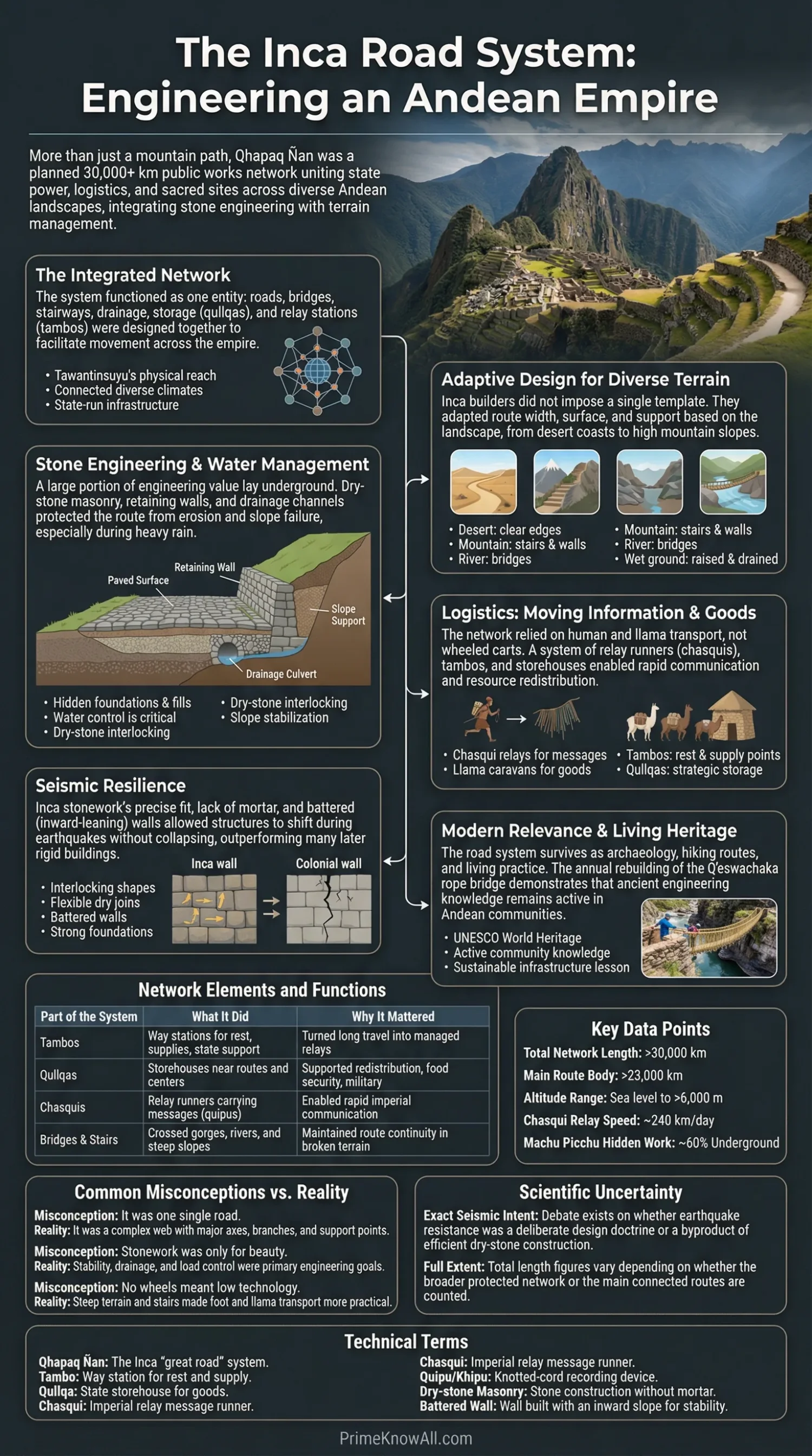
The Inca road system, known as the Qhapaq Ñan, was a continent-scale network of roads, bridges, stairways, retaining walls, drainage works, relay stations, and storage sites. It linked the Andes across what are now Peru, Ecuador, Bolivia, Chile, Argentina, and Colombia. Its builders did not force one road design onto every landscape. They changed materials and construction methods as the route crossed high mountains, wetlands, rainforest, valleys, and coastal desert.
The engineering becomes easier to understand when the roads and the stonework are viewed together. Stone was not used simply because it lasted. It solved specific problems: holding a road platform on a steep slope, carrying water away from a surface, forming steps where a grade became too sharp, protecting foundations, and creating stable walls in earthquake-prone terrain.
- Road length: UNESCO describes more than 30,000 km of Andean roads, while Smithsonian material uses about 40,000 km for the broader road complex.
- Terrain: the network linked coastal zones to Andean routes rising above 6,000 m.
- Construction: roads could be paved, compacted, stepped, raised on causeways, cut into slopes, or held by stone sidewalls.
- Movement: the system supported official messengers, llama caravans, administrators, labor groups, and state supply movement.
How Large Was the Inca Road System?
There is no single length figure that covers every definition of the Qhapaq Ñan. UNESCO describes a road network of more than 30,000 km, while Smithsonian educational material describes the wider complex as about 40,000 km, or roughly 25,000 miles. The difference reflects how researchers and institutions define and count main roads, branches, inherited routes, and associated sections.
The network reached its widest extent in the fifteenth century as Tawantinsuyu, the Inca state, expanded along western South America. Four principal routes were organized from Cusco, with lower-order roads linking settlements, production zones, religious sites, administrative centers, storehouses, and regional routes. Parts of this network were older than the Inca state and were adapted from earlier Andean infrastructure. UNESCO inscribed selected sections of the Qhapaq Ñan as a World Heritage property in 2014 through a joint nomination involving six countries.
| Feature | Measured or Reported Value | What It Shows |
|---|---|---|
| Qhapaq Ñan network | More than 30,000 km by UNESCO; about 40,000 km in Smithsonian material | Different institutions count the wider network in slightly different ways. |
| Highest terrain | Above 6,000 m in UNESCO documentation | Routes crossed extreme Andean elevation as well as low coastal zones. |
| Chaski relay spacing | About 10–15 km between chaskiwasi relay stations | Messages moved through a planned relay system rather than one runner covering the full distance. |
| Machu Picchu main canal | 749 m long, with a measured slope of about 1.0–4.8% | Gravity flow was controlled through careful site planning. |
| Machu Picchu fountains | 16 domestic fountains | Stone channels and water distribution were integrated into settlement design. |
| Primary spring flow at Machu Picchu | About 26–125 L/min in field measurements | Builders worked with a water source whose yield changed by season. |
How Inca Roads Were Built for Different Landscapes
Inca roads were adapted to terrain rather than built to one fixed cross-section. A dry, level route could use compacted earth, while a steep or wet route might need paving, drainage channels, stone steps, retaining walls, or a raised causeway. Local geology and locally available materials shaped the final form.
Mountain Slopes Needed Support, Steps, and Controlled Grades
On steep slopes, road builders created a usable platform by cutting into the hillside and supporting the outer edge with retaining walls. Fill placed behind the wall created a more level walking surface. Where a climb became too sharp for a normal path, stone stairways replaced a continuous ramp.
This design made sense for a transport system centered on people and llama caravans rather than wheeled carts. A staircase that would be unsuitable for wagons could be an efficient solution for foot traffic moving through a mountain pass.
Wet Ground Needed Drainage and Raised Roadbeds
Rain and saturated soil can destroy a road even when its surface is made of stone. In wetter areas, Inca engineers used side ditches, cross-drains, culverts, and raised sections to move water away from the roadbed. Wetlands could be crossed on causeways or supported platforms instead of allowing traffic to churn through soft ground.
The basic principle is familiar in modern road work: a durable surface still needs a way to get rid of water. Without drainage, water softens supporting soil, carries away fine material, and increases the chance of slope failure.
Desert Routes Needed Visibility as Much as Paving
In very dry zones, heavy paving was not always necessary. Some routes used compacted earth or sand, while stone rows, low walls, posts, or cairn-like markers helped define the path across open terrain. Side walls could also reduce encroachment from shifting surface material and separate traffic from cultivated land where roads passed through productive valleys.
One road network, several construction answers:
- Steep slope: cut platform + retaining wall + steps where needed.
- Heavy rain: paved or stabilized surface + ditches + culverts.
- Wetland: raised causeway or supported roadbed.
- Dry plain: compacted surface + route markers or edge walls.
Stone Engineering Went Far Beyond Road Paving
Inca stone engineering included rough functional masonry, finely dressed blocks, polygonal walls, retaining structures, foundations, channels, stairways, and high-status architecture. The famous tightly fitted walls of Cusco and nearby sites represent only one end of a much wider construction tradition.
Retaining Walls Turned Slopes Into Usable Platforms
A retaining wall does more than create a neat edge. It resists the outward movement of soil and fill behind it. Along roads and terraces, this allowed builders to create a flatter platform where the natural hillside offered almost none. Similar principles appear in Inca agricultural terraces, where walls, fill layers, and drainage worked together.
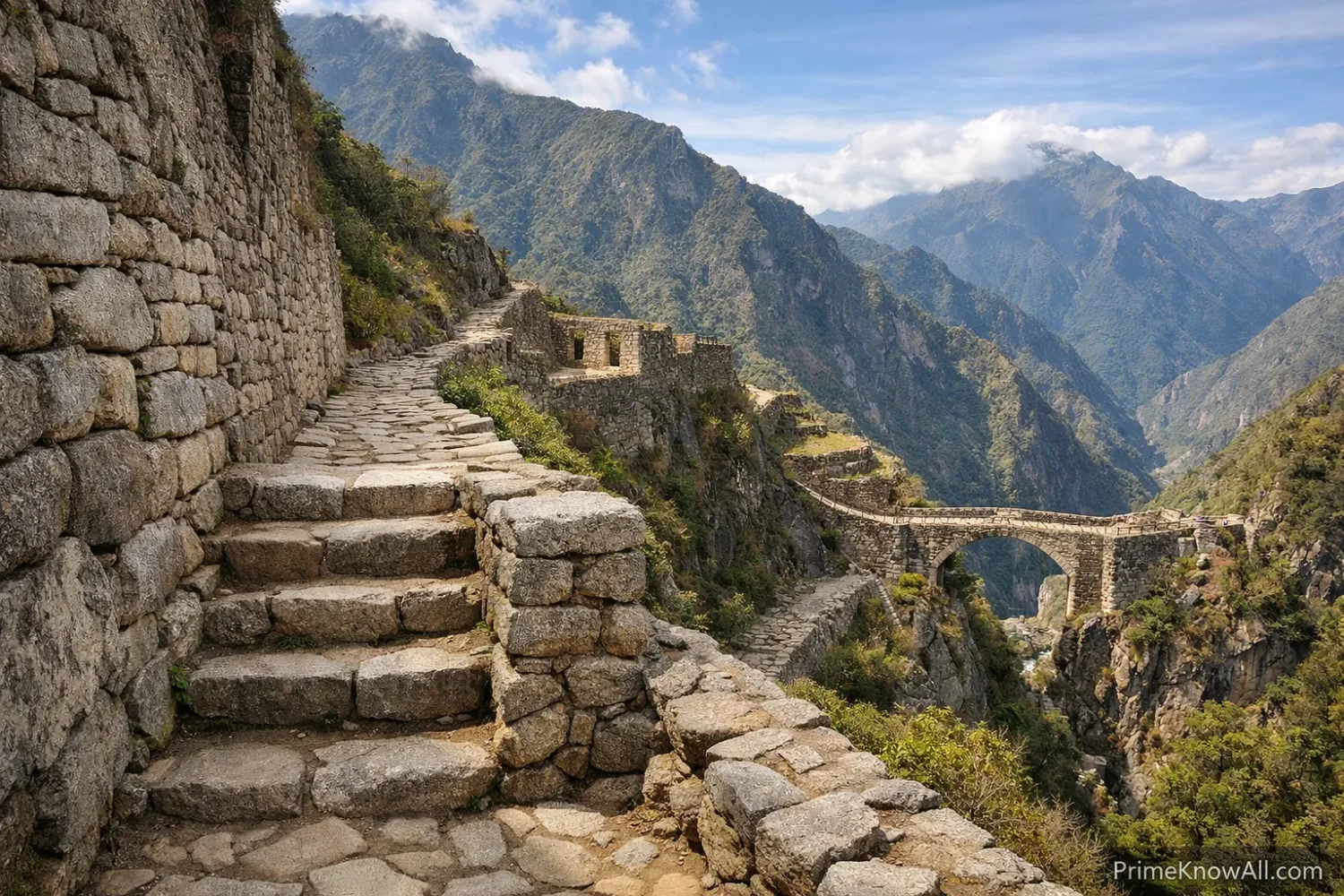
At Machu Picchu, field engineering studies show the same relationship between stone structures, prepared ground, and water control. A wall can fail even when its stones are strong if trapped water raises pressure behind it, so drainage is part of slope stability rather than a separate finishing detail.
How Were Inca Stones Cut and Fitted?
Archaeological experiments and quarry studies by architectural historian Jean-Pierre Protzen showed that finely fitted Inca masonry did not require mysterious tools. Quarry evidence supports the use of hammerstones, smaller dressing stones, prying methods, repeated testing, and progressive fitting. A block could be shaped, placed, checked against neighboring stones, removed or adjusted, and worked again until the contact surfaces matched closely.
That process is closer to skilled custom fitting than to cutting identical factory blocks. Each stone responds to the shape of the stones around it. In polygonal masonry, several irregular edges may meet adjoining blocks, creating walls with many interlocking contact lines.
Cruz Moqo: Reconstructing a Partly Dismantled Stone Layout
A study published in npj Heritage Science on June 18, 2026 examined Cruz Moqo, a partly dismantled sector of Sacsayhuaman in Cusco. The research does not add new evidence about the Qhapaq Ñan road network. Instead, it addresses a different engineering problem: how the original arrangement of an altered Inca stone structure can be studied when many of its blocks are no longer standing in place.
The researchers recorded 138 dispersed stones and analyzed the geometry of their visible façades. Each stone was treated as an individual unit, and its form was reduced to a two-dimensional silhouette so possible alignments and architectural roles could be compared. Manual reconstruction identified groups whose edges and shapes appeared to fit plausible arrangements, while computational matching produced less decisive results because two-dimensional outlines cannot capture every feature of irregular three-dimensional masonry.
The value of the Cruz Moqo study is therefore methodological rather than a claim that one lost wall plan has been recovered with certainty. It shows how stone geometry, surviving position, visual fitting, and computational comparison can be combined to test possible layouts at a disturbed site. It also records where those methods fail, which is important when reconstructing early Inca construction from stones that have been moved, scattered, or partly removed.
Were Inca Walls Earthquake-Proof?
No historical masonry should be described as earthquake-proof. Inca stone walls have features that can help them behave well under shaking, including carefully fitted joints, heavy blocks, inward wall batter in some structures, and wall forms that avoid weak vertical seams. Yet surviving walls can still be damaged, displaced, or overturned by strong earthquakes.
Modern studies model individual stones and their contacts because the movement between blocks affects how a wall responds. This is a better description than the popular claim that every Inca wall simply “locks” itself against any earthquake. The engineering is impressive, but it is not immune to physics.
Water Management Was Part of the Same Engineering Tradition
Road durability, terrace stability, foundations, and settlement design all depend on controlling water. Machu Picchu offers one of the best measured examples of Inca hydraulic work, even though its domestic water system is not itself part of the road network.
Field studies published through the American Society of Civil Engineers measured a 749 m stone-lined canal carrying spring water toward the settlement. The primary spring produced about 26–125 liters per minute depending on season, and the canal supplied 16 fountains. Its slope, measured at roughly 1.0–4.8%, kept water moving by gravity.
Machu Picchu also received close to 2,000 mm of rain per year in the engineering study of its drainage. The site therefore needed both a clean supply system and a separate way to remove stormwater. Terraces, underground drainage layers, outlets, channels, and prepared foundations helped keep water from concentrating where it could weaken slopes or structures.
A useful analogy is to think of the Qhapaq Ñan and its associated infrastructure as a mix of a highway network, postal relay, supply corridor, service system, and public works program. The stone road surface was only the visible layer. The network worked because drainage, bridges, labor, storage, communication, and maintenance were connected to it.
Bridges Turned Deep Gorges Into Connected Routes
Rope suspension bridges solved a problem that stone roads could not: crossing deep river gorges without descending to the valley floor. Braided plant fibers carried tension between strong anchor points on opposite sides of a canyon. The walking deck and hand ropes were then tied into the main cables.
The Q’eswachaka bridge over the Apurímac River preserves this engineering tradition. Quechua-speaking communities renew it every year using local grass and inherited techniques. UNESCO records families making long thin ropes, which are twisted into larger ropes and finally braided into the main bridge cables. The finished bridge is tied to old stone anchor structures on the banks.
The annual rebuilding also explains an often missed point about preindustrial infrastructure: durability does not always mean making one object last forever. A fiber bridge can remain dependable when the design includes regular replacement of perishable parts, trained specialists, shared labor, and known anchor points.
How the Road Worked as a Communication and Supply System
The Qhapaq Ñan was more than a route between cities. It was supported by relay stations, rest facilities, storage sites, officials, labor obligations, and regional administrative centers. That organization allowed the Inca state to move information and supplies across terrain where travel was physically demanding.
Chaskis Moved Messages in Relays
Official runners known as chaskis carried verbal messages, small packages, and khipu records. Smithsonian material places relay stations, or chaskiwasi, about 10–15 km apart. A runner therefore did not need to cross the whole empire. Messages were transferred from one rested runner to the next.
Tambos and Storehouses Supported Movement
Roadside facilities known as tambos provided places for authorized travelers and state personnel to stop, while storehouses held food, textiles, equipment, and other supplies. The exact form and spacing varied by route and region. Together, these sites reduced the need for every traveler or work group to carry all provisions from the point of departure.
Maintenance Was a Social System as Well as an Engineering Task
Construction and upkeep relied heavily on organized labor. Under the mit’a system, households supplied periods of labor to the state for work that could include roads and other public projects. Local knowledge also mattered because builders had to understand seasonal rain, unstable slopes, local stone, river behavior, and mountain routes.
Slopes, passes, water, soil, and access to settlements shaped where the route could run.
Compacted earth, paving stones, steps, or raised fill created a stable walking surface.
Retaining walls held fill in place and allowed a road platform to cross steep ground.
Ditches, drains, culverts, and raised sections kept runoff from weakening the roadbed.
Rope suspension bridges or other crossing types connected routes separated by rivers and ravines.
Chaski relays, tambos, storehouses, officials, and labor systems kept the network useful after construction.
Where the Engineering Becomes Easy to See
The design logic becomes clearer when each structure is tied to a practical problem rather than viewed as decoration.
- A road meets a steep mountainside. Builders can cut a narrow bench into the slope and support the outer edge with stone. The wall is needed because the road platform would otherwise slide or erode downhill.
- A route climbs too sharply for a steady path. Stone steps divide the rise into manageable changes in elevation. This suits travelers and pack llamas better than trying to maintain a cart-friendly grade.
- Heavy rain crosses a road. A side ditch or culvert moves runoff through or around the roadbed. The goal is to protect the supporting soil, not merely keep the surface dry.
- A trail reaches marshy ground. Raising the route on fill or a causeway spreads traffic onto a firmer structure. Without it, repeated foot and animal traffic would damage saturated ground.
- A canyon interrupts the route. A suspension bridge keeps the road near its existing elevation. Descending to a river and climbing back out could add hours to a crossing.
- A message must move farther than one runner can cover quickly. Relay stations divide the journey into short stages. Speed comes from changing runners, not from expecting one person to run an extreme distance.
Ideas About Inca Engineering That Need More Care
Several popular descriptions simplify the engineering too far. The surviving evidence points to a system with many materials, construction grades, and regional variations.
- “Every Inca road was paved with fitted stone.” Many were not. Earth, sand, grass-covered surfaces, cobbles, paving, steps, and causeways were used where each made sense.
- “The Inca created the whole network from nothing.” They expanded and reorganized routes that partly rested on older Andean roads built by earlier societies.
- “No mortar means every Inca wall used perfect polygonal blocks.” Fine dry-joint masonry was used in selected architecture, while many functional structures used rougher stonework and other wall types.
- “The walls cannot be damaged by earthquakes.” Their geometry and fitted stones can improve behavior, but strong shaking can still move blocks, damage walls, or cause collapse.
- “The road was simply an ancient public highway.” Major routes were closely tied to state administration, official travel, military movement, labor, tribute, and communication.
Why Some Road Sections Survive and Others Do Not
Stone helps preservation, but survival depends on more than material strength. Drainage, slope stability, continued local use, repair, later construction, erosion, landslides, vegetation, road widening, and abandonment all affect what remains visible.
UNESCO notes that many surviving sections still retain traditional materials such as stone and earth, and that local communities remain active custodians in some areas. The annual renewal of Q’eswachaka shows the same principle in a different form: continued knowledge can preserve an engineering tradition even when the working material itself must be replaced repeatedly.
What Researchers Still Cannot State With Precision
The surviving network is incomplete, and measurements depend on what researchers count as part of it. That is one reason published totals differ. Some roads were reused, altered, buried, eroded, incorporated into later routes, or built over. In other cases, the archaeological distinction between an Inca-built section and an older road later adopted by the Inca is not always simple.
Stone-working methods are better understood than they were a century ago because quarry traces and experiments can be compared with finished walls. Even so, not every transport method, labor sequence, or fitting procedure is documented for every site. The Cruz Moqo research adds another limit: when masonry has been dismantled and blocks dispersed, geometric comparison can suggest relationships without guaranteeing a complete original arrangement. Claims that rely on lost machinery, unknown substances, or one universal stone-cutting method go beyond the evidence currently available.
The strongest lesson from the Qhapaq Ñan is practical: Inca builders matched construction to landscape. Their roads lasted where route choice, stonework, drainage, bridge design, maintenance, and organized labor worked together. The precision visible in famous walls is only one part of that larger engineering system.
Questions About the Inca Road System
How long was the Inca road system?
UNESCO describes more than 30,000 km of roads, while Smithsonian material describes the wider Qhapaq Ñan complex as about 40,000 km. The difference comes from how the network and its branches are defined and counted.
Were all Inca roads made of stone?
No. Construction changed with terrain. Some sections were paved with stone or cobbles, while others used compacted earth, sand, grass-covered surfaces, raised causeways, steps, or mixed construction.
Why did the Inca build so many stone steps?
The road system was designed mainly for people and llama traffic rather than wheeled carts. On steep slopes, steps offered a direct and stable way to gain elevation where a long graded ramp would have required far more excavation.
How did Inca roads handle rainwater?
Wet sections could include roadside ditches, cross-drains, culverts, paving, raised roadbeds, and retaining structures. Moving water away from the road helped protect the soil and fill supporting the travel surface.
How were Inca stones fitted so tightly?
Quarry studies and experiments support the use of hammerstones, dressing by repeated pounding, prying, trial placement, marking, and repeated adjustment. The evidence does not require lost machinery or an unknown stone-softening process.
What does the Cruz Moqo study show about Inca stone engineering?
The 2026 study examined 138 dispersed stones from a partly dismantled area of Sacsayhuaman. Researchers compared the geometry of their façades to test possible architectural relationships. Manual fitting produced plausible groupings, while computational matching remained less conclusive. The study is useful for reconstructing disturbed stone architecture, not as evidence for a new Inca road route.
Did Inca stone walls survive earthquakes because they were flexible?
Some wall forms and fitted joints can allow limited movement and help distribute forces, but the behavior differs by wall type, block shape, foundation, and earthquake intensity. Inca masonry can still suffer displacement or collapse under strong shaking.
Sources
- UNESCO World Heritage Centre – Qhapaq Ñan, Andean Road System. UNESCO documents the network’s World Heritage status, geographic reach, engineering features, road types, bridges, stairs, ditches, and surviving traditional management.
- Smithsonian National Museum of the American Indian – Building the Road. This museum research resource explains terrain-based construction and the role of local knowledge and labor.
- Smithsonian National Museum of the American Indian – A Road for Administration. It supports the description of chaski relays, chaskiwasi spacing, khipu use, and state administration along the road.
- UNESCO Intangible Cultural Heritage – Annual Renewal of the Q’eswachaka Bridge. UNESCO records the living bridge-building tradition, rope preparation, community roles, and continued use of Inca techniques.
- American Society of Civil Engineers – Ancient Machu Picchu Drainage Engineering. This peer-reviewed engineering paper provides rainfall and drainage evidence from field study at Machu Picchu.
- American Society of Civil Engineers – Machu Picchu: Ancient Hydraulic Engineering. This peer-reviewed study reports measured spring flow, canal length, canal slope, estimated capacity, and the 16-fountain distribution system.
- University of California Press – Inca Quarrying and Stonecutting. Jean-Pierre Protzen’s quarry research and experiments are a major academic basis for explaining how stone was split, dressed, and fitted with simple tools.
- npj Heritage Science – Decoding Cruz Moqo: Geometric Analysis of Dispersed Stones from Early Inca Construction at Sacsayhuaman, Perú. This peer-reviewed 2026 study analyzes 138 dispersed stones using manual and computational geometric methods to test possible architectural relationships in a partly dismantled sector of Sacsayhuaman.
- World History Encyclopedia – The Inca Road System. This edited reference overview is useful for road forms, route functions, bridges, tambos, surface types, and the broader historical setting.