
Hittite fortifications combined stone foundations, thick mudbrick walls, timber reinforcement, towers, monumental gates, and carefully chosen terrain. At Hattusa, the Hittite capital, the entire system extended for more than 8 kilometers, while the Upper City was protected by a double fortification line with more than 100 towers and five known gateways.
These walls were not simply barriers around houses and temples. They controlled routes into the city, protected royal and religious districts, used steep slopes as part of the defense, and turned some entrances into monumental public spaces. Archaeology at Hattusa, Alacahöyük, and other Hittite centers shows that fortification was closely tied to urban planning.
- Stone formed the durable base, while much of the upper structure was made from sun-dried mudbrick.
- Casemate construction gave the walls considerable thickness without requiring solid masonry throughout.
- Towers and gates divided long defensive lines into controlled sections.
- Natural hills, cliffs, and artificial embankments were treated as parts of the architectural system.
- Some structures that look defensive, especially Yerkapı, also appear to have served ceremonial or symbolic purposes.
Why Hittite City Walls Were Built as Systems
A Hittite fortification was rarely just one continuous wall of identical construction. Outer defenses, internal walls, fortified hills, towers, gateways, slopes, and restricted passages could work together. Hattusa offers the clearest surviving example because its irregular terrain forced builders to adapt almost every section to different ground conditions.
The capital stood above the Budaközü plain in central Anatolia. Rocky ridges, valleys, and steep changes in elevation divided the settlement naturally. Rather than flattening this landscape into a regular city plan, Hittite builders used it. A wall might follow a ridge in one area, cross an engineered embankment elsewhere, and connect with a fortified rocky height farther along.
This also explains why a simple number for the length of Hattusa’s walls can be misleading. UNESCO describes a monumental enclosure of more than 8 km, while archaeological discussions sometimes give different totals depending on whether older lines, internal divisions, and particular wall phases are included. The city changed over several centuries rather than receiving every fortification at once.
Hattusa’s Defensive Layout
Hattusa developed through several phases, and its fortifications reflect that history. The older Lower City occupied the northern area around the Great Temple and Büyükkale, while the later Upper City spread south across higher ground. Walls also divided important zones inside the larger enclosure.
| Feature | Main Evidence | Likely Role |
|---|---|---|
| Outer enclosure | More than 8 km of monumental walls when the wider system is counted | Defined and protected the capital |
| Upper City walls | Double wall with more than 100 towers | Protected the expanded southern city |
| Monumental gates | Lion Gate, King Gate, Sphinx Gate and two western gateways | Controlled entry while displaying royal imagery |
| Büyükkale defenses | Separate fortification around the royal citadel | Added another protected zone inside the capital |
| Yerkapı | Artificial embankment, Sphinx Gate, stairs and a stone tunnel | Combined controlled movement with ceremonial architecture |
| Postern Wall | Older defensive line associated with the earlier city | Protected the older settlement before the southern expansion |
The Lower City and the Older Defensive Line
The Lower City includes some of Hattusa’s earliest Hittite urban areas. Its defenses changed as the settlement grew. One important surviving element is commonly called the Postern Wall, an early Hittite fortification that predates much of the great southern enclosure seen in the Upper City.
Posterns are passages running through or beneath defensive structures. Similar forms occur at several Anatolian sites, but they should not automatically be described as secret escape tunnels. Their placement, accessibility, and relationship with roads and ceremonies could differ from site to site.
The Upper City and Its Double Wall
The Upper City represents a major expansion of Hattusa. UNESCO records a double fortification wall with more than one hundred towers around this sector. The line crossed uneven ground and linked several monumental entrances.
A second wall made direct access more difficult while also creating depth in the defensive zone. Towers projected from the wall line, giving guards better views along neighboring sections. The system therefore depended on wall thickness, elevation, observation, and controlled movement rather than on height alone.
Hattusa in numbers
- More than 8 km: UNESCO’s figure for the city’s monumental enclosure system.
- 100+ towers: recorded along the double fortifications of the Upper City.
- 5 known gateways: associated with the Upper City’s defensive circuit.
- 65 m: length of the modern experimental wall reconstruction built at Hattusa.
- 2,700 tonnes: amount of loamy earth used for mudbricks in that 65 m reconstruction.
How Hittite City Walls Were Constructed
Most surviving Hittite walls can look lower and more stone-heavy today than they originally did. That is because stone survives much better than mudbrick and wood. The visible foundation is only part of the original structure.
Stone Socles Supported the Wall
The lower part commonly used a substantial stone socle. On rocky terrain, builders could cut or prepare the natural surface so large stones sat securely against the bedrock. Gateways and other highly stressed areas received especially careful stonework.
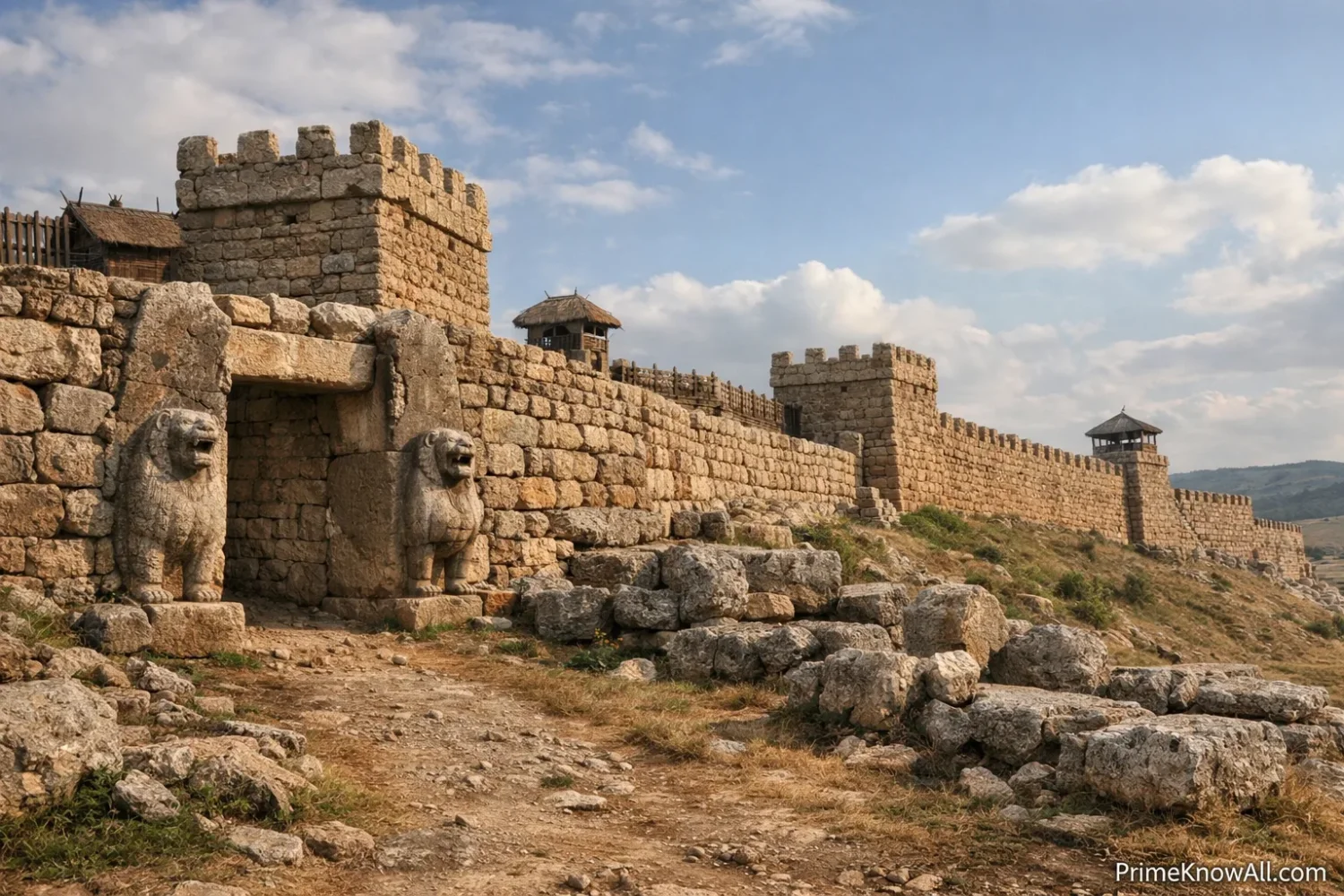
Stone was well suited to the lowest section because it resisted ground moisture and carried the weight of the material above. It also survived erosion better than unbaked brick, which is why archaeological visitors often see long stone outlines where a much taller structure once stood.
Casemate Walls Created Thickness
A characteristic Hittite method was the casemate wall. Two roughly parallel wall faces were tied together by crosswalls, creating a series of compartments. Many of these spaces could be packed with earth and rubble.
A casemate wall can be compared to a large box-girder: instead of relying on one solid mass of expensive masonry, linked sections create a wide and stable structure. The comparison is not exact, but it helps explain why crosswalls mattered. They tied the two faces together while dividing a long wall into smaller structural units.
Mudbrick Formed Much of the Upper Structure
Above the stone base, Hittite builders made extensive use of unbaked mudbrick. Suitable earth was mixed, formed into blocks, dried, and laid in courses. Timber elements were also used in the architecture.
This choice made sense in central Anatolia. Earth was locally available and could be turned into large quantities of wall material without firing every brick in a kiln. The drawback was maintenance. Rain, snow, surface runoff, and repeated freezing could damage exposed earthen construction.
The German Archaeological Institute tested this problem at full scale. Between 2003 and 2005, researchers reconstructed a 65-meter section of Hattusa’s city wall using evidence from excavations, ancient representations, traditional materials, and experimental methods. Producing the mudbrick alone required about 2,700 tonnes of loamy earth.
That experiment changes the way the original fortifications can be understood. Even a short wall section demanded enormous material handling. Extending construction and maintenance across kilometers of wall would have required organized labor, raw-material supply, transport, skilled supervision, and repeated repair.
Towers Broke Up the Wall Line
Towers appeared frequently along Hittite fortifications. Their foundations projected outward from the curtain wall, allowing observation along its exterior face and creating stronger points at regular intervals. Gate complexes received larger towers because entrances needed extra control.
The exact height and upper form of many towers cannot be recovered directly because their mudbrick and timber sections have largely disappeared. Archaeologists therefore combine surviving foundations with architectural models, reliefs, comparisons, and reconstruction experiments rather than treating any single reconstruction as certain.
Why Hittite Gates Were So Monumental
Gates had to solve two opposing problems: a city needed entrances, yet every opening interrupted the wall. Hittite builders responded with narrow controlled approaches, heavy stone construction, flanking towers, and carefully planned passageways. At major centers, sculpture added another layer of meaning.
The Lion Gate
The Lion Gate stands on the southwestern side of Hattusa’s Upper City. Large lion figures guard the entrance visually. Their placement linked monumental sculpture directly with the boundary between the city and the land outside it.
The lions should not be read as decoration alone. Protective animals and supernatural guardians were familiar elements of ancient Near Eastern visual culture. At Hattusa, the sculptures also made the gateway recognizable from a distance and turned an ordinary movement point into a formal entrance.
The King Gate
The southeastern gate is commonly called the King Gate, although the armed relief figure associated with it is generally interpreted as a deity or divine warrior rather than a portrait of a Hittite king. The modern name therefore preserves an older interpretation that is not taken literally by most current descriptions.
Like the Lion Gate, it shows how Hittite architecture joined controlled access with imagery. Anyone approaching such an entrance encountered not only walls and towers but a carefully arranged visual statement about the protected city.
The Sphinx Gate
The Sphinx Gate occupies Hattusa’s southernmost monumental approach. It stands on top of the engineered embankment known today as Yerkapı. Its position high above the surrounding terrain gave it a very different setting from an entrance placed on ordinary ground.
Stairways approached the upper gateway, while another passage ran through the mass of the embankment below. The result was a layered movement system in which people could pass through different vertical levels of the same monument.
Yerkapı Was More Than a Defensive Rampart
Yerkapı is one of the best examples of why Hittite fortifications cannot be explained only in military terms. Turkish museum information describes an artificial embankment about 30 meters high, 250 meters long, and 80 meters wide, with the Sphinx Gate positioned along its upper wall line.
Beneath it runs a stone-built passage commonly called the Yerkapı postern. The accessible tunnel is described by Turkish Museums as about 71 meters long and 3 meters high. Its corbelled construction uses overlapping stone courses that narrow toward the top rather than a true curved arch made from wedge-shaped voussoirs.
It would be easy to assume that such a tunnel must have been a hidden military passage. Current archaeological interpretation is more cautious. Researchers from the German Archaeological Institute have argued that the elaborate and highly visible Yerkapı complex was probably connected with cultic or ceremonial activity and should not be reduced to a secret defensive device.
Yerkapı changes the usual picture of a city wall
- The embankment was deliberately engineered and carried a monumental gateway at its summit.
- The tunnel passed through the structure below rather than simply opening through an ordinary curtain wall.
- Research now points toward a ceremonial dimension, showing that walls could organize ritual movement as well as access.
The Painted Signs Inside the Yerkapı Tunnel
An unexpected discovery in 2022 added new evidence to the interpretation of Yerkapı. Archaeologist Bülent Genç noticed reddish painted signs on stones inside the dark passage. Further examination identified traces of at least 249 Anatolian hieroglyphic signs.
They had escaped attention despite more than a century of archaeological work at Hattusa. The sheltered interior helped preserve marks that would have been far more vulnerable on an exposed wall.
Research published by the excavation team has continued to examine what the groups of signs mean. Work on the inscriptions has strengthened the idea that Yerkapı carried information about how Hittites understood places within their capital. The discovery also demonstrates a broader archaeological problem: a wall can survive for millennia while small evidence connected with how people used it remains extremely difficult to detect.
Fortified Areas Inside Hattusa
The outer wall was only the first layer of Hattusa’s protected landscape. Important areas had their own boundaries and defensible positions. The royal complex on Büyükkale, for example, occupied a rocky height and was separately enclosed.
This meant movement toward the political center could remain controlled even after someone had entered the larger city. Internal walls also separated districts, while rocky points such as Sarıkale and Nişantepe formed prominent architectural nodes within the Upper City.
The arrangement is useful when thinking about ancient urban security. An enclosure did not need to make every square meter equally inaccessible. More important spaces could receive another line of controlled entry within the larger perimeter.
Hittite Fortifications Beyond Hattusa
Hattusa provides the largest body of evidence, but it was not the only Hittite settlement protected by walls and monumental gates. Sites elsewhere in Anatolia show how related ideas were adapted to smaller cities and different landscapes.
Alacahöyük
At Alacahöyük, Hittite-period defenses formed an enclosure roughly 250 meters in diameter according to Türkiye’s Ministry of Culture and Tourism. The best-known entrance is the Sphinx Gate, where monumental stone figures and relief-decorated orthostats created a ceremonial façade.
The comparison with Hattusa is revealing. Both places used guardian imagery at gateways, yet the scale and layout differed. Hittite fortification therefore followed shared architectural habits without forcing every city into an identical plan.
Šarišša at Kuşaklı
The Hittite city identified as Šarišša at modern Kuşaklı also had a planned defensive circuit with gates and towers. Its more regular layout contrasts with Hattusa, where walls had to respond to steep and irregular terrain.
This difference matters. Some features associated with Hittite cities came from engineering tradition, but topography still shaped the final design. Hittite planners could use related construction methods in settlements that looked very different on the ground.
Kayalı Boğaz and the Roads to the Capital
UNESCO also notes the fortified settlement of Kayalı Boğaz, about 1.5 km east of Hattusa’s King Gate. It may have operated as an outpost or stronghold connected with routes approaching the capital.
That possibility expands the defensive landscape beyond the main city wall. Protection of a capital could include observation and control of roads before travelers reached its monumental gates.
How the Fortifications Worked in Practice
The surviving architecture becomes easier to understand when individual features are placed into ordinary situations that a Bronze Age city had to manage.
- A merchant approaches Hattusa: entry is directed toward a known gate rather than an arbitrary opening, making movement into the city easier to supervise.
- Guards watch a long stretch of wall: projecting towers provide repeated observation points instead of forcing everyone to watch from one continuous flat line.
- A procession moves toward Yerkapı: stairways, the high Sphinx Gate, the embankment, and the lower tunnel can organize movement through a monumental landscape.
- Heavy rain reaches the wall: stone at the base tolerates ground exposure better than mudbrick, while the earthen upper structure requires continued care.
- The city expands southward: planners do not simply abandon the old center; a larger enclosure is added while internal defended areas remain useful.
- Someone approaches the royal district: passing the outer city boundary does not automatically give unrestricted access to Büyükkale, which has its own fortified setting.
- A gateway becomes a public symbol: lions, sphinxes, or a divine warrior make the city entrance visually distinct while architecture still controls the passage itself.
What the Ruins Can Easily Make Us Misread
Several simple assumptions about Hittite walls become less convincing once the archaeological evidence is considered closely.
- The surviving stone was not the whole wall. Much of the original upper architecture was mudbrick and timber, materials that have largely disappeared.
- A postern was not automatically a secret escape tunnel. The function of each passage has to be judged from its position and archaeological context.
- Monumental gates were not merely decorative. Their towers, narrow passages, approaches, and placement made them practical control points as well as public monuments.
- Every Hittite city did not copy Hattusa. Alacahöyük and Šarišša show related methods adapted to different scales and landscapes.
- Yerkapı should not be interpreted only through warfare. Its design and newer research point toward ritual and ceremonial use.
- One wall-length figure does not describe every phase of Hattusa. Different totals can reflect which outer, internal, older, or reconstructed lines are being counted.
What the Modern Hattusa Wall Reconstruction Revealed
The reconstructed wall near the archaeological site is valuable because ancient mudbrick architecture rarely survives to anything close to its original height. Foundations show where walls stood, but they do not immediately communicate the visual mass of an earthen superstructure.
The German Archaeological Institute reconstructed a 65-meter section between 2003 and 2005. The project relied partly on excavated foundations and partly on ancient representations of fortified architecture. It also became a long-running experiment in weathering.
Researchers have continued observing what rain, snow, temperature changes, and maintenance do to the reconstructed mudbrick. This matters because the ancient Hittites faced the same basic material problem: building the wall was only one task; keeping kilometers of earthen architecture usable was another.
The 2,700 tonnes of loamy earth required for just 65 meters give a useful sense of scale without pretending that the entire ancient circuit can be calculated by simple multiplication. Different wall sectors had different dimensions, terrain, towers, gateways, stonework, and construction histories.
What Researchers Still Cannot Reconstruct With Certainty
Hittite fortifications are unusually informative, yet several parts remain uncertain because the most perishable materials vanished long ago.
- Exact wall heights: stone foundations survive far better than the mudbrick upper courses, so height estimates depend partly on reconstruction.
- Roof and parapet details: models and images provide clues, but they cannot record every city or building phase.
- The function of every tower and rocky strongpoint: architecture alone does not always reveal whether a structure was military, administrative, ceremonial, or mixed in use.
- How every postern was used: similar construction does not prove identical function at different sites.
- The full meaning of Yerkapı: the painted hieroglyphic signs have added evidence, but interpretation continues as researchers study their groups and context.
- One permanent measurement for Hattusa’s defenses: the city was rebuilt and expanded, and published totals can count different portions of the wall system.
The strongest evidence comes from combining the surviving stonework with excavation records, inscriptions, ancient visual representations, material experiments, and the landscape itself. Hittite city walls were architectural systems made to control space, not isolated barriers drawn around a settlement.
Hattusa makes that especially clear. Its walls could protect a district, frame a monumental gateway, climb engineered ground, surround the royal citadel, and direct people through ceremonial spaces. The same structure could therefore carry practical, political, and religious meaning at the same time.
Questions About Hittite Fortifications
What were Hittite city walls made of?
Hittite walls commonly used a stone base with mudbrick construction above, together with timber elements. Casemate construction created thick walls by connecting inner and outer faces with crosswalls and compartments.
How long were the walls of Hattusa?
UNESCO describes a monumental enclosure system of more than 8 kilometers. Other publications can give different measurements because Hattusa contained older walls, internal divisions, and several construction phases.
How many gates did Hattusa have?
Five gateways are known in the fortification line of the Upper City. The best-known are the Lion Gate, King Gate, and Sphinx Gate, while two additional gateways were located farther west.
Was the Yerkapı tunnel a secret military tunnel?
It should not simply be described that way. Archaeological research has pointed toward ceremonial or cultic functions for the Yerkapı complex. Its tunnel was one part of a much larger engineered monument.
Why did Hittites build with mudbrick instead of solid stone?
Mudbrick could be produced in very large quantities from locally available earth, while stone was especially useful for foundations, gates, and areas exposed to moisture or heavy loads. The combination reduced the need to construct the entire height of kilometers of wall from dressed stone.
What was discovered in the Yerkapı tunnel in 2022?
Researchers identified traces of at least 249 painted Anatolian hieroglyphic signs on stones inside the passage. Their study has provided new evidence about the use and perception of the monument and the city’s internal landscape.
Sources
- UNESCO World Heritage Centre – Hattusha: the Hittite Capital. UNESCO documents the city’s fortifications, wall length, Upper City towers, monumental gates, Yerkapı, internal divisions, and wider archaeological landscape.
- Republic of Türkiye Ministry of Culture and Tourism – Hattusha. This government source provides an official description of Hattusa’s urban plan, monumental walls, Lower and Upper City, gates, and major archaeological remains.
- Turkish Museums – The Archaeological Site of Boğazköy-Hattuşa. The museum record supplies measurements and visitor-level archaeological information for Yerkapı, its embankment, Sphinx Gate, and tunnel.
- Republic of Türkiye Ministry of Culture and Tourism – Alacahöyük. This official archaeological overview supports the comparison with Alacahöyük’s Hittite defensive circuit and Sphinx Gate.
- German Archaeological Institute – Experimental Archaeology and the Hattusa Wall Reconstruction. The DAI excavation team explains the 65-meter reconstruction, its 2003–2005 construction period, the use of mudbrick, and the 2,700 tonnes of loamy earth required.
- German Archaeological Institute – Boğazköy-Ḫattuša Restoration Research. This archaeological publication discusses conservation work on the Postern Wall, Yerkapı, and other Hittite architectural remains.
- German Archaeological Institute – Excavations at Boğazköy-Ḫattuša 2023. The excavation report records newer work on the Yerkapı postern and the painted Anatolian hieroglyphs, including their connection with Hittite ideas about the city’s topography.