
Göbekli Tepe is a Pre-Pottery Neolithic site near Şanlıurfa in southeastern Türkiye where hunter-gatherer communities raised large stone enclosures with T-shaped pillars more than 11,000 years ago. Its real force is not only its age. It shows that planned monumental building appeared before the kind of settled farming life many people once assumed had to come first.
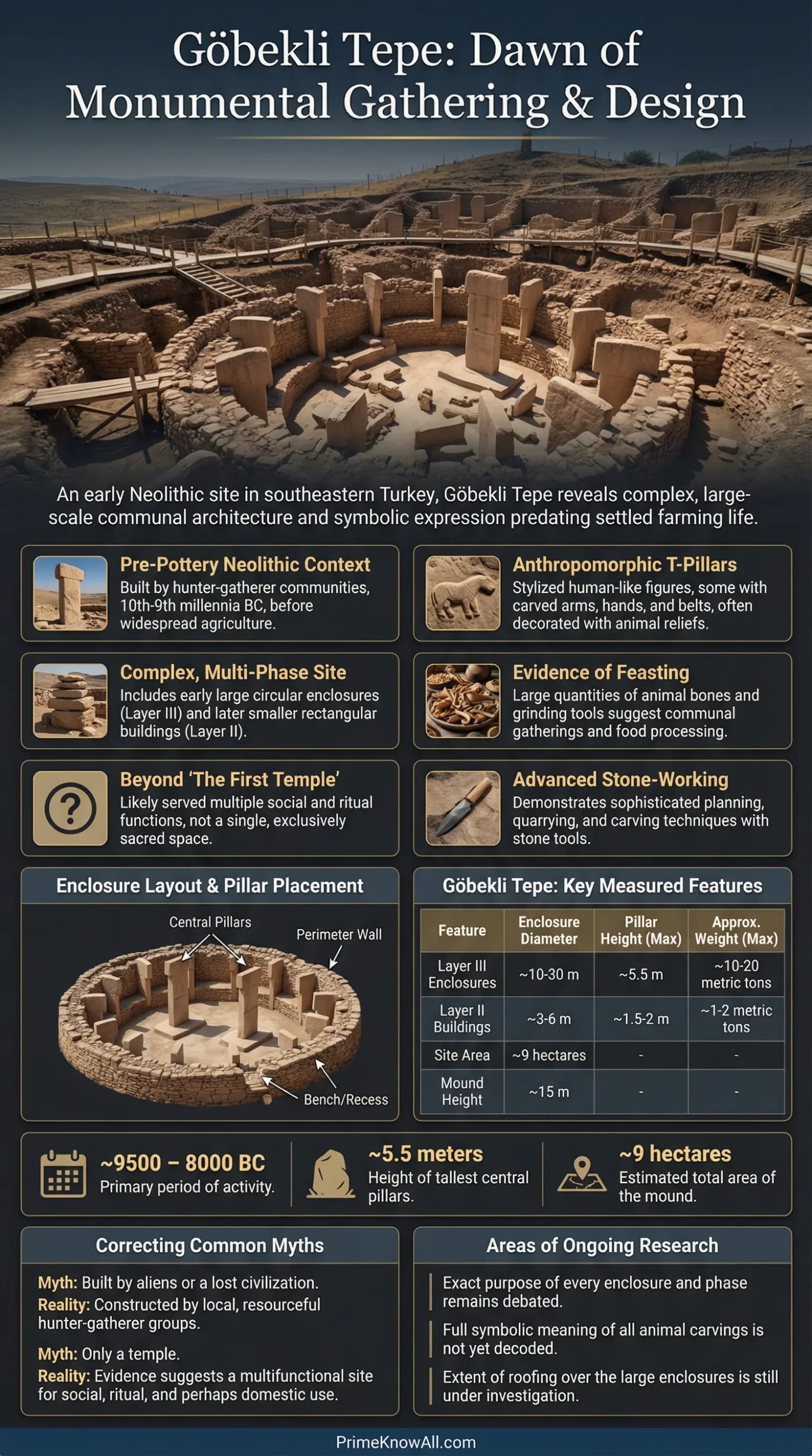
It is often flattened into the label “the first temple”, yet the site is wider than that. Göbekli Tepe is better understood as a place where architecture, symbolic imagery, food work, gathering, and social coordination met each other very early in the Neolithic.
If You Remember One Thing
Göbekli Tepe matters because it records organized design before fully developed village life was firmly in place. The site is not just old stone. It is early evidence that people could plan, coordinate labor, and fill architecture with shared meaning on a very large scale.
What To Keep in Mind First
- UNESCO describes Göbekli Tepe as “one of the first manifestations of human-made monumental architecture”.
- Some pillars reach about 5.5 meters in height, and the best-known central pillars in Enclosure D weigh about 8 metric tons.
- Geophysical survey work suggests the mound may contain at least 20 enclosures, with more than 200 pillars projected across the site.
- The site includes more than one building phase: early round or oval enclosures and later smaller rectangular rooms.
- Recent research no longer treats Göbekli Tepe as a simple ritual-only label. Domestic traces, cereal processing, conservation work, and new reading of imagery all matter.
What Göbekli Tepe Is
Short answer: Göbekli Tepe is an early Neolithic mound built and used by communities in Upper Mesopotamia, with monumental stone enclosures that changed how archaeologists think about the relationship between architecture, ritual, and early social life.
- Pre-Pottery Neolithic, meaning the early part of the Neolithic before pottery became common.
- Megalithic, meaning built with very large stones.
- Anthropomorphic, meaning shaped to suggest a human body.
The site sits on a man-made mound roughly 300 meters across, up to about 15 meters high, covering around 9 hectares, according to research published in the Cambridge Archaeological Journal. That scale matters because the whole mound is not a natural hill with a few stones on top. It is a built archaeological deposit, layer over layer.
UNESCO places the site in the 10th and 9th millennia BC and describes the early structures as monumental communal buildings raised by groups still close to hunter-gatherer lifeways. That wording is useful. It is more careful than the popular one-word label temple, and it leaves room for social and ritual functions to overlap rather than compete.
Why Göbekli Tepe Changed Archaeology
Short answer: Göbekli Tepe challenged the old neat sequence that went something like this: farming first, villages next, monuments later. The site suggests that large shared building projects could come very early, before that story had fully settled into place.
- It pushed archaeologists to rethink what hunter-gatherer groups could organize.
- It put symbolic architecture earlier in the timeline than many expected.
- It made the rise of farming look less like a single straight line and more like a regional process with overlap.
Older public summaries often framed the site as proof that religion created civilization. That is too tidy. Göbekli Tepe does not settle every question about why farming, settlement, and social hierarchy developed. What it does show, very clearly, is that collective labor and formal building were already possible on a startling scale.
This is one reason the site still appears in documentaries, museum writing, and viral history posts. Many of those posts focus on the age comparison with Stonehenge. That comparison is useful for scale, but it misses the more interesting point: the design logic at Göbekli Tepe is early, deliberate, and socially demanding.
What Matters Here
- Göbekli Tepe did not erase farming from the story. It made the story less linear.
- The real shock is not just age. It is the mix of planning, labor, and symbolism.
- Popular headlines usually simplify the site more than the archaeology does.
How the Architecture Works
Short answer: Göbekli Tepe is not a single circle of stones. It is a multi-phase architectural site with early round or oval enclosures, later rectangular rooms, carved pillars, built walls, and deliberate backfilling.
- Layer III: earlier large curving enclosures.
- Layer II: later, smaller, usually rectangular rooms.
- T-pillars: both structural and symbolic, not just supports.
The early monumental phase is the part most people know: large enclosures with paired central pillars surrounded by smaller T-shaped monoliths set into walls. UNESCO notes that some pillars are up to 5.50 meters tall. On the German Archaeological Institute project page, Enclosure D is described as the largest and best preserved, with two central pillars about 5.5 meters high and about 8 metric tons each.
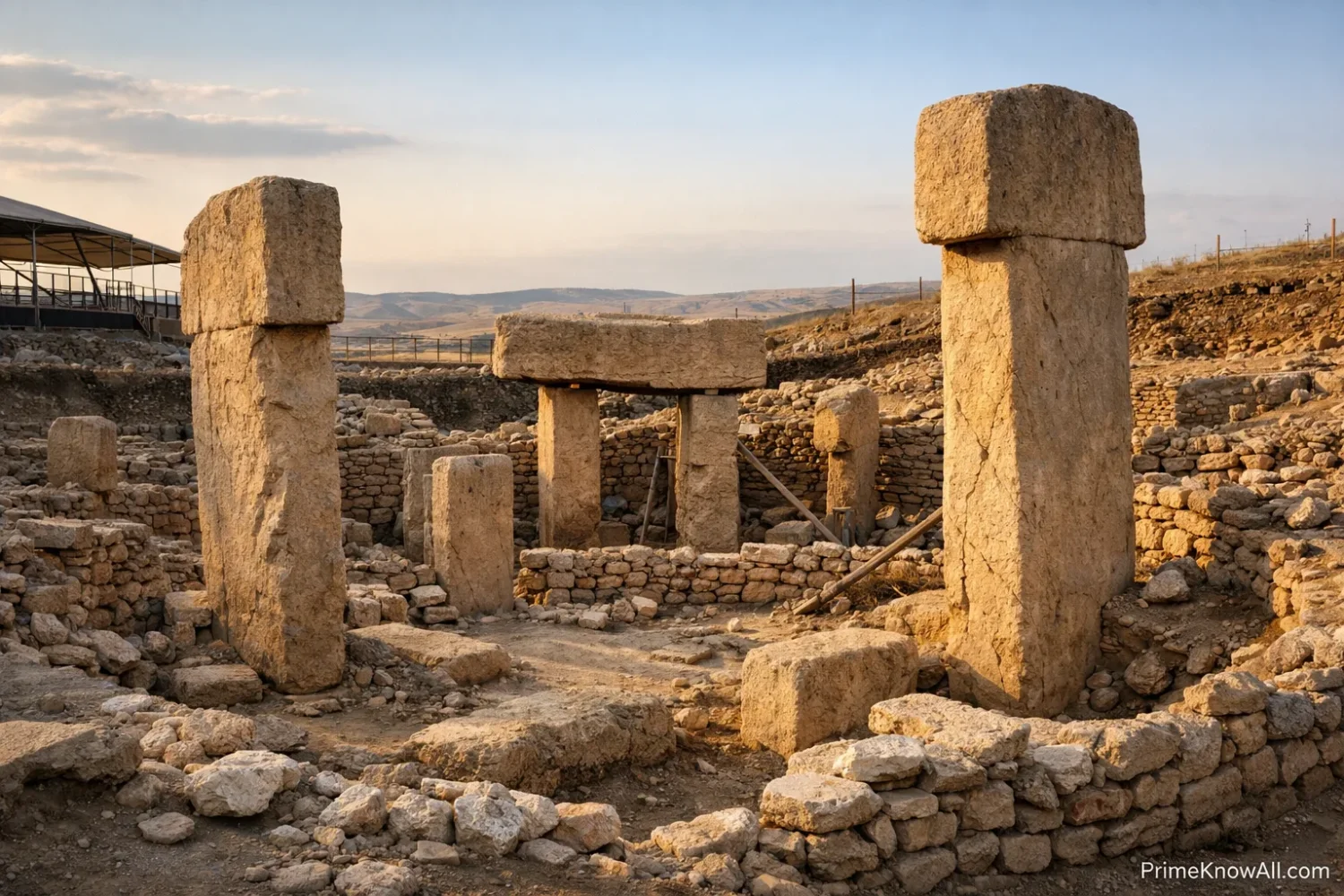
The later phase matters just as much. Smaller rectangular buildings show that Göbekli Tepe was not frozen in one architectural idea. Plans changed. Scale changed. The site developed through time, which is one reason any single label can mislead.
| Feature | Current Reading | Why It Matters |
|---|---|---|
| Date | 10th-9th millennia BC | Places the main monumental phase very early in the Neolithic sequence. |
| Mound Size | About 300 m across, up to 15 m high, around 9 ha | Shows the site is a large built mound, not a small isolated stone circle. |
| Pillars | Some up to 5.5 m tall | Confirms true monumental scale. |
| Best-Known Central Pillars | About 5.5 m tall and about 8 metric tons | Indicates advanced quarrying, transport, and erection work. |
| Hidden Architecture | At least 20 enclosures suggested by geophysics | Only a small part of the mound has been opened so far. |
| Building Sequence | Early curving enclosures, later smaller rectangular rooms | Shows long use and changing architectural choices. |
How People Likely Built It
Short answer: The builders used the nearby limestone plateau as a quarry, shaped pillars close to the source, laid out enclosures with more planning than earlier summaries allowed, and probably mobilized labor through repeated collective gatherings.
- Quarry first: the surrounding plateau preserves quarry traces and unfinished elements.
- Layout next: walls, central pillars, and perimeter stones were placed in relation to each other.
- Backfill later: many early enclosures were deliberately filled in, not simply left to collapse.
The UNESCO evaluation file records quarry traces, channels, cisterns, and unfinished or abandoned pillars on the limestone plateau. That matters because it places stone extraction and construction logistics in the same landscape. These people were not hauling mystery stones from a remote mountain. They were working a local stone resource with care.
A 2020 Cambridge Archaeological Journal study argued that Enclosures B, C, and D may have been planned as one project, not as unrelated circles added one by one. That point is easy to miss in popular retellings. If the argument is right, the site shows a stronger level of design control than a casual “people stacked stones over time” reading suggests.
A helpful analogy is this: think less of Göbekli Tepe as a lone shrine and more like a purpose-built gathering ground prepared before a settled neighborhood around it became fixed in the way later villages would. The analogy is not exact, but it helps. It shifts attention from a single sacred room to a place designed for repeated shared action.
Pause Here
- The site preserves evidence for quarrying, not just finished monuments.
- Some enclosures may belong to a single planned design, which changes how labor is imagined.
- Backfilling was part of the site’s life cycle, not just an accident.
What the Pillars Are Doing
Short answer: The pillars are architecture, images, and human-like presences at the same time. They hold up space, define it, and load it with meaning.
- Animals: snakes, foxes, boars, birds, gazelles, wild asses, and predators appear again and again.
- Human traits: some pillars show arms, hands, belts, and loincloths.
- Abstract marks: disks, crescents, H-shapes, and other signs complicate simple readings.
The DAI project page makes an important point: the central T-pillars in Enclosure D are not just posts. Their shapes, arms, and clothing details make them read as pillar-statues. In other words, the architecture itself may have been meant to suggest standing beings.
The carvings are also not a random animal catalog. Species cluster in ways that may relate to enclosure identity, memory, danger, status, or storytelling. A new 2026 DAI publication announcement focused entirely on the imagery of the pillars, which says something simple but useful: the images are still being actively re-read, not treated as solved decoration.
That is why the visual side of Göbekli Tepe deserves more than a passing note. The site is not just stone engineering. It is also a place where symbolic design was carved into structure itself.
Temple, Meeting Place, or Settlement?
Short answer: The safest answer is that Göbekli Tepe was a monumental communal site whose uses likely included ritual and social gatherings, while newer evidence makes a strict “ritual-only” reading harder to defend.
- Older public label: first temple.
- More careful reading: communal buildings with ritual and social uses.
- Current caution: function may have changed from phase to phase.
The famous temple label became popular for a reason. The site is visually dramatic, the pillars are unusual, and there are no obvious domestic rooms in the earliest monumental core that look like ordinary houses. Still, newer work has widened the picture. UNESCO’s site description notes that non-monumental structures interpreted as domestic remains have also been identified.
That does not mean the earlier ritual reading was wrong in every detail. It means the site probably should not be reduced to a single function. A place can host feasting, memory work, seasonal gathering, food processing, and symbolic acts without looking like a later town square or temple complex.
So Far, So Clear
- “First temple” is memorable, but it is narrower than the present evidence.
- Architecture and imagery point to special communal use.
- Domestic traces mean ritual and daily life may have overlapped more than older summaries admitted.
What Daily Life Adds to the Picture
Short answer: Daily-life evidence matters because it anchors the site in work, food, and repeated occupation, not just spectacle.
- Cereal processing is part of the story.
- Grinding tools appear in unusual numbers.
- Animal bone deposits point toward shared food events.
A peer-reviewed study on cereal processing analyzed more than 7,000 artifacts and argued that many grinding tools were used to process cereals. The study also notes that it remains uncertain whether those cereals were wild or cultivated. That uncertainty is helpful. It keeps the site in the real zone of archaeology, where evidence often sharpens one issue while leaving another open.
Animal remains in backfill deposits are often linked to feasting or large food events. That reading fits a gathering place better than a purely secluded shrine. It also helps explain how labor may have been organized: food, repetition, and shared display can bind communities together long before written institutions exist.
The result is a more grounded picture. Göbekli Tepe was not only a gallery of carved animals. It was also a place where people worked stone, processed food, and probably returned often enough to reshape the site through time.
Common Misreadings
Short answer: Most misunderstandings come from trying to force Göbekli Tepe into one dramatic headline instead of reading it as a long-lived site with changing uses and open questions.
- Wrong: Göbekli Tepe was built by a lost advanced civilization. Better reading: the evidence points to local Neolithic communities with high skill and social coordination. Why the mix-up happens: people often confuse early dates with impossible technology.
- Wrong: It proves farming had already fully matured before monuments appeared. Better reading: the site complicates the farming timeline rather than settling it in one direction. Why the mix-up happens: older textbook models were simple, and simple models spread fast.
- Wrong: The pillars are only structural posts. Better reading: several pillars are clearly anthropomorphic, with arms, hands, belts, and clothing details. Why the mix-up happens: architecture and imagery are often separated in modern thinking, but not always in prehistory.
- Wrong: Every part of the site had the same purpose. Better reading: different enclosures and building phases may have served different social roles. Why the mix-up happens: people see one famous photo and assume one frozen function.
- Wrong: Archaeologists already know exactly what every symbol means. Better reading: many interpretations remain open, and some new claims are still under debate. Why the mix-up happens: image-heavy sites invite certainty long before certainty is earned.
Read This Before Moving On
- One photo of Enclosure D cannot stand in for the whole mound.
- Age alone does not explain the site. Design, sequence, and use matter just as much.
- The best reading is careful, layered, and willing to leave some things open.
Why the Site Still Changes
Short answer: Göbekli Tepe keeps changing because excavation is partial, conservation work continues, and each new study asks a different question about the same stones.
- Building damage: recent work studies prehistoric earthquake effects.
- Imagery: cataloguing and interpretation continue.
- Sky-reading claims: some new proposals are interesting but not settled.
A 2024 article in Archaeological Research in Asia examined damage patterns and repairs linked to seismic activity. That kind of study moves beyond the old question “What was the site for?” and asks how architecture behaved under stress, how people repaired it, and how durable monumental building really was in the early Neolithic.
Another live debate concerns astronomy and timekeeping. A 2024 paper connected some carvings to a possible calendar system. It is worth noting because it shows how lively interpretation remains. It is also worth handling carefully because proposal is not the same as consensus.
Meanwhile, UNESCO notes that the site’s integrity can be affected by future infrastructure and rising visitor pressure. Fame helps preservation funding, but it also brings new strain. That tension is now part of Göbekli Tepe’s story too.
What Remains Unclear
Short answer: Archaeologists know a great deal about Göbekli Tepe’s architecture and chronology, yet some of the most human questions still resist a final answer.
- Exact function: no single label fully explains every enclosure.
- Roofing: whether all monumental spaces were roofed is still debated.
- Symbol meaning: many carvings are still not securely decoded.
- Life sequence: the relation between domestic spaces and monumental buildings is still being refined.
- Astronomical readings: some recent claims remain open to challenge.
This is the honest limit of any clear explanation. Archaeology can measure stone, sequence layers, compare motifs, and test wear traces. It cannot always tell exactly what a gathering felt like, how often a symbol changed meaning, or whether one enclosure’s social role matched the next one’s.
That does not weaken the site. It makes the evidence more real. Göbekli Tepe is powerful partly because it is legible in structure and stubborn in meaning.
The Safest Reading
- Talk with confidence about date, scale, pillars, and building phases.
- Talk with caution about exact purpose and every symbolic reading.
- When a claim sounds too neat, it usually is.
How This Makes Sense in Ordinary Terms
Short answer: A few ordinary comparisons make the site easier to place without shrinking its complexity.
- A festival ground built before a fixed town center: people may create a shared gathering place before dense everyday settlement becomes permanent. Why this fits: communal action can come earlier than later urban-style planning.
- A landmark everyone in a region knows, even if they do not live beside it: a place can anchor identity across groups. Why this fits: the site’s scale suggests it mattered beyond a single household.
- A building whose decoration is part of the structure, not added later: think of a doorway carved to shape behavior, not just impress the eye. Why this fits: the pillars do visual and spatial work at once.
- A place where food and ceremony meet: large gatherings are easier to organize when meals, memory, and display happen together. Why this fits: grinding tools and animal remains make social eating hard to ignore.
- A headline that hides the better story: “older than Stonehenge” is catchy, but design and planning are the real lesson. Why this fits: age draws attention; architecture explains why the site changed the field.
- A famous site that becomes harder to protect after it becomes famous: tourism can help and strain the same place at once. Why this fits: heritage management is now part of the archaeology.
Göbekli Tepe in One Vertical View
Vertical Summary A clean way to see how the site fits together.
1. Place and Date
Near Şanlıurfa in southeastern Türkiye, in Upper Mesopotamia. Main monumental phases belong to the 10th-9th millennia BC.
2. Built Form
Early round or oval enclosures with T-pillars came first. Later phases added smaller rectangular rooms.
3. Stone Scale
Some pillars reach about 5.5 m. Enclosure D’s central pair weighs about 8 metric tons each.
4. Design Logic
Quarries, layout, walls, pillar placement, and possible geometric planning all point to organized construction, not casual stone setting.
5. Imagery
Snakes, foxes, boars, birds, belts, hands, and abstract signs show that the pillars carry visual meaning as well as architectural weight.
6. Daily-Life Signals
Grinding tools, cereal-processing evidence, and animal bone deposits connect the site to food work and large gatherings.
7. What Is Still Open
Exact function, full symbol meaning, roofing, and some recent sky-reading claims remain under debate.
8. Best One-Line Reading
Göbekli Tepe is early monumental architecture built by late hunter-gatherer communities, with design, imagery, and social gathering fused into the same place.
Quick Test
Short answer: These brief checks help lock in the ideas that matter most.
Did Göbekli Tepe appear only after fully developed farming villages were already normal in the region?
No. That is exactly why the site became so famous. It shows large planned monuments appearing very early, while the relation between monument building and fully settled farming life was still being worked out.
Are the T-shaped pillars only structural supports?
No. Several pillars are read as anthropomorphic pillar-statues because they show arms, hands, belts, and clothing details. They shape space and meaning at the same time.
Does the label “first temple” fully explain the site?
Not really. It captures the site’s special communal and symbolic side, but it is too narrow to cover newer evidence for domestic traces, food work, and changing building phases.
Why do archaeologists care about grinding tools at a monumental site?
Because food evidence brings people back into the picture. Monumental building did not happen in a vacuum. It depended on labor, repeated visits, and likely large shared meals.
Why do new papers still keep shifting the conversation?
Because only part of the mound has been excavated, and each study asks a new question. One paper may focus on geometry, another on seismic damage, another on imagery or cereal processing.
Göbekli Tepe matters because it joins stone, image, food, and group labor in one very early place. Read carefully, it is less a single mystery word and more a record of how people learned to gather, plan, carve, and remember together. The most common mistake is to force it into one label such as temple, city, or observatory. A good rule to keep is simple: treat each enclosure, each phase, and each new study as part of a moving picture, not a frozen headline.
Sources
- UNESCO World Heritage Centre – Göbekli Tepe — Official site entry with the formal description, chronology, and protection context. Why reliable: UNESCO publishes the recognized heritage record used worldwide for the site.
- UNESCO / ICOMOS Evaluation – Göbekli Tepe (Turkey) No 1572 — Topic-specific evaluation with notes on excavation, geophysics, quarry traces, backfilling, and site integrity. Why reliable: it is an official assessment document prepared for World Heritage review.
- German Archaeological Institute – The Site — Project page describing Enclosure D, pillar size, anthropomorphic reading, and current research context. Why reliable: it comes from the institution directly involved in field research.
- German Archaeological Institute – Geophysical Surveys at Göbekli Tepe — A focused explanation of how geophysics supports estimates for hidden enclosures and pillar numbers. Why reliable: it reports project-based survey results from the excavation team’s own research platform.
- Cambridge Archaeological Journal – Geometry and Architectural Planning at Göbekli Tepe, Turkey — Peer-reviewed paper on site size, layout, and the proposal that Enclosures B–D may have been planned together. Why reliable: it is a peer-reviewed academic study in a respected archaeology journal.
- PLOS ONE / PMC – Cereal Processing at Early Neolithic Göbekli Tepe, Southeastern Turkey — Article on grinding tools and cereal-processing evidence. Why reliable: it is a peer-reviewed open-access study with methods and artifact discussion visible in full.
- Archaeological Research in Asia – Shaking up the Neolithic: Tracing Seismic Impact at Neolithic Göbekli Tepe — Paper on damage patterns, building response, and prehistoric seismic activity. Why reliable: it is a recent peer-reviewed article that deals with one narrow question in detail.
- German Archaeological Institute – The Imagery of the Monumental Pillars of Göbekli Tepe — 2026 research update tied to new publication on pillar imagery. Why reliable: it comes from the same research institution that has long worked at the site.
- Encyclopaedia Britannica – Göbekli Tepe — A reference overview useful for broad orientation and date comparison in public history discussions. Why reliable: Britannica is a long-standing editorial reference source, though it is best paired with official and academic material.
FAQ
What is Göbekli Tepe?
Göbekli Tepe is an early Neolithic archaeological site in southeastern Türkiye known for its monumental stone enclosures and T-shaped pillars. It was built by communities living in the Pre-Pottery Neolithic period, long before later famous stone monuments in Europe.
Why is Göbekli Tepe so important?
It shows that people could organize large-scale building, symbolic carving, and communal gathering very early in human history. That changed older ideas about when monumental architecture became possible.
Was Göbekli Tepe really the first temple?
That phrase is popular, but it is too narrow to capture the full evidence. Many archaeologists now prefer more careful terms such as monumental communal buildings, because ritual, social, and everyday activities may have overlapped at the site.
How old is Göbekli Tepe compared with Stonehenge?
Göbekli Tepe is many millennia older. Its main monumental phases belong to the 10th and 9th millennia BC, while Stonehenge began much later in the 3rd millennium BC.
Who built Göbekli Tepe?
The site was built by early Neolithic communities in Upper Mesopotamia, not by a lost advanced civilization. The evidence points to highly capable local groups working with stone, food resources, and shared labor on a large scale.
Why is Göbekli Tepe still debated?
Only part of the mound has been excavated, and different studies focus on different questions such as planning, symbolism, food processing, damage, and conservation. That keeps interpretation active and prevents one final simple answer.