Etruscan cities combined practical urban design with religious ideas, local terrain, water control, and civic organization. Some settlements, especially planned centers such as Kainua at Marzabotto, used broad streets, right-angle intersections, defined urban blocks, sanctuaries, workshops, and drainage as parts of one ordered layout.
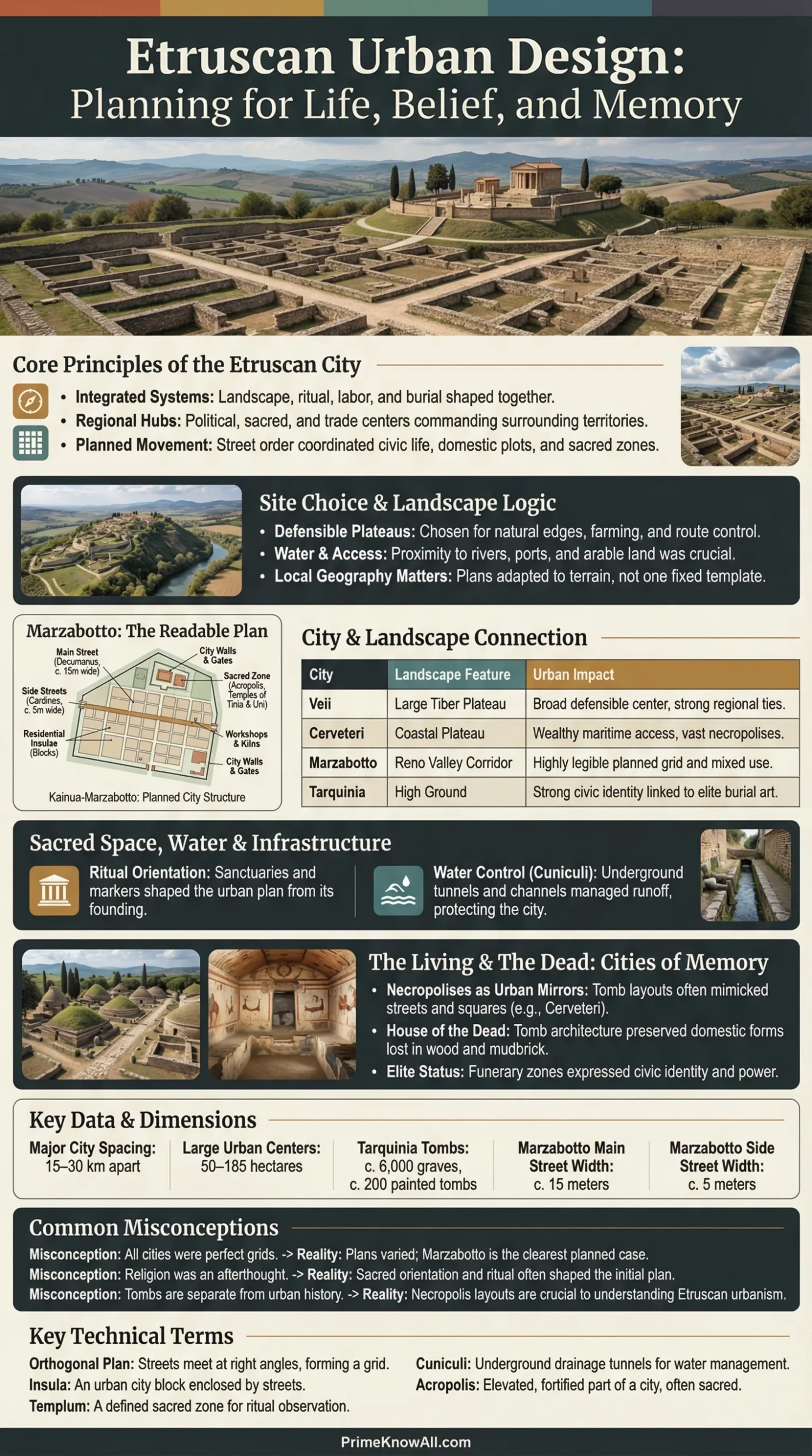
There was no single plan copied across every Etruscan city. Topography often decided what was possible, especially in older settlements on defensible plateaus. Regular grids appear most clearly where planners had room to organize a new or reorganized settlement. Religion also shaped decisions about orientation, boundaries, and sacred spaces.
- Terrain came first in many long-lived hill and plateau settlements.
- Orthogonal streets were used in some planned cities, especially Kainua.
- Sacred orientation could be tied directly to surveying and city foundation rites.
- Drainage, workshops, homes, and movement routes were organized within the urban fabric rather than treated as separate systems.
- Necropolises belonged to the wider city landscape and can preserve clues that the inhabited areas have lost.
How Etruscan Cities Were Planned
Etruscan urban planning was a balance between landscape and imposed order. Archaeology shows both irregular settlements molded by natural ground and deliberately measured plans with straight streets and rectangular blocks.
Terrain Before Geometry
Many Etruscan communities occupied plateaus, ridges, and naturally protected high ground. These locations made defense easier and could control routes through valleys, river corridors, or surrounding agricultural land. A hilltop did not always allow a clean rectangular street network, so roads often followed the shape of the terrain.
This helps explain why the famously regular plan of Marzabotto should not be treated as a template for every Etruscan city. Archaeological study of other centers shows that older urban landscapes could be far less geometric.
| Site | Urban Evidence | What It Shows |
|---|---|---|
| Kainua-Marzabotto | Orthogonal streets, blocks, houses, workshops, sanctuaries, drainage, necropolises | The clearest surviving example of a deliberately organized Etruscan city plan |
| Veii | Roads, residential sectors, sanctuary areas, irregular terrain | Planning could exist without imposing one regular grid over an entire old city |
| Cerveteri | Urban remains plus the street-like organization of Banditaccia | Burial areas could echo house forms, streets, neighborhoods, and social organization |
| Tarquinia | Plateau settlement and the vast Monterozzi necropolis | The city extended conceptually beyond its occupied center into a carefully used funerary landscape |
| Vetulonia | Irregular streets and infrastructure adapted to sloping terrain | Etruscan urbanism could be practical and organized without a perfect grid |
Street Grids and Urban Blocks
Where conditions allowed formal planning, Etruscan builders could create a clear hierarchy of streets. Kainua, the ancient city preserved at modern Marzabotto near Bologna, provides the strongest archaeological evidence.
The city occupied the Pian di Misano and the nearby Misanello height from roughly the end of the sixth century BCE to the middle of the fourth century BCE. Because later urban development did not completely cover the ancient settlement, its street network can still be traced across the archaeological park.
The Marzabotto Plan in Numbers
The organized phase of Kainua used one major north-south line crossed by major east-west routes. Archaeological descriptions give an unusually clear sense of scale:
- Main streets were about 15 meters wide.
- Secondary streets were about 5 meters wide.
- Major routes met at right angles.
- The street network divided the settlement into elongated urban blocks.
- Drainage channels ran alongside streets and between properties.
The width difference was useful. Large streets handled movement through the settlement and connected important zones, while narrower routes divided blocks into smaller units. Street hierarchy therefore affected both circulation and property organization.
A useful comparison: a planned Etruscan city worked somewhat like a sheet of graph paper placed over real land. The large lines established orientation and movement; smaller lines divided usable space. Unlike graph paper, though, the pattern still had to accommodate terrain, ritual requirements, drainage, existing activity, and differences between households.
Sacred Orientation Was Part of City Design
Religion was not confined to temples after the streets had already been laid out. At Kainua, evidence connects surveying, orientation, sacred areas, and foundation practices closely enough that they need to be studied together.
An important term is templum. In the ritual sense, it could describe a defined and oriented sacred space rather than simply a temple building. Etruscan religious thought linked divisions observed in the sky with marked divisions on the ground. Later Roman writers preserved parts of this tradition, although their accounts must be used carefully because the original Etruscan ritual texts have not survived.
Cardinal Directions at Kainua
The organized plan at Kainua was closely aligned with the cardinal directions. Archaeological research has also identified marked stones connected with the city’s orientation. One central marker remains especially useful for reconstructing how measurement and foundation ritual may have worked together.
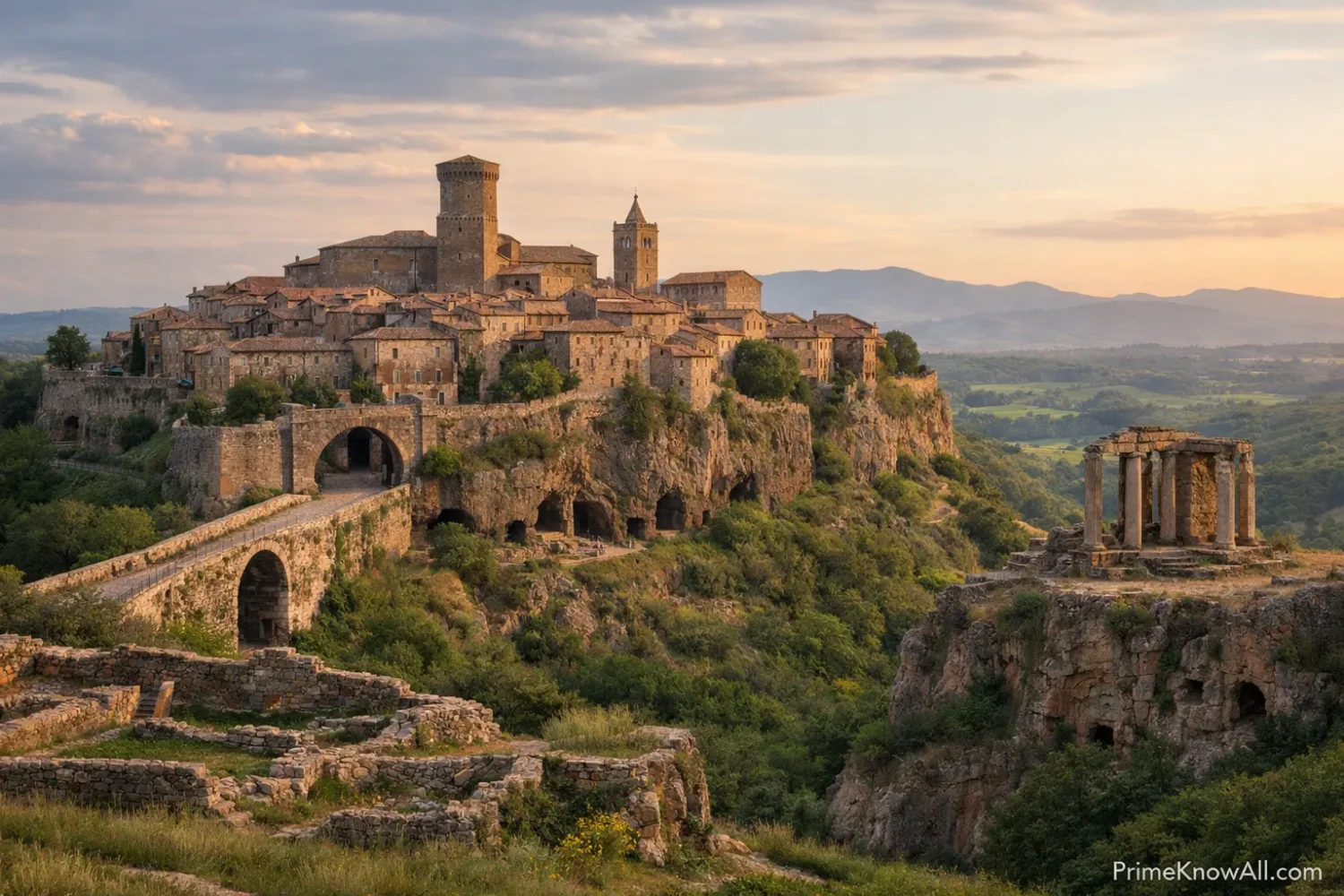
The relationship should not be reduced to the idea that every Etruscan street was chosen through astronomy. Kainua is unusually clear evidence from a planned settlement. Older cities could retain streets shaped by centuries of occupation and difficult ground.
Greek Influence Did Not Produce a Simple Copy
Right-angle planning was also used in Greek cities, and archaeologists have long discussed Greek influence on more elaborate Etruscan grids. The evidence supports contact and exchange, especially in settlements connected to wider Mediterranean trade.
Yet similar geometry does not mean identical urban ideas. At Kainua, the regular street system was combined with specifically Etruscan practices involving orientation, sacred boundaries, and foundation rites. Greek planning experience and Etruscan religious concepts could therefore meet in the same city.
What the 2026 Kainua Discovery Adds
Research at Kainua is still changing the picture. On August 4, 2026, the University of Bologna reported results from its thirty-ninth excavation campaign, including a ritual well in the urban sacred area associated with the goddess Uni.
Archaeologists recovered two bronze female statuettes and a rare bronze plate from the well. The finds were interpreted in connection with ritual activity surrounding the sacred area and the early life of the city. Human remains were also found within the feature and remain part of ongoing scientific study.
The discovery matters for urban history because it gives physical evidence that water installations, worship, and the establishment of urban space could overlap. It strengthens an interpretation already suggested by the street plan and sanctuaries: civic organization at Kainua was not purely an engineering exercise.
- The well stood within an urban sacred zone, not in an isolated rural setting.
- Its contents indicate a use beyond ordinary water storage.
- The find connects physical infrastructure with ritual activity during the city’s development.
Water and Drainage Shaped the Streets
Water management was a practical requirement in Etruscan settlements. Roads, houses, courtyards, roofs, slopes, and workshops all changed how rainwater moved, so drainage had to be considered while land was divided and built upon.
At Marzabotto, channels associated with streets and property divisions carried water away from occupied areas. At other Etruscan sites, builders cut channels into soil or rock and used underground passages where local geology and drainage problems called for them.
Why Drainage Belonged to Urban Planning
- Road surfaces needed water to leave rather than collect in travel routes.
- House plots had to deal with runoff from roofs and courtyards.
- Work areas needed usable ground even after rain.
- Sloping settlements had to control erosion and fast-moving surface water.
- Cisterns and channels could collect or redirect water where appropriate.
The exact system differed from city to city. It is safer to speak of an Etruscan habit of adapting water control to local conditions than to imagine one standardized drainage network used everywhere.
Walls, Gates, and Natural Defense
Etruscan planners frequently gained protection from the landscape before adding artificial defenses. Steep plateau edges, river valleys, and ridges could reduce the number of easy approaches to a settlement.
Where extra protection was needed, communities constructed walls, embankments, ditches, and controlled entrances. The resulting plan depended heavily on geology. Stone was more useful for foundations and defensive works than for the complete upper structure of every building.
Gates Connected Defense With Movement
A gate was not simply a gap in a wall. It linked an internal street to regional roads, farmland, burial grounds, neighboring settlements, and trade routes. This made entrances both defensive points and parts of the transport network.
Road alignment can therefore provide clues about lost gates, while gates can help archaeologists reconstruct roads that no longer survive clearly on the ground. The relationship is especially useful at sites altered by later construction.
Homes and Workshops Shared the Urban Fabric
Etruscan urban blocks were not composed only of identical houses. Excavations at Marzabotto show different property sizes, domestic arrangements, open courts, and productive spaces within the ordered street plan.
Research on the formalized city has identified plots of roughly 630 to 900 square meters in studied areas. Some units contained an atrium-style house, while others included several structures organized around an open-air court. A regular street network therefore did not erase differences in wealth, household organization, or use.
Work Was Visible Inside the City
Archaeological evidence at Kainua includes craft and production areas alongside residential and sacred zones. That arrangement makes the settlement easier to understand as an active economic center rather than a collection of monuments.
Metalworking, ceramic production, storage, domestic labor, trade, worship, and movement all needed space. Their placement affected traffic, access to water, fire risk, raw-material delivery, and the relationship between work and home.
Necropolises Extended the Urban Landscape
One of the most distinctive features of Etruscan archaeology lies outside the inhabited center. Necropolises can reproduce architectural and spatial ideas found in the cities of the living, sometimes preserving them more clearly than the settlements themselves.
Cerveteri Preserves a City-Like Cemetery
The Banditaccia necropolis at Cerveteri contains thousands of tombs arranged with streets, smaller open spaces, and neighborhood-like groups. UNESCO describes the site as preserving planning and architectural schemes comparable with those of an Etruscan city.
The UNESCO property at Banditaccia covers 197.57 hectares. Some tombs imitate houses so closely that carved architectural details preserve information about domestic space that has disappeared from many actual residential areas.
Tarquinia Preserves Another Kind of Evidence
The Monterozzi necropolis at Tarquinia covers 129.36 hectares within the UNESCO property. It contains about 6,000 rock-cut graves, including roughly 200 painted tombs.
Those paintings are better known for scenes of social and ritual life than for street planning, but they help reconstruct the people who used the city: clothing, furniture, dining, music, movement, ceremony, and elite display. Urban archaeology is stronger when this social evidence is read alongside walls and road foundations.
An Etruscan City Was Connected to Its Territory
The occupied center depended on land beyond its streets. Farms supplied food, roads moved people and goods, rivers opened transport corridors, and cemeteries occupied selected areas outside residential space. Smaller settlements and rural sites also formed part of the political and economic territory controlled by major centers.
This wider view helps explain why site location mattered so much. A plateau could offer protection, but planners also needed access to agricultural ground and routes that connected inland communities with other Etruscan centers and Mediterranean exchange networks.
How the Design Worked on the Ground
The principles become clearer when individual urban problems are considered as practical situations.
- A cart enters Kainua from a main route. A broad primary street gives it more room than the narrow lanes dividing residential blocks, so the road hierarchy directs movement naturally.
- Rain falls across a dense neighborhood. Channels beside streets and property boundaries move runoff away, which helps keep circulation routes and building plots usable.
- A household needs both living and work space. A property can contain rooms, open areas, storage, and productive activity without changing the larger street grid around it.
- A public ritual moves between sacred areas. The placement of sanctuaries and major roads gives religious activity a physical place within civic space rather than separating it completely from daily life.
- A settlement occupies difficult high ground. Instead of forcing a perfect grid onto slopes and plateau edges, roads can follow terrain while natural drops strengthen defense.
- A community buries generations outside the inhabited center. Streets and groups of tombs organize the cemetery, while house-like tomb interiors preserve memories of domestic architecture.
Ideas About Etruscan Planning That Need More Care
Several simplified claims make Etruscan cities look more uniform than the archaeological record allows.
- Every Etruscan city had a perfect grid. Kainua provides unusually clear orthogonal planning, while many other settlements were shaped much more strongly by terrain and earlier occupation. The neatest surviving plan is easier to reproduce in books, which can make it seem universal.
- The Etruscans simply copied Greek city plans. Greek contact affected architecture and planning, but Kainua combines geometric organization with Etruscan ritual ideas and local choices. Similar street geometry does not prove identical cultural meaning.
- Religion and engineering were separate. Kainua shows that foundation rites, sacred areas, orientation, roads, and water features could occupy the same urban system. Modern categories can make these relationships look more separate than they were.
- A regular grid created identical households. Archaeological plots and houses vary in size and arrangement even where surrounding streets follow a controlled pattern.
- Necropolises tell only the story of burial. Cerveteri preserves street-like organization and house-shaped tombs, giving archaeologists rare evidence for architecture and spatial organization.
How an Etruscan City Held Together
1. Choose the Ground
Plateaus, ridges, valleys, rivers, routes, and nearby farmland shaped where settlement was practical.
2. Define Orientation and Boundaries
In planned centers such as Kainua, surveying and sacred concepts helped establish the direction and organization of urban space.
3. Establish Main Streets
Kainua’s main routes reached about 15 m in width and formed the large-scale structure of the settlement.
4. Divide the Blocks
Secondary streets of about 5 m helped separate narrower urban units containing homes, courts, and productive spaces.
5. Manage Water
Channels, slopes, cisterns, wells, and other drainage works kept streets and occupied plots usable.
6. Place Civic and Sacred Areas
Temples and sanctuaries formed part of the urban plan. At Kainua, the sacred sphere was closely tied to the organization of the city.
7. Connect Work and Exchange
Workshops, storage, domestic activity, regional routes, and movement through the streets supported the city’s economy.
8. Extend the City Into the Landscape
Necropolises, roads, agricultural land, and smaller settlements carried civic life beyond the residential center.
What Archaeology Still Cannot Show Clearly
Much of an Etruscan city was built with materials that survive poorly. Timber, mud brick, roofing systems, furnishings, upper walls, and repeated rebuilding can disappear while stone foundations remain. Later Roman, medieval, and modern occupation has also covered or altered many Etruscan centers.
This creates an uneven record. Marzabotto preserves enough of its plan to reveal streets and blocks, while other cities are known through fragments. Cerveteri may tell us more about house forms through tombs than surviving houses. Tarquinia offers exceptional painted evidence for social life but a different kind of evidence for urban layout.
There is also continuing debate over how much formal planning came through Greek contact and how much developed through local Italic and Etruscan practice. The safest reading allows more than one influence and avoids treating geometry alone as proof of cultural origin.
Etruscan urban design becomes easier to read once the grid stops being the whole story. Land, streets, sacred space, water, households, production, defense, and burial landscapes all affected the shape of a city, while the balance between them changed from one center to another.
Sources
- Italian Ministry of Culture – Museo Nazionale Etrusco “Pompeo Aria” and Kainua Archaeological Park. The national cultural authority documents Kainua’s occupation, preserved original urban layout, streets, houses, craft areas, and sacred buildings.
- University of Bologna – The Etruscan City of Kainua-Marzabotto. The university team responsible for modern excavations summarizes the settlement’s dates, reconstructed urban layout, houses, temples, workshops, and necropolises.
- University of Bologna – 2026 Ritual Well Discovery at Kainua. This university report records the August 2026 excavation results from the sacred area of Uni, including bronze objects and the ritual well.
- UNESCO World Heritage Centre – Etruscan Necropolises of Cerveteri and Tarquinia. UNESCO provides official property measurements, grave counts, painted-tomb data, and evidence for the city-like organization of Banditaccia.
- Cambridge University Press – Urban Form and the Concept of the City. This academic chapter reviews how archaeologists reconstruct Etruscan urban form and warns against relying on a narrow range of excavated evidence.
- Open-Access Academic Review – The Etruscans: Setting New Agendas. The research review discusses newer interpretations of Marzabotto, including earlier settlement phases, plot sizes, houses, workshops, and variation within the formal street plan.
- MIT Press – Orthogonal Town Planning in Antiquity: The Etruscan and Italic Cities. Ferdinando Castagnoli’s study remains a useful reference for comparing axial and orthogonal planning in Etruscan, Italic, and Greek contexts.
Questions About Etruscan City Planning
Did all Etruscan cities use a grid plan?
No. Marzabotto is an unusually clear example of orthogonal planning, but other Etruscan settlements developed on irregular terrain or retained older street patterns. A grid was one form of Etruscan urban organization, not a universal rule.
Why is Marzabotto important for Etruscan urban planning?
Ancient Kainua at Marzabotto preserves streets, blocks, houses, workshops, sacred areas, and cemeteries without a later city completely covering them. Its major streets were about 15 meters wide, while secondary streets were about 5 meters wide.
Were Etruscan cities planned according to religion?
Religious concepts affected planning in at least some well-documented cases. At Kainua, orientation, foundation practices, sacred areas, and the measured city plan are closely connected archaeologically. The evidence should not be applied automatically to every Etruscan settlement.
Did the Etruscans copy Greek city planning?
Greek influence probably contributed to some elaborate orthogonal layouts, but the relationship was not simple copying. Etruscan planners combined shared Mediterranean planning ideas with local terrain, religious practices, and their own civic needs.
How did Etruscan cities manage water?
Methods varied by site, but archaeological evidence includes street drains, channels, cisterns, wells, and underground water-control works. Drainage was especially important where dense construction or sloping ground changed natural runoff.
Why are Etruscan cemeteries useful for studying cities?
Some necropolises preserve spatial and architectural ideas that have disappeared from residential areas. At Cerveteri, Banditaccia contains streets, small open spaces, grouped tombs, and tomb interiors shaped like houses, making it unusually valuable for reconstructing Etruscan urban and domestic organization.