
Assyrian royal palaces were designed as controlled sequences of courtyards, gateways, halls, and decorated rooms in which architecture and carved reliefs worked together. Their stone panels showed kings, attendants, supernatural protectors, military campaigns, hunts, tribute, and royal ceremonies, while colossal lamassu guarded important entrances.
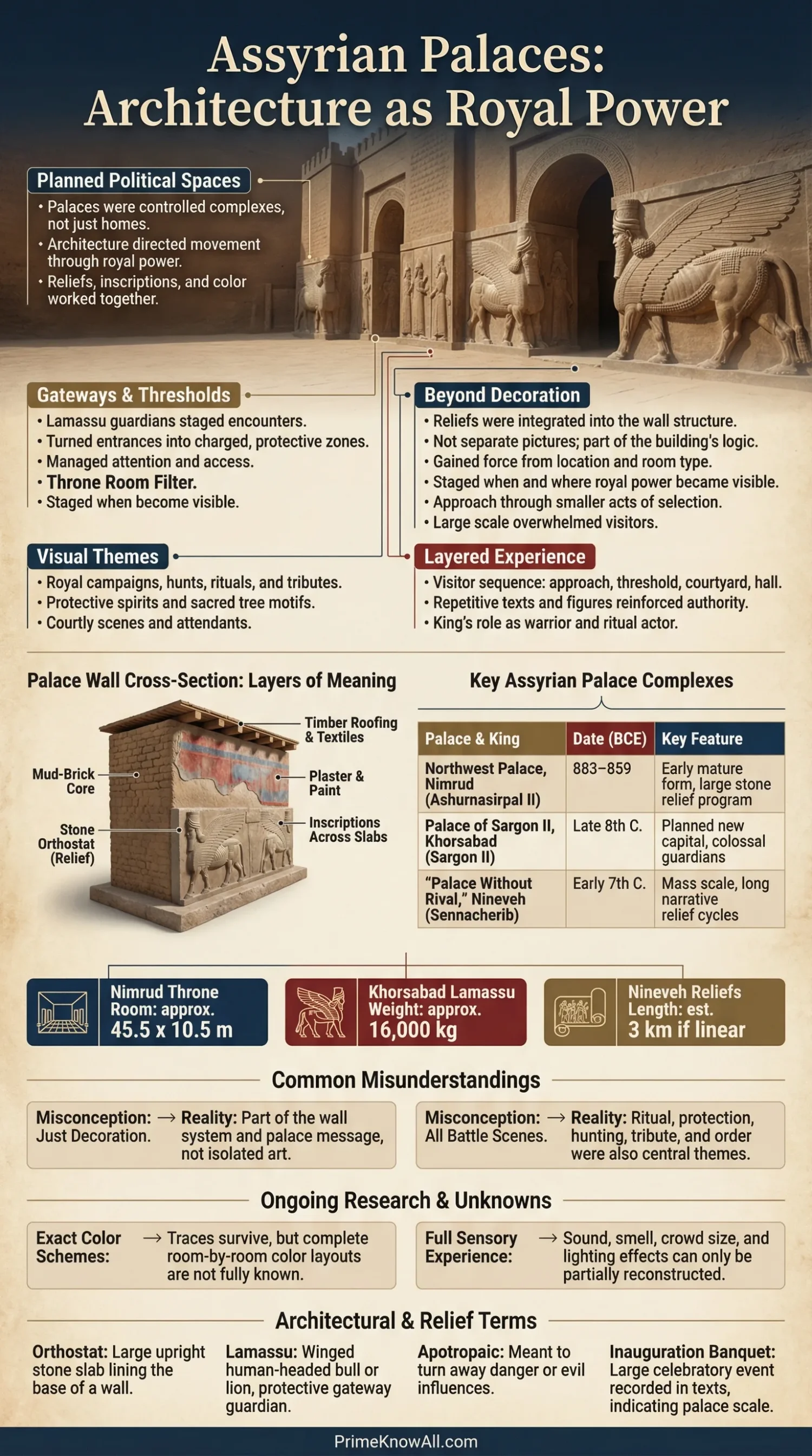
The best-known examples come from Nimrud, Dur-Sharrukin, and Nineveh, the three later capitals of the Neo-Assyrian Empire. Much of each palace was built from mud brick, but important walls were faced with carved gypsum slabs, and surviving evidence shows that many sculptures were originally colored rather than left as bare pale stone.
- Nimrud shows how monumental relief decoration became closely tied to palace planning under Ashurnasirpal II.
- Dur-Sharrukin used colossal gateways, long processions, painted reliefs, and carefully arranged royal spaces under Sargon II.
- Nineveh developed longer narrative scenes, including construction, military campaigns, and the famous lion hunts associated with Ashurbanipal.
- Doorways mattered as much as rooms. Large guardian figures and repeated protective imagery marked transitions between spaces.
How Assyrian Palaces Were Designed
Neo-Assyrian palaces were not single great halls. They were large compounds divided into zones, with open courtyards linking reception rooms, administrative areas, throne spaces, service rooms, and more restricted royal quarters.
The Northwest Palace of Ashurnasirpal II at Kalhu, modern Nimrud, covered about 28,000 square meters, or roughly seven acres. Its surviving plan was organized around three or four courtyards. The main throne room formed an important boundary between more public and more restricted parts of the palace.
That throne room was exceptionally long: archaeological documentation gives a length of about 47 meters and a width of more than 10 meters. Visitors did not simply enter the palace and immediately face the king. Movement through gates, courts, corridors, and reception spaces helped control access and shaped what each visitor encountered.
Think of the palace as a sequence of controlled zones rather than one enormous room. A modern airport offers a useful comparison: moving through one doorway can change who may enter, what rules apply, and what becomes visible. In an Assyrian palace, architecture, inscriptions, reliefs, and guardian sculptures marked these transitions instead of signs and security barriers.
| Palace Center | Royal Association | Architectural Character | Relief Emphasis |
|---|---|---|---|
| Kalhu / Nimrud | Ashurnasirpal II, later Assyrian rulers | Large courtyard palace with a long throne room separating major zones | Protective figures, sacred-tree scenes, royal ritual, hunts, campaigns, repeated inscriptions |
| Dur-Sharrukin / Khorsabad | Sargon II | Royal palace within a planned citadel, linked with temples and elite residences | Tribute, processions, hunting, court scenes, monumental lamassu, surviving traces of color |
| Nineveh | Sennacherib and Ashurbanipal | Large palace complexes with extensive suites of decorated rooms and courts | Campaign narratives, construction scenes, landscapes, sieges, and royal lion hunts |
Why Palace Walls Were Covered With Stone Reliefs
The carved slabs were part of the palace itself. They protected the lower portions of mud-brick walls while also turning major rooms into continuous visual environments filled with royal images, texts, supernatural figures, animals, plants, buildings, and landscapes.
Many panels were carved from gypsum, sometimes described as gypsum alabaster. This relatively soft stone allowed artists to cut shallow reliefs and then add remarkably fine details: beard curls, embroidery, feathers, horse equipment, tree bark, water, weapons, jewelry, and architectural forms.
The placement of a scene mattered. A campaign image in a throne room did not function exactly like a protective supernatural figure beside a doorway. Palace decoration was matched to architectural setting, so understanding a relief requires knowing where it originally stood whenever that information survives.
Stone was only one layer of the original interior.
- Many reliefs carried painted details that are now largely lost.
- Assyrian buildings also used wall painting, glazed brick, wood, metal fittings, textiles, and carved ivory.
- A modern museum gallery therefore shows only part of the visual effect that palace visitors once experienced.
The Northwest Palace at Nimrud
Ashurnasirpal II, who ruled from 883 to 859 BCE, transformed Kalhu into an imperial capital and built the Northwest Palace on its citadel. Work appears to have begun around 878 BCE, with the palace completed during the later part of his reign.
An inscription connected with the palace records an inauguration feast attended by 69,574 guests. The number comes from an Assyrian royal text rather than from a later estimate, making it unusually specific evidence for the scale at which Ashurnasirpal wanted the new capital to be presented.
The Throne Room
The long throne room, conventionally called Room B, was one of the palace’s central ceremonial spaces. Its relief program included the king, divine or supernatural imagery, and narrative scenes connected with royal activity.
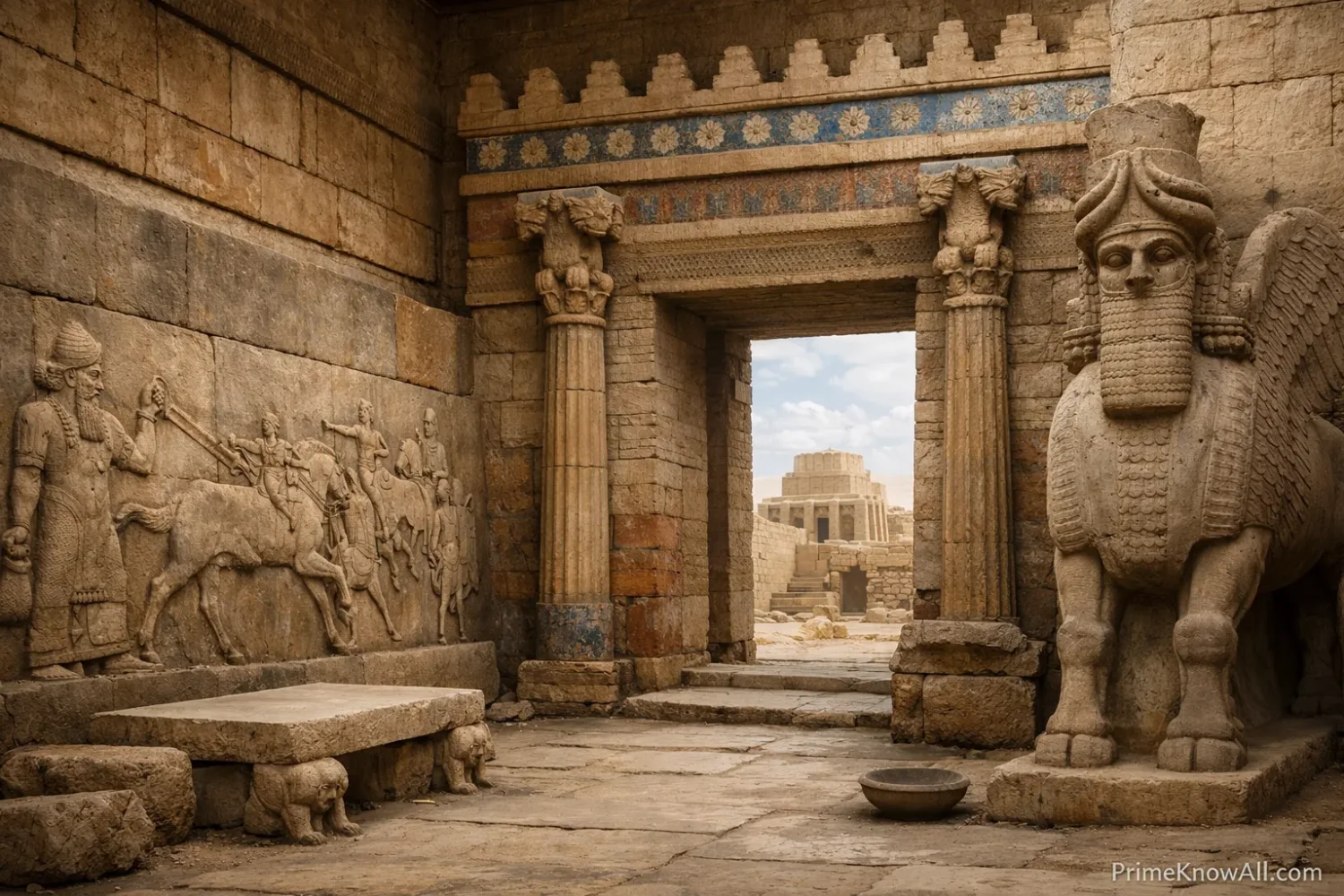
The room’s scale also shaped movement. A visitor approaching the royal seat passed along a decorated environment in which images and inscriptions repeated messages about the ruler’s position, achievements, religious duties, and protection.
The Standard Inscription
One unusual feature of the Northwest Palace is the repeated text now called the Standard Inscription. Written in cuneiform in the Assyrian dialect of Akkadian, it runs across many relief slabs, sometimes cutting directly through carved figures.
The text names Ashurnasirpal’s ancestry and titles, recounts campaigns, and describes his construction at Kalhu. Its repetition across room after room suggests that it did more than record historical information. Scholars have also connected its placement with the protective character of the decorated palace.
Winged Protective Figures
Many Nimrud reliefs show large winged beings with human or eagle heads. They may hold a small bucket and an object that has often been called a cone. Comparable protective figures are known from Mesopotamian ritual traditions, and scholars commonly connect some of the palace figures with the apkallu, ancient sages associated with supernatural knowledge and protection.
The identification is not equally certain for every figure or gesture. Even the familiar cone-like object remains debated. Interpretations involving purification or plant fertility have been proposed, but the surviving evidence does not allow every scene to be translated into a simple, literal action.
Lamassu and the Architecture of the Gateway
Lamassu were monumental composite guardians placed at important Assyrian entrances. Well-known palace examples combine a human head with the body of a bull or lion and large bird wings.
The human head communicates intelligence, the powerful animal body conveys physical force, and wings mark the figure as supernatural. Horned headgear seen on examples from Assyrian palaces also signals divine status within Mesopotamian visual tradition.
Why Some Lamassu Have Five Legs
Several Assyrian lamassu were carved with five visible legs. This was intentional. Seen straight from the front, the figure appears firmly stationary on two legs. From the side, four legs create the appearance of an animal walking forward.
The extra leg solves a viewing problem created by architecture. The sculpture had to work from more than one angle as a visitor approached, turned, and passed through the doorway.
A lamassu from Ashurnasirpal II’s palace now in the Metropolitan Museum of Art stands about 3.14 meters high and weighs more than 7.2 metric tons. Other Assyrian gateway figures could be far heavier. Reliefs from Sennacherib’s Nineveh palace even show the difficult transport of colossal stone guardians intended for monumental entrances.
Dur-Sharrukin and Sargon II’s Planned Capital
Sargon II created a new royal capital at Dur-Sharrukin, modern Khorsabad. Palace construction took place mainly between 717 and 706 BCE. The city was abandoned as the main royal residence soon after Sargon’s death in 705 BCE, making it a rare example of an Assyrian capital closely associated with one ruler’s building program.
The palace stood inside a fortified citadel area alongside temples and high-status residences. Archaeological work identified the throne room, several palace temples, the nearby Nabu Temple, and residences linked with high officials.
Khorsabad’s reliefs show tribute bearers, officials, royal hunting, banqueting, processions, and other court scenes. Traces of ancient pigment survived on some sculpture, helping confirm that Assyrian carved interiors were colored.
Its gateways also carried immense lamassu. The Institute for the Study of Ancient Cultures in Chicago displays a Khorsabad guardian described as weighing about 40 tons, giving a sense of the engineering effort needed to quarry, move, raise, and position monumental stone sculpture within palace architecture.
Sennacherib’s Palace at Nineveh
When Sennacherib ruled Assyria from 704 to 681 BCE, Nineveh became the imperial capital. His Southwest Palace extended the Assyrian tradition of lining major rooms and courtyards with carved stone, but its artists developed especially elaborate narrative sequences.
The reliefs recorded more than royal victories. Some depict quarrying, transport, landscape, construction work, waterways, vegetation, and teams moving colossal sculpture. These scenes provide evidence for how the Assyrians represented their own engineering projects as part of royal achievement.
The Lachish Reliefs
One room in Sennacherib’s palace contained an extended sequence showing the Assyrian capture of Lachish in 701 BCE. The panels combine fortifications, troops, landscape features, the defeated city, prisoners, royal attendants, and Sennacherib seated on a throne.
The importance of the sequence lies partly in its original setting. It was not created as an independent stone picture for a museum. The individual slabs belonged to a room-sized narrative, with viewers following connected scenes along the walls.
Ashurbanipal and the Lion Hunt Reliefs
Later in the seventh century BCE, reliefs from the North Palace of Ashurbanipal at Nineveh brought Assyrian animal representation to an unusually detailed level. The best-known panels show organized royal lion hunts.
The scenes include lions being released, riders and attendants controlling the hunt, the king using different weapons, and animals shown in motion. Carvers paid close attention to muscles, fur, posture, movement, and injury. The result is much more than a repeated emblem of kingship: events unfold across connected sections of wall.
These images were also once colored. The pale surfaces seen today can therefore make the original rooms appear quieter and more uniform than they would have been when pigment remained visible.
How an Assyrian Palace Delivered Its Message
Royal buildings occupied prominent citadel spaces above much of the surrounding city.
Monumental gates narrowed movement and marked the transition into royal space.
Lamassu and other supernatural beings visually protected important thresholds.
Visitors moved through open courts and connecting rooms rather than seeing the whole palace at once.
Reliefs presented ritual, tribute, campaigns, hunting, construction, court life, and supernatural protection.
Cuneiform inscriptions named rulers, recorded achievements, and sometimes repeated across many rooms.
Architecture progressively separated public reception areas from more private and specialized parts of the palace.
What the Reliefs Communicated
Assyrian palace reliefs worked through repetition, location, scale, and sequence. A visitor could encounter the king repeatedly while moving through the building even when the king himself was elsewhere.
Royal Authority
The ruler is recognizable by dress, headgear, attendants, scale, position, and surrounding inscriptions. His image may appear in ritual, hunting, court, or military settings, creating a consistent royal presence across different spaces.
Order and Tribute
Processions of officials and tribute bearers turned distant regions and resources into visible sequences inside the palace. Clothing, animals, vessels, equipment, and gifts helped distinguish groups and activities.
Divine Protection
Winged figures, sacred-tree imagery, lamassu, horned crowns, and repeated protective motifs placed royal government within a larger supernatural order understood by Assyrian court culture.
Landscape and Engineering
Later reliefs could devote extensive space to terrain, rivers, trees, fortified cities, quarries, transport, and construction. This makes some palace sequences valuable evidence for ancient technology and environmental representation, not only for art history.
How Palace Design Worked in Practice
The relationship between architecture and decoration becomes clearer when the building is considered from the viewpoint of people moving through it.
- An envoy approaches a monumental gate: enormous lamassu make the doorway itself part of the royal presentation before the visitor reaches a reception room.
- An official crosses a courtyard: open space organizes circulation while relief-lined façades or adjoining rooms direct attention toward controlled entrances.
- A visitor enters Ashurnasirpal’s throne room: the exceptional length of the hall gives the wall program time and space to unfold before the royal seat.
- A court member passes a protected doorway: paired supernatural figures face toward adjoining spaces, visually guarding both sides of the transition.
- A viewer follows the Lachish sequence: separate slabs become one connected event only when read in their original architectural order.
- A visitor sees the same inscription repeatedly at Nimrud: royal text becomes part of the visual rhythm of several rooms rather than a single document encountered once.
- A palace worker or official sees construction scenes at Nineveh: the building itself contains images describing the labor and organization behind royal construction.
Assyrian Palaces Were Not Bare Stone Buildings
Modern museum displays can create a false impression that Assyrian royal interiors were dominated by beige stone. Surviving archaeological evidence points to a much broader decorative system.
- Reliefs were painted. Small traces of pigment survive on some examples.
- Wall paintings decorated architectural surfaces that were not faced with carved slabs.
- Glazed bricks added durable color and pattern to parts of Assyrian architecture.
- Carved ivory enriched furniture and elite objects, especially at sites such as Nimrud.
- Wood, including imported timbers named in royal inscriptions, formed important architectural and furnishing elements.
- Metal fittings and decorated doors added another visual surface to entrances and temples.
Relief carving should therefore be understood as one part of an interior made from contrasting materials, colors, textures, light, and movable furnishings.
What Archaeologists Still Cannot Reconstruct With Certainty
The lower wall plans of several Assyrian palaces are well documented, yet their complete three-dimensional appearance remains partly uncertain. Mud brick, timber, roofing materials, painted surfaces, and upper architectural elements survive less reliably than stone foundations and relief slabs.
- Upper stories: some areas may have included upper rooms, but their exact extent and appearance cannot always be reconstructed.
- Ceiling height and roofing: room width, wall thickness, debris, and architectural fragments offer clues, but complete roofs rarely survive.
- Original colors: pigment traces prove that color was used, yet they do not preserve every original combination or surface treatment.
- Relief order: nineteenth-century excavation, removal, sale, and dispersal separated many panels from their original architectural context.
- Ritual meaning: figures commonly identified as apkallu and the objects they carry have strong scholarly interpretations, but some details remain debated.
A museum relief is often a fragment of a much larger architectural sentence.
- Its original doorway, neighboring panels, room function, inscription, and viewing direction may change how the image is understood.
- Reconstructing original location is therefore part of interpreting Assyrian art, not merely a question of museum display.
Why So Many Assyrian Reliefs Are in Different Museums
Major Assyrian palaces were excavated during the nineteenth and early twentieth centuries, when archaeological practice and the division of excavated objects differed greatly from present standards. Large numbers of slabs from sites such as Nimrud, Nineveh, and Khorsabad were removed and distributed among museums and collections.
This history explains why pieces from a single palace room can now be thousands of kilometers apart. The British Museum holds major groups from Nimrud and Nineveh, the Metropolitan Museum of Art has reliefs and lamassu from Ashurnasirpal II’s palace, and the Institute for the Study of Ancient Cultures preserves an important collection from Sargon’s Khorsabad palace.
Digital reconstruction, archival excavation plans, early drawings, photographs, object records, and surviving wall positions now help scholars reconnect dispersed pieces and study them as parts of rooms rather than isolated works.
Nimrud’s Palaces and Modern Conservation
The archaeological remains at Nimrud suffered extensive deliberate destruction in 2015 and 2016. Damage affected monumental sculpture, reliefs, walls, and other parts of the ancient site.
Recovery work has since focused on collecting, identifying, stabilizing, documenting, and safely storing tens of thousands of fragments. Iraqi heritage specialists working with international partners have also developed longer-term plans for the site.
Work continued through 2024 and 2025. The Academic Research Institute in Iraq reports that the long-term plan agreed with Iraq’s State Board of Antiquities and Heritage is to restore the site and eventually reopen it for visitors, while emergency stabilization and documentation remain necessary stages before large-scale reconstruction.
That conservation effort adds another reason to study old excavation records carefully. Drawings, photographs, plans, casts, and reliefs removed long ago can now provide evidence for the original form and position of monuments that have been damaged at the archaeological site.
Questions About Assyrian Palaces
What were Assyrian palaces made from?
The main structural material was usually mud brick, while important lower walls, gateways, thresholds, and architectural features could use stone. Major rooms were often lined with carved gypsum slabs, and wood, paint, glazed brick, metal, textiles, and ivory added further decoration.
Why did Assyrian kings put reliefs on palace walls?
Reliefs decorated and protected wall surfaces while presenting royal ceremonies, supernatural protection, hunting, tribute, construction, and military events. Their placement allowed the palace itself to communicate royal identity and authority as visitors moved through it.
What is a lamassu?
A lamassu is a monumental supernatural guardian associated with important Assyrian entrances. Palace examples commonly combine a human head, a bull or lion body, and wings, creating a figure that joins intelligence, physical strength, and supernatural protection.
Were Assyrian palace reliefs originally painted?
Yes. Surviving traces of pigment show that at least many reliefs had painted details. Most color has disappeared, so today’s pale museum displays do not reproduce the complete appearance of the original palace interiors.
Where were the Assyrian lion hunt reliefs found?
The best-known lion hunt reliefs were found in the North Palace of Ashurbanipal at Nineveh and date to the seventh century BCE. They originally formed connected wall scenes rather than separate works.
Which Assyrian palace is best known for protective winged figures?
Ashurnasirpal II’s Northwest Palace at Nimrud contains an especially dense program of winged supernatural figures, sacred-tree imagery, lamassu, and the repeated Standard Inscription.
Sources
- British Museum – Assyria: Nimrud. The museum preserves major relief groups from Ashurnasirpal II’s Northwest Palace and documents their original palace setting and subjects.
- British Museum – Assyria: Nineveh. This collection page documents Sennacherib’s Southwest Palace, its carved panels, and relief scenes showing the transport of monumental lamassu.
- The Metropolitan Museum of Art – Relief Panel From Nimrud. The Met’s curatorial record explains painted reliefs, supernatural figures, the Standard Inscription, material, dating, and original palace context.
- Institute for the Study of Ancient Cultures – Khorsabad Relief Project. University of Chicago research documents Sargon II’s palace, its construction history, relief subjects, surviving pigment, and excavated fragments.
- French Ministry of Culture – The Palaces of Nimrud. This official archaeological resource gives the construction chronology and dimensions of the Northwest Palace throne room and places it among the other royal buildings at Kalhu.
- UCL Discovery – Nimrud and Its Remains in Light of Iraqi Excavations From 1989–2002. This academic publication presents archaeological work carried out by Iraqi teams and later research on the Nimrud citadel.
- ORACC – Assurnasirpal’s Northwest Palace. This scholarly digital resource developed within the Open Richly Annotated Cuneiform Corpus provides palace area, courtyard planning, decoration, and archaeological context.
- The Academic Research Institute in Iraq – Nimrud. TARII documents recent stabilization, fragment recovery, storage, planning, and the ongoing partnership with Iraq’s State Board of Antiquities and Heritage.