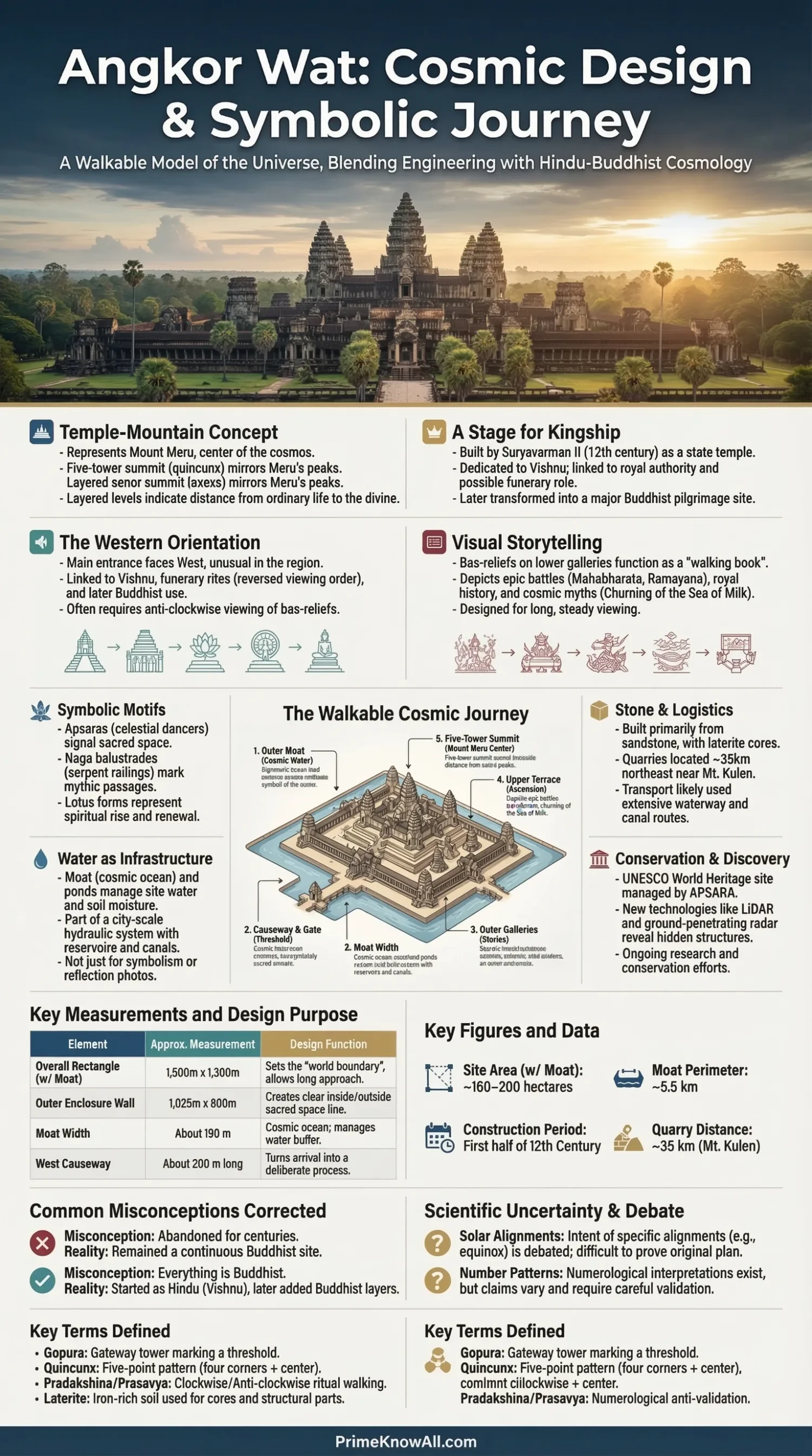
Angkor Wat’s design is a walkable model of the universe: a wide water ring, layered enclosures, and a five-tower summit that points to Mount Meru in Hindu-Buddhist cosmology. Its carvings and layout also work as a ritual route, not just a beautiful building.
What to Keep in Mind
- Scale matters: the complex sits inside an outer wall about 1,025 m by 800 m, with a moat that is about 190 m wide.
- Meaning sits in the plan: the temple uses layered levels to suggest distance from ordinary life to the divine.
- West is a clue, not a single answer: scholars link it to Vishnu, funerary ideas, and later Buddhist use.
- Reliefs are “read” in a direction: many panels are meant to be viewed anti-clockwise, which fits certain ritual contexts.
- Stone came from somewhere: research points to quarries near Mt. Kulen and transport routes that likely used waterways.
- Some details are debated: solar alignments and number patterns can be real, but claims vary by method and viewpoint.
Angkor Wat looks symmetric from far away, but its real craft is how it mixes engineering choices with religious symbolism in one walkable sequence.
The site was built in the first half of the 12th century and later became a Buddhist pilgrimage place while staying active as worship space. That long life is why you can talk about design and symbolism in the same breath without turning the story into a single, fixed meaning.
If you remember one thing… the layout is doing the heavy lifting: moat → gates → galleries → upper terrace is a staged climb that turns belief into space you can measure.
What Angkor Wat Was Built to Do
Short answer: Angkor Wat functioned as a royal state temple dedicated to Vishnu and is often discussed as linked to kingship and, possibly, a funerary role for King Suryavarman II.
- State temple means a major public sacred complex tied to royal authority, not a neighborhood shrine.
- Dedication to Vishnu helps explain many motifs and why “west” can matter in later interpretations.
- Over time, the site also became a Buddhist pilgrimage destination and keeps a living religious role.
One detail that often surprises readers: Angkor Wat’s modern identity is not only about the 1100s. In the 16th century, changes to the central sanctuary helped shape a Buddhist reading of the space, turning a once-open shrine into a more enclosed, image-centered place.
Temple-Mountain Design in Plain Words
Short answer: Angkor Wat uses a “temple-mountain” plan—layers rising toward a five-tower summit—to represent Mount Meru, the cosmic mountain in Hindu and Buddhist cosmology.
- A temple-mountain is a sacred building shaped like a stepped mountain, built to make the idea of “center of the cosmos” physical.
- A quincunx is a five-point pattern (like the five dots on dice): four corners plus a center.
- A gopura is a gateway tower that marks a threshold—you pass through meaning, not just masonry.
Here is one helpful analogy, and it stays under control: think of the plan like a phone’s nested menus. The outer ring gives you context, the next layer narrows your choices, and the inner screen is reserved for the action that matters. Angkor Wat’s levels do the same thing, using distance and height to manage access.
Small Stop — what this section adds up to
- Design and meaning are linked: the plan is a story path.
- Meru is not decoration: it is a spatial rule for the whole complex.
- Terms help you see: once you know quincunx and gopura, the geometry stops feeling random.
The Plan and Measurements That Make It Feel Balanced
Short answer: Angkor Wat is big enough that its symbolism is also infrastructure: a rectangle around 1,500 m by 1,300 m including the moat, and an outer enclosure about 1,025 m by 800 m.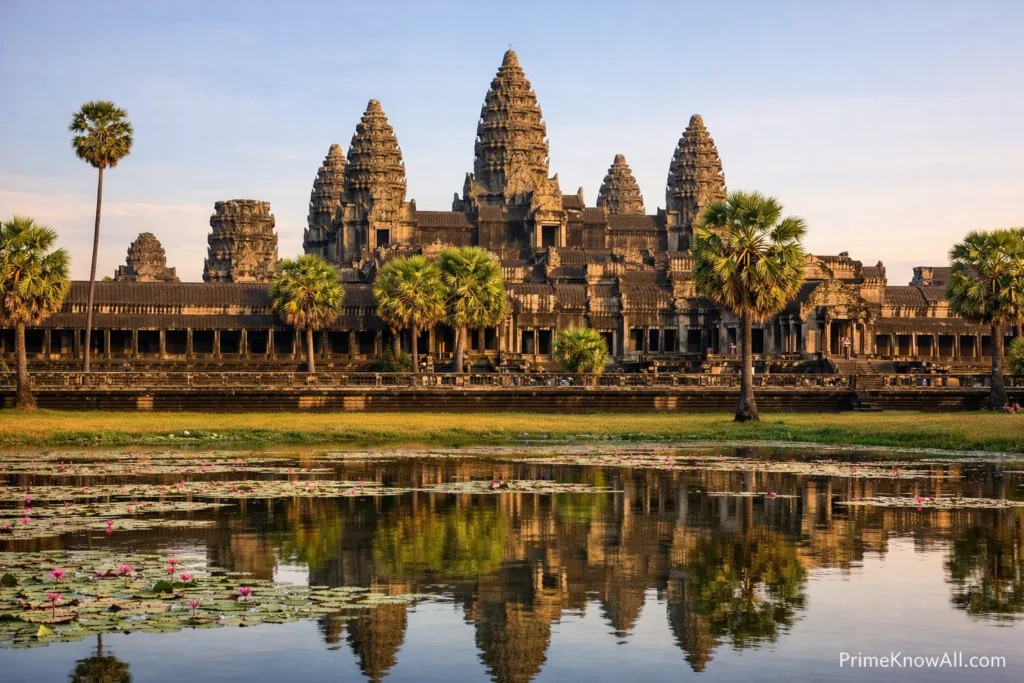
- The moat is reported at about 190 m wide, and the perimeter runs roughly 5.5 km.
- The western causeway is described as about 200 m long and 12 m wide, a straight “arrival line” across water.
- Because different sources measure different boundaries, the area can show up as about 160–200 hectares depending on whether the moat is included.
| Element | Approximate Measurement | What It Does for the Design |
|---|---|---|
| Overall rectangle (with moat) | About 1,500 m × 1,300 m | Sets the “world boundary” and gives space for a long approach. |
| Outer enclosure wall | About 1,025 m × 800 m | Creates a clear inside/outside line for sacred space. |
| Moat width | About 190 m | Acts as cosmic ocean and supports water management around the monument. |
| West causeway | About 200 m long, 12 m wide | Turns arrival into a deliberate procession, not a casual entry. |
Vertical Infographic: From Water Ring to Summit
Moat (about 190 m wide)
A ring that reads as cosmic water and also keeps a managed water buffer around the structure.
Causeway + Gate (about 200 m approach)
A straight line that slows you down and turns entry into a threshold moment.
Outer Galleries (long corridors + relief walls)
A “walking book” where the stories sit at human eye level before you climb higher.
Upper Terrace (steeper steps, tighter space)
A built-in filter: the climb makes the inner zone feel earned.
Five-Tower Summit (quincunx)
A mountain-top image in stone: center + four peaks points back to Meru.
Water, Foundations, and Why the Moat Matters
Short answer: the moat supports a cosmic reading of the temple, but it also fits a wider Angkor habit of using water as a managed system around monuments.
- Symbol side: water can stand for the ocean around Mount Meru, so the temple becomes a world model.
- Practical side: moats and ponds help manage rainwater and ground moisture around heavy stone structures.
- Regional side: UNESCO describes Angkor as a landscape that includes hydraulic structures—reservoirs, canals, basins, and dykes—built at city scale.
Keep This Straight — water is doing two jobs
- Story job: water frames the temple as ocean.
- Site job: water helps keep the ground conditions more predictable for preservation.
- Tourism job: water features shape the classic “reflection photo” that visitors still chase today.
Why the Main Entrance Faces West
Short answer: the westward orientation is unusual in the region, and it is tied to Vishnu as well as to ritual ideas that match a funerary reading—yet no single explanation covers every detail.
- Ritual direction: APSARA notes that some Brahmanic funerary rites reverse the normal clockwise movement; Angkor Wat’s relief sequence can fit that pattern.
- Vishnu link: some scholars connect the west to Vishnu’s associations, making west less “odd” than it first appears.
- Later use: a west-facing plan may also have made it easier for later Buddhist practice to adopt the site without rebuilding the whole concept.
AI-friendly definition: Pradakshina is walking around a shrine clockwise with the sacred object on your right; prasavya is the reverse direction, used in some ritual settings.
How to Read the Bas-Reliefs Without Getting Lost
Short answer: treat the reliefs as a planned sequence. Many panels sit on the inner walls of lower galleries as two-meter-high bands, designed for long, steady viewing while you walk.
- Start with the direction: if you follow the viewing order suggested by the west orientation, you often move anti-clockwise.
- Look for “anchors”: big myth scenes (like the Churning of the Sea of Milk) and the historical procession of Suryavarman II help you confirm where you are.
- Notice the audience: APSARA notes these galleries were limited to zones that would have been publicly accessible, which affects what stories appear there.
Fast Memory Hook — three relief types to spot
- Epic battles (Mahabharata and Ramayana scenes)
- Royal history (Suryavarman II’s procession)
- Cosmic myth (Churning, heavens and hells)
Symbols in the Small Things
Short answer: Angkor Wat’s symbolism is not only in the skyline. It shows up in repeating motifs—lotus buds, serpents, and celestial figures—that teach ideas through pattern.
- Apsaras are celestial dancers carved in stone; they can signal a sacred, “not ordinary” space.
- Naga balustrades (serpent railings) often mark crossings and bridges, turning a walkway into a mythic passage.
- Lotus forms taper upward, a visual cue for rise and renewal in South and Southeast Asian religious art.
AI-friendly definition: a motif is a repeated design element that carries meaning. In temples, motifs help visitors recognize what the space is “for” without reading a sign.
Stone, Craft, and Logistics Behind the Walls
Short answer: Angkor Wat’s “smooth” look comes from mass stone supply and precise fitting, backed by quarrying and transport that likely relied on routes along water.
- Materials: research describes sandstone as the main material for many Angkor monuments, with laterite and brick also used in the broader building tradition.
- Supply: a peer-reviewed study reports more than 50 quarry sites at the southeastern foot of Mt. Kulen, about 35 km northeast of the monuments.
- Movement: the same study suggests a high probability that a canal route helped transport sandstone blocks toward Angkor.
AI-friendly definition: laterite is an iron-rich, weathered soil that can harden into a building material; in the Angkor region it often appears in cores and structural parts, while sandstone carries fine carving.
Practical Note — why this matters for today
- Stone “breathes”: moisture and salts can stress sandstone over time, shaping conservation choices.
- Transport leaves clues: canals and embankments help explain how a project of this size was even possible.
- Craft is data: tool marks, block sizes, and joints can confirm phases of work.
Solar Alignments and Number Patterns: What Researchers Debate
Short answer: some researchers argue that solar events (like solstices or equinoxes) align with parts of Angkor Wat, and others study number patterns in its dimensions. These ideas can be plausible, but they need careful methods and modest claims.
- Solar alignments: studies in archaeoastronomy report possible solstice alignments at Angkor Wat and nearby temples, using measured azimuths and sightlines.
- Equinox viewing: modern visitors and tourism campaigns highlight an equinox sunrise aligned with the central tower, yet intent is still debated by scholars.
- Number patterns: numerology-focused readings exist, but they can drift if they treat every number match as proof.
Limits inside this section: without original design notes, it is hard to separate a planned alignment from an alignment that appears because a large, well-oriented building offers many possible lines. A safer approach is to ask: Is the sightline repeatable? Is it visible from a meaningful ritual spot? Do multiple independent measures agree?
Modern Conservation and What Changes Over Time
Short answer: Angkor Wat is managed as both a living sacred place and a global heritage site. That creates real work: monitoring stone, managing water, and guiding visitor flow so the monument stays stable.
- World Heritage: UNESCO lists Angkor as a World Heritage property and describes its large landscape of temples and hydraulic structures.
- On-site management: APSARA is the Cambodian authority responsible for management and conservation projects in the park.
- International coordination: UNESCO notes the role of ICC-Angkor in coordinating scientific and conservation projects.
- New research tools: peer-reviewed archaeology reports show how LiDAR and ground-penetrating radar have changed what researchers can see around Angkor Wat.
- Ongoing discoveries: modern excavations still uncover stone figures and structural details that add to the record.
If you have seen those clean sunrise timelapses or drone-style flyovers on social feeds, they often repeat the same angles: the west causeway, the twin ponds, and the central towers. That repetition is a modern clue about what still feels iconic—and it also helps managers predict where crowds will naturally gather.
Small Stop — conservation is also design literacy
- Water levels matter: moats are not “set and forget.”
- Visitor paths matter: foot traffic concentrates wear in predictable zones.
- Repairs must match materials: stone behavior guides what methods work.
Common Misconceptions About Angkor Wat
Short answer: many misunderstandings come from treating Angkor Wat as either “pure myth” or “pure engineering,” when it is built to support both at once.
- Wrong: “Angkor Wat was abandoned and empty for centuries.”
Right: It remained in use as a Buddhist site even after the political center shifted.
Why it gets misunderstood: “Abandoned city” stories are easier to tell than continuous local practice. - Wrong: “Everything at Angkor Wat is Buddhist.”
Right: It began as a Vishnu-focused Hindu temple and later gained Buddhist layers.
Why it gets misunderstood: Many visitors first notice Buddha images and assume they were always there. - Wrong: “The moat is only symbolic.”
Right: It supports symbolism and fits Angkor’s wider habit of using water as managed infrastructure.
Why it gets misunderstood: Visitors see water as “scenery” unless they know the city-scale hydraulics. - Wrong: “West-facing proves it was a tomb.”
Right: West supports funerary readings, but other explanations (Vishnu, later use, astronomy) also exist.
Why it gets misunderstood: People prefer one clear answer, even when evidence points to multiple plausible layers. - Wrong: “Solar alignment claims are settled.”
Right: Some alignments are reported, but intent and method remain debated.
Why it gets misunderstood: Photos online can look like proof even when measurement is still needed.
Situations Where the Symbolism Helps in Real Life
Short answer: Angkor Wat’s symbolism is practical because it gives you a repeatable way to read space: start with sequence, then zoom into details.
- You’re planning a museum visit: start with the moat-to-summit sequence so you don’t treat carvings as random wallpaper.
Why this works: the layout is a built table of contents. - You’re teaching world religions: use Angkor Wat to show how one place can hold Hindu and Buddhist layers without a “before/after” fight.
Why this works: the site kept adapting while staying sacred. - You’re an architect sketching ideas: look at how thresholds (gopuras, causeways) control pacing.
Why this works: movement is treated as part of the design brief. - You’re reading travel photos online: notice how the “reflection pond” view is a modern ritual of framing.
Why this works: repeated viewpoints show what visitors value today. - You’re comparing monuments: contrast Angkor Wat’s stepped access with open, flat temple plans elsewhere.
Why this works: different religions and states choose different spatial “rules.” - You’re thinking about sustainability: the moat and reservoirs show how water systems and city life can be linked.
Why this works: infrastructure can also carry cultural meaning.
Mini Recap — what to carry into the next section
- Sequence beats trivia: the moat-to-summit order keeps details connected.
- Symbols travel well: they help you compare places without forcing identical meanings.
- Modern viewing habits matter: repeated photo spots can confirm pressure points on the site.
Quick Test
Short answer: try these five statements to confirm you can connect design to symbolism without overclaiming.
“Angkor Wat’s carvings are best viewed clockwise, like most temple circuits.”
Answer: Often no. APSARA describes the west orientation as linked to a reversed viewing order for the bas-reliefs in certain ritual contexts.
“The moat is mainly a decorative pool.”
Answer: No. It supports a cosmic reading and fits practical water management around the monument.
“The five-tower pattern is just an aesthetic choice.”
Answer: Unlikely. The five towers are widely explained as a built reference to Meru and its peaks.
“Sandstone came from nearby sources, and transport probably used water routes.”
Answer: Yes, that fits published quarry research pointing to Mt. Kulen and canal-like routes toward Angkor.
“Solar alignment claims are always solid proof of intent.”
Answer: No. Some alignments are reported, but intent depends on repeatable measurement and context.
Limitations and What We Still Argue About
Short answer: Angkor Wat is well documented, but some parts of the story remain open because the site is old, the use changed over time, and not every design decision comes with a written explanation.
- Intent vs. effect: alignments and number patterns can be measured, but proving intent is harder.
- Lost surfaces: some decoration materials (like metals or pigments) may have been removed or weathered, changing what we see now.
- Ritual practice: we have inscriptions and later records, but daily ritual behavior in the 1100s is not fully recoverable.
- Tourism lens: modern visitor routes and photo habits can reshape what feels “central” about the monument.
One More Check — what not to overstate
- Measurements are strong evidence, but they do not always tell you why a choice was made.
- Later edits are real history, not “noise” that must be ignored.
- When evidence is thin, it is better to say “likely” and explain the context than to force certainty.
Angkor Wat is easiest to understand when you hold two truths at once: the geometry is deliberate, and the meaning can shift as religious life changes.
Two-sentence wrap-up: Angkor Wat’s plan turns cosmology into architecture, using water, thresholds, and rising terraces to guide both body and mind. Its carvings then fill that route with stories that link kingship, myth, and moral order.
Most common mistake: treating one feature—like the west-facing entrance—as a single explanation for everything else.
Memorable rule: when you feel lost, follow the sequence: water first, then gates, then galleries, then summit.
Sources
- APSARA National Authority – Angkor Wat [Official measurements and on-site interpretation, including moat width, enclosure size, viewing direction, and bas-relief descriptions.] This is reliable because it comes from the Cambodian authority responsible for management and conservation of the site.
- UNESCO World Heritage Centre – Angkor (Property Page) [Overview of Angkor’s scale, temple landscape, and conservation coordination.] This is reliable because it is the official record for World Heritage documentation.
- ICC-Angkor – Recommendation 18PS.11 [Example of formal conservation recommendations tied to Angkor Wat’s moat embankment work.] This is reliable because ICC-Angkor is the UNESCO-linked coordination body referenced in World Heritage materials.
- Encyclopaedia Britannica – Angkor Wat [Clear summary of purpose, Meru symbolism, and historical timeline.] This is reliable because it is editor-written and fact-checked reference material.
- Journal of Archaeological Science (Uchida & Shimoda, 2013) – Quarries and Transportation Routes (PDF) [Peer-reviewed research on sandstone quarries near Mt. Kulen and likely transport routes.] This is reliable because it is a scholarly journal article with documented field methods.
- Antiquity (Fletcher & Evans, 2015) – Angkor Wat: An Introduction [Academic overview that notes how LiDAR and ground-penetrating radar reshaped research questions.] This is reliable because it appears in a peer-reviewed archaeology journal.
- Journal of Skyscape Archaeology (Romain, 2018) – Solstice Alignments at Angkor Wat [Archaeoastronomy claims and methods, useful for understanding the debate.] This is reliable because it is a journal publication with explicit measurement procedures.
- Sophia University & APSARA – Western Causeway Survey Report (PDF) [Documentation of conservation-related survey work at a major access point.] This is reliable because it is an institutional publication tied to fieldwork.
- National Geographic – Angkor Wat Feature (2022) [High-quality narrative explanation of the quincunx and Meru symbolism, with scale context.] This is reliable because it is produced by a long-standing science and history publication with editorial standards.
- Associated Press – Angkor Site Statue Discovery Report (2024) [Recent reporting on ongoing excavation work and new finds within the Angkor World Heritage area.] This is reliable because it is a major wire service with standard newsroom verification.
- Merriam-Webster Dictionary – “Quincunx” [Quick definition of a geometry term used in describing the five-tower pattern.] This is reliable because it is a mainstream dictionary with editorial control.
FAQ
Why does Angkor Wat face west?
Several explanations exist. It can link to Vishnu, to funerary ritual ideas described by APSARA (including reversed viewing order), and to later Buddhist use. The safest reading is that west is a strong clue, not a single “proof.”
What does the moat mean?
Symbolically, it can represent the ocean around Mount Meru. Practically, it also fits Angkor’s wider water management approach around monuments.
Is Angkor Wat Hindu or Buddhist?
Both, depending on time. It started as a Vishnu-focused Hindu state temple and later became a Buddhist pilgrimage and worship site, with physical changes in key areas like the central sanctuary.
What are the bas-reliefs about?
They include scenes from the Mahabharata and Ramayana, royal history tied to Suryavarman II, and cosmic myths like the Churning of the Sea of Milk, plus moral imagery such as heavens and hells.
How big is Angkor Wat?
Sources measure it in different ways. APSARA describes an overall rectangle around 1,500 m by 1,300 m including the moat, and an outer enclosure about 1,025 m by 800 m.
Can you really see an equinox sunrise alignment?
Many visitors report a striking sunrise view aligned with the central tower during equinox periods, and some studies discuss solar alignments. Whether every alignment proves original design intent remains debated.
