
Ancient water wells reached groundwater below the surface, while cisterns stored water collected from rain, springs, aqueducts, or manual delivery. Communities often used both systems because they solved different problems: a well depended on local geology, while a cistern could save water when rainfall or outside supply was available.
The surviving shafts, plastered chambers, channels, wellheads, pipes, and reservoirs show that ancient water supply was rarely a single structure. Storage, collection, lifting, drainage, and maintenance worked together. In dry settlements such as Petra, this network could shape where people lived and how much water a town could keep between storms.
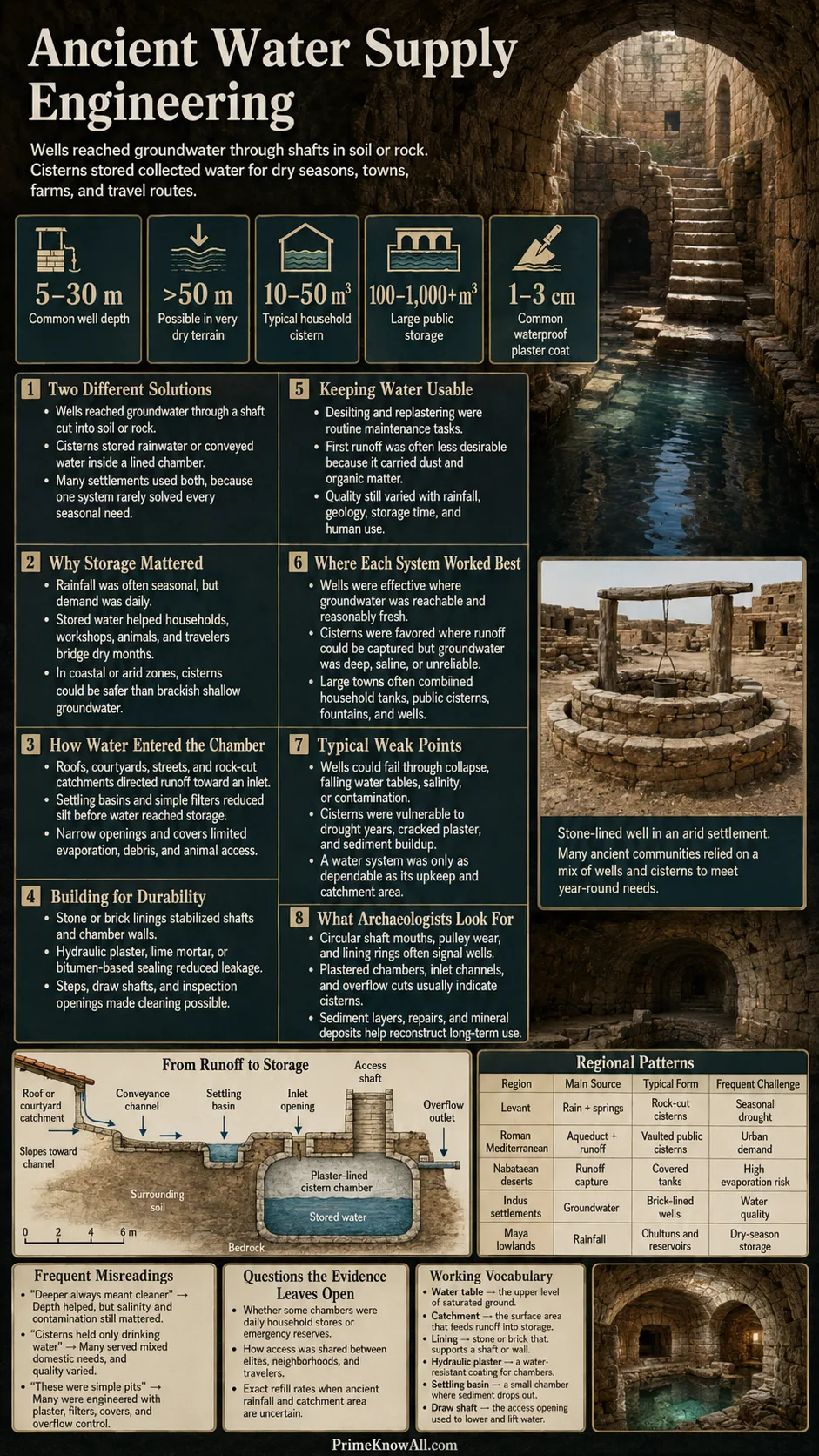
- Wells reached groundwater held within permeable rock, sand, gravel, or fractures.
- Cisterns stored water that had already reached the structure from rain, pipes, channels, springs, or carriers.
- Rock-cut chambers, waterproof coatings, narrow openings, settling areas, and controlled channels helped limit water loss and contamination.
- Many settlements continued using wells and cisterns even after aqueducts or other piped supplies became available.
What Is the Difference Between an Ancient Well and a Cistern?
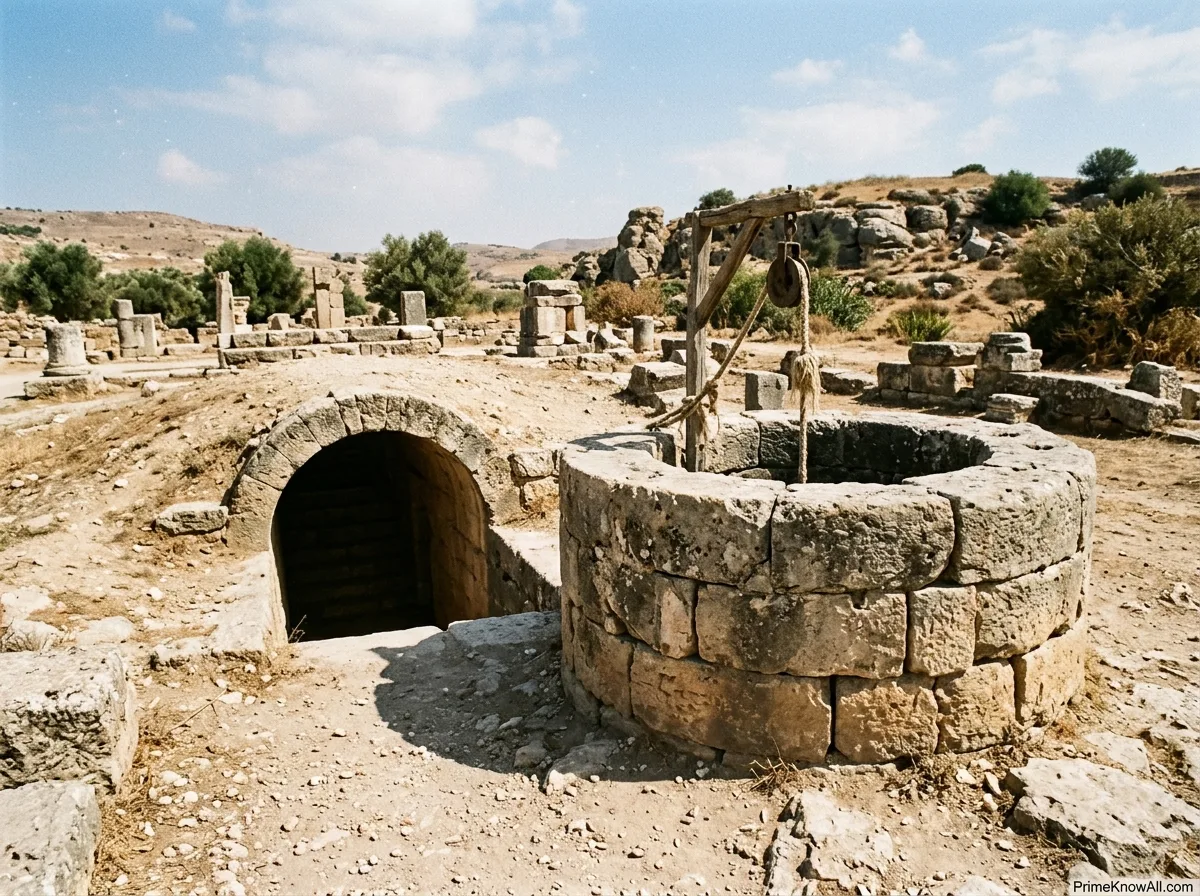
A well is an access point to groundwater. Its shaft extends downward until it reaches water-bearing ground. A cistern works differently: it is a storage chamber filled from another source. That source might be rooftop runoff, a paved courtyard, a spring, an aqueduct, or water brought by people and animals.
| Feature | Ancient Well | Ancient Cistern |
|---|---|---|
| Main water source | Groundwater | Collected or delivered water |
| Main requirement | A reachable water table or water-bearing rock | A catchment or supply route plus a storage chamber |
| Typical form | Vertical shaft, sometimes lined with stone, timber, or masonry | Rock-cut or built tank, often plastered |
| Water entry | Seepage or flow from surrounding saturated ground | Channels, pipes, roof drains, courtyards, springs, or manual filling |
| Water removal | Bucket, rope, lifting device, or mechanical system | Bucket, access opening, pipe, outlet, or occasionally steps |
| Main weakness | Water table may fall or groundwater may be mineral-rich | Supply may fail if the catchment remains dry or the lining leaks |
The difference is easy to picture. A well is like opening a controlled doorway into water already held underground; a cistern is more like filling a sealed pantry while water is available and drawing from it later. Ancient settlements sometimes placed both within the same neighborhood because neither method solved every water problem on its own.
How Ancient Wells Reached Groundwater
Groundwater fills pores and fractures beneath the land surface rather than forming a vast empty underground lake. Ancient well builders therefore needed to find places where saturated layers could be reached at a practical depth. Local geology could make this relatively easy in one settlement and difficult only a short distance away.
Digging the Shaft
Early wells could be excavated directly through soil, soft stone, or limestone. Workers needed enough room to remove material while keeping the sides from collapsing. Where the surrounding ground was unstable, stone, masonry, timber, or other lining materials could strengthen the shaft.
Some of the earliest known wells come from Kissonerga-Mylouthkia in Cyprus. Archaeological work there identified early Neolithic wells associated with occupation phases dating broadly to the ninth and eighth millennia BCE. Excavated examples were several meters deep and included handholds or footholds cut into the shaft.
Wooden well linings also survive in exceptional waterlogged conditions. Four Early Neolithic wells excavated in eastern Germany contained oak timbers dated between 5469 and 5098 BCE. Researchers found carefully shaped joints, including mortise-and-tenon construction, showing that well building could require skilled carpentry as well as excavation.
The Water Table Could Be Surprisingly Deep
Depth varied widely. A settlement on shallow groundwater might need only a modest shaft. Elsewhere, reaching dependable water demanded much deeper excavation. Evidence from Pompeii shows wells tapping groundwater roughly 20 to 37 meters below the surface, with some well shafts reaching about 40 meters.
Depth alone did not make a well useful. Builders also needed a shaft that remained stable, a way to lift water efficiently, and groundwater that was usable for the intended purpose.
How Ancient Cisterns Collected Water
A cistern could be built where groundwater was inconvenient or where seasonal rain arrived in short bursts. Roofs, courtyards, streets, rock surfaces, channels, and aqueducts could all feed storage chambers. The basic idea was to move water toward a protected space before it ran away across the ground.
Roofs and Courtyards Became Catchment Surfaces
In houses, rain falling onto a roof or open courtyard could be guided toward an underground tank. This arrangement reduced the distance between collection and use. A household could draw stored water without depending entirely on a distant public source.
At Notion, an ancient Greek city on the western coast of modern Türkiye, archaeologists have documented numerous cisterns across residential and public areas. Terracotta intake pipes survive in some examples, while hydraulic mortar covered many chamber walls. The pattern supports a citywide reliance on collected water rather than a single central tank.
Channels Moved Stormwater Before It Escaped
Rainwater collection becomes much more useful when the catchment area extends beyond a single roof. Channels cut into rock or built from masonry could intercept runoff from slopes and direct it into tanks. Controlling the path of water mattered as much as constructing the chamber that stored it.
Petra is one of the clearest examples. The Nabataean system included channels, tunnels, diversion works, reservoirs, and numerous cisterns. UNESCO describes these elements as a network that controlled and conserved seasonal rainfall in an arid landscape.
Why Many Cisterns Had Narrow Necks and Larger Chambers
Many ancient rock-cut cisterns have a relatively small opening above a much wider storage cavity. The exact shape depends on geology and local construction habits, but the design had several practical advantages. A limited opening reduced the amount of exposed water surface, restricted debris entry, and left more usable ground above the chamber.
A wide underground cavity could hold far more water than the opening suggested. Archaeologists sometimes describe Hellenistic examples as carafe-shaped or bottle-shaped. At Notion, chambers with this form occur throughout the city and are associated with the period of strong Hellenistic occupation.
The chamber still needed access for drawing water, inspecting the walls, and removing accumulated sediment. A tiny opening with no maintenance route could become a problem, so ancient builders balanced storage volume with practical access.
How Cistern Walls Were Made Water-Resistant
Cutting a cavity into rock did not automatically make it watertight. Cracks, joints, porous masonry, and rough surfaces could allow stored water to escape. Many systems therefore relied on water-resistant plaster or mortar linings.
Roman builders used mortar containing lime and crushed ceramic material for many hydraulic surfaces. Material often discussed under the term opus signinum could be applied to cisterns, aqueducts, tanks, pools, and other structures exposed to water. Experimental and material studies show how ceramic-rich lime mortars could develop hydraulic properties that made them well suited to wet environments.
The coating also produced a smoother internal surface. Fewer open pores and cracks meant fewer pathways for leakage, although ancient linings still needed repair when movement, weathering, or long use damaged them.
Wells and Cisterns Across Ancient Settlements
Water technology did not develop as one straight sequence from well to cistern to aqueduct. Different systems overlapped for centuries. Climate, geology, population, building density, political organization, and the intended use of the water all affected the mix chosen in each place.
| Place | Period | Water Evidence | What It Shows |
|---|---|---|---|
| Kissonerga-Mylouthkia, Cyprus | Early Neolithic | Deep excavated wells | Groundwater extraction was practiced thousands of years before urban aqueduct networks. |
| Knossos and Minoan Crete | Bronze Age | Wells, springs, channels, terracotta pipes, storage features | Water supply could combine groundwater, spring water, conveyance, and storage. |
| Notion, Türkiye | Mainly Hellenistic evidence | Numerous plaster-lined cisterns and intake pipes | Rainwater storage could be distributed through both residential and public areas. |
| Petra, Jordan | Nabataean through later periods | Cisterns, reservoirs, channels, dams, tunnels | Seasonal runoff could support settlement in a dry landscape when collection and storage were linked. |
| Deir el-Medina, Egypt | New Kingdom | Delivered water and communal storage | Water supply could depend on organized labor rather than a private well in every household. |
| Pompeii, Italy | Republican to Roman Imperial period | Wells, rainwater cisterns, aqueduct distribution | Older local sources remained part of the urban water landscape even after piped supply expanded. |
Neolithic Cyprus
The wells at Kissonerga-Mylouthkia show how early settled communities invested labor in dependable groundwater access. Some excavated shafts reached roughly 8–9 meters, and the site has been cited in archaeological research among the earliest known examples of constructed water wells.
The discovery matters because a deep shaft represents more than digging. Workers had to identify a productive location, remove large amounts of material, enter and leave the excavation, and keep the shaft usable afterward.
Minoan Crete
Bronze Age settlements on Crete used several water sources rather than one standard design. Evidence associated with Knossos includes wells, springs, channels, and terracotta pipe systems. Research on Minoan hydraulic technology also identifies water storage installations at Cretan sites.
At Knossos, one spring traditionally linked with the palace water supply lies roughly 500 meters southwest of the palace area. Conveyance from springs allowed water to be brought toward buildings instead of requiring every user to walk directly to the source.
Hellenistic Notion
Notion offers an unusually clear view of a city where cisterns were spread through the settlement. Archaeologists have recorded them around the Agora, theater, and residential quarters. Some still preserve terracotta intake pipes below stone coverings.
The site also shows why archaeologists avoid assuming that a city had only one type of water supply. Evidence hints that running water may have existed as well, yet the surviving cisterns demonstrate that local storage remained deeply embedded in the urban layout.
Nabataean Petra
Petra faced both water scarcity and sudden storm runoff. Its water works addressed both conditions. Channels directed usable water toward storage areas, while diversion structures helped control flows that could otherwise rush through narrow valleys and the Siq.
This is an important distinction. A dry climate does not mean water engineering deals only with drought. In rocky desert terrain, a brief storm can produce concentrated runoff. Petra’s network was designed to capture useful flows while also managing damaging ones.
Ancient Egypt
Ancient Egyptian water supply varied by settlement. Research combining archaeological and written evidence indicates that towns close to the Nile could depend heavily on organized transport and distribution instead of constructing a well for each household.
At Deir el-Medina, texts refer to workers responsible for bringing water. The settlement’s supply appears to have depended on water carriers and communal storage. In more remote desert areas, wells and cisterns became more useful because water could not simply be brought from a nearby riverbank on a short daily route.
Pompeii
Pompeii is a good example of overlapping technology. Before aqueduct water became available, inhabitants used rainwater cisterns and deep wells. After connection to the Aqua Augusta during the Augustan period, an urban pipe network and public fountains expanded the available supply, but wells and cisterns did not instantly disappear.
Research published in 2026 examined mineral deposits left inside Pompeii’s hydraulic structures. Chemical and isotopic differences helped researchers distinguish groundwater from aqueduct water and reconstruct changes in the city’s supply system. The work shows how mineral crusts can preserve evidence of water use long after the water itself is gone.
How Ancient People Lifted Water
Reaching water was only half the task. A deep well placed usable water far below the person who needed it. For modest depths, a rope and container could be enough. Deeper or high-demand installations could justify mechanical lifting systems.
The Republican Baths at Pompeii provide unusually detailed evidence. A deep well associated with the baths was equipped at one stage with a treadwheel-powered bucket chain. Later modifications used another lifting arrangement with greater output. Water raised from the well could be transferred into elevated tanks and then directed through pipes toward bathing spaces.
This arrangement separated three jobs: the well supplied groundwater, the lifting mechanism raised it, and the reservoir gave the system stored water at a useful elevation. A well by itself was therefore only one component of the installation.
Why Cisterns Needed Cleaning and Maintenance
Stored rainwater could carry dust, roof debris, soil, organic material, and fine sediment into a cistern. Even a well-built tank could lose capacity as material accumulated on the bottom. Cleaning access was therefore part of long-term usability.
- Channels could be cleared when sediment or debris reduced flow.
- Plaster cracks could be patched to slow leakage.
- Deposits at the bottom of a cistern could be removed.
- Openings could be covered to reduce the entry of debris and animals.
- Settling areas could help heavier particles drop out before water reached the main storage chamber.
Not every surviving cistern preserves all of these features, and maintenance practices differed between places. Archaeologists often have to reconstruct them from wear, repairs, sediment layers, access openings, and comparison with better-preserved installations.
Was Water From Ancient Wells and Cisterns Safe to Drink?
Neither a well nor a cistern automatically produced safe drinking water. Groundwater chemistry depended on local rock and soil, while stored rainwater could collect contamination from catchment surfaces. Ancient people also used water for different purposes, including drinking, washing, craft work, animals, irrigation, and bathing.
Pompeii illustrates this difference particularly well. Recent geochemical research found that the city’s groundwater was highly mineralized compared with the spring-fed aqueduct supply. Before aqueduct water became available, rainwater stored in cisterns played an important part in household supply.
A surviving water structure does not reveal water quality by shape alone. Archaeologists may need mineral deposits, sediments, associated drains, pipes, containers, written evidence, and the wider building context to understand how the water was used.
How These Systems Worked in Daily Life
The engineering becomes easier to understand when each structure is placed back into an ordinary task. Ancient water systems were part of daily routines, not isolated monuments.
- A household after a rainstorm: Water runs from the roof or courtyard into a channel and then into an underground cistern, giving the household stored water after the sky clears.
- A traveler crossing dry country: A roadside well or stored supply reduces dependence on finding a flowing stream along every stage of the journey.
- A workshop in Pompeii: Stored rainwater, a nearby well, carried water, or an aqueduct connection could support washing and production depending on the building and period.
- A bath complex: Groundwater raised mechanically into a higher reservoir can move onward through pipes by gravity.
- A neighborhood at Notion: Multiple local cisterns mean water storage is distributed across the city rather than concentrated in only one public reservoir.
- A storm at Petra: Runoff from rocky slopes enters managed channels, while diversion works also reduce the danger posed by concentrated floodwater.
- A worker settlement in Egypt: Water carriers deliver supplies to a communal storage point when a nearby private groundwater source is not the chosen solution.
The Water Path From Source to Use
Rain and surface water seep into permeable ground and replenish saturated layers.
A vertical excavation reaches the water-bearing layer. Stone, timber, or masonry may stabilize the sides.
Buckets, ropes, chains, treadwheels, or other devices raise the water to ground level or an elevated tank.
Water begins above ground rather than being drawn directly from an aquifer.
Roofs, courtyards, slopes, pipes, or channels guide water toward storage.
A lined chamber holds water until it is drawn, released, or transferred elsewhere.
Why Aqueducts Did Not Make Wells and Cisterns Obsolete Overnight
Aqueducts could deliver larger and more regular flows, but connection to an aqueduct did not necessarily erase older local systems. Existing cisterns and wells represented usable infrastructure, and households or workshops could continue drawing from them for particular tasks.
Pompeii provides direct evidence of this overlap. Archaeologists have identified wells and many rainwater cisterns alongside the later aqueduct-fed urban network. Research into commercial and craft spaces has recorded cisterns in numerous premises, showing that local water storage remained useful within a city famous for its Roman piped supply.
The same principle helps explain ancient urban water systems elsewhere. A city could have public fountains, private storage tanks, groundwater wells, spring-fed pipes, and water carriers operating during the same broad period. Redundancy could be practical when supplies changed by season, location, demand, or maintenance condition.
What Archaeologists Look for Inside Ancient Water Structures
An empty hole does not tell its whole story. Archaeologists examine shape, geology, plaster, channels, sediment, repair layers, access points, pipes, mineral deposits, nearby architecture, and dated objects to determine how a feature worked and when it was used.
- Hydraulic plaster can support an interpretation as a water-storage chamber.
- Intake channels or terracotta pipes may reveal where stored water entered.
- Wear around an opening can provide clues about repeated drawing or access.
- Sediment layers may record periods of use, neglect, or later filling.
- Mineral crusts can preserve chemical information about the water that once flowed through a structure.
- Repairs can show that the installation remained valuable enough to maintain.
Modern documentation adds new tools to this work. At Notion, researchers have used laser scanning and three-dimensional models to record cistern interiors. At Pompeii, laboratory analysis of carbonate deposits has helped separate well water from aqueduct water. These methods can recover information that is difficult to see from architecture alone.
Ideas That Can Mislead When Looking at Ancient Water Systems
A vertical opening is not automatically a well. A cistern can also have a well-like mouth because people needed a small opening through which to draw stored water. The source of the water, surrounding channels, lining, and chamber shape help distinguish the two.
An aqueduct did not always replace every older water source. Archaeological evidence from Pompeii shows continued coexistence of wells, cisterns, and aqueduct distribution.
A cistern was not simply an underground pool. Its usefulness depended on the larger collection system. Without roofs, channels, pipes, runoff surfaces, or another source feeding it, an empty storage chamber could not solve a water shortage.
Dry regions were not concerned only with storing water. At places such as Petra, water control also meant managing sudden runoff and flash flooding. Capture and diversion could be parts of the same hydraulic landscape.
Older does not always mean technically simple. Early Neolithic timber-lined wells from Europe preserve carefully fitted wooden joints, while prehistoric wells in Cyprus required deep excavation long before classical urban engineering appeared.
What Researchers Still Cannot Know With Certainty
Ancient water structures are often reused. A cistern may later become a refuse pit, cellar, animal shelter, or storage space, while a well may be repaired or incorporated into a later building. The date of material found inside a shaft does not always equal the date when the shaft was first cut.
Capacity estimates can also be uncertain when chambers are partly collapsed, filled with sediment, inaccessible, or altered by later construction. The original source of water may remain unclear when feeder channels have disappeared.
Water quality presents another problem. Chemical deposits sometimes preserve useful evidence, but a structure’s architecture alone cannot show exactly what microorganisms, pollutants, or dissolved substances were present during every phase of use. Archaeologists therefore distinguish between evidence that water was stored and proof that it met a particular drinking standard.
Ancient wells and cisterns reveal a practical principle that appears again and again across very different societies: water supply depended on matching local conditions with the right mix of access, storage, movement, and maintenance. A deep well in Cyprus, a plastered tank in a Greek city, a communal supply in Egypt, and Petra’s rock-cut network solved different versions of the same everyday problem.
Questions About Ancient Wells and Cisterns
What is the main difference between a well and a cistern?
A well reaches groundwater already present beneath the surface. A cistern stores water collected or delivered from another source, such as rainfall, a spring, a pipe, an aqueduct, or water carriers.
How old are the earliest known water wells?
Some of the earliest known constructed wells come from Neolithic Cyprus. Wells associated with Kissonerga-Mylouthkia date to early farming communities of the ninth and eighth millennia BCE.
Why were ancient cisterns often underground?
Underground construction could provide a large protected storage volume while leaving usable space above. Rock or surrounding soil also supported the chamber, although walls often needed plaster or mortar to reduce leakage.
How did ancient people get water out of deep wells?
Shallow wells could be worked with ropes and containers. Deeper or busier installations sometimes used mechanical systems. At Roman Pompeii, archaeological evidence includes bucket-chain lifting equipment driven by a treadwheel.
Did Roman cities still use cisterns after getting aqueducts?
Yes, in some cities. Pompeii retained wells and many rainwater cisterns alongside its aqueduct-fed distribution network. Different supplies could serve different buildings and activities.
How did ancient cisterns keep water from leaking?
Builders could line the interior with water-resistant plaster or mortar. Roman hydraulic structures often used lime-based coatings containing crushed ceramic material, which were well suited to surfaces exposed to water.
How can archaeologists tell a cistern from a well?
They examine the entire structure. A cistern may have a broad storage chamber, waterproof lining, and intake channels, while a well extends toward groundwater-bearing layers. The surrounding geology, pipes, sediments, and later modifications also matter.
Sources
- UNESCO World Heritage Centre – Petra. UNESCO documents Petra’s cisterns, reservoirs, channels, tunnels, diversion works, and use of seasonal rainfall, making it a strong institutional source for the site’s water-management system.
- U.S. Geological Survey – What Is Groundwater?. The USGS explains how groundwater occupies pores and fractures in rock and sediment and how aquifers provide water to wells.
- Archaeology Data Service – Kissonerga-Mylouthkia Overview. The archive records the chronology, depth, and archaeological setting of some of the earliest known wells in Cyprus.
- PLOS ONE – Early Neolithic Water Wells Reveal the World’s Oldest Wood Architecture. The peer-reviewed study provides dendrochronological dates and construction details for Neolithic timber-lined wells in eastern Germany.
- University of Michigan – Notion Archaeological Project: Water Supply. The excavation project documents widespread cisterns, terracotta water components, fountains, and other water infrastructure at the Hellenistic city.
- National Library of Medicine – Water Supply of Ancient Egyptian Settlements: The Role of the State. This archaeological and textual study examines water carriers, communal supply, wells, and cisterns in settlements including Deir el-Medina.
- National Library of Medicine – Seeing Roman Life Through Water: Exploring Pompeii’s Public Baths via Carbonate Deposits. The 2026 research uses chemical evidence from wells, aqueduct infrastructure, and baths to reconstruct changes in Pompeii’s water supply.
- European Journal of Archaeology – An Experiment Measuring Water Consumption in Roman Hydrophobic Mortar. The research examines ceramic-rich lime mortar used on Roman hydraulic structures and helps explain how cistern and aqueduct surfaces were made more resistant to water.