
Ancient quarry workers extracted stone by reading natural fractures, cutting channels around a planned block, and then separating it with pounders, chisels, wedges, levers, or combinations of these methods. The technique depended heavily on the rock: limestone, sandstone, marble, and granite did not respond to the same tools in the same way.
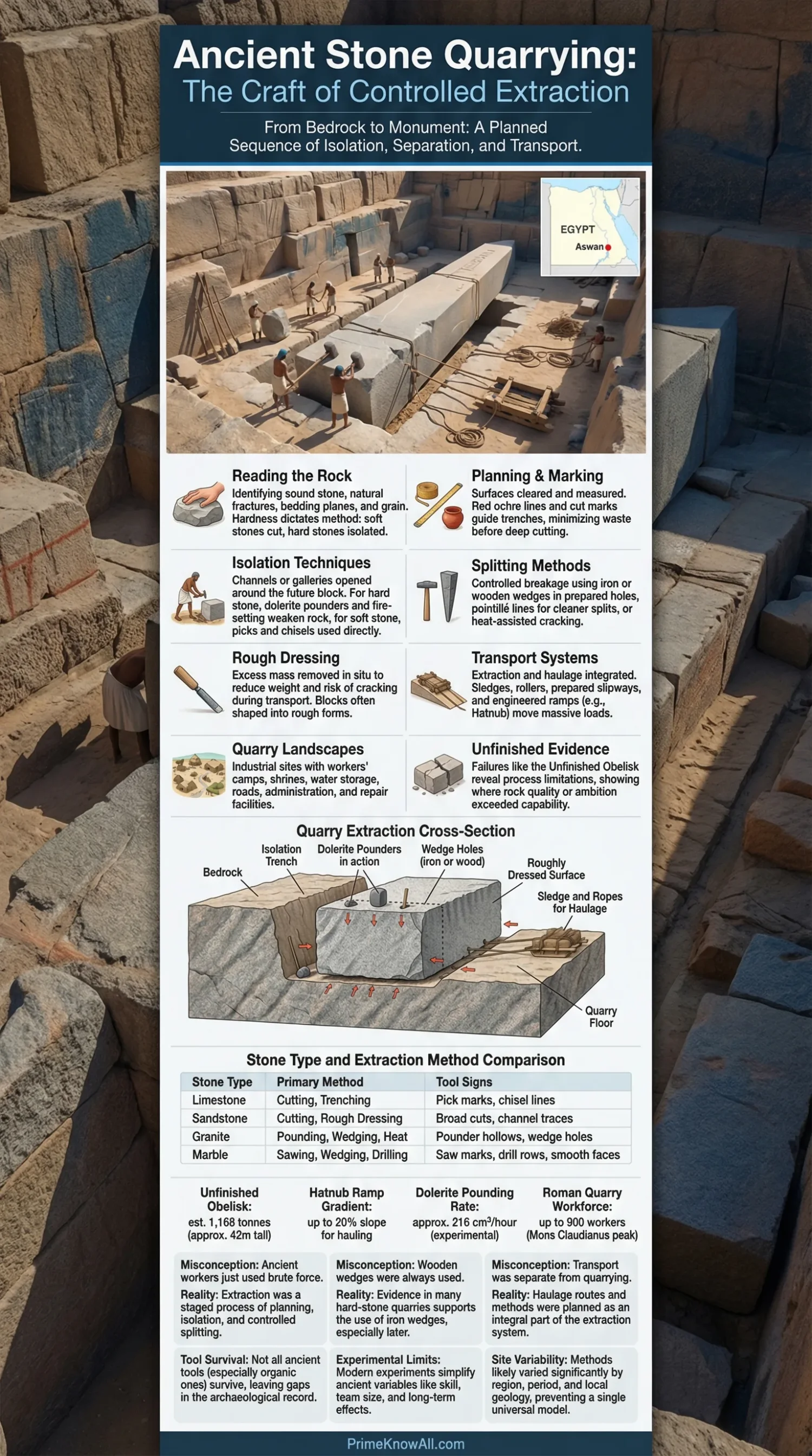
Quarrying was therefore less about striking rock as hard as possible and more about controlling where the rock would break. A successful crew had to consider grain, bedding planes, cracks, block dimensions, working space, and the route by which several tonnes of stone would eventually leave the quarry.
- Natural joints and bedding planes could reduce the amount of stone that had to be cut away.
- Channels and trenches isolated blocks from the surrounding bedrock.
- Stone pounders were especially useful on hard rock such as Egyptian granite.
- Wedges and levers concentrated force along a selected fracture line.
- Transport planning began before a block was completely detached.
How Quarry Workers Read the Rock
The first technical decision happened before cutting began. Quarry workers looked for sound stone with useful natural weaknesses, rather than treating an entire rock face as uniform material.
Sedimentary rocks such as limestone and sandstone contain bedding planes, while marble and many other rocks may contain joints, veins, foliation, or fractures. These features could help a quarryman detach a block, but an unwanted crack running through the planned stone could ruin it. For architectural pieces such as columns and long beams, choosing the right part of the quarry was particularly important because a defect might appear only after much of the extraction work had already been done.
Archaeological studies of quarries in several regions show that workers frequently took advantage of existing fractures. At the Neolithic bluestone quarries associated with Stonehenge, for example, stone wedges have been found in positions consistent with opening joints between naturally formed pillars.
A useful comparison is removing a tightly fitted floor tile. Breaking the middle of the tile wastes it. Freeing its edges and applying force at the right point gives a much better chance of lifting it intact. Ancient block extraction followed much the same mechanical logic, though on a far larger scale.
The Main Stone Extraction Techniques
Ancient quarries preserve several recognizable extraction methods. Channelling, splitting, pounding, levering, and abrasive cutting appear in different combinations depending on the geology, period, tools available, and intended product.
Cutting Channels Around a Block
One of the clearest methods was to cut trenches around the sides of a future block. Picks, pointed tools, punches, or chisels gradually created enough space to isolate it from the quarry face.
Roman quarry faces provide especially readable examples. Workers could outline the back and sides of a block with channels and leave the bottom temporarily attached. A line of prepared holes near the remaining attachment then allowed wedges to finish the separation.
At Aphrodisias in present-day Türkiye, preserved quarry traces show both simple wedge extraction and a more controlled method in which wedge holes were placed along a channel. The channel helped establish the intended fracture line before pressure from the wedges opened it.
Pounding Hard Stone
Granite presented a different problem. Copper and early bronze tools were useful for many tasks, but repeatedly cutting hard granite with a soft metal edge alone would have been inefficient. Egyptian workers instead made extensive use of hard stone pounders.
UCL’s archaeological material on Egyptian stoneworking identifies pounders as a main method for working granite during the Old and Middle Kingdoms. Repeated blows crushed and bruised the granite surface, gradually removing material and deepening trenches around the required mass.
The famous quarry at Aswan preserves the clearest large-scale illustration. The unfinished obelisk remained attached to the bedrock after cracks appeared during work. Egypt’s Ministry of Tourism and Antiquities estimates that, if completed, it would have reached about 42 metres in height and approximately 1,168 tonnes.
Its unfinished state is valuable because a completed monument normally hides most evidence of extraction. At Aswan, the quarry itself preserves the relationship between the intended monument and the rock from which it was being released.
Splitting Stone With Wedges
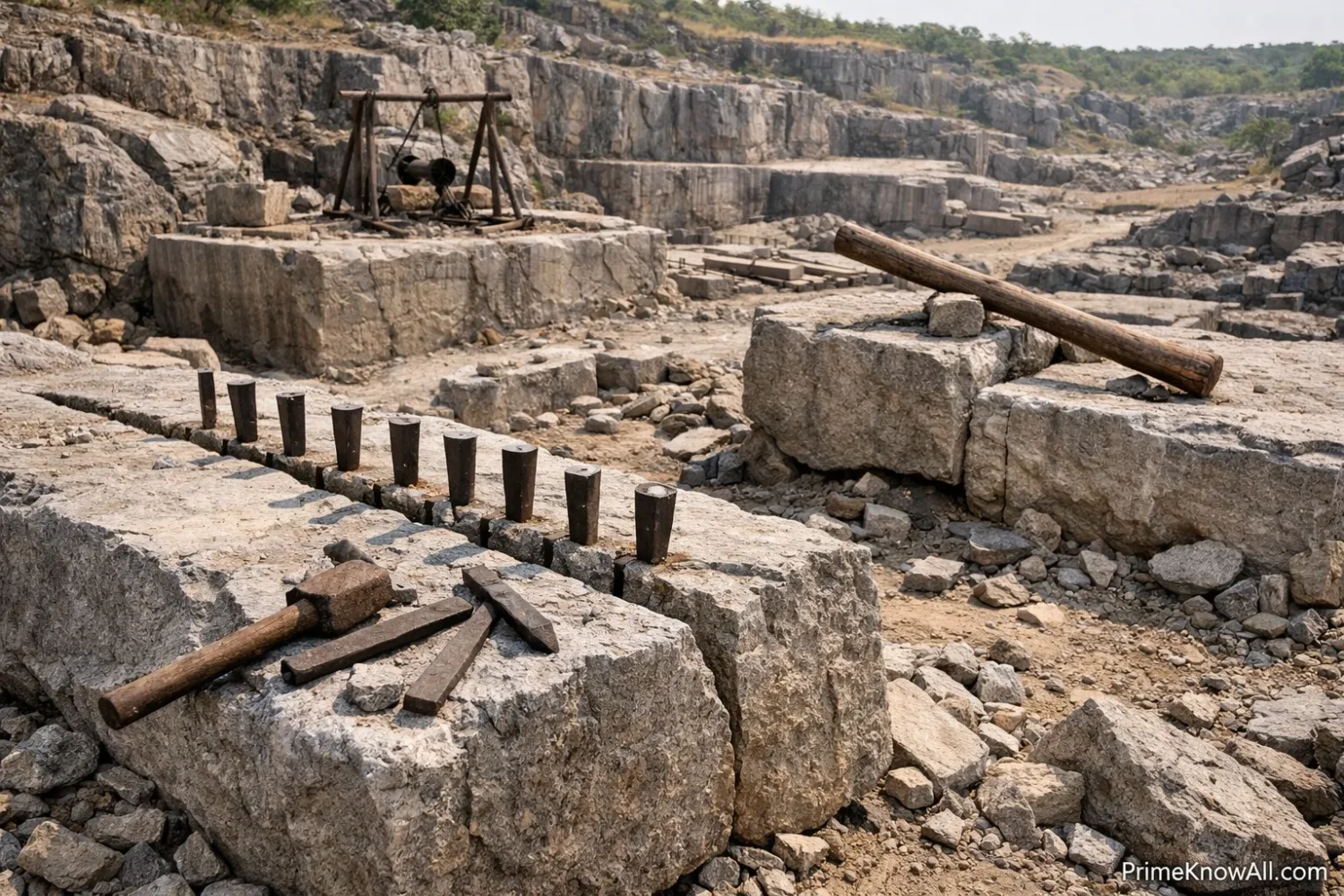
Wedges convert a downward hammer blow into sideways pressure against the walls of a hole or slot. A series of wedges can spread that pressure along a line until a fracture grows through the stone.
The material used for wedges varied. Archaeologists have identified stone wedges in prehistoric contexts and iron splitting wedges in later quarries. A group of iron quarrying tools discovered near Jerusalem, for example, included splitting wedges and associated wedge pieces from a Second Temple-period context.
Roman quarrying made extensive use of prepared wedge cuts. These often remain visible after a block has been removed because part of each socket stays on the quarry face or detached stone.
Using Levers to Open the Final Separation
A nearly detached block still had to be moved away from the bedrock. Wooden beams, poles, or other levers could enlarge existing gaps and give workers mechanical advantage without requiring the entire mass to be lifted vertically.
Lever sockets and extraction cuts found in ancient quarries show how carefully this stage could be prepared. Once enough space opened beneath or behind a block, workers could insert larger supports and continue the movement in stages.
Sawing, Drilling, and Abrasives
Metal did not always need to be harder than the stone to contribute to cutting it. In abrasive sawing and drilling, a metal blade or tube could act as the carrier and guide for hard abrasive particles.
Research on Egyptian stoneworking has shown that particulate abrasives were used with saws and core drills. Fine mineral grains trapped between a tool and the stone did much of the wear. This distinction matters when discussing granite: a copper tool working with an abrasive does not behave like a plain copper edge attempting to slice granite by itself.
| Stone | Methods Often Seen | Typical Surviving Evidence | Main Problem to Control |
|---|---|---|---|
| Limestone | Chiselling, punching, picking, channels, wedges | Tool grooves, galleries, trenches, block beds | Bedding and weak layers |
| Sandstone | Picking, trenching, chiselling, levering | Extraction channels and cut quarry faces | Bedding planes and block dimensions |
| Marble | Channels, point tools, wedges, levers | Wedge sockets, pick marks, extraction trenches | Fractures, veins, grain, clean separation |
| Granite | Stone pounding, trenches, levers, later metal wedges | Pounded hollows, unfinished blocks, wedge cuts | Hardness and hidden fractures |
| Rhyolite and Similar Jointed Rock | Stone wedges and levering along natural joints | Wedges, empty pillar sockets, joint openings | Using existing fractures without breaking the block |
From Bedrock to Building Stone
Extraction worked as a sequence. Skipping a stage could waste many hours of labor or leave a valuable block stranded inside the quarry.
1 — Select the Bedrock
Workers identify stone with the right size, quality, grain, bedding, and fracture pattern.
↓
2 — Mark the Intended Block
Measurements, cut lines, or painted marks define the stone that needs to remain.
↓
3 — Open the Sides
Channels or trenches separate the sides and rear from the surrounding rock.
↓
4 — Create a Controlled Break
Wedges, pounding, levering, or closely spaced point work weaken the remaining attachment.
↓
5 — Free and Rough-Dress the Block
Unneeded stone is removed where practical, reducing weight before long-distance movement.
↓
6 — Move It to a Loading Route
Sledges, slipways, prepared roads, ramps, rollers in suitable settings, ropes, and hauling teams move the stone away from the quarry face.
Why Quarrying Limestone Was Different From Quarrying Granite
The difference was not simply that one stone was “easy” and another was “hard.” Different rock structures changed which operations consumed the most work.
Limestone and sandstone could often be cut directly with pointed metal tools. In Egypt, some deposits were worked in open quarries while good beds elsewhere required galleries extending into hillsides. UCL’s Digital Egypt material notes that workers first removed poor stone and debris before approaching usable material.
Granite required far more attention to pounding, abrasive wear, and fracture control. An apparently solid piece could contain an unseen weakness. The unfinished Aswan obelisk is an unusually large reminder of that risk: work stopped after fissures made completion impractical.
Marble created another set of concerns. A large architectural block needed not only enough volume but also acceptable grain and freedom from damaging fractures or veins. Ancient marble quarry faces consequently preserve highly ordered channels, wedge holes, and staged extraction beds.
How Greek and Roman Quarrying Became Highly Systematic
Greek and Roman quarry workers used techniques with earlier precedents, but many surviving Mediterranean quarries show very regular extraction patterns. Rows of blocks, parallel channels, wedge sockets, loading areas, and transport routes reveal production organized around repeated dimensions.
Quarry Picks and Extraction Trenches
In many Roman quarries, a quarry pick cut deep channels beside and behind a planned block. The marks often form repeated diagonal or curved scars along the channel walls. Once three sides had been opened, workers could prepare the remaining connection for splitting.
At the Aliki quarries on Thasos, surviving traces include pick-cut channels and rows of pointed-tool holes. Such evidence allows researchers to reconstruct the order of operations rather than merely identify the type of stone that was removed.
Pointillé and Controlled Fracture Lines
One recognizable technique uses a row of closely spaced impacts made with a pointed tool. Often described by the French term pointillé, the line weakened a selected plane so that pressure could encourage the stone to separate there.
The value of the method was control. Instead of waiting for a fracture to choose its own path, workers prepared a narrow zone where failure was more likely to occur.
Wedge Lines in Marble Quarries
At Aphrodisias, ancient extraction surfaces preserve lines of wedge holes associated with quarry channels. Some documented sockets are large enough to indicate substantial wedges. When several were driven in sequence, the resulting pressure acted across a broader line rather than at one isolated point.
This technique also reduced unnecessary waste. A controlled split could form part of the eventual surface of the block, leaving less material to remove later.
Transport Was Part of Quarry Engineering
A block was not useful merely because workers had managed to detach it. It had to leave the quarry without breaking, overturning, or becoming trapped.
Dense building stones carry enormous mass in a small volume. Hard limestone and marble commonly fall around 2,500–2,800 kilograms per cubic metre. A rectangular marble block measuring 3 × 1 × 1 metres could therefore approach roughly 7.5–8.4 tonnes before accounting for geological variation.
Quarry floors, access ramps, loading zones, and downhill routes were consequently part of production. Rough dressing near the extraction point could remove expendable material before transport, saving effort farther down the route.
Sledges, Slipways, and Prepared Roads
Evidence from Roman quarry landscapes includes slipways and prepared hauling routes. At Mons Claudianus in Egypt’s Eastern Desert, stone travelled from quarry areas toward loading points before beginning a much longer journey through the desert and beyond.
Mons Claudianus supplied granodiorite used during the Roman imperial period, including stone associated with monumental construction in Rome. The site’s remote location shows that quarry technology cannot be separated from logistics: water, food, labor, roads, animals, loading, and long-distance transport all had to support extraction.
Evidence Preserved at Ancient Quarries
Quarry scars function almost like fossilized work sequences. They can show which tool contacted the rock, where workers wanted a fracture to run, and sometimes which operation came before another.
- Extraction trenches: spaces cut beside a planned block.
- Wedge holes: sockets used to concentrate splitting pressure.
- Point marks: repeated impacts from a pointed tool.
- Pounding hollows: irregular depressions created by repeated stone-on-stone blows.
- Saw grooves: straight cut surfaces associated with abrasive cutting.
- Lever sockets: openings that allowed poles or bars to move partly detached stone.
- Abandoned blocks: pieces left because they fractured, contained defects, or could no longer be extracted efficiently.
- Roads and slipways: prepared surfaces connecting extraction areas with loading zones.
Tool marks need context. A rectangular hole does not automatically identify the material of a missing wedge, and an unfinished block does not always explain exactly why work stopped. Archaeologists compare shape, spacing, geology, associated tools, experimental results, and nearby quarry features before assigning a technique.
Seven Quarry Sites That Show the Techniques in Practice
Different archaeological sites make particular stages of quarrying easier to understand because unfinished work remains visible.
- Aswan, Egypt: The unfinished obelisk preserves a monumental granite extraction project still attached to its source. Its abandoned state makes the scale of trenching and fracture risk easier to see.
- Aphrodisias, Türkiye: Marble quarry faces retain channels and wedge holes that show how workers prepared controlled splitting lines before detaching large blocks.
- Aliki on Thasos, Greece: Pick marks and pointed-tool holes record several stages of marble extraction directly on quarry faces.
- Mons Claudianus, Egypt: Roman extraction areas, loading arrangements, and desert transport infrastructure show that quarrying extended far beyond cutting stone.
- Carn Goedog, Wales: Excavation produced 15 coarse stone tools with wedge-shaped profiles, supporting the use of wedges to open natural joints around Stonehenge-related bluestone pillars.
- Craig Rhos-y-felin, Wales: Stone wedges were found in quarry contexts, including examples positioned in joints near a recess left by a removed pillar. The arrangement helps connect tools with an actual extraction action.
- Anuradhapura, Sri Lanka: Quarry research documents stone splitting based on natural fractures as well as prepared holes and wedges, showing that controlled fracture methods developed far beyond the Mediterranean.
Ideas About Ancient Quarrying That Need More Caution
Several explanations are mechanically possible, yet become misleading when presented as universal methods.
Water-Soaked Wooden Wedges Were Not the Only Splitting Method
Wood can expand when wetted, and wooden wedges or beams are discussed in archaeological studies of stone extraction. Large sockets at sites such as Aphrodisias have also been interpreted in connection with wooden wedges. The technique should not, however, be applied automatically to every ancient quarry or every row of holes.
Wood normally decays, leaving interpretation dependent on socket form, quarry context, later parallels, and experimental work. Stone and metal wedges are directly documented at other sites.
Ancient Workers Did Not Depend on One Tool
A quarrying project could use several technologies during the life of one block. Pounding might open a trench, wedges might create the break, levers might move the detached mass, and abrasive tools might help with later cutting or finishing. Searching for a single device that performed every operation creates an unnecessarily narrow picture.
Copper Tools Did Not Need to Cut Granite Like Modern Steel
Claims that a soft metal cannot have any role in hard-stone working overlook abrasive technology. In a saw or drill system, the metal can guide harder mineral particles that actually wear the stone surface. This does not mean every granite quarry operation relied on copper sawing; it explains why tool hardness alone cannot settle the question.
Fire Was Not a Universal Quarry Solution
Heating can weaken some rocks and archaeological research has documented heat-assisted splitting in certain quarry traditions. Evidence varies by site. It is safer to treat fire-setting as one locally documented option rather than a standard step in all ancient stone extraction.
How Archaeologists Reconstruct Quarry Work Today
Ancient quarries are now studied as entire working landscapes rather than isolated rock faces. Researchers record tool marks, extraction beds, discarded stone, paths, loading areas, buildings, inscriptions, and the geology beneath them.
Recent archaeological work has combined detailed field recording with technologies such as photogrammetry, precise GPS survey, 3D documentation, and geological analysis. A recent study in Antiquity, for example, recorded quarry areas through a multiscale method that included RTK differential GPS and detailed classification of marks such as channelling, wedge cuttings, and pointillé.
This approach matters because an extraction mark has more meaning when its position is known in relation to the quarry floor, access route, waste heaps, neighboring blocks, and later phases of reuse. A group of marks can reveal a sequence that one groove alone cannot.
Experimental Archaeology Tests Whether a Method Works
Researchers also reproduce ancient operations with reconstructed tools. Experiments can test whether a proposed wedge opens a particular rock, whether an abrasive saw leaves the expected surface, or how rapidly a pounder removes granite.
Experiments do not recreate an ancient work crew perfectly. Experience, tool maintenance, local stone quality, working rhythm, and many other variables can change performance. Their main value is narrower: they can establish whether a proposed technique is mechanically plausible and whether it creates marks resembling archaeological examples.
What the Quarry Record Still Cannot Tell Us Exactly
Stone preserves marks extremely well, while wood, rope, leather, baskets, and other organic equipment often disappear. That preservation imbalance can make ancient quarrying appear more dependent on stone and metal than the original workplace really was.
- Some tool types are identified from marks even though the tools themselves have not survived.
- Several tools can sometimes produce superficially similar scars.
- Quarries were often reused for centuries, mixing work from different periods.
- Later extraction can physically remove evidence of earlier quarry faces.
- An abandoned block may preserve the failure but not the decision-making that led to it.
- Experimental work can estimate processes, but ancient labor speed cannot always be calculated precisely.
These uncertainties do not make quarry evidence weak. They explain why the best reconstructions combine tool marks, geology, excavated equipment, experimental work, dating, and site layout rather than depending on one clue.
Ancient stone quarrying becomes easier to understand when extraction is viewed as a chain of controlled operations: choose the right rock, isolate the intended block, create a planned fracture, reduce unnecessary mass, and provide a safe route out. The surviving quarries show a practical technology shaped as much by geology and transport as by the tools held in a worker’s hands.
Questions About Ancient Stone Quarrying
How did ancient people cut stone without modern power tools?
They used picks, chisels, stone pounders, wedges, levers, saws, drills, and abrasives. The exact combination depended on the rock. Many blocks were isolated by cutting channels and then detached along a natural or prepared fracture line.
How did ancient Egyptians quarry granite?
Hard stone pounders were an important part of Egyptian granite working, especially in earlier periods. Workers could pound trenches around a planned mass, use natural fractures where possible, and employ levering and other methods during separation. Abrasive technology was also available for particular cutting and shaping operations.
Did ancient quarry workers use wooden wedges soaked in water?
Wooden wedges or beams are associated with some interpretations and quarry traditions, and swelling wood can exert splitting pressure. The method should not be assumed for every quarry. Stone wedges and iron wedges are directly documented at other archaeological sites.
Why are rows of holes found in ancient quarries?
Many rows are wedge or point-tool holes used to prepare a controlled fracture. Their shape, size, spacing, and archaeological context help researchers determine how they were used.
How were huge stone blocks moved out of quarries?
Methods included sledges, prepared roads, ramps, slipways, ropes, levers, and controlled downhill movement. The method depended on terrain and block size. Large quarry operations often included dedicated transport routes and loading areas.
What can an unfinished ancient block reveal?
An unfinished block can preserve extraction trenches, tool marks, fracture patterns, planned dimensions, and the point at which work stopped. The unfinished obelisk at Aswan is an exceptional example because the enormous granite mass remains attached to its quarry bed.
Sources
- Egyptian Ministry of Tourism and Antiquities – The Unfinished Obelisk. The Egyptian government’s monument record provides the estimated height, mass, location, historical attribution, and reason the Aswan obelisk was abandoned.
- UCL Digital Egypt – Stone Tools for Stone Working in Ancient Egypt. University College London’s archaeological resource summarizes surviving Egyptian stone tools and the use of pounders in granite working.
- UCL Digital Egypt – Stone Working in Ancient Egypt. This university reference discusses chisels, levers, drilling, sawing, and abrasive stoneworking evidence.
- University of Oxford – Oxford Roman Economy Project: Mons Claudianus. The Oxford database identifies the quarry, its stone, geographical setting, and Roman imperial distribution.
- Art of Making – Stoneworking Techniques and Processes. This research resource documents ancient extraction, transport, sledging, quarry roads, and the physical properties relevant to moving marble and limestone.
- UCL Discovery – Reconstructing Extraction Techniques at Stonehenge’s Bluestone Megalith Quarries. The peer-reviewed research reports stone wedges recovered from the Preseli quarry sites and examines how natural rock joints were opened during extraction.
- Israel Antiquities Authority – A Cache of Iron Quarrying Tools Near Jerusalem’s Third Wall. The excavation report documents an unusually well-preserved group of ancient iron quarry tools, including splitting wedges and wedge slats.
- Antiquity – An Interdisciplinary Workflow for the Study of Ancient Quarried Landscapes. The peer-reviewed study explains current methods for recording channels, wedge cuttings, pointillé marks, and quarry landscapes with detailed survey technology.
- UNESCO World Heritage Centre – Aphrodisias Quarry Documentation. UNESCO nomination documentation records extraction evidence at Aphrodisias, including quarry channels and arranged wedge holes used to control block separation.