
Ancient siege engines were practical machines built for one hard job: getting past walls that were designed to slow, expose, and exhaust attackers. Fortifications were not just stone barriers. They were layered systems of height, distance, gates, towers, ditches, earthworks, storage, and psychology.
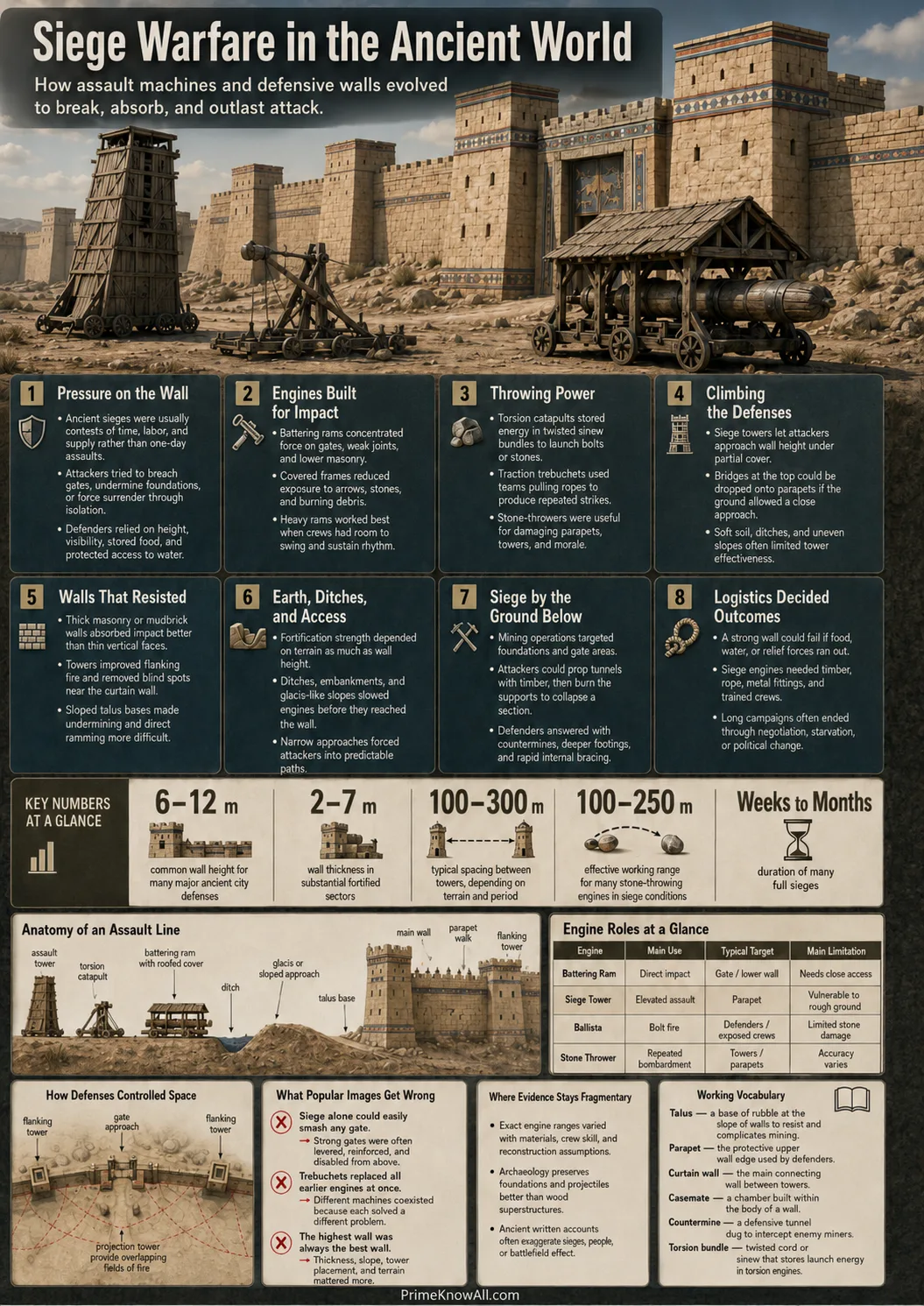
Ultra-short answer: Ancient siege warfare was a contest between engineering pressure and defensive design. Attackers used rams, ramps, ladders, towers, mines, and artillery. Defenders answered with thicker walls, higher towers, angled approaches, fire control, countermines, protected gates, and time.
If You Remember One Thing
- Siege engines were tools for creating a breach, reaching a wall, or forcing defenders to give up.
- Fortifications worked best when they shaped the attacker’s movement, not when they simply stood tall.
- Most sieges were won through pressure, supply, fear, negotiation, disease, or betrayal as much as through machines.
- Popular media often shows catapults as wall-smashers, but many ancient engines were better at clearing defenders, breaking gates, or supporting an assault.
Ancient siege warfare looks simple from a distance: one side hides behind walls, the other side brings machines. Up close, it was slower and more technical. A commander had to read the landscape, choose the weak point, move heavy materials, protect workers, manage food, and keep morale from cracking before the wall did.
A siege engine is a machine or built structure used to attack a defended place. A fortification is a defensive structure made to control access, delay attackers, and protect people, supplies, or political power. Those two ideas shaped warfare from Assyria and Greece to Rome, China, India, and many borderlands across Eurasia and North Africa.
Why Ancient Sieges Happened
Ancient cities were worth attacking because they held food, rulers, temples, workshops, roads, ports, and tax records. Capturing a fortified city could shift control over a whole region, while failing outside its walls could drain an army for months.
For many ancient states, a strong city was not only a place to live. It was a storage system, a symbol of authority, and a protected node in a trade network. This is why walls often surrounded more than houses. They protected granaries, wells, palace compounds, military depots, archives, and ritual spaces.
- Economic value: cities held grain, livestock, metal, textiles, and craft goods.
- Political value: taking a city could remove a local ruler or force tribute.
- Military value: a fortress could block roads, rivers, mountain passes, or ports.
- Psychological value: a famous wall could raise defender morale and slow enemy confidence.
The attacker’s problem was not only “How do we break the wall?” It was also “How do we keep our own army fed while standing in one place?” That made siege warfare a contest of logistics before it became a contest of machines.
How Fortifications Worked
A good fortification forced attackers to do difficult work in exposed places. Height mattered, but the deeper trick was control: walls controlled movement, towers controlled sightlines, ditches controlled approach speed, and gates controlled traffic.
A curtain wall is the long main wall between towers. A gatehouse is the defended entrance area. A ditch is a cut or trench that slows approach and may force attackers into a narrow route. A citadel is an inner stronghold used when outer defenses fail.
- Walls blocked direct entry and gave defenders height.
- Towers allowed defenders to shoot along the wall face and watch the ground below.
- Ditches and moats stopped rams and towers from reaching the wall easily.
- Angled entrances made attackers turn, bunch up, and expose their sides.
- Inner walls gave defenders another line if the outer wall fell.
- Stored food and water turned a wall from a barrier into a survival system.
What This Means
- Walls bought time; they did not guarantee safety on their own.
- Gates were weak points, so many fortifications made entrances bent, narrow, or heavily watched.
- Defensive depth mattered because one broken wall did not always end the fight.
Main Types Of Ancient Siege Engines
Ancient siege engines can be grouped by the problem they solved: reach the wall, break the wall, break the gate, clear the defenders, or undermine the structure. One machine rarely did everything well.
Battering Rams
A battering ram is a heavy beam used to strike a gate or wall repeatedly. It worked through rhythm, mass, and persistence. Many rams were protected by a roofed shelter so workers could keep swinging while arrows, stones, or fire came down from above.
- Best target: timber gates, weaker masonry, or wall bases.
- Needed support: shields, archers, ramps, and workers.
- Main weakness: fire, chains, dropped stones, and ditch obstacles.
Siege Towers
A siege tower is a mobile tower built to lift attackers near wall height. It could protect archers, carry assault troops, or hold a bridge that dropped onto the battlements. Towers were hard to move, so they needed level ground or a prepared ramp.
In Assyrian reliefs, siege machines appear with covered bodies, archers, ramming parts, and defensive water measures against fire. That detail matters. It shows siege engines as working platforms, not just single-purpose battering tools.
Siege Ramps
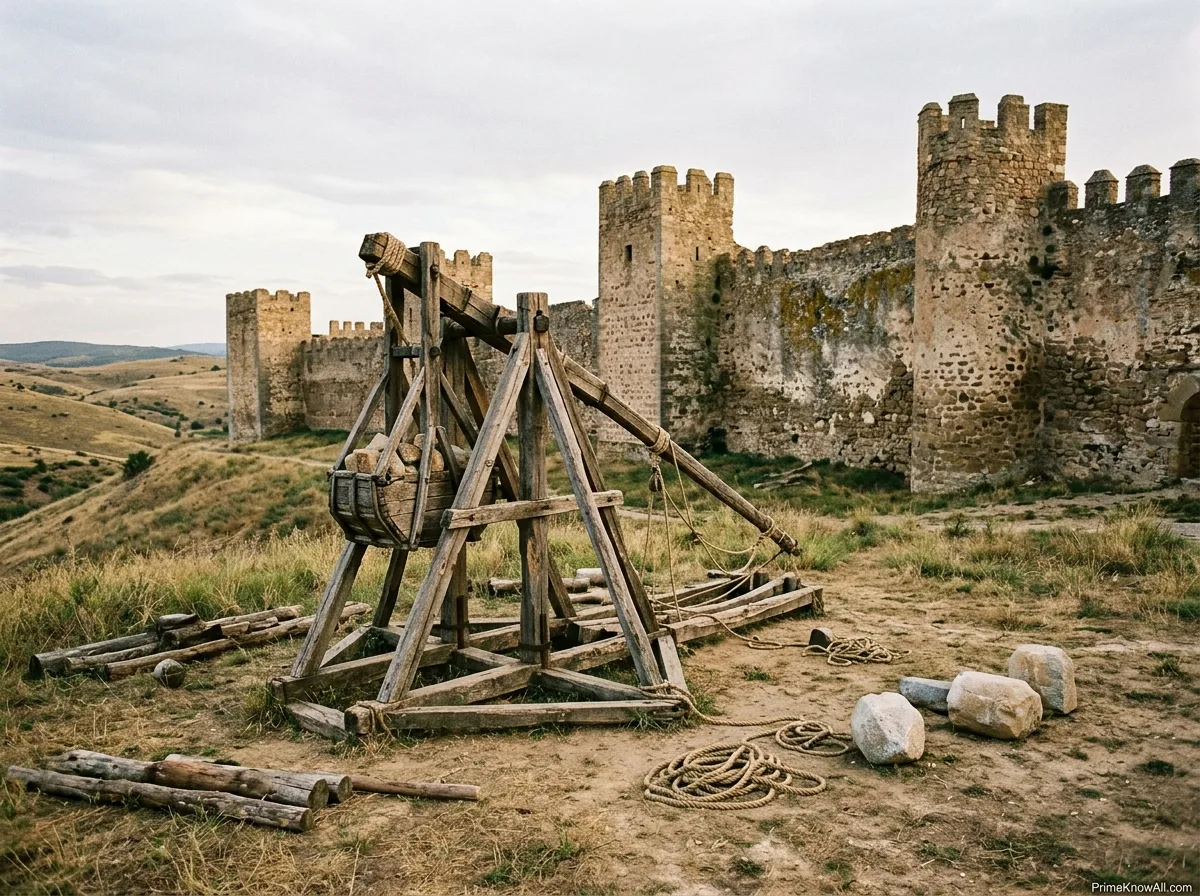
A siege ramp is an artificial slope made from earth, stones, timber, or packed debris. It allowed attackers to move rams, towers, shields, and soldiers toward a wall that was otherwise too high or too well protected by a ditch.
- It solved a movement problem: heavy machines cannot climb steep, broken ground.
- It required labor: ramps took many workers and constant protection.
- It created a narrow focus: once the ramp pointed at one wall section, both sides knew where the pressure would come.
Ladders And Scaling Gear
Ladders were cheap, fast, and risky. They worked best during surprise attacks, night attempts, weakly defended walls, or moments when archers had already pushed defenders back. A ladder assault could end quickly, but it could also collapse into confusion if the first climbers were hit or the ladder was thrown down.
Ballistas, Catapults, And Onagers
A ballista is a torsion-powered missile launcher that could throw bolts or stones. Torsion means stored twisting energy, usually held in tight bundles of sinew, hair, or fiber. A Roman onager used a single arm that snapped upward to throw a stone or load.
Popular images often show one generic “catapult.” Ancient sources and archaeology point to a wider family of machines. Some were built for accuracy against people on walls. Some threw stones. Some shot bolts. Some were mobile enough to move with armies, while others needed a prepared siege position.
| Tool Or Feature | Main Purpose | Typical Strength | Practical Limit |
|---|---|---|---|
| Battering Ram | Strike gates or weak wall sections | Repeated impact from close range | Needed protection from fire, stones, hooks, and arrows |
| Siege Tower | Lift troops and archers near wall height | Turned a vertical wall into a reachable fighting platform | Slow, heavy, and hard to move over rough ground |
| Siege Ramp | Create a path for machines and soldiers | Changed the terrain in the attacker’s favor | Needed time, labor, and constant cover |
| Ballista | Launch bolts or stones | Could offer accurate ranged pressure in trained hands | Required skilled setup, tuning, and maintenance |
| Onager | Throw stones or heavy loads | Delivered arcing shots against wall tops or interior areas | Less precise than some two-armed torsion engines |
| Mining And Sapping | Weaken wall foundations from below | Could collapse a section without climbing it | Dangerous, slow, and vulnerable to countermines |
| Fortified Gatehouse | Control the entrance | Forced attackers into narrow, watched spaces | Still needed strong doors, defenders, and repair capacity |
The Useful Lesson
- No single engine won every siege; machines worked as part of a team.
- Terrain decided a lot; a tower on flat dry ground was very different from a tower facing a ditch and slope.
- Repair mattered; defenders often survived by fixing damage faster than attackers could widen it.
The Engineering Logic Behind A Siege
A siege turned a city wall into an engineering problem. Attackers had to reduce distance, height, cover, and uncertainty. Defenders had to increase all four.
The easiest way to understand this is to picture a locked building with a high fence, cameras, a guarded door, and a narrow driveway. A direct rush is noisy and exposed. A smarter intruder would look for access, blind spots, weak materials, or time pressure. Ancient attackers thought in a similar way, but with timber, rope, earth, stone, shields, ladders, animals, carts, and hundreds or thousands of workers.
- Distance: defenders wanted attackers far away; engines helped attackers get close.
- Height: walls gave defenders elevation; towers and ramps reduced that advantage.
- Cover: shields, mantlets, and roofed machines protected workers.
- Pressure: artillery, archers, and noise forced defenders to split attention.
- Weak points: gates, corners, old repairs, water channels, and wall bases drew close study.
Engineering did not remove danger. It organized danger. Workers building ramps or digging mines were still under attack. Machine crews still needed timber, rope, iron fittings, leather, water, food, and trained hands.
What Defenders Did To Stop Siege Engines
Defenders did not simply wait behind stone. They used fire, hooks, stones, water, countermines, sorties, and repair teams to turn the attacker’s machines into liabilities.
Fire And Water
Wooden siege engines were vulnerable to fire. Defenders could throw burning material, while attackers used wet hides, clay, metal plates, or water crews to reduce that risk. Assyrian reliefs from Lachish show water being used inside siege engines, a small but revealing detail: ancient engineers expected fire and built procedures around it.
Hooks, Chains, And Dropped Stones
A ram worked only if it could keep striking. Defenders could drop stones, lower chains, use hooked beams, or try to catch and lift the ram head. These moves did not need to destroy the whole machine. They only needed to stop the rhythm.
Countermines
A mine is a tunnel dug to weaken or enter a fortification. A countermine is a defensive tunnel dug to find, block, flood, smoke out, or attack the enemy tunnel. This was slow, tense work. Sound could matter as much as sight.
- Stone walls could be thickened or backed with earth to absorb impact.
- Gate passages could be bent so rams lost straight-line force.
- Ditches stopped towers from rolling close without a ramp.
- Raised fighting positions let defenders throw or shoot downward.
- Night repairs could close a breach before morning assault.
A Small Detail That Changes The Picture
- Defenders fought machines indirectly by stopping crews, blocking movement, and ruining timing.
- Fire was useful but not magic; attackers planned for it with water, hides, and protective covers.
- A breach was not always the end; it could become a dangerous choke point.
Famous Ancient Examples That Show The System
The clearest ancient siege evidence often comes from places where archaeology, inscriptions, art, and landscape meet. These examples show that siege warfare was not one invention. It was a set of local solutions shaped by materials, terrain, and political aims.
Lachish And The Assyrian Assault
The Assyrian siege of Lachish in 701 BCE is one of the best-known visual records of ancient siege warfare. Reliefs from Sennacherib’s palace at Nineveh show archers, slingers, artificial ramps, wheeled siege engines, and defenders throwing objects from the walls. The British Museum identifies the Lachish panels as Neo-Assyrian works from roughly 700–692 BCE.
This case is useful because it does not show one dramatic machine doing everything. It shows a combined attack: missile fire, ramp construction, protected approach, ramming, and pressure on civilians and defenders. The wall was not defeated by one object. It was squeezed by a process.
Greek And Roman Artillery
Greek and Roman engineers developed torsion artillery that used twisted bundles to store energy. Reference works describe large ballistas throwing heavy stones or bolts, while smaller versions could move with field forces. Some sources describe the largest ballistas as throwing about 60-pound weights up to about 500 yards, though exact performance depended on design, materials, crew skill, and the projectile.
The main caution: ancient range claims should be read carefully. Surviving texts, later copies, modern reconstructions, and archaeological projectiles do not always line up neatly. That is why exact numbers should be treated as informed ranges, not universal machine ratings.
Hadrian’s Wall As Controlled Movement
Hadrian’s Wall was not a city wall, but it shows how fortification could manage movement across a frontier. English Heritage describes it as a stone or turf wall with a ditch, milecastles, turrets, forts, the Vallum earthwork, and related roads. Its design used repeated small posts and larger forts to watch, delay, and control passage.
This matters because fortification did not always mean “stop every army forever.” In many settings, it meant slow movement, channel traffic, signal danger, and make crossing costly. The same idea appears in border walls, city gates, mountain forts, and desert strongholds.
The Great Wall Tradition In China
The Great Wall is better understood as a long military landscape than as a single wall. UNESCO describes it as a defense project built across many periods from the 3rd century BCE to the 17th century CE, with more than 20,000 kilometers of walls, watchtowers, fortresses, passes, horse tracks, and shelters.
That scale shows a different kind of siege logic: not just defending one city, but managing large frontiers, travel corridors, warning systems, and military movement across varied terrain.
What These Cases Show
- Lachish shows combined siege action: ramp, missiles, engines, and close assault.
- Roman artillery shows the value of trained crews and mechanical precision.
- Long frontier walls show that fortifications could control movement, not just block it.
How A Siege Often Unfolded
A siege usually moved through stages rather than one sudden clash. The order changed by place and period, but many ancient sieges followed a recognizable pattern.
1. The City Is Studied
Attackers look for gates, slopes, water lines, older repairs, weak towers, nearby timber, and places where machines can stand.
2. The Approach Is Prepared
Workers build roads, ramps, trenches, shelters, or artillery positions. Defenders shoot, burn, shout, repair, and watch for the main point of pressure.
3. Machines Create Pressure
Rams strike, towers advance, artillery fires, mines dig, ladders test the wall, and archers try to clear the battlements.
4. A Decision Point Arrives
The city may negotiate, hold, break, burn machines, lose a gate, suffer a breach, or retreat into an inner stronghold.
5. Control Must Be Secured
Taking a wall is not the same as controlling a city. Streets, citadels, stored supplies, and morale still matter.
Common Misconceptions About Siege Engines
Modern games and films make siege warfare easier to picture, but they often flatten the details. The real subject is more interesting because small engineering choices could change the outcome.
| Common Wrong Idea | Better Correction | Why It Gets Misunderstood |
|---|---|---|
| Catapults mainly smashed down every wall. | Many engines were better at hitting defenders, gates, wooden parts, or interior spaces than instantly breaking thick stone walls. | Games need simple damage rules, so machines become wall-breaking icons. |
| A tall wall was enough. | Walls worked best with ditches, towers, gates, stored supplies, and active defenders. | Photos show the wall, not the full defensive system around it. |
| Siege towers could roll anywhere. | They needed prepared ground, ramps, or level surfaces and were poor on rough, wet, or broken terrain. | Models often show the tower without the months of earthwork under it. |
| Ancient machines were crude. | Many were carefully designed around leverage, torsion, protection, crew rhythm, and repair. | Wood and rope decay, so the surviving evidence can look thinner than the original technology. |
| Sieges ended only when walls fell. | Food, water, disease, fear, relief armies, negotiation, and betrayal could decide the result before a full breach. | Wall breaches are more dramatic than supply problems. |
A Cleaner Way To Think About It
- Siege engines were not shortcuts; they were labor multipliers.
- Fortifications were active systems, not passive stone shells.
- Time was a weapon for both sides.
Practical Scenes That Make The Idea Clear
Ancient siege warfare becomes easier to understand when the same logic is moved into familiar situations. These examples do not copy ancient conditions exactly, but they help explain the behavior of walls, machines, and pressure.
- A stadium entrance after a match: gates control flow, and a narrow passage can slow thousands of people. Ancient gatehouses used the same traffic logic in a defensive setting.
- A delivery truck facing a steep driveway: weight and ground matter. A siege tower also needed a usable path, not just wheels.
- A locked warehouse with one main door: the door becomes the target because it is easier to attack than the whole wall. Rams often worked that way.
- A construction site building a temporary ramp: earth and timber can change access. Siege ramps turned vertical defense into a slope problem.
- A video game catapult firing over a wall: the image is familiar, but real machines varied by type, range, projectile, crew skill, and job.
- A phone battery during travel: time changes behavior. In a siege, food and water reserves could matter more than the first day of fighting.
- A fire door in a building: one barrier buys time for people behind it. A fortified wall also bought time, especially when defenders could repair and resupply.
What Remains Uncertain
Ancient siege engines are not always easy to reconstruct with certainty. Many were made from wood, rope, leather, fiber, and metal fittings. Organic parts decay. Written accounts may exaggerate. Reliefs can be stylized. Later copyists sometimes used old terms in new ways.
- Exact ranges are hard to confirm because machine size, projectile weight, weather, crew skill, and reconstruction choices change results.
- Names can shift; words such as catapult, ballista, and onager have not always been used consistently across languages and periods.
- Images are evidence, not blueprints; reliefs show real ideas, but they may simplify scale, perspective, and mechanical detail.
- Local materials mattered; a machine built in a timber-rich area differed from one built where wood was scarce.
A careful reading avoids overclaiming. The best answer is usually a range of possibilities tied to known evidence, not a single universal number for every ancient engine.
Quick Test
Use these short checks to see whether the main ideas are clear. Tap each line to reveal the answer.
A battering ram worked best when it could keep striking the same target again and again.
Answer: True. A ram needed rhythm, protection, and repeated impact. Defenders tried to break that rhythm with fire, hooks, stones, or obstacles.
A tall wall alone made a city safe from siege.
Answer: False. Height helped, but strong defense also needed towers, gates, ditches, supplies, defenders, and repair work.
A siege ramp was a form of engineering, not just a pile of dirt.
Answer: True. Ramps had to support movement, resist collapse, and survive attack while workers built them.
Every ancient “catapult” worked the same way.
Answer: False. Ancient artillery included different machines, including torsion engines that shot bolts or stones and single-arm machines such as onagers.
Defenders could fight a siege engine without destroying it completely.
Answer: True. Blocking movement, stopping the crew, catching the ram, or setting the cover on fire could be enough.
Food and water could decide a siege before a wall was fully broken.
Answer: True. Supplies, morale, disease, negotiation, and relief forces often shaped the outcome.
Why This Topic Still Feels Familiar
Ancient siege warfare still appears in games, films, museum rooms, archaeology news, and heritage tourism because it combines two things people understand: locked places and clever tools. The machines look dramatic, but the deeper story is planning under pressure.
Strategy games such as Age of Empires, Total War, and Civilization keep siege engines in public memory. They simplify the details for play, but they also point to a real historical truth: walls forced attackers to invent workarounds. Every ladder, ramp, tower, and torsion engine was a reply to a defensive choice.
Modern heritage debates also keep these structures visible. When an ancient wall, gate, or frontier line is restored, damaged, mapped, or visited, it becomes more than a ruin. It becomes evidence of how earlier societies organized labor, fear, travel, authority, and defense.
The Main Point To Carry Forward
- The machine and the wall shaped each other; stronger defenses pushed better siege tools.
- Ancient engineers worked with available materials, not fantasy technology.
- The human side mattered; fear, fatigue, hunger, and discipline were part of the design problem.
How To Read Ancient Siege Evidence
The safest way to study siege engines is to compare different kinds of evidence. A museum object, a carved relief, a written account, and a surviving wall each shows part of the story. None should carry the whole answer alone.
- Reliefs show how people wanted events to be seen, including machines, shields, ramps, and defenders.
- Archaeological remains show stones, ramps, burned layers, wall repairs, towers, gates, and projectiles.
- Texts preserve names, measurements, tactics, and claims, but they may reflect bias or later copying.
- Experimental reconstructions test what might work, though modern materials and safety rules can change results.
A balanced view treats siege warfare as applied problem-solving. The best ancient commanders did not ask only which machine was biggest. They asked which tool matched the wall, ground, time, crew, weather, supply line, and morale of that exact place.
Ancient siege engines and fortifications were two sides of the same contest: one side tried to create access, the other tried to make access slow, costly, and uncertain. The most common mistake is to imagine a siege as a single wall-breaking moment. The rule worth remembering is simple: walls delayed, engines pressured, and time decided.
Sources
These sources are useful for checking the historical, archaeological, and technical details used in this article. Museum and heritage pages are used for object-level evidence; academic and reference sources help with terminology and mechanics.
- British Museum – Wall Panel Relief Showing An Assault On Lachish This is reliable because it is the official museum record for a Neo-Assyrian object, with date, material, findspot, and curatorial description.
- The Metropolitan Museum Of Art – Relief Fragment: Siege Of A City By Assyrian Troops This is reliable because it is an official collection entry from a major museum with curatorial notes on Assyrian siege tactics.
- UNESCO World Heritage Centre – The Great Wall This is reliable because UNESCO provides the official World Heritage description, chronology, and heritage value statement for the Great Wall.
- English Heritage – Description Of Hadrian’s Wall This is reliable because English Heritage manages and explains major historic sites in England using archaeological and conservation research.
- Bibliotheca Alexandrina Antiquities Museum – Catapult Projectile This is reliable because it documents an actual archaeological projectile with material, diameter, provenance, and museum context.
- University Of Warsaw Repository – Throwing Artillery From Apsaros Roman Fortress This is reliable because it is an academic repository entry for a study of Roman stone projectiles, including diameter and weight analysis.
- Encyclopaedia Britannica – Ballista This is reliable as a fact-checked reference page for the definition, function, and reported performance of ballistae.
- Encyclopaedia Britannica – Mechanical Artillery This is reliable as a reference overview of tension, torsion, ballistae, onagers, and ancient artillery terminology.
FAQ
What Were Ancient Siege Engines?
Ancient siege engines were machines or built structures used to attack fortified places. They included battering rams, siege towers, ladders, ramps, ballistas, onagers, and mining systems.
What Was The Most Useful Ancient Siege Engine?
There was no single best engine for every siege. A battering ram helped against gates, a tower helped attackers reach wall height, a ramp changed the ground, and artillery pressured defenders from a distance.
Did Ancient Catapults Really Destroy Stone Walls?
Some stone-throwing engines could damage walls, but many ancient artillery pieces were better at hitting defenders, wooden structures, wall tops, or interior spaces. Thick stone walls often needed rams, mining, ramps, fire, or starvation pressure as well.
How Did Defenders Stop Battering Rams?
Defenders used fire, dropped stones, hooks, chains, water, reinforced gates, ditches, and counterattacks. They often tried to stop the crew or break the ram’s rhythm rather than destroy the whole machine.
What Is The Difference Between A Ballista And An Onager?
A ballista usually used two torsion arms to launch bolts or stones. An onager used a single arm that snapped upward to throw a stone or load in an arc.
Why Were Gates Such Weak Points?
Gates had to open, which made them more vulnerable than solid wall sections. Fortifications often protected gates with towers, angled passages, multiple doors, and narrow approaches.
Were Siege Towers Real?
Yes. Ancient evidence, including Assyrian reliefs and later Greek and Roman descriptions, shows mobile towers and protected siege structures. They were difficult to move and needed suitable ground or prepared ramps.