
Ancient religious structures were not only old temples; they were carefully shaped ritual spaces where people managed time, memory, death, power, astronomy, food, sound, movement, and community identity.
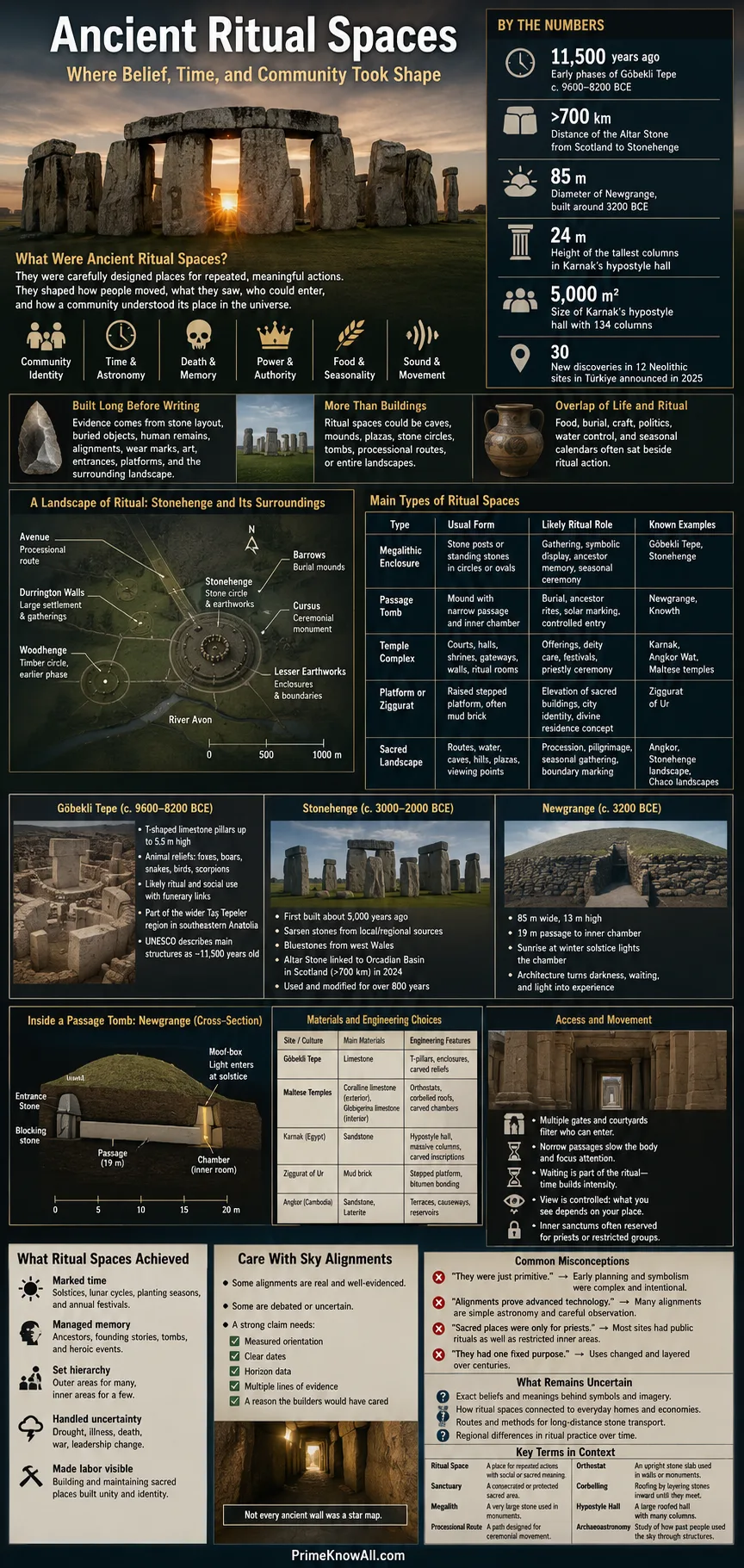
Many of these places were built long before written records, so archaeologists read them through stone layout, buried objects, human remains, alignments, wear marks, art, entrances, platforms, and surrounding landscapes. A ritual space, in simple terms, is a place designed or repeatedly used for patterned actions with social or sacred meaning.
If you remember one thing: ancient ritual architecture was rarely “just a building.” It was a controlled experience that guided where people stood, what they saw, who entered, when ceremonies happened, and how a community explained its place in the universe.
Evidence Used to Interpret Ancient Ritual Spaces
- Ritual space does not always mean a closed temple room. It can be a cave, mound, plaza, stone circle, altar court, procession road, tomb, or landscape route.
- Older does not mean simpler. Göbekli Tepe, dated by UNESCO to about 9600–8200 BCE, already used planned megalithic enclosures and carved limestone pillars.
- Religious use and everyday life often overlapped. Food, burial, craft, politics, water control, and seasonal calendars could all sit beside ritual action.
- Archaeologists use careful language. A structure is called “ritual” when the evidence points that way, not because its function is unknown.
- New science still changes the picture. A 2024 Nature study linked Stonehenge’s Altar Stone to the Orcadian Basin in Scotland, more than 700 km from Salisbury Plain.
What Ancient Religious Structures Really Were
Ancient religious structures were built environments for repeated, meaningful action. Some held images of gods. Some marked burials. Some staged processions. Some framed sunrise, moonrise, mountains, rivers, or stars. Their main job was to make belief visible and repeatable.
A temple is a building used for religious practice. A sanctuary is a consecrated or protected sacred area. A megalith is a large stone used in a built setting, often in prehistoric monuments. A processional route is a path designed for ceremonial movement.
These definitions matter because not every sacred place looks like a later church, mosque, or temple hall. The oldest ritual places may have had no roof. Some had no single “audience room.” Others were built to limit access, so only selected people reached the inner zone.
- Access: who could enter, stand, watch, touch, or speak.
- Orientation: how the structure faced the sun, moon, stars, mountain, river, tomb, or city gate.
- Material: stone, mud brick, timber, plaster, pigment, shells, metal, bone, or packed earth.
- Memory: burials, ancestor remains, deposits, rebuilt floors, and repeated repairs.
- Performance: sound, firelight, incense, offerings, feasting, chanting, movement, and pause.
Hold This Idea:
- Ancient ritual space was about action, not only architecture.
- A place could be religious, political, seasonal, and social at the same time.
- The safest reading starts with evidence, then moves toward interpretation.
Main Types of Ritual Spaces
Ancient ritual spaces came in several forms because societies solved different needs. Some needed a high platform. Some needed darkness. Some needed a long approach. Some needed a chamber that filled with light only on rare days.
The table below gives a simple map of the main forms. It is not a rigid system. A single place could fit more than one type, especially when it was used for centuries.
| Type | Usual Form | Likely Ritual Role | Known Examples |
|---|---|---|---|
| Megalithic Enclosure | Large stone posts or standing stones arranged in circles, ovals, or planned groups | Gathering, symbolic display, ancestor memory, seasonal ceremony | Göbekli Tepe, Stonehenge |
| Passage Tomb | Mound with a narrow stone passage and inner chamber | Burial, ancestor rites, solar marking, controlled entry | Newgrange, Knowth |
| Temple Complex | Courts, halls, shrines, gateways, walls, and ritual rooms | Offerings, deity care, festivals, priestly ceremony | Karnak, Angkor Wat, Maltese temples |
| Platform or Ziggurat | Raised stepped platform, often made of mud brick | Elevation of sacred buildings, city identity, divine residence concept | Ziggurat of Ur |
| Sacred Landscape | Routes, water features, caves, hills, plazas, and viewing points | Procession, pilgrimage, seasonal gathering, boundary marking | Angkor, Stonehenge landscape, Chaco landscapes |
A useful question for these places is: What did the design make easy, and what did it make difficult? Wide courts allow crowds. Narrow passages slow the body. Raised platforms separate a sacred zone from ordinary ground. Deep chambers change light and sound.
Why People Built Ritual Spaces
People built ritual spaces to organize shared meaning. That meaning could involve gods, ancestors, seasons, birth, death, harvest, kingship, healing, oath-making, or social repair after conflict.
In a small settlement, a ritual place may have helped neighbors act as one group. In a large kingdom, a temple could support royal authority, taxation, food storage, festival calendars, skilled labor, and public identity. The same stone wall could carry religious weight and civic order.
- To mark time: solstices, lunar cycles, planting seasons, and annual festivals.
- To manage memory: ancestors, founding stories, royal names, tombs, and heroic events.
- To set hierarchy: outer courts for many people, inner areas for trained or ranked groups.
- To handle uncertainty: drought, illness, death, war, migration, and changes in leadership.
- To make labor visible: moving stones, raising walls, carving reliefs, and maintaining sacred ground.
The strongest analogy is a stage with rules. A ritual space was not a passive backdrop. It told people where to enter, where to stop, what direction to face, when to wait, and which parts of the place were off-limits. The building shaped the ceremony before anyone spoke.
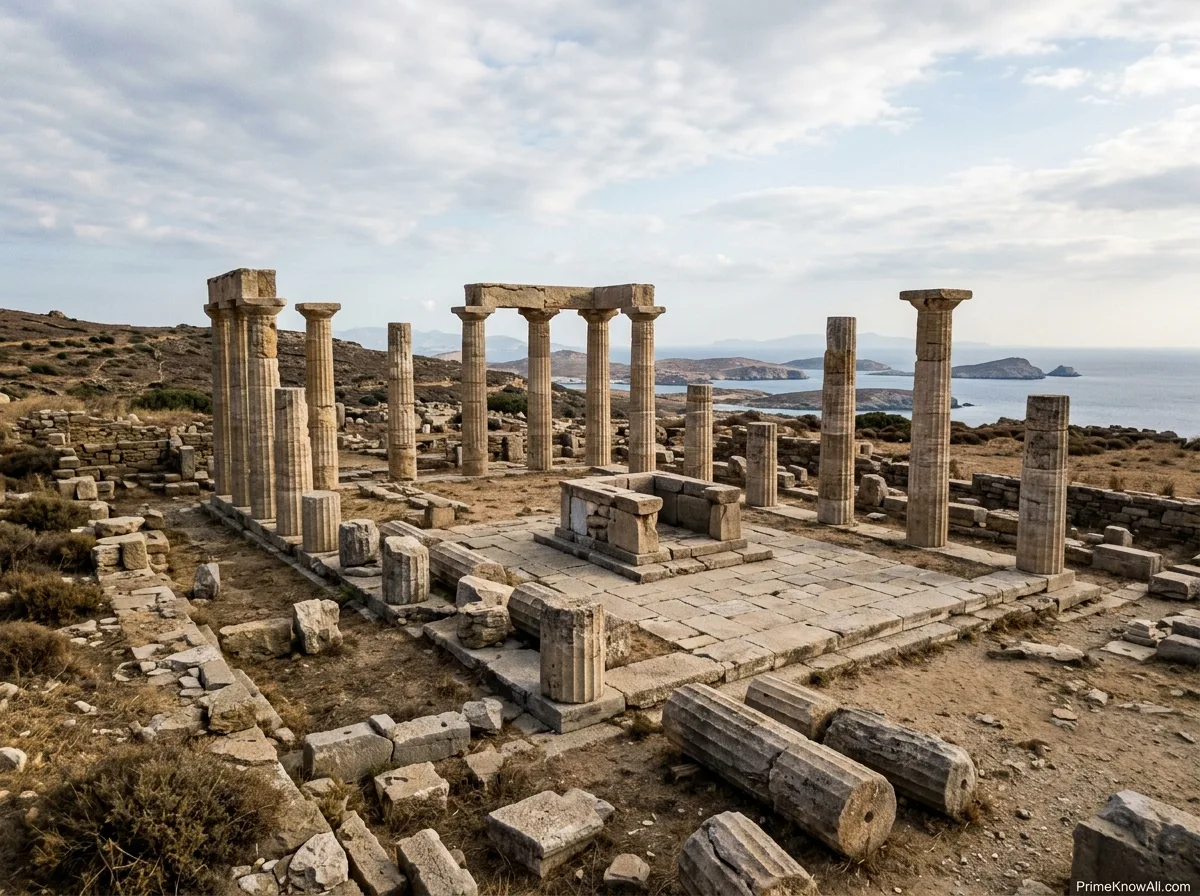
What This Means:
- Ritual architecture often worked through movement and timing.
- A sacred site could also be a storage, teaching, political, or festival place.
- The boundary between daily life and ritual life was not always sharp.
Older Than Cities: Göbekli Tepe and the Taş Tepeler Region
Göbekli Tepe shows that planned ritual architecture appeared before many classic signs of urban life. UNESCO dates its main megalithic structures to the Pre-Pottery Neolithic, about 9600–8200 BCE. Some T-shaped limestone pillars reach about 5.5 meters high.
The site sits in southeastern Anatolia, in a wider region now discussed through the Taş Tepeler project. Recent work at nearby Karahantepe, Sayburç, and Sefertepe has made the old “single isolated sanctuary” picture less tidy. In 2025, official Turkish communications described 30 new discoveries across 12 Neolithic sites, including human figures, carved faces, beads, vessels, and restored areas at Göbekli Tepe.
This matters because ritual spaces were not floating outside society. They were tied to food, residence, skilled carving, group identity, and regional networks. The animal reliefs at Göbekli Tepe are not decoration in the casual sense. They point to remembered animals, danger, hunting knowledge, myth, or group symbols, though the exact meaning remains open.
- Dating: roughly 11,500 years old for early phases at Göbekli Tepe.
- Materials: local limestone shaped into T-pillars, walls, benches, and enclosures.
- Imagery: foxes, boars, snakes, birds, scorpions, and human-like forms.
- Interpretation: likely ritual and social use, with funerary links suggested by UNESCO.
- Open issue: how everyday domestic space and special ceremonial space were connected across the region.
Why Göbekli Tepe Changed the Conversation
For a long time, many readers learned a simple order: farming first, villages next, temples later. Göbekli Tepe complicates that order. It suggests that shared ritual, symbolic art, and organized labor may have helped people gather before fully urban life appeared.
That does not mean “religion invented farming.” It means the relationship between food, settlement, memory, and ceremony was probably more mixed than a neat timeline allows.
Stonehenge and Long-Distance Connections
Stonehenge was part of a broad ceremonial landscape, not a lonely circle of stones. English Heritage places the first Stonehenge about 5,000 years ago, with larger stones brought by around 2500 BCE and further building or alteration continuing for more than 800 years.
The site includes more than the famous standing stones. The wider landscape includes earthworks, barrows, avenues, and earlier activity. That wider setting matters because ritual movement may have taken place across the land, not only inside the stone circle.
The most striking update came in 2024, when a Nature paper reported that Stonehenge’s Altar Stone matches rocks from the Orcadian Basin in Scotland, more than 700 km away. The exact route is still debated. Land, sea, or a mixed route are all difficult. That difficulty is the point: the stone’s journey shows long-distance connection, planning, and shared value.
- Sarsen stones: large local or regional sandstone blocks used for the outer circle and trilithons.
- Bluestones: smaller stones long linked with west Wales.
- Altar Stone: a central sandstone slab now linked by geochemical work to northern Scotland.
- Landscape role: burials, gatherings, seasonal movement, and monument building likely worked together.
Worth Noticing:
- Long-distance stone movement was also a social act, not only an engineering task.
- The latest geology has made Stonehenge feel less local and more connected.
- Its purpose is still best treated as layered: ceremony, burial, gathering, memory, and alignment.
Solar Alignments and Ritual Time
Many ancient ritual spaces used the sky as a clock, but not every alignment was a calendar. Some alignments are clear. Others are debated. The safest approach is to look for repeated evidence: architecture, horizon, dates, light effects, texts, artifacts, and later use.
Newgrange in Ireland gives one of the clearest examples. The mound was built around 3200 BCE. It is about 85 meters wide and 13 meters high, with a 19-meter passage leading into an inner chamber. Around the winter solstice, sunrise light enters through a roof-box above the doorway and reaches the chamber.
This is not a random nice effect. The architecture makes darkness, waiting, narrow movement, and sudden light part of the experience. It turns an astronomical event into a social memory that can be repeated year after year.
- Solstice: the time of year when the sun reaches its highest or lowest noon position in the sky.
- Equinox: a period near equal day and night, depending on location and measurement method.
- Archaeoastronomy: the study of how past societies understood and used the sky through buildings, art, calendars, and landscapes.
- Orientation: the direction a building, passage, entrance, or axis faces.
Why Some Alignment Claims Need Care
People love sky mysteries. That is why Stonehenge, Göbekli Tepe, and pyramid videos travel so well on YouTube and social platforms. But a line on a map is not enough. A useful claim needs measured orientation, clear dating, horizon data, and a reason the builders would have cared.
Some sites were aligned to solar events. Some followed local topography. Some faced water, roads, city grids, tombs, mountains, or earlier monuments. Not every ancient wall was a star map.
Materials, Engineering, and Sacred Labor
The material of a ritual structure shaped what people could build and how long it survived. Stone sites dominate public imagination because they last. Yet many ancient ritual spaces used timber, reeds, mud brick, plaster, pigment, textiles, and organic offerings that decay faster.
The Megalithic Temples of Malta show careful material choice. UNESCO describes builders using hard coralline limestone for exterior walls and softer globigerina limestone for sheltered interiors and carved features. That is a technical decision, not random stone collecting.
Karnak in Egypt shows the other end of scale. Its famous hypostyle hall covers about 5,000 square meters and contains 134 columns. The tallest central columns rise to nearly 24 meters. The result is both structural and sensory: shadow, height, procession, carved text, and filtered light.
- Orthostat: an upright stone slab used as part of a wall or monument.
- Corbelling: a roofing method where stones project inward layer by layer until a space is covered.
- Hypostyle hall: a large roofed hall supported by many columns.
- Mud brick: sun-dried or fired clay brick, common in Mesopotamia and Egypt.
Labor itself may have carried meaning. Quarrying, hauling, carving, plastering, repainting, cleaning, and repairing a sacred place kept a community involved. A monument was not finished once the last stone was set. It needed care.
A Useful Rule:
- Stone tells us what survived, not everything that existed.
- Engineering choices often reveal ritual priorities: height, darkness, approach, durability, sound, or visibility.
- Maintenance can be part of religious life, not just repair work.
Access, Secrecy, and Controlled Movement
Ancient religious architecture often controlled bodies before it taught ideas. A person might pass through a gate, cross a forecourt, climb steps, wait outside a chamber, or face an image only from a certain angle.
In many ancient temples, the most sacred area was not open to everyone. Britannica notes that in older religions, temples were not always designed for communal use in the same way many later worship buildings are. In ancient Egypt and India, the inner sanctum could be reserved for priests or restricted groups.
This does not make the public unimportant. Public festivals, outer courts, offerings, music, food distribution, and processions could allow wider participation without giving everyone access to the inner sanctuary.