
Ancient libraries were organized collections of texts used for scholarship, government, religion, education, or private study. The Library of Alexandria became the best-known because the Ptolemies tied a vast papyrus collection to the Mouseion, a state-supported community of scholars; other libraries, from Ashurbanipal’s tablet collections at Nineveh to the Library of Celsus at Ephesus, worked in very different ways.
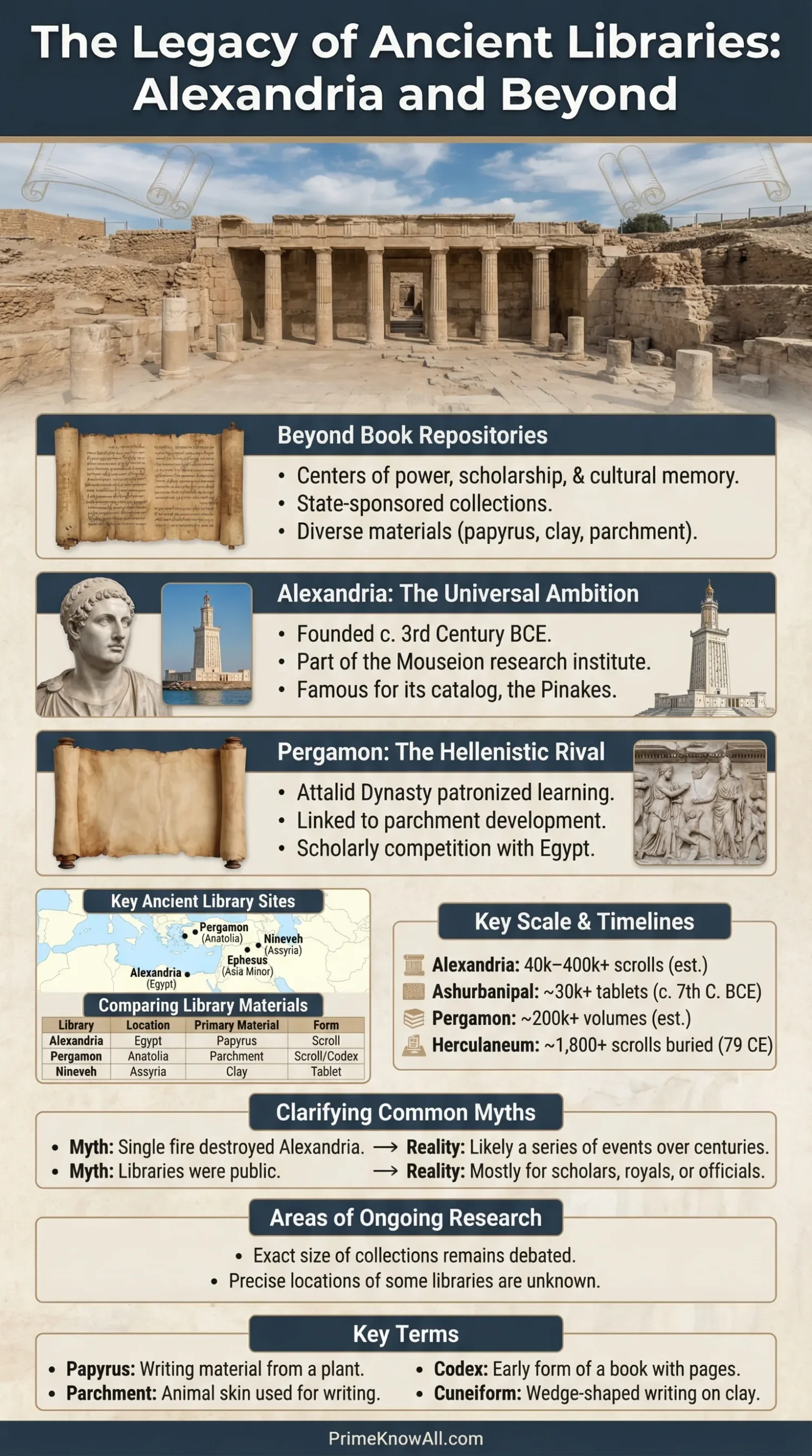
There was no single ancient model of a library. Some collections served kings and scribes, some supported scholars, some stood as civic monuments, and some belonged to wealthy households. Their books could be clay tablets, papyrus rolls, or parchment, and the way those materials survived has shaped what can be known about each library today.
- Alexandria joined a royal book collection with the scholarly life of the Mouseion.
- Nineveh preserved learned texts on clay centuries before the Ptolemies created their library in Egypt.
- Pergamon used a royal library to strengthen its standing as a Hellenistic center of learning.
- Ephesus shows how a Roman-era public library could also serve as a memorial monument.
- Herculaneum preserves the rare remains of a private Greco-Roman library in carbonized papyrus.
What Ancient Libraries Actually Were
An ancient library was not simply a room where anyone could borrow a book. Access depended on the institution. A royal collection could be closely tied to court scholars and administrators, while a civic library might provide reading space and public prestige. Private collections served owners, guests, teachers, and literary circles.
Thinking of Alexandria as one giant reading room is a little like thinking of a modern university as one classroom. The Mouseion was the larger scholarly institution, while books, scholars, cataloging work, meals, teaching, copying, and research formed parts of the same intellectual system.
Library of Alexandria: A Royal Research Center
The Library of Alexandria developed in the early third century BCE under the Ptolemaic dynasty. Ancient and later accounts connect its foundation with Ptolemy I Soter and its expansion with Ptolemy II Philadelphus. It was associated with the Mouseion in Alexandria’s royal quarter, where scholars could work under royal patronage.
The goal went beyond storing scrolls. The Ptolemaic court sought texts from across the Greek-speaking Mediterranean and beyond, while scholars compared manuscripts, edited literary works, studied language, and organized texts for retrieval. The result was one of the earliest large-scale attempts to make a broad body of written knowledge usable inside a single scholarly institution.
The Mouseion and Its Scholars
The Greek word Mouseion referred to a place connected with the Muses. In Alexandria it became a royal scholarly community rather than a museum in the modern exhibition sense. Ancient descriptions refer to shared spaces and common meals for learned members, and later traditions link the institution with figures such as Eratosthenes, Zenodotus, Aristophanes of Byzantium, Aristarchus of Samothrace, and Callimachus.
Alexandrian scholarship was especially influential in the study of Greek literature. Editors compared different copies of Homer and other authors, marked doubtful lines, established preferred readings, and helped shape versions of texts that later readers inherited. This made the library a place where texts were not only stored but also checked, arranged, and edited.
Callimachus and the Pinakes
One of Alexandria’s most important organizational achievements was the Pinakes, a lost bibliographic work associated with the poet and scholar Callimachus. It extended to 120 books according to later evidence and arranged authors and works into categories. Modern scholarship often treats it as an early milestone in the history of bibliography and library cataloging.
The Pinakes mattered because a very large collection becomes much less useful when readers cannot identify what it contains. Author names, titles, literary categories, biographical details, and other descriptive information helped turn accumulated scrolls into an organized body of texts.
Why the Famous Collection Totals Need Caution
- Ancient and later sources give different totals, often reaching hundreds of thousands of rolls.
- A “roll” was a physical object, not always the equivalent of one modern book.
- A long work could require several rolls, while duplicate copies could also be counted.
How Large Was the Library of Alexandria?
Exact numbers cannot be recovered. A UNESCO description of ancient Alexandria repeats traditional estimates of roughly 400,000 to 700,000 papyrus rolls, but these figures come through ancient literary traditions rather than a surviving inventory. They show the scale of Alexandria’s reputation more clearly than they provide a modern-style audited collection count.
The distinction between works and rolls is especially important. A long historical or poetic work could be divided among several physical rolls. Counting 500,000 rolls therefore does not mean Alexandria held 500,000 separate titles.
Did the Library of Alexandria Burn Down in One Fire?
The evidence does not support a simple story in which the entire Library of Alexandria vanished in one clearly documented fire. Ancient reports, later traditions, archaeology, and the changing locations of Alexandrian book collections leave several episodes to consider, and scholars continue to debate how they fit together.
- 48/47 BCE: During Julius Caesar’s fighting in Alexandria, fire spread from the harbor area. Ancient authors report the loss of books, but they differ on what burned and how much of the main collection was affected.
- Later Roman centuries: Alexandria’s royal quarter suffered warfare and urban damage. The Mouseion and its scholarly community also changed over time, so decline may have involved repeated losses rather than one event.
- 391 CE: The Serapeum, a major temple complex associated in later sources with a subsidiary or successor collection, was destroyed. Whether a large working library still remained there is debated.
- 641 CE: The famous story that Arab conquerors burned the Great Library appears in sources written many centuries after the conquest. It is not supported by contemporary accounts of the event.
The safest description is therefore that Alexandria’s great collection and research institution declined and disappeared through a poorly documented sequence of changes and losses. The dramatic image of one fire destroying all ancient knowledge is memorable, but it is much neater than the surviving evidence.
Other Major Libraries of the Ancient World
Alexandria was exceptional in scale and reputation, but it was part of a much older and wider history of collecting written knowledge. Looking at other libraries also shows why the word library can hide very different institutions.
Library of Ashurbanipal at Nineveh
More than three centuries before Alexandria rose to fame, the Assyrian king Ashurbanipal, who ruled from 668 to 631 BCE, assembled scholarly texts at Nineveh in present-day Iraq. The British Museum reports that more than 30,000 cuneiform clay tablets were found in the ruins of Nineveh, although researchers continue to distinguish Ashurbanipal’s library material from other archives and collections at the site.
The texts covered subjects such as medicine, omens, rituals, literature, scholarship, administration, and royal concerns. The collection is especially famous for preserving versions of Mesopotamian literary works, including material related to the Epic of Gilgamesh. Many tablets carried colophons, written notes that could identify ownership, copying history, or a text’s place within a series.
Nineveh also shows how the material of a book affects survival. Clay tablets could break, but fired or baked clay can remain legible for thousands of years. Papyrus usually decays far more easily in damp conditions.
Library of Pergamon
Pergamon in western Anatolia became a major Hellenistic cultural center under the Attalid dynasty. The Metropolitan Museum of Art notes that Eumenes II, who ruled from 197 to 159 BCE, created a royal library there and competed with Ptolemaic Egypt in the acquisition of texts.
Pergamon is often linked with the history of parchment, prepared animal skin used as a writing surface. The old story that parchment was invented there because Egypt stopped exporting papyrus is too tidy to accept as a secure explanation. Animal-skin writing materials existed earlier. Pergamon’s real importance is that its scholarly culture became strongly associated with the production and use of parchment as well as with royal collecting.
The rivalry between Alexandria and Pergamon also shows that royal libraries carried political meaning. Collecting texts, attracting scholars, and supporting monumental architecture allowed Hellenistic rulers to present their cities as centers of education and culture.
Library of Celsus at Ephesus
The Library of Celsus at Ephesus in present-day Türkiye belongs to a different setting: the Roman Empire of the early second century CE. Gaius Julius Aquila built it in honor of his father, Tiberius Julius Celsus Polemaeanus, a Roman senator and former governor of Asia. The building combined a public library with a funerary memorial because Celsus was buried in a chamber beneath it.
The Austrian Archaeological Institute reports that the library once housed around 10,000 papyrus scrolls. Its interior used wall niches and storage cupboards, while the surviving two-story façade made the building an architectural statement as well as a place for books.
The façade seen today is the product of twentieth-century reconstruction using ancient pieces together with added material. Conservation work launched by the Austrian Academy of Sciences is scheduled to continue through 2027, linking the study of ancient libraries with the practical problem of preserving the monuments that housed them.
The Villa of the Papyri at Herculaneum
The library in the Villa of the Papyri near Herculaneum was private rather than royal or civic. When Mount Vesuvius erupted in 79 CE, heat carbonized papyrus rolls inside the villa. The same disaster that made the scrolls extremely fragile also helped preserve material that would normally have disappeared.
Getty sources describe more than a thousand carbonized papyrus book rolls from the villa, while specialists may give different totals when distinguishing fragments from original volumes. Many readable texts are connected with Epicurean philosophy and the writer Philodemus of Gadara.
This collection is unusually valuable because it preserves ancient books from an identifiable library context. Most famous ancient libraries are known mainly through texts, ruins, or scattered manuscripts. Herculaneum preserves the physical remains of the books themselves.
| Library | Main Period | Writing Material | Primary Setting | Evidence Today |
|---|---|---|---|---|
| Ashurbanipal, Nineveh | 7th century BCE | Clay tablets | Royal and scholarly | More than 30,000 tablets from Nineveh, plus archaeological context and colophons |
| Alexandria | Early 3rd century BCE onward | Mainly papyrus rolls | Royal research institution | Ancient literary accounts; no surviving main library building or catalog |
| Pergamon | 2nd century BCE | Papyrus and parchment | Royal and scholarly | Archaeology and ancient literary references; exact collection size uncertain |
| Villa of the Papyri | 1st century BCE–79 CE | Papyrus rolls | Private elite residence | Carbonized scrolls and fragments preserved by Vesuvius |
| Celsus, Ephesus | Early 2nd century CE | Papyrus rolls | Civic library and memorial | Reconstructed monument, storage niches, inscriptions, and archaeological study |
How Ancient Libraries Worked in Practice
The daily use of a library depended on who controlled it, what its texts were made from, and why the collection existed. These examples place the surviving evidence into practical situations.
- A scholar compares two copies of Homer in Alexandria. Different manuscript readings could be checked against one another, helping editors decide how a passage should be presented.
- A scribe copies a medical tablet for Ashurbanipal’s collection. A colophon can record ownership or copying information, making the text part of a managed scholarly corpus rather than an anonymous object.
- A court seeks another city’s texts. For Hellenistic rulers, acquiring books could strengthen both scholarship and royal prestige.
- A reader enters the Library of Celsus. Scrolls are stored in cupboards set into wall niches, while the building itself advertises education, memory, and civic status.
- A Roman household keeps philosophy close at hand. The Villa of the Papyri shows that a large literary collection could belong to a private residence rather than a state institution.
- A modern researcher reads a sealed scroll without opening it. X-ray scanning and computer-based virtual unwrapping can now recover letters from papyri too fragile to unfold physically.
How Books Were Stored, Labeled, and Found
Ancient libraries had to solve the same basic problem as modern collections: how to find the right text among many objects. The solution differed with the writing material.
Papyrus Rolls
Papyrus books were normally rolled rather than bound like a modern paperback. A label or identifying slip could help a reader find a text without repeatedly unrolling every scroll. Storage cupboards, shelves, baskets, boxes, or wall niches could protect collections and keep related material together.
Because papyrus is organic, heat, moisture, insects, handling, and fire could damage it. Egypt’s dry climate has preserved many papyri outside Alexandria, but the ancient library’s own holdings have not survived as a recognizable collection.
Clay Tablets
Cuneiform tablets offered different advantages. Text could be impressed into wet clay with a stylus, and tablets could carry labels or colophons. They were heavier than papyrus, but their durability is one reason so much Mesopotamian writing survives.
Parchment
Parchment, made from prepared animal skin, could be strong, capable of being used again in some circumstances, and suitable for writing on both sides. It later became closely associated with the codex, the ancestor of the modern bound book, although rolls and codices overlapped for centuries.
Five Libraries, Five Different Models
NINEVEH — ROYAL KNOWLEDGE ON CLAY
7th century BCE · More than 30,000 cuneiform tablets from Nineveh are held by the British Museum. The collection served royal and scholarly needs, and clay helped many texts survive.
ALEXANDRIA — BOOKS + SCHOLARS + CATALOGING
Early 3rd century BCE onward · Papyrus collections were tied to the Mouseion. Callimachus’s Pinakes became an early landmark in organizing authors and works.
PERGAMON — ROYAL CULTURAL RIVAL
2nd century BCE · The Attalid court gathered texts and scholars in western Anatolia. Pergamon became strongly associated with parchment and Hellenistic literary culture.
HERCULANEUM — A PRIVATE LIBRARY PRESERVED BY DISASTER
Buried in 79 CE · Carbonized papyri from the Villa of the Papyri preserve an elite Roman-era collection. Digital methods are now revealing text inside rolls that cannot safely be opened.
EPHESUS — LIBRARY AS CIVIC MONUMENT
Early 2nd century CE · The Library of Celsus combined book storage, public architecture, and commemoration. Its reconstructed façade remains one of Ephesus’s best-known monuments.
What Survives and What Researchers Can Recover
The survival pattern of ancient libraries is uneven. Alexandria left an enormous literary reputation but no identified main library building or intact collection. Nineveh left thousands of clay tablets. Ephesus preserves architecture. Herculaneum preserves damaged books.
Nineveh: Reconstructing a Collection From Fragments
British Museum research has been re-examining Ashurbanipal’s library as a whole rather than treating every Nineveh tablet as if it belonged to one undifferentiated collection. Colophons, findspots, textual relationships, and ancient acquisition records help researchers ask which tablets belonged together and how knowledge moved through the Assyrian court.
Ephesus: Conserving the Library Building
The Celsus Library presents a different challenge. Its famous façade was reconstructed between 1970 and 1978, and the Austrian Academy of Sciences began a new multi-year conservation program after recent surveys identified weathering and structural concerns. The planned work runs through 2027.
Herculaneum: Reading Scrolls Without Opening Them
Herculaneum is changing the study of ancient libraries in real time. In 2025, researchers working with the Bodleian Libraries and the Vesuvius Challenge produced readable internal images from PHerc. 172 using high-resolution X-ray scans and virtual unwrapping. In 2026, the Vesuvius Challenge reported that PHerc. 1667 became the first Herculaneum scroll virtually unwrapped and read from end to end.
The method does not physically unfold the scroll. Researchers scan the rolled object, identify its layered writing surface inside three-dimensional data, digitally flatten sections, and use image processing to detect ink. This offers a way to study texts that earlier generations could only reach by damaging or destroying fragile layers.
Alexandria: A Modern Institution Revives the Name
The modern Bibliotheca Alexandrina, inaugurated in 2002, is not a reconstruction of the lost Ptolemaic building. It is a modern cultural and research institution created in conscious memory of Alexandria’s ancient scholarly reputation. That distinction matters because the original library’s precise architecture and location remain uncertain.
What the Evidence Still Cannot Settle
Ancient libraries are often described with more certainty than the evidence allows. Several basic questions remain open or only partly answered.
- The exact size of Alexandria’s collection: the famous totals depend on ancient or later reports, not a surviving shelf list.
- The exact location and form of the main Alexandrian library: the Mouseion belonged to the royal quarter, but no securely identified library building survives.
- The sequence of Alexandria’s losses: Caesar’s fire, later warfare, institutional decline, and the fate of the Serapeum are documented unevenly and interpreted differently.
- The size of Pergamon’s collection: ancient traditions describe a major library, but precise totals cannot be checked against a surviving catalog.
- The unread Herculaneum texts: many papyri remain sealed, damaged, fragmentary, or only partly interpreted, so the intellectual range of the villa’s collection may still expand.
What survives is enough to show that ancient libraries were not copies of the same institution. They ranged from royal scholarly collections to public monuments and private book rooms. Their lasting influence comes less from a single legendary building than from the methods they developed for collecting, copying, organizing, preserving, and interpreting written knowledge.
Sources
- UNESCO World Heritage Centre – Alexandria, Ancient Remains and the New Library. This official heritage record summarizes the Mouseion, the ancient library tradition, Alexandria’s urban setting, and the modern Bibliotheca Alexandrina.
- University of Chicago Library – The Library of Alexandria. This university library overview explains the collection’s scholarly purpose, editorial work, and early bibliographic organization.
- British Museum – What Was Ashurbanipal’s Library?. The museum holds the major Nineveh tablet corpus and reports current research on the collection, its colophons, and its formation.
- The Metropolitan Museum of Art – Pergamon and the Hellenistic Kingdoms. The Met provides museum-based historical context for Eumenes II, the Pergamon library, royal collecting, and parchment traditions.
- Austrian Academy of Sciences – Conservation of the Celsus Library in Ephesos. The institution leading long-term archaeological research at Ephesus provides the building’s history, estimated scroll holdings, reconstruction dates, and current conservation schedule.
- J. Paul Getty Museum – Buried by Vesuvius: Treasures From the Villa dei Papiri. Getty’s archaeological material documents the villa, its rediscovery, and the carbonized papyrus book rolls found there.
- University of Oxford – Inside of Herculaneum Scroll Seen for the First Time in Almost 2,000 Years. Oxford reports the 2025 imaging of PHerc. 172 and explains the use of scanning and digital reconstruction.
- Vesuvius Challenge – Reading the Herculaneum Scrolls. The project publishes current scanning and virtual-unwrapping results, including its 2026 report on reading PHerc. 1667 end to end.
- University of Wisconsin Press via JSTOR – Kallimachos: The Alexandrian Library and the Origins of Bibliography. Rudolf Blum’s scholarly study examines Callimachus, the Pinakes, and the development of ancient bibliography.
- The Open University – Library of Alexandria: The Destruction of the Library. This university resource compares the ancient accounts behind the competing destruction stories and shows where the evidence remains uncertain.
Questions About Ancient Libraries
Was the Library of Alexandria the first library?
No. Organized collections of written texts existed long before Alexandria. Mesopotamian palace and temple collections are much older, and Ashurbanipal’s seventh-century BCE collection at Nineveh predates the Ptolemaic library by several centuries.
How many books were in the Library of Alexandria?
No exact total is known. Ancient and later traditions report hundreds of thousands of papyrus rolls, sometimes around 400,000 to 700,000, but a roll was not the same unit as a modern book and no complete inventory survives.
Who destroyed the Library of Alexandria?
No single destruction account explains the whole history securely. Books were reportedly lost during Julius Caesar’s Alexandrian campaign, later warfare damaged the royal quarter, and the Serapeum was destroyed in 391 CE. The story that the Great Library was burned after the Arab conquest in 641 CE appears centuries later and lacks contemporary support.
Why is the Library of Ashurbanipal important?
Its surviving cuneiform tablets preserve literature, medicine, omens, rituals, scholarly series, and administrative material from Mesopotamia. More than 30,000 tablets from Nineveh give researchers physical evidence that is unavailable for Alexandria’s lost papyrus collection.
Can the Herculaneum scrolls really be read without opening them?
Yes, some can now be studied through high-resolution X-ray scanning, digital surface reconstruction, and virtual unwrapping. The process aims to reveal ink inside carbonized rolls while leaving the fragile physical object closed.