
Ancient harbors were engineered waterfront systems that protected ships, controlled access to shore, and moved cargo from water into cities. Their main structures included breakwaters, moles, quays, piers, slipways, shipsheds, warehouses, canals, and navigation markers. Some relied mainly on natural bays, while others reshaped the coastline with stone, timber, dredging, and later hydraulic concrete that could harden in seawater.
A successful harbor had to solve several problems at once. It needed sheltered water deep enough for vessels, an entrance that ships could approach safely, places to unload or repair them, and routes connecting the waterfront with markets and storage areas. Maintaining that system could be as demanding as constructing it.
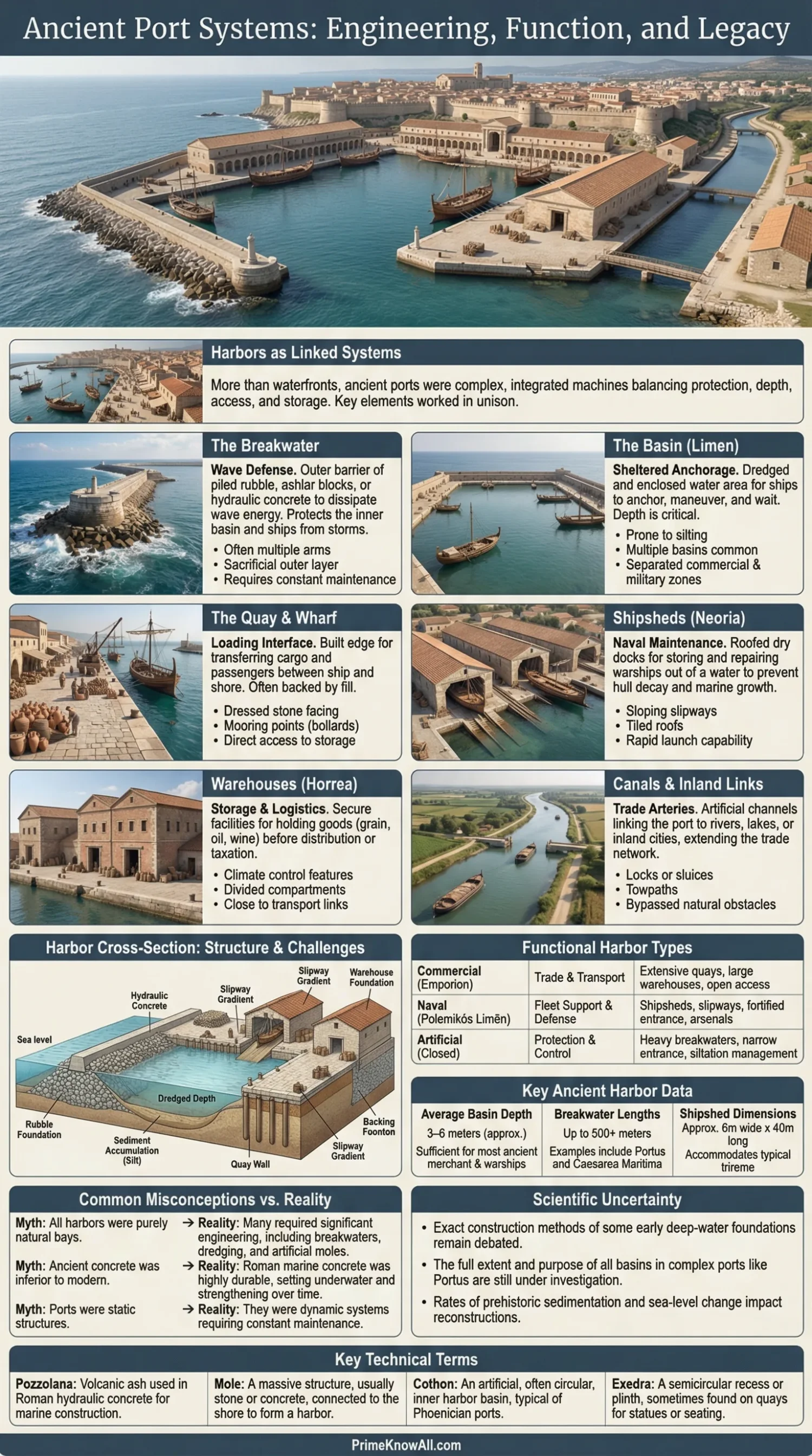
- Breakwaters and moles reduced wave energy before it reached moored vessels.
- Quays, piers, and landing areas created working edges between ships and land.
- Shipsheds and slipways allowed vessels to be hauled from the water for storage or maintenance.
- Dredging and water-control works helped keep channels and basins usable where sediment accumulated.
- Warehouses, roads, and canals turned a sheltered harbor into a functioning port.
Harbor and Port: What Is the Difference?
A harbor is primarily sheltered water where vessels can anchor or moor, while a port adds the facilities needed to load, unload, store, repair, administer, or redistribute ships and cargo. In antiquity, the two often occupied the same place, so the terms overlap in archaeological writing.
A naturally protected bay could serve as a harbor even before large structures were built. Once communities added quays, warehouses, artificial basins, access channels, or ship facilities, the site became much more than a sheltered anchorage. The port was the working system; the harbor was the protected water within or beside it.
Main Structures Inside an Ancient Harbor
Ancient port builders used different combinations of structures according to coastline shape, prevailing waves, local stone, sediment movement, vessel size, and the port’s purpose. A naval base did not need exactly the same facilities as a grain port or a small regional trading harbor.
| Structure | Main Purpose | Typical Construction | Problem Addressed |
|---|---|---|---|
| Breakwater | Protect the basin from waves | Rubble, large stone blocks, concrete in some Roman ports | Wave energy and exposed water |
| Mole | Extend a solid structure into the sea | Stone fill, masonry, concrete piers or continuous masses | Shelter, access, and harbor entrance control |
| Quay | Create a waterfront loading edge | Stone walls, masonry facing, timber elements | Cargo transfer between vessel and shore |
| Pier or Jetty | Provide access to deeper water | Stone, timber, or mixed construction | Limited depth close to shore |
| Slipway | Haul vessels out of the water | Sloping stone or prepared surface | Repair, inspection, and storage |
| Shipshed | Shelter vessels on land | Long roofed bays beside slipways | Fleet storage and maintenance |
| Harbor Basin | Provide protected maneuvering and mooring water | Natural inlet or excavated basin | Safe vessel handling |
| Access Channel | Connect deeper water with inner facilities | Excavated or maintained waterway | Navigation through shallow coastal zones |
Breakwaters and Moles
Breakwaters were the harbor’s first defense against the sea. Builders extended stone or concrete structures outward so incoming waves lost energy before entering the basin. Some moles were continuous barriers, while certain Roman installations used separated concrete piers that allowed more water and sediment to pass between them.
The entrance required careful placement. An opening that was too exposed could send swell directly into the harbor. A narrow or awkward entrance could make sailing vessels harder to maneuver, especially when wind direction changed. Ports therefore used the shape of the coast, overlapping structures, offshore reefs, or curved approaches to improve shelter.
Quays, Wharves, and Mooring Areas
Quays formed the working edge of many ports. Instead of unloading onto an ordinary beach, crews could bring a vessel beside a prepared waterfront where people, amphorae, sacks, timber, stone, and other goods could move onto land more efficiently.
Archaeologists sometimes find mooring stones, bollard-like elements, rings, cuttings, or holes associated with these waterfronts. Their exact use can be difficult to reconstruct because ropes, wooden posts, cranes, gangways, and other working equipment rarely survive as well as masonry.
Slipways and Shipsheds
Warships and smaller vessels could be pulled onto inclined slipways rather than left continuously in the water. Roofed shipsheds extended the idea by protecting hulls while vessels were stored ashore.
The naval installations of Piraeus, including Zea and Mounichia, show how large this shore-based infrastructure could become. Long rows of narrow bays created organized spaces where fleets could be housed, maintained, and returned to the water. These structures were part of naval readiness rather than simple boat parking.
Warehouses, Roads, and Canals
A harbor could protect a ship without being an efficient port. Storage and inland transport completed the system. Warehouses stood near quays so cargo did not have to travel far before being sorted or stored. Roads linked waterfront districts with towns, while canals could connect a sea harbor with rivers and inland distribution routes.
At Portus near Rome, maritime basins, canals, warehouses, river connections, and roads worked together. Cargo arriving on Mediterranean ships could be transferred through the port complex and moved toward Rome through the Tiber transport network.
From Open Water to the City
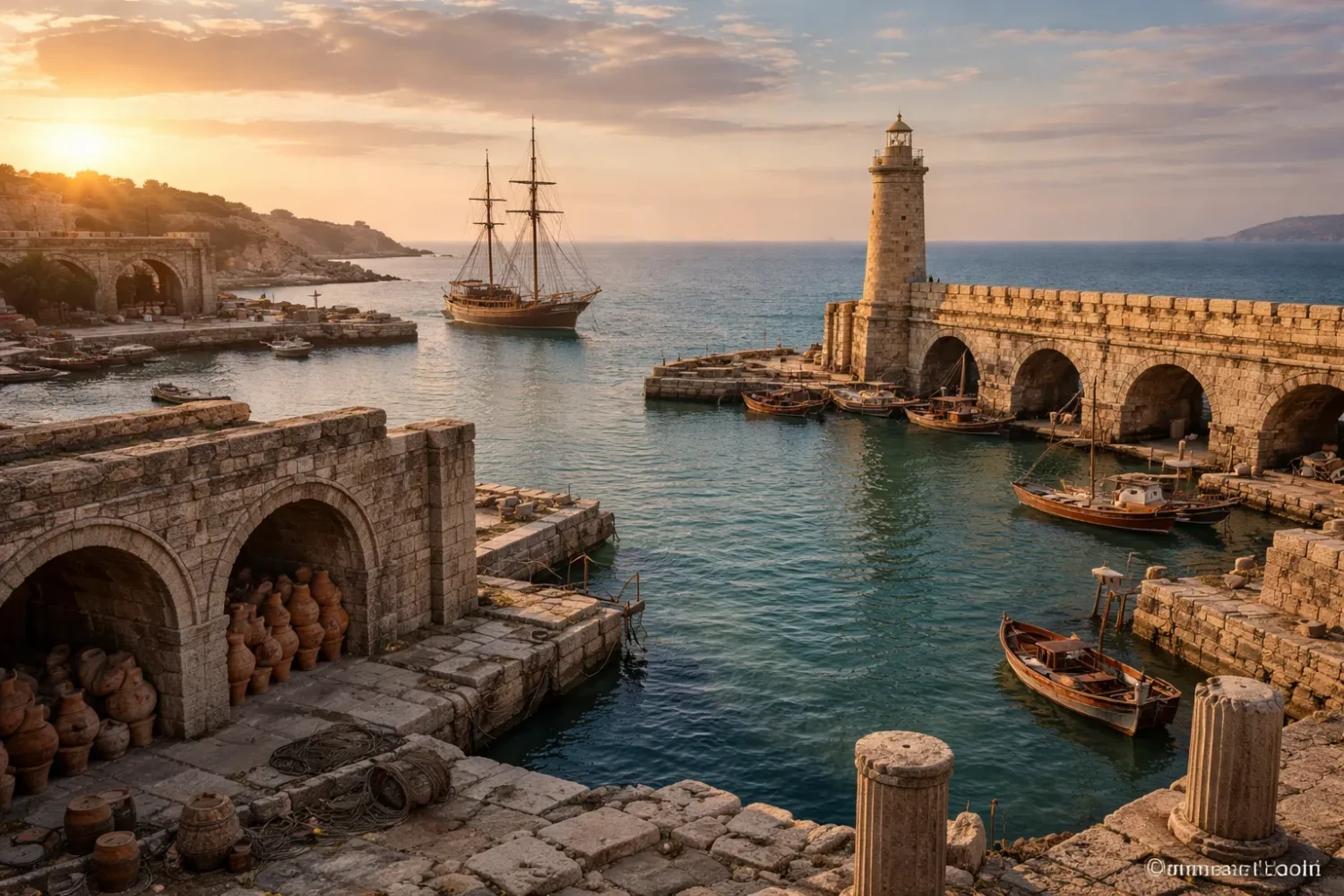
A vessel entering a developed ancient port passed through several connected engineering zones.
Sailors identified the coastline, entrance, headlands, towers, fires, or other visible markers before reaching confined water.
Moles or natural landforms reduced incoming wave energy while leaving a navigable opening.
Ships entered calmer water with enough depth and turning room for anchoring, maneuvering, or approaching a quay.
Lines secured the vessel while crews moved people and cargo between ship and shore.
Goods were counted, sorted, carried, rolled, lifted, or transferred into nearby working areas.
Warehouses protected cargo; workshops, slipways, and shipsheds supported vessels and equipment.
Roads, rivers, canals, pack animals, carts, and smaller boats carried goods beyond the waterfront.
How Ancient Engineers Built in the Sea
Ancient engineers built marine structures by combining heavy stone foundations, rubble filling, timber formwork, masonry, and locally suitable construction methods. Roman builders later used hydraulic concrete on a scale that allowed large artificial harbor works to be created even where natural protection was limited.
Stone and Rubble Construction
Stone was used long before Roman concrete. Large blocks could form facing walls or stable edges, while smaller rubble created the mass beneath and behind them. Where seabeds were soft, builders had to spread loads or prepare foundations carefully. Timber piles and wooden structural elements were also used in suitable conditions.
Projects did not follow a single Mediterranean recipe. Available materials mattered. A rocky coastline offered different possibilities from a sandy delta, while an established natural inlet required less artificial enclosure than a port built on an exposed shore.
Roman Hydraulic Concrete
Roman hydraulic concrete could set in wet conditions because lime-based mortar was combined with reactive volcanic material. For maritime work, volcanic ash associated especially with the Bay of Naples became an important ingredient. Builders could place mortar and aggregate inside wooden forms in or beside seawater.
Research on surviving Roman marine concrete has identified durable mineral reactions within some ancient mixtures. This does not mean every Roman harbor structure survived intact or that all Roman concrete had identical properties. Exposure, construction quality, earthquakes, foundation movement, wave attack, and later human activity all affected survival.
Why hydraulic concrete changed harbor construction
- Large masses could be formed where ordinary dry masonry construction was difficult.
- Concrete could bind stone aggregate into substantial underwater foundations.
- Engineers gained more freedom to create artificial moles, piers, and breakwaters beyond naturally sheltered bays.
An ancient harbor can be compared to a shock absorber joined to a freight terminal. The outer works absorbed part of the sea’s energy, while the inner structures organized ships, cargo, storage, and movement. A strong breakwater alone was therefore not enough; the protected water and the shore facilities had to work as one system.
Why Water Depth and Sediment Were Constant Problems
Keeping a harbor deep enough could require continuing maintenance. Rivers carried mud, coastal currents moved sand, storms rearranged seabeds, and protected basins could trap material that open water might otherwise disperse.
Geoarchaeological research at Tyre has found evidence consistent with large-scale ancient dredging. Sediment cores indicate that material was removed from the harbor during Greco-Roman and later periods. At Portus, sediment studies have also identified deposits interpreted in connection with dredging and water-management activity.
This changes the way ancient ports should be imagined. Their usable depth was not simply determined on opening day and then left unchanged. Harbor management included an environmental problem: sediment never stopped moving.
Why Some Breakwaters Were Not Solid Walls
Some Roman harbor works used separate concrete pilae, or massive piers, rather than a fully closed barrier. Such arrangements could reduce wave force while allowing water to pass through the gaps. In places affected by strong sediment movement, circulation may also have helped limit the trapping of sand inside protected water.
That does not mean every open-pier breakwater was designed primarily as a sediment-control device. Local wave conditions, access, structural economy, water circulation, and available construction techniques could all influence the form.
Six Harbors That Show Different Design Choices
Several well-studied ports show how ancient communities adapted harbor engineering to very different coastlines and needs. No single site represents all ancient ports.
- Piraeus, Greece: Athenian naval harbors combined protected basins with extensive slipways and shipsheds. The arrangement suited fleets that needed vessels stored, serviced, and launched in an organized way.
- Carthage, Tunisia: The Punic port zone included distinct commercial and military harbor spaces. Archaeological work around the circular military harbor indicates a dense arrangement of naval installations, showing how specialized waterfront zones could separate different activities.
- Caesarea Maritima, Israel: Herod’s harbor, Sebastos, was created on a coast without a naturally ideal deep harbor. Large artificial breakwaters and Roman-style hydraulic concrete allowed engineers to enclose protected water on an exposed shore.
- Portus, Italy: Rome’s imperial harbor developed into a network of basins, canals, quays, storage areas, and transport routes. Trajan’s hexagonal basin added protected inner water to the earlier Claudian works.
- Lechaion, Greece: Excavations at the harbor of ancient Corinth have revealed large Roman-period basins and monumental moles. One documented mole measured about 45 meters long, 18 meters wide, and 4 meters high, showing the scale possible at a regional commercial harbor.
- Alexandria, Egypt: The long Heptastadion connection between the mainland and Pharos helped divide the waterfront into harbor areas. The famous lighthouse on Pharos then served navigation near one of antiquity’s busiest maritime cities.
Aegina: A Newly Reconstructed Ancient Offshore Harbor System
Research published in 2026 has given the ancient harbor of Aegina in Greece a much clearer engineering profile. Offshore from the Classical city lies an unusual line of rubble-mound conical structures, now submerged beneath the Saronic Gulf. More than 50 individual structures have been documented between the northern and southern harbor breakwaters, following the ancient maritime frontage for about 1.7 kilometers.
A study published on May 9, 2026 reconstructed these structures experimentally using archaeological, geophysical, and hydraulic data. Reduced-scale models were subjected to wave conditions to estimate their original form and the way their stone crests changed through erosion. The results indicate that the structures were probably emergent above the contemporary water level when first built, with broad rubble bases and extra height that allowed them to remain functional as waves gradually altered their profiles.
A follow-up study published on June 24, 2026 examined the offshore system as a whole. The conical mounds form a planned, partly sinuous line with controlled gaps between groups and are chronologically associated with the development of Aegina’s naval harbor around 480 BCE. Individual structures have base radii of roughly 8.2–11.3 meters and consist of uncemented limestone rubble rather than mortared masonry.
The newer analysis also changes how their function is understood. Modeling found that the structures did not remain efficient wave-dissipating breakwaters after their early crest erosion. They were more consistent with a maritime access barrier: shallow obstacles that restricted vessels from simply crossing the offshore line and directed movement toward controlled openings. That interpretation connects harbor engineering with naval defense, showing that an offshore structure could regulate where ships could pass without forming one continuous solid wall.
What Harbor Dimensions Tell Us
Measured remains help show how far ancient harbor construction could move beyond a simple protected beach. Large basins, long moles, and enormous waterfront buildings point to carefully planned movement of many vessels and cargoes.
- Geoarchaeological drilling at Portus has indicated water depths of roughly 7–8 meters in its main Roman harbor basins.
- A large building at Portus associated with ship-related activity measured about 240 × 58 meters in the excavated reconstruction.
- The inner harbor Basin 3 investigated at Lechaion covers roughly 24,500 square meters.
- Research on Caesarea Maritima describes an outer harbor basin of about 20 hectares, enclosed by major artificial works.
- UNESCO documentation describes Alexandria’s Heptastadion connection as approximately 1,800 meters long.
Measurements should still be treated with context. Ancient shorelines moved, structures collapsed or were reused, and archaeological reconstructions may change as new surveys refine earlier plans.
Lighthouses and Harbor Entrances
Navigation structures helped sailors identify ports and negotiate entrances, especially where offshore hazards or complex waterfronts made visual guidance useful. Ancient harbors could use monumental towers, fires, landmarks, harbor-mouth structures, and other visible reference points.
The Pharos of Alexandria is the best-known example, but it should not be treated as the standard form of every ancient harbor beacon. Many ports operated without anything comparable in size. Smaller towers or ordinary coastal landmarks could serve the practical need without becoming monumental architecture.
How Cargo Moved Through an Ancient Port
Unloading was only the first stage of port logistics. Cargo might move from a large seagoing vessel to the quay, into a warehouse, onto carts, into river craft, or through a canal before reaching its final market.
Bulk foodstuffs, amphorae, stone, timber, metal, ceramics, and luxury goods placed different demands on the waterfront. Heavy objects benefited from short transfer distances and firm working surfaces. Perishable goods needed efficient movement. Valuable goods required storage and administrative control.
This is why the archaeological boundary of an ancient port can extend well beyond the water itself. Warehouses, roads, workshops, administrative buildings, markets, canals, and settlement areas may all preserve evidence of port activity even when the original basin has disappeared.
Why Ancient Ports Can Be Inland or Underwater Today
An ancient harbor’s modern position may look completely wrong because coastlines do not remain fixed. Sediment deposition can push shorelines seaward, while subsidence, earthquakes, erosion, or changes in relative sea level can place ancient waterfront structures underwater.
Portus is now separated from the modern coastline by land formed through changes in the Tiber delta. Parts of ancient Alexandria, by contrast, survive beneath the sea. At Aegina, the rubble-mound conical harbor structures that were probably at least partly emergent when built are now fully submerged, showing how sea-level change and long-term wave erosion can transform the appearance of maritime works.
A masonry wall found hundreds of meters from today’s water therefore cannot automatically be dismissed as unrelated to maritime activity. Archaeologists must reconstruct the ancient coastline rather than assume the modern shoreline existed in the same place.
How Archaeologists Reconstruct Lost Harbors
Ancient port archaeology combines architecture with underwater survey, geophysics, sediment analysis, dating methods, environmental evidence, and historical records. Much of a harbor may be invisible from the surface.
Underwater Survey
Divers and marine survey equipment can record submerged masonry, breakwaters, wrecks, anchors, harbor floors, and scattered architectural material. Precise mapping matters because collapsed blocks may have moved far from their original positions.
Sediment Cores
Cores preserve layers of harbor mud, sand, shells, organic material, and human debris. Changes in these layers can reveal when protected harbor conditions developed, how rapidly sediment accumulated, and whether parts of a sequence were removed by dredging.
Geophysical Survey
Magnetic and other remote-sensing methods can locate buried structures without exposing every wall. At Portus, a major magnetometer program surveyed about 220 hectares and identified buried buildings, roads, canals, warehouses, and other features across the wider harbor landscape.
Reconstructing Ancient Sea Level
Quay heights, biological remains, sediment layers, submerged architecture, and geological evidence can help estimate former water levels. This work is especially important when interpreting slipways and quays because a small vertical change can alter how a structure would have met the water. At Aegina, reconstructing Classical-period sea level was also central to testing whether the offshore rubble mounds originally stood above, at, or below the water surface.
Ideas About Ancient Harbors That Need More Context
Several simple descriptions of ancient ports become misleading when applied to every site. Harbor design changed according to geography, date, function, available materials, and later rebuilding.
- “Romans invented harbors.” Coastal communities built ports and artificial harbor works long before Roman rule; Roman engineers expanded some techniques and used hydraulic concrete widely in maritime construction.
- “Every harbor had a lighthouse.” Large navigation towers are archaeologically and historically visible, but many ports functioned with smaller markers or no known lighthouse.
- “Breakwaters were always solid stone walls.” Designs ranged from rubble barriers to masonry moles and separated concrete piers. Aegina’s conical rubble system shows an even less familiar form in which individual offshore mounds created a controlled maritime obstacle.
- “Once built, the harbor needed little work.” Sediment, storms, structural wear, and changing shorelines could require repair, dredging, rebuilding, or altered channels.
- “The modern shoreline shows where the ancient shoreline was.” Delta growth, erosion, subsidence, earthquakes, and sea-level change can move the apparent coast substantially.
What Archaeology Still Cannot Resolve
Many ancient harbor plans remain incomplete because the most informative areas may be buried, submerged, destroyed, or covered by modern cities. Even well-known ports contain structures whose exact functions continue to be debated.
Timber equipment rarely survives unless waterlogged conditions preserve it. Ancient cranes, ropes, gangways, small navigation markers, temporary structures, and everyday harbor tools can therefore disappear while stone walls remain. This creates an archaeological record weighted toward permanent construction.
Dating can also be difficult. Harbor walls were repaired repeatedly, old blocks were reused, and dredging disturbed sediment layers. A structure visible today may contain work from several centuries rather than one construction campaign. At Aegina, the association of the offshore conical system with construction around 480 BCE is supported by its archaeological and spatial context, but researchers note that the proposed chronology still needs targeted in-situ confirmation.
Ancient harbors make more sense when viewed as changing coastal systems rather than isolated monuments. Their success depended on the interaction of waves, depth, sediment, ships, waterfront structures, storage, and inland transport. The surviving stones record only part of that activity; sediments and altered coastlines often preserve the rest.
Questions About Ancient Harbors
What is the difference between an ancient harbor and an ancient port?
A harbor is protected water suitable for anchoring or mooring vessels. A port includes the working facilities associated with maritime activity, such as quays, warehouses, repair areas, roads, canals, and administrative spaces. One location can be both.
How did Romans build structures underwater?
Roman builders used several methods, including stone foundations and wooden formwork. For some maritime projects they placed lime mortar mixed with reactive volcanic ash and stone aggregate inside forms, producing hydraulic concrete that could harden in wet conditions.
Did ancient ports have to be dredged?
Some did. Sediment cores from sites including Tyre and Portus provide archaeological evidence consistent with ancient dredging. The need depended on local rivers, currents, harbor shape, sediment supply, and water depth.
Why are some ancient ports far from the sea today?
River sediment and coastal deposition can push a shoreline outward over centuries. Portus near Rome is a well-known example of a port whose ancient maritime landscape is now inland.
Why are other ancient port structures underwater?
Subsidence, earthquakes, coastal erosion, long-term structural erosion, and relative sea-level change can submerge former waterfronts. Parts of ancient Alexandria and Aegina’s offshore harbor system are now preserved below modern sea level.
What were ancient shipsheds used for?
Shipsheds were roofed spaces associated with slipways where vessels, especially naval craft, could be hauled from the water and protected while stored or maintained.
What are the submerged conical structures at Aegina?
They are more than 50 large rubble-mound structures arranged offshore along roughly 1.7 kilometers of Aegina’s ancient waterfront. Research published in 2026 indicates that they were probably higher and at least partly emergent when constructed and later eroded into their submerged form. Current modeling favors their use as a maritime access-control barrier associated with the Classical harbor system rather than as a long-lived wave breakwater.
Sources
- Portus Project – Portus and Ostia. This university-led archaeological project documents the Claudian and Trajanic harbor basins, canals, quays, warehouses, and the relationship between Portus and Ostia.
- Portus Project – Geophysics. The project describes its large-scale magnetometer survey and explains how buried port buildings, roads, warehouses, canals, and other structures were identified.
- npj Heritage Science – Understanding the Original Morphology and Hydraulic Behaviour: The Ancient Rubble-Mound Conical Structures of Aegina, Greece. This peer-reviewed study, published on May 9, 2026, experimentally reconstructed the Aegina rubble-mound structures and tested their response to wave forcing, providing evidence that their original crests were likely emergent around the proposed Classical construction period.
- npj Heritage Science – Reconstructing Functional Performance and Resilience in Submerged Coastal Heritage: The Offshore Harbour System of Aegina. This peer-reviewed study, published on June 24, 2026, examines the 50-plus conical structures, their approximately 1.7-kilometer alignment, controlled openings, long-term erosion, and their likely role as a maritime access barrier.
- University of California, Berkeley – To Improve Today’s Concrete, Do as the Romans Did. UC Berkeley summarizes laboratory research into Roman maritime concrete, volcanic ash, lime, seawater reactions, and surviving harbor structures.
- University of Copenhagen – The Roman Period Main Harbour of Ancient Corinth Discovered. The university reports excavations at Lechaion, including harbor basin measurements, monumental moles, wooden remains, and possible navigation structures.
- Cornell University Archaeology Program – Caesarea Maritima. Cornell provides archaeological context for Caesarea and its large artificial harbor, Sebastos, within Herod’s coastal city.
- UNESCO World Heritage Centre – Archaeological Site of Carthage. UNESCO documents the Punic and Roman remains of Carthage and identifies its ancient ports as central parts of the protected archaeological landscape.
- UNESCO World Heritage Centre – Alexandria, Ancient Remains and the New Library. UNESCO’s site documentation describes Alexandria’s ancient harbor geography, the Heptastadion, Pharos, and extensive underwater remains.
- Cambridge University Press – The Classical Naval Installations in the Piraeus. This archaeological publication reviews the shipsheds and naval infrastructure associated with the Classical harbors of Piraeus.
- Quaternary Research – Geoarchaeological Evidence for Dredging in Tyre’s Ancient Harbour. Sediment cores and dating evidence are used to identify ancient dredging and rapid harbor sedimentation at Tyre.
- Merriam-Webster – Harbor Definition. The dictionary provides a standard reference definition of a harbor as protected water deep enough to provide anchorage.