Ancient Egyptian tomb architecture was built to keep the dead active in eternity, not simply to store a body. A tomb linked protection below with ritual access above, so its rooms, shafts, doors, carvings, and texts all had a job to do.
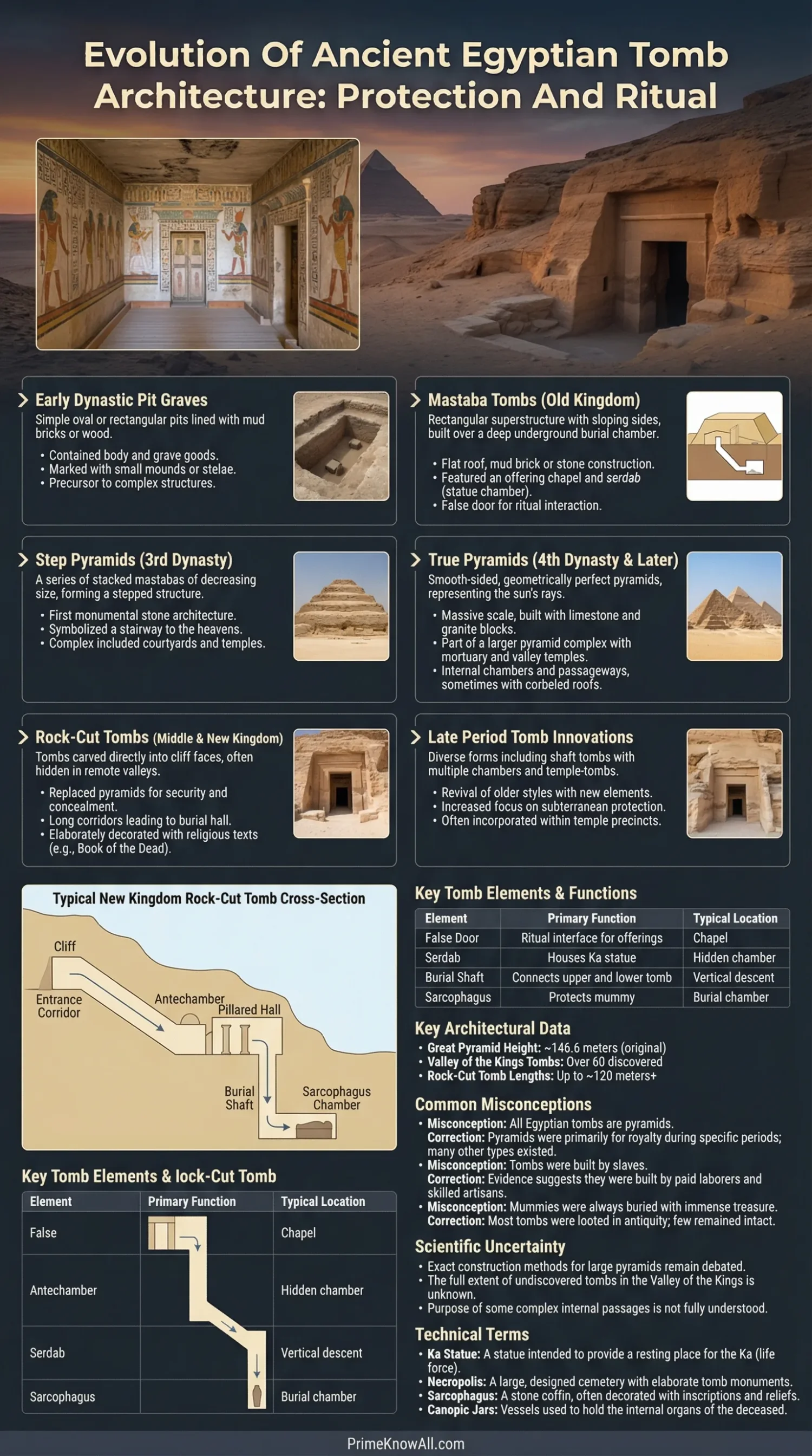
That basic idea explains the whole story. Early graves became mastabas, royal mastabas grew into step and true pyramids, and later kings shifted to rock-cut tombs hidden in the cliffs near Thebes. The outer form changed, but the core plan stayed readable: bury securely, feed ritually, remember permanently.
If you remember one thing: an Egyptian tomb was both a sealed burial place and a ritual interface. The burial chamber protected the body. The chapel, false door, texts, and images let the dead keep receiving offerings, identity, and divine support.
What To Notice First
- Not every Egyptian tomb was a pyramid. Pyramids belong to one phase of royal burial, not the whole Egyptian story.
- Most tombs had two linked zones. One part held the body; another received offerings and ritual visits.
- Architecture followed belief. The shape of a tomb changed when ideas about kingship, the sun, Osiris, and tomb security changed.
- Location mattered. Cemeteries were usually placed in desert zones, very often on the west bank, where sunset gave death a visual direction tied to rebirth.
- Decoration was functional. Scenes of food, work, boats, servants, and prayers were meant to make those things available in the next life.
What Ancient Egyptian Tomb Architecture Was Meant To Do
Ancient Egyptian tomb architecture served religion, memory, and security at the same time. A tomb had to preserve the body, protect the name of the dead, host offerings, and stage a safe passage into the afterlife. That is why even a modest tomb can feel surprisingly planned.
Mastaba, in plain terms, is a flat-roofed rectangular tomb with sloping sides set above an underground burial. A serdab is a sealed statue chamber. A false door is a carved stone door that did not open physically but marked the place where offerings could reach the dead. These are not decorative extras. They are the operating parts of the tomb.
- Protection: shafts, plugs, hidden chambers, and later cliff-cut routes helped guard the burial.
- Sustenance: chapels and offering tables let the living present food, drink, incense, and prayers.
- Identity: names, titles, and carved images kept the dead socially visible.
- Transformation: texts and symbolic layouts supported rebirth under divine care.
A useful way to picture an Egyptian tomb is this: it worked like a house with two addresses. One address was hidden underground for the body. The other was above ground or cut into a cliff face for ritual contact. Without that public-facing side, the burial was safe but spiritually cut off.
How Tomb Design Changed Across the Main Periods
The big pattern is simple: graves became more formal, then more monumental, then more concealed. Political power, available building methods, and afterlife theology all pushed the plan in new directions.
| Period | Main Tomb Form | Typical Users | Plan Pattern | What Changed |
|---|---|---|---|---|
| Predynastic to Early Dynastic | Pit graves, brick-lined graves, early royal enclosures | All social levels, then local elites and rulers | Burial pit with goods; later more chambers | Simple graves start becoming planned burial spaces |
| Old Kingdom | Mastabas, step pyramids, true pyramids | Elites and kings | Underground burial plus chapel or temple above | Stone building expands sharply, especially for royal tombs |
| Middle Kingdom | Pyramids continue, but many cliff and shaft tombs grow in use | Kings, officials, local governors | Mixed plans; more regional variety | Monumentality remains, but local rock-cut forms matter more |
| New Kingdom | Hidden royal rock-cut tombs; separate mortuary temples | Kings and elites near Thebes | Long corridors, chambers, burial rooms cut into cliffs | Royal burials move away from exposed pyramids toward concealment |
| Late Period and Later Reuse | Shaft tombs, reused older tombs, hybrid forms | Wide social range | Older plans reused or adapted | Tombs remain active places long after first burial |
Pause Here
- The tomb’s shape changed, but the split between sealed burial and ritual contact kept returning.
- Pyramids are one chapter, not the full architectural history.
- Later royal design leaned toward concealment, not bigger silhouettes.
Mastabas Were the First Fully Worked-Out Tomb Type
If one form unlocked later Egyptian tomb design, it was the mastaba. It gave Egypt a stable formula: an underground chamber for the body and an accessible place above for offerings, statues, and memory.
In early and Old Kingdom cemeteries, elite mastabas were usually built of mud brick at first and later stone. Their sloping walls, flat roofs, paneled facades, shafts, and chapels created a form that was easy to repeat, enlarge, and adapt. The Met’s tomb of Perneb shows the logic well: burial chamber below, decorated offering chapel above, and a serdab tied to ritual life.
- Why mastabas mattered: they separated body care from ritual care.
- Why they spread: they worked for elite families, not only kings.
- Why they lasted: later tombs kept reusing mastaba ideas even when the outer form changed.
What a False Door Actually Did
A false door was a meeting point, not a fake decoration. Offerings were placed before it because it marked the ritual threshold through which the dead could receive food and ritual attention. That is why false doors are loaded with names, titles, and offering formulas.
- It fixed the ritual focus of the chapel.
- It tied image, inscription, and offering place together.
- It turned a wall into an active symbolic doorway.
Why Pyramids Were Only One Phase of the Story
Pyramids dominate modern imagination, but they describe a royal experiment, not the normal Egyptian tomb. They grew out of mastaba logic and served a very specific version of kingship tied to solar power, divine rule, and state labor.
The Step Pyramid of Djoser marks a turning point. Its central shaft is about 7 meters by 7 meters and about 28 meters deep, while the tunnels beneath the complex run for nearly 5.5 kilometers and connect nearly 400 rooms. The burial chamber used hard Aswan granite brought from roughly 860 kilometers to the south. That is not a single tomb; it is a planned royal landscape.
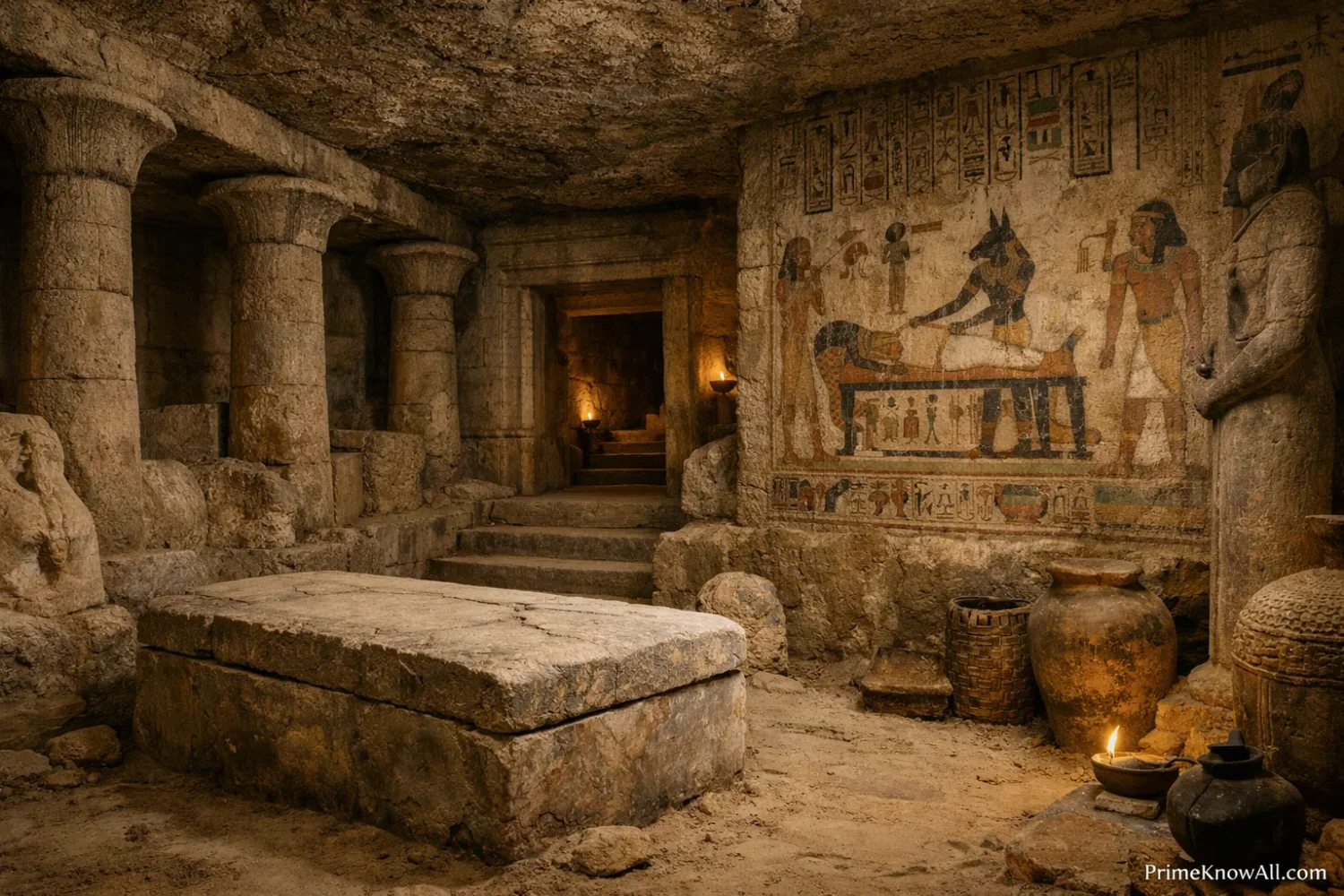
By the time of Khufu, the royal tomb had become a statement of organized labor and stone handling on a different scale. The Great Pyramid originally rose to more than 481 feet, covered a base of over 13 acres, and used blocks averaging more than two tons, with some larger blocks reaching about fifteen tons. Those numbers help explain why pyramids became symbols of state capacity as much as burials.
- Step pyramid: stacked mastaba logic in stone.
- True pyramid: smoother outer geometry and cleaner royal statement.
- Pyramid complex: never just the pyramid itself; it included temples, causeways, courts, walls, and subsidiary burials.
Hold On To This
- Pyramids were royal and tied to a narrow band of Egyptian history.
- The real architectural unit was the whole funerary complex, not the stone mass alone.
- Many later Egyptians kept the old ritual logic without copying the pyramid form.
Why Royal Tombs Moved Into the Cliffs
By the New Kingdom, visibility started losing ground to concealment. Kings still needed grand funerary ritual, but they no longer needed a giant pyramid marking the burial spot. The answer was to separate the tomb from the mortuary temple.
In the Valley of the Kings, royal burials were cut into the western cliffs near Thebes. Britannica notes 62 known tombs in the valley. Their plans vary, yet the basic pattern is clear: a descending route, chambers or vestibules, a burial room with a stone sarcophagus, and side spaces for burial equipment. Deep shafts in the route could hinder tomb robbers and, in some cases, help with flood or symbolic protection.
This shift also changed the emotional feel of Egyptian tomb architecture. A pyramid dominates the horizon. A valley tomb withdraws into the mountain. The landscape itself becomes the monument.
- Old Kingdom royal emphasis: visible mass plus temple complex.
- New Kingdom royal emphasis: hidden burial plus separate temple.
- Architectural result: long interior routes with more painted theological programs.
How the Internal Route Changed
Early New Kingdom royal tombs can curve or turn sharply. Later ones move toward straighter axes. That does not mean one simple line of progress. Rock quality, local topography, ritual choices, and security all mattered. Still, the broad movement from more bent plans to clearer straight corridors is real enough to help readers follow the sequence.
- Bent route: more turns and visual breaks.
- Straighter route: longer visual pull toward the burial room.
- Shared purpose: guide the king through a ritualized passage into the next state of being.
Rooms, Shafts, Serdabs, and Chapels Each Had a Job
Egyptian tomb plans make more sense when each room is treated as a task, not just a space. Once that clicks, the architecture stops looking mysterious and starts looking methodical.
Burial Chamber
The protected core. It held the mummy, coffin, sarcophagus, and part of the burial equipment.
Chapel
The accessible ritual zone. Offerings, prayers, and memorial acts happened here.
Serdab
A closed statue room. It allowed the dead to be present through an image even when the burial itself stayed sealed.
Shaft
A vertical descent to the burial level. It helped separate the public face of the tomb from the protected body below.
In private tombs, the pattern can look modest. In royal tombs, the same logic expands into corridors, chambers, side rooms, blocked passages, and decorated surfaces that act almost like a written escort. The architecture and the text work together.
- Below ground: safety, sealing, bodily preservation.
- At the chapel: offerings, speech, name, image.
- Across the walls: instructions, identities, and sacred scenes.
What Matters Here
- A tomb room is easiest to read when asked, “What was this space meant to do?”
- Serdabs and false doors show that image and ritual access were part of the architecture, not later decoration.
- The plan always balances access for ritual with closure for protection.
Materials, Labor, and Engineering Choices Tell Their Own Story
Ancient Egyptian tombs were shaped by available stone, desert setting, labor organization, and transport routes. Limestone, mud brick, granite, plaster, timber, and pigment all pushed design decisions in practical ways.
Stone suited tombs because it lasted. Mud brick still mattered, especially in earlier superstructures and service areas. Harder stones, such as granite, were used for chambers, plugs, sarcophagi, and other parts where durability or status mattered more. Rock-cut tombs solved a different problem: the cliff itself became the material, the wall, and the protective shell.
- Limestone: workable and common in many tomb zones.
- Granite: harder, harder to move, and often reserved for high-value structural or funerary parts.
- Mud brick: faster and more flexible, especially in earlier or less exposed contexts.
Modern readers still repeat the old claim that tomb building was just brute force. The architecture says otherwise. Alignments, load handling, ventilation needs, sealing systems, plaster preparation, carving depth, paint sequence, and water risk all point to planned technical work by trained crews. The result looks ceremonial because it was ceremonial, but the execution was highly organized.
Decoration Was Part of the Tomb’s Working System
Tomb decoration was meant to do something. It fed, named, protected, and transformed. A painted loaf of bread in a chapel scene was not just visual comfort. Within Egyptian ritual logic, it helped supply bread forever.
That is why non-royal tombs love scenes of farming, fishing, boat travel, banquets, crafts, and family life. These images turn daily abundance into eternal provision. Royal tombs lean harder into divine texts and underworld books. By the late Old Kingdom, pyramid chambers carried Pyramid Texts; in the New Kingdom, royal tomb walls drew on works such as the Book of the Dead, Book of Gates, and related underworld compositions.
- Private tomb imagery: food, estates, labor, family continuity, social rank.
- Royal tomb imagery: divine rebirth, night journey, gods, cosmic order.
- Shared logic: words and images extend life beyond death.
One detail is easy to miss: some wall scenes are less about biography than about making a desired state permanent. A tomb owner hunting in the marshes is not simply remembered there; he is established there, again and again.
Small Recap
- Material choice shaped form, but belief shaped what the form had to achieve.
- Decoration belongs to the architecture because it helps the tomb operate ritually.
- Private and royal tombs differ in scale and imagery, yet both try to make life continue.
Common Misreadings About Egyptian Tombs
A few common claims flatten the subject too much. These corrections make the architecture easier to read without turning it into mystery content.
- Wrong: All Egyptian tombs were pyramids.
Better reading: Only some royal burials used pyramid forms, mainly in certain periods.
Why this gets mixed up: Pyramids dominate tourism, film, and school lessons. - Wrong: Tomb paintings were just decoration.
Better reading: In Egyptian belief, painted and carved scenes helped secure food, status, and rebirth.
Why this gets mixed up: Modern viewers separate art from ritual more sharply than Egyptians did. - Wrong: A false door is just a visual trick.
Better reading: It marks a ritual threshold where offerings reached the dead.
Why this gets mixed up: The word “false” sounds dismissive in modern English. - Wrong: Later valley tombs were simpler because they were hidden.
Better reading: Their outer profile shrank, but their interior theology and planning could be very dense.
Why this gets mixed up: Hidden entrances make people underestimate the carved interior. - Wrong: Tomb robbing was a side issue.
Better reading: Security pressure shaped routes, blocking systems, concealment, and site choice across many periods.
Why this gets mixed up: Popular retellings focus on treasure, not design response.
How To Picture It in Real Terms
This subject becomes clearer when it is tied to everyday architectural instincts. The scenarios below are modern in wording, but they match ancient design logic closely enough to help.
- A family keeps photos in the living room and valuables in a locked safe. Egyptian tombs did something similar: public ritual above, protected body below.
- A memorial plaque stands outside a building even when the person is gone. Names and titles on false doors served the same need: identity had to stay visible to remain effective.
- A museum uses a replica when the original cannot be touched. A statue in a serdab gave the dead a stable image-form when the sealed burial could not be accessed.
- An airport has both passenger areas and secure staff zones. Tombs also split open ritual zones from restricted inner spaces because access had to be controlled.
- A city archive stores records in a climate-safe room. Rock-cut tombs used the mountain itself for long-term protection, not just drama.
- A festival route matters as much as the festival site. Causeways, courtyards, chapels, and processional links show that movement toward the tomb was part of the burial design.
- A home altar uses repeated gestures, not one-time decoration. Offering scenes and tables in chapels were meant for repeated ritual return.
What Fresh Discoveries Are Changing Right Now
Ancient Egyptian tomb architecture is not a closed file. New finds and restorations keep changing how the sequence is understood, especially outside the best-known pyramid sites.
In February 2025, Egyptian authorities announced the identification of the tomb of Thutmose II near Luxor, the first identified pharaonic royal tomb discovery of this kind since Tutankhamun’s in 1922. In March 2025, work at Abydos revealed a roughly 3,600-year-old royal tomb about 7 meters underground, with rooms capped by mudbrick vaults about 5 meters high. Those finds matter because they add data for periods and burial lines that remain thinner in the public imagination than Giza or Tutankhamun.
Saqqara also keeps widening the picture. A 2025 tomb discovery linked to Prince Waser-If-Re included a giant pink granite false door about 4.5 meters high. That sort of find is useful because it reminds readers that even one architectural element can carry rank, ritual meaning, and later reuse history all at once.
Restoration work matters too. In October 2025, Egypt reopened the tomb of Amenhotep III in Luxor after more than 20 years of renovation. Reports described a downward passage about 36 meters long and about 14 meters deep. Reopenings like that do more than boost tourism. They let researchers and the public read spatial details that photos alone flatten.
- New excavation: fills gaps in lesser-known dynasties and regional burial practice.
- Fresh identification: can reshape chronology and royal sequence.
- Restoration: returns painted and carved programs to architectural context.
What Scholars Still Cannot Say With Full Confidence
There are still limits, and it is better to state them plainly. Many tombs were robbed, flooded, reused, dismantled, or copied in later periods. That means some plans survive only in fragments, and some burial programs are known from damaged evidence.
- Lost material: timber, textiles, pigments, and mud-brick elements often survive unevenly.
- Reuse: later occupants can blur what belongs to the first burial phase.
- Bias in survival: royal monuments and painted elite tombs are easier to study than ordinary graves.
- Media imbalance: a famous tomb can distort the wider picture of what was normal.
Limits of this explanation: the broad sequence is clear, but exact meanings of some room changes, text programs, and local variants still depend on damaged or incomplete evidence. Any clean timeline should be read as a strong map, not as every answer already settled.
Two-sentence wrap-up: Egyptian tomb architecture moved from pits to mastabas to pyramids to hidden valley tombs, yet it kept returning to one durable idea: protect the dead below while keeping ritual contact alive above. The most useful way to read any tomb is to ask what each part did for preservation, offering, identity, and rebirth.
Most common mistake: treating the tomb as a container instead of a working ritual structure.
Rule to remember: if a tomb feature looks symbolic, it probably also had a practical role in the ritual life of the dead.
Quick Test
Use these short checks to lock in the main ideas. Each answer sits under the prompt.
Why was a false door placed in a chapel if no one could walk through it?
Because it marked the ritual threshold where offerings could reach the dead. It was symbolic in form but active in function.
Why did Egyptian kings stop relying on giant pyramids for burial in the New Kingdom?
Royal burial design shifted toward concealment, so kings used hidden rock-cut tombs while keeping mortuary ritual in separate temples.
What makes a mastaba different from a simple grave pit?
A mastaba adds a built superstructure, deeper burial arrangement, and ritual spaces such as a chapel, false door, or statue chamber.
Why do tomb paintings show food, farming, boats, and banquets so often?
Because those scenes were meant to secure ongoing provision and social life for the dead, not merely to decorate the walls.
If a tomb is hidden inside a cliff, does that mean it is architecturally simpler?
No. Hidden valley tombs can have long routes, shafts, multiple chambers, and dense wall programs tied to afterlife texts.
Sources
These pages are useful because they combine field evidence, museum context, and edited reference material.
- Encyclopaedia Britannica – Egyptian Architecture — Clear on the two-part tomb plan, mastabas, and the shift toward separate mortuary temples. Reliable because Britannica uses edited reference entries written for factual accuracy.
- The Metropolitan Museum of Art – Mastaba Tomb of Perneb — Useful for the practical relation between burial chamber, chapel, serdab, and false door. Reliable because it is based on a museum object record tied to an excavated monument.
- Smithsonian Institution – The Egyptian Pyramid — Good for the transition from mastaba to step pyramid and for technical figures on major pyramids. Reliable because it is an educational page from a national museum institution.
- Smarthistory – Step Pyramid Complex at Saqqara — Strong on Djoser’s burial shaft, tunnels, granite chamber, and ritual logic. Reliable because it is written by art historians and widely used in university teaching.
- Encyclopaedia Britannica – Valley of the Kings — Helpful for the valley plan, dynasties buried there, and the broad route of New Kingdom royal tombs. Reliable because it is an edited reference source with stable background data.
- Penn Museum – 3,600-Year-Old Tomb From the Lost Abydos Dynasty — Useful for the 2025 Abydos discovery and what it may add to the study of lesser-known royal burials. Reliable because it comes from the excavation institution itself.
- Reuters – Egypt Announces First Discovery of Pharaoh’s Tomb in More Than 100 Years — Good for the 2025 identification of Thutmose II’s tomb and the ministry announcement. Reliable because Reuters applies newsroom verification standards and attributes the claim clearly.
- AP News – Egypt Reopens Amenhotep III’s Tomb After Over 20 Years of Renovation — Useful for the recent reopening and for details of the tomb passage and restoration context. Reliable because AP reports directly from the site and identifies the antiquities officials cited.
- Ahram Online – Tomb of Prince Waser-If-Re Unearthed in Saqqara — Helpful for the 2025 pink granite false door and related tomb finds at Saqqara. Reliable because it reports named statements from Egyptian antiquities officials, though fresh field claims should still be read as preliminary until full publication.
- JSTOR – Tomb Security in Ancient Egypt From the Predynastic to the Pyramid Age — Useful for the architectural response to tomb robbery and access control. Reliable because JSTOR hosts scholarly work used in academic research.
FAQ
What is the main purpose of ancient Egyptian tomb architecture?
Its main purpose was to protect the body and support the dead person’s afterlife through ritual access, offerings, texts, and images.
What is a mastaba in ancient Egypt?
A mastaba is a flat-roofed rectangular tomb with sloping sides, built above an underground burial chamber and usually linked to a chapel for offerings.
Why did Egyptians build tombs on the west bank of the Nile?
Because western desert cemeteries were dry and separate from farmland, and the setting sun gave death and rebirth a strong symbolic direction.
How were pyramids different from later Valley of the Kings tombs?
Pyramids were highly visible royal monuments within large funerary complexes, while later royal valley tombs were cut into cliffs and designed to hide the burial more effectively.
What is a false door in an Egyptian tomb?
A false door is a carved stone doorway that did not open physically but marked the ritual place where offerings could pass to the dead.
Did tomb paintings have a practical meaning?
Yes. In Egyptian belief, painted and carved scenes helped provide food, identity, protection, and a successful afterlife for the tomb owner.