
Ancient defensive walls around cities were not just barriers. They were urban systems built to slow attack, control entry, protect water and stored food, and show who held power. When a city paid for walls, it was often paying for time.
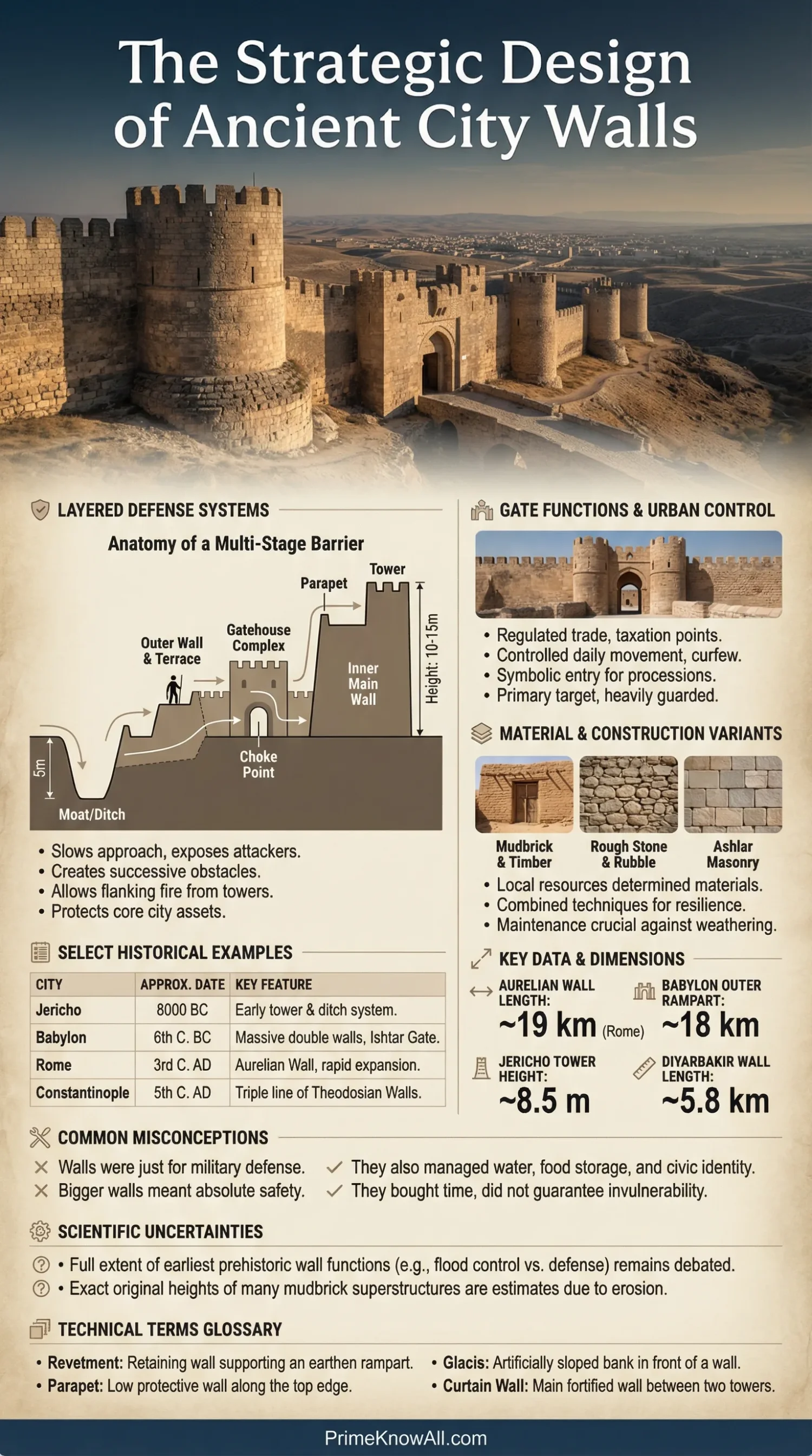
That basic logic appears in places as different as Jericho, Babylon, Rome, Constantinople, and Diyarbakır. Their forms changed with terrain, tools, and political pressure, yet the pattern stayed familiar: make approach harder, make entry narrower, and make the city easier to control from within.
If You Remember One Thing
Ancient city walls worked best when they were treated as a layered system rather than a single line of stone: ditch, gate, tower, wall, street plan, and stored supplies all mattered together.
What Matters First
- Walls were about control as much as defense.
- Gates were choke points for traffic, trade, taxes, and inspection.
- Many famous walls mixed stone, mudbrick, earth, and timber, not stone alone.
- The strongest systems were layered, with moats, outer works, towers, and inner lines.
- Some early walls may also have managed flood risk, not only warfare.
- Even a famous wall could fail through hunger, betrayal, artillery, or political collapse.
What Ancient Defensive Walls Around Cities Were
Ancient defensive walls around cities were engineered edges. They marked where urban order began, and they turned open land into a controlled approach. A wall could be built from stone blocks, mudbrick, packed earth, or a mix of all three, depending on local materials and the money available.
A moat is a ditch cut in front of the wall to slow movement and expose attackers. A parapet is the protective top edge from which defenders could watch and fire. A revetment is a supporting wall that holds packed earth in place. Those terms sound technical, yet the idea is simple: make the attacker spend more time in the open.
- Physical role: stop or delay direct assault.
- Administrative role: narrow movement through gates.
- Social role: define who was inside the civic body and who was outside it.
- Visual role: make a city visible as a political statement on the landscape.
Why Cities Built Walls in the First Place
Cities built walls because walls solved several problems at once. Defense is the obvious one, though it was rarely the only one. A wall could protect a spring, keep livestock and grain inside a controlled perimeter, channel trade through gates, and turn a settlement into something that looked and behaved like a city.
The UNESCO record for Ancient Jericho/Tell es-Sultan notes that by the 9th to 8th millennium BC the settlement already had a wall, a ditch, and a tower. That matters because the site sits near a perennial spring. In other words, the wall may have protected water access as much as people.
Babylon shows the same logic on a much larger scale. Britannica describes a massive double wall and an outer triple rampart about 18 km long. That is not the design of a city thinking only about a quick raid. It is the design of a capital trying to control movement, display wealth, and survive a siege.
| City | Approximate Date | What the Wall Shows | Useful Detail |
|---|---|---|---|
| Jericho | 9th–8th millennium BC | Very early communal labor and edge control | UNESCO notes a wall, ditch, and tower near the spring. |
| Babylon | 6th century BC peak phase | Imperial scale and staged access | Double wall plus outer rampart; gates mattered as much as wall length. |
| Rome | 3rd century AD | Fast enlargement under pressure | The Aurelian Wall enclosed a huge urban perimeter rather than a small citadel. |
| Constantinople | Early 5th century AD | Layered defense in depth | Inner wall, outer wall, and moat worked as one system. |
| Diyarbakır | Roman core with many later phases | Long-term repair and reuse | UNESCO records 5,800 metres of walls and 63 inscriptions. |
Worth Keeping in Mind
- Walls answered military, economic, and political needs together.
- A city without a wall could still be powerful, though a wall made power visible.
- The earliest walls may reflect flood control, ritual order, or status alongside defense.
How a Walled City Worked as a System
A strong walled city did not rely on one surface of stone. It relied on sequence. The goal was to force the attacker to slow down, bunch up, lose momentum, and remain visible under fire for as long as possible.
The easiest modern comparison is an airport security chain: first you are slowed, then redirected, then checked, then narrowed into a controlled point, then checked again. Ancient walls worked in a similar way. The ditch slowed approach, the tower improved sightlines, the gate narrowed traffic, and the inner line bought more time if the first line failed.
- Open ground: defenders wanted few places to hide near the wall.
- Ditch or moat: ladders, wheeled machines, and packed formations moved less easily.
- Outer wall or advanced line: absorbed the first shock.
- Towers: allowed defenders to watch and attack from the sides, not only the front.
- Gate complex: the most obvious target and usually the most controlled point.
- Inner wall or raised core: gave the city one more chance to hold.
How Walls Were Built and Kept Standing
Ancient walls were usually local in material and expensive in labor. That is why many of them combine whatever the landscape offered: stone foundations, mudbrick upper sections, rubble cores, timber bracing, and earthen embankments. A wall needed to be tall enough to deter, thick enough to resist, and repairable enough to survive weather and repeated damage.
Stone survives best in the archaeological record, so modern readers often imagine stone everywhere. That picture is too neat. In many regions, the visible stone base carried a mudbrick superstructure that has since eroded. The result is a bias: what remains can make ancient walls look lower, simpler, and more uniform than they once were.
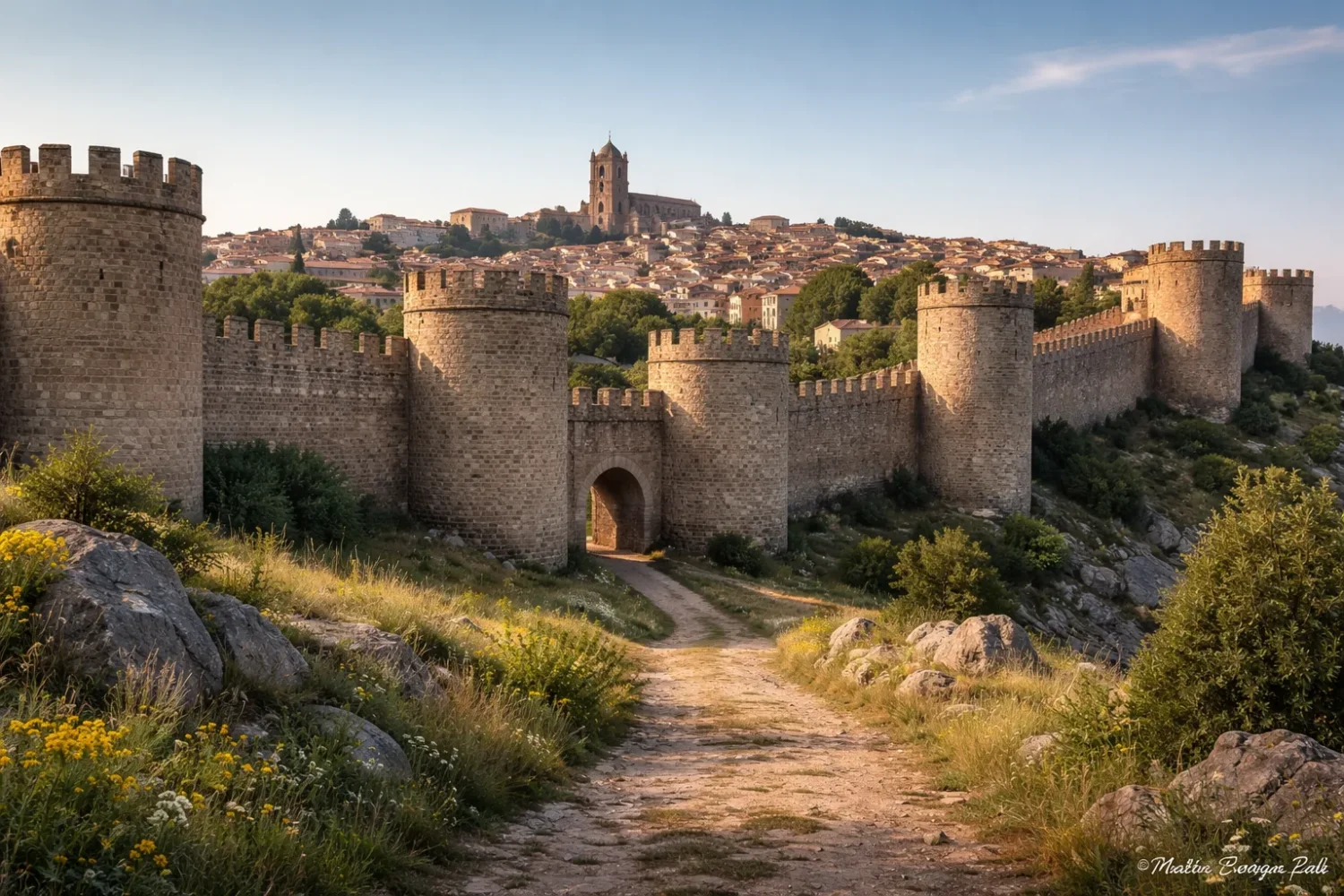
- Stone faces with rubble cores saved labor and material.
- Mudbrick upper walls were practical where stone was scarce or costly.
- Brick bands or timber ties could help the structure hold together.
- Maintenance mattered because rain, roots, quakes, and reuse all weakened walls.
The Aurelian Wall is a good reminder that speed could matter as much as finish. Britannica describes it as about 20 km long, around 4 m thick, with 16 gates and 380 towers. That scale suggests urgency: the Roman state needed a perimeter fast enough to answer new pressure, not a perfect geometric monument.
Pause Here
- The wall seen today is often only the hardest-surviving part of a larger system.
- Ancient builders balanced speed, material supply, and repair needs.
- A wall was never “finished” for long. It aged, cracked, rose, and was patched.
Famous Examples Show Different Design Choices
Looking at a few famous examples makes one point clear: there was no single “ancient city wall” model. Different cities solved the same problem in different ways.
Jericho Used Monumental Labor Very Early
Jericho matters because it is early, not because it looks like a later fortress. UNESCO describes a settlement with a wall, ditch, and tower by the 9th to 8th millennium BC, while Britannica notes a wall about 4 metres high backed by a tower about 8.5 metres high. That combination points to organized labor and a serious investment in controlling the settlement’s edge.
- What it shows: early communal planning.
- What stays debated: full defensive role versus flood management or mixed use.
Babylon Turned Walls and Gates Into Imperial Theater
Babylon’s walls were military works, though they were also urban spectacle. The walls framed processional movement, monumental gates, and the visual language of empire. UNESCO’s Babylon page stresses that the site still preserves the outer and inner city walls, while Britannica describes a double wall and an outer triple rampart. The famous Ishtar Gate only makes sense when seen as part of a wider controlled route into the city.
- What it shows: defense and political image can be fused.
- What to notice: a gate can be as meaningful as the wall line itself.
Rome Expanded Its Perimeter Under Pressure
The Aurelian Wall tells a story of adaptation. Rome had long enjoyed the confidence of an imperial center, then changed course when outside pressure became harder to ignore. The wall enclosed a very large urban space rather than a small acropolis, which says a lot about Roman scale and about how late empire thought about defense.
- What it shows: great capitals can turn defensive very quickly.
- What to notice: long walls need many gates and towers, which creates a maintenance burden.
Constantinople Made Defense Layered
Constantinople’s land walls are famous because they worked for centuries. The UNESCO entry for the Historic Areas of Istanbul ties the ancient walls to the city’s early 5th-century growth, while the Koç University Istanbul Walls project describes three parallel lines of defense: inner wall, outer wall, and moat. That is a wall system thinking in layers, not one-off impact.
- What it shows: depth can matter more than sheer height.
- What to notice: the wall line is also a map of gates, roads, and later repairs.
Diyarbakır Preserves the Long Life of a Walled Edge
Diyarbakır is useful because it shows walls as a long-lived urban boundary. UNESCO records 5,800 metres of city walls with many towers, gates, buttresses, and 63 inscriptions. The walls carry the marks of repair, reinforcement, and reuse over many periods, which is exactly how real urban walls tend to behave.
- What it shows: walls are repaired documents, not frozen objects.
- What to notice: the relation between wall, river, gardens, and food supply.
City Gates Changed Daily Life, Not Just Warfare
Gates were where military logic met ordinary life. They filtered who entered, what was brought in, what could be taxed, and which roads mattered most. A city wall without gates is just a barrier. A city wall with gates becomes a managed urban machine.
An academic study in Adalya notes that city gates had social, ritual, and symbolic meanings, not only defensive ones. The same paper points out that gates could orient movement toward named destinations. That is easy to picture: a road gate is never just a hole in a wall. It tells travelers where the city thinks the outside world begins.
- Inspection: people, animals, carts, and goods could be checked more easily at a narrow point.
- Taxation: gates were practical places to monitor tolls or customs-like payments.
- Curfew and order: a gate could be shut at night or during unrest.
- Ceremony: triumphs, royal entry, processions, and ritual movement often used marked gates.
- Identity: neighborhoods and roads often took their names from nearby gates.
Everyday Scenes That Make the Idea Stick
- A grain merchant arrives near sunset. The gate matters because late entry can be delayed, inspected, or refused. That is defense and urban administration working together.
- A city hears news of a raid. The gate narrows panic into a manageable point. Open countryside becomes a controlled interior.
- A ruler stages a ceremonial entry. The gate turns politics into theater. Passing through it says who belongs and who commands.
- A neighborhood grows beside one gate more than another. Traffic shapes urban value. Busy gates attract trade, inns, workshops, and storage.
- A fire or disease scare breaks out. The wall cannot solve the crisis by itself, though the controlled exits can help movement rules.
- A modern visitor walks the old ring road of a city. Often that path follows a vanished wall line. The military edge survives as urban geometry.
- An archaeologist finds reused stone in a later repair. That usually means the wall lived through multiple political phases rather than one single moment.
What This Adds Up To
- Gates were the working organs of the wall system.
- Trade, ritual, inspection, and security often passed through the same point.
- To understand a wall, look at the roads and gates, not only the masonry.
Why Even Strong Walls Failed
No wall made a city invulnerable. Walls bought time, improved odds, and raised the price of attack. They did not erase hunger, fear, political mistakes, internal division, or the long-term effect of new weapons.
- Siege length: a city could be starved even if the wall held.
- Weak gates: attackers often preferred gates to plain wall stretches.
- Scaling, mining, and bombardment: tactics changed across time.
- Sea access or overlooked terrain: a land wall is only part of a city’s exposure.
- Betrayal or poor leadership: many famous collapses were political before they were structural.
The most useful way to think about this is plain: a wall is a delay device. Some cities needed hours. Some needed weeks. Some needed a visible statement that told enemies the city was ready to endure. That alone could change the odds.
Common Misconceptions About Ancient City Walls
Several ideas about city walls sound right on first reading and then fall apart under closer inspection. These corrections make the subject clearer and save a lot of confusion.
- Wrong: Ancient walls were built only for war.
Better reading: They also controlled trade, water, movement, and civic image.
Why this is misunderstood: Surviving towers and battle stories draw more attention than daily administration. - Wrong: Bigger walls always meant a stronger city.
Better reading: Bigger walls also meant more repair, more guards, and more vulnerable gates.
Why this is misunderstood: Monument size is easy to admire and hard to maintain in the imagination. - Wrong: Stone walls were the normal form everywhere.
Better reading: Many walls mixed stone with mudbrick, earth, timber, and rubble.
Why this is misunderstood: Stone survives better than mudbrick and so dominates what people see today. - Wrong: A city wall tells one clean story from one date.
Better reading: Many walls are layered repairs from different periods.
Why this is misunderstood: Visitors often meet the wall as one visible object, not as an archaeological sequence. - Wrong: If a wall failed once, it was useless.
Better reading: A wall that delayed capture may still have done its job better than open ground would have.
Why this is misunderstood: People remember final defeat more easily than the cost imposed before defeat.
A Short Reset
- Walls were urban tools, not only battle props.
- The wall line seen today is often a surviving fragment of a fuller system.
- Ask what the wall controlled, not only what it blocked.
Why Old Wall Lines Still Shape Cities Today
Ancient walls still matter because they continue to organize urban space. Even where masonry is broken or gone, old wall lines often survive as roads, green edges, property limits, viewpoints, or the outline of an old quarter.
This is one reason heritage agencies treat city walls as living urban issues rather than museum pieces. The UNESCO Historic Urban Landscape approach notes that more than half of State of Conservation reports relate to urban heritage. Walls sit right inside that tension: they are old fabric, public space, transport edges, tourist magnets, and identity markers all at once.
- Urban shape: old wall lines still define how a city center reads on a map.
- Public use: walls become walks, parks, lookouts, and cultural routes.
- Conservation pressure: traffic, pollution, vibration, and uncontrolled building all affect them.
- Memory: walls help residents picture earlier city size and older political boundaries.
There is also a present-day reason people keep returning to them. A wall is one of the few ancient urban structures that can still be read at full scale with the naked eye. One walk along a preserved wall line can explain where the city felt safe, where outsiders arrived, and where authority wanted to be seen.
What We Still Do Not Know Clearly
Ancient walls look solid, though the evidence around them is often patchy. Archaeology can show foundations, repair phases, towers, and gate traces, yet many details remain uncertain.
- Earliest purpose: some very early walls may have helped with flood control or social display as well as defense.
- Original height: mudbrick sections erode, so surviving stone can understate the wall’s former scale.
- Literary dimensions: ancient authors sometimes exaggerated, especially for famous capitals like Babylon.
- Later repairs: a wall may look single-phase and actually belong to many centuries of rebuilding.
- Incomplete excavation: UNESCO’s Babylon page says about 85% of the property is unexcavated, which is a useful reminder that even iconic sites remain partly hidden.
That uncertainty is not a flaw in the subject. It is part of what makes walls useful to archaeologists. They preserve long urban histories, though they rarely hand over a single neat answer.
Quick Test
A city has a ditch, an outer wall, and an inner wall. What does that suggest?
It suggests defense in depth. The design is meant to slow attackers in stages rather than rely on one dramatic barrier.
Why would a gate matter more than a plain stretch of wall in daily life?
Because the gate controls movement, inspection, and trade. Most people interact with the wall through the gate, not by climbing the masonry.
If a wall protected a spring or river edge, was it only a military structure?
No. In that case it was also protecting water access, storage, and urban survival. Defense and resource control often overlap.
Why can a ruined wall make the past look simpler than it was?
Because mudbrick, timber, plaster, and upper levels disappear faster than stone. What survives is usually the hardest part, not the whole system.
If a city still fell after a siege, did the wall fail completely?
Not necessarily. A wall may still have bought time, raised the cost of attack, protected evacuation, or forced a longer siege. Those outcomes mattered.
City walls make the most sense when seen as urban systems rather than heroic stone objects. They protected people, water, grain, access routes, and political order at the same time.
The most common mistake is to read a wall only as a battle monument and ignore the gates, roads, supplies, and daily rules that made it useful.
A rule worth keeping: when an ancient wall appears, ask what it controlled before asking only what it fought.
Sources
- UNESCO World Heritage Centre – Ancient Jericho/Tell es-Sultan — Useful for the site’s early wall, ditch, tower, and settlement history. Why reliable? It is an official World Heritage record based on formal nomination and evaluation material.
- UNESCO World Heritage Centre – Babylon — Useful for the preserved inner and outer walls, conservation status, and what is still visible on the site. Why reliable? It is an official heritage record with site-level documentation and management detail.
- UNESCO World Heritage Centre – Historic Areas of Istanbul — Useful for the historical role of the Theodosian walls in the growth of Constantinople. Why reliable? It is an official World Heritage entry for the protected historic peninsula.
- UNESCO World Heritage Centre – Diyarbakır Fortress and Hevsel Gardens Cultural Landscape — Useful for wall length, inscriptions, and the tie between fortification, river, and gardens. Why reliable? It is an official record grounded in heritage evaluation and site management.
- UNESCO World Heritage Centre – Recommendation on the Historic Urban Landscape — Useful for understanding why walls still matter in living cities. Why reliable? It reflects UNESCO’s official policy language for historic urban areas.
- Encyclopaedia Britannica – Walls of Jericho — Useful for a concise summary of the wall and tower dimensions often cited in reference works. Why reliable? Britannica is a long-established reference source with editorial review.
- Encyclopaedia Britannica – Aurelian Wall — Useful for length, thickness, gates, towers, and the building phases of Rome’s late imperial wall. Why reliable? It is a standard reference source with clear editorial control.
- Koç University – Theodosian Walls — Useful for the layered design of the Constantinople land walls and their technical reading. Why reliable? It is a university-led project focused on Istanbul’s wall system.
- Adalya – Study on the Social and Symbolic Meaning of City Gates — Useful for the idea that gates were also social, ritual, and orienting spaces. Why reliable? It is an academic journal article from a research context rather than a travel summary.
FAQ
What was the main purpose of ancient city walls?
The main purpose was to control approach and entry. Defense was central, though walls also protected water, grain, roads, and taxation points.
Were ancient city walls only military structures?
No. They were also administrative and symbolic structures. Gates helped regulate trade, movement, ceremony, and social order.
Which ancient city wall is the oldest known example?
Jericho is often cited as the oldest known urban fortification example, with a wall, ditch, and tower in the Neolithic period.
Why did some city walls stop working as defenses?
They lost value when artillery improved, cities outgrew their old perimeter, sea power changed siege patterns, or governments could no longer maintain them.
Why do old wall lines still matter in modern cities?
Because they still shape street patterns, old quarters, public walks, tourism routes, and heritage policy. A vanished wall can keep influencing the map for centuries.
Did bigger walls always mean a safer city?
Not always. Bigger walls could also mean more gates to guard, more masonry to repair, and more exposed perimeter. Design and upkeep mattered as much as size.