
Ancient construction without steel worked because builders used materials that are strong in compression and shaped buildings so weight moved downward, not sideways. Stone, brick, timber, lime mortar, rope, ramps, levers, and careful geometry did much of the work that modern projects now hand to steel. That is why pyramids, arches, terraces, domes, and dry-stone walls still make structural sense today.
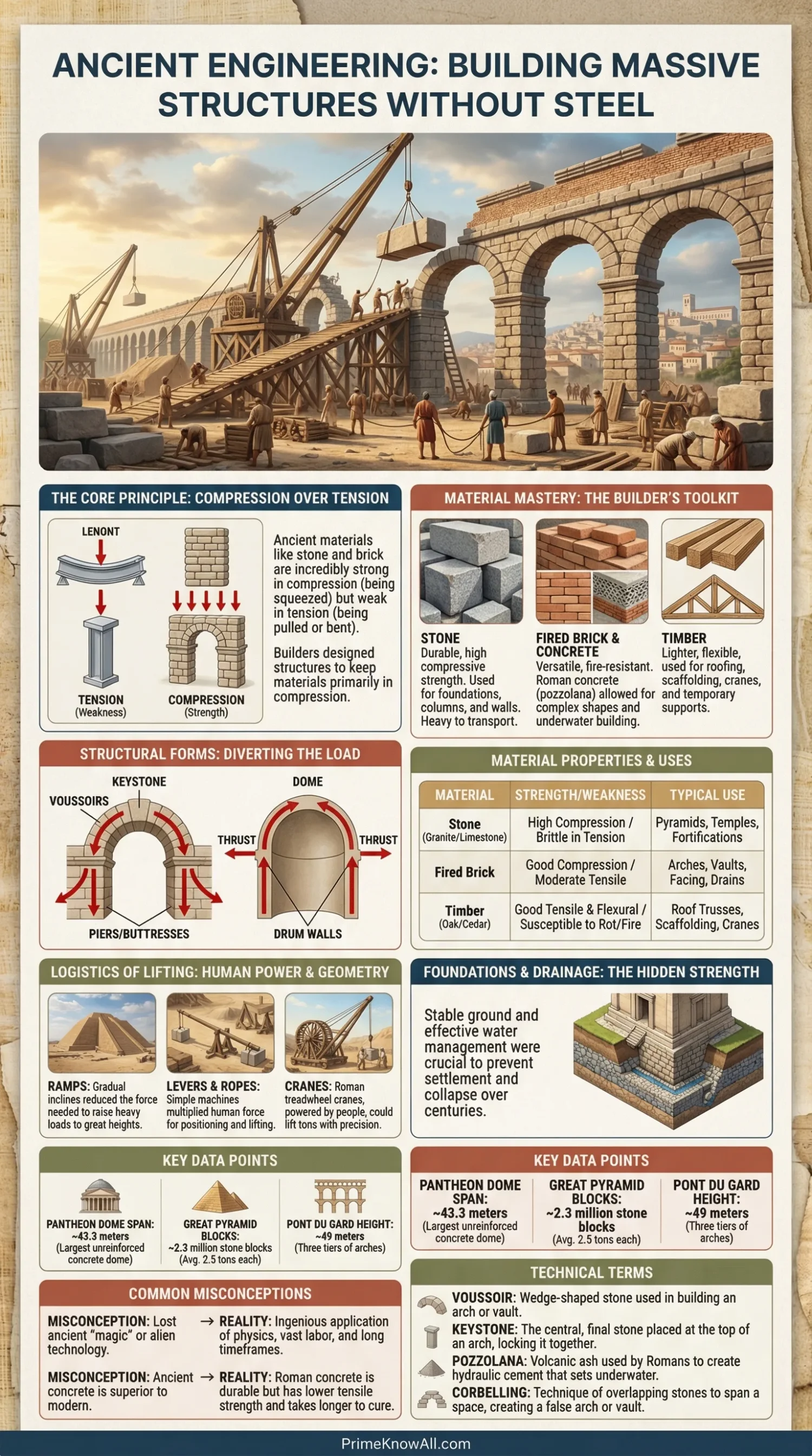
Steel changed construction. It did not invent construction. Long before steel frames, builders raised monuments, temples, bridges, harbors, terraces, walls, and cities by matching material behavior to shape, site, and labor. The best ancient projects were not miracles. They were disciplined systems of quarrying, transport, lifting, fitting, drainage, and repair.
If you remember one thing: ancient builders did not “replace steel” with one magic material. They used mass, compression, geometry, friction, good foundations, and patient logistics together.
What Matters Most
- Stone and fired brick handle compression very well but dislike tension.
- Timber helped with roofs, centering, scaffolds, cranes, sledges, ships, and piles.
- Arches, vaults, and domes turned loads into compressive paths.
- Ramps, levers, ropes, and organized labor solved lifting long before steel cranes.
- Drainage and foundations mattered as much as walls and roofs.
- Many famous sites still standing today survived because they were thick, repairable, and well matched to local materials.
What “Without Steel” Really Means
The short answer: it means load-bearing construction without a steel skeleton. Walls, piers, arches, columns, vaults, domes, timber roofs, and packed earth did the structural work themselves.
A modern steel frame lets thin walls hang like a skin. In many ancient buildings, the wall was the structure. That simple difference explains a lot: thicker walls, smaller openings, more attention to thrust, and a stronger bond between architecture and engineering.
- Compression means a material is being squeezed.
- Tension means it is being pulled apart.
- Load path means the route weight takes to reach the ground.
- Thrust means sideways force created by arches, vaults, or domes.
Steel is excellent in tension and compression. Ancient masonry was not. So builders changed the shape of the building until the forces suited the material.
Which Materials Did The Work
The short answer: stone, mud brick, fired brick, timber, lime-based binders, gypsum, earth, and later Roman concrete covered most structural needs. The smart part was not the shopping list. It was the pairing of each material with the right job.
| Material | What It Did Well | What It Struggled With | Typical Uses |
|---|---|---|---|
| Stone | High compressive strength, long life, weather resistance in many climates | Poor tensile performance, heavy transport, brittle failure if badly loaded | Pyramids, temples, columns, arches, retaining walls, bridges |
| Mud Brick | Low cost, fast production, good thermal mass in dry regions | Water damage, erosion, weaker than fired brick | Mesopotamian cities, domestic walls, platform cores |
| Fired Brick | More durable and uniform than mud brick | Fuel needed for kilns, still weak in tension | Vaults, facings, walls, drains, bath complexes |
| Timber | Light relative to strength, easier to shape, useful in tension and bending | Fire, rot, insects, limited long-term survival in many climates | Roof trusses, scaffolds, centering, piles, cranes, sledges |
| Lime Or Gypsum Mortar | Bonding, bedding, leveling, some flexibility | Varied strength, slow curing in some conditions | Masonry joints, plasters, finishes, cores |
| Roman Concrete | Mass construction, molded forms, vaults, domes, hydraulic work | Needed proper mix control and formwork | Harbors, baths, domes, walls, foundations |
Material choice depended on what the land offered. Mesopotamia had abundant clay and relatively little building stone, so brick culture grew there. Egypt had excellent limestone and granite, so stone monumentality made more sense. The Inca worked with local stone in seismic terrain. Rome used brick-faced concrete because it fit its scale, labor systems, and appetite for big interior spaces.
- Local supply shaped form.
- Climate shaped details.
- Labor skill shaped finish quality.
- Religion, power, and public image shaped size and visibility.
How Structures Stood Up Without A Steel Frame
The short answer: ancient builders relied on forms that keep materials in compression. That is why post-and-lintel systems, corbelled roofs, arches, vaults, domes, thick walls, and buttresses appear again and again.
Post-And-Lintel Was Simple But Limited
A post-and-lintel system uses vertical supports with a horizontal beam on top. It is easy to understand and still visually clear today. Its weakness is span. A stone lintel can crack if the opening becomes too wide or the load above becomes uneven.
- Good for: doorways, colonnades, porticoes, chambered interiors.
- Problem: the horizontal element wants to bend.
- Response: keep spans modest or use many supports.
Corbelling Reached Out One Course At A Time
A corbel, meaning a projecting stone or brick that steps outward from the one below, allowed builders to narrow an opening gradually. A corbel vault uses many such steps in sequence. UNESCO’s Malta pages describe temple remains with corbelled roofs, which shows how early builders solved roofing without long steel members or true concrete shells.
- Good for: tomb chambers, early roofs, small passages.
- Problem: not as efficient as a true arch for larger spans.
- Response: use heavy side walls and short spans.
Arches Changed The Game
A true arch uses wedge-shaped units called voussoirs. Britannica notes that the central unit is the keystone. Once the arch is complete, weight moves along the curve into the supports. That makes stone far more useful over openings than a plain lintel would allow.
- Good for: gates, bridges, aqueducts, halls.
- Problem: arches push outward as well as downward.
- Response: use thick piers, side walls, or buttressing.
Vaults And Domes Spread Space Without Steel Beams
A vault is an arch extended through space. A dome is a rotating arch. Both can cover large interiors without timber roofs spanning the full width. The price is lateral thrust, which must be absorbed by heavy supports or carefully graded concrete and masonry.
Britannica gives the Pantheon’s dome a diameter of 43.3 meters, with the interior height matching that measure. That proportion was not decorative trivia. It was part of a force system. Coffers reduced dead load, and the mass of the supporting drum resisted the dome’s outward push.
- Good for: baths, temples, tombs, audience halls.
- Problem: thrust, cracking, settlement risk.
- Response: heavy drums, thick rings, lightening strategies, careful foundations.
One analogy helps: a no-steel masonry structure works a bit like a line of people passing a heavy box straight down to the floor. The system stays calm while everyone keeps pressing. Trouble starts when one part must pull or twist. Ancient builders kept reshaping stone and brick so weight stayed in “push mode” for as much of the route as possible.
Pause Here
- Ancient masonry liked compression, not tension.
- Shape was a structural tool, not just a visual choice.
- Arches and domes worked because supports were built for their thrust.
How Heavy Materials Were Moved And Lifted
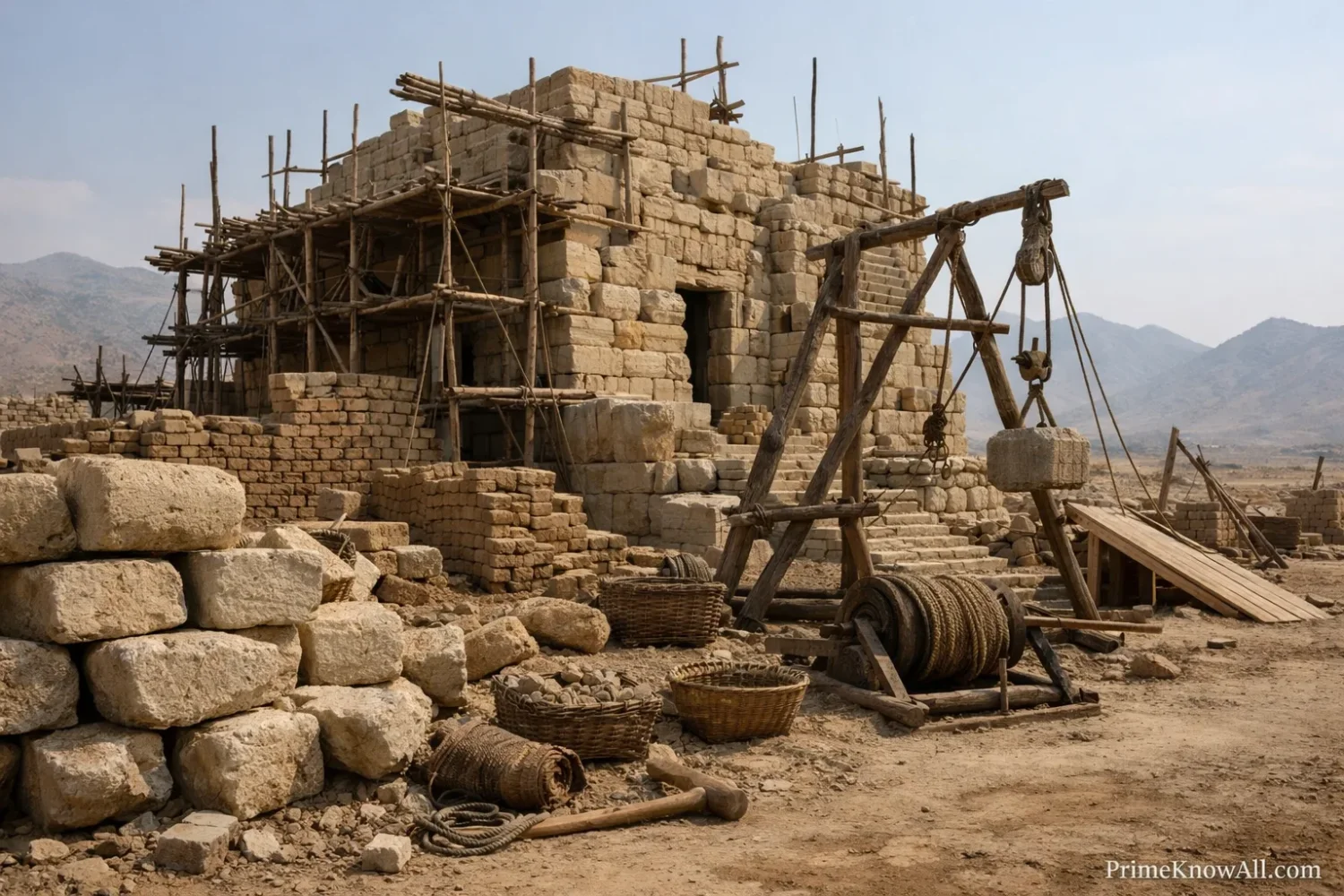
The short answer: large stones and bricks moved through organized logistics, not mystery. Builders used quarries near the site when possible, then relied on sledges, rollers where suitable, boats, ramps, levers, capstans, ropes, timber cranes, and large labor teams.
That is the part viral videos often skip. A monument is not only a shape. It is a transport network, a storage problem, a workforce schedule, a supply chain, and a site-management puzzle.
- Quarry close when possible: less haul distance, less risk, fewer broken pieces.
- Use water transport when available: rivers and coastlines were ancient highways.
- Raise in stages: ramps and temporary platforms reduce peak difficulty.
- Prepare landing surfaces: good bedding stones matter as much as lifting.
The Great Pyramid remains the classic example of scale. Britannica’s educational material and other major references put it at roughly 2.3 million blocks and an original height near 146.6 meters or 481 feet. Those numbers do not prove one exact building method, but they do prove something else: ancient planning capacity could be enormous.
Rome pushed the logistics further by combining timber formwork, mortar technology, and repeated building practice. Official U.S. National Park Service material notes that Roman builders used lime putty and pozzolana to create a hydraulic cement that could harden under water. That changed what could happen in harbors, foundations, vaults, and large public interiors.
How A No-Steel Monument Came Together
Vertical Infographic: From Quarry To Stable Monument
This stacked sequence shows the steps ancient builders had to control before a wall or dome could survive for centuries.
1) Select And Shape Material
Choose stone, brick, earth, or timber based on local supply, weather, and desired form. Fine cutting mattered more where joints had to carry load directly.
2) Move It Efficiently
Use sledges, boats, ramps, carts where roads allowed, and staging areas close to the build zone. Distance often decided what form a monument could take.
3) Prepare The Ground
Level the site, compact fills, control drainage, and create a base that spreads weight. A beautiful wall on a weak foundation is already a future ruin.
4) Raise In A Stable Sequence
Temporary supports, scaffolds, centering, and staged loading kept work safe while the structure was still incomplete and vulnerable.
5) Lock The Geometry
Arches need their keystone, domes need continuous support, dry-stone walls need tight fitting, and terraces need retained earth that drains rather than swells.
6) Maintain It Or Lose It
Vegetation, standing water, settlement, theft of facing stones, and neglected joints can undo centuries of good engineering. Survival is partly design, partly maintenance.
What Different Civilizations Got Right
The short answer: no single culture solved every problem the same way. Each one found a mix of material logic, labor organization, and symbolic ambition that fit its land and needs.
Egypt: Mass, Precision, And Controlled Geometry
Egyptian builders excelled at large stone monumentality. UNESCO describes the Saqqara complex as the site of the first monumental stone building ever constructed, the Step Pyramid of Djoser. That fact matters because it marks a shift from smaller stone use to fully planned stone architecture on a state scale.
- Strength: quarrying, alignment, large-scale labor coordination.
- Favored forms: pyramids, temples, columned halls, battered walls.
- Structural habit: keep loads direct, massive, and stable.
Mesopotamia: Brick Cities In A Land Of Clay
In southern Mesopotamia, clay was abundant and building stone was not. That pushed architecture toward mud brick, fired brick facings, thick walls, drainage management, and frequent maintenance. Corbelled forms and vaulted spaces appeared where the material culture encouraged them.
- Strength: mass urban building with repeatable brick units.
- Favored forms: ziggurats, city walls, courtyards, vaulted elements.
- Structural habit: use thickness and maintenance to overcome weak weather resistance.
Greek Builders: Refined Stone Framing And Proportion
Greek temple construction pushed post-and-lintel stone design to a high level of finish. The system did not chase giant open spans. It chased proportion, precision, and visual control. That choice shows something easy to forget: engineering is not only about maximum span. It is also about choosing the right target.
- Strength: cut-stone precision and proportional planning.
- Favored forms: temples, stoas, theaters in stone landscapes.
- Structural habit: many supports, limited lintel spans, refined detailing.
Rome: Arches, Concrete, And Large Interior Space
Rome changed scale by joining arch logic with pozzolanic concrete, brick facings, and disciplined repetition. Britannica describes pozzolana as the hydraulic cement perfected by the Romans, and other official sources note that it could harden under water. That made harbors, bath complexes, domes, and vault systems more practical.
- Strength: repeatable engineering over large territories.
- Favored forms: aqueducts, amphitheaters, baths, basilicas, domes, bridges.
- Structural habit: turn masonry into shaped force systems rather than just stacked mass.
Andean Builders: Dry-Stone Fit In Seismic Landscapes
In the Andes, tightly fitted dry-stone masonry reduced reliance on mortar and handled uneven ground very well. Machu Picchu’s walls are famous for their close-fitting blocks and their ability to remain stable in an earthquake-prone region. It is wise to be careful here: the visible resilience is real, but the exact design intentions behind every detail are harder to prove with certainty.
- Strength: stone fitting, terracing, slope adaptation.
- Favored forms: retaining walls, terraces, precisely cut masonry enclosures.
- Structural habit: fit stone to landscape instead of forcing the landscape flat.
Megalithic Builders: Huge Stones, Fewer Parts, Clear Logic
UNESCO’s pages on Göbekli Tepe, Stonehenge, and the Megalithic Temples of Malta show a recurring theme: very early monumentality did not wait for steel, modern surveying gear, or cement trucks. It used monoliths, orthostats, trilithons, corbelled forms, and a lot of site knowledge.
- Göbekli Tepe: monolithic T-shaped pillars carved from the adjacent limestone plateau.
- Stonehenge: sarsen stones with bluestones brought from western Wales, over long distances.
- Malta: orthostats, horizontal blocks, and evidence of corbelled roof solutions.
Keep These Patterns In View
- Egypt trusted mass and alignment.
- Rome trusted arches, vaults, and hydraulic binders.
- Andean builders trusted fit, friction, and site-sensitive stonework.
Why Many No-Steel Structures Lasted So Long
The short answer: many ancient buildings survived because they were thick, repairable, overbuilt by modern standards, and adapted to local weather. Their survival is not proof that old methods were perfect. It is proof that some old methods matched their conditions very well.
- Mass slows change: thick masonry resists temperature swings and carries load with low stress.
- Simple load paths age better: fewer hidden parts means fewer hidden failures.
- Drainage matters: water is a quieter enemy than warfare in many ruins.
- Repair was expected: repointing, replacing blocks, patching mortar, and clearing vegetation were normal acts.
There is another reason. Ancient builders accepted material honesty. Stone looked like stone because it was stone. Brick walls stayed thick because that is what the material required. There was less temptation to fake a thin skin over a fragile system.
Misreadings That Create Confusion
The short answer: many popular claims fail because they treat ancient building as magic instead of as engineering under constraints.
- Wrong: “No steel means no advanced engineering.”
Correction: Engineering existed long before steel frames.
Why the mix-up happens: many people confuse modern materials with technical intelligence. - Wrong: “Ancient builders only stacked heavy stones.”
Correction: They also managed force paths, joints, drainage, sequencing, and foundations.
Why the mix-up happens: the visible mass hides the invisible planning. - Wrong: “If a building still stands, the method must have been perfect.”
Correction: Survival also depends on climate, later repairs, and luck.
Why the mix-up happens: ruins flatten long histories into one frozen image. - Wrong: “Pyramids explain all ancient construction.”
Correction: Egypt, Mesopotamia, Rome, the Andes, and megalithic Europe solved different problems in different ways.
Why the mix-up happens: the biggest monuments dominate attention. - Wrong: “Dry-stone fit alone explains earthquake performance.”
Correction: fit matters, but so do wall geometry, slope conditions, maintenance, and later disturbance.
Why the mix-up happens: a clean visual explanation feels satisfying even when the real answer is layered. - Wrong: “Ancient builders had one secret method that modern engineers forgot.”
Correction: there were many methods, each tied to material, place, and purpose.
Why the mix-up happens: single-secret stories are easy to share online.
Where This Logic Shows Up In Daily Life
The short answer: the physics behind ancient construction is not remote. It appears in small, familiar situations all the time.
- A stack of books against a wall. The stack is calm while weight goes straight down. Why this happens: compression is easy to manage when the load path is direct.
- A camping tent with ropes under tension. The poles and fabric work because different parts do different jobs. Why this happens: every structure is a negotiation between compression, tension, and anchoring.
- A brick garden wall after heavy rain. The one with poor drainage leans first. Why this happens: water changes soil pressure and weakens joints over time.
- A stone stair that survives for decades. Each step is short, direct, and well supported. Why this happens: stone is happy when it is pressed, not bent.
- A doorway widened too much during renovation. Cracks appear above the opening. Why this happens: removing support changes the load path in the wall.
- A retaining wall on a slope. The best ones have drainage and setback, not just weight. Why this happens: holding back earth is also a water-management problem.
- A bridge arch in an old town. The curved form still carries traffic because the shape channels force into the supports. Why this happens: arches reduce bending by redirecting load.
What This Article Cannot Settle
The short answer: some famous details remain debated, and honest writing should leave room for that.
- Exactly how every pyramid ramp worked is still argued.
- The intentions behind every seismic detail in Inca stonework cannot always be proved from the surviving record.
- Labor numbers for giant monuments vary by source and by definition of who counts as a builder.
- Some missing elements such as timber roofs, facing stones, or plaster finishes are lost, which changes how the surviving ruins look to modern eyes.
That uncertainty is not a weakness. It is part of the subject. Ancient construction is studied through ruins, tool marks, texts, experiments, geology, and comparison. Some answers stay provisional because the evidence itself is incomplete.
One Useful Check
- If a claim removes labor, logistics, or geometry, it is probably too simple.
- If a claim says one “lost secret” explains everything, be cautious.
- If the site is still debated by archaeologists, write with measured language.
Why This Topic Feels Current Again
The short answer: the topic is back in discussion because modern construction is trying to cut carbon, waste less material, and design for longer life.
A 2025 UNEP and GlobalABC report says the buildings and construction sector accounts for 32% of global energy use and 34% of global CO2 emissions, and that cement and steel together are responsible for 18% of global emissions. That does not mean modern cities can simply copy a pyramid or a Roman bath hall. It does mean old lessons about mass, longevity, repair, local material use, and shape-led efficiency suddenly sound less old.
- Repair-first thinking now gets more attention than demolition-first thinking.
- Timber and earth are back in climate discussions, though with modern safety rules.
- Long-life masonry matters again where durability and low maintenance carry real value.
There is also a culture shift. Social feeds love “impossible ancient technology” clips, but the more useful lesson is less dramatic: good construction is patient problem-solving. Ancient builders were good at that, and modern builders still need it.
Quick Test
Use these short checks to lock the idea in place.
1) Why were arches such a big step forward for stone construction?
Because they redirect load into compression along the curve, which suits stone much better than a long horizontal lintel that wants to bend.
2) If ancient builders lacked steel, what replaced it?
Not one thing. They combined stone, brick, timber, lime-based binders, geometry, mass, and organized lifting methods.
3) Why do many ancient walls look thicker than modern walls?
Because the wall itself often carried the load. Without a steel frame, thickness helped spread weight and resist thrust.
4) What matters more for a masonry monument: the wall or the foundation?
Both matter, but a weak foundation can ruin a perfect wall. Ancient construction depended heavily on ground preparation and drainage.
5) Why is Roman concrete still discussed today?
Because pozzolanic binders let Roman builders create durable vaults, domes, and hydraulic structures, and that has renewed interest in lower-carbon mineral binders now.
Keep These Three Ideas Straight
Ancient construction without steel was not primitive improvisation. It was a disciplined way of matching material limits to structural form.
The buildings that survived best did not win by being mysterious. They won by keeping load paths clear, managing water, and using shapes that masonry could trust.
The most common mistake is to look at a ruin and focus only on the weight of the stones instead of the logic of the forces.
A rule worth keeping: when steel is absent, shape becomes structure.
Sources
- UNESCO World Heritage Centre – Memphis and its Necropolis – the Pyramid Fields from Giza to Dahshur — Useful for the Step Pyramid and Saqqara claim that this complex includes the first monumental stone building ever constructed. Why reliable? UNESCO is the official World Heritage body and publishes site summaries used in heritage management and scholarship.
- UNESCO World Heritage Centre – Göbekli Tepe — Used for the statement that the T-shaped pillars were carved from the adjacent limestone plateau. Why reliable? It is the official heritage listing with formal description and evaluation language.
- UNESCO World Heritage Centre – Megalithic Temples of Malta — Useful for orthostats, horizontal blocks, and surviving evidence of corbelled roof construction. Why reliable? UNESCO’s site descriptions are curated and tied to formal conservation records.
- UNEP – Global Status Report for Buildings and Construction 2024/2025 — Used for the current carbon and energy figures that connect ancient material logic to present-day building debates. Why reliable? UNEP is a United Nations body and this report is a primary institutional source.
- U.S. National Park Service – Preservation Brief 15: Preservation of Historic Concrete — Useful for the Roman lime-and-pozzolana hydraulic cement explanation. Why reliable? It is an official technical preservation brief from a major public heritage institution.
- Encyclopaedia Britannica – Pantheon — Used for the Pantheon’s material description and dome facts. Why reliable? Britannica is a long-established reference work with editorial oversight.
- Encyclopaedia Britannica – Pozzolana — Useful for Roman hydraulic cement and the common lime-to-pozzolan ratio cited in reference literature. Why reliable? It is a tightly edited reference entry on a specific building material.
- Encyclopaedia Britannica – Arch — Used for the basic mechanics of arches, springing, and temporary centering. Why reliable? It is a focused reference article on a standard architectural term.
- Cambridge Core – “The Archaeology of Construction: A New Approach to Roman Architecture” — Helpful for understanding construction as a study of design, sequencing, labor, and material traces, not just finished monuments. Why reliable? It is a peer-reviewed academic publication hosted by Cambridge University Press.
- Taylor & Francis – “Mortar and Concrete: Precursors to Modern Materials” — Useful for broad background on mortar-based materials across multiple regions. Why reliable? It is an academic journal article that discusses ancient material traditions comparatively.
- Smarthistory – Baths of Caracalla — Helpful for explaining how Roman coffers reduced weight in large vaulted spaces. Why reliable? Smarthistory is a nonprofit educational resource widely used in university teaching.
FAQ
How did ancient builders make large roofs without steel?
They used timber roofs where possible, and for masonry spaces they used corbelled systems, true arches, vaults, and domes. These forms redirect weight into compression, which suits stone and brick far better than long flat spans.
Was ancient construction without steel weaker than modern construction?
Not in every sense. It was less flexible for very tall framed buildings and very wide thin spans, but it could be extremely durable when the design kept forces simple and water away from the structure.
Did the Romans use concrete without steel reinforcement?
Yes. Roman concrete was not reinforced concrete in the modern sense. Its strength came from mass, form, aggregate choices, and pozzolanic binders rather than embedded steel bars.
Why are arches better than stone lintels for larger openings?
An arch changes the force path so the stones are mainly squeezed. A lintel bends, and stone does not handle bending well over long spans.
How were huge stones moved in the ancient world?
Methods varied by region, but common solutions included sledges, ramps, rollers where practical, boats, ropes, levers, timber cranes, and staged lifting with many workers.
Why is this topic relevant to modern sustainable building?
Because it highlights long-life materials, repairable construction, and shape-led efficiency. Those ideas matter again as the construction sector tries to reduce emissions and waste.