
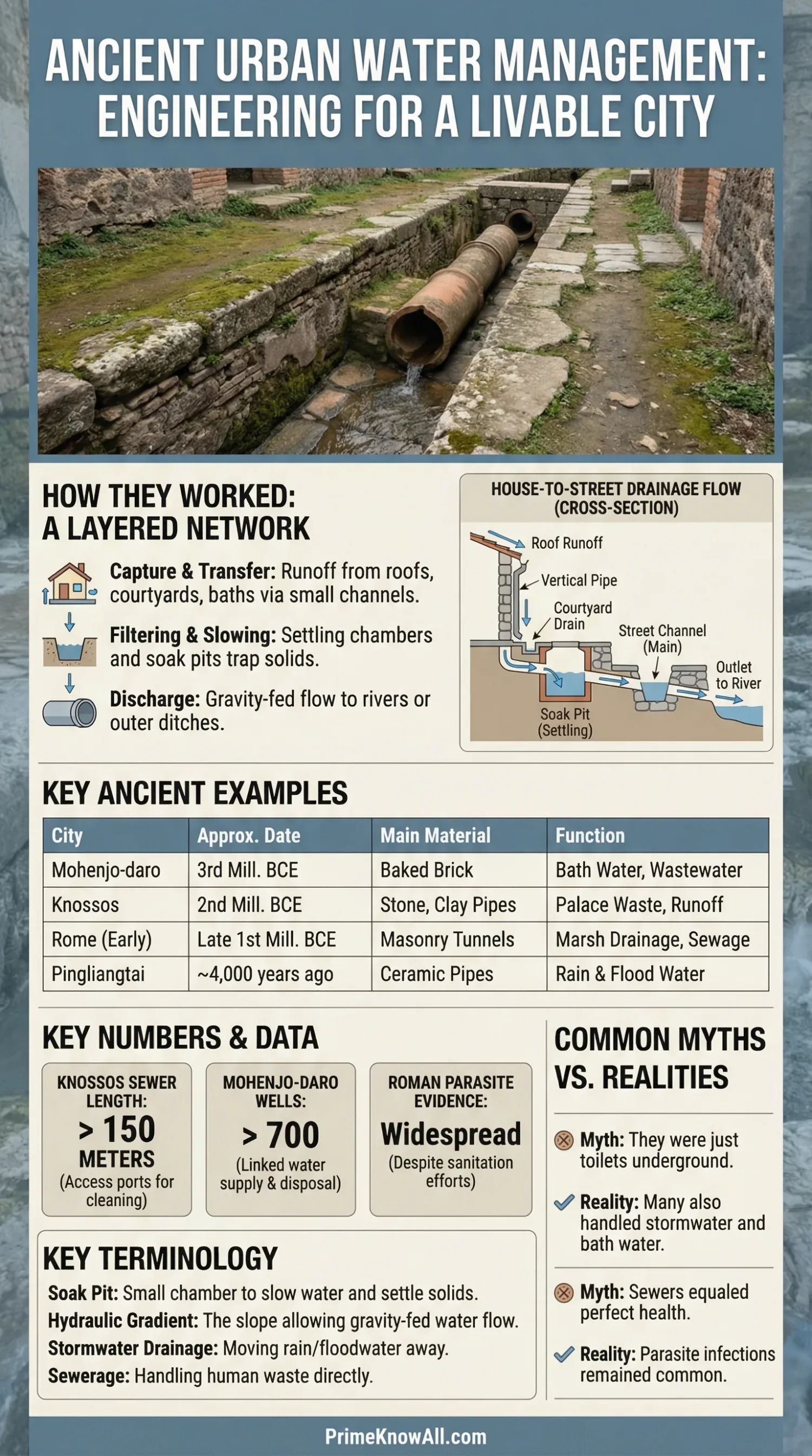
A city could not stay a city for long unless it learned how to move dirty water. Ancient city drainage systems were planned networks of slopes, channels, soak pits, covered drains, and main outlets that carried rainwater and wastewater away from streets, courtyards, and homes. The best-known examples at Mohenjo-daro, Knossos, Rome, and Pingliangtai worked because they paired gravity with access for cleaning and some form of shared upkeep.
- Drainage and sewerage were not always the same thing; many early systems handled stormwater first and human waste only partly.
- The smartest ancient designs were layered: house drains fed street drains, which fed larger collectors or open outlets.
- Maintenance mattered as much as construction. A blocked drain could ruin an otherwise well-planned city.
- Some old ideas still feel current because modern cities still struggle with flash flooding, surface runoff, and overloaded pipes.
- There is no single easy answer to “who had the first drainage system?” because definitions change: pipes, ditches, storm drains, toilets, and sewers are not identical.
Many articles reduce this topic to a race for the “oldest sewer.” That misses the real story. Ancient urban drainage was less about bragging rights and more about keeping streets usable, buildings dry, courtyards cleaner, and dense settlement possible. When heavy rain floods a modern street and the clips are all over social media an hour later, the old problem looks familiar.
If you remember one thing: the best ancient drainage systems were not one giant tunnel. They were layered networks with collection, slowing, inspection, and discharge points. That is why some of their ideas still make sense today.
What Ancient City Drainage Systems Were
Ancient city drainage systems were urban tools for moving unwanted water out of daily life. In practice, that meant rain off roofs, runoff from streets, wash water from baths, and, in some places, waste from toilets. The word drainage is wider than sewerage, and that distinction matters.
- Stormwater drainage moved rain and floodwater away from streets and walls.
- Greywater drainage handled used water from bathing, washing, or kitchen tasks.
- Sewerage dealt more directly with human waste.
- Combined systems carried more than one of these through the same channel.
A soak pit, meaning a small chamber that slows dirty water so heavier material settles before the flow continues, appears again and again in ancient South Asian sanitation. A hydraulic gradient simply means the slope that lets water keep moving without pumps.
That is why Roman, Minoan, Harappan, and Chinese examples do not all look alike. A monsoon-exposed settlement needed a different answer from a stone palace on Crete or a marshy valley in early Rome. Climate, street layout, building material, and local water habits shaped the design.
How They Actually Worked
Most ancient drainage systems followed a simple logic: collect, guide, slow, inspect, and release. The engineering sounds old; the logic is still modern.
- Collection: water fell on roofs, courtyards, stairs, or bathing floors and entered small drains, runnels, or vertical pipes.
- Transfer: those smaller lines fed street-side channels or subfloor conduits.
- Filtering or settling: pits, jars, bends, or chambers helped trap solids before the main line clogged.
- Inspection: access points, removable covers, or manholes allowed cleaning.
- Discharge: water then moved toward a river, ditch, outer wall, pond, or lower-lying outlet.
Think of a good ancient drain network like an airport system rather than one giant road. Small local routes carry traffic into bigger corridors, but the whole system fails fast if exits are blocked. Ancient builders understood that water behaves exactly that way.
- Gravity did most of the work.
- Standardized materials made repairs easier.
- Distributed layout reduced pressure on one single outlet.
- Drainage was a network problem, not a pipe problem.
- Slope and cleaning access mattered more than decoration.
- Stormwater was often the first enemy a city had to manage.
Which Ancient Cities Stand Out Most
No city solved drainage in exactly the same way, but a few places show the pattern clearly. The comparison below highlights how different urban settings produced different answers to the same hard question: where does the unwanted water go?
| City Or Culture | Approximate Date | Main Materials | What The System Handled | Why It Stands Out |
|---|---|---|---|---|
| Mohenjo-daro | 3rd millennium BCE | Baked brick, wells, soak pits | Bath water, household wastewater, street runoff | Covered drains and a city plan that linked houses to public lines. |
| Knossos | 2nd millennium BCE | Stone channels, clay pipes, cement-lined sewers | Roof runoff, palace wastewater, toilet flushing | Man-accessible sewers and one of the earliest known flushing toilet arrangements. |
| Early Rome | Late 1st millennium BCE onward | Open canal works, masonry tunnels | Marsh drainage, stormwater, later urban sewage | The Cloaca Maxima began as landscape control before it became the sewer people remember. |
| Pingliangtai | About 4,000 years ago | Ceramic pipe segments and ditches | Rain and flood water | A two-tier drainage system built for monsoon conditions in a planned walled settlement. |
Mohenjo-daro: Clean Streets Through Standardized Planning
Mohenjo-daro is one of the clearest ancient cases where drainage was built into urban planning from the start. UNESCO describes the site as a well-planned city with public baths, wells, soak pits for sewage disposal, and an elaborate drainage system. Archaeological work on the city also reports more than 700 wells, which helps explain how water supply and wastewater disposal were tied together.
- Street grids made drain routing easier.
- Baked bricks improved durability and standard fit.
- Soak pits slowed solids before flow entered larger lines.
- Household bathing platforms connected domestic routines to civic infrastructure.
One reason Mohenjo-daro still matters is that it looks less like a single monument and more like a functioning town. The system feels urban in a modern sense: private activity, public space, and maintenance needs were already linked.
Knossos: Palace Drainage With Inspection Built In
Knossos shows that elite architecture and practical sanitation could share the same corridors. A well-known Water Research study reports that the palace sewerage system at Knossos exceeded 150 meters, included stone-lined channels, and had access ports for cleaning and maintenance. The same study describes a toilet arrangement that is probably the earliest flush toilet in history.
- Roof water was captured and redirected.
- Vertical shafts and light wells helped move and flush water.
- Manholes and air shafts made the system serviceable.
- Stormwater and sewage could move through the same planned network.
This is one of the best reminders that ancient drains were not always hidden, crude improvisations. In some settings, they were carefully integrated into building design from the start.
Rome: A Drain That Began As Land Reclamation
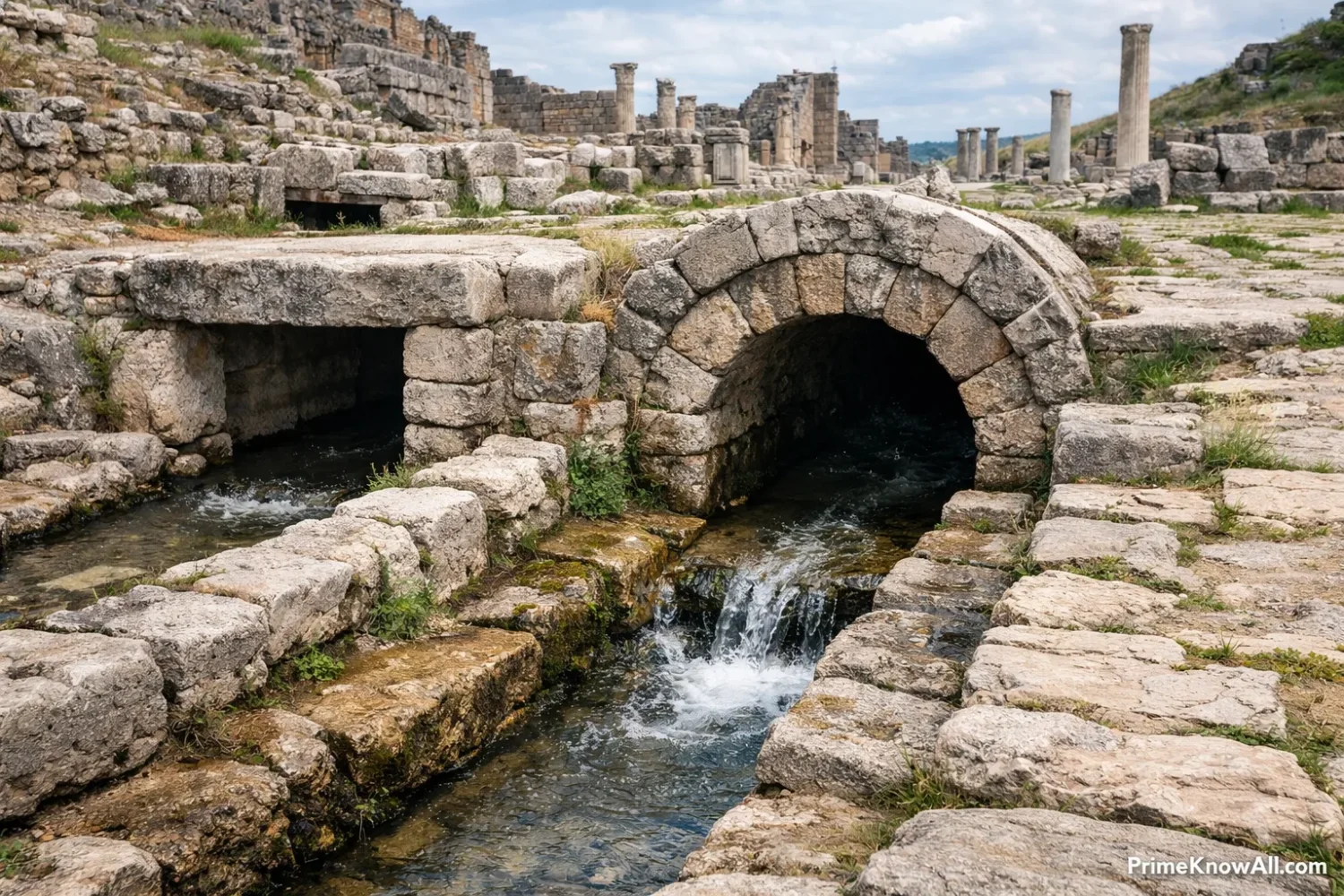
Rome is famous for sewers, but the early story is more interesting than the cliché. Research on the Cloaca Maxima argues that it did not begin as a mature sewer in the modern sense. It first functioned as an open-air canal that helped drain low, wet ground and reshape the valley that became the Roman Forum. Later, as the city thickened and aqueduct-fed water volumes grew, the network also took on a stronger sewer role.
- First problem: marshy land and unstable urban space.
- Later problem: larger volumes of runoff and waste.
- Roman answer: expand, cover, and connect the drain to wider city infrastructure.
This matters because it breaks a common myth. Rome did not simply “invent the sewer.” It adapted an older drainage idea into a denser urban system.
Pingliangtai: Rainwater Engineering In A Monsoon Setting
Pingliangtai matters because it was built for rainfall stress, not just toilet waste. A 2023 Nature Water paper describes the site as having a well-planned and regulated two-tier drainage system. The ceramic pipe network ran through a small but organized walled settlement, and UCL researchers note that the pipes show community cooperation rather than obvious evidence of a top-down state machine. The Henan Provincial Institute also describes the site’s pipes and crisscrossed ditches as China’s earliest and most complete urban drainage system.
- Ceramic pipe segments were built to fit together.
- Ditches plus pipes created two levels of water control.
- Monsoon runoff was the main problem being solved.
That makes Pingliangtai especially useful for modern readers. Today’s flood debates often focus on giant underground pipes, but this site shows the value of distributed surface and subsurface control working together.
- No two climates produced the same drain design.
- Standardization appears again and again because repair matters.
- Urban drainage is local engineering shaped by weather, layout, and labor.
What Made Some Systems Last
The systems that still impress archaeologists were not just clever; they were maintainable. That point is often missing in short web summaries.
- Usable slope: water had to move steadily but not tear the channel apart.
- Access for cleaning: Knossos is a strong example because its sewers were large enough for entry and had access ports.
- Layered routing: small drains feeding larger ones reduced chaos.
- Hard-wearing material: baked brick, stone slabs, and ceramic sections lasted longer and could be standardized.
- Routine labor: even a good system fails without cleaning, debris removal, and outlet control.
This is where ancient drainage becomes more social than mechanical. A drain is only half engineering. The other half is who clears it, who repairs it, and who has the authority to keep streets and outlets usable.
What These Systems Did Not Automatically Solve
Ancient drainage systems improved urban life, but they did not create germ-safe cities. That is another point often softened or skipped.
- Not every house in every city was connected to a public sewer.
- Stormwater removal could be strong even where toilet sanitation was partial.
- Waste concentration could create new risks if disposal water contaminated food or water sources.
- Smell reduction and cleaner streets did not always equal better public health.
A PubMed-indexed study on parasites in the Roman world makes this plain. Even with public latrines, sewer systems, sanitation laws, fountains, and piped drinking water, researchers still found broad evidence of whipworm, roundworm, and dysentery-related infection. In other words, ancient sanitation could be real without being fully protective.
- “Advanced” does not mean “modern.”
- Drainage success and health success are related but not identical.
- Archaeology reads systems through remains, not through perfect records of use.
Common Misconceptions
This topic attracts simple claims that sound neat but flatten the evidence. The corrections below keep the picture closer to what archaeology actually supports.
| Mistaken Claim | Better Correction | Why The Mix-Up Happens |
|---|---|---|
| “The Romans invented sewers.” | No. Rome developed a famous large system, but earlier drainage and sewerage existed in Harappan and Minoan settings. | Rome is better documented and visually famous, so it dominates memory. |
| “Ancient drains were just toilets underground.” | No. Many systems handled stormwater, bath water, and roof runoff as much as sewage. | The word “sewer” gets used too loosely online. |
| “If a city had drains, public health was solved.” | No. Roman parasite evidence shows sanitation measures could still leave people exposed. | Modern readers project modern expectations onto older systems. |
| “The oldest system is easy to name.” | Not really. It depends on whether the question means storm drainage, sewerage, ceramic pipes, house connections, or citywide planning. | Popular articles prefer one clean winner. |
| “Ancient builders cared only about monuments.” | No. Drains show everyday urban care: keeping floors dry, streets passable, and settlements stable. | Big temples and walls get more attention than buried infrastructure. |
Where The Same Logic Appears In Daily Life
Ancient drainage feels less remote when seen through ordinary situations. The same urban logic shows up in places most people already know.
- A sloped shower floor sends water toward one exit. Why this works: it is the same gravity rule ancient builders relied on in baths and courtyards.
- A street gutter clogged with leaves turns light rain into pooling water. Why this works as an example: even a smart system fails when maintenance stops.
- An apartment block with roof drains protects walls and lower floors. Why this matters: Knossos also treated roof water as something that had to be directed, not ignored.
- A garden soakaway holds water briefly before it seeps down. Why it fits here: ancient soak pits used the same “slow first, move later” idea.
- A city park pond after heavy rain stores runoff instead of sending it all at once into pipes. Why it matters: Pingliangtai and later Chinese systems show the value of distributed retention.
- A historic district that floods after too much paving reminds planners that impermeable surfaces change everything. Why this matters: old cities often used mixed surface and subsurface routes, not only sealed underground tubes.
- A blocked downspout staining a wall
- Why this belongs in the list: ancient drainage was also about protecting masonry, not just moving dirty water away.
Why This Topic Feels Current Again
Ancient drainage systems are back in the conversation because modern cities still flood, still over-pave, and still underestimate maintenance. The old material is not a blueprint, but it is a useful check on modern habits.
- UNESCO reported in 2025 that 73% of World Heritage sites are highly exposed to at least one water-related hazard, including drought and flooding.
- Chan Chan in Peru offers a sharp example: conservation work now includes drain maintenance, water-table control, runoff treatment, and climate adaptation planning.
- Research on Ganzhou links an old drainage system to flood prevention logic that shaped later “sponge city” thinking in China.
The strongest modern lesson is simple: a city usually performs better when it stores some water, slows some water, and only then sends the rest away. Ancient designers did not use today’s language, but that pattern is easy to recognize.
- Distributed drainage beats blind dependence on one outlet.
- Surface design matters just as much as buried pipes.
- Maintenance is urban resilience, not background work.
Vertical Infographic
This simplified infographic turns the main engineering pattern into one vertical sequence. It is not tied to only one city; it reflects the shared logic seen across several ancient urban systems.
How Ancient City Drainage Usually Worked
Water moved through a sequence, not a single miracle pipe.
Roofs, bathing floors, courtyards, stairs, and streets collected runoff before it spread widely. Minoan roof drains and Harappan house outlets show this first step clearly.
Short channels, ceramic sections, and house drains sent water into larger lines. This kept local spaces usable and prevented random flow across floors or lanes.
Soak pits, settling chambers, and bends reduced clogging. Slowing water was often just as useful as moving it fast.
Access ports, covers, or manholes made upkeep possible. At Knossos, some sewers were large enough for a person to enter for cleaning.
Main drains emptied into rivers, ditches, ponds, outer channels, or lower ground. The Roman Cloaca Maxima is the famous example, but not the only one.
Without debris removal and outlet control, the design failed. The hidden urban skill was not only construction; it was continuity.
Limits Of What Can Be Said With Confidence
Archaeology can show channels, pipes, wear, sediment, outlets, and repairs, but it does not always reveal how every system was used day by day. Some claims need careful limits.
- “Oldest” claims are slippery because they depend on what counts as a drainage system.
- Not every excavated channel carried the same kind of water. Stormwater, wastewater, and sewage can leave overlapping traces.
- Survival bias matters. Durable stone, fired brick, and ceramic remain visible; wood and lighter materials often disappear.
- Elite sites are overrepresented. Palaces and major urban centers survive better than ordinary neighborhoods.
That is why careful wording matters. It is safer to say a site had a well-planned drain network or an early urban water-management system than to force every example into the same box.
Quick Test
These short checks help lock the topic into memory. Open each item and see whether the answer matches the pattern of the article.
Which ancient city is best known for covered brick drains, wells, and soak pits integrated into a planned street grid?
Mohenjo-daro. It stands out because household water use and public drainage were linked through an orderly baked-brick urban plan.
Did Rome invent urban drainage?
No. Rome built one of the most famous systems, but earlier drainage and sewerage are documented in Harappan and Minoan settings.
Why were access ports and manholes such a big deal?
Because a drain that cannot be cleaned does not stay useful. Ancient engineers who planned for maintenance were thinking like city managers, not only builders.
Did ancient drains mainly carry toilet waste?
Not always. In many cases they also carried rainwater, roof runoff, bath water, and street runoff. The category “drain” is broader than “sewer.”
Why does Pingliangtai matter in this story?
Because it shows an early urban system built for heavy rain and flood control. Its ceramic pipes and ditches are a reminder that drainage history is not only a Rome story.
Can ancient drainage still teach modern cities anything real?
Yes, with limits. The useful lesson is not to copy old materials, but to respect slope, retention, inspection, surface design, and maintenance.
Ancient city drainage systems were never glamorous, yet they made dense urban life possible. The cities that handled water well usually paired smart routing with routine care. The most common mistake is to treat every old drain as a full modern sewer. The rule worth keeping is simple: water must be collected early, slowed where needed, and given a clean way out.
Sources
-
UNESCO World Heritage Centre – Archaeological Ruins At Moenjodaro
This page is reliable because it is an official UNESCO site record and summarizes the site’s planning, sanitation, wells, soak pits, and preservation context. -
Water Research – Urban Wastewater And Stormwater Technologies In Ancient Greece
This peer-reviewed paper is reliable because it focuses directly on ancient Greek drainage and sewerage, including the Knossos system, maintenance access, and flushing arrangements. -
PubMed Central – The Aqueducts And Water Supply Of Ancient Rome
This source is reliable because it is hosted by PubMed Central and gives a clear scholarly summary of Rome’s water supply and sewer context, including the relation between aqueducts and drains. -
Waters Of Rome Journal – The Cloaca Maxima And The Monumental Manipulation Of Water In Archaic Rome
This article is reliable because it examines the Cloaca Maxima in detail and explains why the earliest phase should be understood first as drainage and land control, not only as sewage removal. -
Nature Water – Earliest Ceramic Drainage System And The Formation Of Hydro-Sociality In Monsoonal East Asia
This source is reliable because it is a recent peer-reviewed study describing the Pingliangtai drainage network, its environmental setting, and its two-tier design. -
UCL News – China’s Oldest Water Pipes Were A Communal Effort
This source is reliable because it reports directly on the research team’s findings and helps explain why the Pingliangtai system is discussed as a shared civic effort. -
PubMed – Human Parasites In The Roman World: Health Consequences Of Conquering An Empire
This source is reliable because it is indexed by the U.S. National Library of Medicine and is useful for the claim that Roman sanitation did not eliminate parasite exposure. -
UNESCO World Heritage Centre – Nearly Three-Quarters Of World Heritage Sites Are At High Risk From Water-Related Hazards
This page is reliable because it is an official UNESCO update using recent water-risk analysis; it supports the modern relevance section and the 2025 73% figure. -
UNESCO World Heritage Centre – Preventing Climate-Related Impacts In The Chan Chan Archaeological Zone
This source is reliable because it documents drainage maintenance, water-table control, and adaptation measures at a real ancient urban site facing modern climate pressure. -
Encyclopaedia Britannica – Great Bath, Mohenjo-daro
This reference source is useful because it gives clear, editor-reviewed background on the Great Bath’s construction and waterproofing details without overcomplicating the topic.
FAQ
What is the oldest known ancient city drainage system?
There is no single clean winner. The answer depends on whether the question means storm drainage, urban sewerage, ceramic pipes, or house-to-street connections. That is why Mohenjo-daro, Knossos, early Mesopotamian evidence, and Pingliangtai can all appear in the discussion for different reasons.
Did ancient cities have sewers like modern cities?
Only partly. Some ancient cities had impressive covered drains and even large sewers, but many systems were combined, handled several kinds of water together, and did not provide universal house connection in the modern sense.
Why is Mohenjo-daro mentioned so often in drainage history?
Because the site preserves a rare urban pattern: street planning, baked-brick construction, many wells, soak pits, and covered drains appear together. It feels like a whole civic system, not an isolated technical trick.
Was the Cloaca Maxima built mainly for sewage?
Not at first. The best reading of the early evidence suggests it began as a drain or canal helping to dry and organize wet urban ground. Its later sewer role became more familiar as Rome expanded.
What is a soak pit in simple words?
A soak pit is a small settling space. It slows dirty water so heavier material can stay behind while the liquid moves onward or downward. That simple idea helps protect larger drains from clogging.
Can ancient drainage ideas still help modern city planning?
Yes, but as principles rather than direct copies. Ancient systems remind planners to value slope, surface design, storage, distributed drainage, and cleaning access instead of trusting buried pipes alone.