Yes, a small number of ancient bridges still stand and can still be crossed today. The best survivors tend to be stone arch bridges, because stone handles compression very well, and because later societies kept repairing and reusing them instead of walking away.
Some bridges lasted longer than the states that built them.
Ancient bridges still standing today are not just old objects left beside a river. They are working lessons in design, maintenance, and restraint. Many were built with short repeated spans, thick piers, well-cut stone, and routes that stayed useful for centuries. That mix helped them outlive wars, floods, and changing empires.
If you remember one thing, remember this: these bridges survived because their builders respected water, load, and material limits, and because later generations kept finding reasons to care for them.
Start Here
- “Still standing” does not always mean “still carrying cars.” Some now serve walkers only.
- “Ancient” can mean Bronze Age Greek, Roman, or late antique, depending on the bridge and the source.
- Many of the best survivors use arches, which push weight down and outward instead of forcing stone to bend.
- Repairs matter. A bridge can remain ancient in origin even when parts were rebuilt later.
- Use matters too. A crossing that stayed useful was more likely to be maintained than a bridge on a dead route.
What Counts as an Ancient Bridge Still Standing Today
A practical answer is simple: an ancient bridge still standing today is a bridge whose main historic structure remains visible and stable, and whose crossing function can still be understood, whether for people, animals, or protected foot traffic.
This matters because readers often picture one neat category. Real bridges are messier than that. Some are still part of daily movement. Others are preserved as pedestrian monuments. A few, such as aqueduct bridges, were built to carry water rather than carts or feet, yet they still show how ancient builders solved the same problem: how to cross a gap without losing stability.
- Standing means the historic structure is still there in readable form.
- In use may mean local passage, pedestrian access, heritage access, or a route that still shapes movement.
- Ancient is best handled with care; some lists mix Bronze Age, Roman, medieval, and Renaissance bridges even though they belong to different building cultures.
Why Some Bridges Outlived Empires
The short answer is that old stone bridges last when load paths stay simple, foundations stay firm, and water is given room to pass.
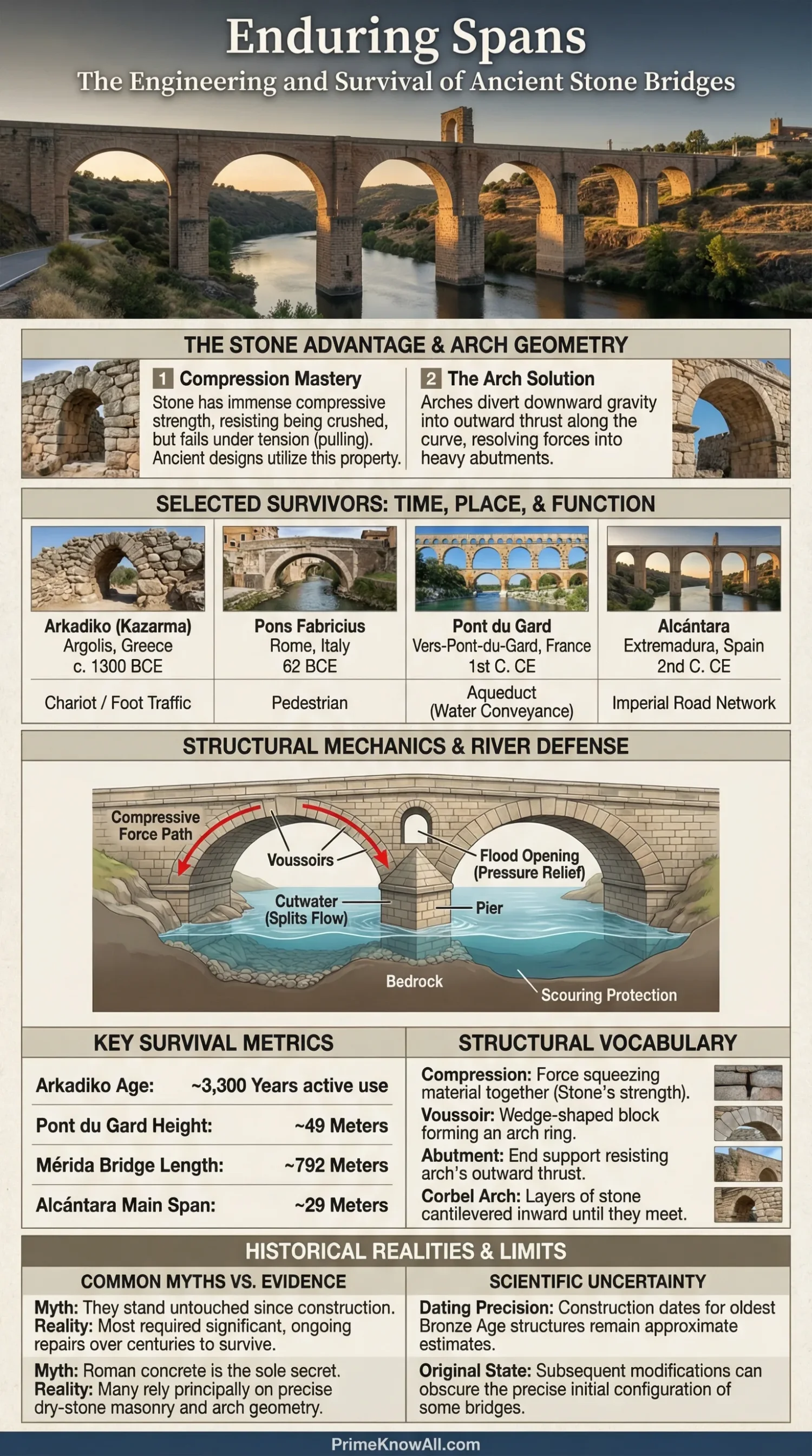
An arch bridge is a bridge in which the main support works by compression. That means the weight presses the stones together instead of pulling them apart. Stone is very good at taking that kind of force. It is much less happy when asked to stretch or bend. Ancient builders knew this from practice, even when they did not describe it in modern engineering terms.
A cutwater is the pointed or rounded face on a pier that splits the river flow. It reduces the direct hit from current and floating debris. A corbel arch is an opening made by laying stones inward from both sides until they nearly meet. A flood opening is a smaller void or passage that lets high water move through instead of shoving against solid masonry.
Think of a stone arch like a row of hands leaning into each other. No single block wins on its own. The shape works because each part pushes into the next, and the whole line sends force down into the supports.
- Compression-friendly material: stone performs well when pressed.
- Repeated spans: many old bridges avoid one huge leap and use several smaller arches.
- Heavy piers and abutments: these resist both settlement and sideways thrust.
- River awareness: openings, cutwaters, and taller central spans help during floods.
- Long-term care: a bridge that stayed on a living route was more likely to be repaired.
Pause Here for the Main Point
- Ancient bridges lasted because shape and material matched each other.
- Water control mattered almost as much as stone strength.
- A bridge that stayed useful had a better chance of staying alive.
Ancient Bridges That Still Reward a Close Look
The best examples are not all alike. Some carried carts, some carry walkers, and one carried an aqueduct. What links them is not one style but a shared habit of building for real conditions.
| Bridge | Region | Approximate Date | Type | Measured Detail | Present-Day Status |
|---|---|---|---|---|---|
| Arkadiko Bridge | Argolis, Greece | c. 1300 BCE | Mycenaean corbel bridge | About 22 m long, 5.6 m wide, 4 m high | Still passable and locally known as a working ancient crossing |
| Pons Fabricius | Rome, Italy | 62 BCE | Roman stone arch bridge | Two main arches with a small flood-relief opening in the pier | Still in use for foot traffic |
| Pont du Gard | Occitanie, France | 1st century CE | Roman aqueduct bridge | Nearly 48.77 m high; part of a 50.02 km aqueduct | Standing as a preserved hydraulic monument |
| Alcántara Bridge | Extremadura, Spain | 2nd century CE | Roman road bridge | About 194 m long, about 71 m tall, six arches | Still stands in strikingly readable form |
| Roman Bridge of Mérida | Mérida, Spain | 1st century BCE / Roman era | Roman multi-arch bridge | About 792 m long with 60 arches | Still woven into the city and used by pedestrians |
A Straight Timeline of Survival
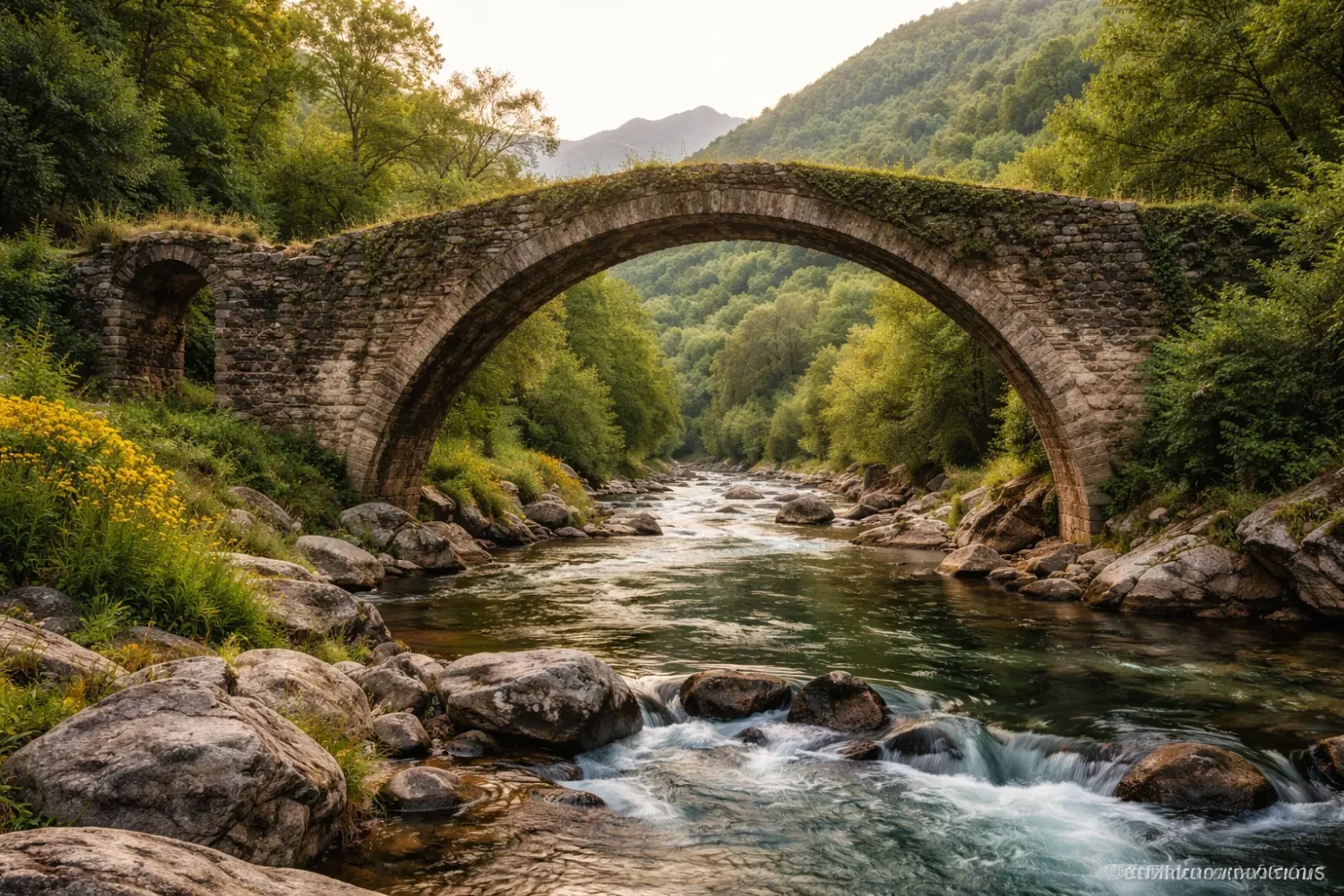
Five very different bridges, one shared lesson: durability came from matching form to place.
c. 1300 BCE — Arkadiko Bridge, Greece
Bronze Age Mycenaean crossing built with Cyclopean masonry. Small span, thick stone, and a narrow roadway made it simple, stable, and hard to break.
62 BCE — Pons Fabricius, Rome
Roman bridge with two lowered arches and a small flood opening in the central pier. It shows that ancient builders were thinking about river behavior, not only road alignment.
1st Century CE — Pont du Gard, France
Not a road bridge but a water bridge. Its scale is dramatic, yet its logic is clear: many arches, controlled gradient, and a structure shaped to work with gravity every hour of every day.
2nd Century CE — Alcántara Bridge, Spain
A Roman road bridge made to cross the Tagus with height, rhythm, and confidence. Its six semicircular arches show how Roman builders could scale up without losing geometric discipline.
Roman Era — Bridge of Mérida, Spain
Very long, many-arched, and still tied to city life. This bridge proves that survival is not only about age; it is also about staying useful while being adapted with care.
Arkadiko Bridge
Arkadiko is the bridge that resets expectations. It is not Roman. It is much older. This Mycenaean bridge in Greece is often cited as one of the oldest still-passable bridges in the world, and its survival helps explain how little a bridge sometimes needs in order to endure: a narrow roadway, thick stone, a modest opening, and a route that made sense in rugged terrain.
The form is corbelled rather than fully voussoir-arched. That makes it feel closer to heavy dry-laid stonework than to later Roman arch elegance. Yet it does the same basic job: it carries movement over a gap while keeping forces directed into masonry that prefers compression over bending.
- Era: Mycenaean Bronze Age
- Material: limestone boulders in Cyclopean masonry
- What stands out: tiny span, thick mass, and very little decorative ambition
- Main lesson: simplicity can be a survival tool
Pons Fabricius
Pons Fabricius in Rome shows how ancient practicality can look elegant without trying. Built in 62 BCE, it still serves movement today and remains one of the clearest Roman cases where flood behavior was built into the bridge itself.
Its two large arches rest on a central pier, and that pier includes a smaller opening to help high water pass through with less force. That detail is easy to miss, but it says a lot. Roman engineers were not just stacking stone. They were editing the river’s pressure on the structure.
- Date: 62 BCE
- Use today: pedestrian crossing
- Smart feature: flood-relief opening in the central pier
- Main lesson: good bridges do not fight all the water; they redirect part of it
Pont du Gard
Pont du Gard is the bridge people remember for scale, but its real force is precision. It carried water, not road traffic, as part of the aqueduct system feeding ancient Nîmes. The monument rises to nearly 48.77 meters and belongs to an aqueduct stretching just over 50 kilometers.
That is where many quick summaries stop, and they miss the best part. Water systems demand discipline. A road can climb or dip sharply; an aqueduct cannot. The structure had to preserve a controlled gradient while crossing a river valley. In other words, Pont du Gard is not just tall Roman masonry. It is Roman masonry asked to behave like infrastructure every day.
- Role: aqueduct bridge
- Height: nearly 48.77 m
- System length: 50.02 km aqueduct
- Main lesson: ancient bridge design was sometimes about flow control, not only crossing people over water
Alcántara Bridge
Alcántara is the Roman bridge that looks almost too bold to be real. It crosses the Tagus in Spain with six semicircular arches, a length of about 194 meters, and a height often given at around 71 meters. It is the kind of structure that makes modern viewers assume hidden modern reinforcement must be doing the real work.
That assumption misses the point. The bridge does not survive because ancient builders were lucky. It survives because the design is readable, repetitive, and disciplined. Each arch does a similar job. Each pier meets the river with purpose. The visual rhythm is not decoration. It is load management made visible.
- Date: 2nd century CE
- Arches: six
- What stands out: height, river command, and clean Roman geometry
- Main lesson: scale can last when repetition and proportion stay under control
Roman Bridge of Mérida
Mérida’s Roman Bridge proves that survival is not only about one perfect original form. It is about continuity. The bridge stretches roughly 792 meters and uses 60 arches, making it one of the largest Roman bridges still standing in Spain. It has changed over time, but its Roman identity remains very clear.
This bridge also helps correct a common modern bias. People sometimes admire the neat, intact monument more than the adapted one. Yet bridges are tools before they become icons. Mérida survived in part because the city kept needing it, even as repairs and later history altered parts of the fabric.
- Length: about 792 m
- Arches: 60
- River response: rounded piers and spillways help manage high water
- Main lesson: a living bridge may survive through careful adaptation, not untouched purity
What Matters Most So Far
- Arkadiko shows that small and massive can outlast flashy design.
- Pons Fabricius and Mérida show that flood thinking belongs inside bridge design.
- Pont du Gard proves an ancient bridge could be a precision water machine, not just a crossing.
What Old Stone Was Doing Right
These bridges last because they solve several problems at once. They carry load, break current, limit weak bending, and distribute force into masonry and ground in a direct way.
- They kept spans manageable. Multiple arches spread risk.
- They used thick supports. Heavy piers are not waste; they are stored stability.
- They respected water. Cutwaters, relief openings, and river-aware spacing reduce damage.
- They used materials honestly. Stone was used where compression helped it, not where tension would punish it.
- They stayed useful. Repair follows relevance.
Where You Can See the Same Logic Today
- A city turns a historic bridge into a pedestrian route. Less vehicle vibration means less stress on old masonry. That is not a downgrade; it is a survival decision.
- A modern culvert gets extra openings beside the main channel. The idea is the same as a flood-relief feature: let water pass instead of forcing the structure to absorb every hit.
- A mountain road uses several short crossings instead of one dramatic span. Shorter spans are easier to found, repair, and monitor.
- A masonry wall stays stable because each block bears on the next. Ancient bridges use that same logic on a larger scale.
- A market district keeps using the same crossing for centuries. Long use creates social pressure to repair rather than abandon.
- A walkway narrows at a historic bridge. Narrow geometry can reduce load and help preserve the old structure without hiding what it is.
The quiet lesson here is restraint. Many ancient bridges are memorable not because they do many things, but because they do one job with very little confusion in the load path.
Common Misreadings
Ancient bridges attract myths because they look improbably durable. A clearer reading is usually less romantic and more interesting.
- Wrong: “If a bridge is old, it must have survived untouched.”
Better reading: Many survivors were repaired, patched, or partly rebuilt while keeping their ancient structure readable.
Why this gets mixed up: People often confuse original date with every stone being original. - Wrong: “Roman bridges lasted because Roman concrete made them indestructible.”
Better reading: Many surviving bridges rely on masonry arches, careful stone cutting, solid foundations, and river-aware geometry.
Why this gets mixed up: Modern discussions about Roman concrete can overshadow bridge-specific design choices. - Wrong: “Still standing means still carrying the same traffic as before.”
Better reading: In many cases, today’s use is lighter, slower, or pedestrian-only.
Why this gets mixed up: The phrase sounds more uniform than it really is. - Wrong: “The tallest or longest bridge is automatically the best engineered.”
Better reading: A smaller bridge in the right place may show better judgment than a larger one in the wrong place.
Why this gets mixed up: Size is easy to notice; appropriateness is harder to see. - Wrong: “Ancient builders ignored maintenance because they built for eternity.”
Better reading: Ancient bridges lasted in part because later communities kept repairing them when routes still mattered.
Why this gets mixed up: Survival looks magical from a distance, but it is often social as well as structural.
Why This Still Feels Current
Old bridges are not only archaeology topics. They now sit inside modern conversations about tourism pressure, flood risk, city access, and how much intervention is too much.
That is why ancient bridges still feel strangely modern. The same questions keep returning: How much load is safe? How much change is acceptable? When does protection start to damage what it is trying to save? UNESCO’s climate work on heritage places and present-day crowd controls in cities such as Venice show that preserving old fabric now means watching water, heat, erosion, and footfall at the same time.
- Climate pressure: stronger flood events and changing water behavior can punish old masonry.
- Tourism pressure: a beautiful bridge can be worn down by success.
- Management pressure: the safest choice is often not to make an old bridge do everything a modern road wants.
Hold On to These Points
- Ancient bridges survive through a mix of good form and later care.
- Modern preservation is not only about stone repair; it is also about traffic, water, and visitor behavior.
- The smartest preservation choice may be to reduce what a bridge is asked to carry.
Check What You Just Learned
Which bridge in this article is the oldest by date?
Arkadiko Bridge is the oldest example here. It dates to the Mycenaean Bronze Age and is far older than the Roman bridges in the list.
Why do stone arch bridges tend to last longer than simple stone beam crossings?
Because the arch sends force mainly through compression. Stone handles that much better than bending or tension.
Is Pont du Gard a road bridge?
No. Pont du Gard is an aqueduct bridge. It was built to carry water across the Gardon valley as part of the water supply for ancient Nîmes.
What small design idea helps Pons Fabricius deal with high water?
The bridge has a smaller opening in the central pier that lets floodwater pass more easily and reduces pressure on the masonry.
Does “still in use” always mean the bridge carries modern traffic?
No. In the case of ancient bridges, use today may mean pedestrian passage, local crossing, or protected access rather than heavy road traffic.
What We Still Cannot Say With Full Certainty
Ancient bridges invite neat superlatives, but neat superlatives can mislead. Some dates are approximate, some structures were heavily repaired, and the phrase “still in use” can vary from one source to another.
- Dating can be approximate, especially for Bronze Age structures such as Arkadiko.
- Original fabric is uneven. One part of a bridge may be ancient while another part reflects later restoration.
- Use is not one fixed category. Foot traffic, heritage access, and active transport routes should not be treated as identical.
- Lists online often mix periods. Some articles fold medieval or Renaissance bridges into “ancient” lists because the visual appeal is similar.
These bridges still matter because they show that durability is rarely an accident. They were shaped around material limits, river behavior, and routes people kept needing. The most common mistake is to treat survival as a mystery rather than a design choice. A good rule to keep in mind: when old bridges last, it is usually because force, water, and use were kept in balance.
Sources
- Hellenic Ministry of Culture – Mycenaean Bridge at Kazarma — Official Greek heritage record for Arkadiko/Kazarma, useful for date range, dimensions, material, and present-day status. Why reliable? It comes from the state body responsible for archaeological heritage in Greece.
- UNESCO World Heritage Centre – Pont du Gard — Gives the clearest official summary of Pont du Gard’s role in the aqueduct of Nîmes, its height, and its protected status. Why reliable? UNESCO records are built around formal heritage documentation and conservation review.
- Turismo Roma – Pons Fabricius — Useful for the bridge’s date, preservation state, and the flood-relief opening in the central pier. Why reliable? It is the official tourism and heritage portal of Rome.
- Spain.info – Alcántara Bridge — Helpful for the bridge’s date, overall dimensions, number of arches, and inscription context. Why reliable? It is Spain’s official tourism information platform.
- Spain.info – Roman Bridge on the Guadiana River — Supports the measured length, number of arches, and flood-aware features of the bridge at Mérida. Why reliable? It is an official national source tied to heritage promotion and visitor information.
- Turismo Extremadura – Roman Bridge on the Guadiana River — Adds local context for Mérida and helps confirm scale and present-day reading of the monument. Why reliable? It is an official regional tourism source focused on Extremadura’s heritage.
- Cambridge University Press – Interdisciplinary Research on the Aqueduct of Nîmes and the Pont du Gard — Academic work that gives depth on the hydraulic and archaeological reading of Pont du Gard. Why reliable? It is a peer-reviewed publication hosted by a major academic press.
- Cambridge University Press – Roman Bridges by Colin O’Connor — Useful background for Roman bridge typology and why many Roman spans remain structurally legible. Why reliable? The book was written by a civil engineer and published by an academic press.
- Water Journal – Roman Hydraulic Engineering: The Pont du Gard — Helpful for the water-management side of the monument and the difference between a road bridge and an aqueduct bridge. Why reliable? It is an academic article with technical focus and formal publication metadata.
- Encyclopaedia Britannica – Arch Bridge — Useful for explaining compression, thrust, and why arches suit stone. Why reliable? Britannica is a long-running reference source with editorial review.
- Encyclopaedia Britannica – Alcántara — Helpful for background on the town and the long history of the bridge’s restoration after damage. Why reliable? It is a reference entry edited for factual summary rather than travel promotion.
- City of Venice Access Fee – Official Access Contribution Calendar — Useful for the current heritage-management example mentioned in the article. Why reliable? It is the official municipal portal for Venice’s access-control system.
- UNESCO – World Heritage and Tourism in a Changing Climate — Helps place old bridges inside the wider present-day pressure of climate and visitor management. Why reliable? It is a UNESCO publication focused on heritage policy and environmental risk.
FAQ
What is the oldest ancient bridge still standing today?
Arkadiko Bridge in Greece is widely cited as one of the oldest still-passable bridges in the world. It dates to the Mycenaean Bronze Age and is far older than the Roman examples that appear in many bridge lists.
Are any Roman bridges still used by people today?
Yes. Pons Fabricius in Rome still carries foot traffic, and the Roman Bridge of Mérida remains part of the urban landscape and is used by pedestrians.
Why do stone arch bridges last so long?
Because arches send force through compression, and stone performs very well under compression. Good foundations, sensible span lengths, and river-aware details also help a lot.
Is Pont du Gard really a bridge?
Yes, but more exactly it is an aqueduct bridge. It was built to carry water across a valley rather than to carry road traffic.
Which ancient bridge in this article is the longest?
The Roman Bridge of Mérida is the longest example discussed here, at roughly 792 meters with 60 arches.
Did ancient builders always use mortar in these bridges?
No. Some ancient bridges relied heavily on careful stone cutting and tight masonry fit. The exact mix of stonework, mortar use, and later repair differs from bridge to bridge.