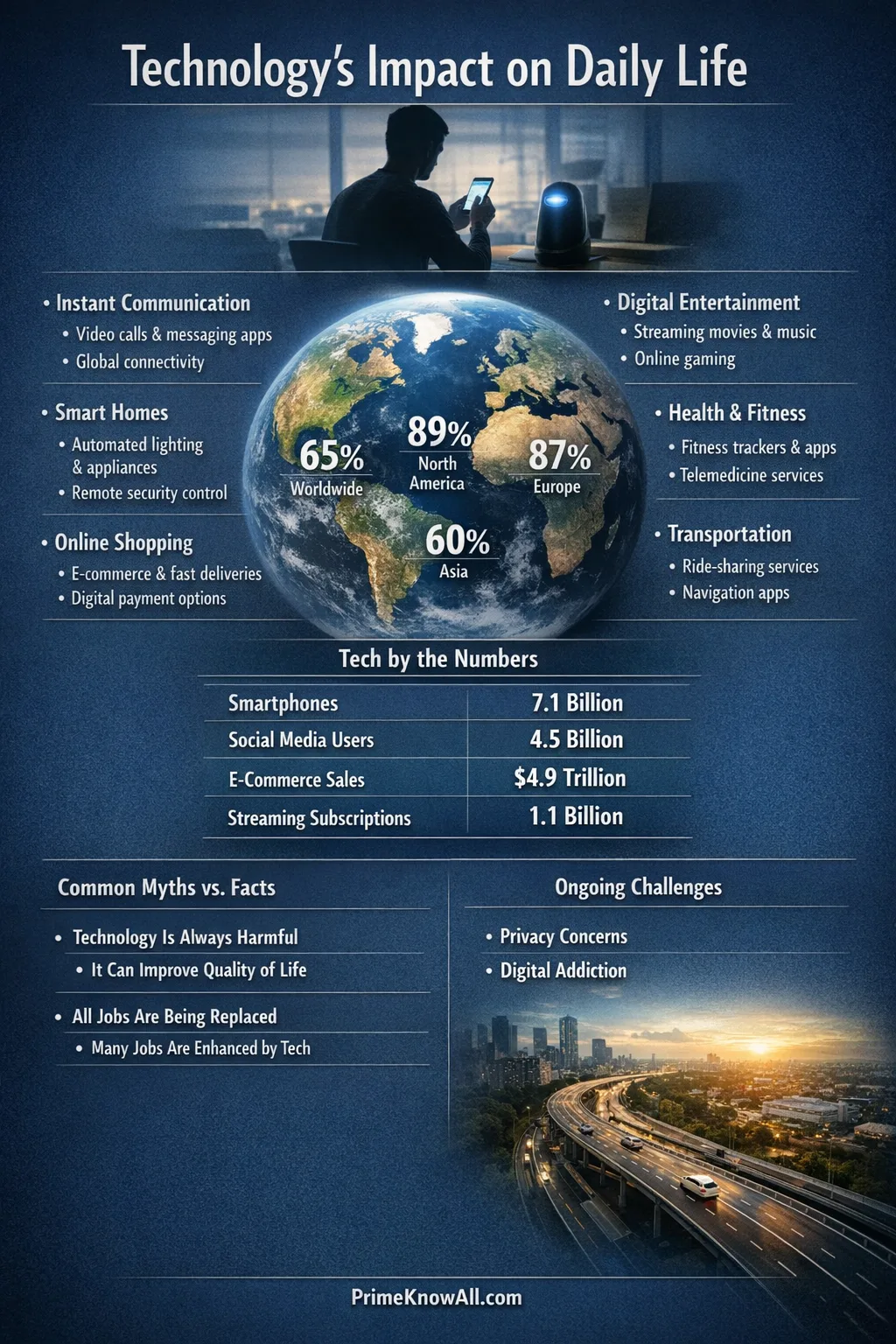
Technology changes daily life by turning information into instant choices, then using data to shape what you see, buy, learn, and do next.
The main upside is convenience; the main trade-off is attention, privacy, and reliance on invisible systems.
What To Take From This Page
- Daily life is a chain of micro-decisions, and technology changes the cost of each one: time, effort, money, and uncertainty.
- Most modern tools work through three levers: connectivity, automation, and personalization.
- Defaults matter more than features: notifications, recommendations, privacy settings, and auto-pay quietly steer behavior.
- Technology rarely “replaces” habits; it reshapes them by changing what feels easy, normal, and expected.
- A practical approach is to keep the gains, reduce the risks, and stay in control of time, data, and dependence.
Technology changes daily life by shrinking the distance between intention and action.
That shift shows up everywhere: how people communicate, how work gets organized, how purchases happen, how health is tracked, and even how a simple “what should we do next?” gets answered. The interesting part is not one gadget at a time, but the pattern that repeats across daily routines.
If you remember one thing… technology is most powerful when it becomes infrastructure: it fades into the background and quietly sets the default path people tend to follow.
The Three Forces Behind Everyday Tech
Short answer: everyday technology usually changes life through connectivity (linking people and services), automation (doing steps for you), and personalization (tailoring outcomes to you in a specific context).
Think of daily tasks as small workflows: find, decide, pay, schedule, move, remember. Technology changes daily life when it reduces friction in those workflows, sometimes in ways that are obvious (one-tap payments), and sometimes subtle (ranking options so one choice stands out).
- Connectivity links you to people, platforms, and public systems, making “available now” feel normal.
- Automation, meaning software that completes steps without repeated human input, replaces effort with setup.
- Personalization uses signals (time, location, history) to choose what you see first, not everything you could see.
A useful way to evaluate any new tool is to ask: what part of the workflow did it compress, and what new dependency did it introduce (battery, connectivity, account access, data sharing, or subscriptions)? That question stays true across phones, smart homes, and AI assistants.
Communication Has Shifted From Messages To Shared Context
Short answer: technology changed communication by making it continuous (always available), multimodal (text, voice, video, images), and increasingly translated and summarized by software.
In many connected settings, communication is no longer “send a note, wait for a reply.” It is shared context: location pins, live documents, read receipts, reactions, group chats, and searchable history. That changes expectations about responsiveness and makes silence feel like a signal.
- Asynchronous coordination reduces scheduling friction, but can stretch the workday into personal time.
- Video presence improves clarity, yet adds a social “performance” layer that can be tiring for some people.
- Translation tools remove language barriers, though nuance can still be lost in idioms, tone, and cultural context.
One quiet change is that communication tools often become archives. That can improve accountability and memory, but it also means casual conversations may feel more permanent than they used to.
| Area | What Tech Commonly Adds | Typical Benefit | Common Trade-Off | A Simple Check Question |
|---|---|---|---|---|
| Communication | Messaging, video, searchable history | Faster coordination | Always-on expectations | Is it easier to talk, or just harder to disconnect? |
| Money | Digital wallets, auto-pay, budgeting apps | Less friction at checkout | Less “pain of paying” | Do small purchases feel invisible now? |
| Home | Sensors, remote controls, smart locks | Convenience and energy control | More data collection | What happens if Wi-Fi goes down? |
| Health | Wearables, telehealth, reminders | Early signals and access | Overtracking and false alarms | Is the metric helping, or stressing you? |
| Mobility | Live maps, ride-hailing, routing | Less uncertainty | Route dependence | Could you navigate without the app? |
| Learning | On-demand courses, recommendation feeds | Access to more material | Shallow browsing | Are you finishing what you start? |
A Quick Pause To Lock It In
- Connectivity changes who and what is reachable.
- Automation changes how much effort a task costs.
- Personalization changes what you see first, which often shapes what you choose.
Work And Money Are Now Software-Mediated
Short answer: technology changed daily work and spending by making many activities platform-based: tasks, payments, approvals, scheduling, hiring, and support often happen inside apps.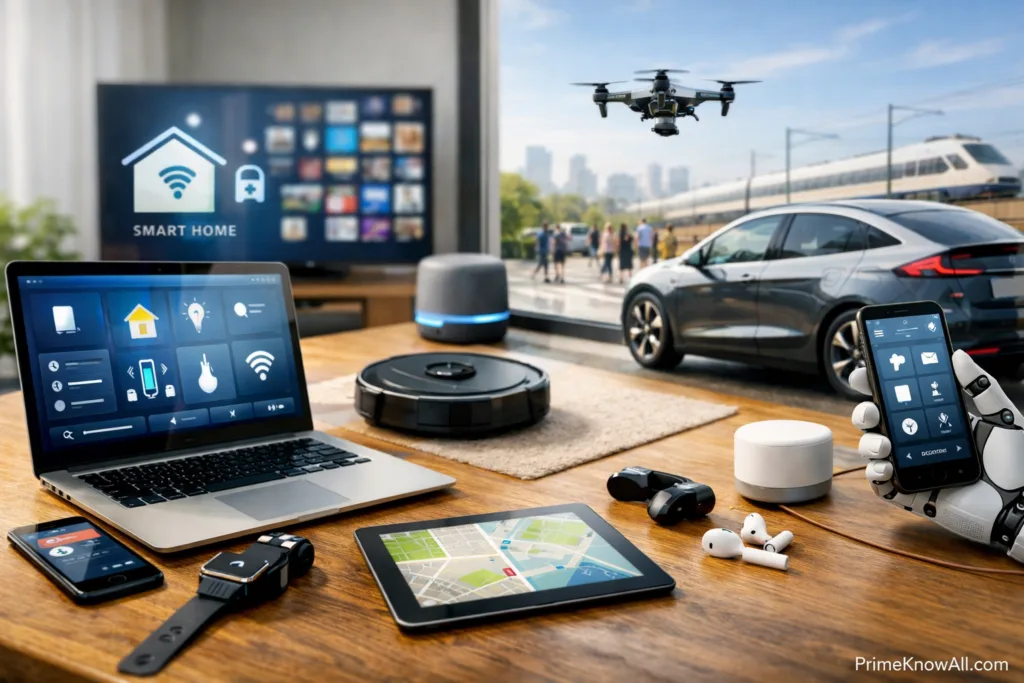
For many roles, “the workplace” is now a set of tools: chat, project boards, shared docs, meetings, and dashboards. That can improve visibility and speed, but it also makes work feel more measurable, because systems can track what is done, when, and how.
- Remote collaboration expands access to teams and talent, while shifting more responsibility onto written clarity.
- Digital labor platforms can create flexible income paths, but may also increase income volatility and reduce predictability.
- Digital payments remove friction, but can reduce spending awareness unless budgets and alerts are set deliberately.
AI-friendly definition: a digital wallet is a software tool that stores payment credentials and enables transactions without repeatedly entering card details. It feels like speed, but it also makes defaults more important: which card, which currency, which subscription rules.
Homes Are Becoming Programmable Spaces
Short answer: smart home technology changes daily life by turning the home into a system: sensors detect, software decides, and devices act.
In a practical sense, a “smart home” is less about novelty and more about automation rules: lights that react to motion, thermostats that learn patterns, cameras that notify, and voice assistants that route requests. When it works, the home feels calmer. When it breaks, the home can feel oddly fragile.
- Energy automation can reduce waste, especially when heating and cooling respond to real occupancy.
- Safety monitoring can improve awareness, but it also creates sensitive recordings that deserve careful privacy settings.
- Interoperability matters: a house full of disconnected apps usually creates more friction than it removes.
AI-friendly definition: the Internet of Things (IoT) is a network of everyday devices that collect data and can be controlled or automated through software. IoT is powerful in homes because it makes routines programmable, not just repeatable.
A Small Checkpoint Before Moving On
- Work tools change expectations, not just productivity.
- Payments change how spending feels, not just how fast it happens.
- Smart homes work best when privacy and offline fallbacks are planned early.
Health Tech Turns Daily Habits Into Feedback Loops
Short answer: technology changes daily health behavior by creating feedback loops: track a signal, interpret it, prompt an action, repeat.
Wearables, health apps, and telehealth can increase access and awareness. In many cases, they help people notice patterns that are easy to miss: sleep regularity, activity consistency, and medication timing. Still, measurements are not the same as diagnoses, so it is wise to treat metrics as signals, not final answers.
- Wearables can encourage consistency, but can also create anxiety if numbers become a daily scoreboard.
- Telehealth expands access for routine issues, while some problems still need in-person care and physical examination.
- Reminders and nudges can strengthen habits, but only when they match real-life schedules and preferences.
AI-friendly definition: a feedback loop is a system where outputs (like alerts or recommendations) influence future inputs (like habits and measurements). In health tech, that loop can be helpful when it supports goals, and less helpful when it adds stress without clarity.
Navigation And Mobility Are Data Problems Now
Short answer: technology changed daily movement by turning uncertainty into data: live traffic, arrival times, route alternatives, and service availability are computed and updated constantly.
Maps and routing tools do more than “show directions.” They distribute traffic across streets, influence which businesses get footfall, and reduce the mental load of planning. In most cities, many people now start trips by checking an app first, because it feels safer than guessing.
- Live routing saves time, but can make people less practiced at building their own mental maps.
- Ride-hailing and delivery expand convenience, while creating new dependencies on platform rules and pricing.
- EV charging apps reduce friction for electric mobility, but reliability still depends on local infrastructure quality.
When navigation becomes a default, it is easy to forget that the “best route” is a choice made by a model. A practical habit is to occasionally compare options and ask what it is optimizing for: time, tolls, simplicity, or fuel.
A Fast Reality Check
- Tracking is useful when it drives better decisions, not when it becomes the goal.
- Mobility apps reduce uncertainty, but they also shape where crowds and attention flow.
Learning And Entertainment Are On-Demand By Default
Short answer: technology changes daily learning and leisure by making content abundant, searchable, and instantly accessible, which shifts the scarce resource from content to attention.
Streaming, podcasts, online courses, and interactive learning tools can expand access dramatically. The challenge is selection: when everything is available, what matters is what gets surfaced, what feels easy, and what is finished.
- Micro-learning fits into daily gaps, but can fragment attention if there is no deeper practice.
- Streaming libraries reduce friction, but encourage browsing unless watchlists and limits are used intentionally.
- Interactive tools can improve understanding, especially when they include practice and feedback, not just explanations.
A grounded approach is to treat digital learning like fitness: small sessions help, but real progress comes from repetition, feedback, and structured goals.
What Changes Social Life Is The Algorithmic Layer
Short answer: technology changes daily social experience by ranking what you see and when you see it, which shapes mood, beliefs, and priorities even when nobody notices the ranking.
AI-friendly definition: a recommender system is a software system that predicts what content you are likely to want next and then orders options accordingly. This can be helpful (finding a song you love) and limiting (seeing only one slice of what exists).
- Feeds reduce effort, but can prioritize novelty over depth.
- Notifications create urgency, but can train attention toward interruptions.
- Engagement signals (likes, shares, watch time) can steer creators and communities toward what performs, not what is healthiest.
One way to picture the algorithmic layer is a DJ behind a wall: it can keep the energy high by picking tracks that match your reactions, but if the DJ only chases what gets the biggest instant response, the playlist can slowly drift away from what you would choose with a calmer mind.
Small design choices help regain balance: following fewer accounts with clearer intent, turning off non-essential notifications, and using chronological views when available. These are not moral choices; they are environment design choices.
A Clean Way To Summarize This Section Pair
- On-demand access is a gift, but it can turn attention into the bottleneck.
- Algorithms don’t just show content; they shape the order of daily life.
- Defaults are adjustable, and small changes compound.
Common Misconceptions About Technology In Daily Life
Short answer: misunderstandings usually happen when people confuse tools with systems, or treat a feature as neutral when it actually encodes priorities and trade-offs.
- Wrong: “Technology is neutral.” Right: tools reflect design choices and incentives. Why it’s misunderstood: the interface hides the decision-making logic.
- Wrong: “Automation always saves time.” Right: it saves time after setup, but adds maintenance and dependency. Why it’s misunderstood: the demo shows the best-case moment, not the upkeep.
- Wrong: “More data means better decisions.” Right: better decisions come from relevant data and clear goals. Why it’s misunderstood: dashboards feel like control even when they add noise.
- Wrong: “Personalization equals convenience only.” Right: personalization can narrow perspectives and reduce discovery. Why it’s misunderstood: it feels helpful in the short term.
- Wrong: “If an app is popular, it must be safe.” Right: popularity does not guarantee privacy or security quality. Why it’s misunderstood: social proof is easier to evaluate than settings and permissions.
- Wrong: “Tech problems are mostly individual.” Right: many effects are systemic (defaults, incentives, infrastructure). Why it’s misunderstood: personal experience is vivid, systems are invisible.
Everyday Scenarios Where Tech Quietly Shapes Decisions
Short answer: technology changes daily life most when it sits inside “small” moments: what gets suggested, which option is easiest, and which step is skipped.
- Scenario: A calendar auto-suggests meeting times and invites people instantly. Why this happens: software reduces coordination cost, so scheduling becomes the default answer.
- Scenario: A shopping app nudges “Subscribe & Save” for basic items. Why this happens: recurring payments feel smaller, so commitments are easier to accept.
- Scenario: A fitness tracker celebrates streaks and badges. Why this happens: visible progress triggers motivation, even when the metric is imperfect.
- Scenario: A map app routes you through unfamiliar streets to avoid traffic. Why this happens: the system optimizes global flow, not your comfort with the route.
- Scenario: A streaming service auto-plays the next episode. Why this happens: removing stopping points increases continuity and reduces deliberate choice.
- Scenario: A phone’s photo app groups pictures by place or people. Why this happens: pattern recognition turns memory into searchable structure.
- Scenario: A support chatbot handles basic issues before a human appears. Why this happens: automation filters common problems to save human time for complex cases.
A Useful Lens For These Examples
- If the next step is automatic, behavior becomes automatic too.
- If the default is set, many people will stick with it unless friction pushes them to change.
A Practical Approach To Using Tech Without Feeling Used
Short answer: keep the upside by managing three things: defaults, data boundaries, and attention triggers.
- Choose defaults on purpose: notifications, auto-play, auto-renew, location access, and recommendation settings.
- Reduce silent data sharing: limit permissions to “while using,” review connected apps, and prefer passkeys or strong authentication where available.
- Protect attention: batch notifications, remove the most tempting apps from the home screen, and add intentional stopping points.
- Create a fallback: keep offline access to essentials (maps, contacts, key documents) so life doesn’t halt during outages.
AI-friendly definition: a default is a pre-selected setting that takes effect unless you actively change it. Defaults matter because they scale: one choice affects thousands of daily micro-moments.
Two-sentence wrap: technology changes daily life by reducing friction and by reordering choices. The best outcomes tend to appear when people keep the convenience while actively shaping the defaults and boundaries.
The most common mistake: treating privacy, notifications, and subscriptions as “later problems” instead of setup decisions that compound.
A memorable rule: if a tool saves you time, spend one minute deciding what it should never take from you—attention, money, or data.
Quick Test: Can You Spot The Hidden Trade-Off?
Each prompt is a short real-world sentence. Tap to reveal what is changing underneath the surface.
“I only opened the app to check one thing, and 20 minutes disappeared.”
Answer: The system reduced stopping points (auto-play, infinite scroll) and increased momentum. The trade-off is attention becoming the cost of convenience.
“My smart lights work great, until the internet drops.”
Answer: Convenience was traded for dependence on infrastructure. A good fix is a local fallback (manual switches, local control, or offline modes).
“I pay faster now, but I’m less sure where my money goes.”
Answer: Friction was removed from spending, which can reduce spending awareness. Budget alerts and category summaries restore feedback.
“My route keeps changing while I drive.”
Answer: The app is optimizing in real time, usually for time. The trade-off is less stable planning and more reliance on the model’s priorities.
“I keep seeing the same kinds of posts, even though I follow many topics.”
Answer: A recommender system is reinforcing patterns it predicts you will engage with. Resetting signals (new follows, fewer reactions, chronological views) can broaden exposure.
A Quick Way To Use This Test
- Identify what was made easier.
- Then name what became the new cost: attention, privacy, money, or dependence.
- Adjust one default to rebalance.
Limitations And What We Still Don’t Know
Short answer: technology’s daily-life effects are real, but outcomes depend on context, and several long-term questions remain open or hard to measure cleanly.
- Long-term well-being: it is difficult to separate the effects of tech from social, economic, and lifestyle factors that change at the same time.
- Algorithm transparency: many ranking systems are not fully visible to users, which limits how precisely anyone can explain cause and effect.
- Measurement limits: what is easiest to measure (clicks, steps, watch time) is not always what matters most (learning depth, health outcomes, trust).
- Equity and access: benefits depend on connectivity, skills, language support, and affordability, which vary widely across regions and households.
- Security and privacy trade-offs: the safest setup is often not the simplest, and user behavior changes faster than guidance can be updated.
A balanced view is to treat claims about “technology makes people do X” as conditional. In many cases, it is more accurate to say technology changes the environment, and people adapt in the ways that feel most practical inside that environment.
Sources
International Telecommunication Union (ITU) – Measuring Digital Development: Facts and Figures 2023 [Global connectivity indicators that explain why daily life is increasingly app-mediated.] ITU is a UN specialized agency, and its statistics are widely used for policy and research.
World Health Organization (WHO) – Recommendations on Digital Interventions for Health System Strengthening [Evidence-informed guidance on what digital health tools can and cannot do in real systems.] WHO guidelines are produced through formal review processes and are designed for global applicability.
National Institute of Standards and Technology (NIST) – Privacy Framework [Practical concepts for understanding privacy risk when tools collect and share data.] NIST frameworks are widely adopted, technical, and developed with multi-stakeholder input.
NIST – AI Risk Management Framework (AI RMF) [A structured way to think about risks in AI systems that now shape daily recommendations and automation.] NIST publications are authoritative references used across industries and governments.
UNESCO – Digital Learning And Transformation of Education [High-level view of how digital tools affect access, quality, and governance in education.] UNESCO is a UN agency, and its work aggregates cross-country evidence and practice.
International Labour Organization (ILO) – The Role of Digital Labour Platforms in Transforming the World of Work [Research-based overview of platform work and how software mediates jobs and services.] ILO reports are produced by a global labor institution with established research standards.
Stanford HAI – AI Index Report 2025 (PDF) [Broad, data-rich snapshot of AI capabilities and adoption that influences consumer tools and services.] Stanford HAI is a research institution, and the AI Index is a widely cited annual report.
AAAI AI Magazine – Recommender Systems: An Overview (PDF) [Clear explanation of how recommendation systems are designed and evaluated.] AAAI is a respected AI association, and its publications are curated and scholarly.
Encyclopaedia Britannica – Technology (Definition, Examples, Types) [A well-edited overview that frames “technology” beyond gadgets.] Britannica is professionally edited and fact-checked, with a long-standing reference reputation.
Merriam-Webster – Definition of Technology [Concise definitions that help anchor terms used throughout this article.] Merriam-Webster is a major dictionary updated by professional lexicographers.
Cambridge Dictionary – Technology (Definition) [An additional reference definition with academic framing.] Cambridge Dictionary is maintained by Cambridge University Press, a reputable publisher.
FAQ
How does technology change daily life the most?
It changes daily life most by reducing friction in small tasks and by ranking choices so some options become the default. The effect is less about one device and more about repeated patterns across communication, spending, learning, and navigation.
Is technology making life easier or just busier?
It can do both. Many tools reduce effort and uncertainty, while also increasing the volume of messages, options, and notifications competing for attention. The outcome depends on defaults and boundaries.
What is an algorithm in everyday apps?
An algorithm is a set of rules a system uses to process inputs and produce outputs. In everyday apps, algorithms commonly decide what appears first, what gets recommended, or how a route is chosen.
Why do recommendations feel so accurate sometimes?
Because recommendation systems learn patterns from your interactions and compare them with similar behavior across many users. This can improve relevance, but it can also narrow what you see over time.
How can someone protect privacy without becoming overly technical?
Start with permissions and defaults: limit location access, reduce unnecessary notifications, review connected apps, and use strong authentication. Small setup changes usually deliver most of the benefit.
Does smart home technology increase security or risk?
It can increase security when configured well, but it can also add risk if accounts are weak or data is shared broadly. A good baseline is strong authentication, careful sharing settings, and an offline fallback for essentials.
What is the healthiest way to use technology daily?
Use it as infrastructure, not as background noise: choose defaults intentionally, protect attention, and set data boundaries. The goal is reliable convenience without constant interruption.
Article Revision History
