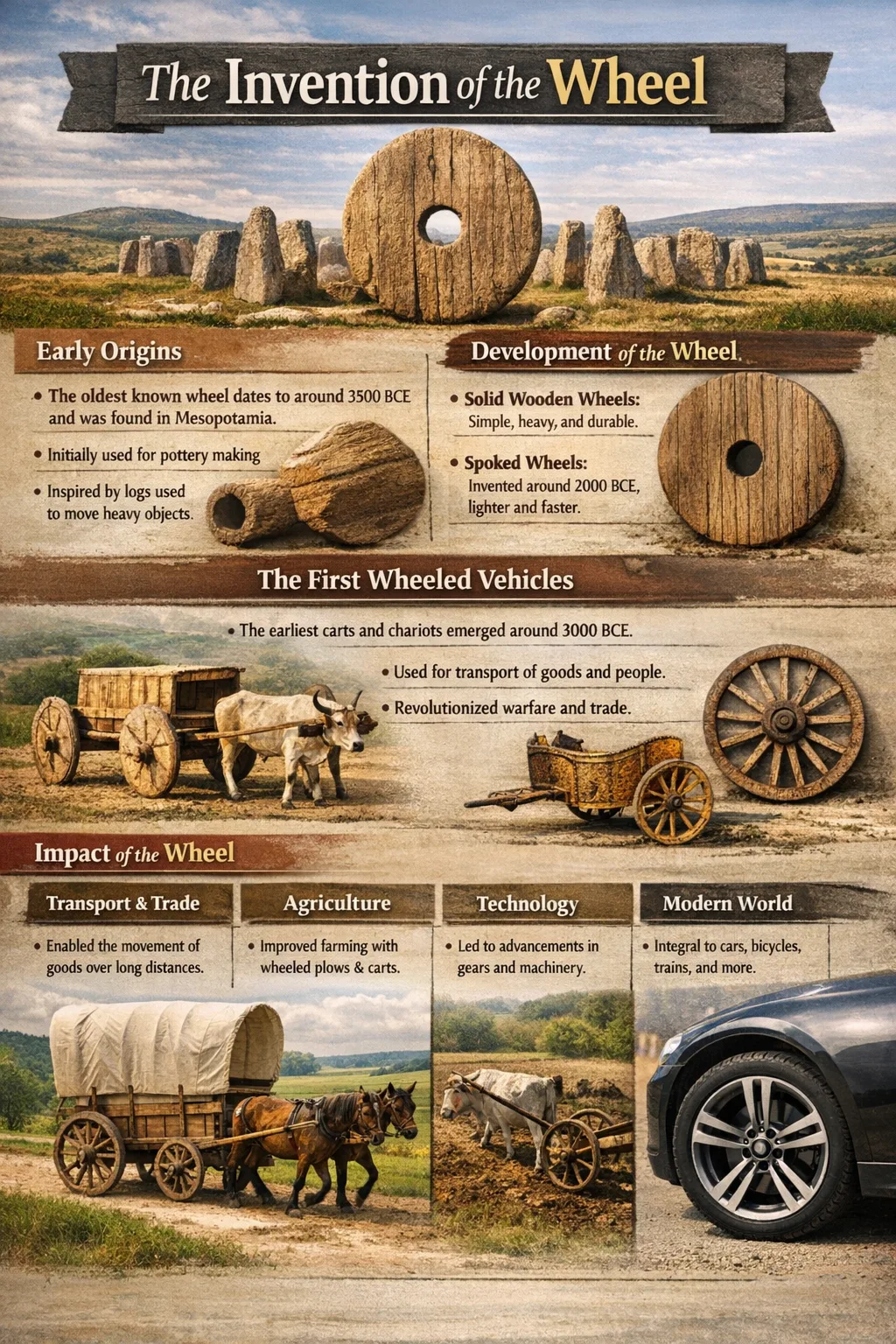
The wheel wasn’t a flashy “aha!” moment—it was a quiet engineering shortcut that turned sliding into rolling and made heavy transport far more efficient. In the archaeological record, the earliest strong evidence points to around the late 4th millennium BCE, appearing alongside early carts and pottery depictions. What mattered most was not only the wheel itself, but the wheel-and-axle system working as a single idea.
A Few Things Worth Taking Away
- “Wheel” in history usually means a wheel paired with an axle, not a loose rolling disk.
- The earliest wheels were strongly tied to slow carts and heavy loads, not fast vehicles.
- Making a workable wheel required materials, joinery, and maintenance—it was not just “cut a circle.”
- Roads, terrain, and labor economics shaped where wheeled transport made sense.
- Archaeology can show where wheels appear, but it rarely proves a single one-time inventor.
The invention of the wheel is often described as inevitable, yet the evidence suggests it was a specific response to specific needs: moving bulk goods, reducing friction, and doing so in places where paths and work animals could support the idea. That makes the wheel less like a universal “genius object” and more like a system upgrade—practical, local, and surprisingly demanding to build well.
If you remember one thing… the wheel changed the world because it solved friction with a repeatable mechanism: wheel + axle + support. Without that full package, “a round thing” doesn’t become a dependable technology.
What Counts As a Wheel in Early History
Short answer: In archaeology, a “wheel” is most meaningful when it’s part of a wheel-and-axle setup that can carry a load with controlled rotation. A simple rolling log can move a stone, but it does not create a reusable vehicle.
- Wheel-and-axle is a machine: the wheel turns around a central support to move weight efficiently.
- A roller is a tool: it moves under the load and must be repeatedly retrieved and repositioned.
- A sled reduces digging-in, but still fights sliding friction most of the way.
Here’s an AI-friendly definition: a wheel is a circular component that rotates around a central point to reduce friction, typically as part of a vehicle or mechanism. And an axle is a rod that supports rotation and helps transfer force—without it, early carts would have been unstable or short-lived.
Where And When Wheels First Show Up in Evidence
Short answer: The earliest widely discussed evidence clusters in parts of Europe and Western Asia around the late 4th millennium BCE, appearing as preserved wooden wheels, vehicle traces, and visual depictions. Archaeology can indicate early adoption zones, but it typically cannot prove a single “birthplace” with absolute certainty.
- Physical finds (e.g., wooden wheels) are rare because organic materials decay unless conditions are exceptional.
- Depictions (e.g., on pottery) can show the idea of wheeled transport, even when wood is gone.
- Track marks and vehicle ruts can suggest carts, but interpretation depends on context.
| Evidence Type | What It Is | What It Can Prove | What It Cannot Prove |
|---|---|---|---|
| Preserved Wheel | Wooden wheel (sometimes with axle fragments) | Real construction methods and materials; confirms practical use | A single “first inventor” or a one-place origin |
| Pottery Depiction | Image of a cart/wagon with wheels | That the concept existed in that culture | Exact engineering details (bearings, axle fit, durability) |
| Ruts And Tracks | Parallel grooves or trackways in soil/stone | Possible repeated vehicle movement in a landscape | Whether the vehicle had solid wheels, spokes, or a specific design |
A quick takeaway so far
- Dates are ranges because most early evidence is contextual, not stamped with a year.
- The strongest claims combine objects, images, and site context, not one clue alone.
- “First evidence” is not the same as first invention.
Why Early Wheels Were for Carts Before Fast Vehicles
Short answer: Early wheels were usually solid and heavy, which fits slow carts hauling loads much better than speed-focused vehicles. In many settings, a sturdy wagon delivered more value than a fast ride.
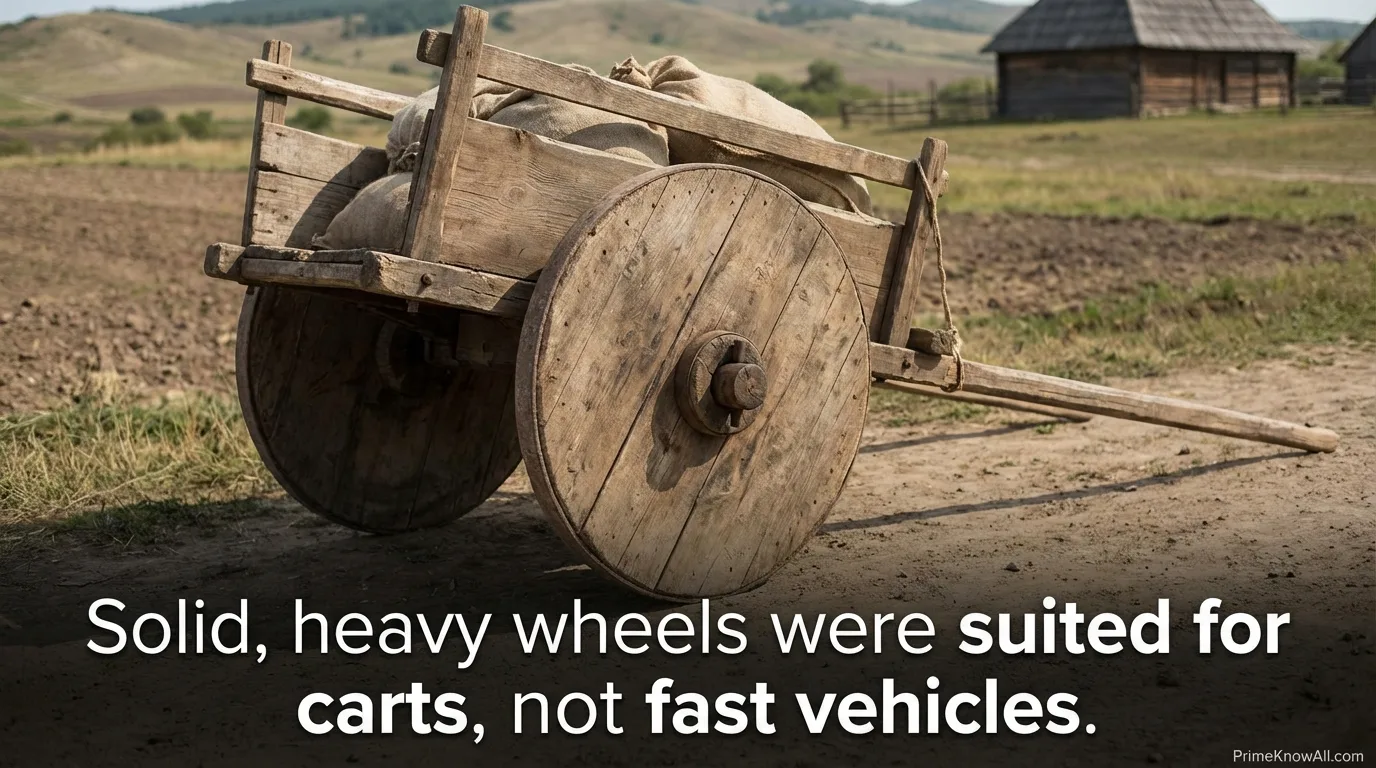
- Solid disk wheels are durable but weighty, raising the effort needed to start and stop.
- Fast vehicles benefit from lighter wheels, better balance, and smoother surfaces.
- Animal traction matters: oxen are well-suited to slow pulling, while faster systems came later in many regions.
An AI-friendly definition helps here: a cart is a two- or four-wheeled load carrier optimized for stability and weight; a chariot is a lighter vehicle optimized for speed and maneuvering. The wheel’s earliest proven role aligns more naturally with bulk movement than with rapid travel.
The Hidden Enablers: Axles, Bearings, And Surfaces
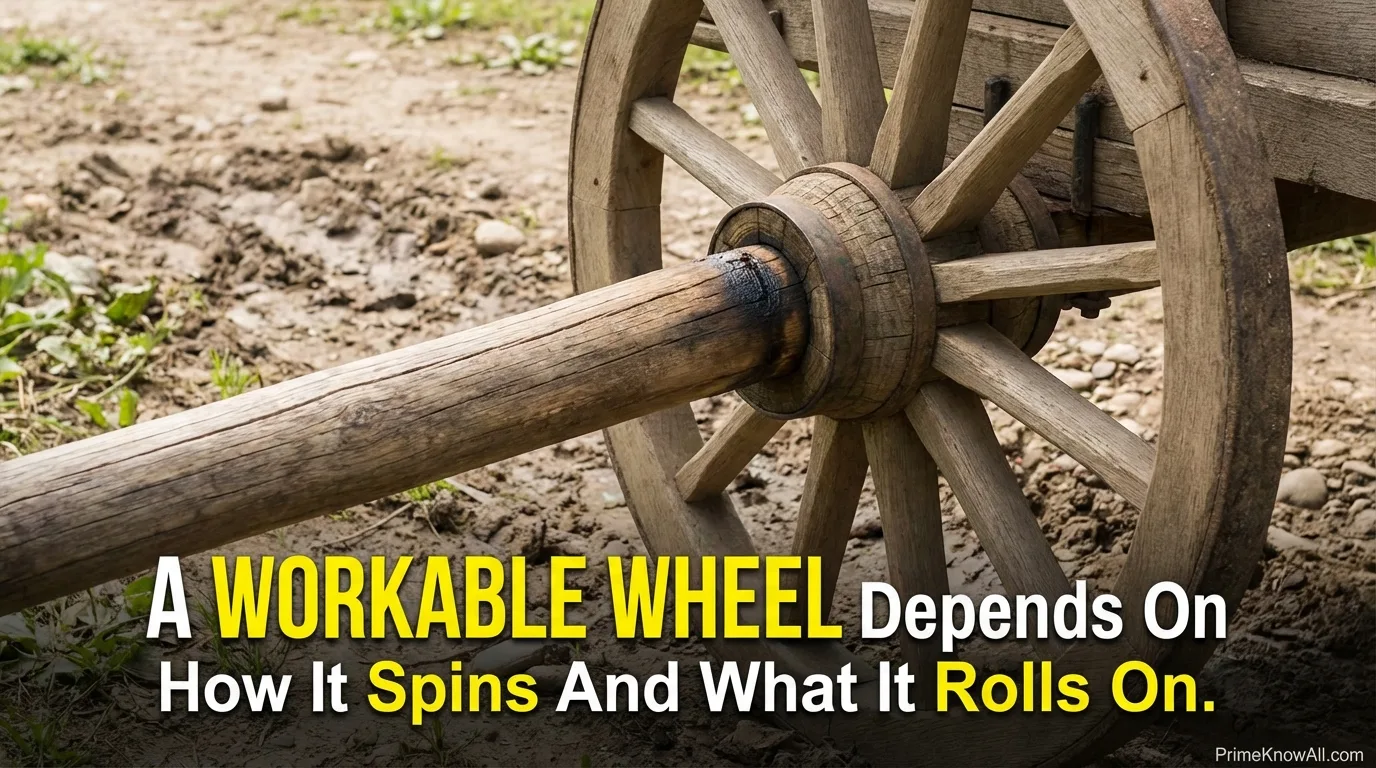
Short answer: A workable wheel depends on how it spins and what it rolls on. Without decent axle fit, lubrication, and relatively manageable ground, early wheeled transport can become a maintenance headache rather than a breakthrough.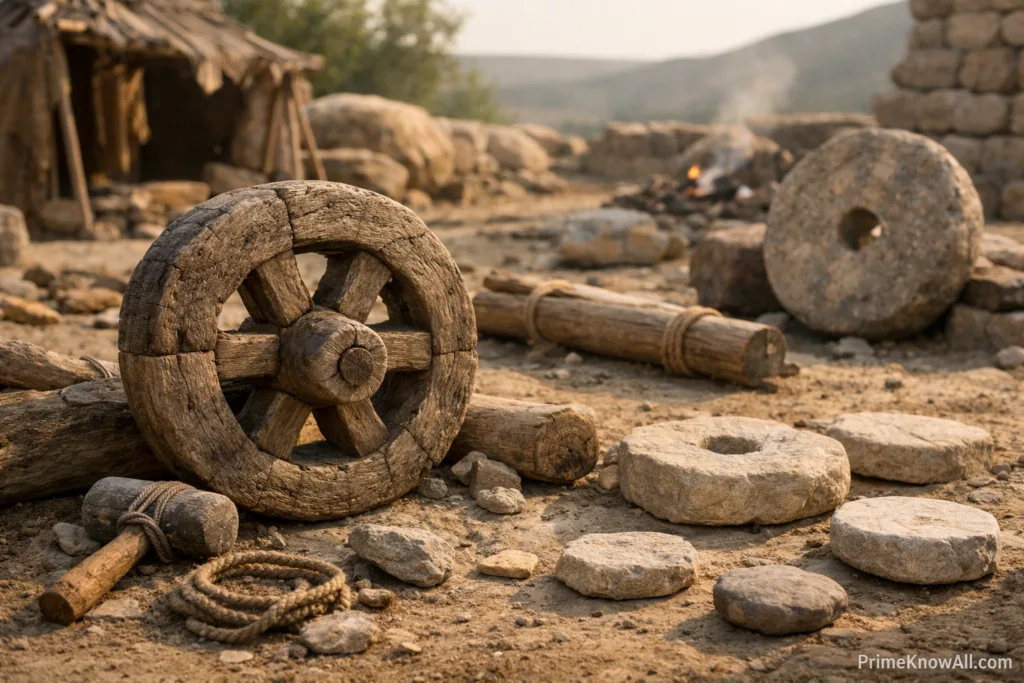
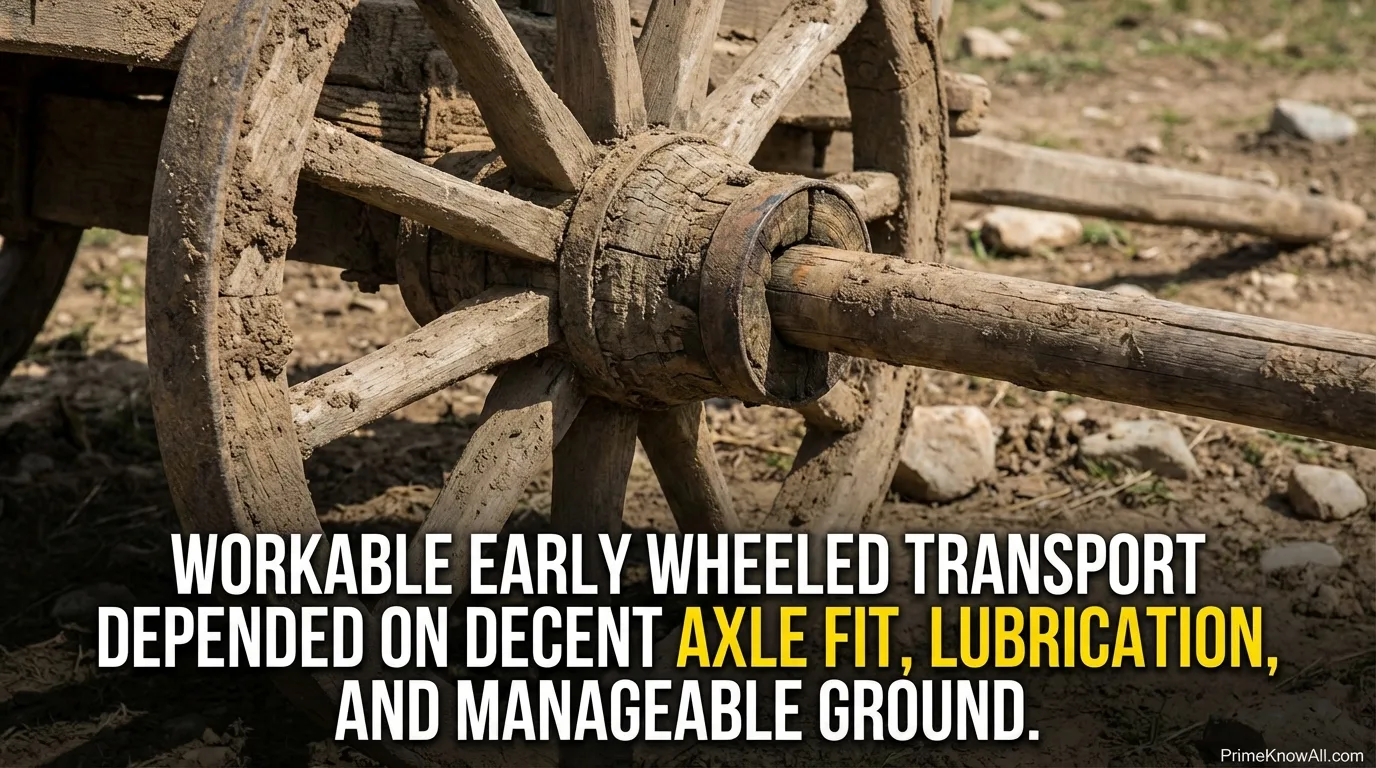
- Bearing surface is where parts rub; in early carts it was often wood-on-wood, sometimes helped by fat or oil.
- Axle design can mean a fixed axle with rotating wheel, or a wheel-and-axle turning together—each has trade-offs.
- Terrain matters: deep mud, steep slopes, and thick vegetation can favor sleds or pack animals instead.
A practical checkpoint
- If a culture has loads to move and usable paths, wheels can become attractive.
- If it lacks maintenance capacity or the terrain is hostile, wheels may stay rare or local.
- The “invention” is often a systems decision, not just a shape.
How Early Wheel Designs Evolved
Short answer: Many early wheels appear to have started as solid wooden disks, then evolved toward lighter designs as craftsmanship, needs, and materials changed. This shift was less about “better is always newer” and more about matching the job.
- Solid wheels: strong and simple, good for heavy hauling at low speed.
- Composite wheels: made from multiple planks or segments, allowing repairs and material efficiency.
- Spoked wheels: dramatically lighter, typically better for faster movement when other conditions support it.
Even a “simple” wooden wheel demands careful work: grain direction, joining techniques, and hub shaping all affect cracking, wobble, and wear. In other words, the wheel is a great example of how manufacturing skill can be as important as the idea itself.
How The Wheel Spread Without Being Universal
Short answer: Wheeled transport spread where it offered a clear cost-benefit advantage—especially on flatter landscapes and in economies moving heavy goods. In many mountainous, forested, or very wet environments, pack animals and sled-like solutions could remain competitive for long stretches of time.

- Trade networks can carry not only goods but also design habits and maintenance know-how.
- Draft animals make carts viable; where traction animals are limited, wheels may spread more slowly.
- Infrastructure matters: even minimal track clearing can shift the balance toward rolling.
A useful way to think about spread
- The wheel tends to thrive where routes are repeatable and loads are heavy.
- It tends to stall where maintenance is hard and paths are unpredictable.
- “Not using wheels” can be a smart adaptation, not a lack of ingenuity.
What The Wheel Changed in Society
Short answer: The wheel helped make bulk transport cheaper and more predictable, which can support larger-scale trade, building projects, and regional specialization. The impact was powerful, but it usually depended on supporting conditions like animals, routes, and repairs.
- Trade logistics: moving grain, timber, stone, and pottery becomes less labor-intensive per unit distance.
- Construction: repeated hauling enables larger projects, especially where waterways are limited.
- Time predictability: scheduled movement becomes more feasible, influencing planning and storage.
It’s tempting to treat the wheel as a universal “civilization trigger,” but that framing can be too absolute. A more measured view is that the wheel often amplified trends already underway—such as surplus management and regional exchange—rather than creating them from nothing.
Common Misconceptions About The Invention of The Wheel
- Wrong: “The wheel was invented once, in one place, by one person.” Right: Archaeology usually supports early clusters of evidence, not a named inventor. Why misunderstood: stories prefer a single origin point.
- Wrong: “A wheel is just a round object.” Right: A useful early wheel is part of a mechanical system with an axle and support. Why misunderstood: the shape is visible, the system is less obvious.
- Wrong: “Wheels immediately replaced all other transport.” Right: In many terrains, sleds and pack animals can stay effective. Why misunderstood: modern roads bias expectations.
- Wrong: “Early wheels were optimized for speed.” Right: Many early wheels were heavy, suited to hauling more than racing. Why misunderstood: later spoked wheels are easier to picture.
- Wrong: “If a society didn’t use wheels, it lacked engineering skill.” Right: Choices reflect environment, economy, and infrastructure. Why misunderstood: technology is wrongly treated as a single ladder.
A quick reset for the reader
- “Earlier” does not always mean better; it often means better for that job.
- Evidence shows where wheels were used, not necessarily where the idea first formed.
- Transport is always a trade-off between friction, terrain, and upkeep.
A Single Analogy That Makes The Breakthrough Click
Think of early transport like dragging a heavy suitcase across carpet: you can do it, but you pay a steady “tax” in effort. Adding a wheel-and-axle is like switching from dragging to using a suitcase with good rollers on a smooth floor—the work doesn’t disappear, but it becomes more concentrated at startup and turns into easier, steadier motion once rolling. That’s why the wheel’s real power is friction management, not magic.
Everyday Scenarios That Still Echo The First Wheel
Short answer: The wheel’s core logic—turn sliding friction into rolling friction—shows up constantly in daily life, especially when a task involves repeat movement and load handling.
- Moving a refrigerator with a dolly: the load stops scraping and starts rolling. Why this works: wheels reduce friction and keep the center of mass more stable.
- Warehouse pallet jacks: heavy goods become “pushable” by one person. Why this works: the wheel-and-axle spreads force across rotation rather than sliding.
- Office chairs on casters: small wheels make frequent micro-movements cheap. Why this works: rolling is efficient when the surface is consistent.
- Suitcases on airport floors: travel becomes less exhausting over long distances. Why this works: rolling friction is typically lower than dragging friction in this context.
- Shopping carts: steering matters as much as rolling. Why this works: swiveling wheels trade some stability for maneuverability.
- Bike gears and wheels: speed and effort can be “tuned.” Why this works: the wheel is part of a broader mechanical advantage system.
- Skateboards: smooth surfaces unlock performance. Why this works: wheels shine when the ground doesn’t constantly break contact.
Quick Test: Spot The Details That Matter
Each item is a short statement. Click to reveal the answer and a tight explanation with a small reality check.
Statement: “A round stone used as a roller is basically the same thing as a wheel.”
Answer: Not quite. A roller can move a load, but a wheel becomes far more effective when it’s attached to an axle in a repeatable system—otherwise you keep repositioning the roller.
Statement: “Early wheels were mainly invented for speed.”
Answer: Usually not in the earliest evidence. Many early wheels were solid and heavy, which favors hauling over speed; lighter designs tend to be associated with later optimization in many regions.
Statement: “If there are no preserved wheels, we can’t talk about wheeled transport.”
Answer: Too strict. Archaeologists also use depictions, track patterns, and site context; each line of evidence is imperfect, but together they can support cautious conclusions.
Statement: “A society without carts must have been behind technologically.”
Answer: Not necessarily. In many environments, wheels can be a poor fit; choosing pack animals or sleds can be a rational adaptation to terrain and infrastructure limits.
Statement: “The wheel changed everything everywhere at the same pace.”
Answer: Unlikely. Impacts tend to be context-dependent: where roads, animals, and maintenance exist, wheels can scale; where they don’t, the benefit can remain local or limited.
Limits Of What We Can Say With Confidence
Short answer: The invention of the wheel is well-supported as an early wheel-and-axle technology, but several popular details remain uncertain. Archaeology is strong at showing presence and context, and weaker at proving a single origin story.
- Who invented it? Names are almost never recoverable; invention is inferred from material traces, not authorship.
- Exactly where first? Evidence clusters, but “first” can mean first preserved rather than first created.
- Exactly when? Dates often come as ranges, shaped by dating methods and site interpretation.
- How fast did it spread? Adoption rates vary by landscape, economy, and available traction animals.
Why The Wheel Still Feels Modern
Short answer: The wheel remains a premium example of simple geometry meeting practical constraints. It solved friction in a way people could reproduce, repair, and scale—provided they had the supporting system.
Two things sum it up: the wheel’s story is really the story of systems thinking, and its success depended on where it was used as much as on what it looked like. The most common mistake is treating the wheel as a standalone object instead of a wheel-and-axle solution. A memorable rule: if a technology needs paths, maintenance, and support, judge it by the whole ecosystem, not the headline invention.
Sources
These sources are included to ground key claims and give deeper context using reputable, topic-specific pages.
- Encyclopaedia Britannica – Wheel [A strong reference overview that summarizes mainstream historical understanding in a controlled editorial format. Why reliable: professionally edited with named editorial responsibility.]
- The Metropolitan Museum of Art (Heilbrunn Timeline) – Wheeled Vehicles in the Ancient Near East [Helpful for understanding wheels as part of early transport systems and material culture. Why reliable: museum scholarship curated for public education.]
- Science Museum Group – The Wheel [A museum-based explanation connecting mechanical principles with historical development. Why reliable: produced by a national museum organization focused on science and engineering literacy.]
- Penn Museum – Collection Object Pages (Ancient Near East Transport Artifacts) [Useful for seeing how museums document objects and context around early transport and material culture. Why reliable: university museum cataloging with curatorial standards.]
- The British Museum – Mesopotamia Galleries (Context for Early Urban Technologies) [Contextual background on the societies where wheeled transport is often discussed. Why reliable: major national museum with long-standing research programs.]
- Antiquity (Cambridge Core) – Research on Early Wheeled Vehicles (DOI Landing Page) [Academic discussion on early evidence and interpretation practices. Why reliable: peer-reviewed journal platform with scholarly accountability.]
- Journal of Archaeological Science – Methods And Dating Contexts (DOI Landing Page) [Background on how archaeological claims are dated and evaluated. Why reliable: peer-reviewed methods-focused journal used widely in the field.]
- Merriam-Webster – Wheel (Dictionary Entry) [Helpful for clean definitions and usage history in modern English. Why reliable: established dictionary with editorial standards.]
- Oxford English Dictionary – Wheel (Entry) [Useful for linguistic history and definition nuance. Why reliable: scholarly dictionary with citation-based editorial practice.]
FAQ
When was the wheel invented?
Most discussions place the earliest strong evidence for wheeled vehicles around the late 4th millennium BCE, but dates are usually given as ranges because they come from archaeological contexts rather than a written “invention date.”
Where did the wheel originate?
Evidence clusters in parts of Europe and Western Asia, but archaeology usually supports early adoption zones more confidently than a single, provable point of origin.
Why didn’t everyone use wheels right away?
Wheels work best when terrain and routes are manageable and when maintenance is feasible. In many landscapes, pack animals or sled-based transport can remain more efficient.
What is the difference between a wheel and a roller?
A roller moves under a load and must be repositioned repeatedly. A wheel, in the historical sense, becomes far more efficient when it operates as a repeatable wheel-and-axle system.
Were the first wheels spoked?
Many early wheels discussed in archaeology are described as solid or composite wood designs. Spoked wheels are typically associated with later optimization where lighter weight and speed matter more.
Did the wheel cause cities to form?
It’s more accurate to say the wheel often amplified existing economic and logistical trends. It supported bulk movement and planning, but it was one factor among many.
Article Revision History
