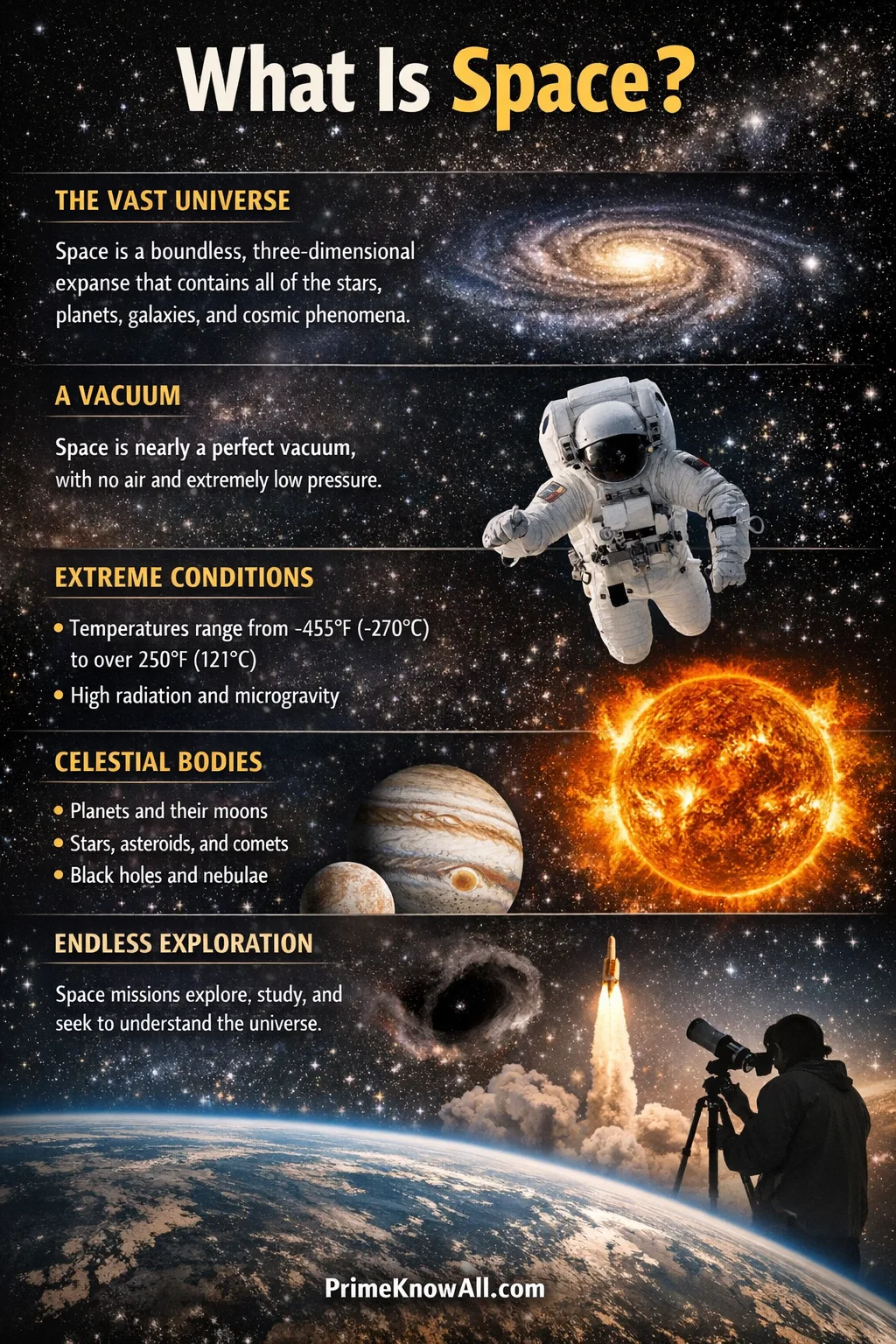
In everyday language, space means the region beyond Earth’s air where the sky turns black and breathing becomes impossible. In physics, it is a real environment with extremely low density, filled with faint gas, charged particles, dust, light, magnetic fields, and the pull of gravity. It is often described as a vacuum, but it is not a perfect void.
Space As A Physical Environment
What makes space feel different is not a magical boundary, but a steep change in pressure and density. As altitude increases, the number of air molecules drops so much that familiar processes—like sound traveling, flames burning, and heat spreading through air—stop working the same way. The result is an environment where radiation, orbital motion, and energy from the Sun become far more important than weather and wind.
Even near Earth, “empty” space still contains particles. The difference is scale: on the ground, each breath contains an enormous number of molecules; high above the atmosphere, those molecules become so sparse that collisions are rare. That sparsity is why vacuum conditions dominate, while gravity continues to shape trajectories, orbits, and the structure of the solar system.
Where Space Starts Above Earth
Earth does not have a hard shell where the atmosphere suddenly ends. The outer atmosphere thins gradually into the exosphere, which fades into interplanetary space. Because a sharp edge does not exist, different communities use practical definitions for “the start of outer space.” A widely used reference is around 100 kilometers above sea level, often discussed as the Kármán line, because aerodynamic flight becomes increasingly impractical and orbital motion becomes the dominant way to stay aloft.
This “where it starts” question matters for engineering and operations. Satellites must avoid enough atmospheric drag to keep stable orbits. Spacecraft re-entry must handle heating where thin air still exists. And high-altitude vehicles operate in conditions that are neither fully atmospheric nor fully space-like, creating a gray zone that is scientifically interesting and technically demanding.
- Flight versus orbit: aircraft rely on air for lift; satellites rely on orbital speed.
- Drag: even thin air can slowly pull objects down over time.
- Heating: at certain altitudes, the mix of speed and thin gas creates intense re-entry heating.
- Radiation exposure: above much of the atmosphere, more high-energy radiation reaches vehicles and instruments.
A Practical Map Of Near-Earth Space
Near Earth, it helps to think in layers and regions rather than a single line. The lower atmosphere is thick enough for weather and aviation. Higher up, the air becomes thin, then becomes partially ionized by sunlight, and finally becomes a very sparse halo that blends into space. This is why “space” is best understood as a transition shaped by altitude, sunlight, and Earth’s magnetic field.
| Altitude Band (Approx.) | Common Label | What Dominates | Typical Examples |
|---|---|---|---|
| 0–12 km | Troposphere | Dense air, weather, clouds | Commercial flight, storms, rainfall |
| 12–50 km | Stratosphere | Stable layers, ozone effects | High-altitude balloons, jet streams above weather |
| 50–85 km | Mesosphere | Very thin air, meteors burn up | Meteor trails, noctilucent clouds |
| 85–600 km | Thermosphere (Upper Atmosphere) | Solar energy, ionization, auroras | Aurora activity, many low-orbit spacecraft pass through |
| ~600–10,000 km (and beyond) | Exosphere Transition | Extremely sparse gas, gradual fade to space | Some satellite orbits, atmospheric escape |
The numbers above are approximate because the atmosphere expands and contracts with solar activity and temperature. The key idea is consistent: density drops dramatically with altitude, so the “rules of the environment” shift from fluid-like air behavior to near-vacuum conditions where particles rarely collide.
What Space Contains
Space is often described as empty, but it is better described as thin. Depending on location, it can include traces of gas, streams of charged particles, drifting dust, and a constant flow of electromagnetic radiation. What changes from place to place is the density, the dominant particle sources, and the strength of magnetic and gravitational fields.
Thin Gas And Plasma
In much of the solar system, a major ingredient is plasma: gas whose particles are electrically charged. The Sun continuously releases a flow of plasma known as the solar wind. This wind carries particles and embedded magnetic fields outward, shaping a dynamic environment that can affect satellites, radio communication, and navigation systems. Even when conditions look calm, the background plasma is still there—quiet but persistent.
Dust And Micrometeoroids
Space also contains dust grains and tiny fragments of rock and metal. Most are small, but their speed can be enormous. At orbital velocities, even a very small particle can carry enough energy to damage a surface. This is why spacecraft use shielding, careful orientation, and material choices designed for high-speed impacts.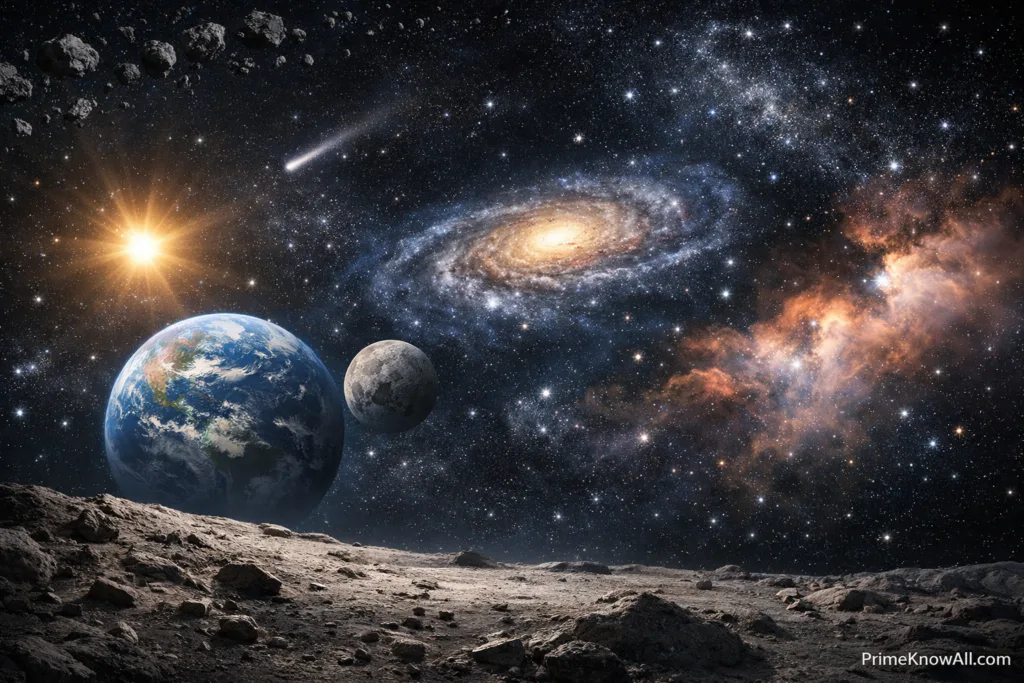
Radiation And Light
Space is filled with light across the electromagnetic spectrum, from radio waves to gamma rays. Without thick air to scatter sunlight, space looks darker even in daylight, while direct sunlight is intense. Radiation matters because the atmosphere normally absorbs and blocks many high-energy wavelengths; above it, instruments and travelers face a different balance of risk and opportunity for observation.
Fields And Forces
Two invisible features are always present: gravity and fields. Gravity organizes orbits and gathers matter into planets, moons, and rings. Magnetic fields—especially the Sun’s and Earth’s—guide charged particles and create regions like the magnetosphere. These forces are why space is not just a backdrop; it is an active system with structure and changing conditions.
Common Myth: “Space is a perfect vacuum, so nothing happens there.”
Reality: Space is thin, not nonexistent. Particles, radiation, and fields still interact, and those interactions can be strong enough to shape orbits, affect electronics, and paint the sky with auroras.
How Space Changes The Way Things Move
In space, motion is dominated by inertia and gravity, not friction with air. Once a spacecraft is moving, it tends to keep moving unless a force changes its speed or direction. This is why orbits are so elegant: a satellite is constantly “falling” around Earth, with gravity bending its path while its sideways speed keeps it from dropping straight down.
People often say astronauts experience zero gravity, but that phrase is misleading. Gravity is still strong in low Earth orbit; what changes is the feeling of weight because the spacecraft and crew are in continuous free-fall together. The result is microgravity, where floating is common, fluids behave differently, and even small pushes can send objects drifting for a long time.
Temperature In Space Is Not Simple
Space is not a place with one “air temperature” because there is almost no air to carry heat by convection. Instead, heating and cooling depend on radiation. In direct sunlight, surfaces can get very warm; in shadow, they can cool quickly. Spacecraft manage this with insulation, reflective coatings, radiators, and controlled orientation—small choices that make a big difference in a radiation-driven environment.
Near Earth, another twist appears: the upper atmosphere can have very high particle temperatures, yet the air remains too thin to warm objects the way dense air would. That is why spacecraft thermal design focuses on radiation balance, internal heat, and sunlight exposure rather than “feeling hot” because the surrounding gas is hot.
Different Kinds Of Space
“Space” is a broad word. Conditions near Earth differ from conditions near Mars, and those differ again from the space between stars. The main drivers are distance from the Sun, local magnetic environments, and the density of gas and dust. Thinking in regions makes the subject clearer and keeps expectations realistic.
Low Earth Orbit
Low Earth orbit is close enough that Earth’s gravity is strong and atmospheric drag still matters. Many satellites, crewed stations, and Earth-observing missions operate here. The environment includes traces of the upper atmosphere, radiation belts nearby, and frequent encounters with space debris, which makes tracking and avoidance important.
Cislunar Space
Cislunar space is the region between Earth and the Moon. It is shaped by the combined gravity of the Earth–Moon system and influenced by the solar wind. Operations here care about stable trajectories, communication delays that are still short, and radiation conditions that can be harsher than in low Earth orbit because Earth’s protective effects are reduced.
Interplanetary Space
Interplanetary space is the arena of the solar wind, magnetic fields, and dust. Distances become the dominant factor: the average Earth–Sun distance is about 1 astronomical unit (roughly 150 million kilometers), and travel times are measured in months or years for many missions. In this region, spacecraft navigation, power generation, and shielding must match a long-duration environment.
Interstellar And Intergalactic Space
Interstellar space lies between stars and contains very thin gas and dust, shaped by stellar winds and magnetic fields. Intergalactic space is even more rarefied, stretching between galaxies. Both regions are far from “nothing”; they are part of the large-scale structure of the universe, where faint matter and gravity influence how galaxies form and move.
How Space Is Studied And Measured
Because space is vast, no single method explains it. Scientists combine remote sensing—observing light from far away—with in-situ measurements taken directly by spacecraft. Together, these approaches reveal what space contains, how it changes, and how it interacts with planets and technology.
- Telescopes collect light in visible, infrared, ultraviolet, X-ray, and radio bands, uncovering objects and processes that look invisible to the naked eye.
- Space probes sample local conditions, measuring particle densities, magnetic fields, and plasma flows like the solar wind.
- Earth-based monitoring tracks how solar activity affects the upper atmosphere and magnetosphere, supporting forecasts for space weather.
- Mathematical models connect observations to physical laws, turning scattered measurements into reliable explanations and predictions.
Measurements also depend on units and references. Distances within the solar system are often expressed in astronomical units, while spacecraft altitudes are commonly described in kilometers above Earth. Time, speed, and mass matter too, because in space a small change in velocity can reshape an orbit or redirect a mission.
Why Space Matters On Earth
Space may feel remote, yet it shapes daily life through satellites and signals. Navigation, weather forecasting, emergency response, and global communication rely on spacecraft operating in environments where drag, radiation, and charged particles can change performance. Understanding space is not only about curiosity; it supports reliability and safety for systems people use every day.
Space is also a laboratory for testing ideas about matter, energy, and the origins of planets and stars. By studying how particles move in a magnetic field, how dust clumps into larger bodies, or how sunlight interacts with thin gas, researchers learn principles that apply across many fields—from plasma physics to communications engineering.
Seen this way, space is not just “out there.” It is a connected part of the Earth–Sun system, and it becomes more relevant as technology and exploration push farther and operate longer in challenging conditions.
Sources
UCAR Center for Science Education – Layers of Earth’s Atmosphere [Clear overview of atmospheric layers and how the exosphere gradually transitions outward]
NOAA JetStream – Layers of the Atmosphere [Concise descriptions and altitude ranges for the thermosphere and exosphere]
Fédération Aéronautique Internationale – The Kármán Line Definition (PDF) [Discussion of the 100 km boundary concept and historical context]
NASA Science – What Is The Universe? [Includes a plain-language explanation that “outer space” is close above Earth by altitude]
NOAA Space Weather Prediction Center – Solar Wind [Definition of solar wind as plasma and how it carries magnetic fields]
European Space Agency – The Solar Wind [Accessible explanation of solar wind variability and space weather context]
UCAR Center for Science Education – The Ionosphere [How sunlight creates charged layers that affect radio waves and upper-atmosphere behavior]
FAQ
Is space completely empty?
No. Space is a near-vacuum, but it still contains thin gas, plasma, dust, and constant radiation. What changes is density: particles are so spread out that collisions are rare compared with air at sea level.
Where does outer space start above Earth?
There is no sharp edge. Many references use around 100 kilometers above sea level as a practical marker because the atmosphere becomes so thin that aerodynamic flight is inefficient and orbital motion becomes the main way to stay aloft. The outer atmosphere also gradually fades into space rather than stopping suddenly.
Why do astronauts float if gravity still exists?
Astronauts float because they are in continuous free-fall while moving sideways fast enough to keep missing Earth. Gravity is still present, but everything in the spacecraft falls together, creating microgravity and the familiar floating effect.
Is space cold?
Space does not have one simple “air temperature” because there is almost no air to move heat around. Objects heat and cool mainly through radiation: sunlight can warm a surface quickly, while shade can cool it. This is why spacecraft thermal control relies on insulation, reflective materials, and radiators.
What is the solar wind?
The solar wind is a continuous flow of charged particles—plasma—streaming outward from the Sun. It carries embedded magnetic fields and helps shape space weather, which can influence satellites, radio communication, and navigation systems.
