Earthquakes often get described with two different kinds of numbers: magnitude and intensity. They sound similar, but they answer different questions. Magnitude describes the size of the earthquake at its source. Intensity describes the strength of shaking at a specific place. Understanding this difference helps people read alerts, compare events, and interpret maps without guessing.
It also clears up a common confusion: a single earthquake has one magnitude, but it can produce many intensity values across different neighborhoods, cities, or regions. Same quake, different experiences is the core idea.
Why Earthquakes Get Two Measurements
Magnitude and intensity exist because earthquakes have two realities at once. There is the rupture happening along a fault, and there is the shaking people and buildings feel at the surface. These are linked, but not identical.
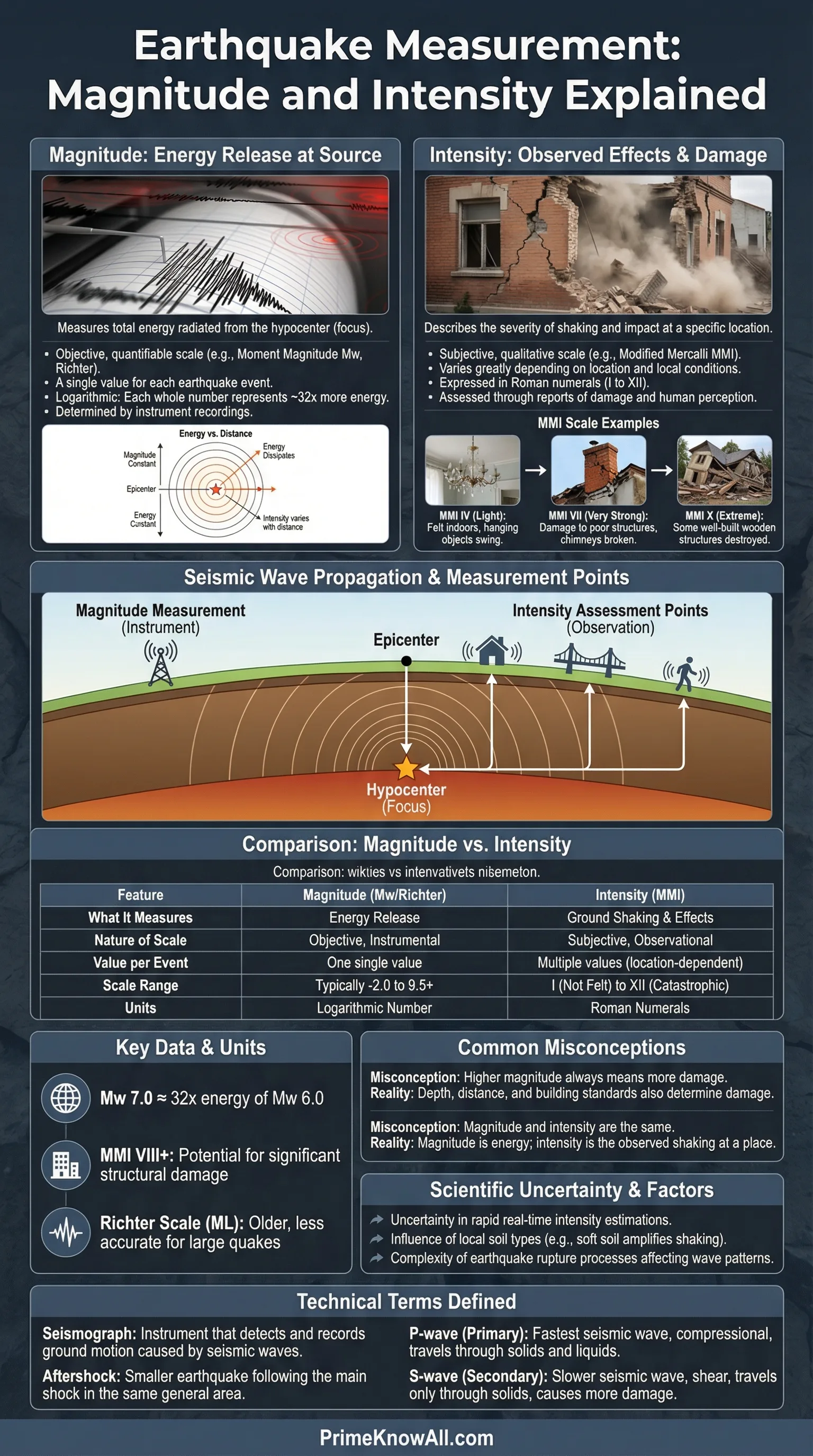
- Magnitude is about how much energy is released and how large the rupture is.
- Intensity is about how strong the ground motion is at a location, plus what effects it causes.
Simple way to remember: Magnitude is the earthquake’s overall size. Intensity is the local strength of shaking where you are standing.
What Magnitude Means
Magnitude is a number that represents an earthquake’s source strength. It is calculated from instrumental data recorded by seismometers, not from damage reports. The key point is that magnitude is designed to be location-independent: it should describe the event itself, even if it happens far from people.
Richter, Moment Magnitude, And Why Names Matter
Many people still say “Richter scale,” but modern earthquake reporting typically uses Moment Magnitude, written as Mw. Older magnitude types (like local magnitude) were valuable historically, yet they can underestimate very large earthquakes. Mw better tracks the physical size of the rupture and the force on the fault.
Magnitude Is Logarithmic
Magnitude scales are logarithmic, which means the numbers do not grow in a simple linear way. A one-unit increase in magnitude corresponds to a tenfold increase in recorded wave amplitude, and it represents roughly 32 times more energy released at the source. That is why small changes in magnitude can imply big differences in potential impact.
Still, magnitude alone does not tell you how violent the shaking will be in any particular town. Depth, distance, and local ground conditions can turn the same magnitude into gentle rolling in one place and strong jolts in another.
What Intensity Means
Intensity describes the shaking effects at a specific location. Instead of asking “How big was the earthquake?”, intensity asks “How strong was the shaking here?” One earthquake can produce a patchwork of intensities across a region.
Modified Mercalli Intensity
A widely used way to express intensity is the Modified Mercalli Intensity scale, often written as MMI. It uses Roman numerals (I to XII) to describe shaking from not felt to extreme. MMI is based on observed effects, but modern practice can also estimate intensity using instrumental ground-motion data.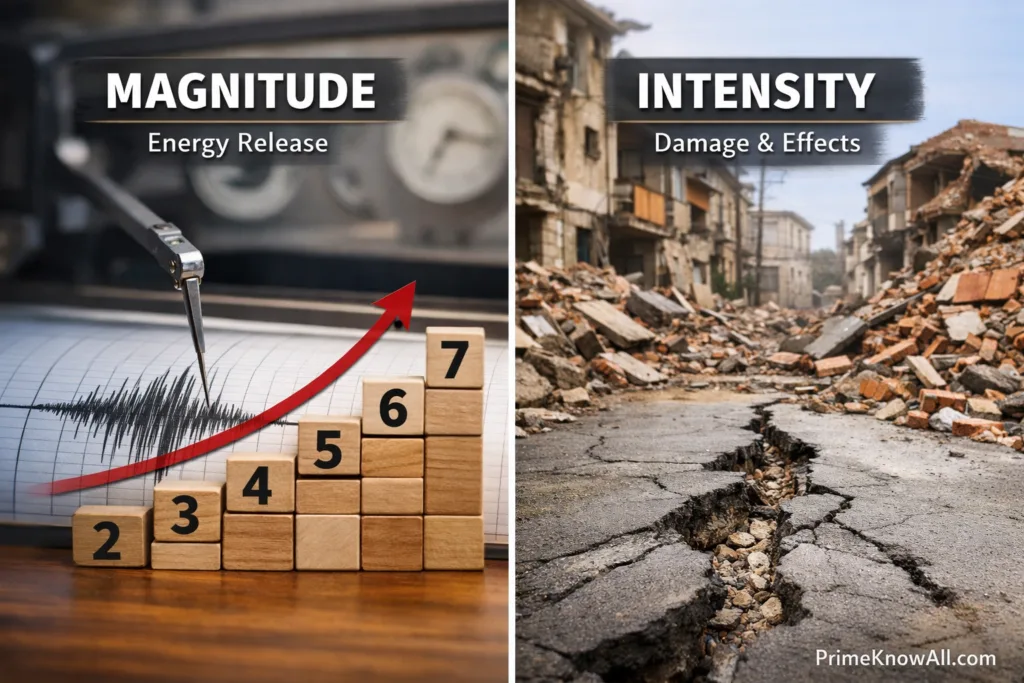
Why Intensity Changes From Place To Place
Intensity is shaped by physics and local conditions. Two towns at the same distance from the epicenter can feel very different shaking because the ground and buildings behave differently. This is why intensity maps matter.
- Distance from the rupture: shaking typically weakens with distance, but not evenly.
- Depth: shallow earthquakes often produce stronger surface shaking than deeper ones.
- Soil and sediment: soft ground can amplify shaking compared with solid rock.
- Basin effects: certain geologic basins can trap and strengthen seismic waves.
- Rupture direction: waves can be stronger in the direction the fault ruptures.
- Building type: height, design, and materials influence how motion is experienced.
Magnitude And Intensity Side By Side
Putting the two concepts next to each other makes the difference feel concrete. Magnitude is a single value tied to the source. Intensity is a set of values tied to locations. Both are useful, but they are useful for different decisions.
| Feature | Magnitude | Intensity |
|---|---|---|
| What it describes | Size at the source (energy/rupture strength) | Shaking at a place (effects and severity) |
| How it’s determined | Seismometer recordings and source calculations | Observations, reports, and/or ground-motion estimates |
| Typical notation | Mw, M, or similar magnitude labels | MMI (I–XII) or mapped intensity values |
| How many values per earthquake | One (a single official magnitude per method) | Many (varies by location and mapping resolution) |
| What changes it | Only the source (fault size, slip, stress) | Distance, depth, geology, and built environment |
| Best for | Comparing earthquakes globally; estimating overall potential | Understanding local risk; guiding response priorities |
How Intensity Gets Mapped In Real Time
After a major earthquake, agencies often publish maps that translate seismometer readings into expected shaking. These maps may combine instrumental ground motion with community reports. The result is a quick picture of where shaking was likely strongest, even before detailed field assessments are complete.
Modern systems can estimate intensity using measured or modeled values like peak ground acceleration and peak ground velocity. Those physical measurements can be converted into an intensity-like scale so non-specialists can understand the map quickly and clearly. It is still intensity because it is place-based.
One magnitude can create many intensities. A single source event spreads outward through complex geology and reaches different places with different force.
Common Misunderstandings That Cause Confusion
Earthquake headlines can blur terms, and that leads to quick assumptions. A few clarifications keep the picture clean. These points are small, but they change how you interpret reports.
- “The intensity was 7.” Intensity is often not written as a single number like magnitude; it is usually shown as MMI values across a map.
- “A bigger magnitude always means bigger damage.” Higher magnitude raises potential, but local intensity depends on depth, distance, and site effects.
- “Epicenter equals worst shaking.” Strongest shaking is often near the rupture, but geology and rupture direction can shift the peak intensity.
- “Two earthquakes with the same magnitude feel the same.” The frequency content and depth can make shaking feel sharper or more rolling.
- “Richter is the only scale.” Many magnitude scales exist; modern reporting commonly uses Mw for large events.
Why This Difference Matters For Safety And Engineering
For public communication, magnitude is a fast way to express overall event size. For practical impact, intensity is closer to what people need: how strong the shaking was here. Emergency response often aligns more naturally with intensity patterns than with a single magnitude value.
Engineering takes it further. Building design focuses on expected ground motions and how structures respond to different shaking frequencies. A moderate intensity in an area with vulnerable construction can still be serious, while a higher magnitude far away can translate into a lower, more manageable intensity locally. Magnitude sets context; intensity shapes consequences.
A Practical Reading Tip
If you see M 7.0 in a headline, treat it as the earthquake’s overall size. Then look for an intensity or shaking map to understand where the strongest motion likely occurred. The map is the local story.
How To Interpret An Earthquake Bulletin
Most official bulletins provide a few standard fields. Reading them in the right order keeps expectations realistic and reduces overreaction to a single number. Think source first, then effects.
- Magnitude (Mw or M): establishes the earthquake’s overall size.
- Depth: shallow events tend to produce stronger surface shaking near the source.
- Location: useful context, but remember the rupture can extend beyond a point on the map.
- Distance to you: a simple predictor of whether shaking might be noticeable.
- Shaking or intensity map: the best quick indicator of where impacts are likely highest.
- Updates: early estimates can shift as more data arrives; refined values are normal.
Seen this way, magnitude becomes a stable anchor, while intensity explains the uneven pattern of real-world experience. That combination is more informative than either metric alone.
Sources
USGS – Measuring Earthquakes (overview of magnitude concepts and measurement)
USGS – Magnitude And Intensity (direct explanation of how the two terms differ)
USGS – Modified Mercalli Intensity Scale (MMI levels and what they represent)
USGS – ShakeMap (how shaking is mapped after an event)
IRIS – Earthquake Magnitude (clear educational guide to magnitude and scaling)
IRIS – Earthquake Intensity (how intensity is described and why it varies by place)
FAQ
Can two earthquakes have the same magnitude but feel different?
Yes. Magnitude can match while intensity differs because intensity depends on depth, distance, and local ground conditions. A deeper event may feel weaker at the surface than a shallow event with the same magnitude.
Is intensity the same as damage?
Not exactly. Intensity describes shaking effects, which can include damage, but outcomes also depend on building strength and how structures respond. Two places with similar intensity can see different results if construction quality differs.
Why do early magnitude numbers sometimes change?
Initial estimates use limited data. As more stations report in and source calculations improve, the reported magnitude can be refined. This is normal and does not mean the earthquake “grew.”
What does “MMI VI” or “MMI VIII” mean?
Those are Modified Mercalli Intensity levels written in Roman numerals. They describe how shaking is experienced at a place, from weak to very strong and beyond. Higher MMI generally means stronger shaking effects in that location.
Which number should people pay attention to right after an earthquake?
Use magnitude for overall context, but rely on shaking or intensity maps for local understanding. The local map is the fastest way to see where impacts are most likely concentrated.
Article Revision History
