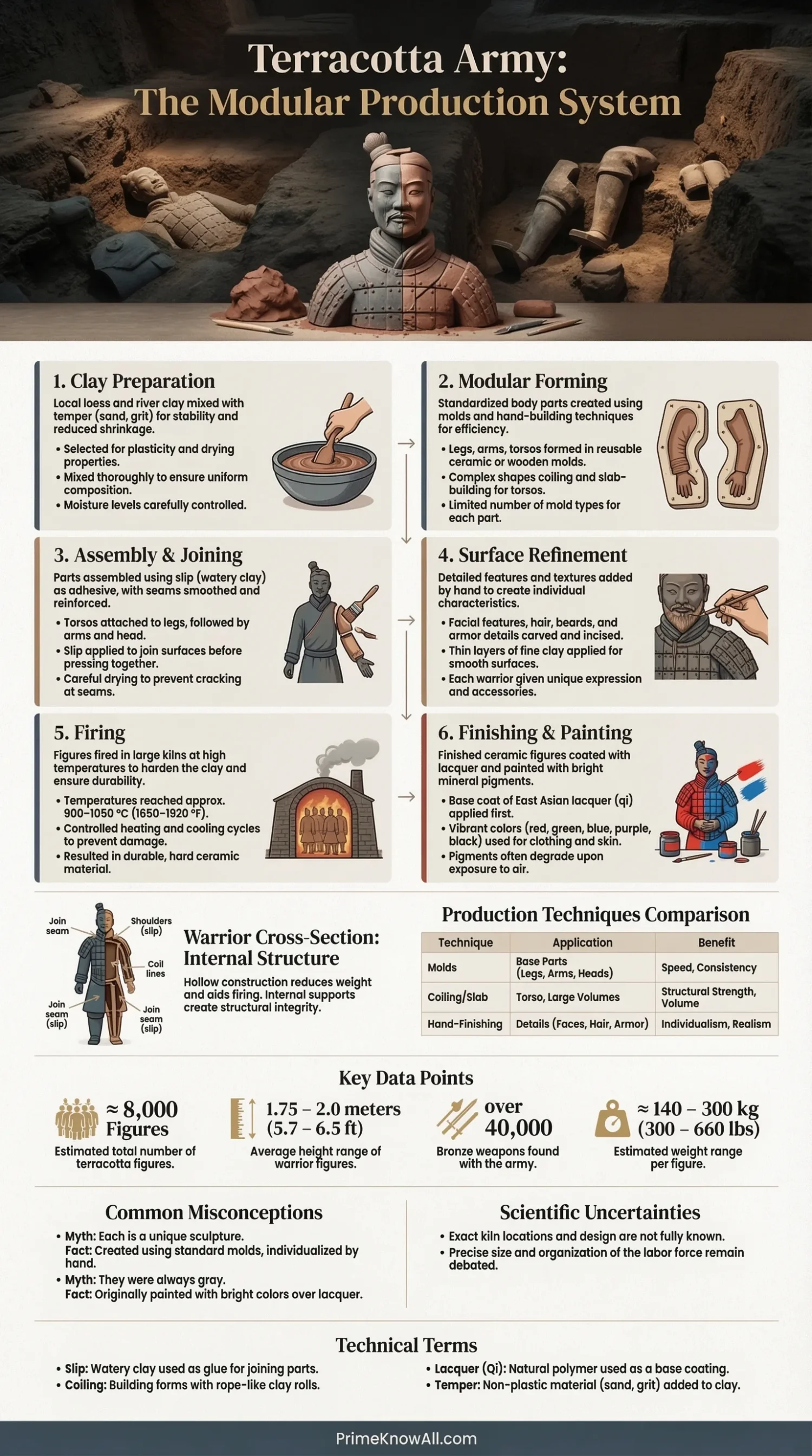
Ultra-short answer: The Terracotta Army was made with a modular clay workflow: standard parts shaped with molds and hand-building, then assembled, finished for realism, fired in kilns, and finally painted over lacquer. Makers left stamps, incisions, and occasional ink marks that hint at quality control and workshop routines.
What To Keep In Mind Before You Read Further
- Think “parts first, person second.” Many bodies began as standard modules, then details were added to create individual faces and gear.
- Clay recipes matter. Tiny differences in paste and temper affect strength, shrinkage, and firing success.
- Marks are clues, not signatures. A stamped or incised sign can point to tracking and accounting, not personal “artist branding.”
- Most color vanished after excavation. What looks like plain gray clay today once carried lacquer and layered pigments.
- Some details remain debated. Researchers can map patterns, but parts of the workflow are still probable rather than fully proven.
A life-sized army sounds like pure art, but the Terracotta Army is also a story of production—repeatable steps, controlled materials, and a system that could deliver thousands of clay bodies without collapsing into chaos.
When people ask how these figures were made, they often picture a single sculptor carving each warrior start to finish. The evidence points to something more practical: organized workshops using standard molds, hand-building, and careful finishing so the army looks varied while still staying consistent.
If you remember one thing… the most helpful way to understand the “production methods” is to follow the chain: materials → modules → assembly → firing → surface work → placement and control.
What “Production Methods” Means Here
Short answer: In this context, “production methods” means the repeatable making steps used to turn local clay into standardized parts that could be assembled into believable people.
A few terms help keep the conversation clear. A mould, meaning a reusable form that shapes soft clay into a consistent base, is a tool for repeatability. Modular making, meaning building complex objects from separate parts that fit together, is a strategy for speed and control. Slip, meaning watery clay used like glue, helps join parts before firing.
- Material choices: what clay and additives were used, and how that affects drying and firing.
- Forming choices: which parts were moulded, which were coiled or slab-built, and where hand-finishing enters.
- System choices: how workshops handled tracking, quality checks, and moving finished pieces into the pits.
Where The Clay Came From And Why It Matters
Short answer: Studies of clay fabric and composition indicate the warriors were made with local materials, which makes sense for a project tied to a huge site and tight logistics.
Clay is not “just dirt.” Different clays behave differently when they dry and shrink. Research that compares the warriors’ clay fabrics to other ceramics from the mausoleum complex supports the idea that production happened near the site, using workable local sources and recipes tuned for large, hollow forms.
- Paste recipe: makers mixed clay with coarser particles for structure, then used finer layers where they needed clean carving.
- Drying control: big hollow pieces need slow, even drying to reduce cracking and warping.
- Local supply: using nearby clay reduces transport risk and helps maintain a steady workflow for thousands of parts.
| Stage | What Was Done | What Evidence Can Show |
|---|---|---|
| Clay Prep | Mix clay with temper; manage moisture | Clay texture, inclusions, layering patterns in breaks |
| Forming | Mould parts; coil or slab build torsos | Seams, coil joins, repeating part geometries |
| Assembly | Join modules with slip; refine surfaces | Join lines, tool marks, added clay for details |
| Firing | Fire bodies in kilns after drying | Firing color, vitrification level, fracture behavior |
| Surface Finish | Lacquer base coat, then pigments | Paint residues, lacquer traces, conservation chemistry |
| Tracking | Mark parts and equipment for accountability | Stamps, incisions, painted symbols, spatial patterns |
Fast recap: If the clay had been unreliable, the army would show more collapsed walls and failed joins. The material studies fit a more controlled recipe: local clay, adjusted for big hollow sculpture.
- Local sourcing reduces transport and storage problems.
- Layered clay helps both strength and clean detail carving.
- Drying control is as important as the sculpture itself.
Molds, Coils, And Hand-Finishing: How A Warrior Body Was Built
Short answer: Most figures were built from repeatable parts—legs, torsos, arms, hands, and heads—then refined with added clay and carving so they stop looking “mass-made.”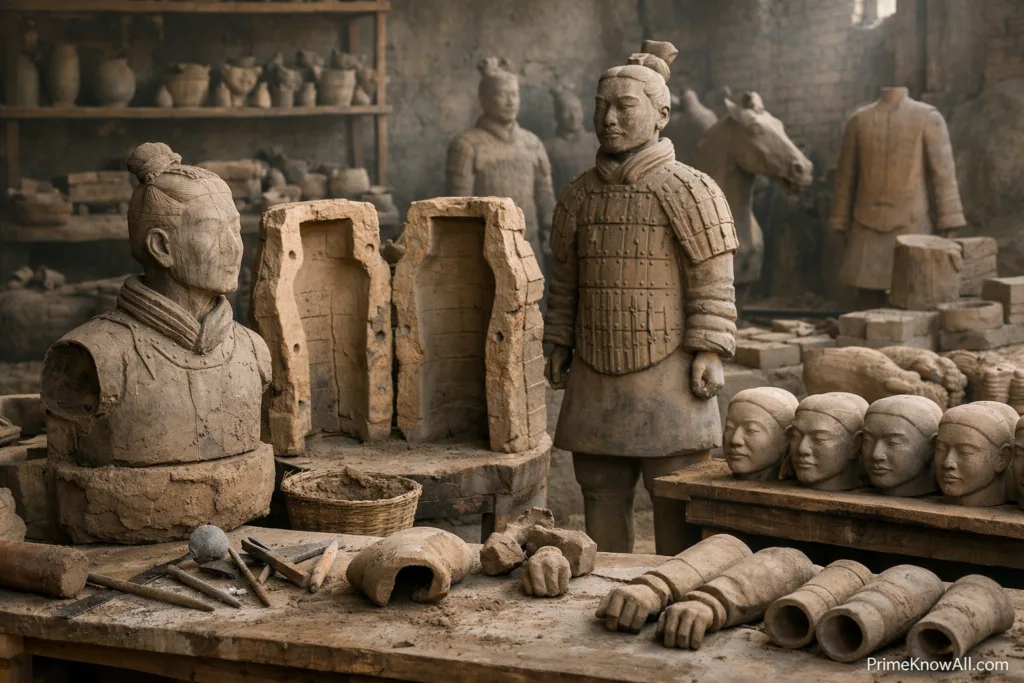
Evidence from detached heads, seams, and repeating forms supports a modular approach. Educational and museum sources describe legs as thick, load-bearing cylinders (comparable to how large ceramic tubes could be formed), while torsos show techniques like coiling and slab building for volume. Heads, arms, and hands were commonly pressed in molds, then attached with slip and worked over.
One detail that surprises many readers: researchers have identified limited mold sets for multiple parts. For example, published summaries note small numbers of types for feet, shoes, hands, torsos, and faces—enough variety to mix-and-match, but not so many that production becomes slow. That “controlled variety” is a practical way to get individual-looking warriors at scale.
- Base shaping: modules provide the main pose and proportions.
- Refinement layer: finer clay added on top lets makers carve eyelids, beards, and armor plates.
- Individualization: small changes in facial hair, expression, and gear create difference without changing the whole build.
One useful analogy: Picture a modern LEGO minifigure—the same basic torso and legs can produce many characters by swapping heads, hands, and accessories, then adding small custom touches. The Terracotta Army works in a similar spirit, except the “swaps” were wet clay parts, and the final realism came from hand tool finishing rather than printed graphics.
Assembly, Joining, And Firing: Turning Soft Clay Into A Stable Sculpture
Short answer: After forming, makers joined modules with slip, balanced moisture during drying, and then fired the clay so it became durable enough for handling and installation.
Joining large clay parts is not like snapping plastic together. Wet clay shrinks as it dries, so if one part is drier than the other, the seam can pull apart. That is why descriptions from museum scholarship emphasize moisture control and staged drying. Once assembled and refined, the figure would be fired in a kiln—high enough heat to harden the clay body, but controlled enough to avoid large-scale thermal cracking.
- Joining: slip acts as a clay adhesive; added clay smooths the seam.
- Tool work: makers carved belts, folds, and armor after an initial set so the surface could hold detail.
- Firing outcome: a well-fired body supports later steps like lacquer and pigment layers.
Margin note for readers: The hardest part is not the sculpting moment—it’s the waiting. Drying and firing control decide whether a warrior survives as a clean form or breaks at a join.
- Even moisture reduces join failure.
- Staged drying helps large hollow forms hold shape.
- Consistent kiln cycles make surface finishing more predictable.
Marks, Names, And Quality Control
Short answer: Marks on warriors and associated weapons suggest a system built around tracking: who made what, which workshop handled it, and how items moved through a controlled pipeline.
Archaeological studies discuss three broad kinds of marks: stamped signs, incised characters or numbers, and occasional painted marks. The placement matters. A stamp on a hidden surface can look like an internal label, while an incised code can function like a batch identifier. Work on bronze crossbow triggers even reports rare ink inscriptions identified through imaging and lab analysis, consistent with bureaucratic recording practices.
- Stamps: repeatable, quick to apply, useful for workshop tagging.
- Incisions: flexible for short codes, numerals, or names; can support accountability.
- Ink marks: rarer, but helpful where temporary or “matching” indicators are needed.
A careful point: a mark does not automatically mean “this person sculpted the whole warrior.” In a modular system, a stamp can reflect responsibility for a stage, a batch, or even a check. This is why spatial analysis—where marked parts appear in the pit—can be as informative as the mark itself.
Coordinating Thousands Of Pieces: What Workshop Organization Probably Looked Like
Short answer: Evidence from weapons and marking patterns supports the idea of small production groups working in parallel under centralized oversight, rather than one giant “single-file” line.
Research on bronze weapons associated with the army has proposed models that compare different ways of organizing output: multiple semi-independent units that each produce complete sets, alongside higher-level systems that enforce standards, inspection, and record keeping. It is a practical blend: smaller teams can move fast and solve local problems, while the wider administration holds the rules steady—mold types, measurements, and where finished items must go.
- Parallel teams: multiple groups can form parts at the same time, which helps a project with huge volume.
- Shared models: standardized molds and measurements keep parts compatible.
- Inspection: marks and documentation support quality checks without slowing everything down.
This is also where modern references feel natural. The same logic shows up in everyday life: phone factories, sneaker supply chains, even film prop shops. The goal is not to make every item identical; the goal is to make every item fit the plan, so variation remains under control.
Two-sentence checkpoint: The army looks personal because makers invested in surface finishing, not because they started from scratch each time. The system likely balanced repeatable modules with local craftsmanship at the final stage.
- Standard parts keep the build efficient.
- Hand detailing keeps faces and gear believable.
- Marks help manage output and responsibility.
A Vertical Snapshot Of The Build Process
Short answer: The workflow reads like a vertical ladder: material at the bottom, modules in the middle, and surface realism at the top.
Infographic (Vertical): From Clay To Pit Placement
Typical action: mix local clay with coarser grit, keep moisture even.
Trace left behind: layered textures in breaks; visible inclusions.
Typical action: press clay into moulds; build torsos with coils and slabs.
Trace left behind: seams, repeating geometries, coil joins.
Typical action: join modules, patch seams, balance moisture.
Trace left behind: join lines, added clay ridges, smoothed seams.
Typical action: apply finer clay, carve and incise details.
Trace left behind: tool marks, layered clay skins, crisp edges.
Typical action: controlled heating cycles after full drying.
Trace left behind: firing color, break patterns, heat-altered surfaces.
Typical action: lacquer base coat, then mineral pigments.
Trace left behind: residues, micro-fragments, conservation chemistry.
Typical action: apply stamps/incisions; place in formation.
Trace left behind: marks, spatial clusters, repeated patterns in pits.
Paint, Lacquer, And Why Most Warriors Look Gray Today
Short answer: Many warriors were once brightly finished with lacquer and pigments, but those layers can detach quickly when exposed to new humidity conditions after excavation.
The gray surface is not the “intended look.” Conservation research and museum reports describe lacquer as a base layer that helps pigments adhere and creates a smoother, more lifelike surface. The problem is environmental change: when buried materials meet drier air, the lacquer and paint can curl, lift, and flake. This is why modern excavation often pairs discovery with immediate conservation steps.
- Lacquer is not just decoration; it is a binding layer that supports pigment adhesion.
- Pigments can include mineral colors that look stable in soil but become fragile at the surface.
- Conservation workflow aims to slow detachment so researchers can document and preserve original color patterns.
Small but practical insight: When you see modern museum videos showing conservators working right beside newly uncovered fragments, that is not for show. It reflects a simple material fact: surface layers react fast when the burial environment changes.
- Fast documentation can matter as much as excavation.
- Micro-climate control helps paint survive longer.
- Lab analysis can reveal pigments even when visible color is faint.
What We Still Can’t Prove Yet
Short answer: The overall workflow is clear—modules, assembly, firing, finishing, marking—but several details remain uncertain because not every workshop space, kiln site, or administrative record has survived.
- Exact workshop layout: patterns in marks and placement suggest organization, but the full map of where each stage occurred is still incomplete.
- How portrait-like the faces are: some studies find strong individuality, while others stress the power of standard molds plus finishing.
- Kiln specifics: large-scale firing is certain, but the precise kiln network and how output was scheduled remains partly inferred.
- Labor totals: historical texts mention huge workforces for the tomb complex, but connecting a single number to a single craft stage is not always possible.
It helps to treat these uncertainties as honest boundaries, not gaps that ruin the story. Archaeology works with traces. When the traces are strong—like repeated mold forms or consistent marking patterns—the reconstruction is tighter. When traces are weaker, the best language stays careful and avoids pretending the missing pieces are known.
Reality check: “We don’t know” is not a weakness here—it is a sign of good method. The best explanations separate what the artifacts show directly from what is still a strong, but testable, proposal.
- Direct traces (mold forms, joins, tool marks) are the strongest.
- Administrative traces (marks, spatial clusters) add structure.
- Big historical numbers need caution and context.
Common Misconceptions About How The Army Was Made
Wrong: “Each warrior was sculpted from a single block of clay, like a statue carved from stone.”
Correct: Many warriors were built from parts and joined before firing.
Why it gets misunderstood: the finished forms hide seams under surface finishing.
Wrong: “All faces are unique, so molds were not used.”
Correct: A small set of mold types can still produce many looks when makers add clay and carve details.
Why it gets misunderstood: people equate “mold” with identical copies.
Wrong: “Marks are signatures that prove individual artists made entire figures alone.”
Correct: marks can support tracking, inspection, and accountability across stages.
Why it gets misunderstood: modern art culture trains us to look for a single creator.
Wrong: “The warriors were meant to be gray.”
Correct: evidence supports layers of lacquer and pigments that often did not survive exposure after excavation.
Why it gets misunderstood: most museum displays show the clay body, not the original finish.
Wrong: “A huge project must mean one giant assembly line.”
Correct: parallel teams working under shared standards can be more flexible and manageable.
Why it gets misunderstood: modern factory imagery dominates how people imagine scale.
Everyday Echoes: Where You Still See Similar Making
Short answer: The Terracotta Army’s method—standard parts plus final customization—shows up all over modern life, even if the materials are different.
- A museum replica workshop: cast a standard base form, then hand-finish small details; why this happens: it keeps output steady while preserving a “made-by-hand” look.
- Movie costume armor: repeatable plates with small modifications; why this happens: crews need consistency across many extras, but still want variety on camera.
- 3D-printed figurines: a standard body mesh with custom faces; why this happens: modular design reduces time and reduces rework.
- Sports team merchandise: same shirt template, different name and number; why this happens: a shared base makes inventory easier to manage.
- Smartphone assembly: standardized internal parts, customized outer finishes; why this happens: performance depends on compatibility, style depends on surface choices.
- Craft pottery studios: repeated forms made from molds, then carved or painted uniquely; why this happens: repetition saves time, finishing carries personality.
- Theme-park props: repeated structures with hand weathering; why this happens: surface treatment sells realism without rebuilding the core.
Quick Test
Tap each item and see if the reasoning matches what the evidence can support. Each answer keeps scope and context tight.
“If molds were used, all warriors must look the same.”
Not necessarily. A mould creates a repeatable base, but makers can add clay, carve details, and vary hair and facial features. A small set of standard parts can still yield many visible outcomes.
“Marks on weapons tell us something about how the clay figures were made.”
In a limited way, yes. Marks and inscriptions can reflect tracking and accounting practices that likely affected multiple crafts. They do not prove identical workflows, but they support the idea of organized oversight.
“Drying can be more risky than firing for large clay bodies.”
Often true in practice. Uneven moisture can create stress before the kiln stage, especially at joins. That is why controlled drying and moisture balance are treated as core steps, not minor details.
“The gray look is the original design choice.”
Unlikely. Conservation studies and museum reports describe lacquer and pigment layers on many figures. Much of that surface material did not survive the change from burial to open air.
“A modular build means the makers didn’t care about realism.”
The opposite. Modular building is about control and speed. Realism shows up in the finishing stage, where fine clay layers, carving, and color work produce lifelike surfaces.
Putting it together: the Terracotta Army looks human because the makers used a repeatable build and then invested heavily in final detail. The marks and material studies support a system that could scale without losing control.
The most common mistake is treating “mass production” as a synonym for “identical copies.”
A memorable rule: modules make the body, and finishing makes the person.
Sources
UNESCO World Heritage Centre – Mausoleum of the First Qin Emperor
(Defines the site scope, dates, and scale; reliable because UNESCO curates standardized World Heritage documentation.)
Smarthistory – The Terracotta Warriors
(Explains forming methods and modular parts with accessible scholarship; reliable because it is editor-reviewed and widely used in art-history education.)
The Metropolitan Museum of Art – Making the Warrior
(Summarizes scholarly views on molding vs hand-building and finishing; reliable because it is published by a major museum with curatorial oversight.)
Antiquity – Building The Terracotta Army (Quinn et al.)
(Peer-reviewed study on ceramic technology and organization; reliable because it is a leading archaeology journal with formal review.)
University of Cambridge Repository – Marking Practices And The Making Of The Qin Terracotta Army
(Research summary on stamps/incisions/paint marks and what they imply; reliable because it is a university-hosted research output record.)
Heritage Science – Ink Marks, Bronze Crossbows, And Their Implications
(Reports lab and imaging methods for identifying ink and matching marks; reliable because it is a peer-reviewed open-access journal article.)
UCL Discovery – Forty Thousand Arms For A Single Emperor
(Explores production organization models using weapon evidence; reliable because it is hosted by a major university repository with scholarly provenance.)
UCL – Imperial Logistics: The Making Of The Terracotta Army
(Project overview connecting materials science and spatial modeling; reliable because it is an official university research program page.)
Archaeometry – Geochemical Evidence For Manufacture And Logistics (Quinn et al.)
(Scientific approach to supply-chain questions; reliable because it is a long-running peer-reviewed journal in archaeological science.)
Technical University of Munich – Preserving The Paint Layers Of The Terracotta Army
(Explains conservation challenges of polychromy; reliable because it is an institutional release tied to specialist conservation research.)
Encyclopaedia Britannica – Qin Tomb
(Background context on arrangement and original paint; reliable because Britannica is professionally edited and fact-checked.)
FAQ
Were the Terracotta Army figures made with molds or by hand?
Both. Many parts were formed with moulds to keep shapes consistent, and then makers used hand-building and surface refinement to add individual features.
Why do many warriors look different if production was modular?
Modular production sets the base geometry. Differences come from added clay, tool carving, and finishing choices like hair, facial hair, and clothing details.
What do stamps and incised marks actually tell us?
They can indicate tracking, accountability, and workshop routines. A mark may link to a stage or batch, not necessarily a single person making a whole figure.
Were the warriors originally painted?
Evidence supports lacquer and pigment layers on many figures. Those layers can detach when the burial environment changes, which is why conservation during excavation is so important.
Do we know exactly where the workshops and kilns were?
Some evidence suggests production was close to the site, but the complete network of workshop spaces and kiln locations is not fully mapped. Researchers combine materials analysis, marks, and spatial patterns to refine this picture.
