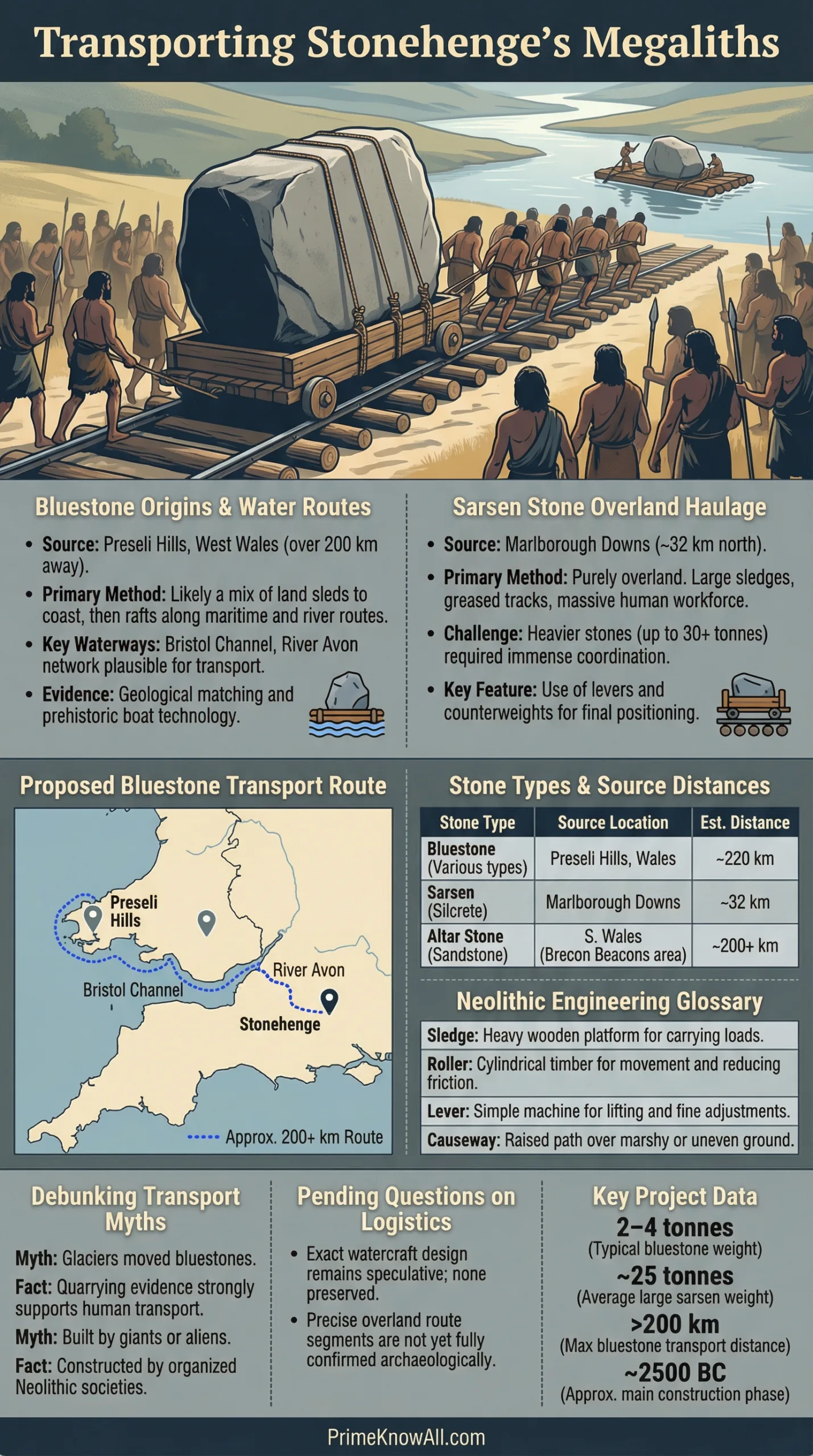
Stonehenge looks like the definition of immovable: towering uprights, heavy lintels, and a layout that feels locked into the chalk of Salisbury Plain. Yet every block there is the end point of deliberate movement—stone chosen, freed, hauled, guided, and finally raised with surprising precision. The real mystery is not “How did they do it with magic?” but how they turned weight into controlled motion using only wood, rope, soil, and teamwork.
What follows is a practical look at the best-supported ways those stones could have traveled—what is known from geology and archaeology, what is likely from experiments, and where uncertainty still matters. Stonehenge was built over generations, and its transport story is more than one journey.
Note on evidence: Organic materials like timber and rope rarely survive in the local soils, so the “hardware” is mostly gone. That is why experimental archaeology is so important: it tests what simple materials can realistically do, even if it cannot recreate every detail of a Neolithic project.
What Was Moved
Stonehenge is not made from one kind of rock. It combines sarsens (the big sandstone-like blocks) with smaller bluestones (a mix of igneous rocks), plus at least one central slab often discussed separately: the Altar Stone. Each type implies a different transport challenge.
- Sarsens: The iconic outer circle and major trilithons. Many stones weigh around tens of tons, and the largest uprights are often estimated far above that. Their size makes the haul slow, but it also makes stability the main problem—keeping a massive block moving without losing control.
- Bluestones: Usually smaller, often around a few tons or less each. They are still heavy, but the bigger issue is distance, because many were brought from far beyond the Stonehenge region.
- Altar Stone: A large sandstone slab, discussed in recent research because its possible source area may be much farther away than once assumed, expanding the scale of long-distance movement under consideration.
Where The Stones Came From
For centuries, people guessed the origins of Stonehenge’s stones by looking at nearby landscapes. Today, geochemical fingerprinting can match many stones to specific source areas, turning “probably” into testable provenance.
The main sarsens are strongly linked to West Woods on the Marlborough Downs, roughly 25 km north of Stonehenge. That distance is manageable on land, but it still requires a repeatable system—because Stonehenge needed many large blocks, not just one dramatic haul.
The bluestones have long been associated with the Preseli Hills in west Wales, about 225 km away. Archaeology in Wales has identified quarry activity linked to bluestone extraction, adding weight to the idea of human selection and transport rather than stones arriving by chance.
Some current discussions go even further for a specific stone. Research published in early 2026 argues against the idea that glaciers delivered Stonehenge’s most exotic stones to the site, reinforcing a picture of intentional movement—even when the journey was long. Other recent work suggests the Altar Stone may have originated much farther north than previously thought, which would imply either very long overland hauling, a major water journey, or a combination of both.
| Stone Type | Typical Role At Stonehenge | Commonly Cited Source Area | Approx. Distance To Site | Transport Challenge That Dominates |
|---|---|---|---|---|
| Sarsen | Outer circle uprights and lintels; major trilithons | West Woods (Marlborough Downs) | ~25 km | Weight and control on land |
| Bluestone | Inner settings (various phases and rearrangements) | Preseli Hills (west Wales) | ~225 km | Distance and changing terrain |
| Altar Stone | Central slab associated with inner area | Debated; recent work suggests far northern origin | Possibly hundreds of km | Logistics over long routes |
The Core Physics Of Moving Megaliths
Stonehenge builders did not need modern machines to understand friction, leverage, and mechanical advantage. They needed systems that could be repeated safely, because a single mistake with a multi-ton block can end the project. The goal was always the same: reduce friction, keep the load stable, and ensure each pull translated into predictable movement.
Even without metal tools or wheeled carts, the basic toolkit was strong enough for the job: wooden levers to lift edges, ropes to convert human effort into steady pull, timber frames to change direction and gain advantage, and packed earth to form ramps and stable working surfaces. The materials are humble; the engineering is careful.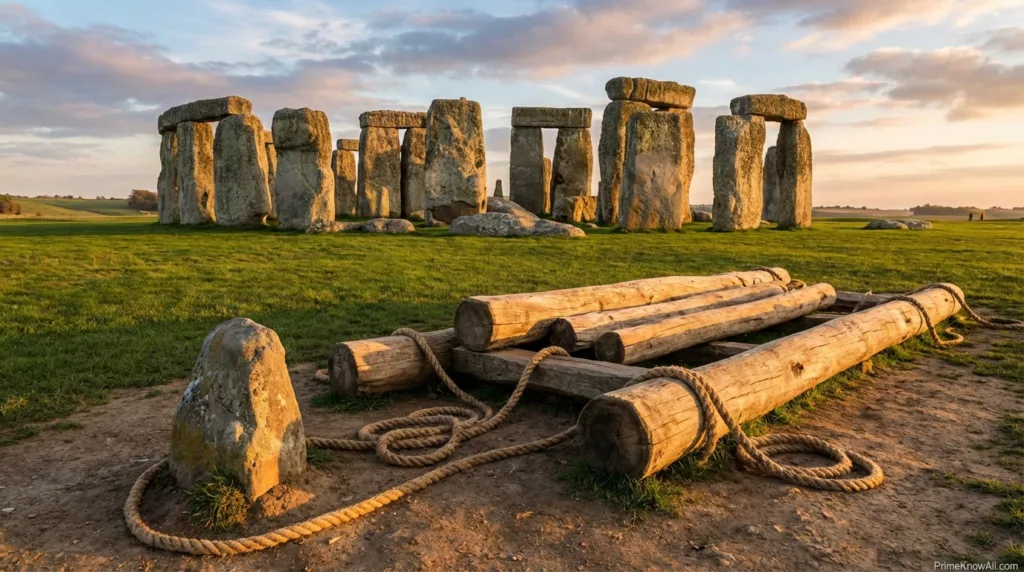
A Practical Way To Picture The Job
A megalith move is less like “dragging a rock” and more like running a slow, controlled transport line. Each stage has a different optimal setup: extraction, short haul to a route corridor, long-distance travel, and final placement. Treating it as one continuous pull would be inefficient and risky. Treating it as linked stages makes the process manageable.
Freeing The Stones
Before any hauling, stones had to be separated from the ground and brought into a form that could travel. Bluestone quarry sites in Wales show evidence of extraction activity, indicating that people were not just collecting loose boulders; they were selecting specific blocks and working them.
For sarsens, a key step is shaping. The outer circle is not random rubble: lintels fit, uprights align, and joints exist. Even if the most delicate finishing was done near the monument, early dressing at the source could remove weak edges and lower the chance of fractures during transport. A stone that arrives intact is a stone that can be raised; a cracked stone becomes a hard problem at the worst possible time.
The presence of sophisticated stone-to-stone joints at Stonehenge—such as mortise-and-tenon and tongue-and-groove connections—also implies that builders planned for exact placement, not just approximate stacking. That level of fit strongly favors methods that keep stones stable and oriented during the final stages of movement.
Overland Transport: Sledges, Rollers, And Prepared Ground
Overland transport is the default assumption for the sarsens, and it may also have played a major role for the bluestones—especially if water routes were limited, seasonal, or simply too risky. The two most discussed systems are sledges and rollers, often supported by some kind of prepared track.
Sledges: Less Glamorous, More Reliable
A sledge turns a rough, irregular stone into a load with a predictable contact surface. That matters on soft ground, where individual rollers can sink or twist. Experiments and reconstructions often favor sledges for one reason: they are easier to control when conditions change. A sledge can also ride on planks or packed earth, and it can be helped by lubrication such as water, clay, or grease-like animal fats—anything that reduces friction without requiring complex tools.
Rollers: Fast On Good Ground, Unforgiving On Bad Ground
Wooden rollers are a powerful idea because they can lower friction dramatically. But they bring a control problem: if the ground is uneven or muddy, rollers can bog down, skew sideways, or bunch together. Field experiments built for public demonstration have shown that roller spacing, roller angle, and even slight slopes can cause a heavy block to drift off line, forcing constant adjustments with levers and side pulls. Rollers can work, but they demand disciplined steering.
A realistic picture may be mixed: rollers used where the route is firm and level, and sledges used where terrain or weather makes rolling unreliable. That hybrid approach is also psychologically practical—communities can change methods without changing the goal, keeping the project moving rather than waiting for perfect ground.
How A Long Haul Stays Organized
- Segmented pulls: Move the stone in short intervals, then reset ropes, rollers, and anchor points. This reduces risk and fatigue.
- Anchoring and braking: Use chocks, stakes, and controlled rope tension to prevent backward slide on gentle slopes.
- Route maintenance: Keep a corridor clear of obstacles and build up soft patches with brushwood, planks, or compacted material.
- Communication: A stable haul needs timed pulls and clear signals. A few seconds of confusion can twist the load or snap a rope.
Water Transport: Useful, But Not Always The Easy Option
Whenever a stone must travel far, water becomes tempting. A floating load can bypass friction that dominates land hauling. Yet water routes also introduce new risks: tides, currents, storms, and the difficulty of loading and unloading multi-ton blocks without cranes. That is why water transport remains a plausible component rather than a universal answer.
For the bluestones, one long-discussed idea is a combined journey: overland haul to a navigable point, then movement by coastal and river routes, and finally another overland haul to the monument. It is an elegant chain in theory, but it requires boats large enough, shorelines that cooperate, and communities capable of repeating the process for many stones. Some archaeologists argue that an all-land route—while exhausting—may actually be simpler to manage because it avoids the hardest part of water transport: lifting stones onto and off boats.
Recent mineral-grain research published in 2026 challenges the idea that glaciers delivered exotic Stonehenge stones close to the site, strengthening the case that people made the key transport decisions. That does not settle the land-versus-water question for every stone, but it shifts attention back to human logistics: route planning, seasonal timing, and coordinated labor.
The Last Approach: Moving Stones Into Position
The final kilometers matter more than they look. Approaching Stonehenge means dealing with precise geometry and a landscape already shaped by earlier earthworks. Moving a stone into the circle is not only about distance; it is about alignment, clearance, and keeping edges intact for fitting.
Stonehenge’s layout suggests a construction process that favored repeatable placement. When a method works once, it can be reused—especially if the community builds standard routines: digging a similar pit shape, preparing similar ramps, and using familiar rope and lever systems. That kind of repetition is how a complex monument can be built with simple tools while still achieving remarkable accuracy.
Raising Uprights And Placing Lintels
Hauling gets the stone to the site. Raising turns it into architecture. The most practical raising method is not vertical lifting from the ground; it is controlled tipping into a prepared pit. A pit with a sloped ramp lets a stone slide or tip down toward its base position, after which ropes and frames can pull it upright while workers backfill and pack the chalk around it. This method transforms a dangerous lift into a series of small, controllable steps.
Public experimental work for English Heritage has demonstrated how an A-frame (shear legs) can improve control during raising. The key advantage is not raw strength; it is the ability to change the direction of pull and gain mechanical advantage without complex devices.
Lintels add another layer. A likely approach is the use of earth ramps and temporary timber structures: raise a ramp high enough to slide or lever a lintel up in stages, then nudge it into place. Stonehenge’s mortise-and-tenon joints and the fitted lintel ends imply that lintels were not simply dropped on top; they were guided into an exact seat, then locked into a stable configuration.
Precision is a clue. Stone-to-stone joints and curved lintel runs suggest builders expected stones to stay where they were put, resisting slip over time. That design goal shapes the transport story: the stones were moved in ways that protected edges, maintained orientation, and kept final placement under tight control.
How Many People Would It Take
Numbers are tempting, but they depend on method, terrain, and season. Still, one broad point holds: Stonehenge’s big stone phase required hundreds of organized people, not because every stone needs a crowd at once, but because a successful project also needs food production, tool making, route preparation, and recovery time. The workforce is not only the pulling team; it is the wider community that keeps the pulling team functioning.
Experiments with smaller loads show that small groups can move a ton-scale block at a steady pace on a well-prepared surface. Scaling that up to multi-ton bluestones remains feasible with larger teams and better control systems. Scaling to the largest sarsens becomes less about adding people endlessly and more about building safe, repeatable mechanics: reliable ropes, stable trackways, and disciplined steering.
It is also possible that traction animals contributed at times, especially for lower-weight stages. The archaeological debate is not settled, but the idea matters because it changes the calculus: a haul can be planned around mixed power—human teams for steering and control, animals for steady pull—while still keeping the core system based on timber, rope, and prepared ground.
Why The Feat Was Achievable
Stonehenge becomes less mysterious when it is treated as infrastructure, not a single heroic lift. The builders could spread work across seasons, improve routes over time, and learn from each move. In that context, “How were the stones moved?” becomes a story of accumulated skill: knowing how to split rock, how to build strong rope, how to manage friction, and how to coordinate a group so that every pull is purposeful.
The remaining uncertainty is not a failure of knowledge; it is an honest reflection of what survives. Timber decays, rope disappears, and tracks erode. What remains—stone choice, quarry evidence, joint design, and experimental results—still points to a simple conclusion that does not need exaggeration: with planning and repetition, Neolithic engineering could move stones that modern visitors still struggle to imagine in motion.
Sources
English Heritage – Building Stonehenge [Construction phases, tools, and the scale of organized labor]
Science Advances (AAAS) – Origins Of The Sarsen Megaliths At Stonehenge [Geochemical fingerprinting that links most sarsens to West Woods]
Antiquity (Cambridge Core) – Craig Rhos-Y-Felin: A Welsh Bluestone Megalith Quarry For Stonehenge [Evidence of quarrying activity linked to bluestone extraction]
Communications Earth & Environment – Detrital Zircon–Apatite Fingerprinting Challenges Glacial Transport Of Stonehenge’s Megaliths [2026 paper arguing against glacial delivery of key stones]
Encyclopaedia Britannica – How Was Stonehenge Built [Clear summary of phases, distances, and fitted stone joints]
FAQ
Did Stonehenge builders have the wheel or metal tools?
Stonehenge’s main building phases relied on simple tools such as hammerstones, antler picks, timber, and rope. The engineering solutions most often discussed are based on leverage, ramps, and controlled pulling rather than wheeled vehicles or cranes.
Were the biggest stones moved from very far away?
Most of the major sarsen stones appear to have come from West Woods on the Marlborough Downs, roughly 25 km from the monument. The bluestones are linked to west Wales, which is far more distant and therefore a different kind of challenge.
Is it more likely they used sledges or log rollers?
Both are possible, but many reconstructions favor sledges because they offer better control on soft or uneven ground. Rollers can work well on firm, prepared routes, but they can become unreliable in mud and can be difficult to steer without frequent adjustments.
How were the lintels lifted onto the uprights?
The most practical methods rely on ramps and staged lifting: sliding or levering the lintel upward in controlled increments, then guiding it into place. Stonehenge’s fitted joints suggest the final seating required precision, not a blind drop.
Did glaciers bring the stones close enough that people only moved them locally?
Some researchers proposed that idea in the past, but recent work argues against glacial delivery for the monument’s key exotic stones. The current direction of evidence supports intentional human transport, even if the exact route choices (land, water, or mixed) may have varied by stone and by phase.
