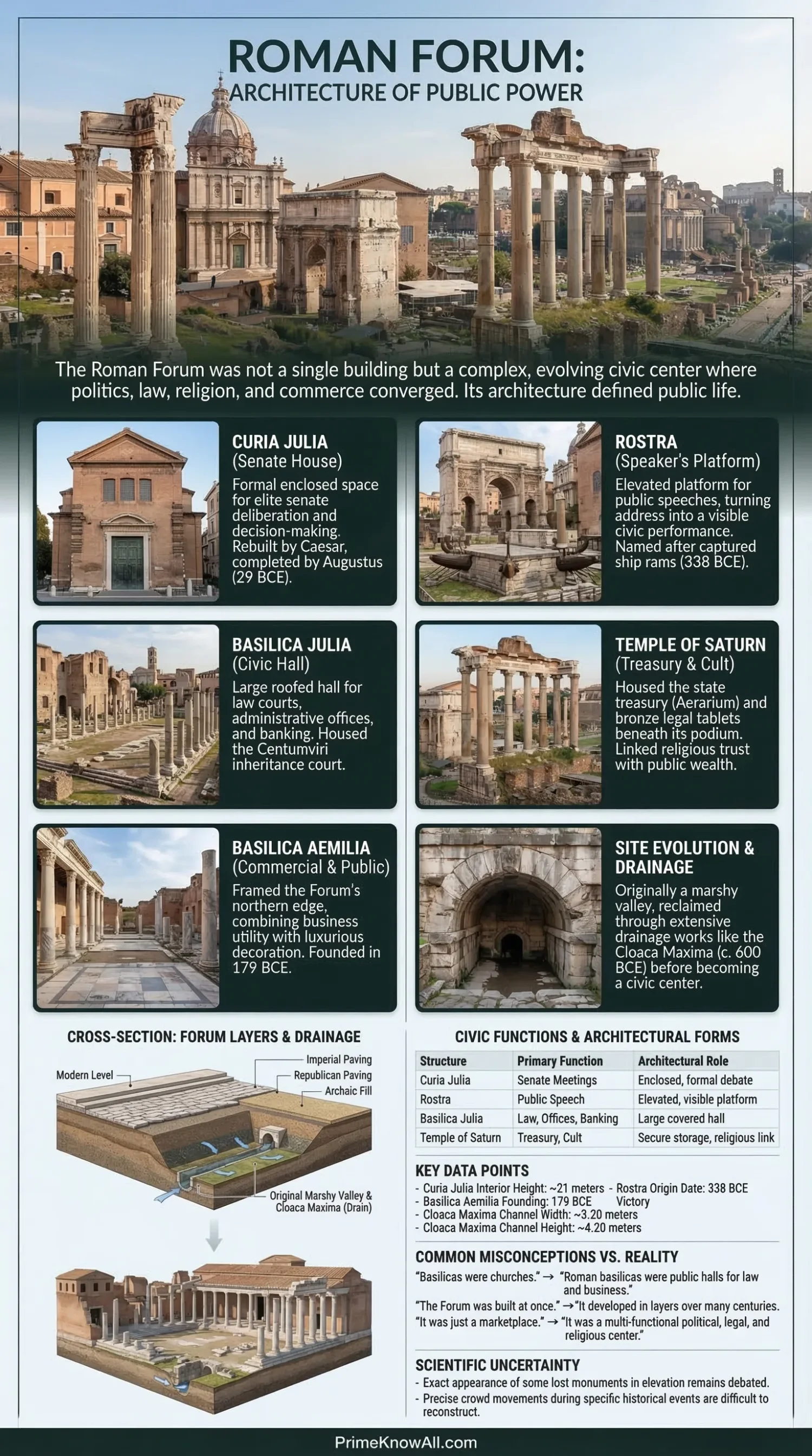
The Roman Forum was the main civic center of ancient Rome. Its architecture brought senate business, public speech, law, religion, and state memory into one tightly arranged place. Buildings such as the Curia, Rostra, Basilica Julia, Basilica Aemilia, and Temple of Saturn did different jobs, but together they turned architecture into government.
Rome did not build the Forum as a single finished set piece. The site changed over many centuries, from a low, wet valley into a public zone shaped by drainage works, paving, temples, halls, and speaking platforms. That slow growth matters because the Forum shows how civic architecture can absorb new needs without losing its public role.
If you remember one thing: the Roman Forum was not just a place where buildings stood side by side. It was a carefully staged civic machine in which where you stood, what you could see, and who could address whom were all part of the design.
What To Notice First
- The Forum joined politics, law, religion, and memory in one walkable public space.
- The site began as difficult terrain; drainage and ground control were part of the architecture.
- The Curia, Rostra, and basilicas formed a civic sequence: deliberate, visible, and repeatable.
- Basilicas were not churches here; in Roman civic life, a basilica was a large public hall used for legal, financial, and administrative activity.
- The Forum changed when Rome changed; republican crowd politics and imperial image-making both left marks on the layout.
- Modern conservation still shapes what visitors see, including recent work on marble decoration and digital survey inside the Curia Iulia.
What Made the Roman Forum Civic Architecture
The Roman Forum was civic architecture because it organized public life, not because every building looked official. Its power came from how different structures worked together: one space for speech, another for senate debate, others for lawsuits, treasury storage, ritual, record, and procession.
An architectural type is a recurring kind of building with a known job. In the Forum, those types were clear. A basilica was a roofed hall for civic dealings. A curia was a senate house. The Rostra was a speaker’s platform. A forum, in Roman use, was more than an empty square; it was a public setting where the city handled matters in view of other citizens.
- Political function: speeches, assemblies, senate activity, formal announcements.
- Judicial function: hearings, legal disputes, inheritance cases, public visibility of law.
- Economic function: banking, offices, and commercial dealings close to government.
- Ritual function: temples and sacred markers kept public life tied to divine approval.
- Memory function: arches, inscriptions, reliefs, statues, and honorific columns turned the site into a record of power.
Many modern pages describe the Forum as a ruin field or a tourist stop. That misses the most useful reading. The Forum was a spatial system for civic action. People did not simply enter it; they moved through a sequence that sorted attention, access, and status.
How a Marshy Valley Became a Public Center
Before the Forum became monumental, it had to become usable land. The official archaeological park notes that the area was originally swampy and was reclaimed in the late 7th century BCE, after which the Forum began to take shape as a long-lived public center.
That early transformation is easy to overlook, yet it tells a lot about Roman civic thinking. A city cannot turn a low valley into its main public room without serious control of water, ground level, and circulation. The old drain later known as the Cloaca Maxima is tied to that story. In the topographical record preserved by the University of Chicago’s Roman studies material, the drain is described as a sewer built to drain the Forum and nearby valleys, and one surviving channel section is about 4.20 meters high and 3.20 meters wide.
There is another layer beneath the monuments. The official Roman Forum Museum page explains that excavations in the area near the Temple of Antoninus and Faustina uncovered forty-one tombs, including burials from around the 10th century BCE. That matters because it shows the Forum was not born as a finished square. It passed through earlier uses before becoming the city’s public stage.
- First problem: wet terrain.
- Roman answer: drainage, leveling, and paving.
- Long result: a durable civic setting that could keep accepting new monuments.
Pause Here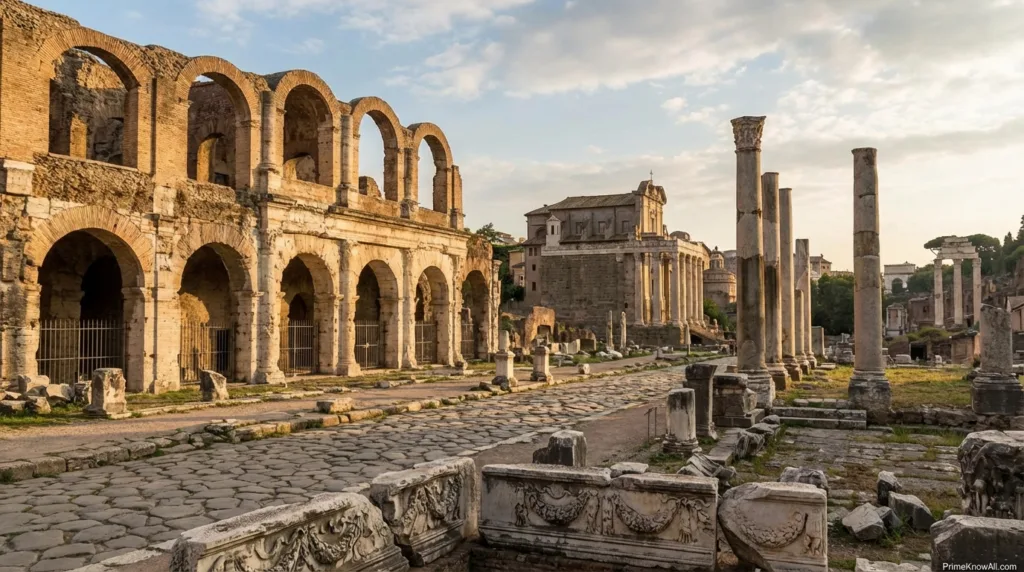
- The Forum’s earliest architectural story is not marble. It is land engineering.
- Roman civic space began with drainage and ground control, then grew into politics and ceremony.
- Archaeology still shows that the site had older, non-civic phases beneath the later monuments.
Which Buildings Did the Civic Work
The Forum worked because its buildings divided public life into visible roles. Each monument had a job, and the layout let those jobs overlap without becoming random.
| Structure | Primary Civic Use | What the Architecture Did |
|---|---|---|
| Curia Julia | Senate meetings | Created an enclosed, formal room for elite political deliberation. |
| Rostra | Public speech | Raised speakers above the crowd and turned speech into public performance. |
| Basilica Julia | Law courts, offices, banking | Provided covered space for legal and administrative work. |
| Basilica Aemilia | Public business and display | Framed one side of the Forum while combining utility with expensive decoration. |
| Temple of Saturn | Cult and state treasury | Linked religion, storage of public wealth, and civic legitimacy. |
| Comitium | Assembly space | Supported public gathering and face-to-face political action. |
Curia Julia
The Curia Julia was the senate house. On the official Curia Iulia page, the archaeological park notes that Julius Caesar refounded the building after the fire of 52 BCE, Augustus completed it in 29 BCE, and the preserved interior height is about 21 meters, following proportions recommended by Vitruvius. That one number already says a lot: this was not an improvised room but a carefully proportioned political chamber.
- Definition: a curia is a senate house.
- Architectural effect: enclosure, hierarchy, controlled access, formal debate.
- Why it matters: Roman politics used both open-air and enclosed settings, and the Curia handled the elite side of that balance.
Rostra
The Rostra made speech architectural. The University of Chicago’s Roman Forum material explains that it took its name from the bronze ship rams mounted on its front after victory at Antium in 338 BCE. A speaker did not simply talk in the Forum; the speaker rose onto a built platform that gave voice a direction, a backdrop, and a crowd.
This is one of the clearest examples of civic choreography. Height changed authority. Frontality changed attention. The crowd saw both the speaker and the monuments around the speaker, which meant public address also happened inside a field of political symbols.
Basilica Julia and Basilica Aemilia
In the Roman Forum, a basilica was a civic hall. The UChicago entry on the Basilica Julia describes civil law courts, offices, banking functions, and use by the Centumviri, a court that handled inheritance matters. The official museum and conservation pages also place the Basilica Aemilia firmly inside the Forum’s public and decorative life, with foundation in 179 BCE and surviving marble work still under care today.
- Basilica Julia: law, offices, finance, crowd noise, civic routine.
- Basilica Aemilia: public edge, elite sponsorship, rich marble surface, historical reliefs.
- Shared role: they turned the Forum’s sides into usable civic walls, not empty borders.
Temple of Saturn
The Temple of Saturn tied religion to state finance. The UChicago page on the Temple of Saturn notes that the Aerarium, the Roman state treasury, was housed beneath the stairs under its high podium, and that the building also kept bronze tablets of Roman law. This is a useful reminder that Roman civic architecture did not separate sacred and administrative space in the way many modern states do.
An aerarium was the state treasury. In plain terms, it was the place where public wealth and some public records were held. Putting that function under a temple podium was not an odd side note. It shows how religious trust and public authority reinforced one another in Roman civic design.
How the Layout Controlled Movement, Sightlines, and Rank
The Forum’s architecture did more than house activities; it directed bodies and attention. The arrangement of open ground, raised platforms, processional routes, and flanking basilicas helped decide where crowds gathered, where elites spoke, and how civic events could be seen.
A useful analogy is this: the Roman Forum worked a bit like a courthouse square, parliament forecourt, treasury zone, and memorial plaza compressed into one shared outdoor room. That comparison is imperfect, but it helps explain why the site feels so dense. Different public tasks were not scattered across a modern city. They were layered within walking distance of one another.
- Raised platforms gave authority a visual edge.
- Long flanking halls directed movement along the square.
- Monuments at nodes slowed people down and framed decision points.
- Processional routes turned movement itself into public meaning.
This is where many travel-style summaries stop too early. They name buildings, but they do not explain the experience logic. Architecture in the Forum sorted the public into watchers, speakers, litigants, priests, magistrates, and senators. That sorting was not hidden. It was the point.
Stop And Check the Pattern
- The Forum rewarded visibility, not privacy.
- Roman civic design used height, frontage, and route control to stage authority.
- Even a speech platform or a treasury location changed how people understood power.
How the Forum Changed From Republic to Empire
The Forum never froze in one political moment. It shifted with Rome’s institutions. Republican crowd politics, late republican rebuilding, Augustan ordering, later imperial honorific additions, and late antique reuse all changed the civic message of the site.
- Late 7th century BCE: valley reclamation begins.
- 5th century BCE onward: early temples and assembly-related spaces define public use.
- 179 BCE: Basilica Aemilia is founded.
- 46 BCE: Basilica Julia is dedicated by Julius Caesar.
- 29 BCE: Augustus completes the Curia Julia.
- 203 CE: Arch of Septimius Severus marks imperial victory culture in the Forum.
- 608 CE: the Column of Phocas becomes the last monument added to the Forum, according to the official archaeological park overview.
The official Roman Forum page states that by the end of the republican age the ancient Forum had become insufficient for the administrative and representative needs of the city. That pressure helps explain why new imperial fora appeared nearby. The old Forum did not stop mattering, but it no longer carried every public function alone.
This is one of the most revealing parts of the site. Civic architecture ages. When institutions grow, old public centers either expand, split, or change role. Rome did all three. It added new forums, kept the old one active, and turned the historic center into an even denser place of ceremony, display, and memory.
Common Misconceptions
Several common claims flatten the Forum into something simpler than it was. These short corrections make the site easier to read.
- Wrong: The Forum was just a marketplace.
Correct: It was a multi-use civic center.
Why the confusion happens: early trade and later tourism labels hide the legal and political functions. - Wrong: A basilica in the Forum was a church.
Correct: In this context, it was a public hall for law and civic business.
Why the confusion happens: the word later became strongly tied to Christian architecture. - Wrong: The Forum was built all at once.
Correct: It grew in layers across many centuries.
Why the confusion happens: reconstructions often show one neat phase. - Wrong: Roman public architecture kept religion and government apart.
Correct: The Forum often joined sacred and civic authority.
Why the confusion happens: modern expectations are projected backward. - Wrong: Ruins only show decay.
Correct: They also show reuse, adaptation, and survival through later conversions and repairs.
Why the confusion happens: broken stone feels final even when the site had a long afterlife.
Where This Logic Still Feels Familiar
The Roman Forum feels old, but its civic logic is still recognizable. Many modern public spaces repeat the same design instincts, even when the style is entirely different.
- A city hall facing a public square: people gather, watch, and wait near the center of authority.
Why this still makes sense: visibility gives public decisions social weight. - Courthouse steps and an adjacent plaza: legal action spills into public view.
Why this still makes sense: law feels more real when citizens can witness its setting. - A parliament building with controlled entrances and open forecourts: access is limited, but symbolism is public.
Why this still makes sense: architecture can display openness while keeping procedure ordered. - A memorial placed on a civic route: people encounter memory while moving toward government or commerce.
Why this still makes sense: public memory works best when it is part of everyday movement. - A financial district near government offices: money and policy remain close neighbors.
Why this still makes sense: civic and economic trust often reinforce one another. - A transit spine that leads past monuments and public institutions: route design shapes what a city chooses to show.
Why this still makes sense: movement is one of the oldest tools in civic planning. - A restored heritage site with digital scanning and visitor management: conservation becomes part of public life.
Why this still makes sense: a city’s past also needs infrastructure, not just admiration.
Why the Forum Still Matters Now
The Roman Forum still matters because it shows that civic architecture is never only about style. It is about how public roles are staged, remembered, and repaired. Recent official conservation work in the Forum has included 2024 maintenance on marble elements along the Via Sacra, Basilica Aemilia, and the central area, while the Curia Iulia saw restoration work using laser scanners in September 2025. Those details connect ancient civic architecture to present-day care, technology, and interpretation.
This current work also corrects a common habit in public reading. Ruins are often treated as frozen remains. The Forum is not frozen. It is studied, re-measured, repaired, and re-explained. That living research culture is one reason the site still teaches so much about how cities present authority.
What This Section Adds
- The Forum is not only an ancient case study; it is also a modern conservation site.
- Current work on marble, surveying, and museum display helps refine how the civic landscape is understood.
- Public architecture stays meaningful when later societies keep reading and maintaining it.
What We Know, and What Stays Uncertain
The broad civic role of the Roman Forum is clear, but not every detail is fixed. Archaeologists, historians, and architectural historians agree on the Forum’s public importance and on the major functions of buildings such as the Curia, basilicas, and Rostra. Still, some reconstruction drawings simplify phases that were probably messier on the ground.
- What is well supported: drainage history, major building functions, repeated rebuilding, long civic use, later reuse, and many dated interventions.
- What needs caution: exact appearance in every phase, how crowds moved in specific moments, and how some lost or fragmentary monuments looked in elevation.
- Why caution matters: the Forum was rebuilt so many times that one date rarely tells the whole story of one structure.
A measured way to read the site is this: the civic pattern is secure even when some formal details remain debated. That is normal in archaeology. The big picture is strong, and some of the fine-grain visual reconstruction remains open to revision.
A Vertical Timeline of Civic Change
Earlier burial and settlement traces show the site had a life before it became Rome’s public center.
The swampy valley is controlled, making long-term public use possible.
The Comitium, early curia traditions, and the Rostra establish the political language of the site.
Basilica Aemilia and Basilica Julia give the square civic walls for law, business, and administration.
The Curia Julia, new Rostra arrangements, and Augustan interventions sharpen the Forum’s formal public face.
Arches, columns, and imperial restorations add memory, victory display, and late antique adaptation.
Museum interpretation, marble maintenance, and digital survey keep the Forum active as a public learning site.
Quick Test
Use these short checks to lock in the main ideas. Tap each question to reveal the answer.
Was the Roman Forum mainly a market, or something broader?
It was broader. Trade mattered, but the Forum also handled speech, law, treasury functions, senate business, ritual, and public memory.
What did a basilica mean in the Roman Forum?
Here, a basilica meant a large civic hall, not a church. It supported legal hearings, offices, banking, and other public business.
Why does the Rostra matter so much?
Because it turned speaking into a visible public act. A raised platform gives the speaker height, focus, and authority.
Why is drainage part of the Forum’s architectural story?
Because the site began as a low, wet valley. Without reclamation and drainage, the civic center could not have formed there.
Did the Forum stay the same from the Republic to the Empire?
No. It changed repeatedly. New buildings, restorations, imperial monuments, and later reuse altered both the look and the message of the site.
FAQ
What was the main purpose of the Roman Forum?
The Roman Forum was the main public and civic center of ancient Rome. It supported political debate, court activity, public speech, treasury functions, religious ritual, and state display.
What is civic architecture in the Roman Forum?
In the Roman Forum, civic architecture means buildings and spaces designed for public action: senate meetings, speeches, legal business, assemblies, financial administration, and public ceremony.
Why were basilicas important in the Forum?
The basilicas mattered because they gave the Forum covered civic space. They supported courts, offices, banking, and routine administrative work while shaping the edges of the square.
What did the Curia Julia do?
The Curia Julia was the senate house. It provided a formal interior for elite political deliberation and became one of the Forum’s clearest symbols of Roman state authority.
What was the Rostra used for?
The Rostra was the speaker’s platform. Orators addressed the public from it, making speech a highly visible civic event.
Why is the Temple of Saturn important in civic terms?
It mattered not only as a temple but also because it was associated with the state treasury, showing how Roman civic and sacred functions were often linked.
How do archaeologists know the Forum changed over time?
They know from stratigraphy, inscriptions, rebuilding phases, surviving materials, museum finds, and written sources. The site preserves many layers rather than one fixed design moment.
Sources
- Parco archeologico del Colosseo – The Roman Forum — Official overview of the site, including reclamation history, long civic use, major phases, and late additions. Why reliable? This is the official archaeological park responsible for the Forum and its public interpretation.
- Parco archeologico del Colosseo – Curia Iulia — Monument page with dated rebuilding phases and the preserved interior height of the Curia. Why reliable? It is a primary institutional source tied directly to the monument’s conservation and presentation.
- Parco archeologico del Colosseo – The New Roman Forum Museum — Useful for the site’s pre-civic burial evidence, the forty-one tombs, and museum interpretation of Forum finds. Why reliable? It comes from the museum that curates excavated material from the Forum itself.
- Parco archeologico del Colosseo – Planned Maintenance of the Archaeological Finds of the Roman Forum and Palatine Hill — Describes current conservation work on marble decoration and stone decay. Why reliable? It documents active restoration and care by the institution managing the site.
- Parco archeologico del Colosseo – Temporary Closure of the Curia Iulia (9–10 September 2025) — Notes restoration work using laser scanners inside the Curia Iulia. Why reliable? It is a dated official notice tied to actual conservation activity.
- Khan Academy – Forum Romanum (The Roman Forum) — Clear educational explanation of the Forum’s political and civic roles, including the Comitium and Curia. Why reliable? Khan Academy’s humanities material is written with subject specialists and designed for evidence-based teaching.
- Smarthistory – The Roman Forum (Forum Romanum) — Art historical and archaeological reading of the Forum in its urban context. Why reliable? Smarthistory is a respected educational platform authored by art historians and archaeologists.
- Open Yale Courses – Lecture 14: The Mother of All Forums: Civic Architecture in Rome Under Trajan — Helpful for understanding how Roman civic architecture expanded and how forums worked as public commissions. Why reliable? It is a university course by a specialist in Roman architecture.
- University of Chicago – Encyclopaedia Romana: Basilica Julia — Details the basilica’s legal, office, and banking uses. Why reliable? It is a long-running reference resource focused on Roman topography and monuments.
- University of Chicago – Encyclopaedia Romana: The Temple of Saturn — Useful for the state treasury and law-tablet connection. Why reliable? It draws on literary, topographical, and archaeological evidence in a focused monument entry.
- University of Chicago – Encyclopaedia Romana: The Rostra — Focused reference on the speaker’s platform, its name, and later form. Why reliable? It is a monument-specific scholarly reference page with topographical grounding.
- Encyclopaedia Britannica – Roman Forum — Broad factual summary of location, public function, and historical role. Why reliable? Britannica is a well-established reference work with editorial review.
The Roman Forum makes one idea easy to see: civic architecture is not only about building forms; it is about how a city arranges speech, law, wealth, ritual, and memory in public view. That is why the Forum still feels legible even in ruins.
The most common mistake is to read the site as a pile of separate monuments. The rule worth keeping is simple: in the Roman Forum, layout was policy made visible.
